Downloaded 411 times

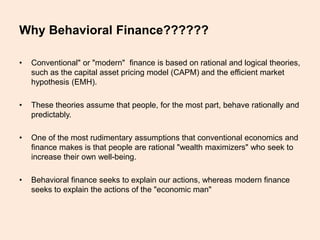
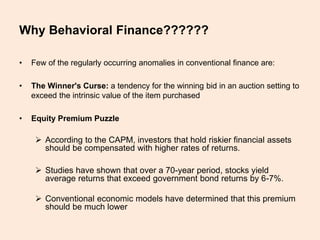
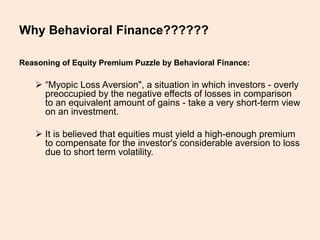






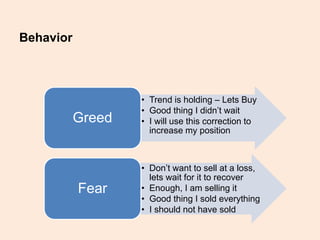

Behavioral finance is the study of how psychology impacts financial decision-making and markets. It developed in response to anomalies observed in conventional finance theories which assume rational decision-making. Behavioral finance draws on insights from psychology and microeconomic theory to understand irrational behaviors like herding, overconfidence, and loss aversion. It aims to better explain market phenomena like bubbles, crashes, and the high average returns of stocks relative to predicted risk levels. The scope of behavioral finance includes understanding market anomalies, identifying investor personalities, analyzing the effects of biases, and developing tools to hedge against behavioral risks. Its objectives are to critically examine standard finance theories, protect stakeholders, and develop more tailored investment advice and products.


![Lecture 1 Introduction to Behavioral Finance [Autosaved].pptx](https://cdn.slidesharecdn.com/ss_thumbnails/lecture1introductiontobehavioralfinanceautosaved-221006085706-b76921c7-thumbnail.jpg?width=640&height=640&fit=bounds)


