EBIT/EPS Analysis The tax benefit of debt Trade-off theory  Practical considerations in the determination of capital structure CAPITAL STRUCTUR E Lecture 2
Capital structure  Issues: EBIT-EPS analysis The tax shield benefit of debt The trade-off theory of capital structure P ractical considerations  that affect the  capital structure decision
Business Risk   vs Financial Risk Business risk  is the  variability of a firm’s  E arnings  B efore  I nterest and  T axes ( EBIT ) Financial risk arises from the use of d ebt , which imposes a  fixed cost in the form of interest payments  =   financial leverage .
EBIT/ EPS  analysis Examine s  how different capital structures affect earnings  available to shareholders (EPS) and risk Question : for different levels of  EBIT , how does financial leverage affect  EPS ?
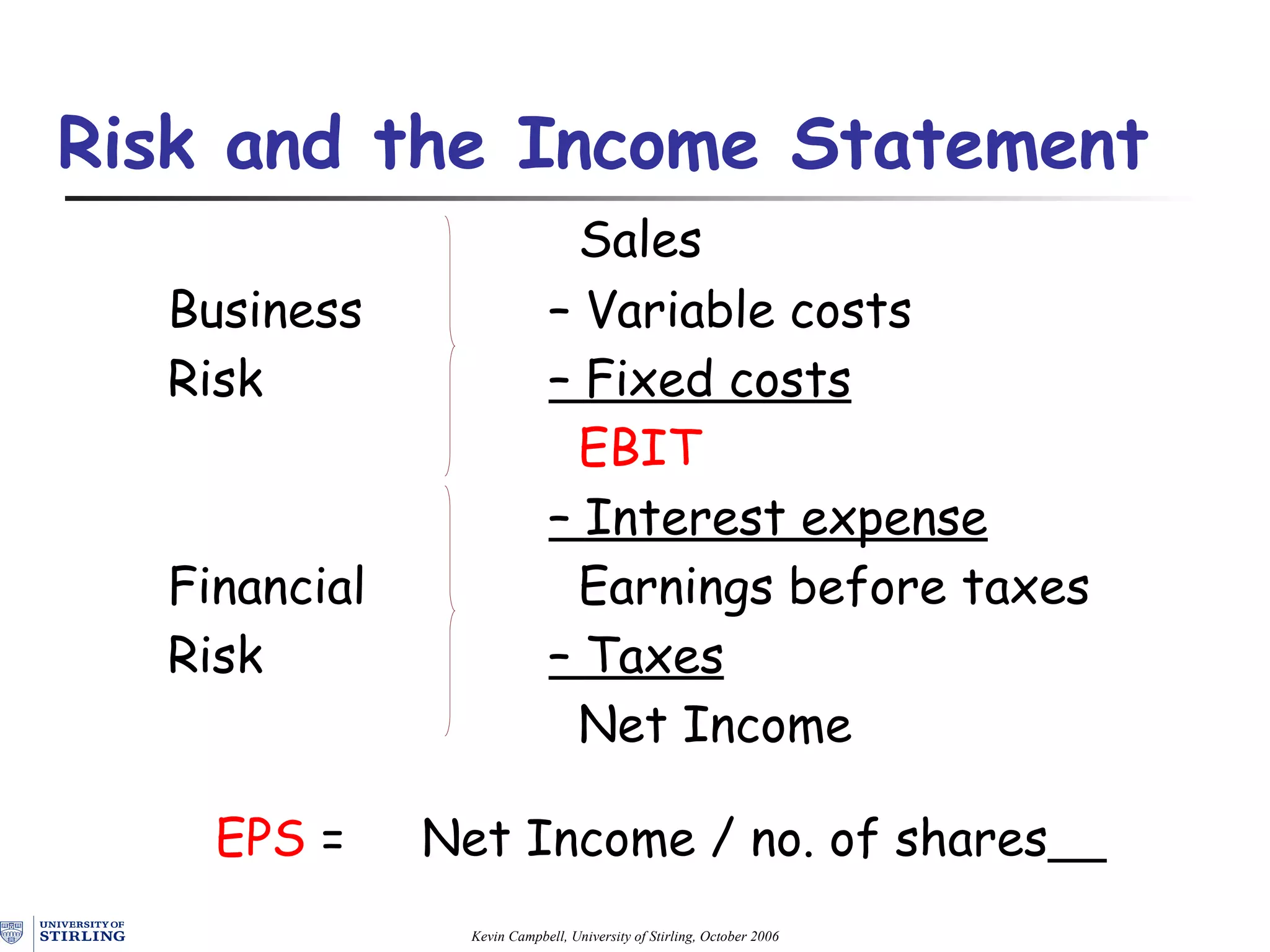
Risk and the Income Statement   Sales Business –   Variable costs Risk –   Fixed costs     EBIT   –   Interest expense Financial   Earnings before taxes Risk –   Taxes   Net Income EPS  = Net Income  / no. of shares
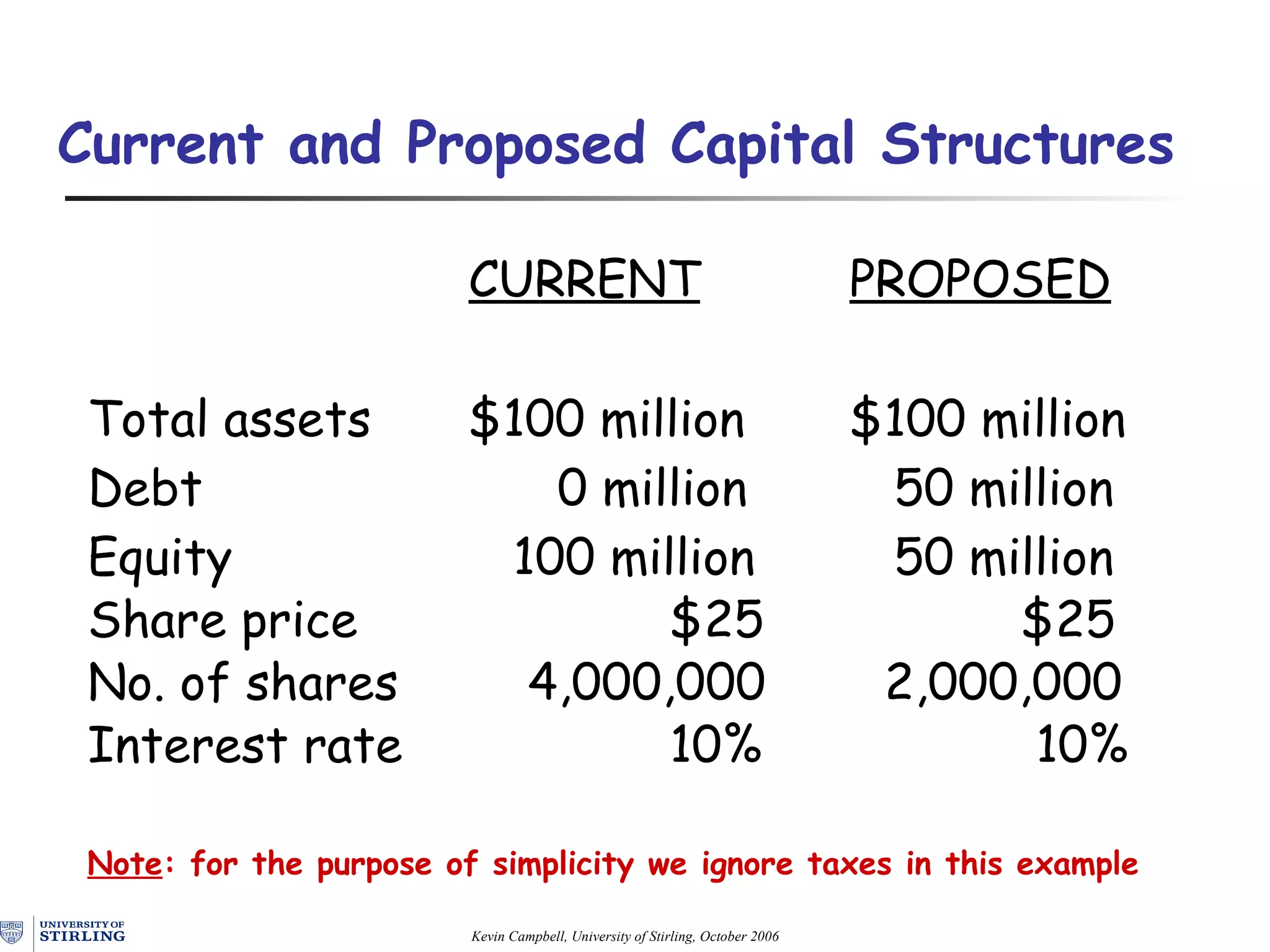
Current and Proposed Capital Structures   CURRENT   PROPOSED Total assets  $100 million  $100 million Debt       0 million   50 million Equity     100 million   50 million Share price     $25     $25 N o.  of  shares   4,000,000  2,000,000 Interest rate     10%   10% Note : for the purpose of simplicity we ignore taxes in this example
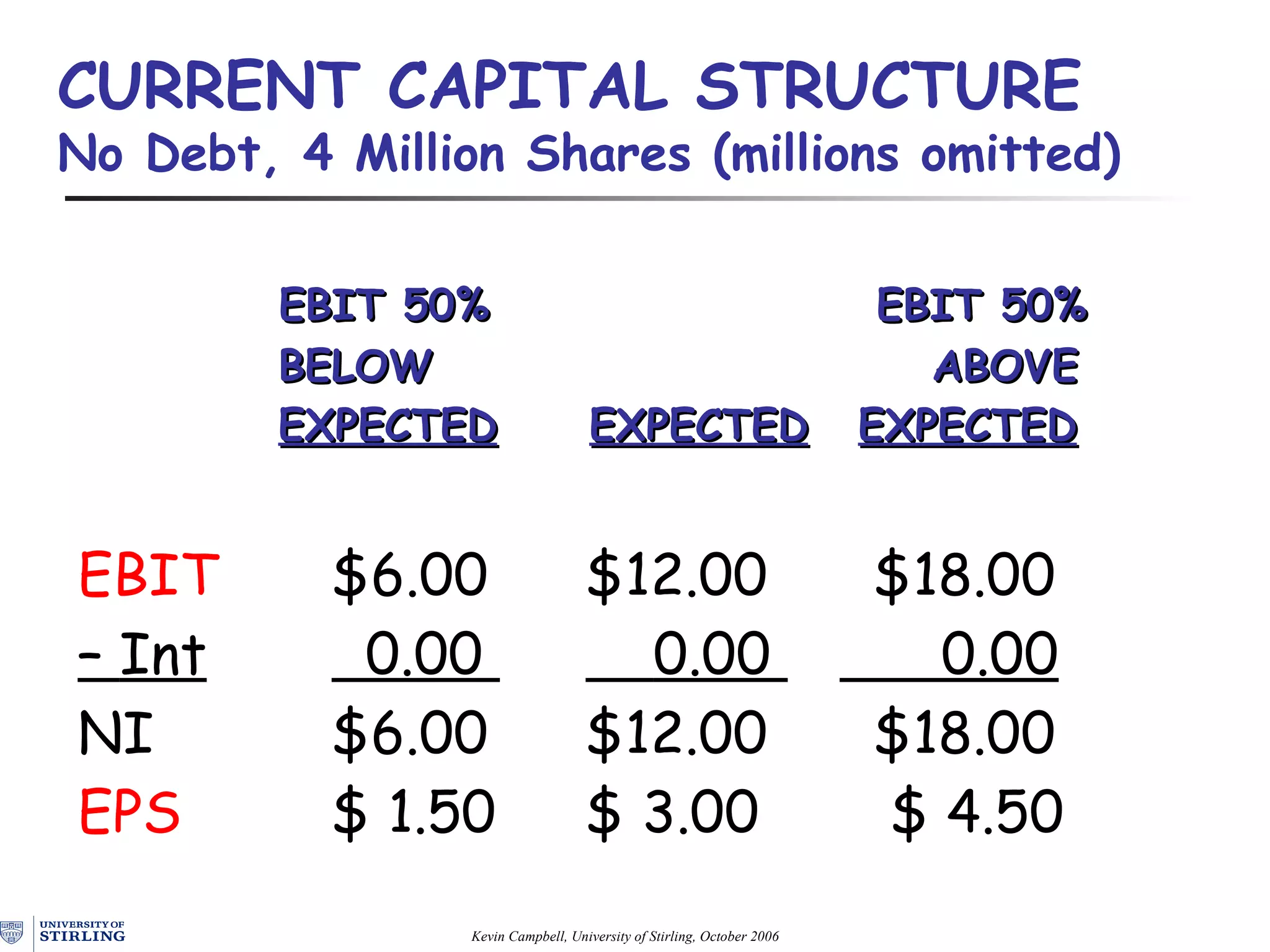
CURRENT  CAPITAL STRUCTURE  No Debt, 4 Million Shares ( m illions  o mitted)   EBIT 50%   EBIT 50%   BELOW   ABOVE   EXPECTED   EXPECTED     EXPECTED EBIT   $6.00 $12.00   $18.00 –  Int   0.00    0.00    0.00 NI   $6.00 $12.00   $18.00 EPS   $ 1.50 $ 3.00   $ 4.50
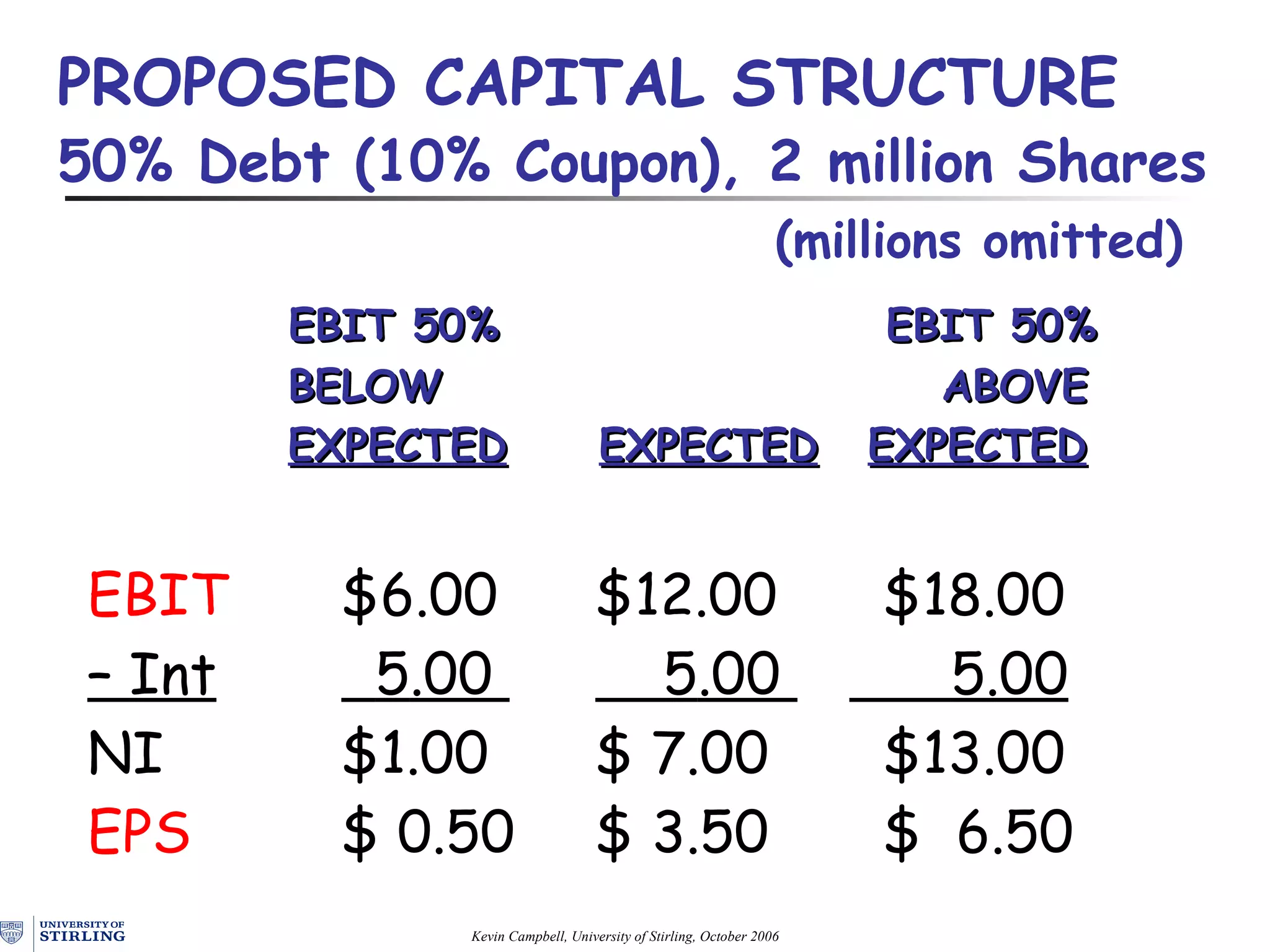
  EBIT 50%   EBIT 50%   BELOW   ABOVE   EXPECTED   EXPECTED     EXPECTED EBIT   $6.00 $12.00   $18.00 –  Int   5 .00    5 .00    5 .00 NI   $ 1 .00 $  7 .00   $1 3 .00 EPS   $  0 .50 $ 3. 5 0   $  6 .50 PROPOSED CAPITAL STRUCTURE  50% Debt (10% Coupon),   2  m illion Shares     ( m illions  o mitted)
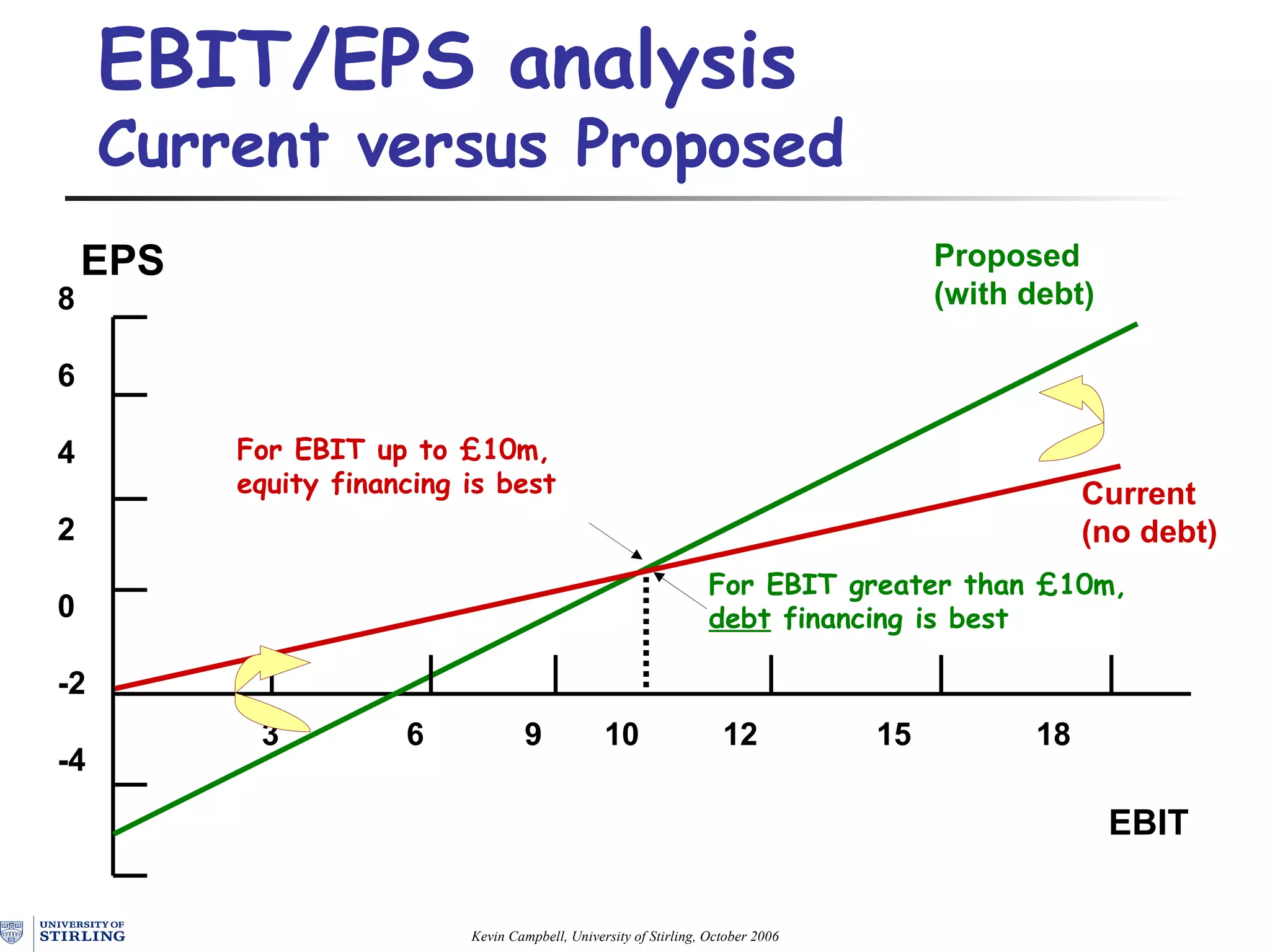
EBIT/ EPS  analysis Current versus Proposed Current   (no debt) Proposed  (with debt) EPS 8 6 4 2 0 -2 -4 3   6  9  10   12   15  18 EBIT For EBIT up to £ 10m, e quity financing is best For EBIT  greater than  £ 10m,  debt  financing is best
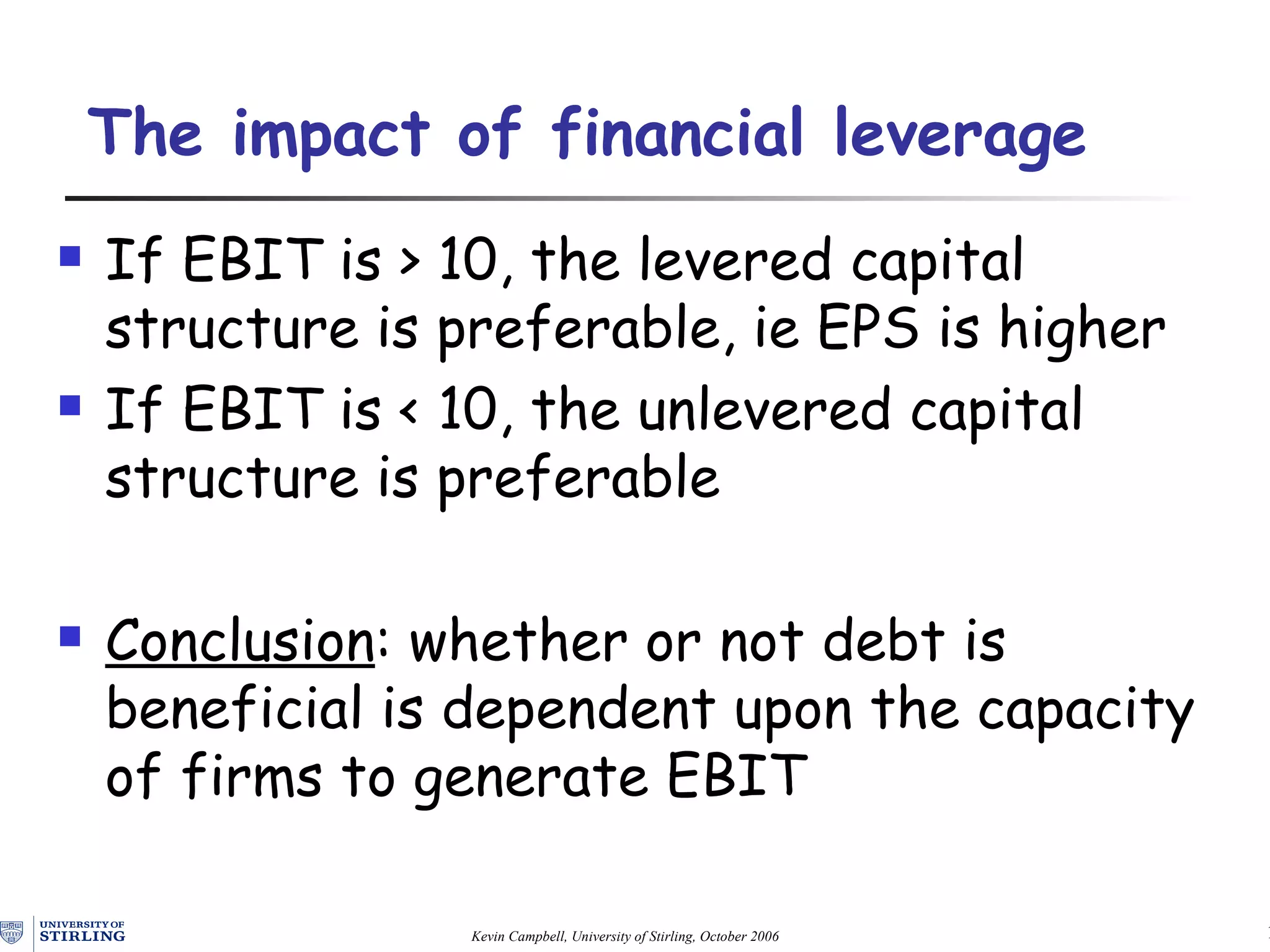
The impact of financial leverage If EBIT is > 10, the levered capital structure is preferable, ie EPS is higher If EBIT is < 10, the unlevered capital structure is preferable Conclusion : whether or not debt is beneficial is dependent upon the capacity of firms to generate EBIT
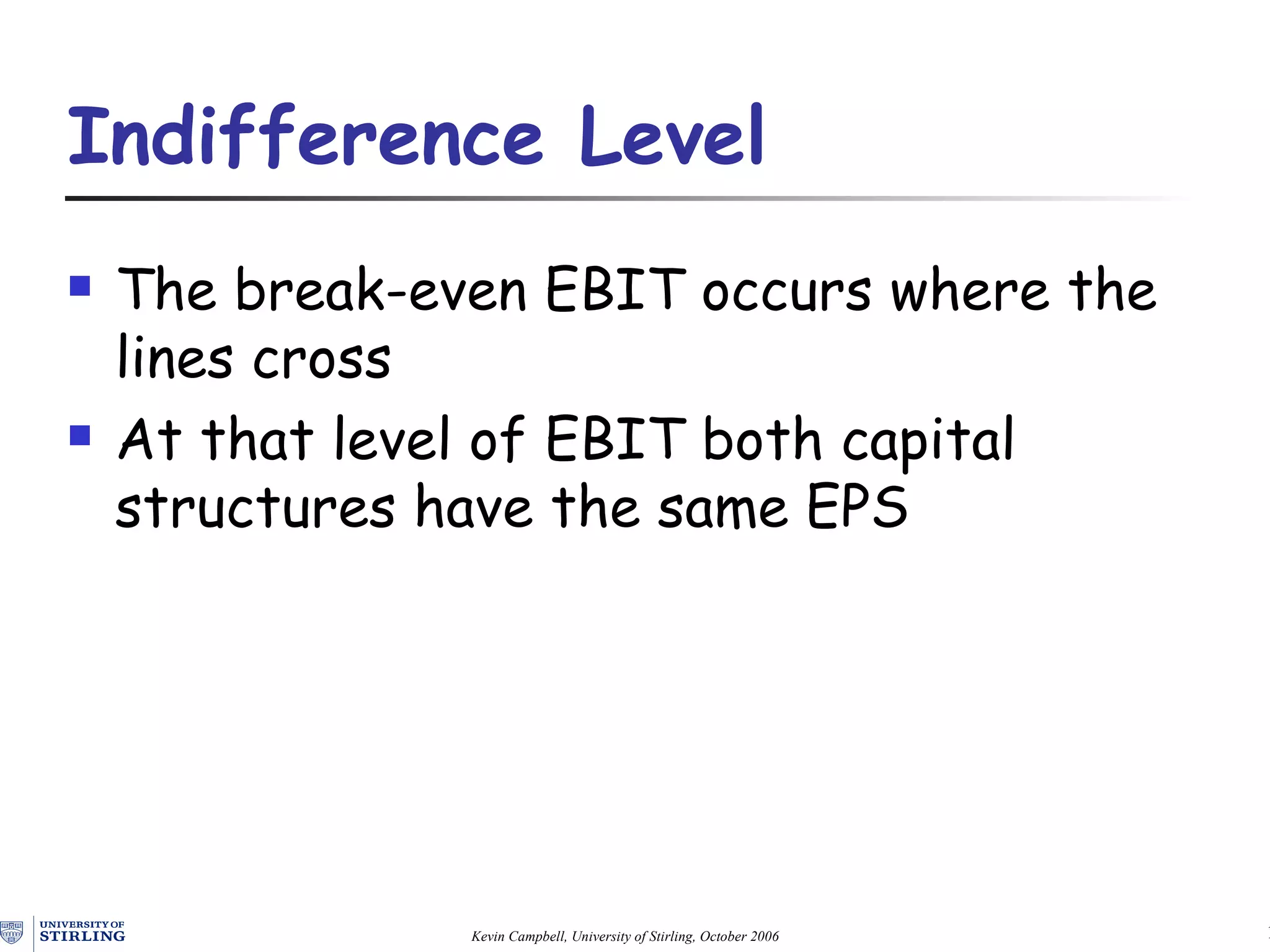
Indifference Level The break-even EBIT o ccurs where the lines cross At  that level of EBIT both capital structures have the same  EPS
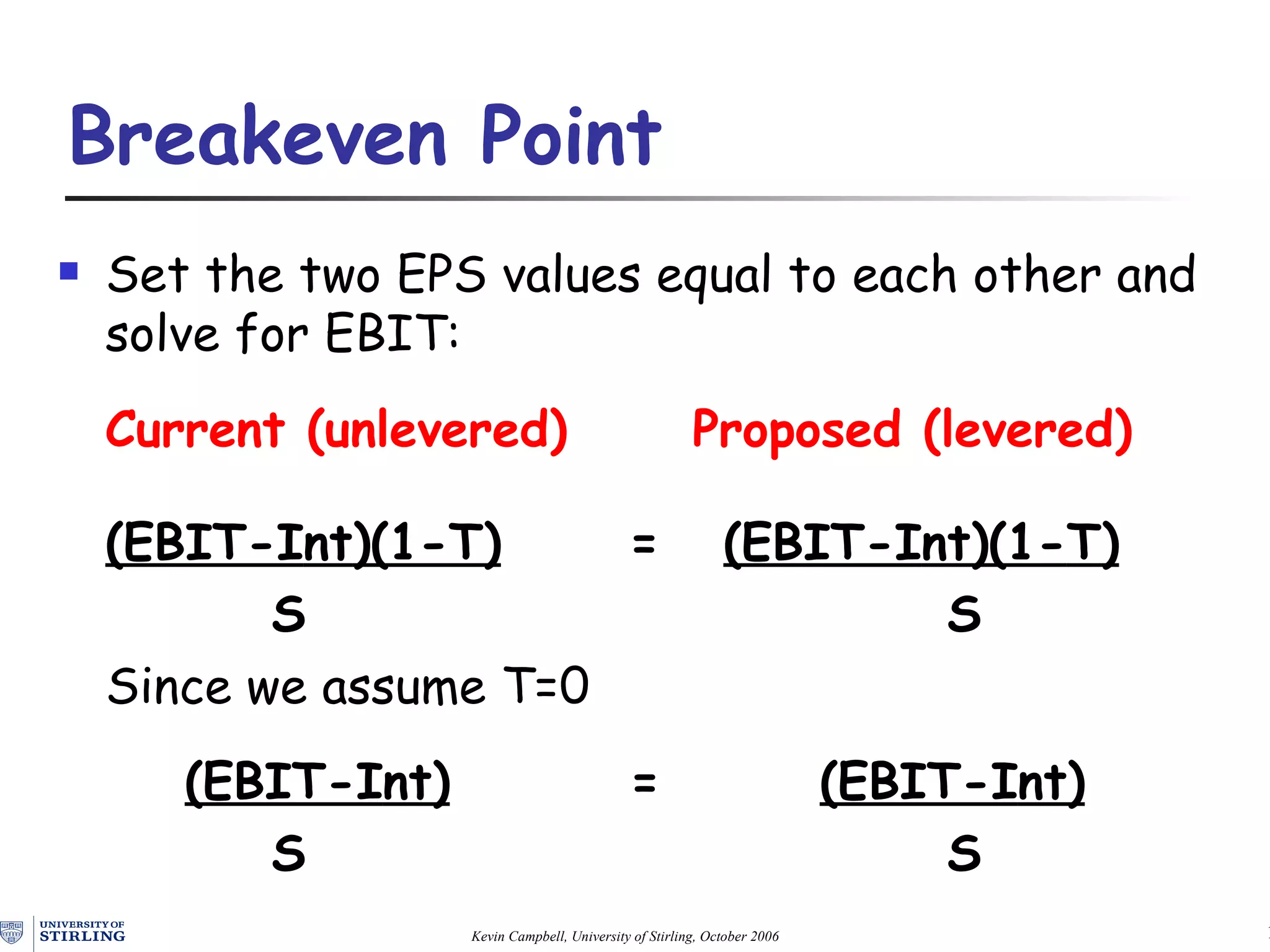
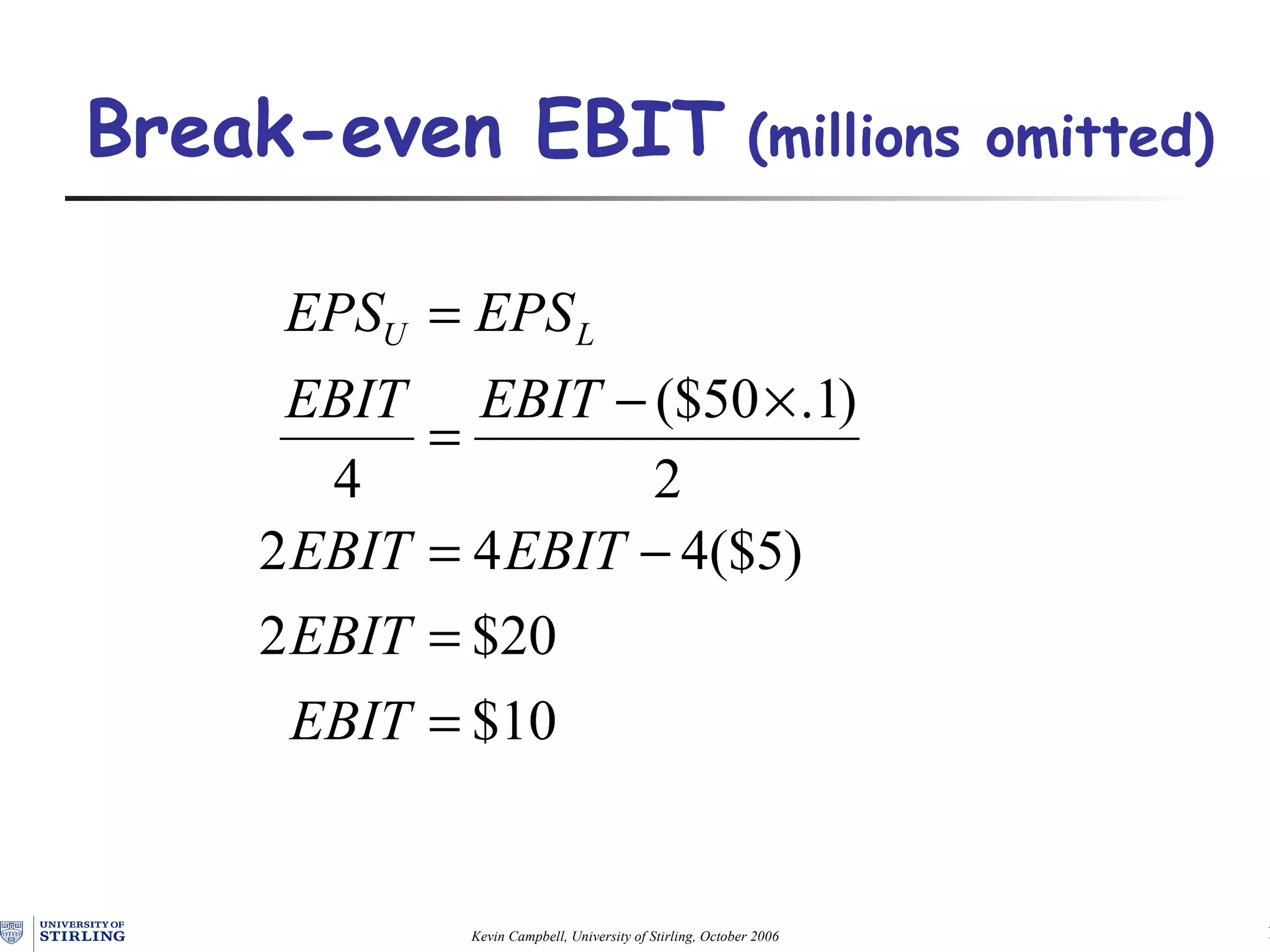
Set  the two  EPS  values  equal to each other and solve for EBIT: Current (unlevered) Proposed (levered) (EBIT-I nt )(1- T )   =  (EBIT-I nt )(1- T ) S  S Since we assume T=0 (EBIT-I nt )     =  (EBIT-I nt ) S  S Breakeven Point
Break-even EBIT   ( m illions  o mitted)
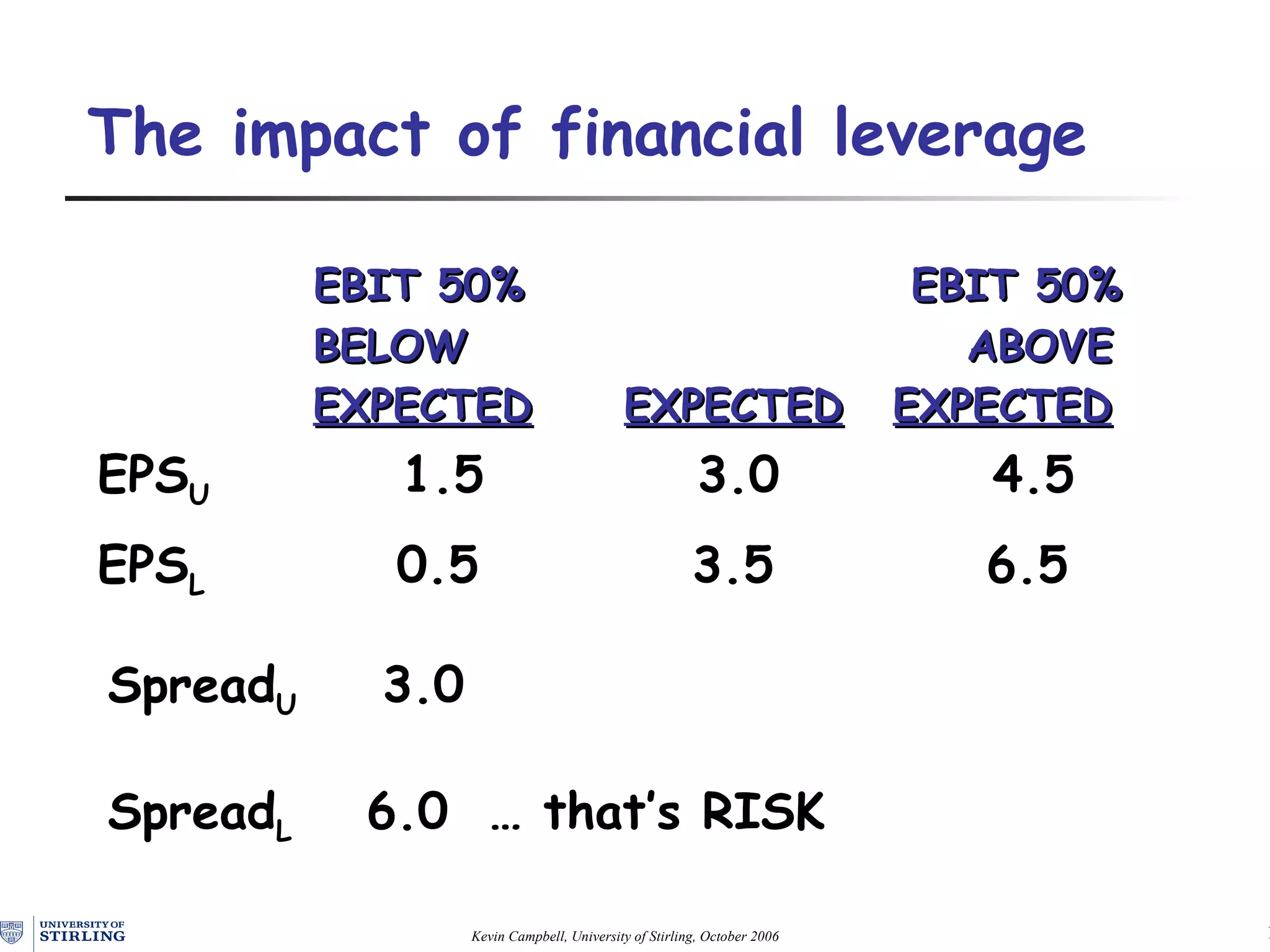
The impact of financial leverage EPS U   1.5   3.0   4.5 EPS L   0.5   3.5   6.5 Spread U   3.0 Spread L  6.0   … t hat’s RISK   EBIT 50%   EBIT 50%   BELOW   ABOVE   EXPECTED   EXPECTED     EXPECTED
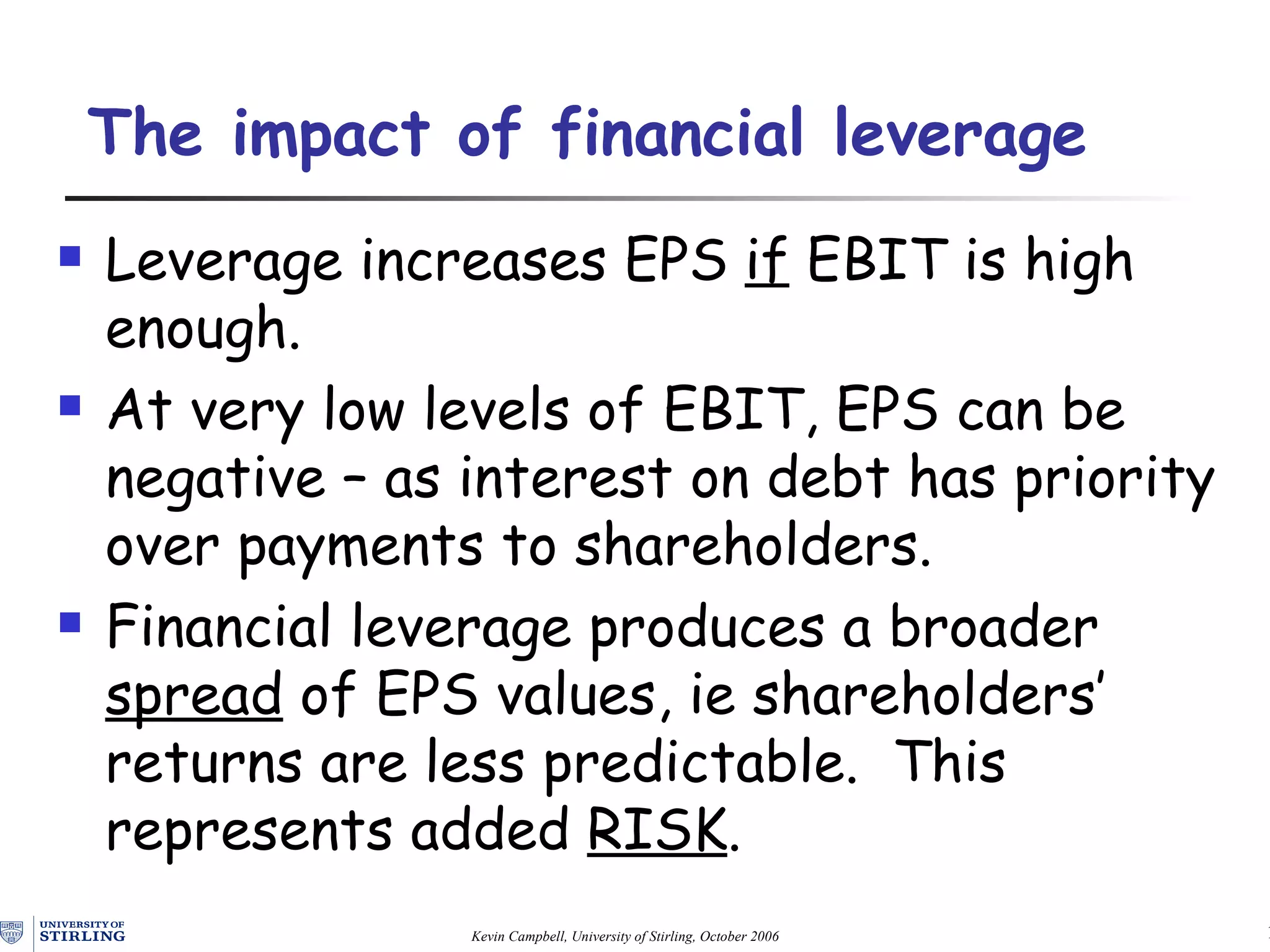
The impact of financial leverage Leverage increases EPS  if  EBIT is high enough. At very low levels of EBIT, EPS can be negative – as interest on debt has priority over payments to shareholders. Financial leverage produces  a broader   spread  of  EPS values, ie shareholders’  returns are less predictable.  This represents added   RISK .
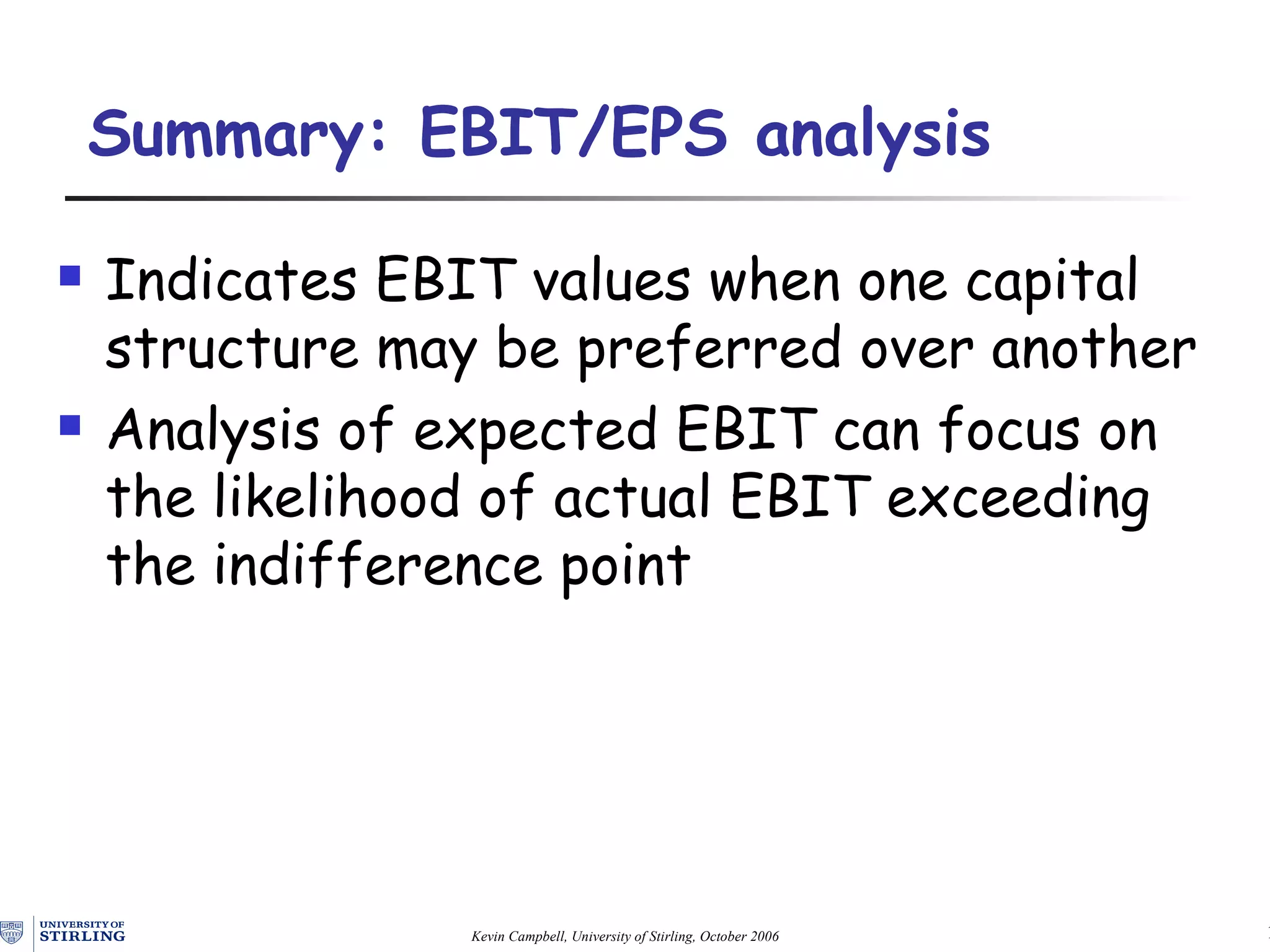
Summary:  EBIT/ EPS  analysis Indicates EBIT values when one capital structure may be preferred over another Analysis of expected EBIT can focus on the likelihood of actual EBIT exceeding the indifference point
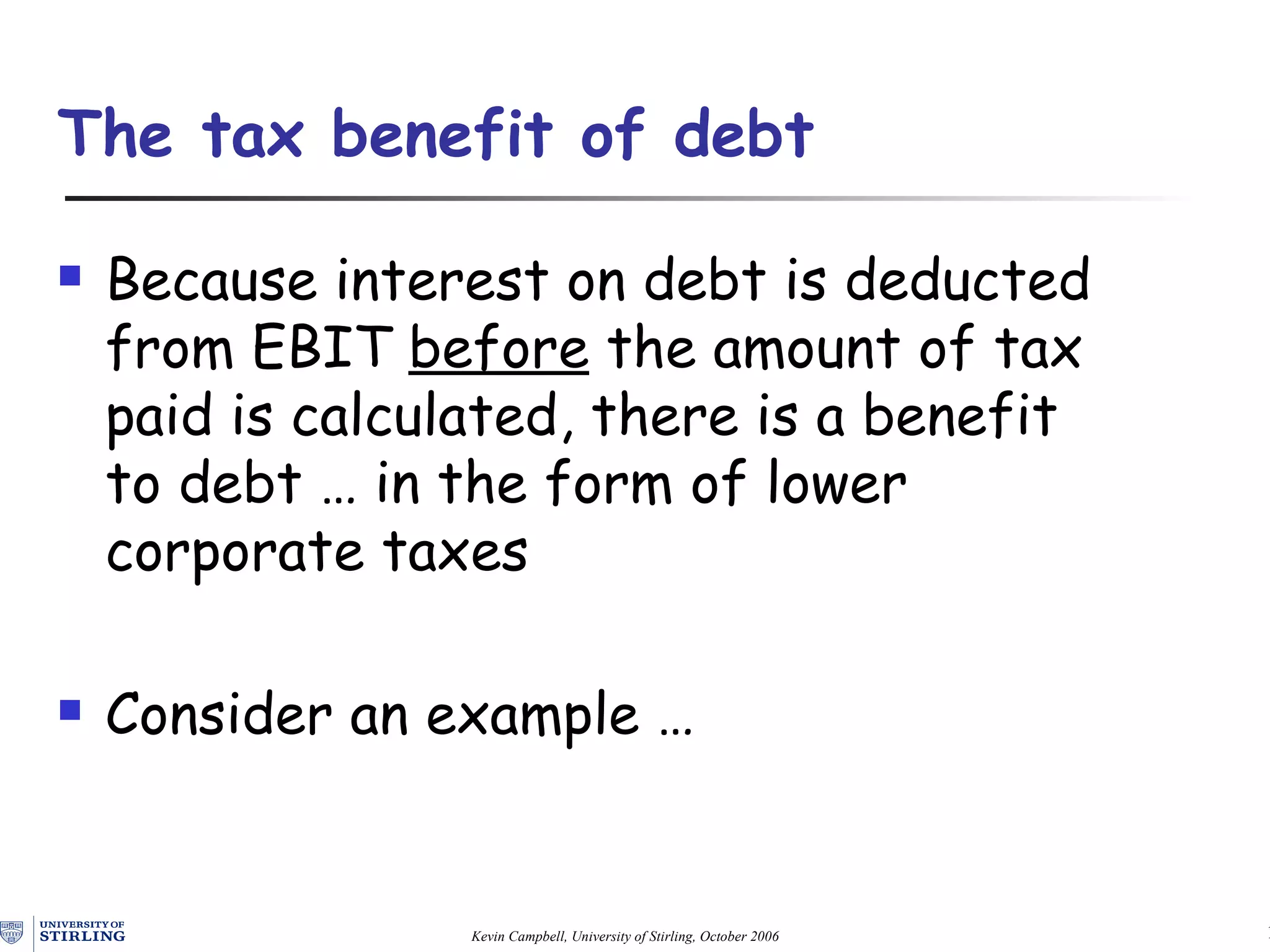
Because interest on debt is deducted from EBIT  before  the amount of tax paid is calculated, there is a benefit to debt … in the form of lower corporate taxes Consider an example … The tax benefit of debt
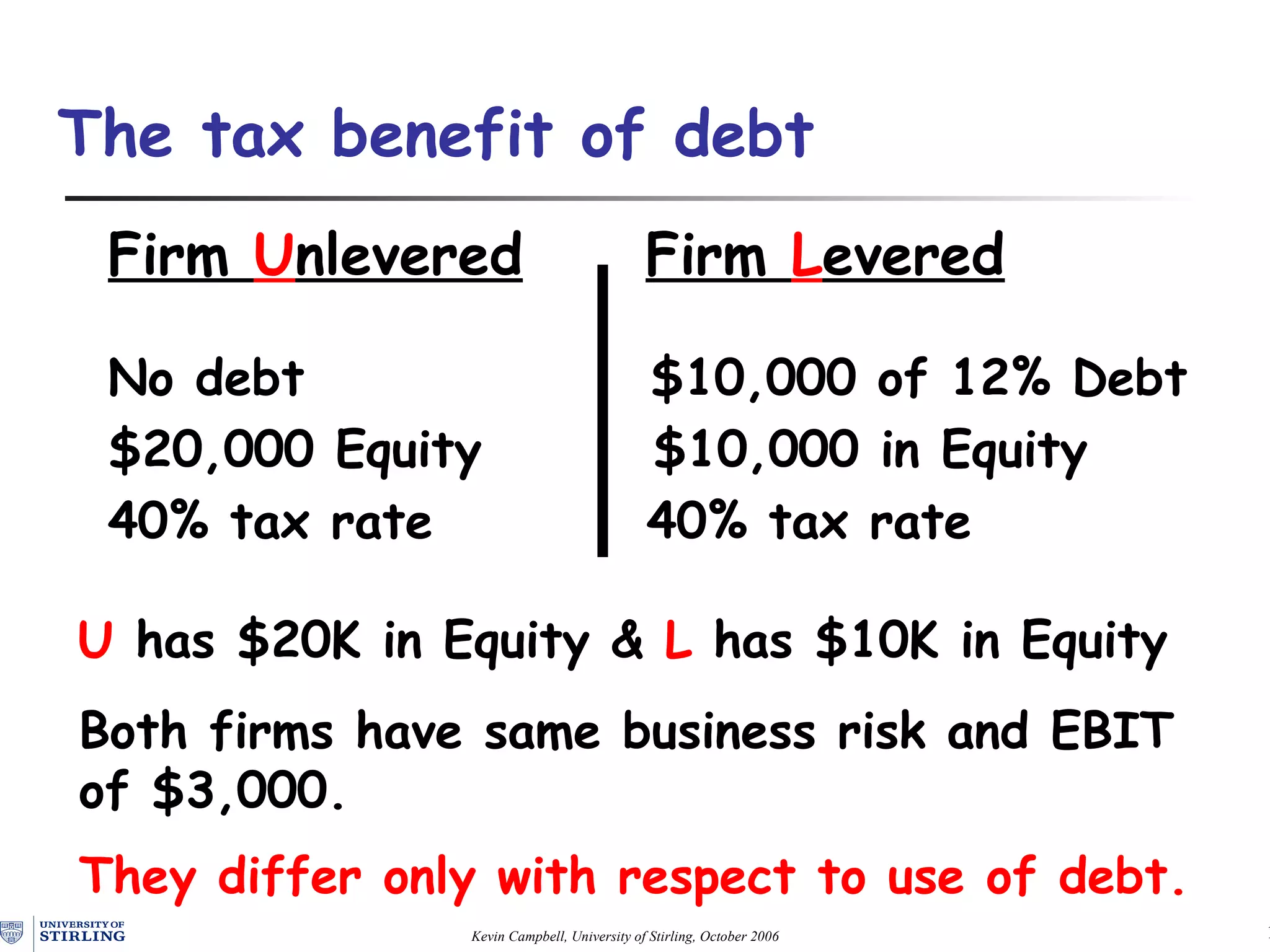
Firm  U nlevered   Firm  L evered No debt $10,000 of 12% Debt $20,000 Equity  $10,000 in Equity 40% tax rate  40% tax rate The tax benefit of debt Both firms have same business risk and EBIT of $3,000.   They differ only with respect to use of debt. U  has $20K in Eq uity  &  L  has $10K in Eq uity
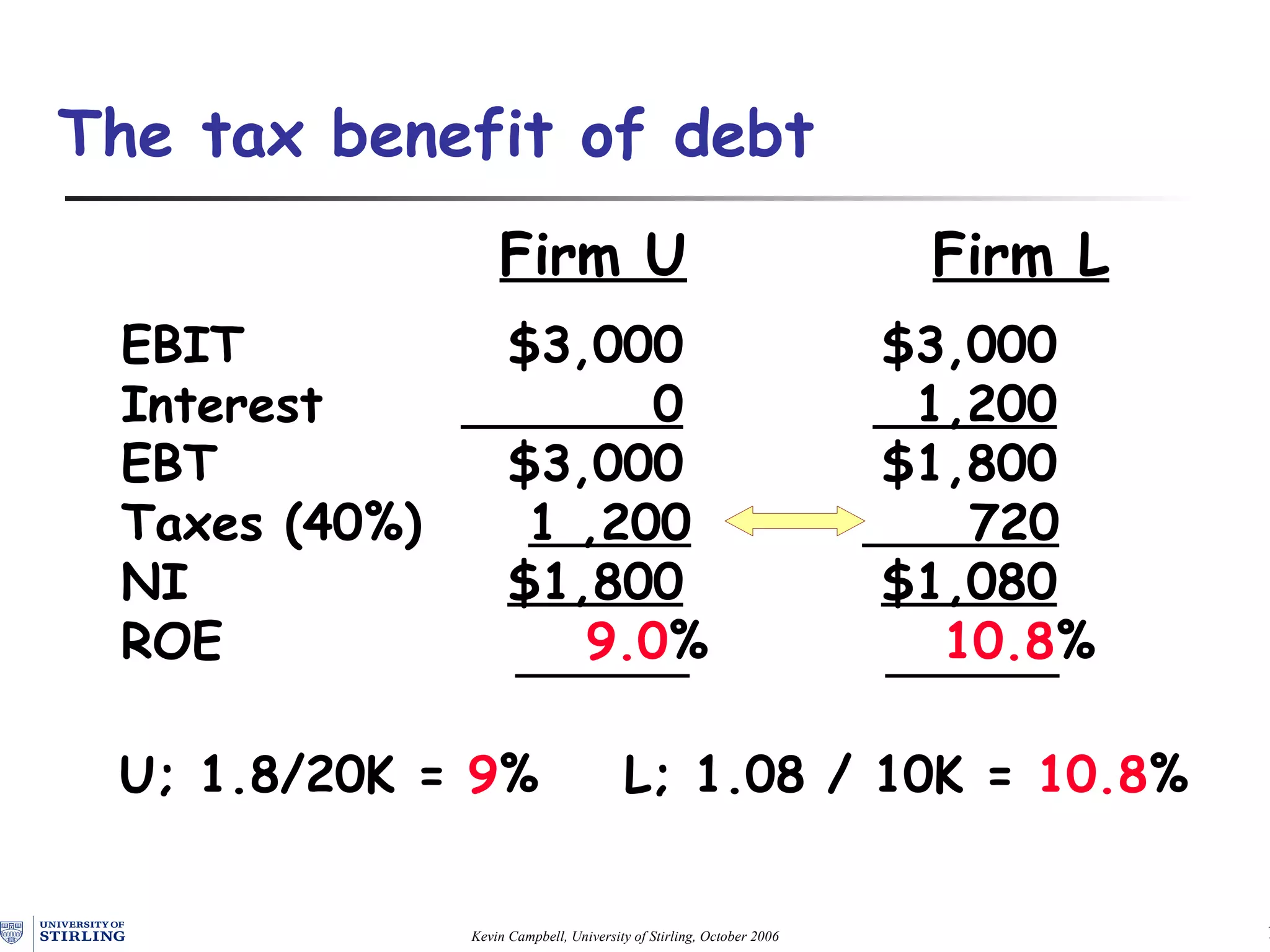
EBIT   $3,000 $3,000 Interest   0   1,200 EBT $3,000 $1,800 Taxes (40%)   1 ,200   720 NI   $1,800 $1,080 ROE  9.0 %  10.8 % Firm U   Firm L U; 1.8/20K =  9 %  L; 1.08 / 10K =  10.8 % The tax benefit of debt
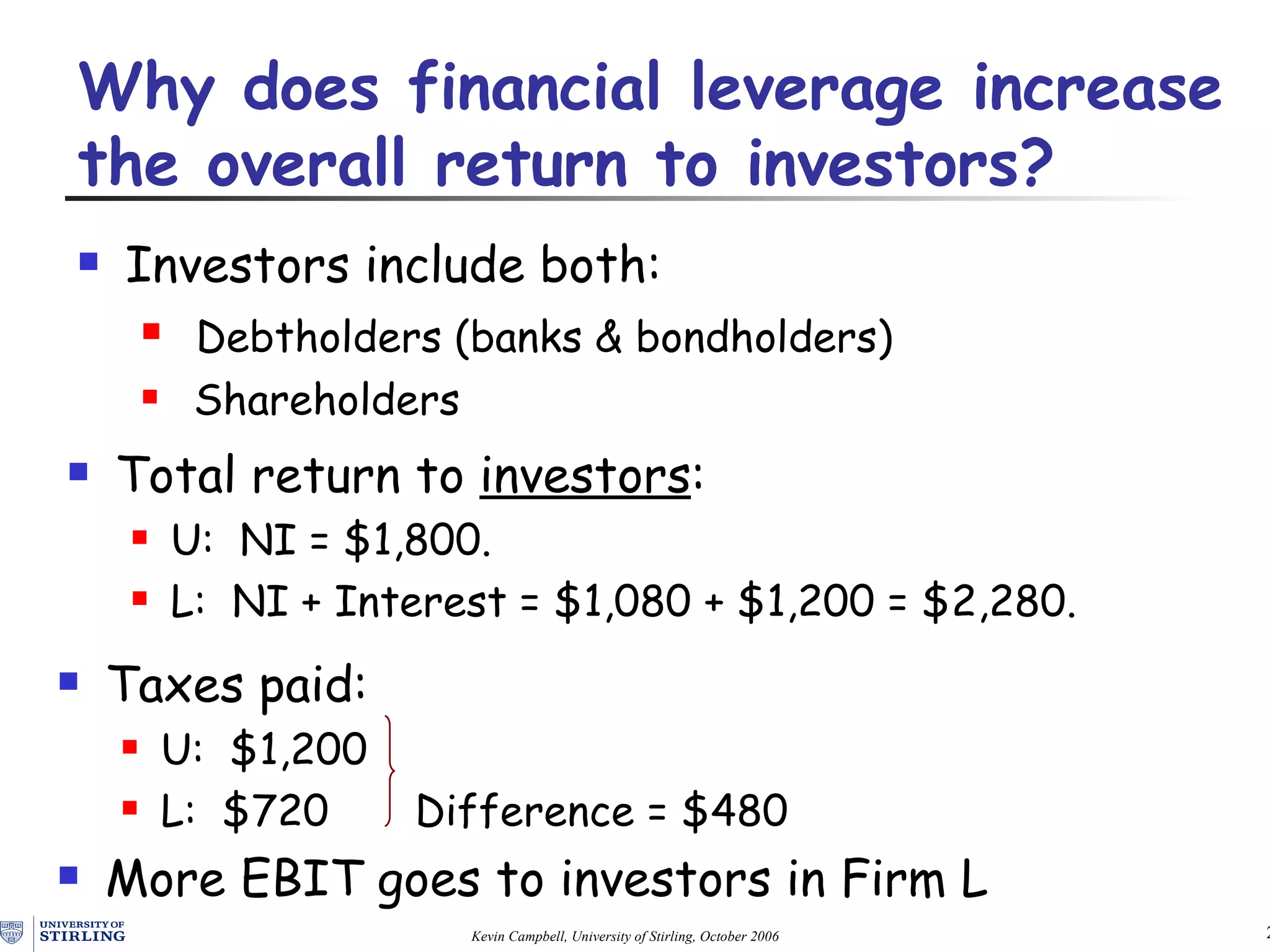
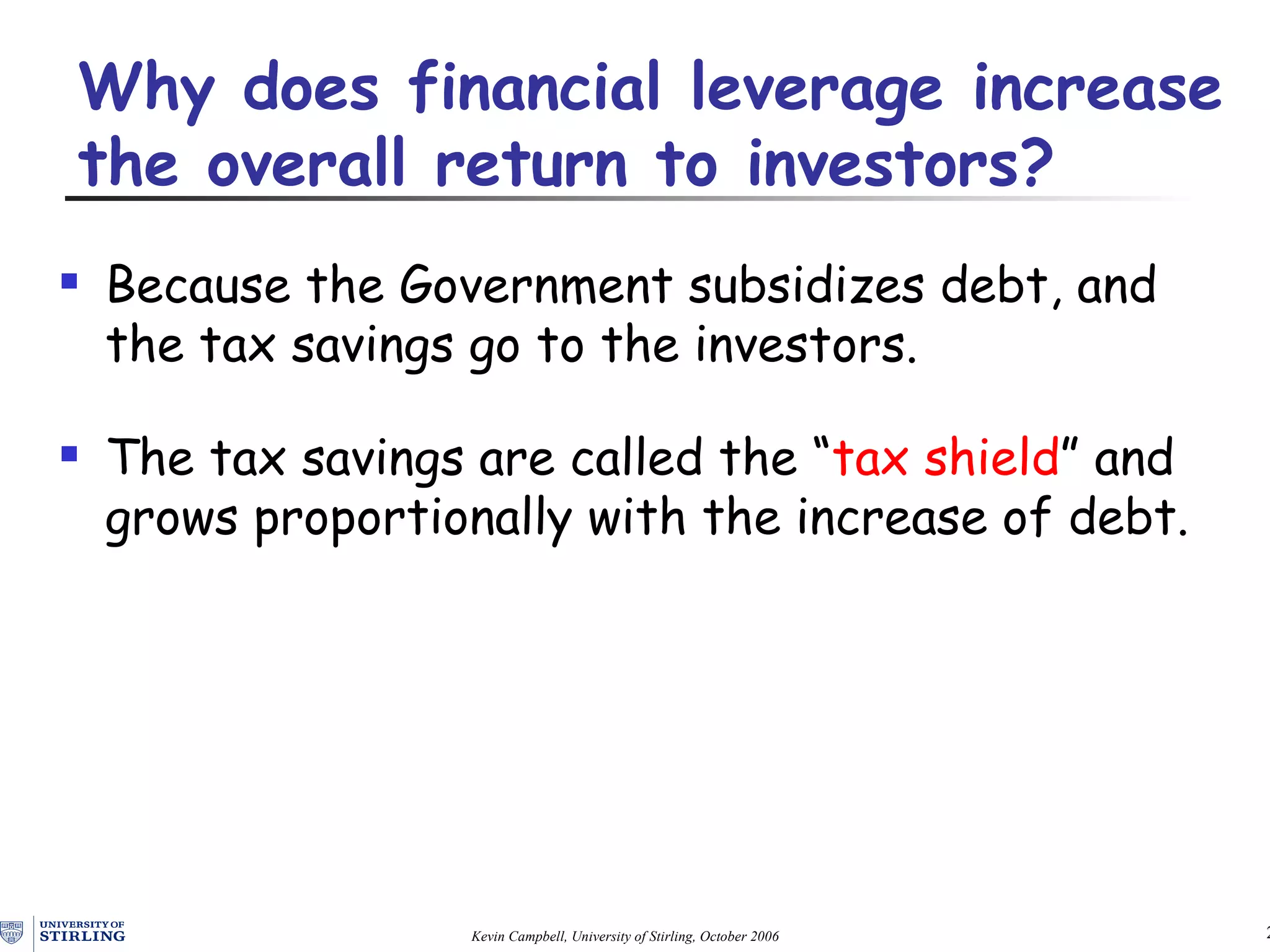
Why does  financial  leverag e  increase the overall return to investors? I nvestors include both : Debt h olders (banks & bondholders) S hare holders Total return to  investors : U:  NI = $1,800. L:  NI + Int erest  = $1,080 + $1,200 = $2,280. Taxes paid : U:  $1,200 L:  $720   Difference = $480 More EBIT goes to investors in Firm L
Because  the Government  subsidizes debt, and the tax savings go to the investors. The tax savings  are  called the “ tax shield ” and grows proportionally with the increase of debt . Why does  financial  leverag e  increase the overall return to investors?
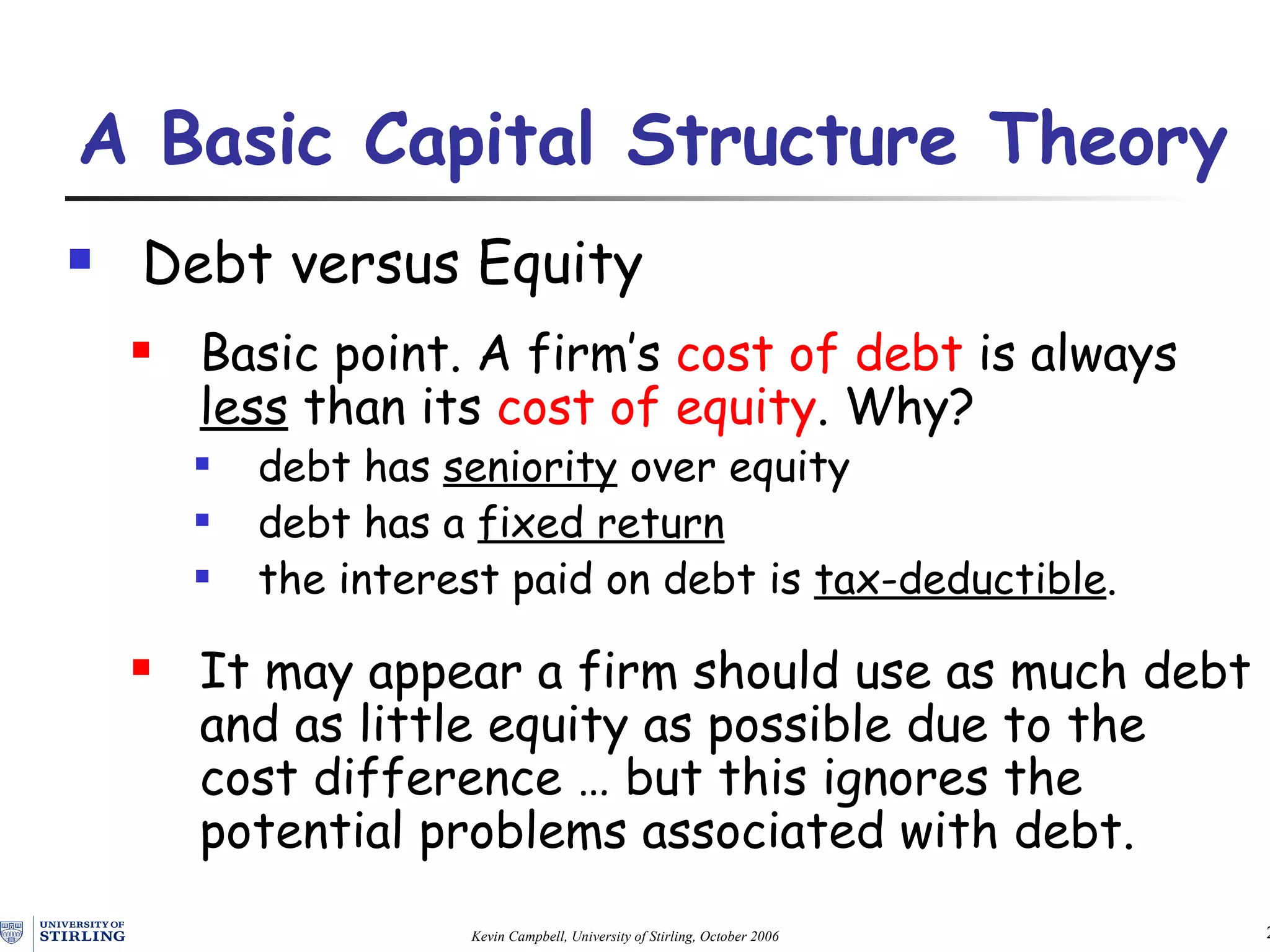
Debt  v ersus Equity Basic point.  A firm’s  cost of debt  is always  less  than its  cost of equity .   Why? debt has  seniority  over equity debt has a  fixed return   the interest paid on debt is  tax-deductible . It may appear a firm should use as much debt and as little equity as possible due to the cost difference  …  but this ignores the potential problems associated with debt. A Basic Capital Structure Theory
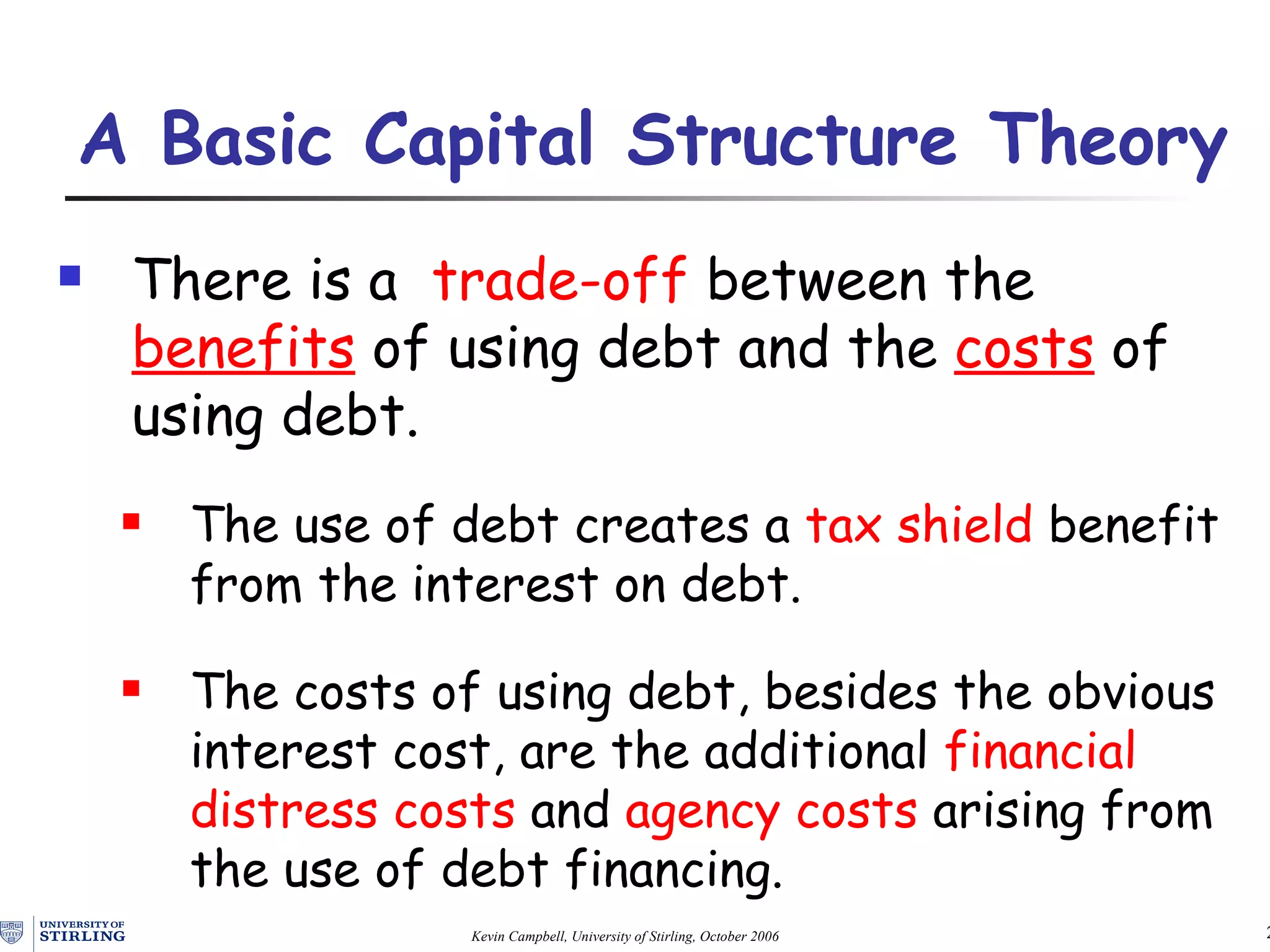
A Basic Capital Structure Theory   There is a  trade-off  between the  benefits  of using debt and the  costs  of using debt. The use of debt creates a  tax sh ield  benefit from the interest on debt. The costs of using debt, besides the obvious interest cost, are the additional  financial distress costs  and  agency costs  arising from the use of debt financing.
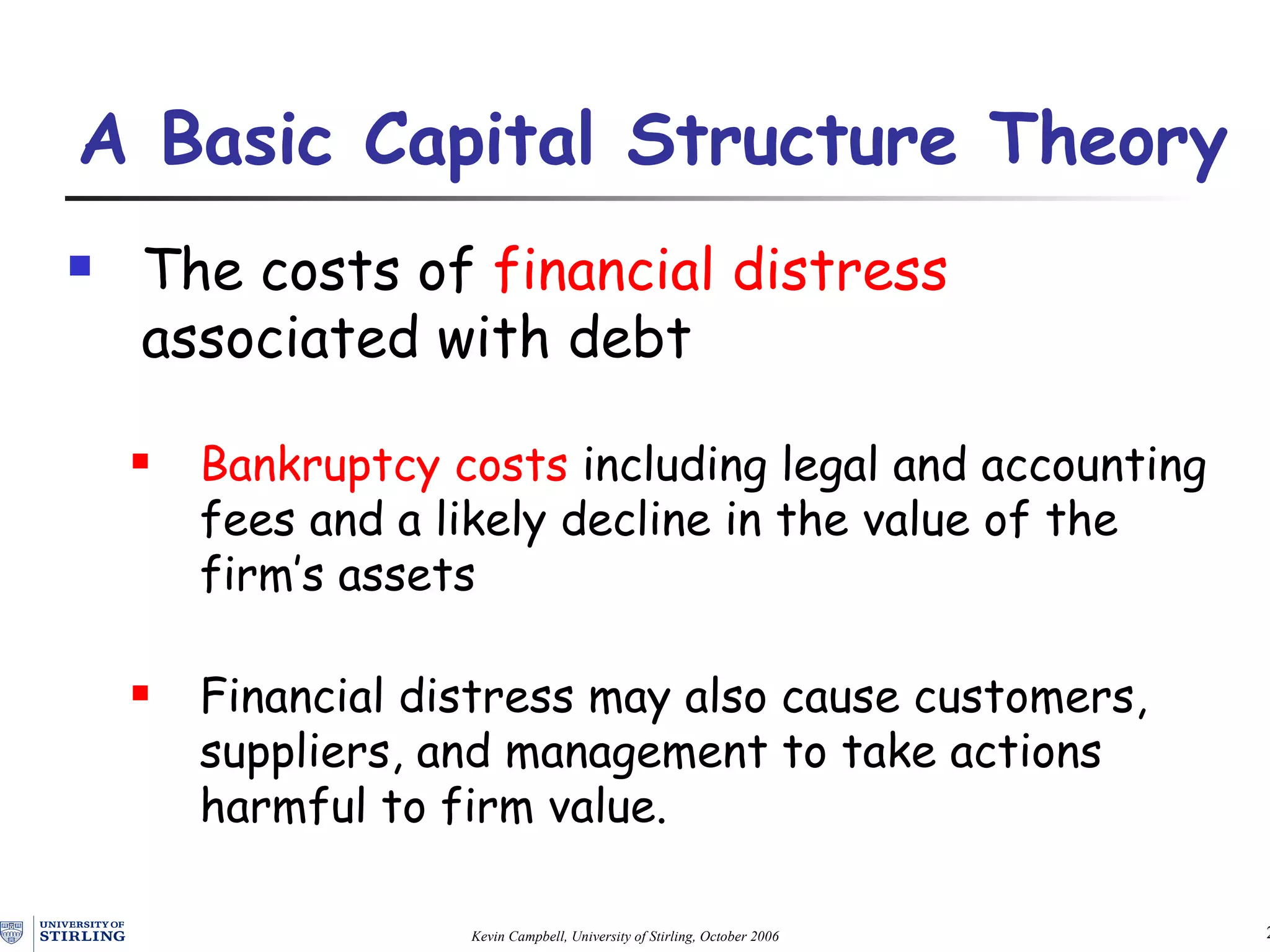
The costs of  financial distress  associated with debt Bankruptcy costs  including legal and accounting fees and a likely decline in the value of the firm’s assets Financial distress may also cause customers, suppliers, and management to take actions harmful to firm value. A Basic Capital Structure Theory
Agency costs  arise from conflicts between shareholders and bondholders When you lend money to a business, you are allowing the shareholders to use that money in the course of running that business.  Shareholders interests are different from your interests, because  You (as lender) are interested in getting your money back Shareholders are interested in maximizing their wealth A Basic Capital Structure Theory
Agency costs  associated with debt: Restrictive covenants meant to protect creditors can reduce firm efficiency. Monitoring costs may be expended to insure the firm abides by the restrictive covenants. As the level of debt financing increases, the contractual and monitoring costs are expected to increase. A Basic Capital Structure Theory
In addition to the variables described by the trade-off theory of capital structure, a  variety of practical considerations  also affect  a firm’s capital structure decisions: Industry standards Creditor and rating agency requirements Maintaining excess borrowing capacity Profitability and the need for funds Managerial risk aversion Corporate control Capital structure:  practical considerations
Industry  s tandards It is natural to compare a firm’s capital structure to other firms in the same industry. Business risk is a significant factor impacting a firm’s capital structure and is heavily influenced by  a firm’s  industry. Evidence indicate firms’ capital structures tend toward an industry average. Practical  c onsiderations
Creditor and Rating Agency Requirements Firms need to abide by restrictive covenants , which  may include restrictions on the amount of future debt. Firms typically desire to appear financially strong to potential creditors in order to maintain borrowing capacity and low interest rates.  Using less debt in capital structure helps to maintain this appearance. Practical  c onsiderations
Maintaining Excess Borrowing Capacity Successful firms typically maintain excess borrowing capacity.  This provides financial flexibility to react to investment opportunities. The maintenance of excess borrowing capacity causes firms to use less debt in their capital structure than otherwise. Practical  c onsiderations
Profitability and the Need for Funds Profits can be paid out as dividends to sh areh olders or reinvested in the firm.  If a firm generates high profits and reinvests a large proportion back into the firm, then it has a continuous source of internal funding.  This will reduce the use of debt in the firm’s capital structure. Practical  c onsiderations
Practical  c onsiderations   Managerial Risk Aversion Well-diversified s hare holders are likely to welcome the use of financial leverage. Management wealth is typically much more dependent upon the success of the company acting as  their  employer.  To the extent management can act on their own desires, the firm is likely to have less debt in its capital structure than is desired by s hare holders.
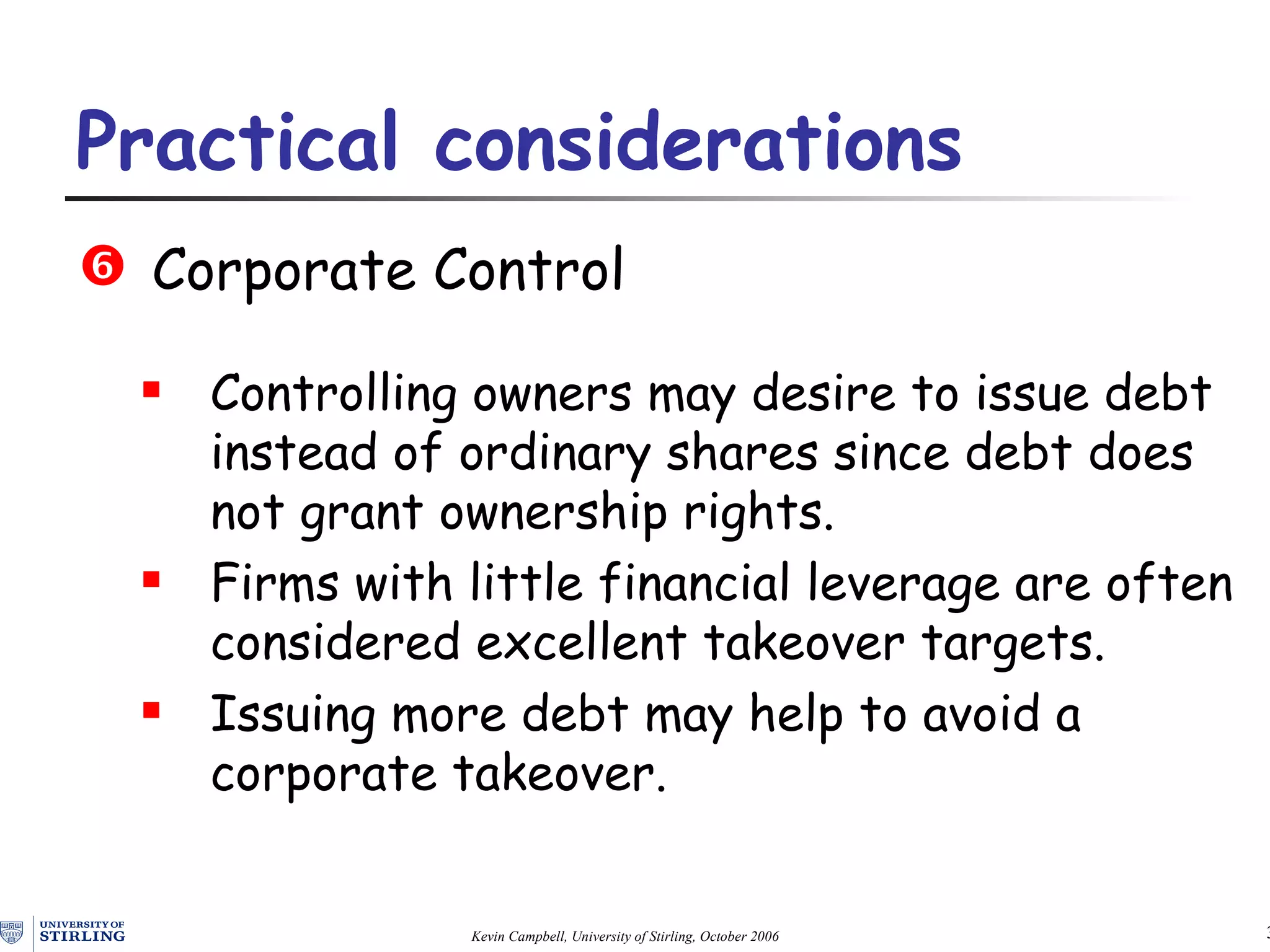
Practical  c onsiderations   Corporate Control Controlling owners may desire to issue debt instead of  ordinary shares  since debt does not grant ownership rights. Firms with little financial leverage are often considered excellent takeover targets.  Issuing more debt may help to avoid a corporate takeover.
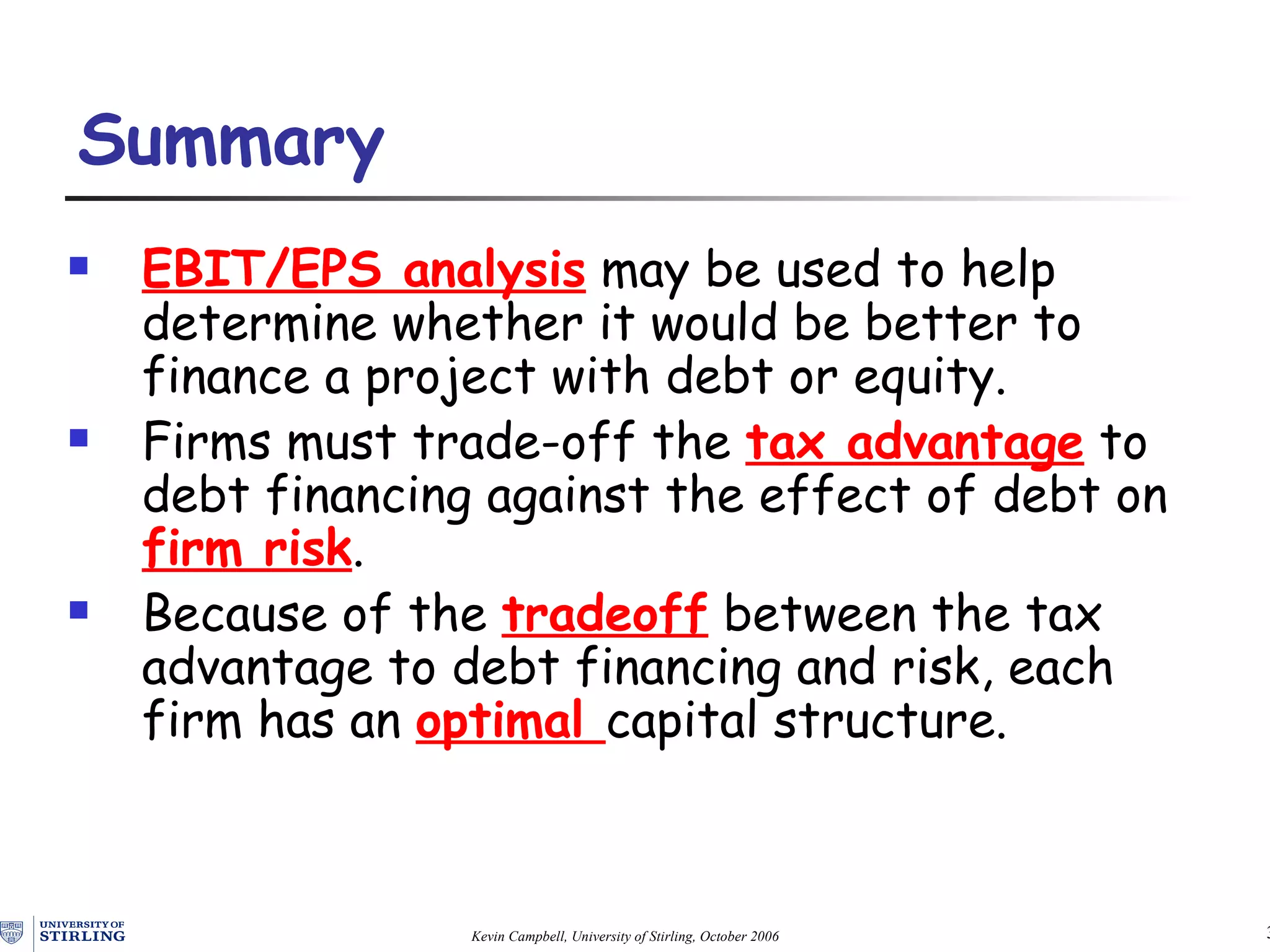
EBIT/EPS analysis   may be  used to help determine whether it would be better to finance a project with debt or equity. Firms must trade-off the   tax advantage  to debt financing  against the  effect of  debt  on  firm risk . Because of the  tradeoff   between the tax advantage to debt financing and risk, each firm has an  optimal  capital structure . Summary
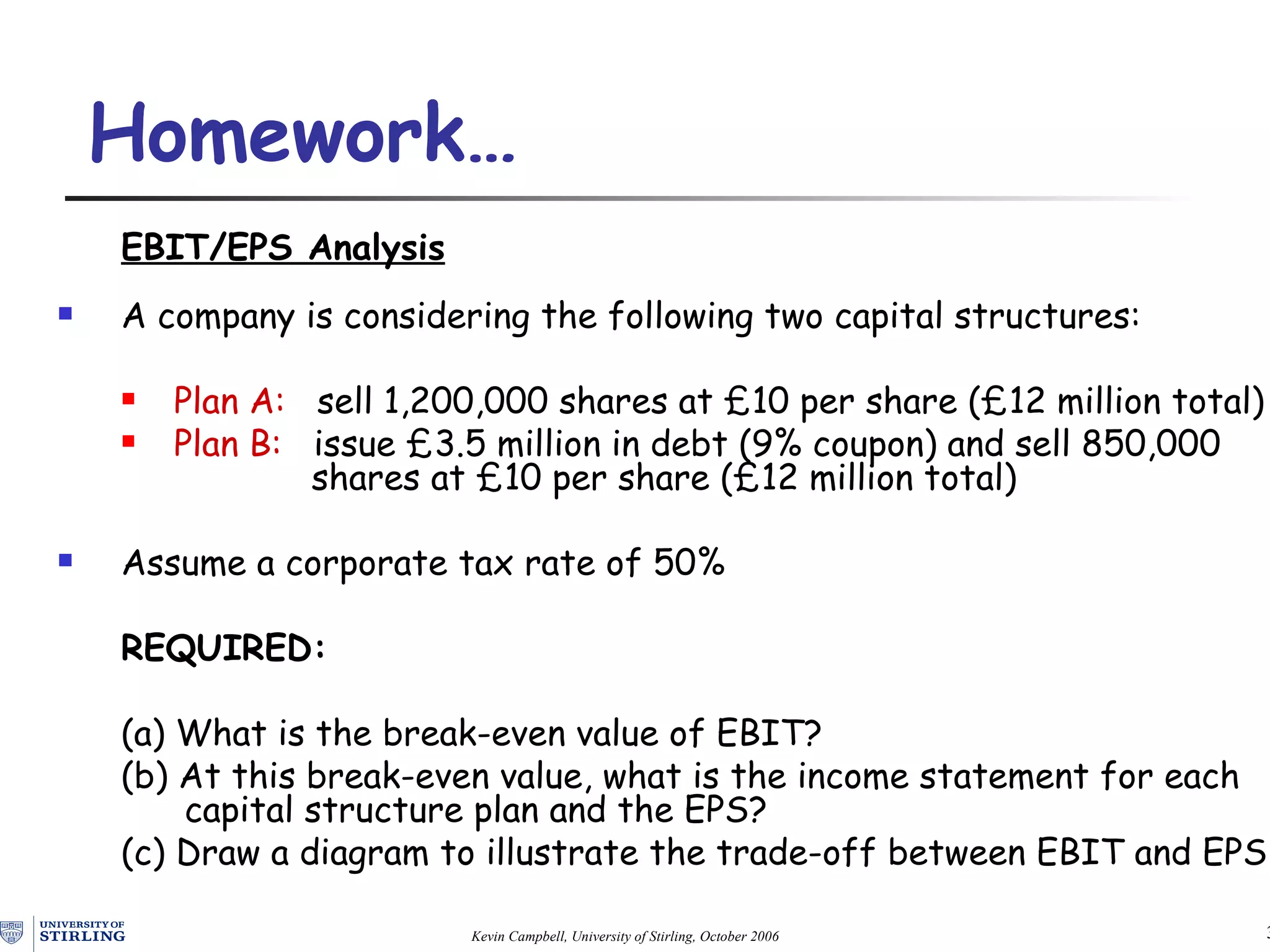
Homework… EBIT/EPS Analysis A company is considering the following two capital structures: Plan A:   sell 1,200,000 shares at £10 per share  ( £ 12 million total)   Plan B:   issue £3.5 million in debt  ( 9%  coupon)  and sell 850,000  shares at   £10 per   share  ( £ 12 million total)   Assume a corporate tax rate of 50% REQUIRED: (a) What is the break-even value of EBIT? (b) At this break-even value, what is the income statement for each  capital structure plan and the EPS? (c) Draw a diagram to illustrate the trade-off between EBIT and EPS

197.capital structure lecture

  • 1.
    EBIT/EPS Analysis Thetax benefit of debt Trade-off theory Practical considerations in the determination of capital structure CAPITAL STRUCTUR E Lecture 2
  • 2.
    Capital structure Issues: EBIT-EPS analysis The tax shield benefit of debt The trade-off theory of capital structure P ractical considerations that affect the capital structure decision
  • 3.
    Business Risk vs Financial Risk Business risk is the variability of a firm’s E arnings B efore I nterest and T axes ( EBIT ) Financial risk arises from the use of d ebt , which imposes a fixed cost in the form of interest payments = financial leverage .
  • 4.
    EBIT/ EPS analysis Examine s how different capital structures affect earnings available to shareholders (EPS) and risk Question : for different levels of EBIT , how does financial leverage affect EPS ?
  • 5.
    Risk and theIncome Statement Sales Business – Variable costs Risk – Fixed costs EBIT – Interest expense Financial Earnings before taxes Risk – Taxes Net Income EPS = Net Income / no. of shares
  • 6.
    Current and ProposedCapital Structures CURRENT PROPOSED Total assets $100 million $100 million Debt 0 million 50 million Equity 100 million 50 million Share price $25 $25 N o. of shares 4,000,000 2,000,000 Interest rate 10% 10% Note : for the purpose of simplicity we ignore taxes in this example
  • 7.
    CURRENT CAPITALSTRUCTURE No Debt, 4 Million Shares ( m illions o mitted) EBIT 50% EBIT 50% BELOW ABOVE EXPECTED EXPECTED EXPECTED EBIT $6.00 $12.00 $18.00 – Int 0.00 0.00 0.00 NI $6.00 $12.00 $18.00 EPS $ 1.50 $ 3.00 $ 4.50
  • 8.
    EBIT50% EBIT 50% BELOW ABOVE EXPECTED EXPECTED EXPECTED EBIT $6.00 $12.00 $18.00 – Int 5 .00 5 .00 5 .00 NI $ 1 .00 $ 7 .00 $1 3 .00 EPS $ 0 .50 $ 3. 5 0 $ 6 .50 PROPOSED CAPITAL STRUCTURE 50% Debt (10% Coupon), 2 m illion Shares ( m illions o mitted)
  • 9.
    EBIT/ EPS analysis Current versus Proposed Current (no debt) Proposed (with debt) EPS 8 6 4 2 0 -2 -4 3 6 9 10 12 15 18 EBIT For EBIT up to £ 10m, e quity financing is best For EBIT greater than £ 10m, debt financing is best
  • 10.
    The impact offinancial leverage If EBIT is > 10, the levered capital structure is preferable, ie EPS is higher If EBIT is < 10, the unlevered capital structure is preferable Conclusion : whether or not debt is beneficial is dependent upon the capacity of firms to generate EBIT
  • 11.
    Indifference Level Thebreak-even EBIT o ccurs where the lines cross At that level of EBIT both capital structures have the same EPS
  • 12.
    Set thetwo EPS values equal to each other and solve for EBIT: Current (unlevered) Proposed (levered) (EBIT-I nt )(1- T ) = (EBIT-I nt )(1- T ) S S Since we assume T=0 (EBIT-I nt ) = (EBIT-I nt ) S S Breakeven Point
  • 13.
    Break-even EBIT ( m illions o mitted)
  • 14.
    The impact offinancial leverage EPS U 1.5 3.0 4.5 EPS L 0.5 3.5 6.5 Spread U 3.0 Spread L 6.0 … t hat’s RISK EBIT 50% EBIT 50% BELOW ABOVE EXPECTED EXPECTED EXPECTED
  • 15.
    The impact offinancial leverage Leverage increases EPS if EBIT is high enough. At very low levels of EBIT, EPS can be negative – as interest on debt has priority over payments to shareholders. Financial leverage produces a broader spread of EPS values, ie shareholders’ returns are less predictable. This represents added RISK .
  • 16.
    Summary: EBIT/EPS analysis Indicates EBIT values when one capital structure may be preferred over another Analysis of expected EBIT can focus on the likelihood of actual EBIT exceeding the indifference point
  • 17.
    Because interest ondebt is deducted from EBIT before the amount of tax paid is calculated, there is a benefit to debt … in the form of lower corporate taxes Consider an example … The tax benefit of debt
  • 18.
    Firm Unlevered Firm L evered No debt $10,000 of 12% Debt $20,000 Equity $10,000 in Equity 40% tax rate 40% tax rate The tax benefit of debt Both firms have same business risk and EBIT of $3,000. They differ only with respect to use of debt. U has $20K in Eq uity & L has $10K in Eq uity
  • 19.
    EBIT $3,000 $3,000 Interest 0 1,200 EBT $3,000 $1,800 Taxes (40%) 1 ,200 720 NI $1,800 $1,080 ROE 9.0 % 10.8 % Firm U Firm L U; 1.8/20K = 9 % L; 1.08 / 10K = 10.8 % The tax benefit of debt
  • 20.
    Why does financial leverag e increase the overall return to investors? I nvestors include both : Debt h olders (banks & bondholders) S hare holders Total return to investors : U: NI = $1,800. L: NI + Int erest = $1,080 + $1,200 = $2,280. Taxes paid : U: $1,200 L: $720 Difference = $480 More EBIT goes to investors in Firm L
  • 21.
    Because theGovernment subsidizes debt, and the tax savings go to the investors. The tax savings are called the “ tax shield ” and grows proportionally with the increase of debt . Why does financial leverag e increase the overall return to investors?
  • 22.
    Debt versus Equity Basic point. A firm’s cost of debt is always less than its cost of equity . Why? debt has seniority over equity debt has a fixed return the interest paid on debt is tax-deductible . It may appear a firm should use as much debt and as little equity as possible due to the cost difference … but this ignores the potential problems associated with debt. A Basic Capital Structure Theory
  • 23.
    A Basic CapitalStructure Theory There is a trade-off between the benefits of using debt and the costs of using debt. The use of debt creates a tax sh ield benefit from the interest on debt. The costs of using debt, besides the obvious interest cost, are the additional financial distress costs and agency costs arising from the use of debt financing.
  • 24.
    The costs of financial distress associated with debt Bankruptcy costs including legal and accounting fees and a likely decline in the value of the firm’s assets Financial distress may also cause customers, suppliers, and management to take actions harmful to firm value. A Basic Capital Structure Theory
  • 25.
    Agency costs arise from conflicts between shareholders and bondholders When you lend money to a business, you are allowing the shareholders to use that money in the course of running that business. Shareholders interests are different from your interests, because You (as lender) are interested in getting your money back Shareholders are interested in maximizing their wealth A Basic Capital Structure Theory
  • 26.
    Agency costs associated with debt: Restrictive covenants meant to protect creditors can reduce firm efficiency. Monitoring costs may be expended to insure the firm abides by the restrictive covenants. As the level of debt financing increases, the contractual and monitoring costs are expected to increase. A Basic Capital Structure Theory
  • 27.
    In addition tothe variables described by the trade-off theory of capital structure, a variety of practical considerations also affect a firm’s capital structure decisions: Industry standards Creditor and rating agency requirements Maintaining excess borrowing capacity Profitability and the need for funds Managerial risk aversion Corporate control Capital structure: practical considerations
  • 28.
    Industry standards It is natural to compare a firm’s capital structure to other firms in the same industry. Business risk is a significant factor impacting a firm’s capital structure and is heavily influenced by a firm’s industry. Evidence indicate firms’ capital structures tend toward an industry average. Practical c onsiderations
  • 29.
    Creditor and RatingAgency Requirements Firms need to abide by restrictive covenants , which may include restrictions on the amount of future debt. Firms typically desire to appear financially strong to potential creditors in order to maintain borrowing capacity and low interest rates. Using less debt in capital structure helps to maintain this appearance. Practical c onsiderations
  • 30.
    Maintaining Excess BorrowingCapacity Successful firms typically maintain excess borrowing capacity. This provides financial flexibility to react to investment opportunities. The maintenance of excess borrowing capacity causes firms to use less debt in their capital structure than otherwise. Practical c onsiderations
  • 31.
    Profitability and theNeed for Funds Profits can be paid out as dividends to sh areh olders or reinvested in the firm. If a firm generates high profits and reinvests a large proportion back into the firm, then it has a continuous source of internal funding. This will reduce the use of debt in the firm’s capital structure. Practical c onsiderations
  • 32.
    Practical considerations Managerial Risk Aversion Well-diversified s hare holders are likely to welcome the use of financial leverage. Management wealth is typically much more dependent upon the success of the company acting as their employer. To the extent management can act on their own desires, the firm is likely to have less debt in its capital structure than is desired by s hare holders.
  • 33.
    Practical considerations Corporate Control Controlling owners may desire to issue debt instead of ordinary shares since debt does not grant ownership rights. Firms with little financial leverage are often considered excellent takeover targets. Issuing more debt may help to avoid a corporate takeover.
  • 34.
    EBIT/EPS analysis may be used to help determine whether it would be better to finance a project with debt or equity. Firms must trade-off the tax advantage to debt financing against the effect of debt on firm risk . Because of the tradeoff between the tax advantage to debt financing and risk, each firm has an optimal capital structure . Summary
  • 35.
    Homework… EBIT/EPS AnalysisA company is considering the following two capital structures: Plan A: sell 1,200,000 shares at £10 per share ( £ 12 million total) Plan B: issue £3.5 million in debt ( 9% coupon) and sell 850,000 shares at £10 per share ( £ 12 million total) Assume a corporate tax rate of 50% REQUIRED: (a) What is the break-even value of EBIT? (b) At this break-even value, what is the income statement for each capital structure plan and the EPS? (c) Draw a diagram to illustrate the trade-off between EBIT and EPS

Editor's Notes

  • #8 Note: for the sake of simplicity we ignore taxes
  • #10 Disadvantage to debt Advantage to debt
  • #13 54
  • #36 58