Chapter 11
TECHNIQUES OF CAPITAL BUDGETING
OUTLINE
• Importance
• Capital Budgeting Process
• Project Classification
• Investment Criteria
• Payback Period
• Accounting Rate of Return
• Net Present Value
• Benefit Cost Ratio
• Internal Rate of Return
• Modified Internal Rate of Return
CAPITAL EXPENDITURES AND THEIR IMPORTANCE
 The basic characteristics of a capital expenditure (also referred to
as a capital investment or just project) is that it involves a current
outlay (or current and future outlays) of funds in the expectation
of receiving a stream of benefits in future
 Importance stems from
• Long-term consequences
• Substantial outlays
• Difficulty in reversing
CAPITAL BUDGETING PROCESS
• Identification of Potential Investment Opportunities
• Assembling of Investment Proposals
• Decision Making
• Preparation of Capital Budget and Appropriations
• Implementation
• Performance Review
PROJECT CLASSIFICATION
• Mandatory Investments
• Replacement Projects
• Expansion Projects
• Diversification Projects
• Research and Development Projects
• Miscellaneous Projects
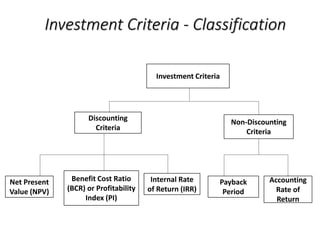
Investment Criteria - Classification
Investment Criteria
Discounting
Criteria
Non-Discounting
Criteria
Net Present
Value (NPV)
Benefit Cost Ratio
(BCR) or Profitability
Index (PI)
Internal Rate
of Return (IRR)
Payback
Period
Accounting
Rate of
Return
Pay Back Period (PBP)
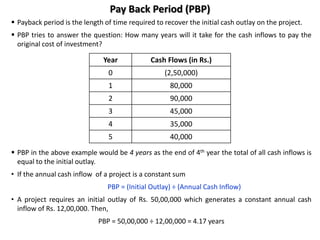
 Payback period is the length of time required to recover the initial cash outlay on the project.
 PBP tries to answer the question: How many years will it take for the cash inflows to pay the
original cost of investment?
 PBP in the above example would be 4 years as the end of 4th year the total of all cash inflows is
equal to the initial outlay.
• If the annual cash inflow of a project is a constant sum
PBP = (Initial Outlay) ÷ (Annual Cash Inflow)
• A project requires an initial outlay of Rs. 50,00,000 which generates a constant annual cash
inflow of Rs. 12,00,000. Then,
PBP = 50,00,000 ÷ 12,00,000 = 4.17 years
Year Cash Flows (in Rs.)
0 (2,50,000)
1 80,000
2 90,000
3 45,000
4 35,000
5 40,000
Pay Back Period (PBP)
• In certain projects if the annual cash flows are unequal, the calculation of PBP
becomes slightly complex.
• PBP of above project =
Lower Year + [(Outlay – CCFLL) ÷ (CCFUL – CCFLL)]
3 + [(1,35,000 – 1,15,000) ÷ (1,62,500 – 1,15,000)] = 3.42 years
Year 0 1 2 3 4 5
Cash Flows 1,35,000 30,000 40,000 45,000 47,500 50,000
Year Cash Flows (in Rs.) Cumulative Cash Flows (CCF) (in Rs.)
0 (1,35,000) -
1 30,000 30,000
2 40,000 70,000
3 45,000 1,15,000
4 47,500 1,62,500
5 50,000 2,12,500
Pay Back Period (PBP)
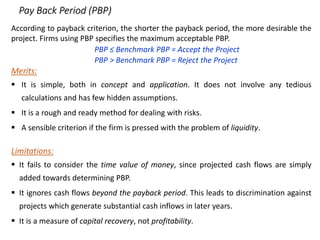
According to payback criterion, the shorter the payback period, the more desirable the
project. Firms using PBP specifies the maximum acceptable PBP.
PBP ≤ Benchmark PBP = Accept the Project
PBP > Benchmark PBP = Reject the Project
Merits:
 It is simple, both in concept and application. It does not involve any tedious
calculations and has few hidden assumptions.
 It is a rough and ready method for dealing with risks.
 A sensible criterion if the firm is pressed with the problem of liquidity.
Limitations:
 It fails to consider the time value of money, since projected cash flows are simply
added towards determining PBP.
 It ignores cash flows beyond the payback period. This leads to discrimination against
projects which generate substantial cash inflows in later years.
 It is a measure of capital recovery, not profitability.
Discounted Pay Back Period
• Overcomes an inherent shortcoming of PBP criterion by factoring in time value of
money into the analysis.
• Discounted PBP of above project =
Lower Year + [(Outlay – CCFLL) ÷ (CCFUL – CCFLL)]
3 + [(10,000 – 8,209) ÷ (10,941 – 8,209)] = 3.6 years
Year 0 1 2 3 4 5
Cash Flows -10,000 3,000 3,000 4,000 4,000 5,000
Year Cash Flows
(in Rs.)
Discount Factor
@10%
Present Value
(in Rs.)
Cumulative
Discounted Cash
Flows (in Rs.)
0 (10,000) - - -
1 3,000 0.909 2,727 2,727
2 3,000 0.826 2,478 5,205
3 4,000 0.751 3,004 8,209
4 4,000 0.683 2,732 10,941
5 5,000 0.621 3,105 14,046
Accounting Rate of Return
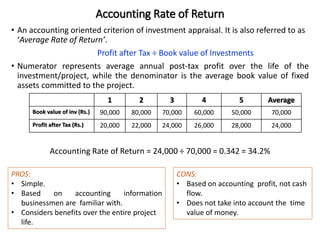
• An accounting oriented criterion of investment appraisal. It is also referred to as
‘Average Rate of Return’.
Profit after Tax ÷ Book value of Investments
• Numerator represents average annual post-tax profit over the life of the
investment/project, while the denominator is the average book value of fixed
assets committed to the project.
Accounting Rate of Return = 24,000 ÷ 70,000 = 0.342 = 34.2%
1 2 3 4 5 Average
Book value of inv (Rs.) 90,000 80,000 70,000 60,000 50,000 70,000
Profit after Tax (Rs.) 20,000 22,000 24,000 26,000 28,000 24,000
PROS:
• Simple.
• Based on accounting information
businessmen are familiar with.
• Considers benefits over the entire project
life.
CONS:
• Based on accounting profit, not cash
flow.
• Does not take into account the time
value of money.
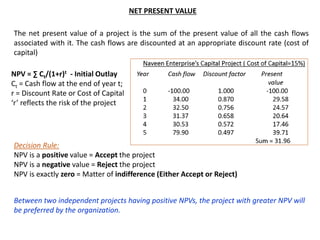
NET PRESENT VALUE
The net present value of a project is the sum of the present value of all the cash flows
associated with it. The cash flows are discounted at an appropriate discount rate (cost of
capital)
NPV = ∑ Ct/(1+r)t - Initial Outlay
Ct = Cash flow at the end of year t;
r = Discount Rate or Cost of Capital
‘r’ reflects the risk of the project
Decision Rule:
NPV is a positive value = Accept the project
NPV is a negative value = Reject the project
NPV is exactly zero = Matter of indifference (Either Accept or Reject)
Between two independent projects having positive NPVs, the project with greater NPV will
be preferred by the organization.
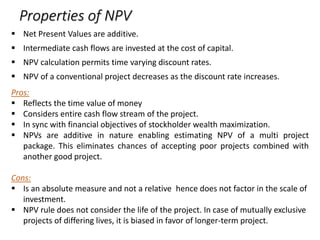
Properties of NPV
 Net Present Values are additive.
 Intermediate cash flows are invested at the cost of capital.
 NPV calculation permits time varying discount rates.
 NPV of a conventional project decreases as the discount rate increases.
Pros:
 Reflects the time value of money
 Considers entire cash flow stream of the project.
 In sync with financial objectives of stockholder wealth maximization.
 NPVs are additive in nature enabling estimating NPV of a multi project
package. This eliminates chances of accepting poor projects combined with
another good project.
Cons:
 Is an absolute measure and not a relative hence does not factor in the scale of
investment.
 NPV rule does not consider the life of the project. In case of mutually exclusive
projects of differing lives, it is biased in favor of longer-term project.
Properties of NPV
 Net Present Values are additive.
 Intermediate cash flows are invested at the cost of capital.
 NPV calculation permits time varying discount rates.
 NPV of a conventional project decreases as the discount rate increases.
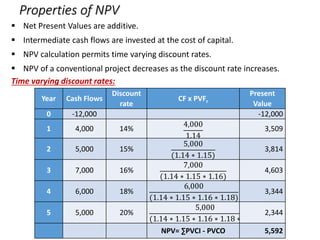
Time varying discount rates:
Year Cash Flows
Discount
rate
CF x PVFr
Present
Value
0 -12,000 -12,000
1 4,000 14%
4,000
1.14
3,509
2 5,000 15%
5,000
(1.14 ∗ 1.15)
3,814
3 7,000 16%
7,000
(1.14 ∗ 1.15 ∗ 1.16)
4,603
4 6,000 18%
6,000
(1.14 ∗ 1.15 ∗ 1.16 ∗ 1.18)
3,344
5 5,000 20%
5,000
(1.14 ∗ 1.15 ∗ 1.16 ∗ 1.18 ∗
2,344
NPV= ∑PVCI - PVCO 5,592
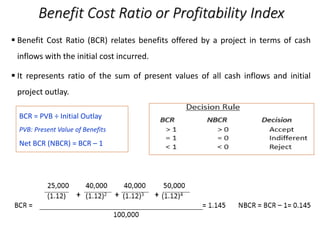
Benefit Cost Ratio or Profitability Index
 Benefit Cost Ratio (BCR) relates benefits offered by a project in terms of cash
inflows with the initial cost incurred.
 It represents ratio of the sum of present values of all cash inflows and initial
project outlay.
BCR = PVB ÷ Initial Outlay
PVB: Present Value of Benefits
Net BCR (NBCR) = BCR – 1
Benefit Cost Ratio – Suitability
• A school of thought suggests that since BCR measures NPV per rupee of outlay,
it can discriminate better between large and small investment proposals as
compared to standard NPV criterion.
• Weingartner studied validity of above argument. Findings were:
 Under unconstrained conditions, BCR and NPV will accept and reject same projects.
 When the capital budget is limited, BCR can rank projects correctly in the order of
decreasingly efficient use of capital.
 However, its use is not recommended owing to no possibility of aggregating smaller
projects and comparing with a larger one.
 If outlays occur beyond the current period, BCR criterion becomes unsuitable.
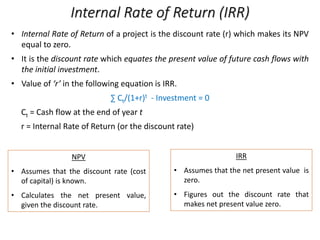
Internal Rate of Return (IRR)
• Internal Rate of Return of a project is the discount rate (r) which makes its NPV
equal to zero.
• It is the discount rate which equates the present value of future cash flows with
the initial investment.
• Value of ‘r’ in the following equation is IRR.
∑ Ct/(1+r)t - Investment = 0
Ct = Cash flow at the end of year t
r = Internal Rate of Return (or the discount rate)
NPV
• Assumes that the discount rate (cost
of capital) is known.
• Calculates the net present value,
given the discount rate.
IRR
• Assumes that the net present value is
zero.
• Figures out the discount rate that
makes net present value zero.
Internal Rate of Return (IRR)
Following are the projected cash flows of a proposed project
IRR is the value of ‘r’ which satisfies the following equation:
1,00,000 = [30,000/(1+r)] + [30,000/(1+r)2] + [40,000/(1+r)3] + [45,000/(1+r)4]
or 1,00,000 = 30,000 (PVIFr,1) + 30,000 (PVIFr,2) + 40,000 (PVIFr,3) + 45,000 (PVIFr,4)
Assume ‘r’ = 15%
30,000 (PVIFr,1) + 30,000 (PVIFr,2) + 40,000 (PVIFr,3) + 45,000 (PVIFr,4) = 1,00,801 > 1,00,000
Consider ‘r’ = 16%
30,000 (PVIFr,1) + 30,000 (PVIFr,2) + 40,000 (PVIFr,3) + 45,000 (PVIFr,4) = 98,636 < 1,00,000
IRR (or r) lies between 15% and 16%
Year 0 1 2 3 4
Cash Flow (in INR) (1,00,000) 30,000 30,000 40,000 45,000
= 15%
801
801+1364
x 16% - 15 %
IRR = 15.37 %
Merits and Limitations of IRR
Merits
 Easier to think in terms of rates of returns rather than absolute
rupee values.
 Easy interpretation by all stakeholders of the project.
 Non-requirement of prior knowledge of discount rate, unlike NPV
calculation.
Limitations
 Non-conventional Cash Flows.
 Mutually Exclusive Projects.
 Lending vs. Borrowing.
 Differences between short-term and long-term interest rates
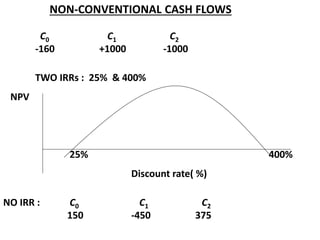
NON-CONVENTIONAL CASH FLOWS
C0 C1 C2
-160 +1000 -1000
TWO IRRs : 25% & 400%
NPV
25% 400%
Discount rate( %)
NO IRR : C0 C1 C2
150 -450 375
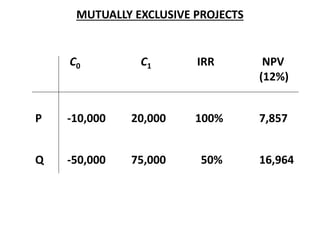
MUTUALLY EXCLUSIVE PROJECTS
C0 C1 IRR NPV
(12%)
P -10,000 20,000 100% 7,857
Q -50,000 75,000 50% 16,964
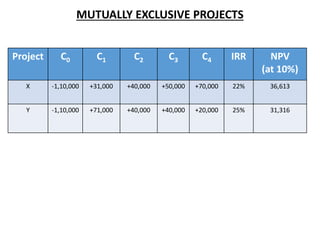
MUTUALLY EXCLUSIVE PROJECTS
Project C0 C1 C2 C3 C4 IRR NPV
(at 10%)
X -1,10,000 +31,000 +40,000 +50,000 +70,000 22% 36,613
Y -1,10,000 +71,000 +40,000 +40,000 +20,000 25% 31,316
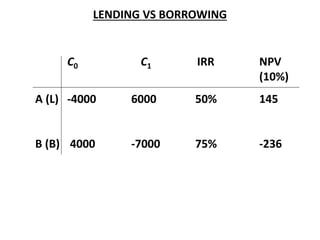
LENDING VS BORROWING
C0 C1 IRR NPV
(10%)
A (L) -4000 6000 50% 145
B (B) 4000 -7000 75% -236
Modified IRR (MIRR)
• IRR assumes intermediate positive cash flows from a project are reinvested at its
IRR.
• This assumption generates inflated IRR estimates which may lead to selection of
inferior projects.
• (http://www.mckinsey.com/business-functions/strategy-and-corporate-
finance/our-insights/internal-rate-of-return-a-cautionary-tale)
• MIRR offers an improvement to traditional IRR enabling a more accurate
reflection of cost and profitability of a project.
• MIRR considers reinvestment of intermediate positive cash flows at the firm’s cost
of cost of capital, while initial outlay(s) are financed at firm’s financing cost.
MIRR = (Total FV of cash inflows @ cost of capital ÷ PV of initial outlay @ financing cost)1/n – 1
Two year project with an initial outlay of $195 and a cost of capital of 12% will return
$121 in year 1 and $131 in year 2. IRR vs MIRR ?
IRR = 18.66%, MIRR = [{121(1.12) + 131}/195]1/2 – 1 = 16.91%
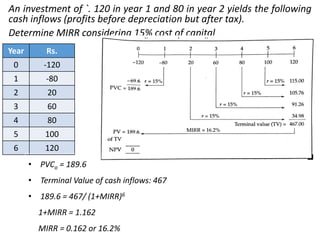
An investment of `. 120 in year 1 and 80 in year 2 yields the following
cash inflows (profits before depreciation but after tax).
Determine MIRR considering 15% cost of capital
Year Rs.
0 -120
1 -80
2 20
3 60
4 80
5 100
6 120
• PVCo = 189.6
• Terminal Value of cash inflows: 467
• 189.6 = 467/ (1+MIRR)6
1+MIRR = 1.162
MIRR = 0.162 or 16.2%
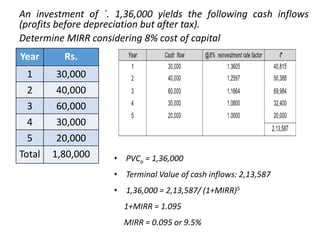
An investment of `. 1,36,000 yields the following cash inflows
(profits before depreciation but after tax).
Determine MIRR considering 8% cost of capital
Year Rs.
1 30,000
2 40,000
3 60,000
4 30,000
5 20,000
Total 1,80,000 • PVCo = 1,36,000
• Terminal Value of cash inflows: 2,13,587
• 1,36,000 = 2,13,587/ (1+MIRR)5
1+MIRR = 1.095
MIRR = 0.095 or 9.5%
INVESTMENT APPRAISAL IN PRACTICE
• Over time, discounted cash flow methods have gained in importance and
internal rate of return is the most popular evaluation method.
• Firms typically use multiple evaluation methods.
• Accounting rate of return and payback period are widely employed as
supplementary evaluation methods.
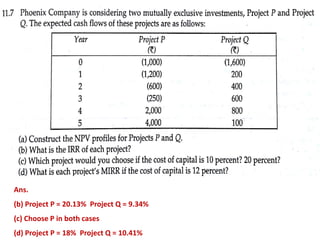
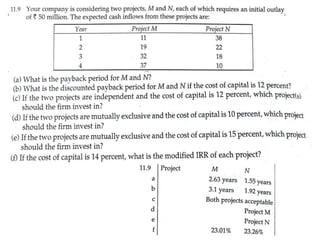
Ans.
(b) Project P = 20.13% Project Q = 9.34%
(c) Choose P in both cases
(d) Project P = 18% Project Q = 10.41%
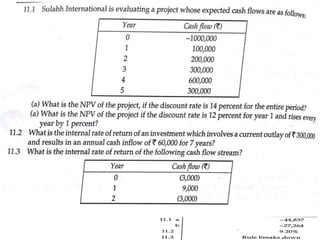
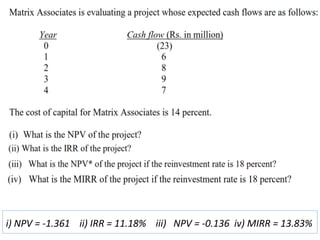
i) NPV = -1.361 ii) IRR = 11.18% iii) NPV = -0.136 iv) MIRR = 13.83%
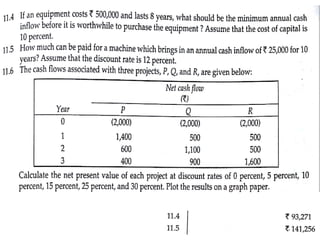
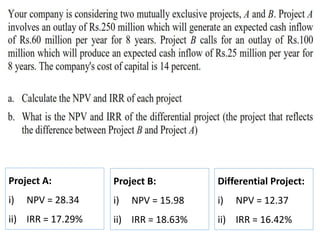
Project A:
i) NPV = 28.34
ii) IRR = 17.29%
Project B:
i) NPV = 15.98
ii) IRR = 18.63%
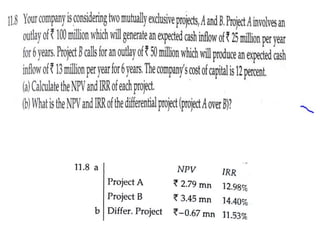
Differential Project:
i) NPV = 12.37
ii) IRR = 16.42%

Ch-11 Capital Budgeting.pdf

  • 1.
    Chapter 11 TECHNIQUES OFCAPITAL BUDGETING
  • 2.
    OUTLINE • Importance • CapitalBudgeting Process • Project Classification • Investment Criteria • Payback Period • Accounting Rate of Return • Net Present Value • Benefit Cost Ratio • Internal Rate of Return • Modified Internal Rate of Return
  • 3.
    CAPITAL EXPENDITURES ANDTHEIR IMPORTANCE  The basic characteristics of a capital expenditure (also referred to as a capital investment or just project) is that it involves a current outlay (or current and future outlays) of funds in the expectation of receiving a stream of benefits in future  Importance stems from • Long-term consequences • Substantial outlays • Difficulty in reversing
  • 4.
    CAPITAL BUDGETING PROCESS •Identification of Potential Investment Opportunities • Assembling of Investment Proposals • Decision Making • Preparation of Capital Budget and Appropriations • Implementation • Performance Review
  • 5.
    PROJECT CLASSIFICATION • MandatoryInvestments • Replacement Projects • Expansion Projects • Diversification Projects • Research and Development Projects • Miscellaneous Projects
  • 6.
    Investment Criteria -Classification Investment Criteria Discounting Criteria Non-Discounting Criteria Net Present Value (NPV) Benefit Cost Ratio (BCR) or Profitability Index (PI) Internal Rate of Return (IRR) Payback Period Accounting Rate of Return
  • 7.
    Pay Back Period(PBP)  Payback period is the length of time required to recover the initial cash outlay on the project.  PBP tries to answer the question: How many years will it take for the cash inflows to pay the original cost of investment?  PBP in the above example would be 4 years as the end of 4th year the total of all cash inflows is equal to the initial outlay. • If the annual cash inflow of a project is a constant sum PBP = (Initial Outlay) ÷ (Annual Cash Inflow) • A project requires an initial outlay of Rs. 50,00,000 which generates a constant annual cash inflow of Rs. 12,00,000. Then, PBP = 50,00,000 ÷ 12,00,000 = 4.17 years Year Cash Flows (in Rs.) 0 (2,50,000) 1 80,000 2 90,000 3 45,000 4 35,000 5 40,000
  • 8.
    Pay Back Period(PBP) • In certain projects if the annual cash flows are unequal, the calculation of PBP becomes slightly complex. • PBP of above project = Lower Year + [(Outlay – CCFLL) ÷ (CCFUL – CCFLL)] 3 + [(1,35,000 – 1,15,000) ÷ (1,62,500 – 1,15,000)] = 3.42 years Year 0 1 2 3 4 5 Cash Flows 1,35,000 30,000 40,000 45,000 47,500 50,000 Year Cash Flows (in Rs.) Cumulative Cash Flows (CCF) (in Rs.) 0 (1,35,000) - 1 30,000 30,000 2 40,000 70,000 3 45,000 1,15,000 4 47,500 1,62,500 5 50,000 2,12,500
  • 9.
    Pay Back Period(PBP) According to payback criterion, the shorter the payback period, the more desirable the project. Firms using PBP specifies the maximum acceptable PBP. PBP ≤ Benchmark PBP = Accept the Project PBP > Benchmark PBP = Reject the Project Merits:  It is simple, both in concept and application. It does not involve any tedious calculations and has few hidden assumptions.  It is a rough and ready method for dealing with risks.  A sensible criterion if the firm is pressed with the problem of liquidity. Limitations:  It fails to consider the time value of money, since projected cash flows are simply added towards determining PBP.  It ignores cash flows beyond the payback period. This leads to discrimination against projects which generate substantial cash inflows in later years.  It is a measure of capital recovery, not profitability.
  • 10.
    Discounted Pay BackPeriod • Overcomes an inherent shortcoming of PBP criterion by factoring in time value of money into the analysis. • Discounted PBP of above project = Lower Year + [(Outlay – CCFLL) ÷ (CCFUL – CCFLL)] 3 + [(10,000 – 8,209) ÷ (10,941 – 8,209)] = 3.6 years Year 0 1 2 3 4 5 Cash Flows -10,000 3,000 3,000 4,000 4,000 5,000 Year Cash Flows (in Rs.) Discount Factor @10% Present Value (in Rs.) Cumulative Discounted Cash Flows (in Rs.) 0 (10,000) - - - 1 3,000 0.909 2,727 2,727 2 3,000 0.826 2,478 5,205 3 4,000 0.751 3,004 8,209 4 4,000 0.683 2,732 10,941 5 5,000 0.621 3,105 14,046
  • 11.
    Accounting Rate ofReturn • An accounting oriented criterion of investment appraisal. It is also referred to as ‘Average Rate of Return’. Profit after Tax ÷ Book value of Investments • Numerator represents average annual post-tax profit over the life of the investment/project, while the denominator is the average book value of fixed assets committed to the project. Accounting Rate of Return = 24,000 ÷ 70,000 = 0.342 = 34.2% 1 2 3 4 5 Average Book value of inv (Rs.) 90,000 80,000 70,000 60,000 50,000 70,000 Profit after Tax (Rs.) 20,000 22,000 24,000 26,000 28,000 24,000 PROS: • Simple. • Based on accounting information businessmen are familiar with. • Considers benefits over the entire project life. CONS: • Based on accounting profit, not cash flow. • Does not take into account the time value of money.
  • 12.
    NET PRESENT VALUE Thenet present value of a project is the sum of the present value of all the cash flows associated with it. The cash flows are discounted at an appropriate discount rate (cost of capital) NPV = ∑ Ct/(1+r)t - Initial Outlay Ct = Cash flow at the end of year t; r = Discount Rate or Cost of Capital ‘r’ reflects the risk of the project Decision Rule: NPV is a positive value = Accept the project NPV is a negative value = Reject the project NPV is exactly zero = Matter of indifference (Either Accept or Reject) Between two independent projects having positive NPVs, the project with greater NPV will be preferred by the organization.
  • 13.
    Properties of NPV Net Present Values are additive.  Intermediate cash flows are invested at the cost of capital.  NPV calculation permits time varying discount rates.  NPV of a conventional project decreases as the discount rate increases. Pros:  Reflects the time value of money  Considers entire cash flow stream of the project.  In sync with financial objectives of stockholder wealth maximization.  NPVs are additive in nature enabling estimating NPV of a multi project package. This eliminates chances of accepting poor projects combined with another good project. Cons:  Is an absolute measure and not a relative hence does not factor in the scale of investment.  NPV rule does not consider the life of the project. In case of mutually exclusive projects of differing lives, it is biased in favor of longer-term project.
  • 14.
    Properties of NPV Net Present Values are additive.  Intermediate cash flows are invested at the cost of capital.  NPV calculation permits time varying discount rates.  NPV of a conventional project decreases as the discount rate increases. Time varying discount rates: Year Cash Flows Discount rate CF x PVFr Present Value 0 -12,000 -12,000 1 4,000 14% 4,000 1.14 3,509 2 5,000 15% 5,000 (1.14 ∗ 1.15) 3,814 3 7,000 16% 7,000 (1.14 ∗ 1.15 ∗ 1.16) 4,603 4 6,000 18% 6,000 (1.14 ∗ 1.15 ∗ 1.16 ∗ 1.18) 3,344 5 5,000 20% 5,000 (1.14 ∗ 1.15 ∗ 1.16 ∗ 1.18 ∗ 2,344 NPV= ∑PVCI - PVCO 5,592
  • 15.
    Benefit Cost Ratioor Profitability Index  Benefit Cost Ratio (BCR) relates benefits offered by a project in terms of cash inflows with the initial cost incurred.  It represents ratio of the sum of present values of all cash inflows and initial project outlay. BCR = PVB ÷ Initial Outlay PVB: Present Value of Benefits Net BCR (NBCR) = BCR – 1
  • 16.
    Benefit Cost Ratio– Suitability • A school of thought suggests that since BCR measures NPV per rupee of outlay, it can discriminate better between large and small investment proposals as compared to standard NPV criterion. • Weingartner studied validity of above argument. Findings were:  Under unconstrained conditions, BCR and NPV will accept and reject same projects.  When the capital budget is limited, BCR can rank projects correctly in the order of decreasingly efficient use of capital.  However, its use is not recommended owing to no possibility of aggregating smaller projects and comparing with a larger one.  If outlays occur beyond the current period, BCR criterion becomes unsuitable.
  • 17.
    Internal Rate ofReturn (IRR) • Internal Rate of Return of a project is the discount rate (r) which makes its NPV equal to zero. • It is the discount rate which equates the present value of future cash flows with the initial investment. • Value of ‘r’ in the following equation is IRR. ∑ Ct/(1+r)t - Investment = 0 Ct = Cash flow at the end of year t r = Internal Rate of Return (or the discount rate) NPV • Assumes that the discount rate (cost of capital) is known. • Calculates the net present value, given the discount rate. IRR • Assumes that the net present value is zero. • Figures out the discount rate that makes net present value zero.
  • 18.
    Internal Rate ofReturn (IRR) Following are the projected cash flows of a proposed project IRR is the value of ‘r’ which satisfies the following equation: 1,00,000 = [30,000/(1+r)] + [30,000/(1+r)2] + [40,000/(1+r)3] + [45,000/(1+r)4] or 1,00,000 = 30,000 (PVIFr,1) + 30,000 (PVIFr,2) + 40,000 (PVIFr,3) + 45,000 (PVIFr,4) Assume ‘r’ = 15% 30,000 (PVIFr,1) + 30,000 (PVIFr,2) + 40,000 (PVIFr,3) + 45,000 (PVIFr,4) = 1,00,801 > 1,00,000 Consider ‘r’ = 16% 30,000 (PVIFr,1) + 30,000 (PVIFr,2) + 40,000 (PVIFr,3) + 45,000 (PVIFr,4) = 98,636 < 1,00,000 IRR (or r) lies between 15% and 16% Year 0 1 2 3 4 Cash Flow (in INR) (1,00,000) 30,000 30,000 40,000 45,000 = 15% 801 801+1364 x 16% - 15 % IRR = 15.37 %
  • 19.
    Merits and Limitationsof IRR Merits  Easier to think in terms of rates of returns rather than absolute rupee values.  Easy interpretation by all stakeholders of the project.  Non-requirement of prior knowledge of discount rate, unlike NPV calculation. Limitations  Non-conventional Cash Flows.  Mutually Exclusive Projects.  Lending vs. Borrowing.  Differences between short-term and long-term interest rates
  • 20.
    NON-CONVENTIONAL CASH FLOWS C0C1 C2 -160 +1000 -1000 TWO IRRs : 25% & 400% NPV 25% 400% Discount rate( %) NO IRR : C0 C1 C2 150 -450 375
  • 21.
    MUTUALLY EXCLUSIVE PROJECTS C0C1 IRR NPV (12%) P -10,000 20,000 100% 7,857 Q -50,000 75,000 50% 16,964
  • 22.
    MUTUALLY EXCLUSIVE PROJECTS ProjectC0 C1 C2 C3 C4 IRR NPV (at 10%) X -1,10,000 +31,000 +40,000 +50,000 +70,000 22% 36,613 Y -1,10,000 +71,000 +40,000 +40,000 +20,000 25% 31,316
  • 23.
    LENDING VS BORROWING C0C1 IRR NPV (10%) A (L) -4000 6000 50% 145 B (B) 4000 -7000 75% -236
  • 24.
    Modified IRR (MIRR) •IRR assumes intermediate positive cash flows from a project are reinvested at its IRR. • This assumption generates inflated IRR estimates which may lead to selection of inferior projects. • (http://www.mckinsey.com/business-functions/strategy-and-corporate- finance/our-insights/internal-rate-of-return-a-cautionary-tale) • MIRR offers an improvement to traditional IRR enabling a more accurate reflection of cost and profitability of a project. • MIRR considers reinvestment of intermediate positive cash flows at the firm’s cost of cost of capital, while initial outlay(s) are financed at firm’s financing cost. MIRR = (Total FV of cash inflows @ cost of capital ÷ PV of initial outlay @ financing cost)1/n – 1 Two year project with an initial outlay of $195 and a cost of capital of 12% will return $121 in year 1 and $131 in year 2. IRR vs MIRR ? IRR = 18.66%, MIRR = [{121(1.12) + 131}/195]1/2 – 1 = 16.91%
  • 25.
    An investment of`. 120 in year 1 and 80 in year 2 yields the following cash inflows (profits before depreciation but after tax). Determine MIRR considering 15% cost of capital Year Rs. 0 -120 1 -80 2 20 3 60 4 80 5 100 6 120 • PVCo = 189.6 • Terminal Value of cash inflows: 467 • 189.6 = 467/ (1+MIRR)6 1+MIRR = 1.162 MIRR = 0.162 or 16.2%
  • 26.
    An investment of`. 1,36,000 yields the following cash inflows (profits before depreciation but after tax). Determine MIRR considering 8% cost of capital Year Rs. 1 30,000 2 40,000 3 60,000 4 30,000 5 20,000 Total 1,80,000 • PVCo = 1,36,000 • Terminal Value of cash inflows: 2,13,587 • 1,36,000 = 2,13,587/ (1+MIRR)5 1+MIRR = 1.095 MIRR = 0.095 or 9.5%
  • 27.
    INVESTMENT APPRAISAL INPRACTICE • Over time, discounted cash flow methods have gained in importance and internal rate of return is the most popular evaluation method. • Firms typically use multiple evaluation methods. • Accounting rate of return and payback period are widely employed as supplementary evaluation methods.
  • 30.
    Ans. (b) Project P= 20.13% Project Q = 9.34% (c) Choose P in both cases (d) Project P = 18% Project Q = 10.41%
  • 35.
    i) NPV =-1.361 ii) IRR = 11.18% iii) NPV = -0.136 iv) MIRR = 13.83%
  • 36.
    Project A: i) NPV= 28.34 ii) IRR = 17.29% Project B: i) NPV = 15.98 ii) IRR = 18.63% Differential Project: i) NPV = 12.37 ii) IRR = 16.42%