CAPITAL BUDGETING 

OUTLINE 
 Importance 
 Capital Budgeting Process 
 Project Classification 
 Investment Criteria 
 Net Present Value 
 Benefit Cost Ratio 
 Internal Rate of Return 
 Modified Internal Rate of Return 
 Payback Period 
 Accounting Rate of Return
CAPITAL EXPENDITURES AND THEIR IMPORTANCE 
• The basic characteristics of a capital expenditure (also 
referred to as a capital investment or just project) is that 
it involves a current outlay (or current and future 
outlays) of funds in the receiving a stream of benefits in 
future 
• Importance stems from 
 Long-term consequences 
 Substantial outlays 
 Difficulty in reversing
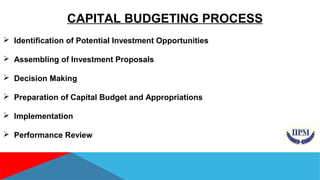
CAPITAL BUDGETING PROCESS 
 Identification of Potential Investment Opportunities 
 Assembling of Investment Proposals 
 Decision Making 
 Preparation of Capital Budget and Appropriations 
 Implementation 
 Performance Review
PROJECT CLASSIFICATION 
 Mandatory Investments 
 Replacement Projects 
 Expansion Projects 
 Diversification Projects 
 Research and Development Projects 
 Miscellaneous Projects
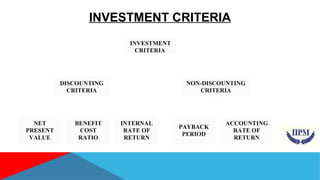
INVESTMENT CRITERIA 
INVESTMENT 
CRITERIA 
DISCOUNTING 
CRITERIA 
NON-DISCOUNTING 
CRITERIA 
NET 
PRESENT 
VALUE 
BENEFIT 
COST 
RATIO 
INTERNAL 
RATE OF 
RETURN 
PAYBACK 
PERIOD 
ACCOUNTING 
RATE OF 
RETURN
NET PRESENT VALUE 
n Ct 
NPV = å – Initial investment 
t=1 (1 + rt )t
NET PRESENT VALUE 
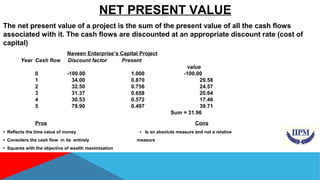
The net present value of a project is the sum of the present value of all the cash flows 
associated with it. The cash flows are discounted at an appropriate discount rate (cost of 
capital) 
Naveen Enterprise’s Capital Project 
Year Cash flow Discount factor Present 
value 
0 -100.00 1.000 -100.00 
1 34.00 0.870 29.58 
2 32.50 0.756 24.57 
3 31.37 0.658 20.64 
4 30.53 0.572 17.46 
5 79.90 0.497 39.71 
Sum = 31.96 
Pros Cons 
• Reflects the time value of money • Is an absolute measure and not a relative 
• Considers the cash flow in its entirely measure 
• Squares with the objective of wealth maximisation
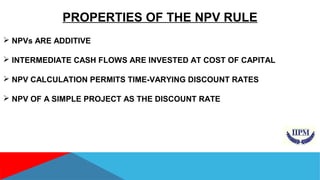
PROPERTIES OF THE NPV RULE 
 NPVs ARE ADDITIVE 
 INTERMEDIATE CASH FLOWS ARE INVESTED AT COST OF CAPITAL 
 NPV CALCULATION PERMITS TIME-VARYING DISCOUNT RATES 
 NPV OF A SIMPLE PROJECT AS THE DISCOUNT RATE
BENEFIT COST RATIO 
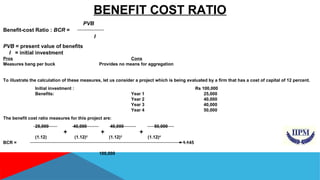
PVB 
Benefit-cost Ratio : BCR = 
I 
PVB = present value of benefits 
I = initial investment 
Pros Cons 
Measures bang per buck Provides no means for aggregation 
To illustrate the calculation of these measures, let us consider a project which is being evaluated by a firm that has a cost of capital of 12 percent. 
Initial investment : Rs 100,000 
Benefits: Year 1 25,000 
Year 2 40,000 
Year 3 40,000 
Year 4 50,000 
The benefit cost ratio measures for this project are: 
25,000 40,000 40,000 50,000 
+ + + 
(1.12) (1.12)2 (1.12)3 (1.12)4 
BCR = = 1.145 
100,000
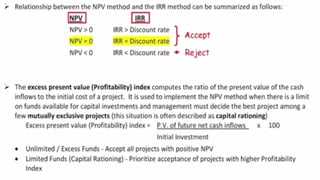
INTERNAL RATE OF RETURN 
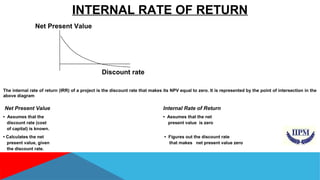
Discount rate 
Net Present Value 
The internal rate of return (IRR) of a project is the discount rate that makes its NPV equal to zero. It is represented by the point of intersection in the 
above diagram 
Net Present Value Internal Rate of Return 
• Assumes that the • Assumes that the net 
discount rate (cost present value is zero 
of capital) is known. 
• Calculates the net • Figures out the discount rate 
present value, given that makes net present value zero 
the discount rate.
CALCULATION OF IRR 
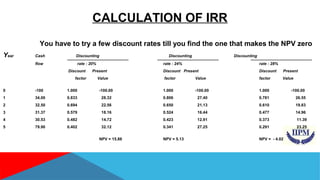
You have to try a few discount rates till you find the one that makes the NPV zero 
Year Cash Discounting Discounting Discounting 
flow rate : 20% rate : 24% rate : 28% 
Discount Present Discount Present Discount Present 
factor Value factor Value factor Value 
0 -100 1.000 -100.00 1.000 -100.00 1.000 -100.00 
1 34.00 0.833 28.32 0.806 27.40 0.781 26.55 
2 32.50 0.694 22.56 0.650 21.13 0.610 19.83 
3 31.37 0.579 18.16 0.524 16.44 0.477 14.96 
4 30.53 0.482 14.72 0.423 12.91 0.373 11.39 
5 79.90 0.402 32.12 0.341 27.25 0.291 23.25 
NPV = 15.88 NPV = 5.13 NPV = - 4.02
CALCULATION OF IRR 
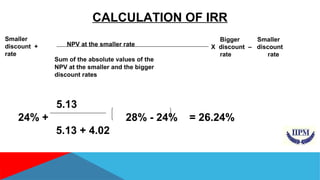
NPV at the smaller rate 
Sum of the absolute values of the 
NPV at the smaller and the bigger 
discount rates 
5.13 
24% + 28% - 24% = 26.24% 
5.13 + 4.02 
Bigger Smaller 
X discount – discount 
rate rate 
Smaller 
discount + 
rate
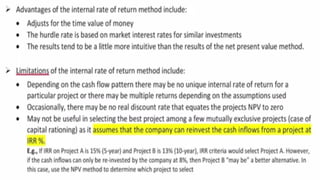
PROBLEMS WITH IRR 
 NON-CONVENTIONAL CASH FLOWS 
 MUTUALLY EXCLUSIVE PROJECTS 
 DIFFERENCES BETWEEN SHORT-TERM & LONG-TERM INTEREST RATES
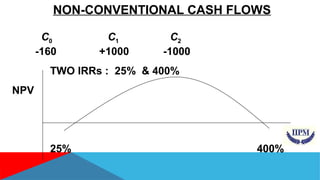
NON-CONVENTIONAL CASH FLOWS 
C0 C1 C2 
-160 +1000 -1000 
TWO IRRs : 25% & 400% 
NPV 
25% 400%
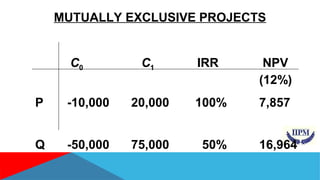
MUTUALLY EXCLUSIVE PROJECTS 
C0 C1 IRR NPV 
(12%) 
P -10,000 20,000 100% 7,857 
Q -50,000 75,000 50% 16,964
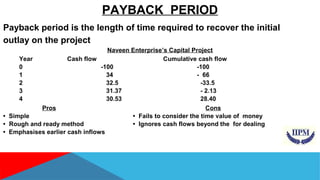
PAYBACK PERIOD 
Payback period is the length of time required to recover the initial 
outlay on the project 
Naveen Enterprise’s Capital Project 
Year Cash flow Cumulative cash flow 
0 -100 -100 
1 34 - 66 
2 32.5 -33.5 
3 31.37 - 2.13 
4 30.53 28.40 
Pros Cons 
• Simple • Fails to consider the time value of money 
• Rough and ready method • Ignores cash flows beyond the for dealing 
• Emphasises earlier cash inflows
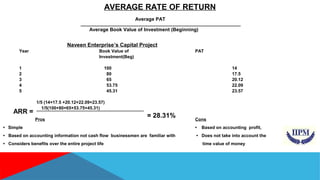
AVERAGE RATE OF RETURN 
Average PAT 
Average Book Value of Investment (Beginning) 
Naveen Enterprise’s Capital Project 
Year Book Value of PAT 
Investment(Beg) 
1 100 14 
2 80 17.5 
3 65 20.12 
4 53.75 22.09 
5 45.31 23.57 
1/5 (14+17.5 +20.12+22.09+23.57) 
1/5(100+80+65+53.75+45.31) 
Pros Cons 
ARR = = 28.31% 
• Simple • Based on accounting profit, 
• Based on accounting information not cash flow businessmen are familiar with • Does not take into account the 
• Considers benefits over the entire project life time value of money
INVESTMENT APPRAISAL IN PRACTICE 
 Over time, discounted cash flow methods have gained in importance and 
internal rate of return is the most popular evaluation method. 
 Firms typically use multiple evaluation methods. 
 Accounting rate of return and payback period are widely employed as 
supplementary evaluation methods.
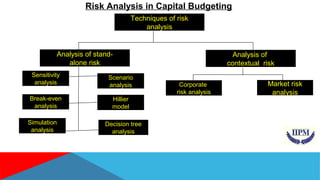
Risk Analysis in Capital Budgeting 
Techniques of risk 
analysis 
Analysis of stand-alone 
risk 
Analysis of 
contextual risk 
Sensitivity 
analysis 
Break-even 
analysis 
Simulation 
analysis 
Scenario 
analysis Corporate 
risk analysis 
Market risk 
analysis 
Hillier 
model 
Decision tree 
analysis
SOURCES AND PERSPECTIVE OF RISK 
Sources of Risk 
• Project-specific risk 
• Competitive risk 
• Industry-specific risk 
• Market risk 
• International risk 
Perspectives on Risk 
• Standalone risk 
• Firm risk 
• Market risk
MANAGING RISK 
 FIXED AND VARIABLE COST 
 PRICING STRATEGY 
 SEQUENTIAL INVESTMENT 
 FINANCIAL LEVERAGE 
 INSURANCE 
 LONG-TERM ARRANGEMENTS 
 STRATEGIC ALLIANCE
PROJECT SELECTION UNDER RISK 
 Judgmental Evaluation 
 Payback Period Requirement 
 Risk Adjusted Discount Rate 
 Certainty Equivalent Method
SUMMING UP 
n Ct 
• NPV = å – I 
t = 1 (1 + r)t 
PVB 
• BCR = 
I 
• IRR is the value of r in the following equation 
n Ct 
I = å 
t = 1 (1 + r)t 
•The payback period is the length of time required to recover the initial cash outlay on the 
project 
• The accounting rate is defined as: 
Average profit after tax 
Average book value of investment
THANK 
YOU

Capital Budgeting

  • 1.
  • 2.
    OUTLINE  Importance  Capital Budgeting Process  Project Classification  Investment Criteria  Net Present Value  Benefit Cost Ratio  Internal Rate of Return  Modified Internal Rate of Return  Payback Period  Accounting Rate of Return
  • 3.
    CAPITAL EXPENDITURES ANDTHEIR IMPORTANCE • The basic characteristics of a capital expenditure (also referred to as a capital investment or just project) is that it involves a current outlay (or current and future outlays) of funds in the receiving a stream of benefits in future • Importance stems from  Long-term consequences  Substantial outlays  Difficulty in reversing
  • 4.
    CAPITAL BUDGETING PROCESS  Identification of Potential Investment Opportunities  Assembling of Investment Proposals  Decision Making  Preparation of Capital Budget and Appropriations  Implementation  Performance Review
  • 5.
    PROJECT CLASSIFICATION Mandatory Investments  Replacement Projects  Expansion Projects  Diversification Projects  Research and Development Projects  Miscellaneous Projects
  • 6.
    INVESTMENT CRITERIA INVESTMENT CRITERIA DISCOUNTING CRITERIA NON-DISCOUNTING CRITERIA NET PRESENT VALUE BENEFIT COST RATIO INTERNAL RATE OF RETURN PAYBACK PERIOD ACCOUNTING RATE OF RETURN
  • 7.
    NET PRESENT VALUE n Ct NPV = å – Initial investment t=1 (1 + rt )t
  • 8.
    NET PRESENT VALUE The net present value of a project is the sum of the present value of all the cash flows associated with it. The cash flows are discounted at an appropriate discount rate (cost of capital) Naveen Enterprise’s Capital Project Year Cash flow Discount factor Present value 0 -100.00 1.000 -100.00 1 34.00 0.870 29.58 2 32.50 0.756 24.57 3 31.37 0.658 20.64 4 30.53 0.572 17.46 5 79.90 0.497 39.71 Sum = 31.96 Pros Cons • Reflects the time value of money • Is an absolute measure and not a relative • Considers the cash flow in its entirely measure • Squares with the objective of wealth maximisation
  • 9.
    PROPERTIES OF THENPV RULE  NPVs ARE ADDITIVE  INTERMEDIATE CASH FLOWS ARE INVESTED AT COST OF CAPITAL  NPV CALCULATION PERMITS TIME-VARYING DISCOUNT RATES  NPV OF A SIMPLE PROJECT AS THE DISCOUNT RATE
  • 10.
    BENEFIT COST RATIO PVB Benefit-cost Ratio : BCR = I PVB = present value of benefits I = initial investment Pros Cons Measures bang per buck Provides no means for aggregation To illustrate the calculation of these measures, let us consider a project which is being evaluated by a firm that has a cost of capital of 12 percent. Initial investment : Rs 100,000 Benefits: Year 1 25,000 Year 2 40,000 Year 3 40,000 Year 4 50,000 The benefit cost ratio measures for this project are: 25,000 40,000 40,000 50,000 + + + (1.12) (1.12)2 (1.12)3 (1.12)4 BCR = = 1.145 100,000
  • 11.
    INTERNAL RATE OFRETURN Discount rate Net Present Value The internal rate of return (IRR) of a project is the discount rate that makes its NPV equal to zero. It is represented by the point of intersection in the above diagram Net Present Value Internal Rate of Return • Assumes that the • Assumes that the net discount rate (cost present value is zero of capital) is known. • Calculates the net • Figures out the discount rate present value, given that makes net present value zero the discount rate.
  • 12.
    CALCULATION OF IRR You have to try a few discount rates till you find the one that makes the NPV zero Year Cash Discounting Discounting Discounting flow rate : 20% rate : 24% rate : 28% Discount Present Discount Present Discount Present factor Value factor Value factor Value 0 -100 1.000 -100.00 1.000 -100.00 1.000 -100.00 1 34.00 0.833 28.32 0.806 27.40 0.781 26.55 2 32.50 0.694 22.56 0.650 21.13 0.610 19.83 3 31.37 0.579 18.16 0.524 16.44 0.477 14.96 4 30.53 0.482 14.72 0.423 12.91 0.373 11.39 5 79.90 0.402 32.12 0.341 27.25 0.291 23.25 NPV = 15.88 NPV = 5.13 NPV = - 4.02
  • 13.
    CALCULATION OF IRR NPV at the smaller rate Sum of the absolute values of the NPV at the smaller and the bigger discount rates 5.13 24% + 28% - 24% = 26.24% 5.13 + 4.02 Bigger Smaller X discount – discount rate rate Smaller discount + rate
  • 14.
    PROBLEMS WITH IRR  NON-CONVENTIONAL CASH FLOWS  MUTUALLY EXCLUSIVE PROJECTS  DIFFERENCES BETWEEN SHORT-TERM & LONG-TERM INTEREST RATES
  • 15.
    NON-CONVENTIONAL CASH FLOWS C0 C1 C2 -160 +1000 -1000 TWO IRRs : 25% & 400% NPV 25% 400%
  • 16.
    MUTUALLY EXCLUSIVE PROJECTS C0 C1 IRR NPV (12%) P -10,000 20,000 100% 7,857 Q -50,000 75,000 50% 16,964
  • 17.
    PAYBACK PERIOD Paybackperiod is the length of time required to recover the initial outlay on the project Naveen Enterprise’s Capital Project Year Cash flow Cumulative cash flow 0 -100 -100 1 34 - 66 2 32.5 -33.5 3 31.37 - 2.13 4 30.53 28.40 Pros Cons • Simple • Fails to consider the time value of money • Rough and ready method • Ignores cash flows beyond the for dealing • Emphasises earlier cash inflows
  • 18.
    AVERAGE RATE OFRETURN Average PAT Average Book Value of Investment (Beginning) Naveen Enterprise’s Capital Project Year Book Value of PAT Investment(Beg) 1 100 14 2 80 17.5 3 65 20.12 4 53.75 22.09 5 45.31 23.57 1/5 (14+17.5 +20.12+22.09+23.57) 1/5(100+80+65+53.75+45.31) Pros Cons ARR = = 28.31% • Simple • Based on accounting profit, • Based on accounting information not cash flow businessmen are familiar with • Does not take into account the • Considers benefits over the entire project life time value of money
  • 19.
    INVESTMENT APPRAISAL INPRACTICE  Over time, discounted cash flow methods have gained in importance and internal rate of return is the most popular evaluation method.  Firms typically use multiple evaluation methods.  Accounting rate of return and payback period are widely employed as supplementary evaluation methods.
  • 20.
    Risk Analysis inCapital Budgeting Techniques of risk analysis Analysis of stand-alone risk Analysis of contextual risk Sensitivity analysis Break-even analysis Simulation analysis Scenario analysis Corporate risk analysis Market risk analysis Hillier model Decision tree analysis
  • 21.
    SOURCES AND PERSPECTIVEOF RISK Sources of Risk • Project-specific risk • Competitive risk • Industry-specific risk • Market risk • International risk Perspectives on Risk • Standalone risk • Firm risk • Market risk
  • 22.
    MANAGING RISK FIXED AND VARIABLE COST  PRICING STRATEGY  SEQUENTIAL INVESTMENT  FINANCIAL LEVERAGE  INSURANCE  LONG-TERM ARRANGEMENTS  STRATEGIC ALLIANCE
  • 23.
    PROJECT SELECTION UNDERRISK  Judgmental Evaluation  Payback Period Requirement  Risk Adjusted Discount Rate  Certainty Equivalent Method
  • 24.
    SUMMING UP nCt • NPV = å – I t = 1 (1 + r)t PVB • BCR = I • IRR is the value of r in the following equation n Ct I = å t = 1 (1 + r)t •The payback period is the length of time required to recover the initial cash outlay on the project • The accounting rate is defined as: Average profit after tax Average book value of investment
  • 33.