Chapter 13Chapter 13
Exchange Rates and the Foreign Exchange Market:Exchange Rates and the Foreign Exchange Market:
An Asset ApproachAn Asset Approach
Prepared by Iordanis Petsas
To Accompany
International Economics: Theory and PolicyInternational Economics: Theory and Policy, Sixth Edition
by Paul R. Krugman and Maurice Obstfeld
 Introduction
 Exchange Rates and International Transactions
 The Foreign Exchange Market
 The Demand for Foreign Currency Assets
 Equilibrium in the Foreign Exchange Market
 Interest Rates, Expectations, and Equilibrium
 Summary
Chapter Organization
Introduction
 Exchange rates are important because they enable us
to translate different counties’ prices into comparable
terms.
 Exchange rates are determined in the same way as
other asset prices.
 The general goal of this chapter is to show:
• How exchange rates are determined
• The role of exchange rates in international trade
Exchange Rates and
International Transactions
 An exchange rate can be quoted in two ways:
• Direct
– The price of the foreign currency in terms of dollars
• Indirect
– The price of dollars in terms of the foreign currency
Exchange Rates and
International Transactions
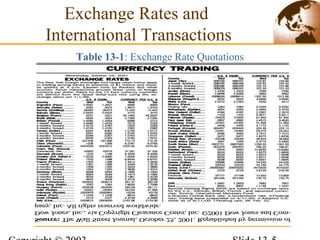
Table 13-1: Exchange Rate Quotations
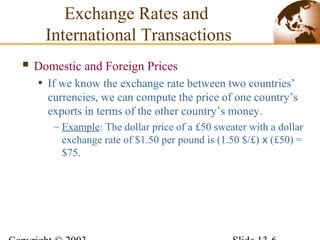
 Domestic and Foreign Prices
• If we know the exchange rate between two countries’
currencies, we can compute the price of one country’s
exports in terms of the other country’s money.
– Example: The dollar price of a £50 sweater with a dollar
exchange rate of $1.50 per pound is (1.50 $/£) x (£50) =
$75.
Exchange Rates and
International Transactions
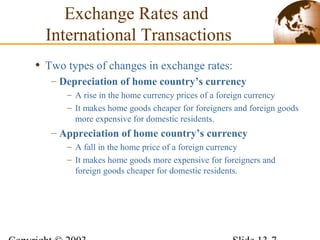
• Two types of changes in exchange rates:
– Depreciation of home country’s currency
– A rise in the home currency prices of a foreign currency
– It makes home goods cheaper for foreigners and foreign goods
more expensive for domestic residents.
– Appreciation of home country’s currency
– A fall in the home price of a foreign currency
– It makes home goods more expensive for foreigners and
foreign goods cheaper for domestic residents.
Exchange Rates and
International Transactions
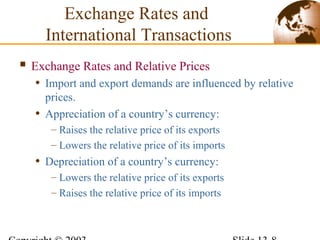
 Exchange Rates and Relative Prices
• Import and export demands are influenced by relative
prices.
• Appreciation of a country’s currency:
– Raises the relative price of its exports
– Lowers the relative price of its imports
• Depreciation of a country’s currency:
– Lowers the relative price of its exports
– Raises the relative price of its imports
Exchange Rates and
International Transactions
Exchange Rates and
International Transactions
Table 13-2: $/£ Exchange Rates and the Relative Price of American
Designer Jeans and British Sweaters
The Foreign Exchange Market
 Exchange rates are determined in the foreign
exchange market.
• The market in which international currency trades take
place
 The Actors
• The major participants in the foreign exchange market
are:
– Commercial banks
– International corporations
– Nonbank financial institutions
– Central banks
• Interbank trading
– Foreign currency trading among banks
– It accounts for most of the activity in the foreign
exchange market.
Exchange Rates and
International Transactions
 Characteristics of the Market
• The worldwide volume of foreign exchange trading is
enormous, and it has ballooned in recent years.
• New technologies, such as Internet links, are used
among the major foreign exchange trading centers
(London, New York, Tokyo, Frankfurt, and
Singapore).
• The integration of financial centers implies that there
can be no significant arbitrage.
– The process of buying a currency cheap and selling it
dear.
Exchange Rates and
International Transactions
• Vehicle currency
– A currency that is widely used to denominate
international contracts made by parties who do not
reside in the country that issues the vehicle currency.
– Example: In 2001, around 90% of transactions between banks
involved exchanges of foreign currencies for U.S. dollars.
Exchange Rates and
International Transactions
 Spot Rates and Forward Rates
• Spot exchange rates
– Apply to exchange currencies “on the spot”
• Forward exchange rates
– Apply to exchange currencies on some future date at a
prenegotiated exchange rate
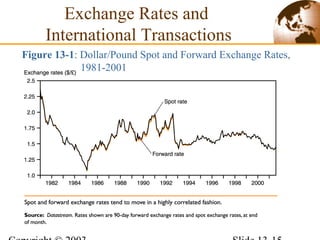
• Forward and spot exchange rates, while not
necessarily equal, do move closely together.
Exchange Rates and
International Transactions
Figure 13-1: Dollar/Pound Spot and Forward Exchange Rates,
1981-2001
Exchange Rates and
International Transactions
 Foreign Exchange Swaps
• Spot sales of a currency combined with a forward
repurchase of the currency.
• They make up a significant proportion of all foreign
exchange trading.
Exchange Rates and
International Transactions
 Futures and Options
• Futures contract
– The buyer buys a promise that a specified amount of
foreign currency will be delivered on a specified date in
the future.
• Foreign exchange option
– The owner has the right to buy or sell a specified
amount of foreign currency at a specified price at any
time up to a specified expiration date.
Exchange Rates and
International Transactions
 The demand for a foreign currency bank deposit is
influenced by the same considerations that influence
the demand for any other asset.
 Assets and Asset Returns
• Defining Asset Returns
– The percentage increase in value an asset offers over
some time period.
• The Real Rate of Return
– The rate of return computed by measuring asset values
in terms of some broad representative basket of
products that savers regularly purchase.
The Demand for
Foreign Currency Assets
 Risk and Liquidity
• Savers care about two main characteristics of an asset
other than its return:
– Risk
– The variability it contributes to savers’ wealth
– Liquidity
– The ease with which it can be sold or exchanged for goods
The Demand for
Foreign Currency Assets
 Interest Rates
• Market participants need two pieces of information in
order to compare returns on different deposits:
– How the money values of the deposits will change
– How exchange rates will change
• A currency’s interest rate is the amount of that
currency an individual can earn by lending a unit of
the currency for a year.
– Example: At a dollar interest rate of 10% per year, the
lender of $1 receives $1.10 at the end of the year.
The Demand for
Foreign Currency Assets
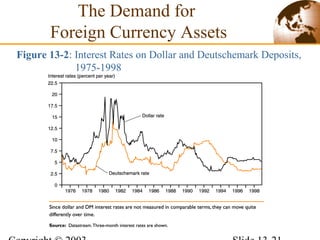
Figure 13-2: Interest Rates on Dollar and Deutschemark Deposits,
1975-1998
The Demand for
Foreign Currency Assets
 Exchange Rates and Asset Returns
• The returns on deposits traded in the foreign exchange
market depend on interest rates and expected exchange
rate changes.
• In order to decide whether to buy a euro or a dollar
deposit, one must calculate the dollar return on a euro
deposit.
The Demand for
Foreign Currency Assets
 A Simple Rule
• The dollar rate of return on euro deposits is
approximately the euro interest rate plus the rate of
depreciation of the dollar against the euro.
– The rate of depreciation of the dollar against the euro is
the percentage increase in the dollar/euro exchange rate
over a year.
The Demand for
Foreign Currency Assets
• The expected rate of return difference between dollar
and euro deposits is:
R$ - [R€ + (Ee
$/€ - E$/€ )/E$/€ ]= R$ - R€ - (Ee
$/€ -E$/€ )/E$/€ (13-1)
where:
R$ = interest rate on one-year dollar deposits
R€ = today’s interest rate on one-year euro deposits
E$/€ = today’s dollar/euro exchange rate (number of
dollars per euro)
Ee
$/€ = dollar/euro exchange rate (number of dollars per
euro) expected to prevail a year from today
The Demand for
Foreign Currency Assets
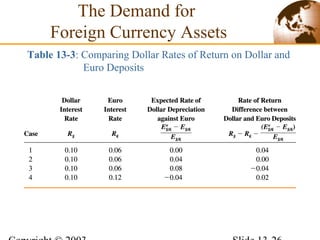
• When the difference in Equation (13-1) is positive,
dollar deposits yield the higher expected rate of return.
When it is negative, euro deposits yield the higher
expected rate of return.
The Demand for
Foreign Currency Assets
Table 13-3: Comparing Dollar Rates of Return on Dollar and
Euro Deposits
The Demand for
Foreign Currency Assets
 Return, Risk, and Liquidity in the Foreign Exchange
Market
• The demand for foreign currency assets depends not
only on returns but on risk and liquidity.
– There is no consensus among economists about the
importance of risk in the foreign exchange market.
– Most of the market participants that are influenced by
liquidity factors are involved in international trade.
– Payments connected with international trade make up a very
small fraction of total foreign exchange transactions.
• Therefore, we ignore the risk and liquidity motives for
holding foreign currencies.
The Demand for
Foreign Currency Assets
Equilibrium in the
Foreign Exchange Market
 Interest Parity: The Basic Equilibrium Condition
• The foreign exchange market is in equilibrium when
deposits of all currencies offer the same expected rate
of return.
• Interest parity condition
– The expected returns on deposits of any two currencies
are equal when measured in the same currency.
– It implies that potential holders of foreign currency
deposits view them all as equally desirable assets.
– The expected rates of return are equal when:
R$ = R€ + (Ee
$/€- E$/€)/E$/€ (13-2)
 How Changes in the Current Exchange Rate Affect
Expected Returns
• Depreciation of a country’s currency today lowers the
expected domestic currency return on foreign currency
deposits.
• Appreciation of the domestic currency today raises the
domestic currency return expected of foreign currency
deposits.
Equilibrium in the
Foreign Exchange Market
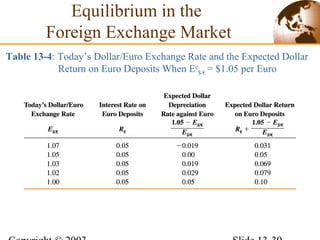
Table 13-4: Today’s Dollar/Euro Exchange Rate and the Expected Dollar
Return on Euro Deposits When Ee
$/€ = $1.05 per Euro
Equilibrium in the
Foreign Exchange Market
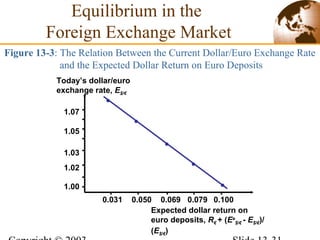
Figure 13-3: The Relation Between the Current Dollar/Euro Exchange Rate
and the Expected Dollar Return on Euro Deposits
Expected dollar return on
euro deposits, R€ + (Ee
$/€ - E$/€)/
(E$/€)
Today’s dollar/euro
exchange rate, E$/€
1.02
1.03
1.05
1.07
0.031 0.050 0.069 0.079 0.100
1.00
Equilibrium in the
Foreign Exchange Market
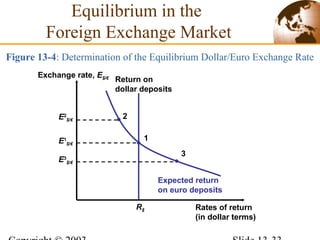
 The Equilibrium Exchange Rate
• Exchange rates always adjust to maintain interest
parity.
• Assume that the dollar interest rate R$, the euro interest
rate R€, and the expected future dollar/euro exchange
rate Ee
$/€, are all given.
Equilibrium in the
Foreign Exchange Market
R$
Return on
dollar deposits
Figure 13-4: Determination of the Equilibrium Dollar/Euro Exchange Rate
Rates of return
(in dollar terms)
Exchange rate, E$/€
E2
$/€
2
1E1
$/€
E3
$/€
3
Expected return
on euro deposits
Equilibrium in the
Foreign Exchange Market
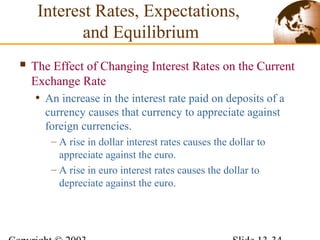
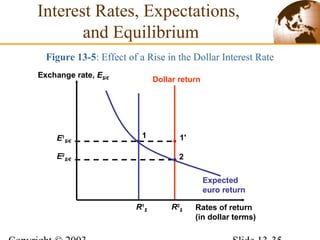
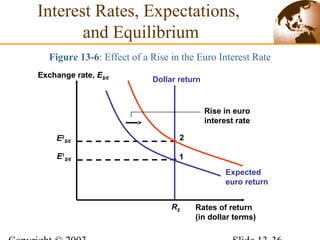
 The Effect of Changing Interest Rates on the Current
Exchange Rate
• An increase in the interest rate paid on deposits of a
currency causes that currency to appreciate against
foreign currencies.
– A rise in dollar interest rates causes the dollar to
appreciate against the euro.
– A rise in euro interest rates causes the dollar to
depreciate against the euro.
Interest Rates, Expectations,
and Equilibrium
Dollar return
R2
$R1
$
Figure 13-5: Effect of a Rise in the Dollar Interest Rate
Rates of return
(in dollar terms)
Exchange rate, E$/€
2E2
$/€
1'1E1
$/€
Expected
euro return
Interest Rates, Expectations,
and Equilibrium
Dollar return
R$
Figure 13-6: Effect of a Rise in the Euro Interest Rate
Rates of return
(in dollar terms)
Exchange rate, E$/€
1E1
$/€
2E2
$/€
Rise in euro
interest rate
Expected
euro return
Interest Rates, Expectations,
and Equilibrium
 The Effect of Changing Expectations on the Current
Exchange Rate
• A rise in the expected future exchange rate causes a
rise in the current exchange rate.
• A fall in the expected future exchange rate causes a
fall in the current exchange rate.
Interest Rates, Expectations,
and Equilibrium
Summary
 Exchange rates play a role in spending decisions
because they enable us to translate different
countries’ prices into comparable terms.
 A depreciation (appreciation) of a country’s currency
against foreign currencies makes its exports cheaper
(more expensive) and its imports more expensive
(cheaper).
 Exchange rates are determined in the foreign
exchange market.
Summary
 An important category of foreign exchange trading is
forward trading.
 The exchange rate is most appropriately thought of as
being an asset price itself.
 The returns on deposits traded in the foreign
exchange market depend on interest rates and
expected exchange rate changes.
Summary
 Equilibrium in the foreign exchange market requires
interest parity.
• For given interest rates and a given expectation of the
future exchange rate, the interest parity condition tells
us the current equilibrium exchange rate.
 A rise in dollar (euro) interest rates causes the dollar
to appreciate (depreciate) against the euro.
 Today’s exchange rate is altered by changes in its
expected future level.

International economic ch13

  • 1.
    Chapter 13Chapter 13 ExchangeRates and the Foreign Exchange Market:Exchange Rates and the Foreign Exchange Market: An Asset ApproachAn Asset Approach Prepared by Iordanis Petsas To Accompany International Economics: Theory and PolicyInternational Economics: Theory and Policy, Sixth Edition by Paul R. Krugman and Maurice Obstfeld
  • 2.
     Introduction  ExchangeRates and International Transactions  The Foreign Exchange Market  The Demand for Foreign Currency Assets  Equilibrium in the Foreign Exchange Market  Interest Rates, Expectations, and Equilibrium  Summary Chapter Organization
  • 3.
    Introduction  Exchange ratesare important because they enable us to translate different counties’ prices into comparable terms.  Exchange rates are determined in the same way as other asset prices.  The general goal of this chapter is to show: • How exchange rates are determined • The role of exchange rates in international trade
  • 4.
    Exchange Rates and InternationalTransactions  An exchange rate can be quoted in two ways: • Direct – The price of the foreign currency in terms of dollars • Indirect – The price of dollars in terms of the foreign currency
  • 5.
    Exchange Rates and InternationalTransactions Table 13-1: Exchange Rate Quotations
  • 6.
     Domestic andForeign Prices • If we know the exchange rate between two countries’ currencies, we can compute the price of one country’s exports in terms of the other country’s money. – Example: The dollar price of a £50 sweater with a dollar exchange rate of $1.50 per pound is (1.50 $/£) x (£50) = $75. Exchange Rates and International Transactions
  • 7.
    • Two typesof changes in exchange rates: – Depreciation of home country’s currency – A rise in the home currency prices of a foreign currency – It makes home goods cheaper for foreigners and foreign goods more expensive for domestic residents. – Appreciation of home country’s currency – A fall in the home price of a foreign currency – It makes home goods more expensive for foreigners and foreign goods cheaper for domestic residents. Exchange Rates and International Transactions
  • 8.
     Exchange Ratesand Relative Prices • Import and export demands are influenced by relative prices. • Appreciation of a country’s currency: – Raises the relative price of its exports – Lowers the relative price of its imports • Depreciation of a country’s currency: – Lowers the relative price of its exports – Raises the relative price of its imports Exchange Rates and International Transactions
  • 9.
    Exchange Rates and InternationalTransactions Table 13-2: $/£ Exchange Rates and the Relative Price of American Designer Jeans and British Sweaters
  • 10.
    The Foreign ExchangeMarket  Exchange rates are determined in the foreign exchange market. • The market in which international currency trades take place  The Actors • The major participants in the foreign exchange market are: – Commercial banks – International corporations – Nonbank financial institutions – Central banks
  • 11.
    • Interbank trading –Foreign currency trading among banks – It accounts for most of the activity in the foreign exchange market. Exchange Rates and International Transactions
  • 12.
     Characteristics ofthe Market • The worldwide volume of foreign exchange trading is enormous, and it has ballooned in recent years. • New technologies, such as Internet links, are used among the major foreign exchange trading centers (London, New York, Tokyo, Frankfurt, and Singapore). • The integration of financial centers implies that there can be no significant arbitrage. – The process of buying a currency cheap and selling it dear. Exchange Rates and International Transactions
  • 13.
    • Vehicle currency –A currency that is widely used to denominate international contracts made by parties who do not reside in the country that issues the vehicle currency. – Example: In 2001, around 90% of transactions between banks involved exchanges of foreign currencies for U.S. dollars. Exchange Rates and International Transactions
  • 14.
     Spot Ratesand Forward Rates • Spot exchange rates – Apply to exchange currencies “on the spot” • Forward exchange rates – Apply to exchange currencies on some future date at a prenegotiated exchange rate • Forward and spot exchange rates, while not necessarily equal, do move closely together. Exchange Rates and International Transactions
  • 15.
    Figure 13-1: Dollar/PoundSpot and Forward Exchange Rates, 1981-2001 Exchange Rates and International Transactions
  • 16.
     Foreign ExchangeSwaps • Spot sales of a currency combined with a forward repurchase of the currency. • They make up a significant proportion of all foreign exchange trading. Exchange Rates and International Transactions
  • 17.
     Futures andOptions • Futures contract – The buyer buys a promise that a specified amount of foreign currency will be delivered on a specified date in the future. • Foreign exchange option – The owner has the right to buy or sell a specified amount of foreign currency at a specified price at any time up to a specified expiration date. Exchange Rates and International Transactions
  • 18.
     The demandfor a foreign currency bank deposit is influenced by the same considerations that influence the demand for any other asset.  Assets and Asset Returns • Defining Asset Returns – The percentage increase in value an asset offers over some time period. • The Real Rate of Return – The rate of return computed by measuring asset values in terms of some broad representative basket of products that savers regularly purchase. The Demand for Foreign Currency Assets
  • 19.
     Risk andLiquidity • Savers care about two main characteristics of an asset other than its return: – Risk – The variability it contributes to savers’ wealth – Liquidity – The ease with which it can be sold or exchanged for goods The Demand for Foreign Currency Assets
  • 20.
     Interest Rates •Market participants need two pieces of information in order to compare returns on different deposits: – How the money values of the deposits will change – How exchange rates will change • A currency’s interest rate is the amount of that currency an individual can earn by lending a unit of the currency for a year. – Example: At a dollar interest rate of 10% per year, the lender of $1 receives $1.10 at the end of the year. The Demand for Foreign Currency Assets
  • 21.
    Figure 13-2: InterestRates on Dollar and Deutschemark Deposits, 1975-1998 The Demand for Foreign Currency Assets
  • 22.
     Exchange Ratesand Asset Returns • The returns on deposits traded in the foreign exchange market depend on interest rates and expected exchange rate changes. • In order to decide whether to buy a euro or a dollar deposit, one must calculate the dollar return on a euro deposit. The Demand for Foreign Currency Assets
  • 23.
     A SimpleRule • The dollar rate of return on euro deposits is approximately the euro interest rate plus the rate of depreciation of the dollar against the euro. – The rate of depreciation of the dollar against the euro is the percentage increase in the dollar/euro exchange rate over a year. The Demand for Foreign Currency Assets
  • 24.
    • The expectedrate of return difference between dollar and euro deposits is: R$ - [R€ + (Ee $/€ - E$/€ )/E$/€ ]= R$ - R€ - (Ee $/€ -E$/€ )/E$/€ (13-1) where: R$ = interest rate on one-year dollar deposits R€ = today’s interest rate on one-year euro deposits E$/€ = today’s dollar/euro exchange rate (number of dollars per euro) Ee $/€ = dollar/euro exchange rate (number of dollars per euro) expected to prevail a year from today The Demand for Foreign Currency Assets
  • 25.
    • When thedifference in Equation (13-1) is positive, dollar deposits yield the higher expected rate of return. When it is negative, euro deposits yield the higher expected rate of return. The Demand for Foreign Currency Assets
  • 26.
    Table 13-3: ComparingDollar Rates of Return on Dollar and Euro Deposits The Demand for Foreign Currency Assets
  • 27.
     Return, Risk,and Liquidity in the Foreign Exchange Market • The demand for foreign currency assets depends not only on returns but on risk and liquidity. – There is no consensus among economists about the importance of risk in the foreign exchange market. – Most of the market participants that are influenced by liquidity factors are involved in international trade. – Payments connected with international trade make up a very small fraction of total foreign exchange transactions. • Therefore, we ignore the risk and liquidity motives for holding foreign currencies. The Demand for Foreign Currency Assets
  • 28.
    Equilibrium in the ForeignExchange Market  Interest Parity: The Basic Equilibrium Condition • The foreign exchange market is in equilibrium when deposits of all currencies offer the same expected rate of return. • Interest parity condition – The expected returns on deposits of any two currencies are equal when measured in the same currency. – It implies that potential holders of foreign currency deposits view them all as equally desirable assets. – The expected rates of return are equal when: R$ = R€ + (Ee $/€- E$/€)/E$/€ (13-2)
  • 29.
     How Changesin the Current Exchange Rate Affect Expected Returns • Depreciation of a country’s currency today lowers the expected domestic currency return on foreign currency deposits. • Appreciation of the domestic currency today raises the domestic currency return expected of foreign currency deposits. Equilibrium in the Foreign Exchange Market
  • 30.
    Table 13-4: Today’sDollar/Euro Exchange Rate and the Expected Dollar Return on Euro Deposits When Ee $/€ = $1.05 per Euro Equilibrium in the Foreign Exchange Market
  • 31.
    Figure 13-3: TheRelation Between the Current Dollar/Euro Exchange Rate and the Expected Dollar Return on Euro Deposits Expected dollar return on euro deposits, R€ + (Ee $/€ - E$/€)/ (E$/€) Today’s dollar/euro exchange rate, E$/€ 1.02 1.03 1.05 1.07 0.031 0.050 0.069 0.079 0.100 1.00 Equilibrium in the Foreign Exchange Market
  • 32.
     The EquilibriumExchange Rate • Exchange rates always adjust to maintain interest parity. • Assume that the dollar interest rate R$, the euro interest rate R€, and the expected future dollar/euro exchange rate Ee $/€, are all given. Equilibrium in the Foreign Exchange Market
  • 33.
    R$ Return on dollar deposits Figure13-4: Determination of the Equilibrium Dollar/Euro Exchange Rate Rates of return (in dollar terms) Exchange rate, E$/€ E2 $/€ 2 1E1 $/€ E3 $/€ 3 Expected return on euro deposits Equilibrium in the Foreign Exchange Market
  • 34.
     The Effectof Changing Interest Rates on the Current Exchange Rate • An increase in the interest rate paid on deposits of a currency causes that currency to appreciate against foreign currencies. – A rise in dollar interest rates causes the dollar to appreciate against the euro. – A rise in euro interest rates causes the dollar to depreciate against the euro. Interest Rates, Expectations, and Equilibrium
  • 35.
    Dollar return R2 $R1 $ Figure 13-5:Effect of a Rise in the Dollar Interest Rate Rates of return (in dollar terms) Exchange rate, E$/€ 2E2 $/€ 1'1E1 $/€ Expected euro return Interest Rates, Expectations, and Equilibrium
  • 36.
    Dollar return R$ Figure 13-6:Effect of a Rise in the Euro Interest Rate Rates of return (in dollar terms) Exchange rate, E$/€ 1E1 $/€ 2E2 $/€ Rise in euro interest rate Expected euro return Interest Rates, Expectations, and Equilibrium
  • 37.
     The Effectof Changing Expectations on the Current Exchange Rate • A rise in the expected future exchange rate causes a rise in the current exchange rate. • A fall in the expected future exchange rate causes a fall in the current exchange rate. Interest Rates, Expectations, and Equilibrium
  • 38.
    Summary  Exchange ratesplay a role in spending decisions because they enable us to translate different countries’ prices into comparable terms.  A depreciation (appreciation) of a country’s currency against foreign currencies makes its exports cheaper (more expensive) and its imports more expensive (cheaper).  Exchange rates are determined in the foreign exchange market.
  • 39.
    Summary  An importantcategory of foreign exchange trading is forward trading.  The exchange rate is most appropriately thought of as being an asset price itself.  The returns on deposits traded in the foreign exchange market depend on interest rates and expected exchange rate changes.
  • 40.
    Summary  Equilibrium inthe foreign exchange market requires interest parity. • For given interest rates and a given expectation of the future exchange rate, the interest parity condition tells us the current equilibrium exchange rate.  A rise in dollar (euro) interest rates causes the dollar to appreciate (depreciate) against the euro.  Today’s exchange rate is altered by changes in its expected future level.