Aakash Singh
Enrollment No. : 150410119112
Mechanical -2 – C
Sardar Vallabhbhai Patel Institute of
Technology, Vasad
Content :
 Inequality Of Clausius
 Entropy Change For Open System
 Reversible & Irreversible Processes
History
 The Clausius Theorem is a mathematical
explanation of the Second Law of
Thermodynamics.
 Also referred to as the “Inequality of Clausius”, the
theorem was developed by Rudolf Clausius who
intended to explain the relationship between the
heat flow in a system and the entropy of the
system and its surroundings.
 The Clausius Theorem was first published in 1862
in Clausius’ sixth memoir, “On the Application of
the Theorem of the Equivalence of
Transformations to Interior Work”.
1
Inequality of Clausius
 “ When a system undergoes a complete cyclic process, the
integral of around the cycle is less than zero.”
 Mathematically : ( ) ≤ 0
 δQ is energy flow into the system due to heating
and T being absolute temperature of the body when that
energy is absorbed.
 The following equation must be found true for any cyclical
process that is possible, reversible or not.
2
Proof
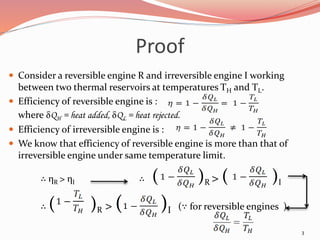
 Consider a reversible engine R and irreversible engine I working
between two thermal reservoirs at temperatures TH and TL.
 Efficiency of reversible engine is :
where QH = heat added, QL = heat rejected.
 Efficiency of irreversible engine is :
 We know that efficiency of reversible engine is more than that of
irreversible engine under same temperature limit.
∴ ηR > ηI ∴ ( )R > ( )I
∴ ( )R > ( )I (∵ for reversible engines )
3
Proof
 ∴ ( ) < ( )I
 ∴ ( )I < ( )I
 ∴ ( )I - ( )I < 0
 We know that, heat added ( Q H ) should be positive and heat rejected
( Q L ) should be negative.
 ∴ ( )I - (- )I < 0
4
Proof
 ∴ ( )I + ( )I < 0
 Considering complete original irreversible cycle :
 ∴
 ∴ ∮ ( ) < 0 for an irreversible cycle.
 According to Clausius Theorem ∮ = 0 for reversible cycle.
 Combining results for reversible and irreversible cycle, we get :
This expression is known as
Clausius Inequality.
5
10
11
Entropy Change For Open System
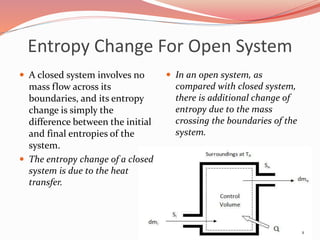
 A closed system involves no
mass flow across its
boundaries, and its entropy
change is simply the
difference between the initial
and final entropies of the
system.
 The entropy change of a closed
system is due to the heat
transfer.
 In an open system, as
compared with closed system,
there is additional change of
entropy due to the mass
crossing the boundaries of the
system.
1
Entropy Change For Open System
 The general entropy balance
equation is :
[Rate of change of C.V.] = [Rate
of entropy transfer with heat] +
[Rate of entropy transport with
mass]
 To = temperature of
surroundings
Si = specific entropy of the inlet
So = specific entropy of the
outlet
dmi = mass entering the system
dmo = mass leaving the system
2
Entropy Change For Open System
 The small change of entropy of the system during a small interval is
given by :
For reversible process
 In above equation, entropy flow into the system is considered positive
and entropy out-flow is considered negative.
 This equation is applicable to reversible process in which the heat
interactions and mass transport to and from the system is accomplished
reversibly.
3
Entropy Change For Open System
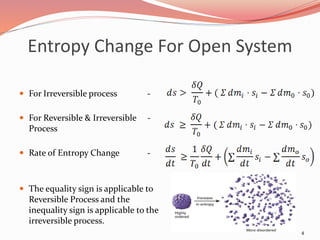
 For Irreversible process -
 For Reversible & Irreversible -
Process
 Rate of Entropy Change -
 The equality sign is applicable to
Reversible Process and the
inequality sign is applicable to the
irreversible process.
4
Entropy Change For Open System
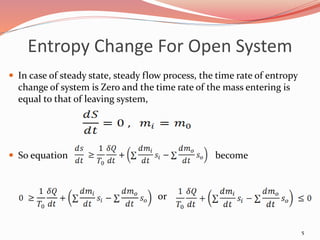
 In case of steady state, steady flow process, the time rate of entropy
change of system is Zero and the time rate of the mass entering is
equal to that of leaving system,
 So equation become
or
5
Entropy Change For Open System
 For Adiabatic Steady Flow Process,
 If the process is Reversible Adiabatic steady flow ,
then
6
7
Reversible Process
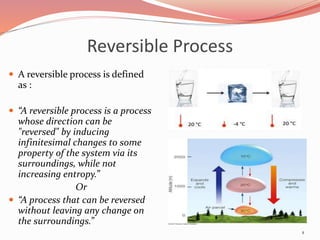
 A reversible process is defined
as :
 “A reversible process is a process
whose direction can be
"reversed" by inducing
infinitesimal changes to some
property of the system via its
surroundings, while not
increasing entropy.”
Or
 “A process that can be reversed
without leaving any change on
the surroundings.”
1
Reversible Process
 A reversible process passes through a
continuous series of equilibrium
states.
 It can be stopped at any stage and
reversed so that the system and
surroundings are exactly restored to
their initial states.
 Consider the system in fig. The process
take place from state 1 to state 2 by
following path 1-2.
 If process is reversed, path 2-1 will be
followed and system will reach its
initial state. So the process 1-2 is called
Reversible Process.
2
Reversible Process
 Consider expansion of a gas as shown in figure.
 The expansion of the gas takes place by removing infinitesimal weights
slowly from the piston one by one, therefore process passes through
equilibrium states and tending to reversible process.
 The gas can be brought back by compression after putting weights on
the piston.
3
Reversible Process
 Some of the processes that can be
idealized as reversible process are :
 Frictionless relative motion
 Expansion and compression of spring
 Frictionless adiabatic expansion or
compression of fluid
 Isothermal Expansion or compression
 Elastic stretching of a solid
 Electrolysis process
 A reversible process produces the
maximum work in engines and
requires minimum work in devices
such as heat pumps
4
5
Irreversible Process
 “A process that is not reversible is
called an Irreversible Process.”
 In irreversible process, system
passes through a series of non-
equilibrium states.
 It is difficult to locate properties
on property diagram as they don’t
have a unique value.
 When irreversible process is
made to proceed in backward
direction, it does not reach its
original state.
 The system reaches a new state.
 Irreversible processes are usually
represented by dotted lines. 1
Irreversible Process
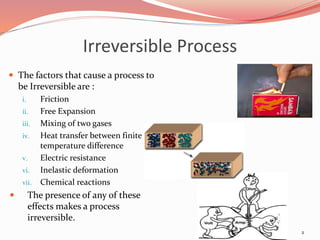
 The factors that cause a process to
be Irreversible are :
i. Friction
ii. Free Expansion
iii. Mixing of two gases
iv. Heat transfer between finite
temperature difference
v. Electric resistance
vi. Inelastic deformation
vii. Chemical reactions
 The presence of any of these
effects makes a process
irreversible.
2
Irreversible Process
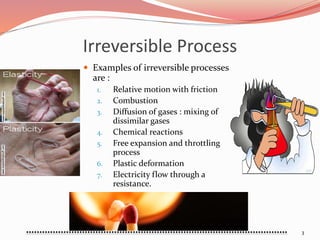
 Examples of irreversible processes
are :
1. Relative motion with friction
2. Combustion
3. Diffusion of gases : mixing of
dissimilar gases
4. Chemical reactions
5. Free expansion and throttling
process
6. Plastic deformation
7. Electricity flow through a
resistance.
3
29
30
31

Entropy

  • 1.
    Aakash Singh Enrollment No.: 150410119112 Mechanical -2 – C Sardar Vallabhbhai Patel Institute of Technology, Vasad
  • 3.
    Content :  InequalityOf Clausius  Entropy Change For Open System  Reversible & Irreversible Processes
  • 5.
    History  The ClausiusTheorem is a mathematical explanation of the Second Law of Thermodynamics.  Also referred to as the “Inequality of Clausius”, the theorem was developed by Rudolf Clausius who intended to explain the relationship between the heat flow in a system and the entropy of the system and its surroundings.  The Clausius Theorem was first published in 1862 in Clausius’ sixth memoir, “On the Application of the Theorem of the Equivalence of Transformations to Interior Work”. 1
  • 6.
    Inequality of Clausius “ When a system undergoes a complete cyclic process, the integral of around the cycle is less than zero.”  Mathematically : ( ) ≤ 0  δQ is energy flow into the system due to heating and T being absolute temperature of the body when that energy is absorbed.  The following equation must be found true for any cyclical process that is possible, reversible or not. 2
  • 7.
    Proof  Consider areversible engine R and irreversible engine I working between two thermal reservoirs at temperatures TH and TL.  Efficiency of reversible engine is : where QH = heat added, QL = heat rejected.  Efficiency of irreversible engine is :  We know that efficiency of reversible engine is more than that of irreversible engine under same temperature limit. ∴ ηR > ηI ∴ ( )R > ( )I ∴ ( )R > ( )I (∵ for reversible engines ) 3
  • 8.
    Proof  ∴ () < ( )I  ∴ ( )I < ( )I  ∴ ( )I - ( )I < 0  We know that, heat added ( Q H ) should be positive and heat rejected ( Q L ) should be negative.  ∴ ( )I - (- )I < 0 4
  • 9.
    Proof  ∴ ()I + ( )I < 0  Considering complete original irreversible cycle :  ∴  ∴ ∮ ( ) < 0 for an irreversible cycle.  According to Clausius Theorem ∮ = 0 for reversible cycle.  Combining results for reversible and irreversible cycle, we get : This expression is known as Clausius Inequality. 5
  • 10.
  • 11.
  • 13.
    Entropy Change ForOpen System  A closed system involves no mass flow across its boundaries, and its entropy change is simply the difference between the initial and final entropies of the system.  The entropy change of a closed system is due to the heat transfer.  In an open system, as compared with closed system, there is additional change of entropy due to the mass crossing the boundaries of the system. 1
  • 14.
    Entropy Change ForOpen System  The general entropy balance equation is : [Rate of change of C.V.] = [Rate of entropy transfer with heat] + [Rate of entropy transport with mass]  To = temperature of surroundings Si = specific entropy of the inlet So = specific entropy of the outlet dmi = mass entering the system dmo = mass leaving the system 2
  • 15.
    Entropy Change ForOpen System  The small change of entropy of the system during a small interval is given by : For reversible process  In above equation, entropy flow into the system is considered positive and entropy out-flow is considered negative.  This equation is applicable to reversible process in which the heat interactions and mass transport to and from the system is accomplished reversibly. 3
  • 16.
    Entropy Change ForOpen System  For Irreversible process -  For Reversible & Irreversible - Process  Rate of Entropy Change -  The equality sign is applicable to Reversible Process and the inequality sign is applicable to the irreversible process. 4
  • 17.
    Entropy Change ForOpen System  In case of steady state, steady flow process, the time rate of entropy change of system is Zero and the time rate of the mass entering is equal to that of leaving system,  So equation become or 5
  • 18.
    Entropy Change ForOpen System  For Adiabatic Steady Flow Process,  If the process is Reversible Adiabatic steady flow , then 6
  • 19.
  • 21.
    Reversible Process  Areversible process is defined as :  “A reversible process is a process whose direction can be "reversed" by inducing infinitesimal changes to some property of the system via its surroundings, while not increasing entropy.” Or  “A process that can be reversed without leaving any change on the surroundings.” 1
  • 22.
    Reversible Process  Areversible process passes through a continuous series of equilibrium states.  It can be stopped at any stage and reversed so that the system and surroundings are exactly restored to their initial states.  Consider the system in fig. The process take place from state 1 to state 2 by following path 1-2.  If process is reversed, path 2-1 will be followed and system will reach its initial state. So the process 1-2 is called Reversible Process. 2
  • 23.
    Reversible Process  Considerexpansion of a gas as shown in figure.  The expansion of the gas takes place by removing infinitesimal weights slowly from the piston one by one, therefore process passes through equilibrium states and tending to reversible process.  The gas can be brought back by compression after putting weights on the piston. 3
  • 24.
    Reversible Process  Someof the processes that can be idealized as reversible process are :  Frictionless relative motion  Expansion and compression of spring  Frictionless adiabatic expansion or compression of fluid  Isothermal Expansion or compression  Elastic stretching of a solid  Electrolysis process  A reversible process produces the maximum work in engines and requires minimum work in devices such as heat pumps 4
  • 25.
  • 26.
    Irreversible Process  “Aprocess that is not reversible is called an Irreversible Process.”  In irreversible process, system passes through a series of non- equilibrium states.  It is difficult to locate properties on property diagram as they don’t have a unique value.  When irreversible process is made to proceed in backward direction, it does not reach its original state.  The system reaches a new state.  Irreversible processes are usually represented by dotted lines. 1
  • 27.
    Irreversible Process  Thefactors that cause a process to be Irreversible are : i. Friction ii. Free Expansion iii. Mixing of two gases iv. Heat transfer between finite temperature difference v. Electric resistance vi. Inelastic deformation vii. Chemical reactions  The presence of any of these effects makes a process irreversible. 2
  • 28.
    Irreversible Process  Examplesof irreversible processes are : 1. Relative motion with friction 2. Combustion 3. Diffusion of gases : mixing of dissimilar gases 4. Chemical reactions 5. Free expansion and throttling process 6. Plastic deformation 7. Electricity flow through a resistance. 3
  • 29.
  • 30.
  • 31.