S2Q4
CHEMICAL
ENERGETICS
A. Energy Changes in Chemical
Reactions
Thermochemistry
The study of changes in heat energy which take
place during chemical reactions
Classify into:
• Exothermic reaction
• Endothermic reaction
TIPS:
EXmean to go out/exit
EN mean to come in/enter
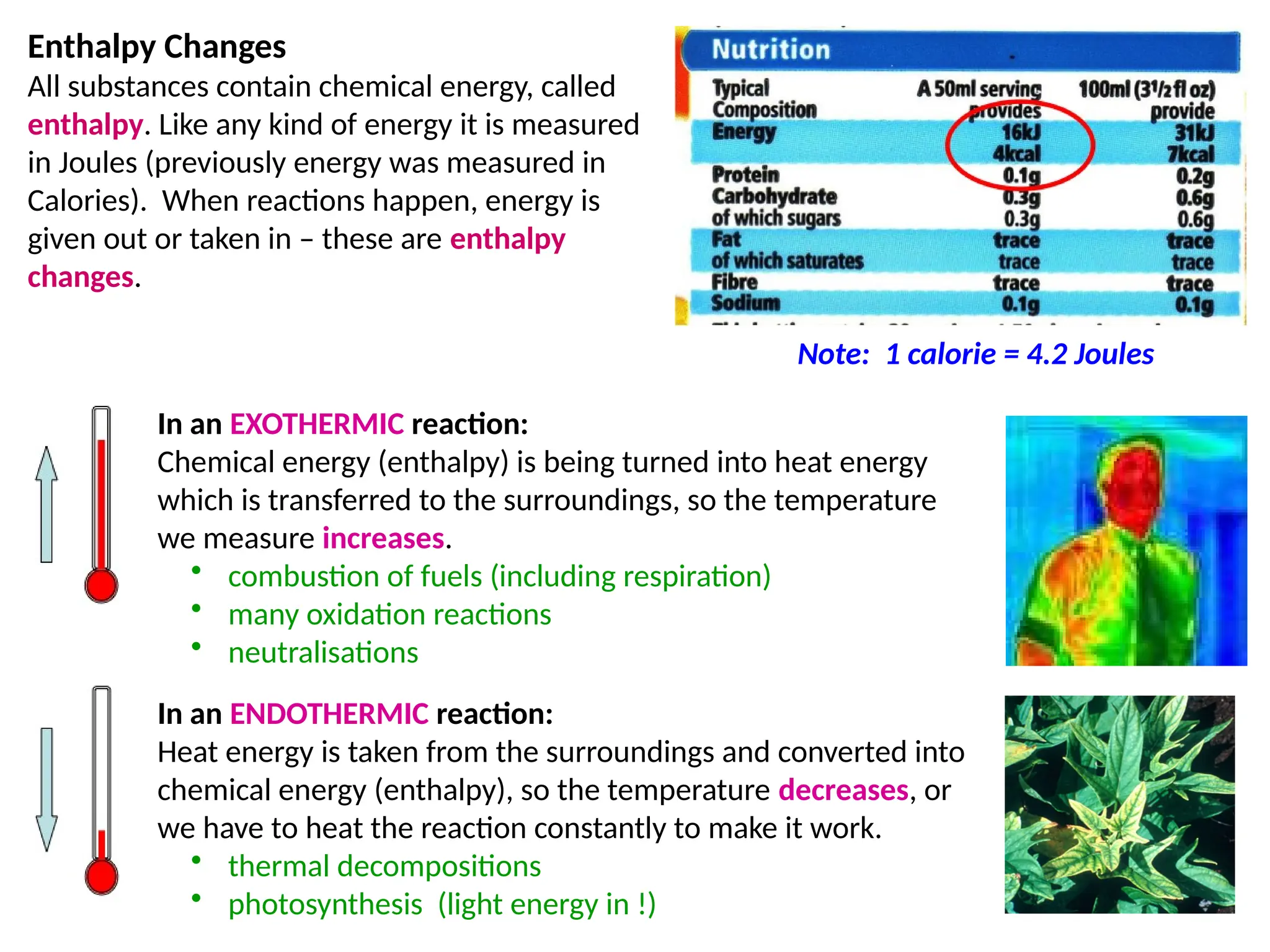
Note: 1 calorie = 4.2 Joules
Enthalpy Changes
All substances contain chemical energy, called
enthalpy. Like any kind of energy it is measured
in Joules (previously energy was measured in
Calories). When reactions happen, energy is
given out or taken in – these are enthalpy
changes.
In an EXOTHERMIC reaction:
Chemical energy (enthalpy) is being turned into heat energy
which is transferred to the surroundings, so the temperature
we measure increases.
• combustion of fuels (including respiration)
• many oxidation reactions
• neutralisations
In an ENDOTHERMIC reaction:
Heat energy is taken from the surroundings and converted into
chemical energy (enthalpy), so the temperature decreases, or
we have to heat the reaction constantly to make it work.
• thermal decompositions
• photosynthesis (light energy in !)
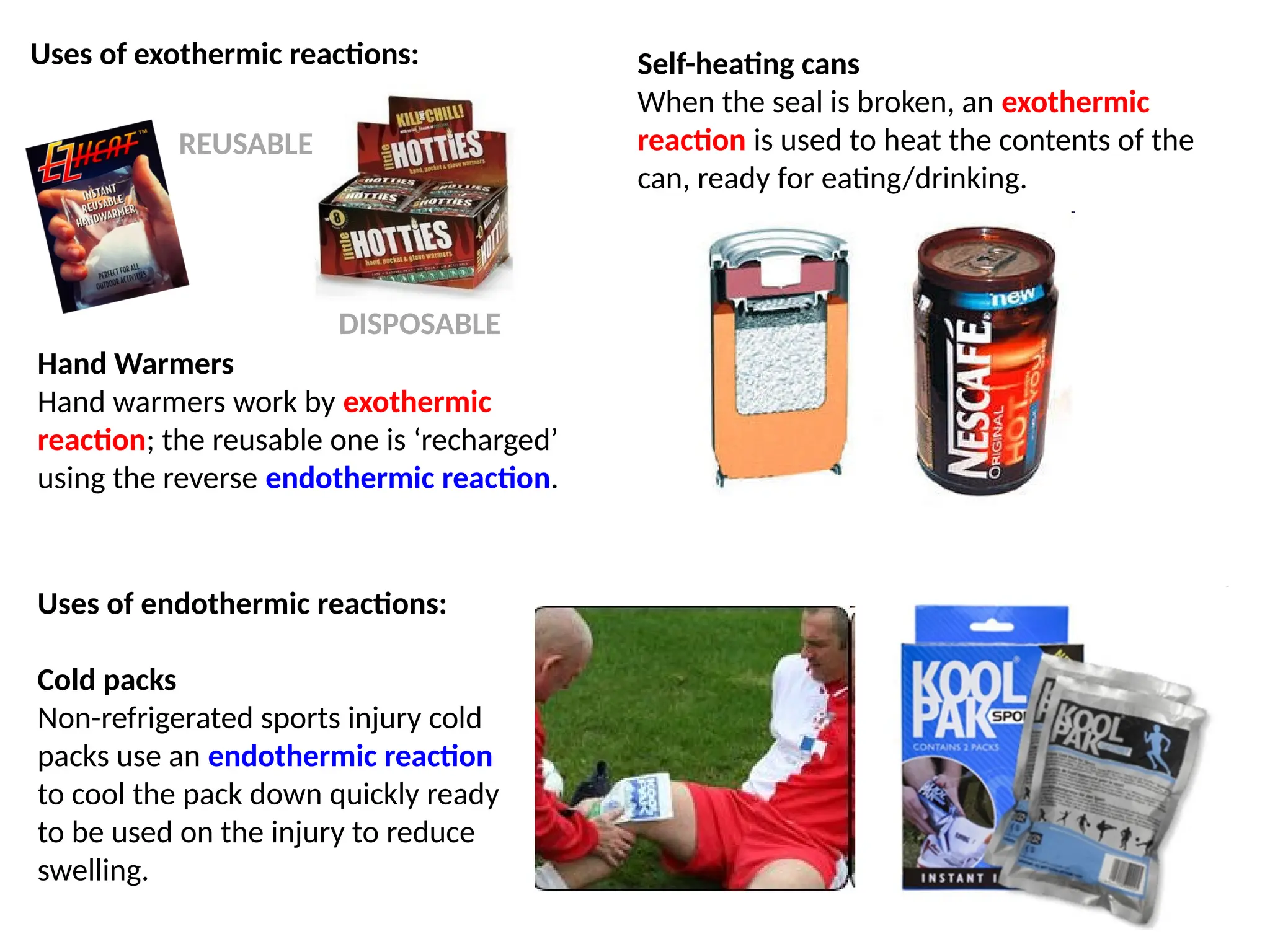
REUSABLE
Uses of exothermic reactions:
Hand Warmers
Hand warmers work by exothermic
reaction; the reusable one is ‘recharged’
using the reverse endothermic reaction.
DISPOSABLE
Self-heating cans
When the seal is broken, an exothermic
reaction is used to heat the contents of the
can, ready for eating/drinking.
Uses of endothermic reactions:
Cold packs
Non-refrigerated sports injury cold
packs use an endothermic reaction
to cool the pack down quickly ready
to be used on the injury to reduce
swelling.
Exothermic and endothermic reactions
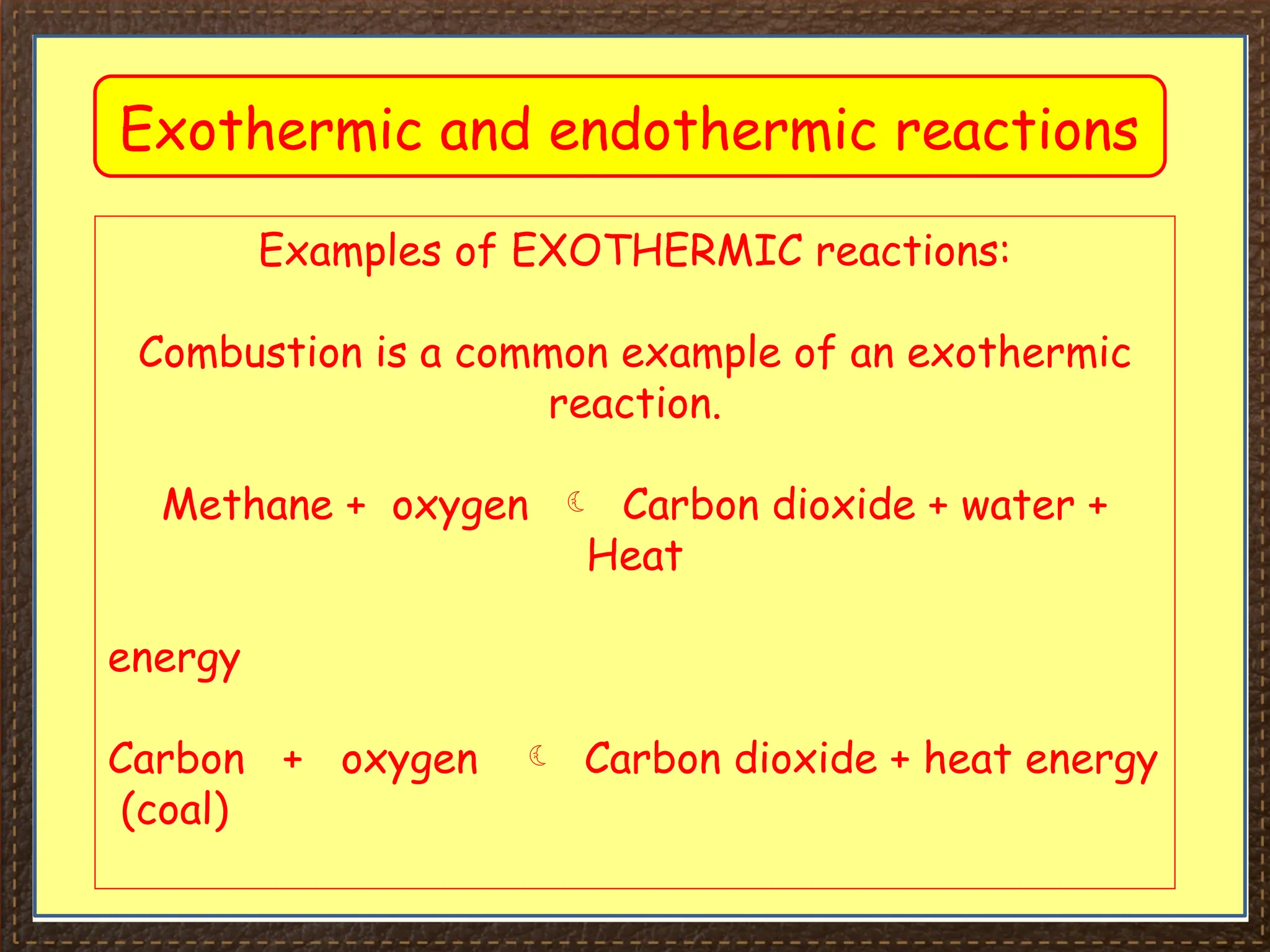
Examples of EXOTHERMIC reactions:
Combustion is a common example of an exothermic
reaction.
Methane + oxygen  Carbon dioxide + water +
Heat
energy
Carbon + oxygen  Carbon dioxide + heat energy
(coal)
Exothermic and endothermic reactions
Examples of EXOTHERMIC reactions:
Neutralisation is another example of an exothermic
reaction.
Acid + Alkali  Salt + Water + Heat energy
Exothermic and endothermic reactions
Examples of EXOTHERMIC reactions:
Neutralisation is another example of an exothermic
reaction.
Acid + Alkali  Salt + Water + Heat energy
The symbol to show a change in the amount of
heat energy is ∆H (pronounced delta H)
Exothermic and endothermic reactions
For an EXOTHERMIC
reaction, ∆H is negative.
This means that heat has
been lost from the
reaction.
Increasing
energy
reactants
products
Loss
of
energy
Time
Exothermic and endothermic reactions
Examples of ENDOTHERMIC reactions:
Endothermic reactions tend to be less common.
Dissolving ammonium nitrate crystals in water is an
endothermic reaction.
Ammonium + Water  ammonium nitrate – Heat
nitrate solution energy
Temperature of reactants = 20o
C
Temperature of products = 13o
C
Exothermic and endothermic reactions
For an ENDOTHERMIC
reaction, ∆H is positive.
This means that heat has
been gained in the
reaction.
Increasing
energy
reactants
products
Gain
in
energy
Time
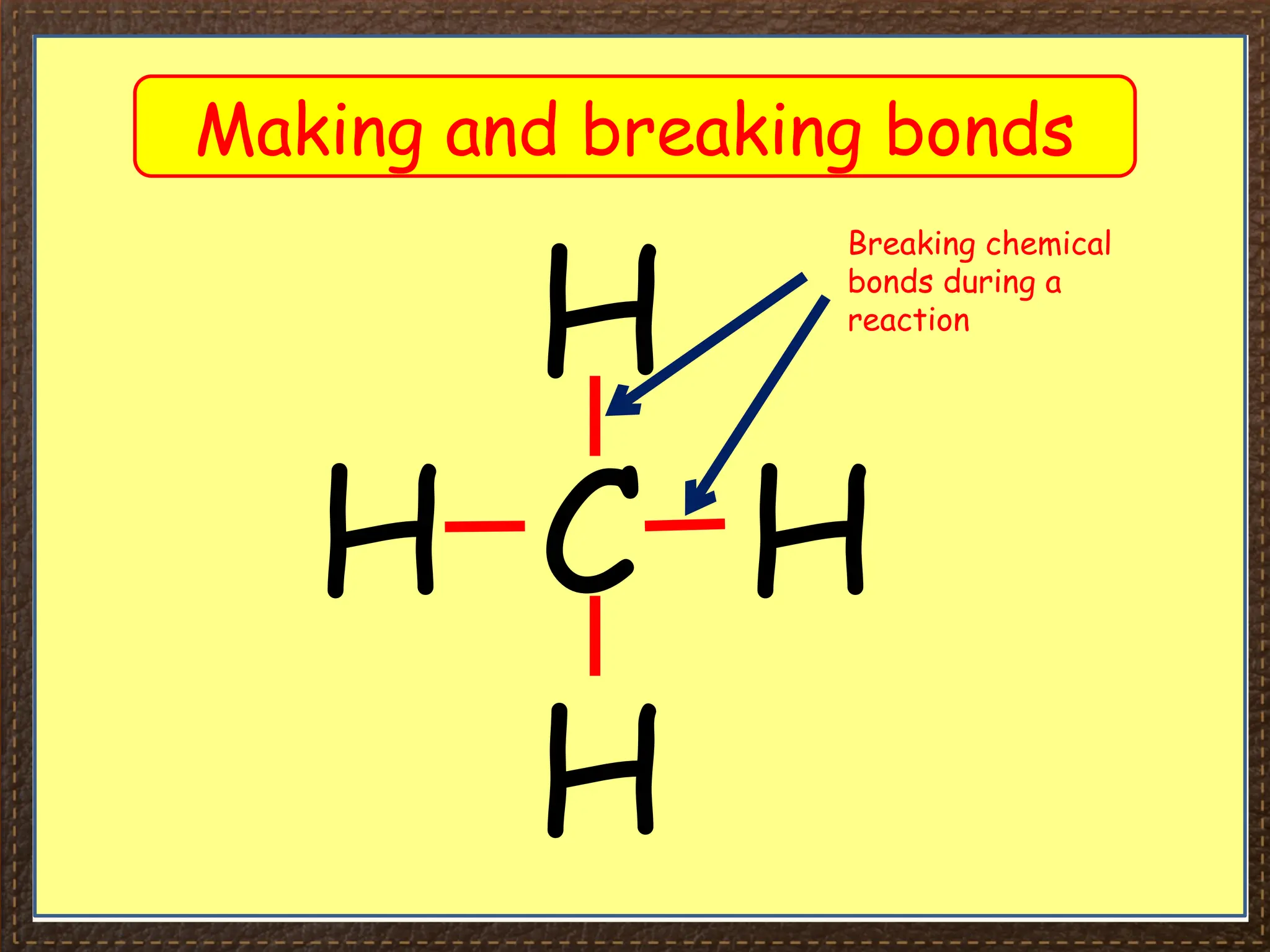
Making and breaking bonds
Why are there energy
(temperature) change sin
chemical reactions?
Because chemical reactions
involve the making and
breaking of bonds!
Making and breaking bonds
C
H
H
H
H
Making and breaking bonds
C
H
H
H
H
Breaking chemical
bonds during a
reaction
Making and breaking bonds
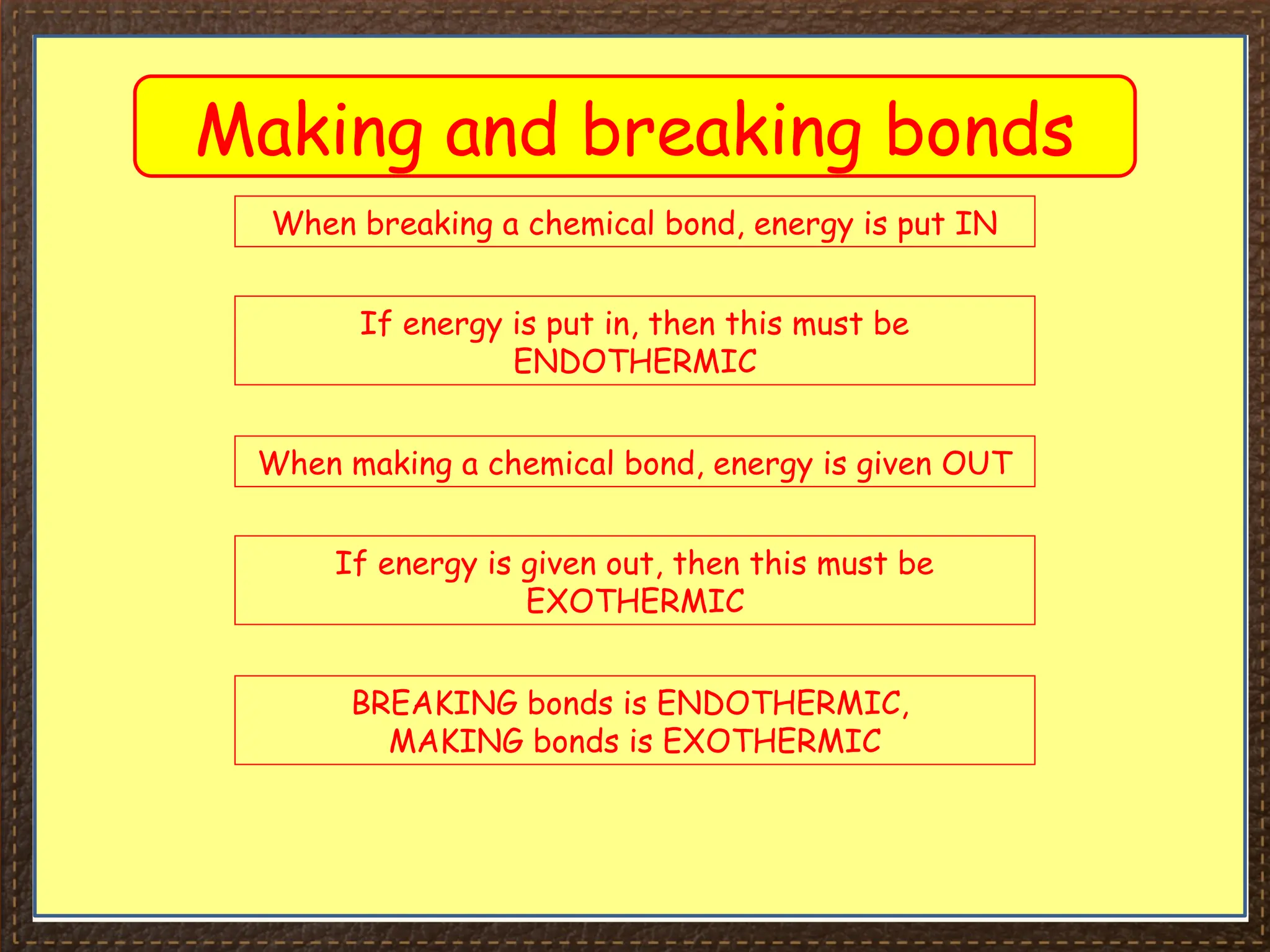
When breaking a chemical bond, energy is put IN
If energy is put in, then this must be
ENDOTHERMIC
When making a chemical bond, energy is given OUT
If energy is given out, then this must be
EXOTHERMIC
BREAKING bonds is ENDOTHERMIC,
MAKING bonds is EXOTHERMIC
Making and breaking bonds
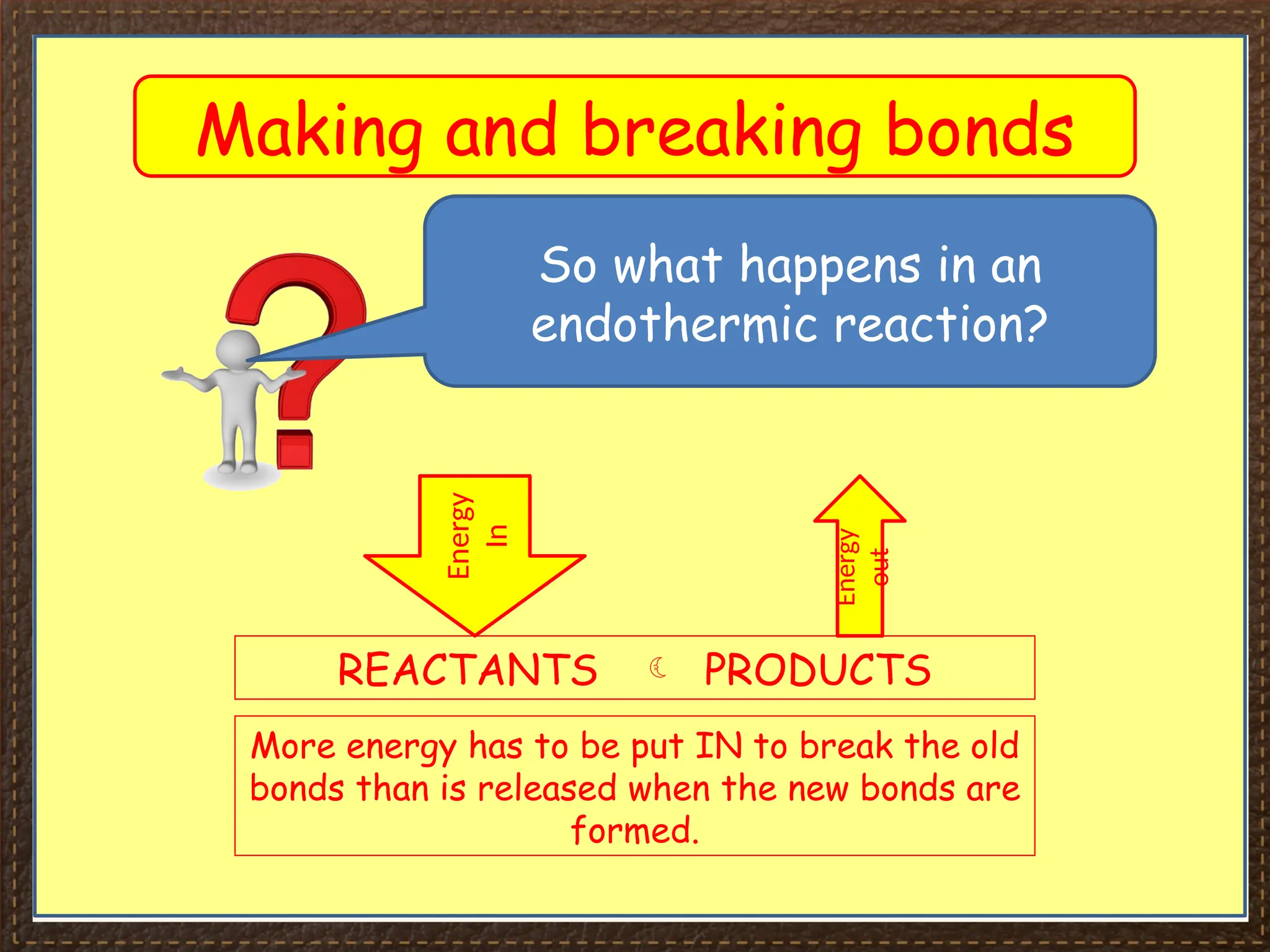
So what happens in an
endothermic reaction?
REACTANTS  PRODUCTS
Energy
In
Energy
out
More energy has to be put IN to break the old
bonds than is released when the new bonds are
formed.
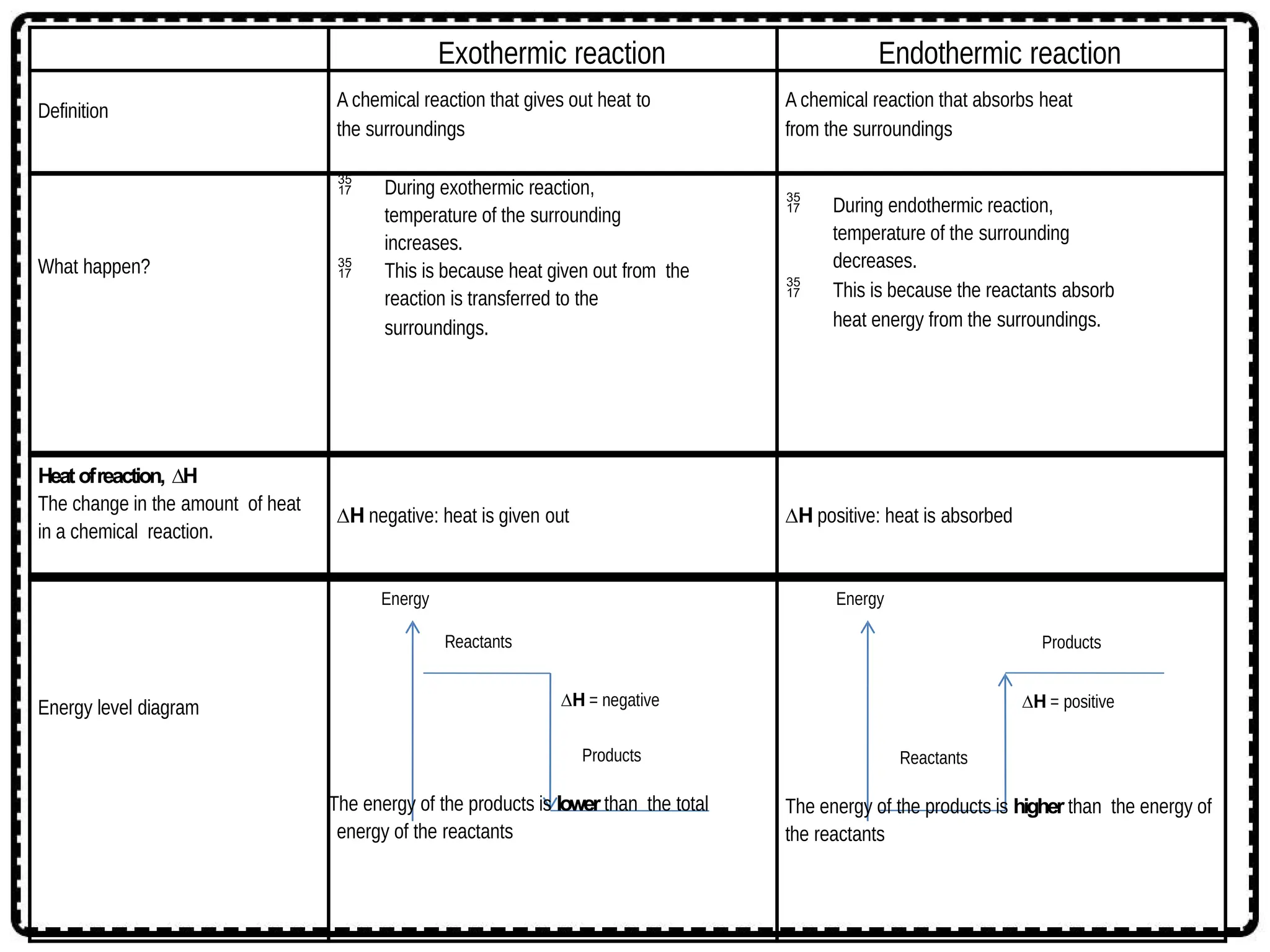
Exothermic reaction Endothermic reaction
Definition
A chemical reaction that gives out heat to
the surroundings
A chemical reaction that absorbs heat
from the surroundings
What happen?
 During exothermic reaction,
temperature of the surrounding
increases.
 This is because heat given out from the
reaction is transferred to the
surroundings.
 During endothermic reaction,
temperature of the surrounding
decreases.
 This is because the reactants absorb
heat energy from the surroundings.
Heatofreaction, ∆H
The change in the amount of heat
in a chemical reaction.
∆H negative: heat is given out ∆H positive: heat is absorbed
Energy level diagram
Energy
Reactants
∆H = negative
Products
The energy of the products is lower than the total
energy of the reactants
Energy
Products
∆H = positive
Reactants
The energy of the products is higher than the energy of
the reactants
Step to construct energy level
diagrams
Step 6 Label ∆H as positive or negative
Step 1
Identify whether the reaction is exothermic or
endothermic
Step 2 Draw and label the energy axis
Step 3
Draw the energy level for reactants and
products
Step 4
Draw an arrow from reactants level to the
products level
Step 5
Write the reactants and products based on the
balanced chemical equations
Construct energy level diagrams for the
following thermochemical equations
• Zn + 2HCl → ZnCl2+ H2
• N2+ 2O2→ 2NO2
• KOH+ HNO3→KNO3+ H2O
• C+ 2S → CS2
• Ca(NO3)2+ K2CO3 → CaCO3+
2KNO3
∆H = -152
kJ
∆H = +220
kJ
∆H = -57 kJ
∆H = +220
kJ
∆H = +12 kJ
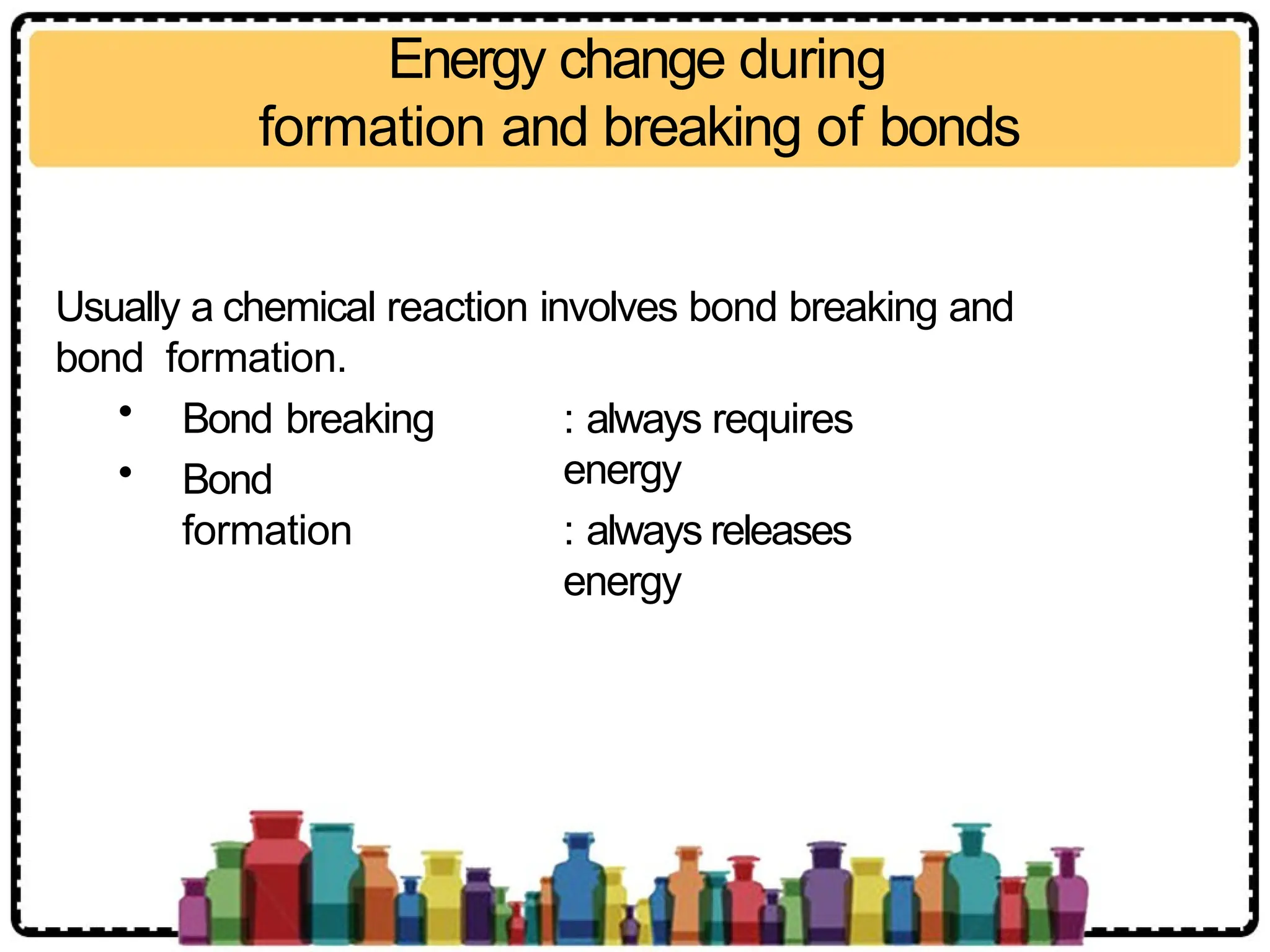
Energy change during
formation and breaking of bonds
Usually a chemical reaction involves bond breaking and
bond formation.
• Bond breaking
• Bond
formation
: always requires
energy
: always releases
energy
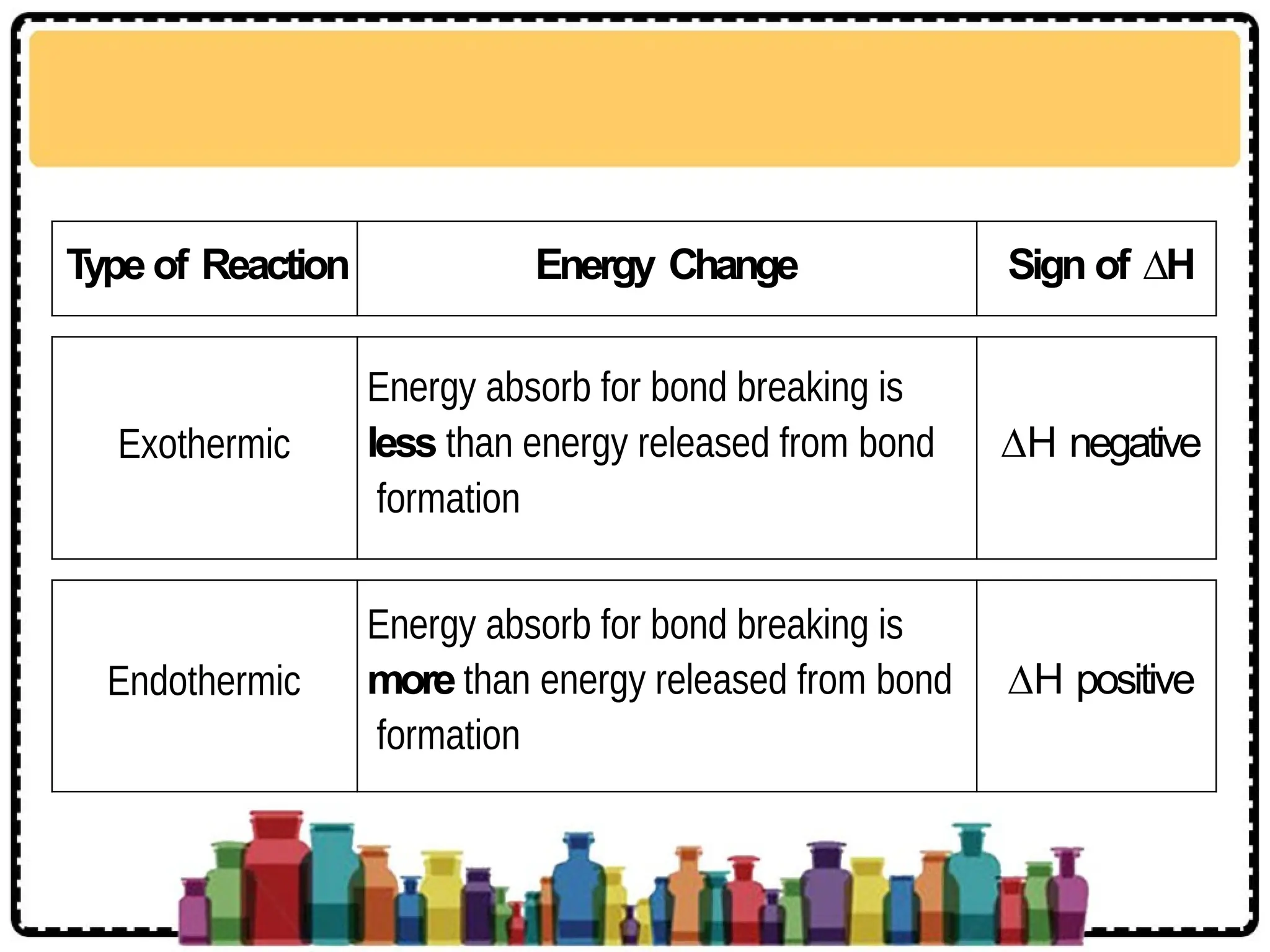
Endothermic
Energy absorb for bond breaking is
more than energy released from bond
formation
∆H positive
Type of Reaction Energy Change Sign of ∆H
Exothermic
Energy absorb for bond breaking is
less than energy released from bond
formation
∆H negative
Application of
exothermic and endothermic
reaction
Cold packs
Contain chemicals (water & solid ammonium nitrate, NH4NO3)
that react to absorb heat from surroundings.
• Help to reduce high temperature
• Help to reduced swelling
Application of
exothermic and endothermic
reaction
Hot packs
Contain chemicals (calcium chloride, CaCl2
or magnesium sulphate, MgSO4and water)that react to
release heat.
• Help to warm up something
• Help to lessen the pain of aching muscles
Application of
exothermic and endothermic
reaction
Reusable heat pack
Contain sodium acetate crystallization and re-solution
system
Lye (drain cleaner)
Contain sodium hydroxide, NaOH
Calculating energy changes - Higher
Using bond energies
Different bonds have different bond energies. These are given
when they are needed for calculations.
To calculate an energy change for a reaction:
add together the bond energies for all the bonds in the reactants
- this is the 'energy in'
add together the bond energies for all the bonds in the products -
this is the 'energy out'
energy change = energy in - energy out
Calorimetry
Calorimetry is the technique of measuring how much energy a food or fuel releases when it
burns. Foods also release energy when they are used for respiration - this is also an
exothermic reaction, exactly the same as burning, but taking place inside the body.
We calculate the heat energy released during a reaction, Q, by measuring the temperature
change when a known mass of water is heated using this energy.
Q = m c T Q is energy released, in Joules
m is the mass of water (in g)
T is the change in temp. (in ˚C)
c is a constant = 4.2 (J/g/˚C)
c is called the Specific Heat Capacity,
and its value will be given in the question
Working out energy released:
e.g. In a calorimetry experiment, a fuel sample was burned and produced a temperature
change of 25°C in the calorimeter, which contained 100g of water. c = 4.2 J/g/˚C
Q = m x c x T = 100 x 4.2 x 25
= 10,500 J (or 10.5 kJ)
Comparing enthalpy changes
To compare reactions, we can calculate the energy released per mole of reactant used,
which we call the molar enthalpy change, ΔH.
To do this we work out the energy released as before, then divide by the moles reactant
used.
ΔH = -Q / moles
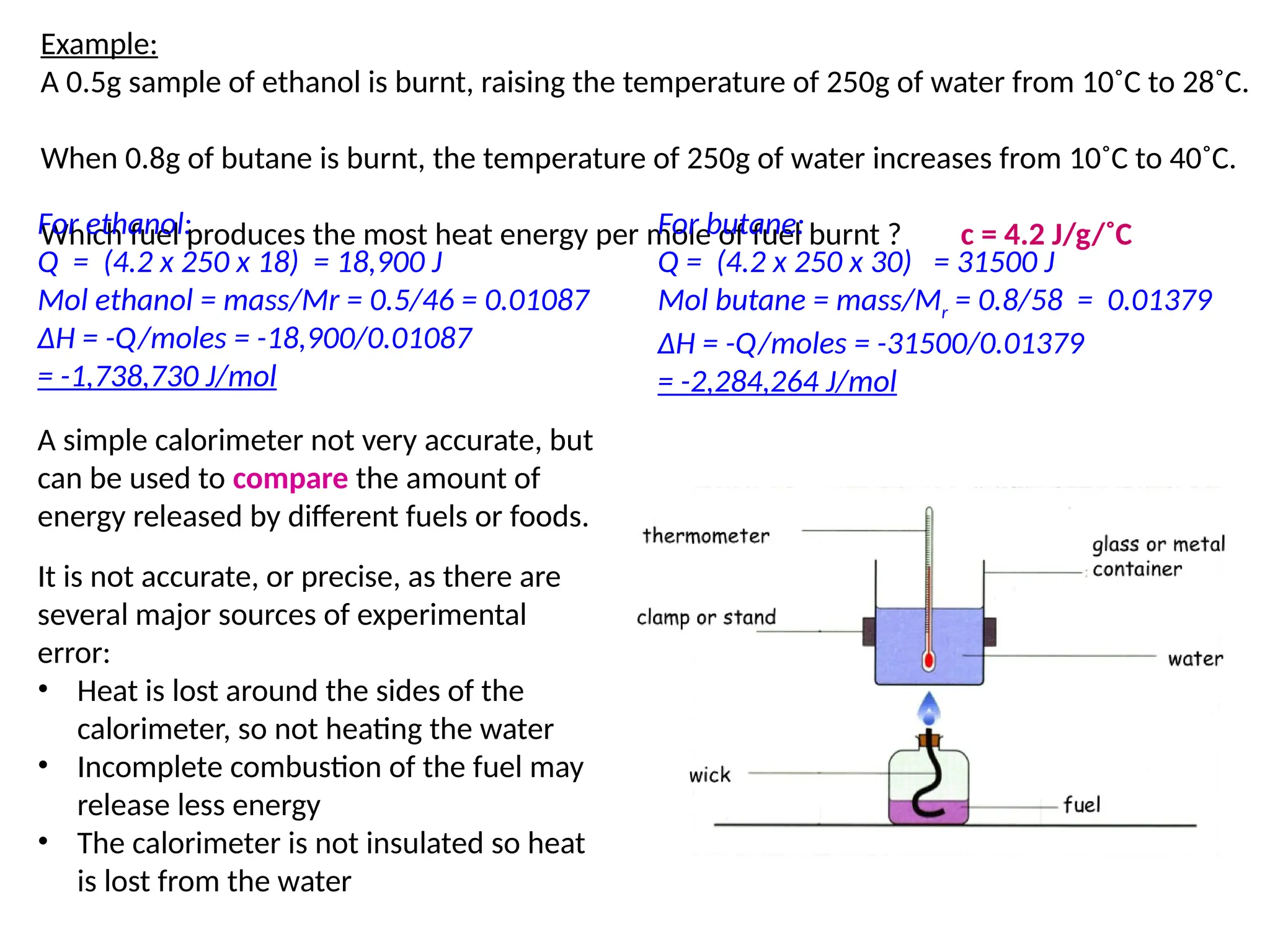
A simple calorimeter not very accurate, but
can be used to compare the amount of
energy released by different fuels or foods.
It is not accurate, or precise, as there are
several major sources of experimental
error:
• Heat is lost around the sides of the
calorimeter, so not heating the water
• Incomplete combustion of the fuel may
release less energy
• The calorimeter is not insulated so heat
is lost from the water
Example:
A 0.5g sample of ethanol is burnt, raising the temperature of 250g of water from 10˚C to 28˚C.
When 0.8g of butane is burnt, the temperature of 250g of water increases from 10˚C to 40˚C.
Which fuel produces the most heat energy per mole of fuel burnt ? c = 4.2 J/g/˚C
For ethanol:
Q = (4.2 x 250 x 18) = 18,900 J
Mol ethanol = mass/Mr = 0.5/46 = 0.01087
ΔH = -Q/moles = -18,900/0.01087
= -1,738,730 J/mol
For butane:
Q = (4.2 x 250 x 30) = 31500 J
Mol butane = mass/Mr = 0.8/58 = 0.01379
ΔH = -Q/moles = -31500/0.01379
= -2,284,264 J/mol
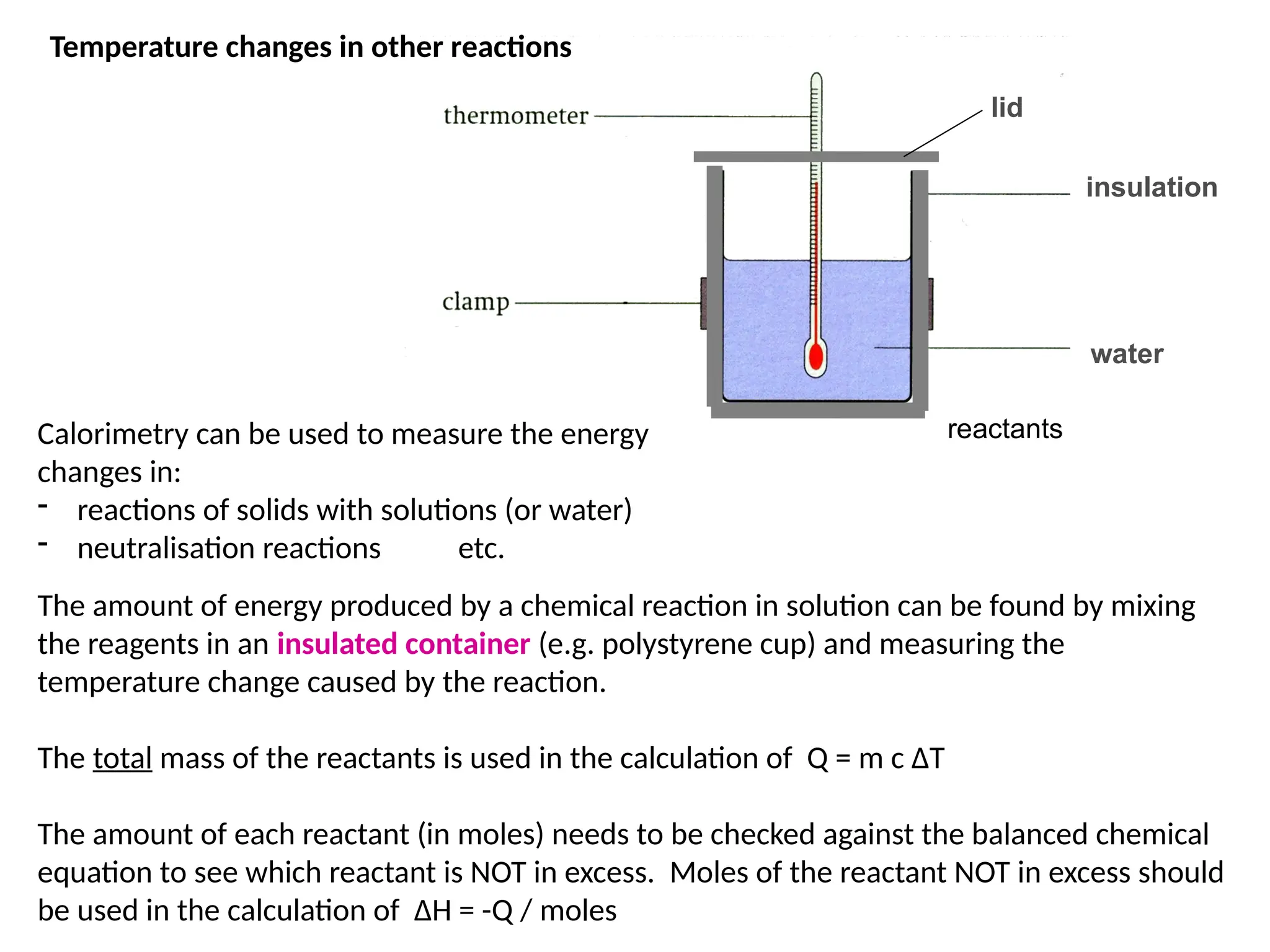
The amount of energy produced by a chemical reaction in solution can be found by mixing
the reagents in an insulated container (e.g. polystyrene cup) and measuring the
temperature change caused by the reaction.
The total mass of the reactants is used in the calculation of Q = m c ΔT
The amount of each reactant (in moles) needs to be checked against the balanced chemical
equation to see which reactant is NOT in excess. Moles of the reactant NOT in excess should
be used in the calculation of ΔH = -Q / moles
water
insulation
lid
Temperature changes in other reactions
reactants
Calorimetry can be used to measure the energy
changes in:
- reactions of solids with solutions (or water)
- neutralisation reactions etc.
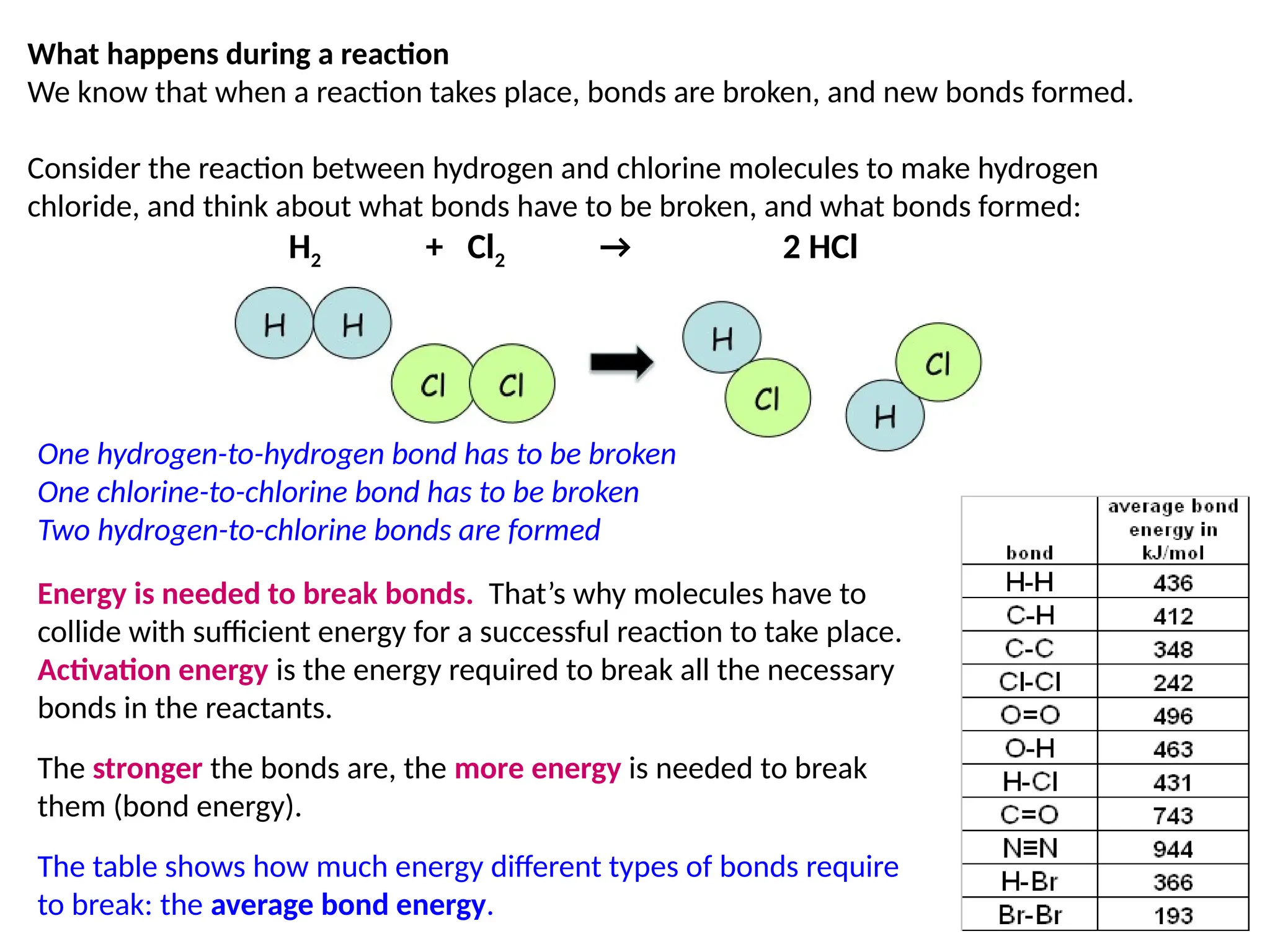
What happens during a reaction
We know that when a reaction takes place, bonds are broken, and new bonds formed.
Consider the reaction between hydrogen and chlorine molecules to make hydrogen
chloride, and think about what bonds have to be broken, and what bonds formed:
H2 + Cl2 → 2 HCl
One hydrogen-to-hydrogen bond has to be broken
One chlorine-to-chlorine bond has to be broken
Two hydrogen-to-chlorine bonds are formed
Energy is needed to break bonds. That’s why molecules have to
collide with sufficient energy for a successful reaction to take place.
Activation energy is the energy required to break all the necessary
bonds in the reactants.
The stronger the bonds are, the more energy is needed to break
them (bond energy).
The table shows how much energy different types of bonds require
to break: the average bond energy.
So bond breaking requires heat energy to be taken from the surroundings and used to break
the bonds. The surroundings get cooler. Bond breaking is ENDOTHERMIC
When new bonds form, energy is given out. This causes the surroundings to heat up. Bond
forming is EXOTHERMIC. (The amount of energy given out is equal to the bond energy for
that bond)
Consider our reaction between
hydrogen and chlorine again:
One H-H bond is broken: 436 kJ/mol
One Cl-Cl bond is broken: 242 kJ/mol
TOTAL ENERGY TAKEN IN = 678 kJ/mol
Two H-Cl bonds are made 2 x 431 kJ/mol
TOTAL ENERGY GIVEN OUT = 862 kJ/mol
Overall, is less energy is taken in than is given out. This means overall
energy is being released – this reaction is exothermic.
The molar enthalpy change for reactions can be calculated:
ΔH = energy taken in – energy given out
In this example the molar enthalpy change is -184 KJ/mol. We see
that the value of ΔH is negative for all exothermic reactions.
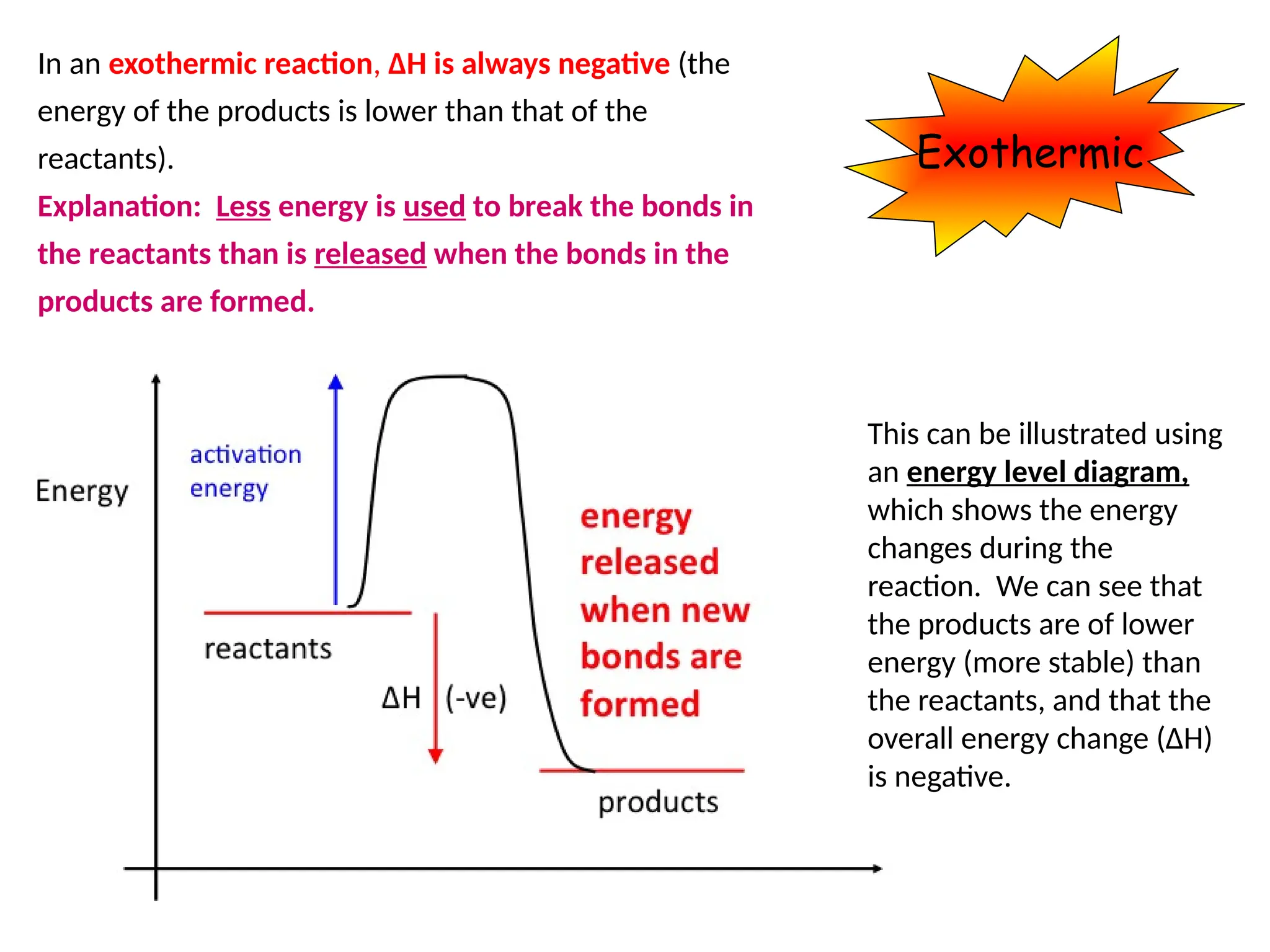
Exothermic
In an exothermic reaction, ΔH is always negative (the
energy of the products is lower than that of the
reactants).
Explanation: Less energy is used to break the bonds in
the reactants than is released when the bonds in the
products are formed.
This can be illustrated using
an energy level diagram,
which shows the energy
changes during the
reaction. We can see that
the products are of lower
energy (more stable) than
the reactants, and that the
overall energy change (ΔH)
is negative.
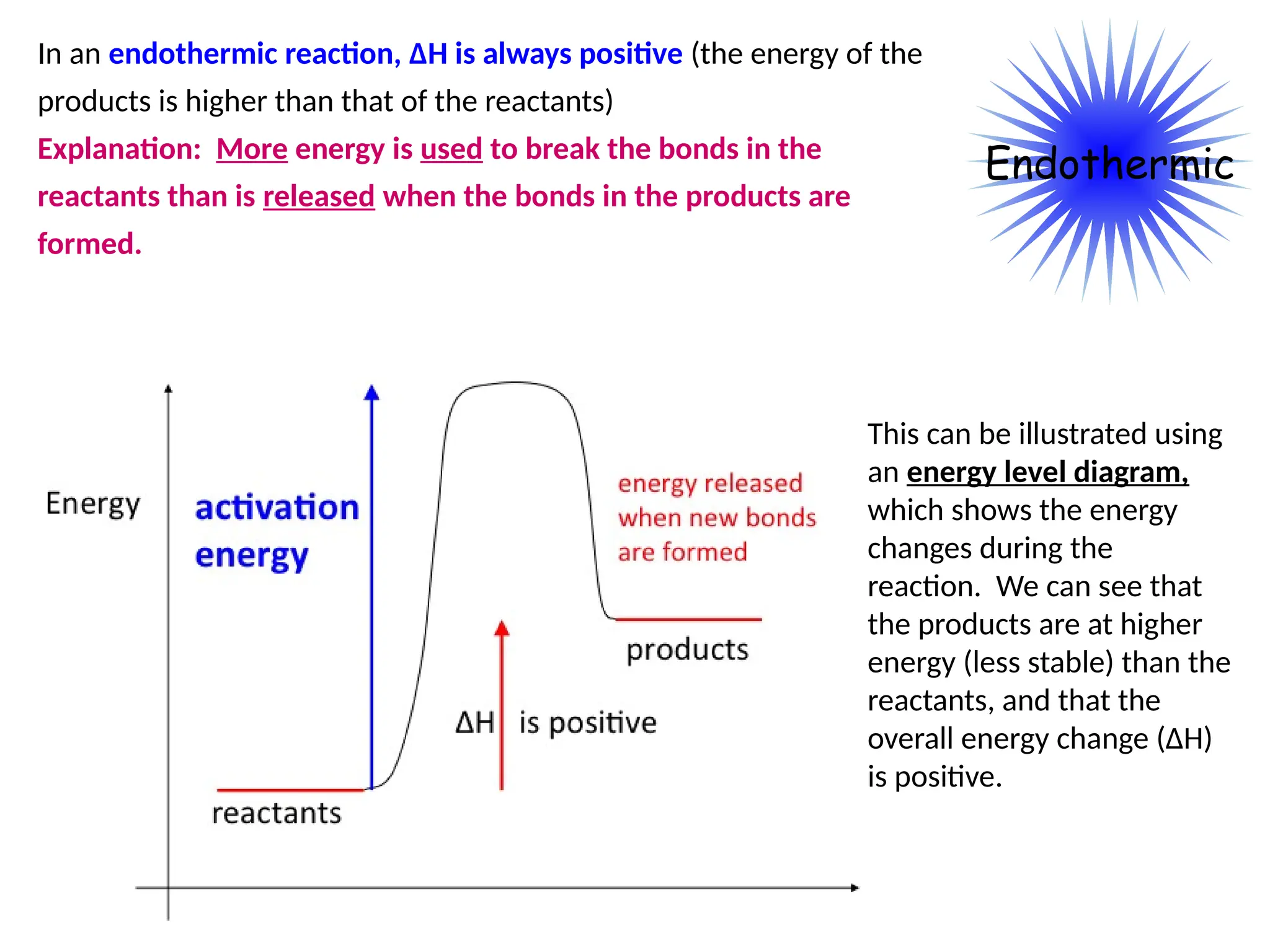
Endothermic
In an endothermic reaction, ΔH is always positive (the energy of the
products is higher than that of the reactants)
Explanation: More energy is used to break the bonds in the
reactants than is released when the bonds in the products are
formed.
This can be illustrated using
an energy level diagram,
which shows the energy
changes during the
reaction. We can see that
the products are at higher
energy (less stable) than the
reactants, and that the
overall energy change (ΔH)
is positive.

CHEMICAL ENERGETICS for IGCSE Chemistry revision

  • 1.
  • 2.
    A. Energy Changesin Chemical Reactions Thermochemistry The study of changes in heat energy which take place during chemical reactions Classify into: • Exothermic reaction • Endothermic reaction TIPS: EXmean to go out/exit EN mean to come in/enter
  • 3.
    Note: 1 calorie= 4.2 Joules Enthalpy Changes All substances contain chemical energy, called enthalpy. Like any kind of energy it is measured in Joules (previously energy was measured in Calories). When reactions happen, energy is given out or taken in – these are enthalpy changes. In an EXOTHERMIC reaction: Chemical energy (enthalpy) is being turned into heat energy which is transferred to the surroundings, so the temperature we measure increases. • combustion of fuels (including respiration) • many oxidation reactions • neutralisations In an ENDOTHERMIC reaction: Heat energy is taken from the surroundings and converted into chemical energy (enthalpy), so the temperature decreases, or we have to heat the reaction constantly to make it work. • thermal decompositions • photosynthesis (light energy in !)
  • 4.
    REUSABLE Uses of exothermicreactions: Hand Warmers Hand warmers work by exothermic reaction; the reusable one is ‘recharged’ using the reverse endothermic reaction. DISPOSABLE Self-heating cans When the seal is broken, an exothermic reaction is used to heat the contents of the can, ready for eating/drinking. Uses of endothermic reactions: Cold packs Non-refrigerated sports injury cold packs use an endothermic reaction to cool the pack down quickly ready to be used on the injury to reduce swelling.
  • 5.
    Exothermic and endothermicreactions Examples of EXOTHERMIC reactions: Combustion is a common example of an exothermic reaction. Methane + oxygen  Carbon dioxide + water + Heat energy Carbon + oxygen  Carbon dioxide + heat energy (coal)
  • 6.
    Exothermic and endothermicreactions Examples of EXOTHERMIC reactions: Neutralisation is another example of an exothermic reaction. Acid + Alkali  Salt + Water + Heat energy
  • 7.
    Exothermic and endothermicreactions Examples of EXOTHERMIC reactions: Neutralisation is another example of an exothermic reaction. Acid + Alkali  Salt + Water + Heat energy The symbol to show a change in the amount of heat energy is ∆H (pronounced delta H)
  • 8.
    Exothermic and endothermicreactions For an EXOTHERMIC reaction, ∆H is negative. This means that heat has been lost from the reaction. Increasing energy reactants products Loss of energy Time
  • 9.
    Exothermic and endothermicreactions Examples of ENDOTHERMIC reactions: Endothermic reactions tend to be less common. Dissolving ammonium nitrate crystals in water is an endothermic reaction. Ammonium + Water  ammonium nitrate – Heat nitrate solution energy Temperature of reactants = 20o C Temperature of products = 13o C
  • 10.
    Exothermic and endothermicreactions For an ENDOTHERMIC reaction, ∆H is positive. This means that heat has been gained in the reaction. Increasing energy reactants products Gain in energy Time
  • 11.
    Making and breakingbonds Why are there energy (temperature) change sin chemical reactions? Because chemical reactions involve the making and breaking of bonds!
  • 12.
    Making and breakingbonds C H H H H
  • 13.
    Making and breakingbonds C H H H H Breaking chemical bonds during a reaction
  • 14.
    Making and breakingbonds When breaking a chemical bond, energy is put IN If energy is put in, then this must be ENDOTHERMIC When making a chemical bond, energy is given OUT If energy is given out, then this must be EXOTHERMIC BREAKING bonds is ENDOTHERMIC, MAKING bonds is EXOTHERMIC
  • 15.
    Making and breakingbonds So what happens in an endothermic reaction? REACTANTS  PRODUCTS Energy In Energy out More energy has to be put IN to break the old bonds than is released when the new bonds are formed.
  • 16.
    Exothermic reaction Endothermicreaction Definition A chemical reaction that gives out heat to the surroundings A chemical reaction that absorbs heat from the surroundings What happen?  During exothermic reaction, temperature of the surrounding increases.  This is because heat given out from the reaction is transferred to the surroundings.  During endothermic reaction, temperature of the surrounding decreases.  This is because the reactants absorb heat energy from the surroundings. Heatofreaction, ∆H The change in the amount of heat in a chemical reaction. ∆H negative: heat is given out ∆H positive: heat is absorbed Energy level diagram Energy Reactants ∆H = negative Products The energy of the products is lower than the total energy of the reactants Energy Products ∆H = positive Reactants The energy of the products is higher than the energy of the reactants
  • 17.
    Step to constructenergy level diagrams Step 6 Label ∆H as positive or negative Step 1 Identify whether the reaction is exothermic or endothermic Step 2 Draw and label the energy axis Step 3 Draw the energy level for reactants and products Step 4 Draw an arrow from reactants level to the products level Step 5 Write the reactants and products based on the balanced chemical equations
  • 18.
    Construct energy leveldiagrams for the following thermochemical equations • Zn + 2HCl → ZnCl2+ H2 • N2+ 2O2→ 2NO2 • KOH+ HNO3→KNO3+ H2O • C+ 2S → CS2 • Ca(NO3)2+ K2CO3 → CaCO3+ 2KNO3 ∆H = -152 kJ ∆H = +220 kJ ∆H = -57 kJ ∆H = +220 kJ ∆H = +12 kJ
  • 19.
    Energy change during formationand breaking of bonds Usually a chemical reaction involves bond breaking and bond formation. • Bond breaking • Bond formation : always requires energy : always releases energy
  • 20.
    Endothermic Energy absorb forbond breaking is more than energy released from bond formation ∆H positive Type of Reaction Energy Change Sign of ∆H Exothermic Energy absorb for bond breaking is less than energy released from bond formation ∆H negative
  • 21.
    Application of exothermic andendothermic reaction Cold packs Contain chemicals (water & solid ammonium nitrate, NH4NO3) that react to absorb heat from surroundings. • Help to reduce high temperature • Help to reduced swelling
  • 22.
    Application of exothermic andendothermic reaction Hot packs Contain chemicals (calcium chloride, CaCl2 or magnesium sulphate, MgSO4and water)that react to release heat. • Help to warm up something • Help to lessen the pain of aching muscles
  • 23.
    Application of exothermic andendothermic reaction Reusable heat pack Contain sodium acetate crystallization and re-solution system Lye (drain cleaner) Contain sodium hydroxide, NaOH
  • 24.
    Calculating energy changes- Higher Using bond energies Different bonds have different bond energies. These are given when they are needed for calculations. To calculate an energy change for a reaction: add together the bond energies for all the bonds in the reactants - this is the 'energy in' add together the bond energies for all the bonds in the products - this is the 'energy out' energy change = energy in - energy out
  • 25.
    Calorimetry Calorimetry is thetechnique of measuring how much energy a food or fuel releases when it burns. Foods also release energy when they are used for respiration - this is also an exothermic reaction, exactly the same as burning, but taking place inside the body. We calculate the heat energy released during a reaction, Q, by measuring the temperature change when a known mass of water is heated using this energy. Q = m c T Q is energy released, in Joules m is the mass of water (in g) T is the change in temp. (in ˚C) c is a constant = 4.2 (J/g/˚C) c is called the Specific Heat Capacity, and its value will be given in the question Working out energy released: e.g. In a calorimetry experiment, a fuel sample was burned and produced a temperature change of 25°C in the calorimeter, which contained 100g of water. c = 4.2 J/g/˚C Q = m x c x T = 100 x 4.2 x 25 = 10,500 J (or 10.5 kJ) Comparing enthalpy changes To compare reactions, we can calculate the energy released per mole of reactant used, which we call the molar enthalpy change, ΔH. To do this we work out the energy released as before, then divide by the moles reactant used. ΔH = -Q / moles
  • 26.
    A simple calorimeternot very accurate, but can be used to compare the amount of energy released by different fuels or foods. It is not accurate, or precise, as there are several major sources of experimental error: • Heat is lost around the sides of the calorimeter, so not heating the water • Incomplete combustion of the fuel may release less energy • The calorimeter is not insulated so heat is lost from the water Example: A 0.5g sample of ethanol is burnt, raising the temperature of 250g of water from 10˚C to 28˚C. When 0.8g of butane is burnt, the temperature of 250g of water increases from 10˚C to 40˚C. Which fuel produces the most heat energy per mole of fuel burnt ? c = 4.2 J/g/˚C For ethanol: Q = (4.2 x 250 x 18) = 18,900 J Mol ethanol = mass/Mr = 0.5/46 = 0.01087 ΔH = -Q/moles = -18,900/0.01087 = -1,738,730 J/mol For butane: Q = (4.2 x 250 x 30) = 31500 J Mol butane = mass/Mr = 0.8/58 = 0.01379 ΔH = -Q/moles = -31500/0.01379 = -2,284,264 J/mol
  • 27.
    The amount ofenergy produced by a chemical reaction in solution can be found by mixing the reagents in an insulated container (e.g. polystyrene cup) and measuring the temperature change caused by the reaction. The total mass of the reactants is used in the calculation of Q = m c ΔT The amount of each reactant (in moles) needs to be checked against the balanced chemical equation to see which reactant is NOT in excess. Moles of the reactant NOT in excess should be used in the calculation of ΔH = -Q / moles water insulation lid Temperature changes in other reactions reactants Calorimetry can be used to measure the energy changes in: - reactions of solids with solutions (or water) - neutralisation reactions etc.
  • 28.
    What happens duringa reaction We know that when a reaction takes place, bonds are broken, and new bonds formed. Consider the reaction between hydrogen and chlorine molecules to make hydrogen chloride, and think about what bonds have to be broken, and what bonds formed: H2 + Cl2 → 2 HCl One hydrogen-to-hydrogen bond has to be broken One chlorine-to-chlorine bond has to be broken Two hydrogen-to-chlorine bonds are formed Energy is needed to break bonds. That’s why molecules have to collide with sufficient energy for a successful reaction to take place. Activation energy is the energy required to break all the necessary bonds in the reactants. The stronger the bonds are, the more energy is needed to break them (bond energy). The table shows how much energy different types of bonds require to break: the average bond energy.
  • 29.
    So bond breakingrequires heat energy to be taken from the surroundings and used to break the bonds. The surroundings get cooler. Bond breaking is ENDOTHERMIC When new bonds form, energy is given out. This causes the surroundings to heat up. Bond forming is EXOTHERMIC. (The amount of energy given out is equal to the bond energy for that bond) Consider our reaction between hydrogen and chlorine again: One H-H bond is broken: 436 kJ/mol One Cl-Cl bond is broken: 242 kJ/mol TOTAL ENERGY TAKEN IN = 678 kJ/mol Two H-Cl bonds are made 2 x 431 kJ/mol TOTAL ENERGY GIVEN OUT = 862 kJ/mol Overall, is less energy is taken in than is given out. This means overall energy is being released – this reaction is exothermic. The molar enthalpy change for reactions can be calculated: ΔH = energy taken in – energy given out In this example the molar enthalpy change is -184 KJ/mol. We see that the value of ΔH is negative for all exothermic reactions.
  • 30.
    Exothermic In an exothermicreaction, ΔH is always negative (the energy of the products is lower than that of the reactants). Explanation: Less energy is used to break the bonds in the reactants than is released when the bonds in the products are formed. This can be illustrated using an energy level diagram, which shows the energy changes during the reaction. We can see that the products are of lower energy (more stable) than the reactants, and that the overall energy change (ΔH) is negative.
  • 31.
    Endothermic In an endothermicreaction, ΔH is always positive (the energy of the products is higher than that of the reactants) Explanation: More energy is used to break the bonds in the reactants than is released when the bonds in the products are formed. This can be illustrated using an energy level diagram, which shows the energy changes during the reaction. We can see that the products are at higher energy (less stable) than the reactants, and that the overall energy change (ΔH) is positive.