Introduction to Stoichiometry and Molecalculations.ppt
1.
The Basics ofStoichiometry and
Mole Calculations
References and Resources
•Our TB: Ch. 3 of Chemistry: The central Science AP version (10th
edition)
•Powerpoint *and in-class work
•POGIL activities
•Online resources for our TB (in particular: Practice Quiz and e-book)
•Concept map for Stoichiometry and problem solving (handout)
•Video lectures from chem guy (see next page)
•Chem tours from ch. 3 of the W.W. Norton online book by Gilbert:
•http://www.wwnorton.com/college/chemistry/gilbert2/contents/ch03/studyplan.asp
•*Some figures and examples in this PPT file have been taken from Melissa Brophy’s
presentation at http://teacherweb.com/TX/McNeilHS/brophy/photo2.aspx
2.
Resources: Video lecturesfor Chemistry
• Chemguy videos (google AP chemistry and chemguy videos; use in sequence)
(good, short, video lectures that are appropriate for regular, honors, or AP chemistry)
• chem Guy video for mole 1 http://www.youtube.com/watch?
v=xiVweBpjXJo&playnext=1&videos=kHh8a0fILuY&feature=mfu_in_order
• Mole 2 chem guy: http://www.youtube.com/watch?
v=xqw2BWdKl1Q&feature=PlayList&p=C09489B20AE215DF&playnext=1&playnext_from=PL&index
=19
• Mole 3 (Junior) :
• http://www.youtube.com/watch?
v=O7qjYRYxkso&feature=PlayList&p=C09489B20AE215DF&playnext=1&playnext_from=PL&index=
20
• Stoichiometry video with worked example for predicting amount of product from 2.6 mol of one of
reactant: see http://www.youtube.com/watch?v=-W9-sNfM5Xo&feature=related
• Empirical formula for AP chem with chem. Guy: http://www.youtube.com/watch?
v=fFXtX_8NgsQ&feature=related
3.
The Basics ofStoichiometry and
Mole Calculations
Topics (review and new)
• Reading and writing
chemical equations
• Balancing Equations
• Types of reactions
• Formula Weights
• Formula Weights and Molar
Masses
• Percent composition
• Avagadro’s Number
(continued)
• Mole calculations
• Solving problems using
dimensional analysis using
(1) Avagadro’s number, (2)
GFM, or (3) mole ratios
from coefficients of
balanced equations
• Determining Empirical
formulas and Molecular
formulas
• Limiting reagents(reactants)
4.
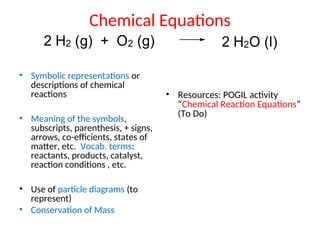
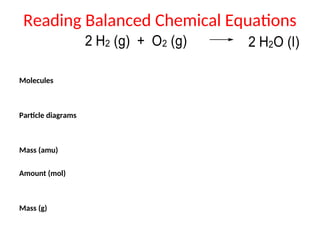
Chemical Equations
• Symbolicrepresentations or
descriptions of chemical
reactions
• Meaning of the symbols,
subscripts, parenthesis, + signs,
arrows, co-efficients, states of
matter, etc. Vocab. terms:
reactants, products, catalyst,
reaction conditions , etc.
• Use of particle diagrams (to
represent)
• Conservation of Mass
• Resources: POGIL activity
“Chemical Reaction Equations”
(To Do)
2 H2 (g) + O2 (g) 2 H2O (l)
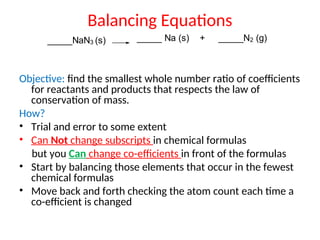
Balancing Equations
Objective: findthe smallest whole number ratio of coefficients
for reactants and products that respects the law of
conservation of mass.
How?
• Trial and error to some extent
• Can Not change subscripts in chemical formulas
but you Can change co-efficients in front of the formulas
• Start by balancing those elements that occur in the fewest
chemical formulas
• Move back and forth checking the atom count each time a
co-efficient is changed
_____NaN3 (s) _____ Na (s) + _____N2 (g)
7.
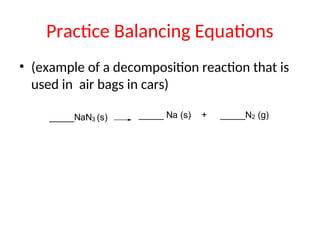
Practice Balancing Equations
•(example of a decomposition reaction that is
used in air bags in cars)
_____NaN3 (s) _____ Na (s) + _____N2 (g)
8.
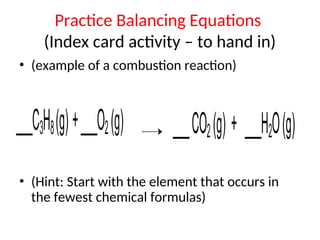
Practice Balancing Equations
(Indexcard activity – to hand in)
• (example of a combustion reaction)
• (Hint: Start with the element that occurs in
the fewest chemical formulas)
___C3H8(g)+___O2(g) ___CO2(g) + ___H2O(g)
9.
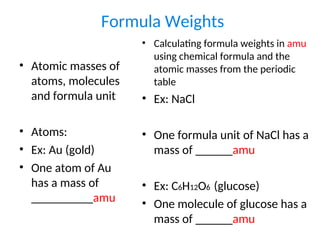
Formula Weights
• Atomicmasses of
atoms, molecules
and formula unit
• Atoms:
• Ex: Au (gold)
• One atom of Au
has a mass of
__________amu
• Calculating formula weights in amu
using chemical formula and the
atomic masses from the periodic
table
• Ex: NaCl
• One formula unit of NaCl has a
mass of ______amu
• Ex: C6H12O6 (glucose)
• One molecule of glucose has a
mass of ______amu
10.
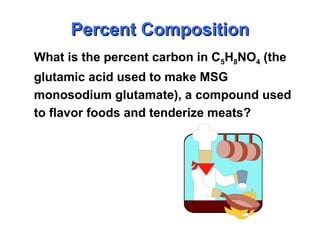
What is thepercent carbon in C5H8NO4 (the
glutamic acid used to make MSG
monosodium glutamate), a compound used
to flavor foods and tenderize meats?
Percent Composition
Percent Composition
11.
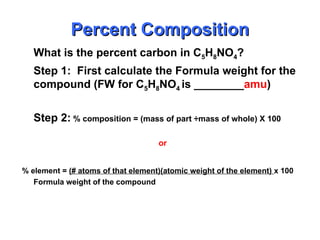
What is thepercent carbon in C5H8NO4?
Step 1: First calculate the Formula weight for the
compound (FW for C5H8NO4 is ________amu)
Step 2: % composition = (mass of part ÷mass of whole) X 100
or
% element = (# atoms of that element)(atomic weight of the element) x 100
Formula weight of the compound
Percent Composition
Percent Composition
12.
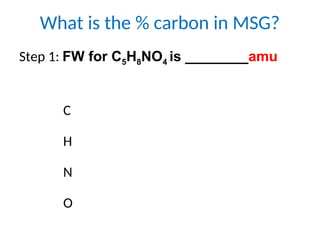
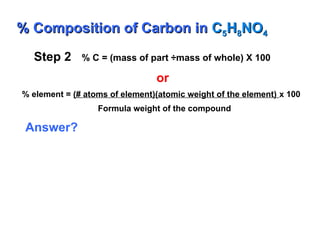
What is the% carbon in MSG?
Step 1: FW for C5H8NO4 is ________amu
C
H
N
O
13.
Step 2 %C = (mass of part ÷mass of whole) X 100
or
% element = (# atoms of element)(atomic weight of the element) x 100
Formula weight of the compound
Answer?
% Composition of Carbon in
% Composition of Carbon in C
C5
5H
H8
8NO
NO4
4
14.
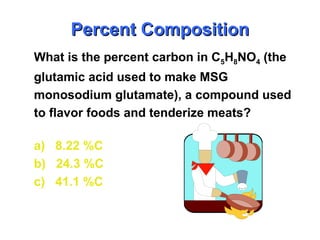
What is thepercent carbon in C5H8NO4 (the
glutamic acid used to make MSG
monosodium glutamate), a compound used
to flavor foods and tenderize meats?
a) 8.22 %C
b) 24.3 %C
c) 41.1 %C
Percent Composition
Percent Composition
15.
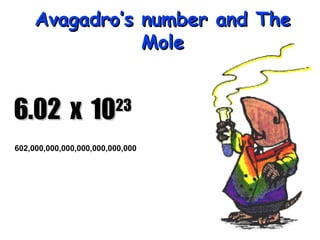
Avagadro’s number andThe
Avagadro’s number and The
Mole
Mole
6.02 x 10
6.02 x 10²³
23
602,000,000,000,000,000,000,000
16.
The Mole
The Mole
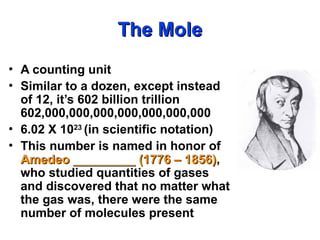
•A counting unit
• Similar to a dozen, except instead
of 12, it’s 602 billion trillion
602,000,000,000,000,000,000,000
• 6.02 X 10²³
(in scientific notation)
• This number is named in honor of
Amedeo _________ (1776 – 1856)
Amedeo _________ (1776 – 1856),
who studied quantities of gases
and discovered that no matter what
the gas was, there were the same
number of molecules present
17.
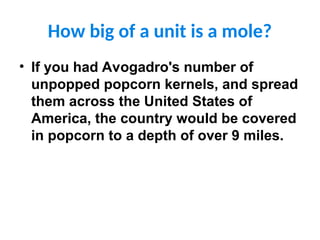
How big ofa unit is a mole?
• If you had Avogadro's number of
unpopped popcorn kernels, and spread
them across the United States of
America, the country would be covered
in popcorn to a depth of over 9 miles.
18.
The Mole (abbreviatedas mol)
The Mole (abbreviated as mol)
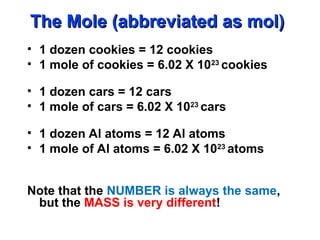
• 1 dozen cookies = 12 cookies
• 1 mole of cookies = 6.02 X 10²³
cookies
• 1 dozen cars = 12 cars
• 1 mole of cars = 6.02 X 10²³
cars
• 1 dozen Al atoms = 12 Al atoms
• 1 mole of Al atoms = 6.02 X 10²³
atoms
Note that the NUMBER is always the same,
but the MASS is very different!
19.
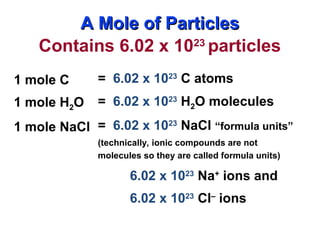
= 6.02 x10²³
C atoms
= 6.02 x 10²³
H2O molecules
= 6.02 x 10²³
NaCl “formula units”
(technically, ionic compounds are not
molecules so they are called formula units)
6.02 x 10²³
Na+
ions and
6.02 x 10²³
Cl–
ions
A Mole of Particles
A Mole of Particles
Contains 6.02 x 10²³
particles
1 mole C
1 mole H2O
1 mole NaCl
20.
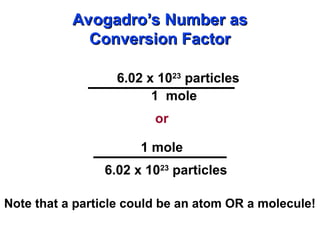
6.02 x 10²³
particles
1mole
or
1 mole
6.02 x 10²³
particles
Note that a particle could be an atom OR a molecule!
Avogadro’s Number as
Avogadro’s Number as
Conversion Factor
Conversion Factor
21.
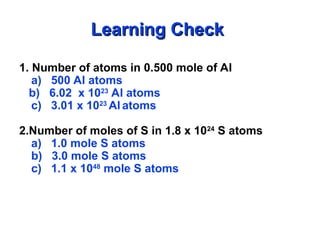
1. Number ofatoms in 0.500 mole of Al
a) 500 Al atoms
b) 6.02 x 10²³
Al atoms
c) 3.01 x 10²³
Al atoms
2.Number of moles of S in 1.8 x 1024
S atoms
a) 1.0 mole S atoms
b) 3.0 mole S atoms
c) 1.1 x 1048
mole S atoms
Learning Check
Learning Check
22.
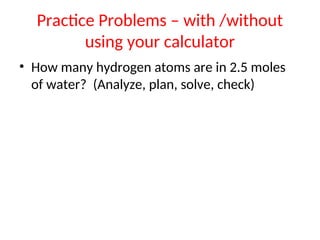
Practice Problems –with /without
using your calculator
• How many hydrogen atoms are in 2.5 moles
of water? (Analyze, plan, solve, check)
23.
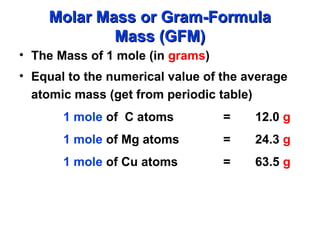
• The Massof 1 mole (in grams)
• Equal to the numerical value of the average
atomic mass (get from periodic table)
1 mole of C atoms = 12.0 g
1 mole of Mg atoms = 24.3 g
1 mole of Cu atoms = 63.5 g
Molar Mass or Gram-Formula
Molar Mass or Gram-Formula
Mass (GFM)
Mass (GFM)
24.
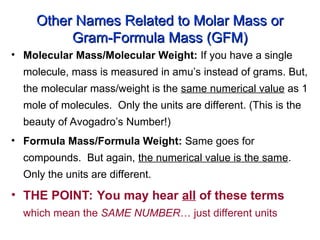
Other Names Relatedto Molar Mass or
Other Names Related to Molar Mass or
Gram-Formula Mass (GFM)
Gram-Formula Mass (GFM)
• Molecular Mass/Molecular Weight: If you have a single
molecule, mass is measured in amu’s instead of grams. But,
the molecular mass/weight is the same numerical value as 1
mole of molecules. Only the units are different. (This is the
beauty of Avogadro’s Number!)
• Formula Mass/Formula Weight: Same goes for
compounds. But again, the numerical value is the same.
Only the units are different.
• THE POINT: You may hear all of these terms
which mean the SAME NUMBER… just different units
25.
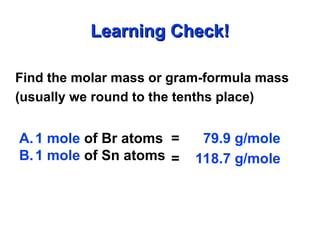
Find the molarmass or gram-formula mass
(usually we round to the tenths place)
Learning Check!
Learning Check!
A.1 mole of Br atoms
B.1 mole of Sn atoms
= 79.9 g/mole
= 118.7 g/mole
26.
Practice Problems –use mole road
map or concept map to help you solve
• How many atoms of copper are there in a 3
gram sample of copper?
(Interconverting mass and numbers of particles)
27.
Problems involving EmpiricalFormulas
and Molecular Formulas
• Resources:
• PPT
• POGIL
• Practice problems (in-class, chapter problem
set, online practice quiz questions)
28.
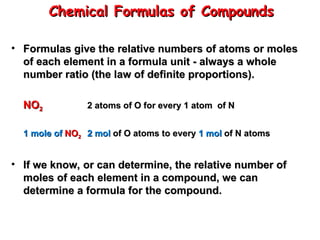
Chemical Formulas ofCompounds
Chemical Formulas of Compounds
• Formulas give the relative numbers of atoms or moles
Formulas give the relative numbers of atoms or moles
of each element in a formula unit - always a whole
of each element in a formula unit - always a whole
number ratio (the law of definite proportions).
number ratio (the law of definite proportions).
NO
NO2
2 2 atoms of O for every 1 atom of N
2 atoms of O for every 1 atom of N
1 mole of
1 mole of NO
NO2
2 2 mol
2 mol of O atoms to every
of O atoms to every 1 mol
1 mol of N atoms
of N atoms
• If we know, or can determine, the relative number of
If we know, or can determine, the relative number of
moles of each element in a compound, we can
moles of each element in a compound, we can
determine a formula for the compound.
determine a formula for the compound.
29.
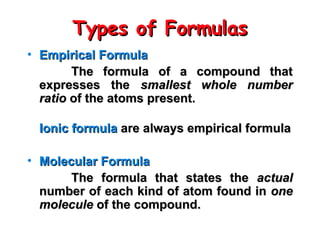
Types of Formulas
Typesof Formulas
• Empirical Formula
Empirical Formula
The formula of a compound that
The formula of a compound that
expresses the
expresses the smallest whole number
smallest whole number
ratio
ratio of the atoms present.
of the atoms present.
Ionic formula
Ionic formula are always empirical formula
are always empirical formula
• Molecular Formula
Molecular Formula
The formula that states the
The formula that states the actual
actual
number of each kind of atom found in
number of each kind of atom found in one
one
molecule
molecule of the compound.
of the compound.
30.
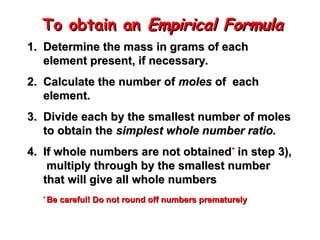
To obtain an
Toobtain an Empirical Formula
Empirical Formula
1.
1. Determine the mass in grams of each
Determine the mass in grams of each
element present, if necessary.
element present, if necessary.
2.
2. Calculate the number of
Calculate the number of moles
moles of
of each
each
element.
element.
3.
3. Divide each by the smallest number of moles
Divide each by the smallest number of moles
to obtain the
to obtain the simplest whole number ratio.
simplest whole number ratio.
4.
4. If whole numbers are not obtained
If whole numbers are not obtained*
*
in step 3),
in step 3),
multiply through by the smallest number
multiply through by the smallest number
that will give all whole numbers
that will give all whole numbers
*
*
Be careful! Do not round off numbers prematurely
Be careful! Do not round off numbers prematurely
31.
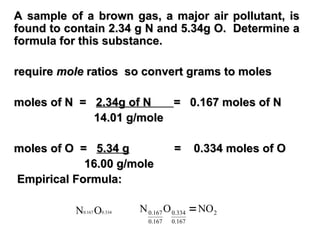
A sample ofa brown gas, a major air pollutant, is
A sample of a brown gas, a major air pollutant, is
found to contain 2.34 g N and 5.34g O. Determine a
found to contain 2.34 g N and 5.34g O. Determine a
formula for this substance.
formula for this substance.
require
require mole
mole ratios so convert grams to moles
ratios so convert grams to moles
moles of N =
moles of N = 2.34g of N
2.34g of N = 0.167 moles of N
= 0.167 moles of N
14.01 g/mole
14.01 g/mole
moles of O =
moles of O = 5.34 g
5.34 g = 0.334 moles of O
= 0.334 moles of O
16.00 g/mole
16.00 g/mole
Empirical Formula:
Empirical Formula:
0.334
0.167 O
N 0.167 0.334 2
0.167 0.167
N O NO
32.
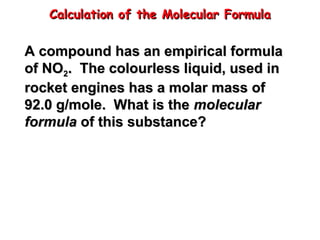
Calculation of theMolecular Formula
Calculation of the Molecular Formula
A compound has an empirical formula
A compound has an empirical formula
of NO
of NO2
2. The colourless liquid, used in
. The colourless liquid, used in
rocket engines has a molar mass of
rocket engines has a molar mass of
92.0 g/mole. What is the
92.0 g/mole. What is the molecular
molecular
formula
formula of this substance?
of this substance?
33.
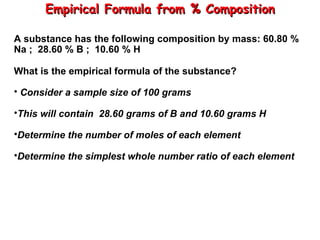
Empirical Formula from% Composition
Empirical Formula from % Composition
A substance has the following composition by mass: 60.80 %
Na ; 28.60 % B ; 10.60 % H
What is the empirical formula of the substance?
• Consider a sample size of 100 grams
•This will contain 28.60 grams of B and 10.60 grams H
•Determine the number of moles of each element
•Determine the simplest whole number ratio of each element
34.
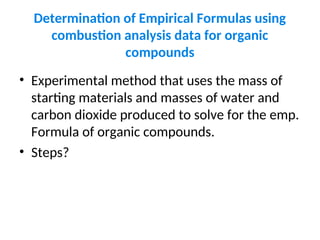
Determination of EmpiricalFormulas using
combustion analysis data for organic
compounds
• Experimental method that uses the mass of
starting materials and masses of water and
carbon dioxide produced to solve for the emp.
Formula of organic compounds.
• Steps?
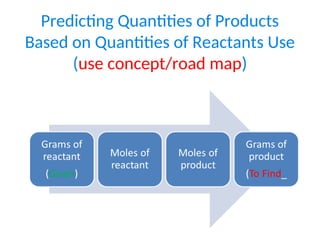
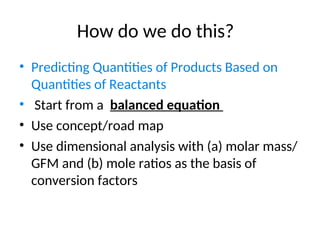
How do wedo this?
• Predicting Quantities of Products Based on
Quantities of Reactants
• Start from a balanced equation
• Use concept/road map
• Use dimensional analysis with (a) molar mass/
GFM and (b) mole ratios as the basis of
conversion factors
37.
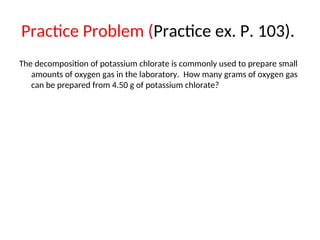
Practice Problem (Practiceex. P. 103).
The decomposition of potassium chlorate is commonly used to prepare small
amounts of oxygen gas in the laboratory. How many grams of oxygen gas
can be prepared from 4.50 g of potassium chlorate?
38.
Limiting reagents(reactants) problems
(Startwith POGIL “Limiting reactants”)
• Start with the balanced chemical equation
• Determine moles of reactants
• Setup tables [(initial, change and end (final)]
or ICE charts
• Identify the limiting reagent/reactant
• Finish the problem using dimensional analysis
40.
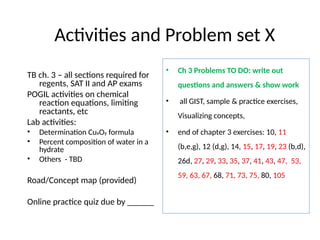
Activities and Problemset X
TB ch. 3 – all sections required for
regents, SAT II and AP exams
POGIL activities on chemical
reaction equations, limiting
reactants, etc
Lab activities:
• Determination CuxOy formula
• Percent composition of water in a
hydrate
• Others - TBD
Road/Concept map (provided)
Online practice quiz due by ______
• Ch 3 Problems TO DO: write out
questions and answers & show work
• all GIST, sample & practice exercises,
Visualizing concepts,
• end of chapter 3 exercises: 10, 11
(b,e,g), 12 (d,g), 14, 15, 17, 19, 23 (b,d),
26d, 27, 29, 33, 35, 37, 41, 43, 47, 53,
59, 63, 67, 68, 71, 73, 75, 80, 105
Editor's Notes
#15 To play the movies and simulations included, view the presentation in Slide Show Mode.

![Limiting reagents(reactants) problems
(Start with POGIL “Limiting reactants”)
• Start with the balanced chemical equation
• Determine moles of reactants
• Setup tables [(initial, change and end (final)]
or ICE charts
• Identify the limiting reagent/reactant
• Finish the problem using dimensional analysis](https://image.slidesharecdn.com/introductiontostoichiometryandmolecalculations-260105061215-4d785058/85/Introduction-to-Stoichiometry-and-Molecalculations-ppt-38-320.jpg)



![Ppt 2 S1.4Counting particles by mass The mole [Autosaved].pptx](https://cdn.slidesharecdn.com/ss_thumbnails/ppt2s1-240830135241-76f72799-thumbnail.jpg?width=640&height=640&fit=bounds)


![namma_kalvi_11th_chemistry_unit_1_ppt_em_218218 [Autosaved].pptx](https://cdn.slidesharecdn.com/ss_thumbnails/nammakalvi11thchemistryunit1pptem218218autosaved-250528062629-1e37d33f-thumbnail.jpg?width=640&height=640&fit=bounds)


