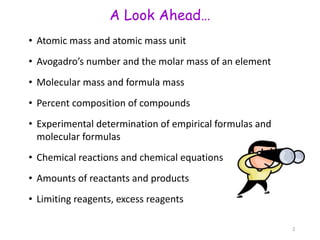
A Look Ahead…
•Atomic mass and atomic mass unit
• Avogadro’s number and the molar mass of an element
• Molecular mass and formula mass
• Percent composition of compounds
• Experimental determination of empirical formulas and
molecular formulas
• Chemical reactions and chemical equations
• Amounts of reactants and products
• Limiting reagents, excess reagents
2
3.
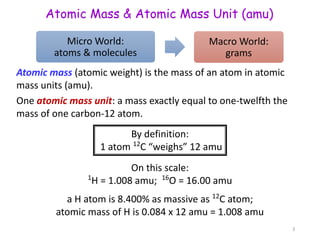
By definition:
1 atom12
C “weighs” 12 amu
On this scale:
1
H = 1.008 amu; 16
O = 16.00 amu
Atomic mass (atomic weight) is the mass of an atom in atomic
mass units (amu).
One atomic mass unit: a mass exactly equal to one-twelfth the
mass of one carbon-12 atom.
a H atom is 8.400% as massive as 12
C atom;
atomic mass of H is 0.084 x 12 amu = 1.008 amu
Atomic Mass & Atomic Mass Unit (amu)
3
Micro World:
atoms & molecules
Macro World:
grams
4.
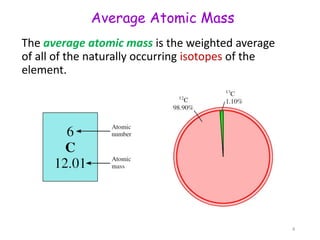
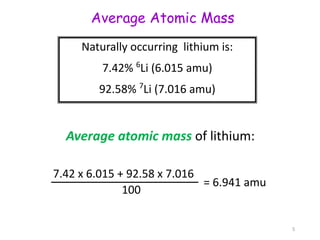
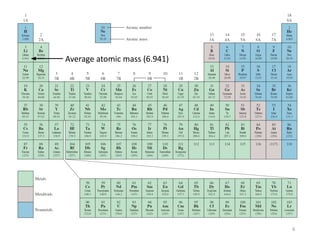
The average atomicmass is the weighted average
of all of the naturally occurring isotopes of the
element.
Average Atomic Mass
4
5.
Naturally occurring lithiumis:
7.42% 6
Li (6.015 amu)
92.58% 7
Li (7.016 amu)
7.42 x 6.015 + 92.58 x 7.016
100
= 6.941 amu
Average atomic mass of lithium:
Average Atomic Mass
5
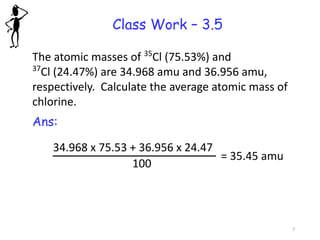
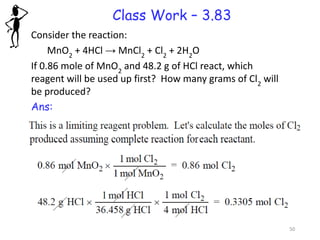
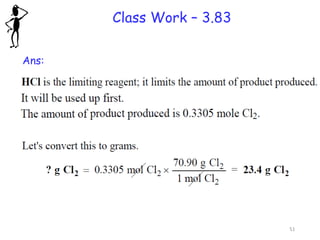
Class Work –3.5
The atomic masses of 35
Cl (75.53%) and
37
Cl (24.47%) are 34.968 amu and 36.956 amu,
respectively. Calculate the average atomic mass of
chlorine.
Ans:
34.968 x 75.53 + 36.956 x 24.47
100
= 35.45 amu
7
8.
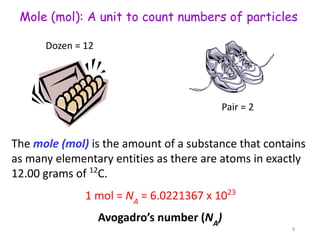
The mole (mol)is the amount of a substance that contains
as many elementary entities as there are atoms in exactly
12.00 grams of 12
C.
1 mol = NA
= 6.0221367 x 10²³
Avogadro’s number (NA
)
Dozen = 12
Pair = 2
Mole (mol): A unit to count numbers of particles
8
9.
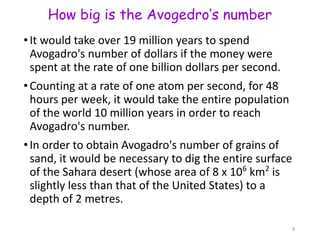
How big isthe Avogedro’s number
•It would take over 19 million years to spend
Avogadro's number of dollars if the money were
spent at the rate of one billion dollars per second.
•Counting at a rate of one atom per second, for 48
hours per week, it would take the entire population
of the world 10 million years in order to reach
Avogadro's number.
•In order to obtain Avogadro's number of grains of
sand, it would be necessary to dig the entire surface
of the Sahara desert (whose area of 8 x 10⁶
km2
is
slightly less than that of the United States) to a
depth of 2 metres.
9
10.
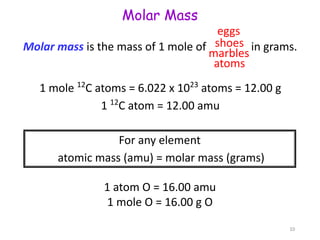
Molar mass isthe mass of 1 mole of in grams.
eggs
shoes
marbles
atoms
1 mole 12
C atoms = 6.022 x 10²³
atoms = 12.00 g
1 12
C atom = 12.00 amu
For any element
atomic mass (amu) = molar mass (grams)
Molar Mass
1 atom O = 16.00 amu
1 mole O = 16.00 g O
10
11.
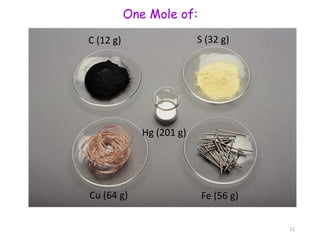
One Mole of:
C(12 g) S (32 g)
Cu (64 g) Fe (56 g)
Hg (201 g)
11
12.
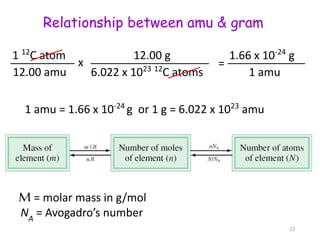
1 amu =1.66 x 10⁻²⁴
g or 1 g = 6.022 x 10²³
amu
1 12
C atom
12.00 amu
x
12.00 g
6.022 x 10²³ 12
C atoms
=
1.66 x 10⁻²⁴
g
1 amu
M = molar mass in g/mol
NA
= Avogadro’s number
Relationship between amu & gram
12
13.
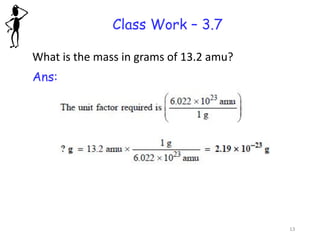
Class Work –3.7
What is the mass in grams of 13.2 amu?
Ans:
13
14.
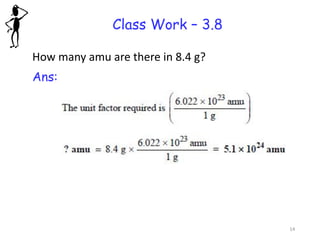
Class Work –3.8
How many amu are there in 8.4 g?
Ans:
14
15.
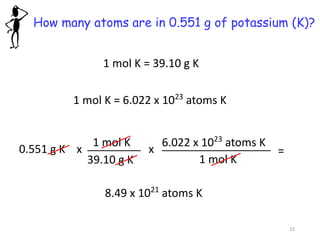
x
6.022 x 10²³
atomsK
1 mol K
=
How many atoms are in 0.551 g of potassium (K)?
1 mol K = 39.10 g K
1 mol K = 6.022 x 10²³
atoms K
0.551 g K
1 mol K
39.10 g K
x
8.49 x 10²¹
atoms K
15
16.
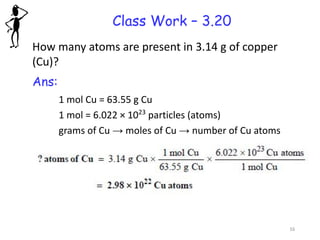
Class Work –3.20
How many atoms are present in 3.14 g of copper
(Cu)?
Ans:
1 mol Cu = 63.55 g Cu
1 mol = 6.022 × 10²³
particles (atoms)
grams of Cu → moles of Cu → number of Cu atoms
16
17.
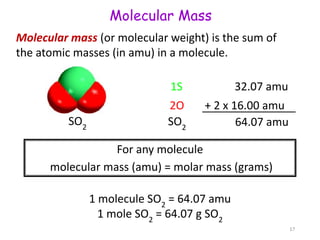
Molecular mass (ormolecular weight) is the sum of
the atomic masses (in amu) in a molecule.
1S 32.07 amu
2O + 2 x 16.00 amu
SO2
64.07 amu
For any molecule
molecular mass (amu) = molar mass (grams)
1 molecule SO2
= 64.07 amu
1 mole SO2
= 64.07 g SO2
SO2
Molecular Mass
17
18.
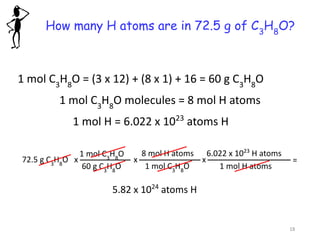
How many Hatoms are in 72.5 g of C3
H8
O?
1 mol C3
H8
O = (3 x 12) + (8 x 1) + 16 = 60 g C3
H8
O
1 mol H = 6.022 x 10²³
atoms H
5.82 x 1024
atoms H
1 mol C3
H8
O molecules = 8 mol H atoms
72.5 g C3
H8
O
1 mol C3
H8
O
60 g C3
H8
O
x
8 mol H atoms
1 mol C3
H8
O
x
6.022 x 1023
H atoms
1 mol H atoms
x =
18
19.
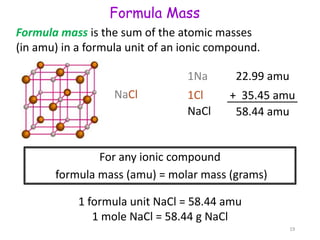
Formula mass isthe sum of the atomic masses
(in amu) in a formula unit of an ionic compound.
1Na 22.99 amu
1Cl + 35.45 amu
NaCl 58.44 amu
For any ionic compound
formula mass (amu) = molar mass (grams)
1 formula unit NaCl = 58.44 amu
1 mole NaCl = 58.44 g NaCl
NaCl
Formula Mass
19
20.
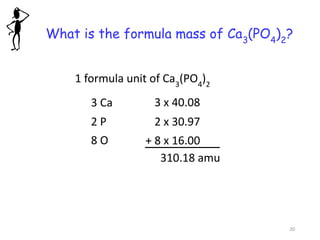
What is theformula mass of Ca3
(PO4
)2
?
1 formula unit of Ca3
(PO4
)2
3 Ca 3 x 40.08
2 P 2 x 30.97
8 O + 8 x 16.00
310.18 amu
20
21.
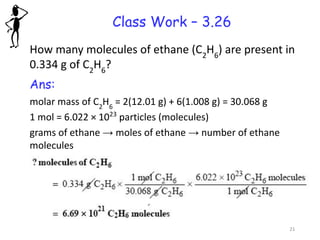
Class Work –3.26
How many molecules of ethane (C2
H6
) are present in
0.334 g of C2
H6
?
Ans:
molar mass of C2
H6
= 2(12.01 g) + 6(1.008 g) = 30.068 g
1 mol = 6.022 × 10²³
particles (molecules)
grams of ethane → moles of ethane → number of ethane
molecules
21
22.
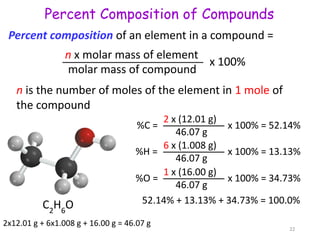
Percent composition ofan element in a compound =
n x molar mass of element
molar mass of compound
x 100%
n is the number of moles of the element in 1 mole of
the compound
C2
H6
O
%C =
2 x (12.01 g)
46.07 g
x 100% = 52.14%
%H =
6 x (1.008 g)
46.07 g
x 100% = 13.13%
%O =
1 x (16.00 g)
46.07 g
x 100% = 34.73%
52.14% + 13.13% + 34.73% = 100.0%
Percent Composition of Compounds
2x12.01 g + 6x1.008 g + 16.00 g = 46.07 g
22
23.
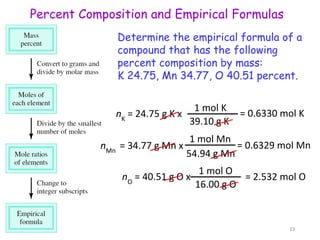
Percent Composition andEmpirical Formulas
Determine the empirical formula of a
compound that has the following
percent composition by mass:
K 24.75, Mn 34.77, O 40.51 percent.
nK
= 24.75 g K x = 0.6330 mol K
1 mol K
39.10 g K
nO
= 40.51 g O x = 2.532 mol O
1 mol O
16.00 g O
nMn
= 34.77 g Mn x = 0.6329 mol Mn
1 mol Mn
54.94 g Mn
23
24.
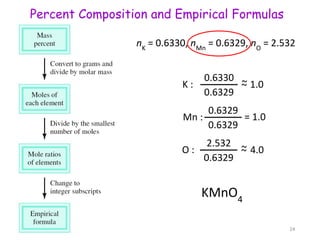
Percent Composition andEmpirical Formulas
K : ~
~ 1.0
0.6330
0.6329
Mn :
0.6329
0.6329
= 1.0
O : ~
~ 4.0
2.532
0.6329
nK
= 0.6330, nMn
= 0.6329, nO
= 2.532
KMnO4
24
25.
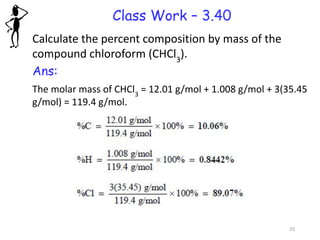
Class Work –3.40
Calculate the percent composition by mass of the
compound chloroform (CHCl3
).
Ans:
The molar mass of CHCl3
= 12.01 g/mol + 1.008 g/mol + 3(35.45
g/mol) = 119.4 g/mol.
25
26.
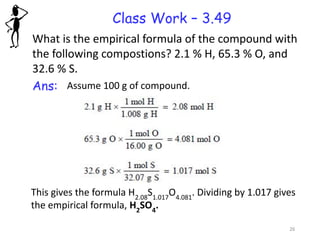
Class Work –3.49
What is the empirical formula of the compound with
the following compostions? 2.1 % H, 65.3 % O, and
32.6 % S.
Ans: Assume 100 g of compound.
This gives the formula H2.08
S1.017
O4.081
. Dividing by 1.017 gives
the empirical formula, H2
SO4
.
26
27.
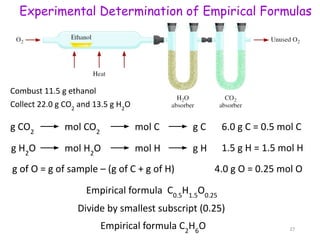
g CO2
mol CO2
molC g C
g H2
O mol H2
O mol H g H
g of O = g of sample – (g of C + g of H)
Combust 11.5 g ethanol
Collect 22.0 g CO2
and 13.5 g H2
O
6.0 g C = 0.5 mol C
1.5 g H = 1.5 mol H
4.0 g O = 0.25 mol O
Empirical formula C0.5
H1.5
O0.25
Divide by smallest subscript (0.25)
Empirical formula C2
H6
O
Experimental Determination of Empirical Formulas
27
28.
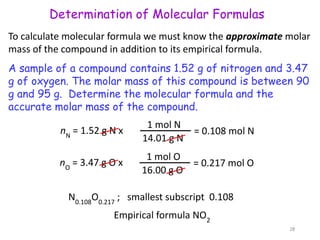
Determination of MolecularFormulas
A sample of a compound contains 1.52 g of nitrogen and 3.47
g of oxygen. The molar mass of this compound is between 90
g and 95 g. Determine the molecular formula and the
accurate molar mass of the compound.
nN
= 1.52 g N x = 0.108 mol N
1 mol N
14.01 g N
nO
= 3.47 g O x = 0.217 mol O
1 mol O
16.00 g O
N0.108
O0.217
; smallest subscript 0.108
Empirical formula NO2
28
To calculate molecular formula we must know the approximate molar
mass of the compound in addition to its empirical formula.
29.
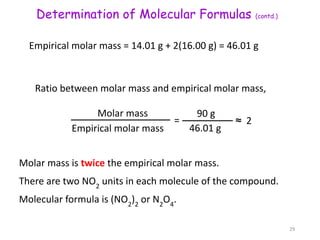
Determination of MolecularFormulas (contd.)
Empirical molar mass = 14.01 g + 2(16.00 g) = 46.01 g
Ratio between molar mass and empirical molar mass,
Molar mass
Empirical molar mass
90 g
46.01 g
= ≈ 2
Molar mass is twice the empirical molar mass.
There are two NO2
units in each molecule of the compound.
Molecular formula is (NO2
)2
or N2
O4
.
29
30.
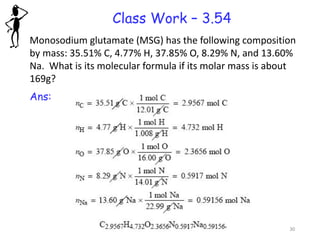
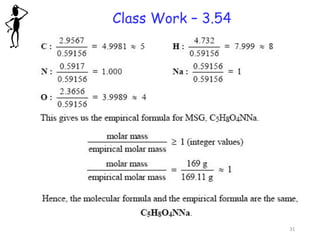
Class Work –3.54
Monosodium glutamate (MSG) has the following composition
by mass: 35.51% C, 4.77% H, 37.85% O, 8.29% N, and 13.60%
Na. What is its molecular formula if its molar mass is about
169g?
Ans:
30
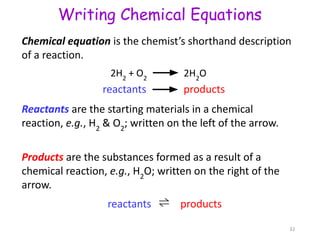
reactants products
Writing ChemicalEquations
2H2
+ O2
2H2
O
Reactants are the starting materials in a chemical
reaction, e.g., H2
& O2
; written on the left of the arrow.
Chemical equation is the chemist’s shorthand description
of a reaction.
Products are the substances formed as a result of a
chemical reaction, e.g., H2
O; written on the right of the
arrow.
reactants products
⇌
32
33.
Writing Chemical Equations
Physicalstates are represented by g(gas), l(liquid) & s(solid):
2CO(g) + O2
(g) 2CO2
(g)
2HgO(s) 2Hg(l) + O2
(g)
NaCl(s) NaCl(aq)
H2
O
KBr(aq) + AgNO3
(aq) KNO3
(aq) + AgBr(s)
[No reaction in solid phase]
33
34.
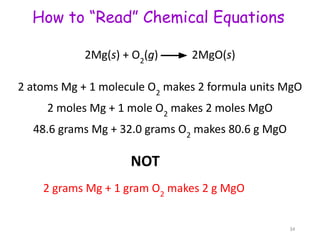
How to “Read”Chemical Equations
2Mg(s) + O2
(g) 2MgO(s)
2 atoms Mg + 1 molecule O2
makes 2 formula units MgO
2 moles Mg + 1 mole O2
makes 2 moles MgO
48.6 grams Mg + 32.0 grams O2
makes 80.6 g MgO
NOT
2 grams Mg + 1 gram O2
makes 2 g MgO
34
35.
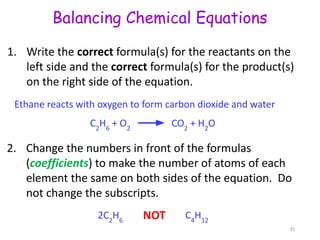
Balancing Chemical Equations
1.Write the correct formula(s) for the reactants on the
left side and the correct formula(s) for the product(s)
on the right side of the equation.
Ethane reacts with oxygen to form carbon dioxide and water
C2
H6
+ O2
CO2
+ H2
O
2. Change the numbers in front of the formulas
(coefficients) to make the number of atoms of each
element the same on both sides of the equation. Do
not change the subscripts.
2C2
H6 NOT C4
H12
35
36.
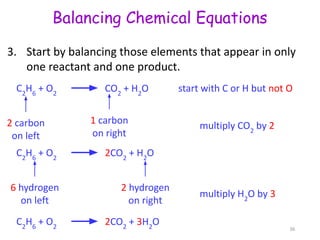
Balancing Chemical Equations
3.Start by balancing those elements that appear in only
one reactant and one product.
C2
H6
+ O2
CO2
+ H2
O start with C or H but not O
2 carbon
on left
1 carbon
on right
multiply CO2
by 2
C2
H6
+ O2
2CO2
+ H2
O
6 hydrogen
on left
2 hydrogen
on right
multiply H2
O by 3
C2
H6
+ O2
2CO2
+ 3H2
O
36
37.
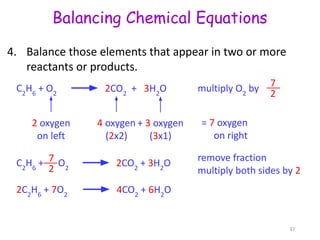
Balancing Chemical Equations
4.Balance those elements that appear in two or more
reactants or products.
2 oxygen
on left
4 oxygen
(2x2)
C2
H6
+ O2
2CO2
+ 3H2
O
+ 3 oxygen
(3x1)
multiply O2
by
7
2
= 7 oxygen
on right
C2
H6
+ O2
2CO2
+ 3H2
O
7
2
remove fraction
multiply both sides by 2
2C2
H6
+ 7O2
4CO2
+ 6H2
O
37
38.
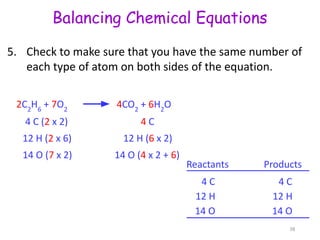
Balancing Chemical Equations
5.Check to make sure that you have the same number of
each type of atom on both sides of the equation.
2C2
H6
+ 7O2
4CO2
+ 6H2
O
Reactants Products
4 C
12 H
14 O
4 C
12 H
14 O
4 C (2 x 2) 4 C
12 H (2 x 6) 12 H (6 x 2)
14 O (7 x 2) 14 O (4 x 2 + 6)
38
39.
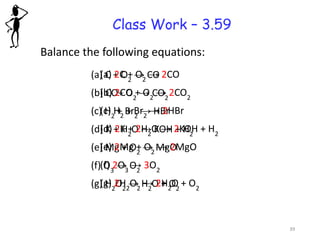
Class Work –3.59
Balance the following equations:
(a) C + O2
→ CO
(b) CO+ O2
→ CO2
(c) H2
+ Br2
→ HBr
(d) K + H2
O → KOH + H2
(e) Mg + O2
→ MgO
(f) O3
→ O2
(g) H2
O2
→ H2
O + O2
(a) 2C + O2
→ 2CO
(b) 2CO + O2
→ 2CO2
(c) H2
+ Br2
→ 2HBr
(d) 2K + 2H2
O → 2KOH + H2
(e) 2Mg + O2
→ 2MgO
(f) 2O3
→ 3O2
(g) 2H2
O2
→ 2H2
O + O2
39
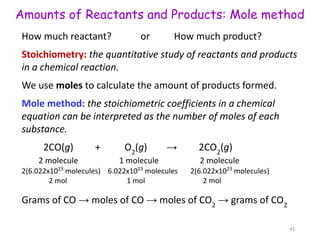
How much reactant?or How much product?
Stoichiometry: the quantitative study of reactants and products
in a chemical reaction.
We use moles to calculate the amount of products formed.
Mole method: the stoichiometric coefficients in a chemical
equation can be interpreted as the number of moles of each
substance.
2CO(g) + O2
(g) → 2CO2
(g)
2 molecule 1 molecule 2 molecule
2(6.022x10²³
molecules) 6.022x10²³
molecules 2(6.022x10²³
molecules)
2 mol 1 mol 2 mol
Grams of CO → moles of CO → moles of CO2
→ grams of CO2
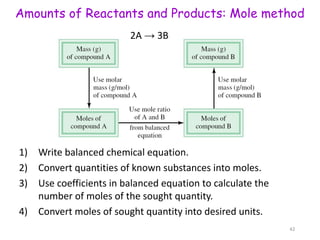
Amounts of Reactants and Products: Mole method
41
42.
1) Write balancedchemical equation.
2) Convert quantities of known substances into moles.
3) Use coefficients in balanced equation to calculate the
number of moles of the sought quantity.
4) Convert moles of sought quantity into desired units.
Amounts of Reactants and Products: Mole method
42
2A → 3B
43.
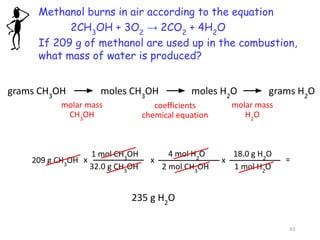
Methanol burns inair according to the equation
2CH3
OH + 3O2
→ 2CO2
+ 4H2
O
If 209 g of methanol are used up in the combustion,
what mass of water is produced?
grams CH3
OH moles CH3
OH moles H2
O grams H2
O
molar mass
CH3
OH
coefficients
chemical equation
molar mass
H2
O
209 g CH3
OH
1 mol CH3
OH
32.0 g CH3
OH
x
4 mol H2
O
2 mol CH3
OH
x
18.0 g H2
O
1 mol H2
O
x =
235 g H2
O
43
44.
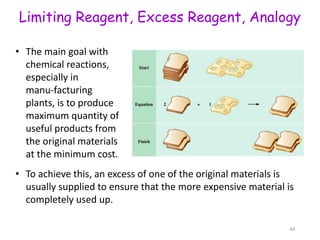
Limiting Reagent, ExcessReagent, Analogy
44
• The main goal with
chemical reactions,
especially in
manu-facturing
plants, is to produce
maximum quantity of
useful products from
the original materials
at the minimum cost.
• To achieve this, an excess of one of the original materials is
usually supplied to ensure that the more expensive material is
completely used up.
45.
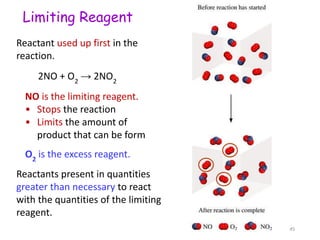
Limiting Reagent
2NO +O2
→ 2NO2
NO is the limiting reagent.
• Stops the reaction
• Limits the amount of
product that can be form
O2
is the excess reagent.
Reactant used up first in the
reaction.
Reactants present in quantities
greater than necessary to react
with the quantities of the limiting
reagent.
45
46.
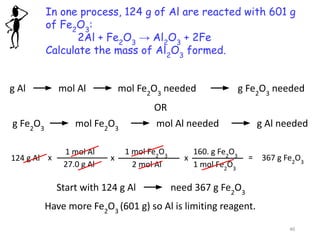
In one process,124 g of Al are reacted with 601 g
of Fe2
O3
:
2Al + Fe2
O3
→ Al2
O3
+ 2Fe
Calculate the mass of Al2
O3
formed.
g Al mol Al mol Fe2
O3
needed g Fe2
O3
needed
OR
g Fe2
O3
mol Fe2
O3
mol Al needed g Al needed
124 g Al
1 mol Al
27.0 g Al
x
1 mol Fe2
O3
2 mol Al
x
160. g Fe2
O3
1 mol Fe2
O3
x = 367 g Fe2
O3
Start with 124 g Al need 367 g Fe2
O3
Have more Fe2
O3
(601 g) so Al is limiting reagent.
46
47.
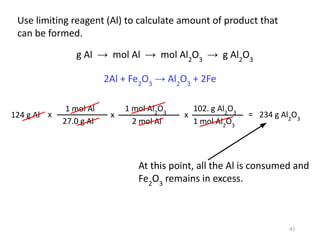
Use limiting reagent(Al) to calculate amount of product that
can be formed.
124 g Al
1 mol Al
27.0 g Al
x
1 mol Al2
O3
2 mol Al
x
102. g Al2
O3
1 mol Al2
O3
x = 234 g Al2
O3
2Al + Fe2
O3
→ Al2
O3
+ 2Fe
At this point, all the Al is consumed and
Fe2
O3
remains in excess.
47
g Al → mol Al → mol Al2
O3
→ g Al2
O3
48.
Class Work –3.83
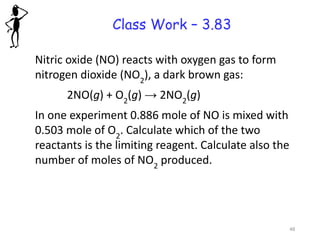
Nitric oxide (NO) reacts with oxygen gas to form
nitrogen dioxide (NO2
), a dark brown gas:
2NO(g) + O2
(g) → 2NO2
(g)
In one experiment 0.886 mole of NO is mixed with
0.503 mole of O2
. Calculate which of the two
reactants is the limiting reagent. Calculate also the
number of moles of NO2
produced.
48
49.
Class Work –3.83
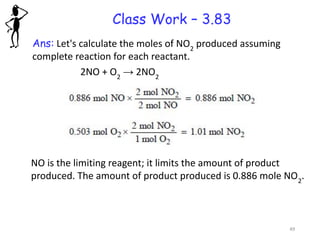
Ans: Let's calculate the moles of NO2
produced assuming
complete reaction for each reactant.
2NO + O2
→ 2NO2
NO is the limiting reagent; it limits the amount of product
produced. The amount of product produced is 0.886 mole NO2
.
49
50.
Class Work –3.83
Consider the reaction:
MnO2
+ 4HCl → MnCl2
+ Cl2
+ 2H2
O
If 0.86 mole of MnO2
and 48.2 g of HCl react, which
reagent will be used up first? How many grams of Cl2
will
be produced?
Ans:
50

![Writing Chemical Equations
Physical states are represented by g(gas), l(liquid) & s(solid):
2CO(g) + O2
(g) 2CO2
(g)
2HgO(s) 2Hg(l) + O2
(g)
NaCl(s) NaCl(aq)
H2
O
KBr(aq) + AgNO3
(aq) KNO3
(aq) + AgBr(s)
[No reaction in solid phase]
33](https://image.slidesharecdn.com/03ch03massrelation-250317223728-b186621b/85/03_Ch03_Chemistry_Mass-Relation-pptx-2-pdf-33-320.jpg)


![Ppt 2 S1.4Counting particles by mass The mole [Autosaved].pptx](https://cdn.slidesharecdn.com/ss_thumbnails/ppt2s1-240830135241-76f72799-thumbnail.jpg?width=640&height=640&fit=bounds)


![Polymer [ बहुलक ] Chemistry Notes PDF - Irfanullah Mehar - JJ Sir Chemistry.pdf](https://cdn.slidesharecdn.com/ss_thumbnails/polymerchemistrynotespdf-irfanullahmehar-jjsirchemistry-260210172118-3f9b37f7-thumbnail.jpg?width=640&height=640&fit=bounds)


