Calculating Truss Forces
Forces
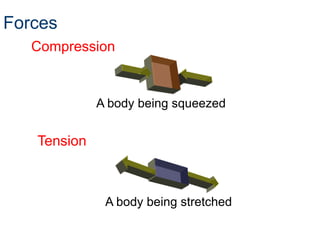
   Compression


             A body being squeezed


   Tension


              A body being stretched
Truss
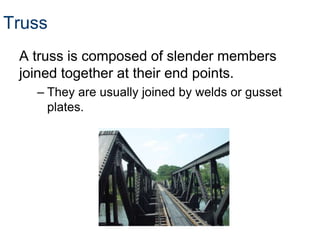
 A truss is composed of slender members
 joined together at their end points.
   – They are usually joined by welds or gusset
     plates.
Simple Truss
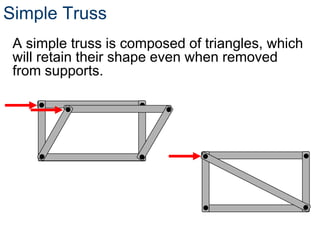
 A simple truss is composed of triangles, which
 will retain their shape even when removed
 from supports.
Pinned and Roller Supports
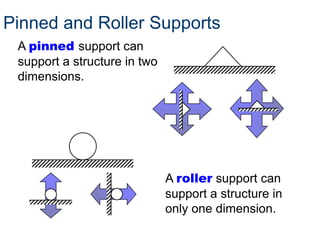
 A pinned support can
 support a structure in two
 dimensions.


                              A roller support can
                              support a structure in
                              only one dimension.
Solving Truss Forces
 Assumptions:
   All members are perfectly straight.
   All loads are applied at the joints.
   All joints are pinned and frictionless.
   Each member has no weight.
   Members can only experience tension or
   compression forces.
     What risks might these assumptions pose if
     we were designing an actual bridge?
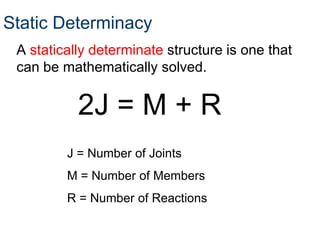
Static Determinacy
 A statically determinate structure is one that
 can be mathematically solved.


           2J = M + R
         J = Number of Joints
         M = Number of Members
         R = Number of Reactions
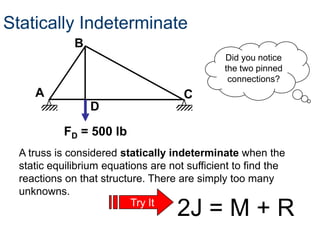
Statically Indeterminate
              B
                                               Did you notice
                                               the two pinned
                                                connections?
     A                                C
                  D

           FD = 500 lb
  A truss is considered statically indeterminate when the
  static equilibrium equations are not sufficient to find the
  reactions on that structure. There are simply too many
  unknowns.
                           Try It
                                     2J = M + R
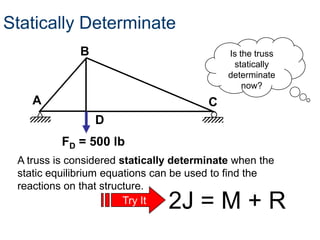
Statically Determinate
             B                              Is the truss
                                             statically
                                            determinate
                                                now?
    A                                   C
                 D
          FD = 500 lb
 A truss is considered statically determinate when the
 static equilibrium equations can be used to find the
 reactions on that structure.
                        Try It  2J = M + R
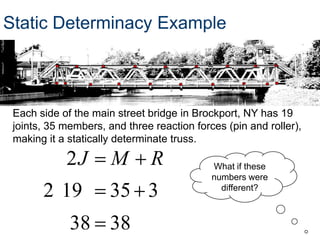
Static Determinacy Example


 Each side of the main street bridge in Brockport, NY has 19
 joints, 35 members, and three reaction forces (pin and roller),
 making it a statically determinate truss.

            2J        M        R            What if these
                                            numbers were
       2 19           35 3                    different?


             38 38
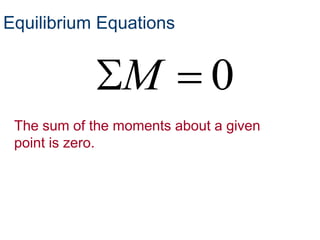
Equilibrium Equations


                M            0
 The sum of the moments about a given
 point is zero.
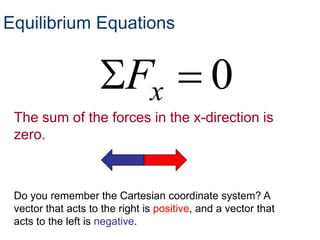
Equilibrium Equations


                          Fx                  0
 The sum of the forces in the x-direction is
 zero.


 Do you remember the Cartesian coordinate system? A
 vector that acts to the right is positive, and a vector that
 acts to the left is negative.
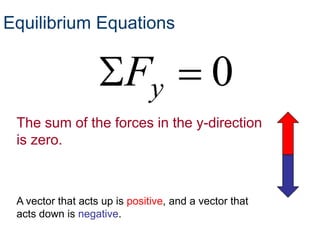
Equilibrium Equations


                         Fy                 0
 The sum of the forces in the y-direction
 is zero.


 A vector that acts up is positive, and a vector that
 acts down is negative.
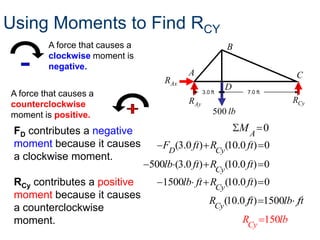
Using Moments to Find RCY
         A force that causes a                            B
         clockwise moment is
         negative.
                                          A                                C
                                    RAx
                                                          D
A force that causes a                            3.0 ft         7.0 ft

counterclockwise                          R Ay                             RCy
moment is positive.                                   500 lb

 FD contributes a negative                                     MA 0
 moment because it causes           FD(3.0 ft) RCy(10.0 ft) 0
 a clockwise moment.
                                 500lb (3.0 ft) RCy(10.0 ft) 0
 RCy contributes a positive         1500lb ft RCy(10.0 ft) 0
 moment because it causes
                                                    RCy (10.0 ft) 1500lb ft
 a counterclockwise
 moment.                                                       RCy 150lb
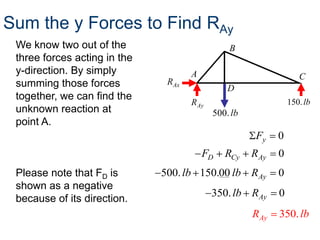
Sum the y Forces to Find RAy
 We know two out of the                         B
 three forces acting in the
 y-direction. By simply              A                             C
 summing those forces          RAx
                                                D
 together, we can find the                                      150. lb
                                     R Ay
 unknown reaction at                        500. lb
 point A.
                                                      Fy    0
                                         FD    RCy    RAy   0
 Please note that FD is       500. lb 150.00 lb RAy         0
 shown as a negative
                                            350. lb RAy     0
 because of its direction.
                                                      RAy   350. lb
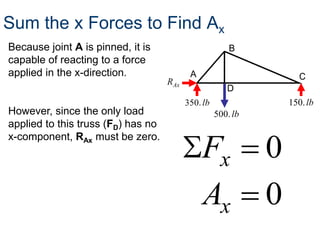
Sum the x Forces to Find Ax
Because joint A is pinned, it is                        B
capable of reacting to a force
applied in the x-direction.                A                        C
                                    RAx
                                                       D
                                          350. lb                 150. lb
However, since the only load                        500. lb
applied to this truss (FD) has no
x-component, RAx must be zero.
                                               Fx             0
                                               Ax             0
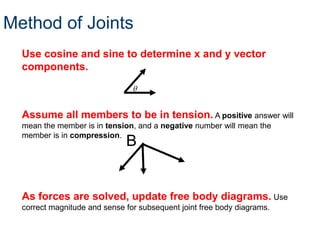
Method of Joints
  Use cosine and sine to determine x and y vector
  components.


  Assume all members to be in tension. A positive answer will
  mean the member is in tension, and a negative number will mean the

                              B
  member is in compression.


  As forces are solved, update free body diagrams. Use
  correct magnitude and sense for subsequent joint free body diagrams.
Method of Joints
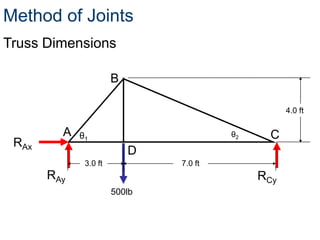
Truss Dimensions

                       B

                                                   4.0 ft

         A   θ1                         θ2     C
 RAx
                           D
              3.0 ft           7.0 ft
       RAy                                   RCy
                       500lb
Method of Joints
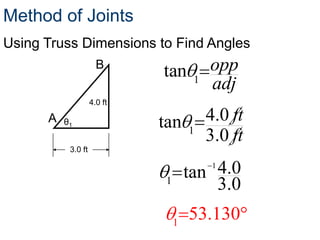
Using Truss Dimensions to Find Angles
                      B
                                 tan           opp
                                           1
                                               adj
                                                            4.0 ft
                    4.0 ft

      A   θ1                     tan           4.0 ft
                                                θ   2   C
                                           1
                             D                 3.0 ft
           3.0 ft                 7.0 ft


                                          tan 4.0
                                                1
                                  1
                                              3.0
                                      1
                                           53.130
Method of Joints
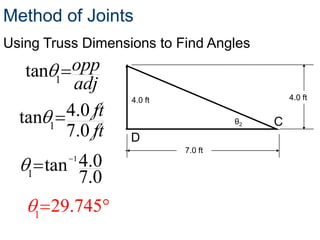
Using Truss Dimensions to Find Angles

   tan 1  opp              B
          adj
                               4.0 ft                     4.0 ft
         4.0 ft
  tan 1 A θ                                      θ2   C
         7.0 ft   1

                               D
                  3.0 ft                7.0 ft

           tan 4.0
              1
   1
               7.0
       1
           29.745
Method of Joints
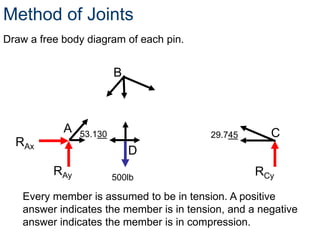
Draw a free body diagram of each pin.


                         B


            A   53.130                    29.745      C
  RAx
                             D
          RAy            500lb
                                                   RCy
   Every member is assumed to be in tension. A positive
   answer indicates the member is in tension, and a negative
   answer indicates the member is in compression.
Method of Joints
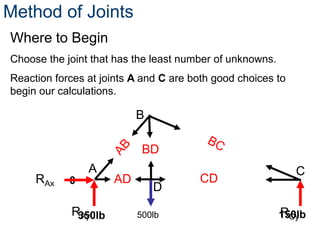
Where to Begin
Choose the joint that has the least number of unknowns.
Reaction forces at joints A and C are both good choices to
begin our calculations.

                          B

                           BD
                A                                            C
     RAx    0        AD                CD
                              D
            RAy
             350lb        500lb                           RCy
                                                          150lb
Method of Joints

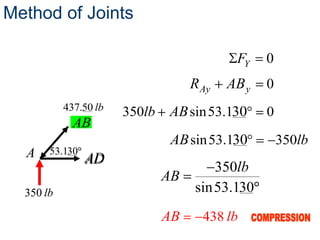
                                           FY    0
                                    RAy   AB y   0
           437.50 lb   350lb   AB sin 53.130     0
             AB
                               AB sin 53.130         350lb
  A    53.130
                AD
                                        350lb
                               AB
  350 lb                            sin 53.130
                               AB    438 lb
Method of Joints
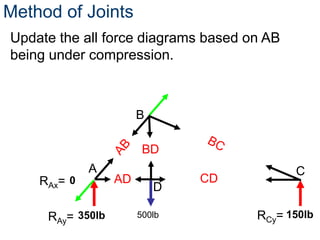
Update the all force diagrams based on AB
being under compression.


                       B

                        BD
             A                              C
    RAx= 0        AD           CD
                           D

     RAy= 350lb        500lb         RCy= 150lb
Method of Joints

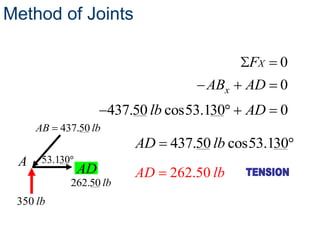
                                             FX   0
                                       ABx   AD 0
                       437.50 lb cos53.130   AD 0
     AB   437.50 lb
                           AD 437.50 lb cos53.130
 A    53.130
                AD         AD    262.50 lb
               262.50 lb
 350 lb
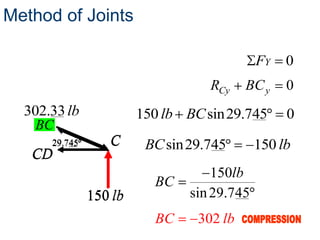
Method of Joints

                                             FY   0
                                   RCy    BC y    0
  302.33 lb             150 lb BC sin 29.745      0
    BC
      29.745      C      BC sin 29.745       150 lb
   CD
                                    150lb
                          BC
               150 lb           sin 29.745
                          BC     302 lb
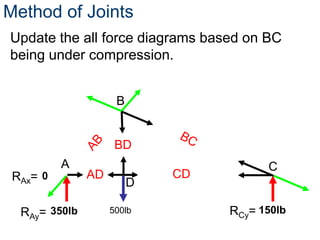
Method of Joints
Update the all force diagrams based on BC
being under compression.


                     B


                     BD
          A                             C
 RAx= 0        AD            CD
                         D

  RAy= 350lb        500lb         RCy= 150lb
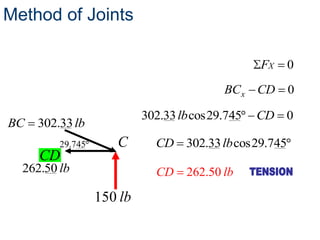
Method of Joints

                                                 FX   0
                                          BCx CD      0

                           302.33 lb cos29.745   CD 0
BC   302.33 lb
         29.745      C       CD 302.33 lb cos29.745
     CD
  262.50 lb                  CD    262.50 lb

                  150 lb
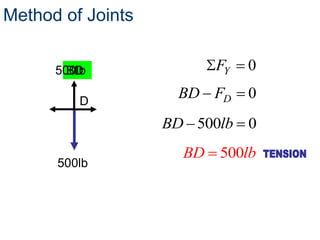
Method of Joints


      500lb
        BD              FY   0

         D
                    BD FD    0
                   BD 500lb 0
                     BD 500lb
      500lb

Calculating truss forces

  • 1.
  • 2.
    Forces Compression A body being squeezed Tension A body being stretched
  • 3.
    Truss A trussis composed of slender members joined together at their end points. – They are usually joined by welds or gusset plates.
  • 4.
    Simple Truss Asimple truss is composed of triangles, which will retain their shape even when removed from supports.
  • 5.
    Pinned and RollerSupports A pinned support can support a structure in two dimensions. A roller support can support a structure in only one dimension.
  • 6.
    Solving Truss Forces Assumptions: All members are perfectly straight. All loads are applied at the joints. All joints are pinned and frictionless. Each member has no weight. Members can only experience tension or compression forces. What risks might these assumptions pose if we were designing an actual bridge?
  • 7.
    Static Determinacy Astatically determinate structure is one that can be mathematically solved. 2J = M + R J = Number of Joints M = Number of Members R = Number of Reactions
  • 8.
    Statically Indeterminate B Did you notice the two pinned connections? A C D FD = 500 lb A truss is considered statically indeterminate when the static equilibrium equations are not sufficient to find the reactions on that structure. There are simply too many unknowns. Try It 2J = M + R
  • 9.
    Statically Determinate B Is the truss statically determinate now? A C D FD = 500 lb A truss is considered statically determinate when the static equilibrium equations can be used to find the reactions on that structure. Try It 2J = M + R
  • 10.
    Static Determinacy Example Each side of the main street bridge in Brockport, NY has 19 joints, 35 members, and three reaction forces (pin and roller), making it a statically determinate truss. 2J M R What if these numbers were 2 19 35 3 different? 38 38
  • 11.
    Equilibrium Equations M 0 The sum of the moments about a given point is zero.
  • 12.
    Equilibrium Equations Fx 0 The sum of the forces in the x-direction is zero. Do you remember the Cartesian coordinate system? A vector that acts to the right is positive, and a vector that acts to the left is negative.
  • 13.
    Equilibrium Equations Fy 0 The sum of the forces in the y-direction is zero. A vector that acts up is positive, and a vector that acts down is negative.
  • 14.
    Using Moments toFind RCY A force that causes a B clockwise moment is negative. A C RAx D A force that causes a 3.0 ft 7.0 ft counterclockwise R Ay RCy moment is positive. 500 lb FD contributes a negative MA 0 moment because it causes FD(3.0 ft) RCy(10.0 ft) 0 a clockwise moment. 500lb (3.0 ft) RCy(10.0 ft) 0 RCy contributes a positive 1500lb ft RCy(10.0 ft) 0 moment because it causes RCy (10.0 ft) 1500lb ft a counterclockwise moment. RCy 150lb
  • 15.
    Sum the yForces to Find RAy We know two out of the B three forces acting in the y-direction. By simply A C summing those forces RAx D together, we can find the 150. lb R Ay unknown reaction at 500. lb point A. Fy 0 FD RCy RAy 0 Please note that FD is 500. lb 150.00 lb RAy 0 shown as a negative 350. lb RAy 0 because of its direction. RAy 350. lb
  • 16.
    Sum the xForces to Find Ax Because joint A is pinned, it is B capable of reacting to a force applied in the x-direction. A C RAx D 350. lb 150. lb However, since the only load 500. lb applied to this truss (FD) has no x-component, RAx must be zero. Fx 0 Ax 0
  • 17.
    Method of Joints Use cosine and sine to determine x and y vector components. Assume all members to be in tension. A positive answer will mean the member is in tension, and a negative number will mean the B member is in compression. As forces are solved, update free body diagrams. Use correct magnitude and sense for subsequent joint free body diagrams.
  • 18.
    Method of Joints TrussDimensions B 4.0 ft A θ1 θ2 C RAx D 3.0 ft 7.0 ft RAy RCy 500lb
  • 19.
    Method of Joints UsingTruss Dimensions to Find Angles B tan opp 1 adj 4.0 ft 4.0 ft A θ1 tan 4.0 ft θ 2 C 1 D 3.0 ft 3.0 ft 7.0 ft tan 4.0 1 1 3.0 1 53.130
  • 20.
    Method of Joints UsingTruss Dimensions to Find Angles tan 1 opp B adj 4.0 ft 4.0 ft 4.0 ft tan 1 A θ θ2 C 7.0 ft 1 D 3.0 ft 7.0 ft tan 4.0 1 1 7.0 1 29.745
  • 21.
    Method of Joints Drawa free body diagram of each pin. B A 53.130 29.745 C RAx D RAy 500lb RCy Every member is assumed to be in tension. A positive answer indicates the member is in tension, and a negative answer indicates the member is in compression.
  • 22.
    Method of Joints Whereto Begin Choose the joint that has the least number of unknowns. Reaction forces at joints A and C are both good choices to begin our calculations. B BD A C RAx 0 AD CD D RAy 350lb 500lb RCy 150lb
  • 23.
    Method of Joints FY 0 RAy AB y 0 437.50 lb 350lb AB sin 53.130 0 AB AB sin 53.130 350lb A 53.130 AD 350lb AB 350 lb sin 53.130 AB 438 lb
  • 24.
    Method of Joints Updatethe all force diagrams based on AB being under compression. B BD A C RAx= 0 AD CD D RAy= 350lb 500lb RCy= 150lb
  • 25.
    Method of Joints FX 0 ABx AD 0 437.50 lb cos53.130 AD 0 AB 437.50 lb AD 437.50 lb cos53.130 A 53.130 AD AD 262.50 lb 262.50 lb 350 lb
  • 26.
    Method of Joints FY 0 RCy BC y 0 302.33 lb 150 lb BC sin 29.745 0 BC 29.745 C BC sin 29.745 150 lb CD 150lb BC 150 lb sin 29.745 BC 302 lb
  • 27.
    Method of Joints Updatethe all force diagrams based on BC being under compression. B BD A C RAx= 0 AD CD D RAy= 350lb 500lb RCy= 150lb
  • 28.
    Method of Joints FX 0 BCx CD 0 302.33 lb cos29.745 CD 0 BC 302.33 lb 29.745 C CD 302.33 lb cos29.745 CD 262.50 lb CD 262.50 lb 150 lb
  • 29.
    Method of Joints 500lb BD FY 0 D BD FD 0 BD 500lb 0 BD 500lb 500lb