University of Engineering and Technology
Peshawar, Pakistan
CE-117: Engineering Mechanics
MODULE 6:
Equilibrium of Coplanar force system
Free Body Diagram (FBD) concept
Prof. Dr. Mohammad Javed & Engr. Mudassir Iqbal
mjaved@uetpeshawar.edu.pk mudassiriqbal@uetpeshawar.edu.pk
1
2
Albert Einstein
Lecture Objectives
 To learn drawing Free Body Diagram (FBD), a key
concept to handle problems involving Equilibrium of
Force systems
4
If a system of forces acting on a body, keeps the body in
a state of rest or in a state of uniform motion along a
straight line, then the system of forces is said to be in
Equilibrium.
ALTERNATIVELY, if the resultant of the force system is
zero, then, the force system is said to be in equilibrium.
equiLibrium
5
equiLibrium cOnditiOns
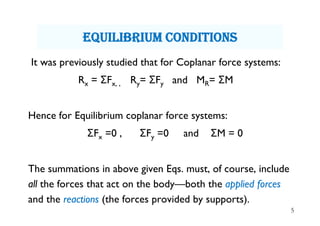
It was previously studied that for Coplanar force systems:
Rx = ΣFx, , Ry= ΣFy and MR= ΣM
Hence for Equilibrium coplanar force systems:
ΣFx =0 , ΣFy =0 and ΣM = 0
The summations in above given Eqs. must, of course, include
all the forces that act on the body—both the applied forces
and the reactions (the forces provided by supports).
6
FBD is a sketch or drawing of the body of interest
separated from all interacting bodies.
 FBD includes information about the forces acting on
the body, and any significant geometry
 The term free implies that all supports have been
removed and replaced by the forces (reactions) that
they exert on the body
Free bOdy diagram (Fbd)
7
Forces that act on a body can be divided into two general
categories:
1. Reactive forces (or, simply, reactions) and
2. Applied forces.
• Reactions are those forces that are exerted on a body by the
supports to which it is attached.
• Forces acting on a body that are not provided by the
supports are called Applied forces.
All forces, both reactive and applied, must be shown on free-
body diagrams.
Free bOdy diagram (Fbd)
8
9
Step 1: Draw a sketch of the body assuming that all supports
(surfaces of contact, supporting cables, etc.) have been
removed.
Step 2: Draw and label all applied forces on the sketch.
Consider weight of the body as an applied force acting at the
centre of gravity.
Step 3: Draw and label the support reactions on the sketch.
If the sense of a reaction is unknown, it should be assumed.All
Step 4: Show all the relevant angles and dimensions on the
sketch.
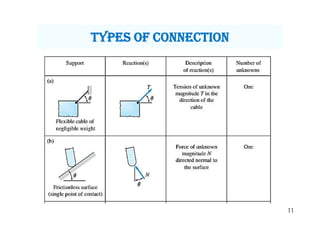
PrOcedure tO draw F.b.d
10
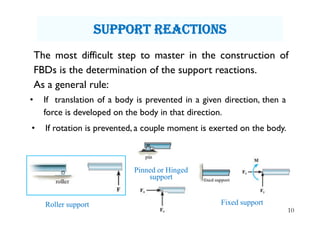
The most difficult step to master in the construction of
FBDs is the determination of the support reactions.
As a general rule:
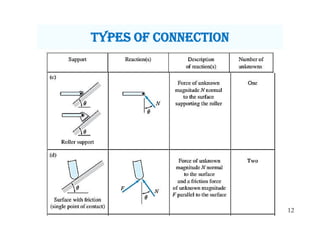
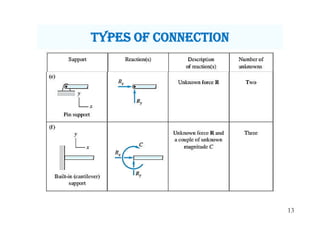
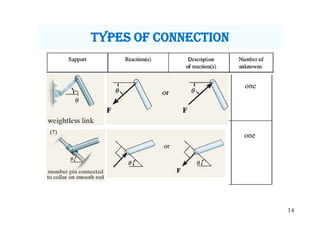
suPPOrt reactiOns
Roller support
Pinned or Hinged
support
Fixed support
• If translation of a body is prevented in a given direction, then a
force is developed on the body in that direction.
• If rotation is prevented, a couple moment is exerted on the body.
11
tyPes OF cOnnectiOn
12
tyPes OF cOnnectiOn
13
tyPes OF cOnnectiOn
14
tyPes OF cOnnectiOn
Oneone
one
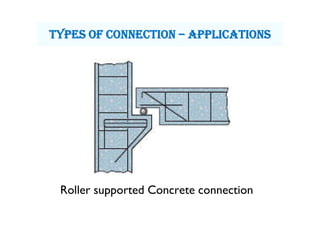
Roller supported Concrete connection
tyPes OF cOnnectiOn – aPPLicatiOns
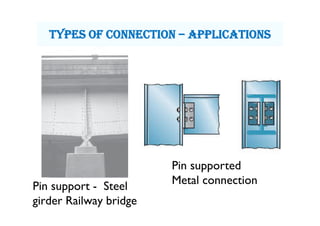
Pin support - Steel
girder Railway bridge
Pin supported
Metal connection
tyPes OF cOnnectiOn – aPPLicatiOns
17
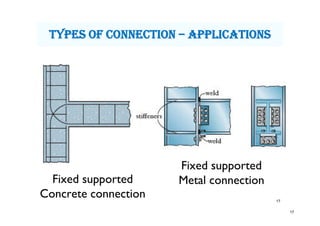
Fixed supported
Concrete connection 17
Fixed supported
Metal connection
tyPes OF cOnnectiOn – aPPLicatiOns
18
tyPes OF cOnnectiOn – aPPLicatiOns
19
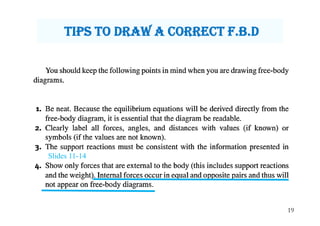
tiPs tO draw a cOrrect F.b.d
Slides 11-14
20
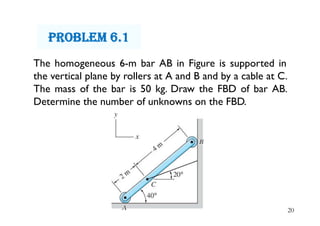
PrObLem 6.1
The homogeneous 6-m bar AB in Figure is supported in
the vertical plane by rollers at A and B and by a cable at C.
The mass of the bar is 50 kg. Draw the FBD of bar AB.
Determine the number of unknowns on the FBD.
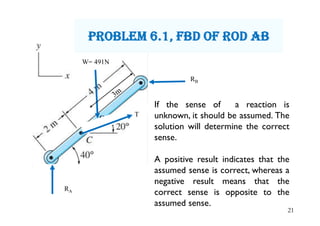
21
G
W= 491N
RB
RA
T
If the sense of a reaction is
unknown, it should be assumed. The
solution will determine the correct
sense.
A positive result indicates that the
assumed sense is correct, whereas a
negative result means that the
correct sense is opposite to the
assumed sense.
PrObLem 6.1, Fbd OF rOd ab
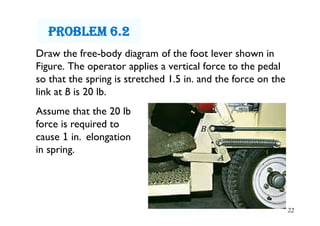
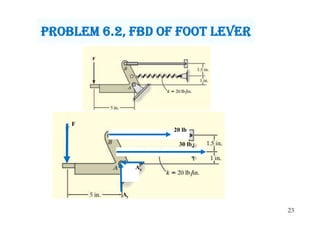
Draw the free-body diagram of the foot lever shown in
Figure. The operator applies a vertical force to the pedal
so that the spring is stretched 1.5 in. and the force on the
link at B is 20 lb.
22
Assume that the 20 lb
force is required to
cause 1 in. elongation
in spring.
PrObLem 6.2
23
20 lb
30 lb
Ax
Ay
F
PrObLem 6.2, Fbd OF FOOt Lever
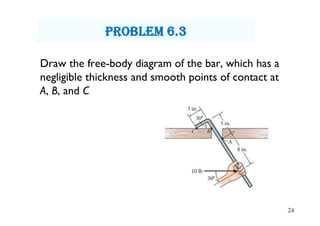
Draw the free-body diagram of the bar, which has a
negligible thickness and smooth points of contact at
A, B, and C
24
PrObLem 6.3
25
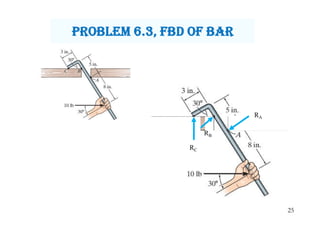
RA
RB
RC
PrObLem 6.3, Fbd OF bar
26
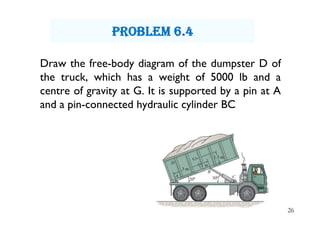
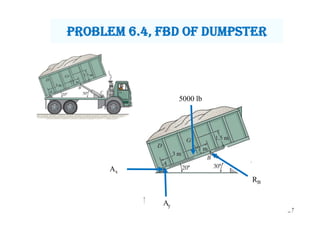
Draw the free-body diagram of the dumpster D of
the truck, which has a weight of 5000 lb and a
centre of gravity at G. It is supported by a pin at A
and a pin-connected hydraulic cylinder BC
PrObLem 6.4
27
5000 lb
RB
Ax
Ay
PrObLem 6.4, Fbd OF dumPster
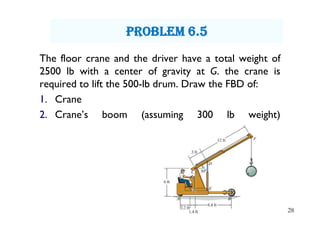
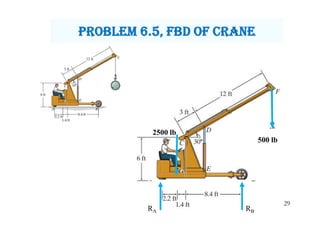
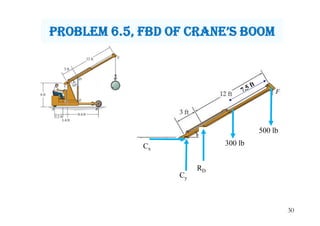
The floor crane and the driver have a total weight of
2500 lb with a center of gravity at G. the crane is
required to lift the 500-lb drum. Draw the FBD of:
1. Crane
2. Crane’s boom (assuming 300 lb weight)
28
PrObLem 6.5
29
2500 lb
500 lb
RBRA
PrObLem 6.5, Fbd OF crane
30
500 lb
300 lbCx
Cy
RD
PrObLem 6.5, Fbd OF crane’s bOOm
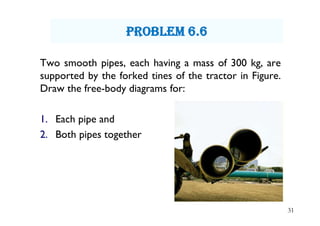
Two smooth pipes, each having a mass of 300 kg, are
supported by the forked tines of the tractor in Figure.
Draw the free-body diagrams for:
1. Each pipe and
2. Both pipes together
31
PrObLem 6.6
32
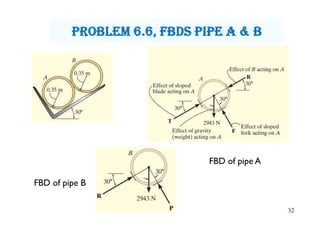
PrObLem 6.6, Fbds PiPe a & b
FBD of pipe A
FBD of pipe B
33
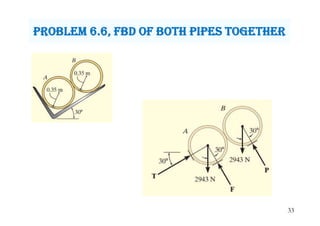
PrObLem 6.6, Fbd OF bOth PiPes tOgether
34
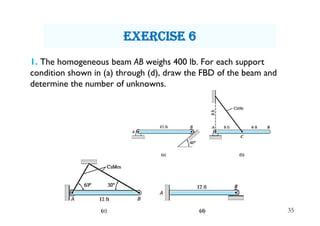
1. The homogeneous beam AB weighs 400 lb. For each support
condition shown in (a) through (d), draw the FBD of the beam and
determine the number of unknowns.
35
exercise 6
`
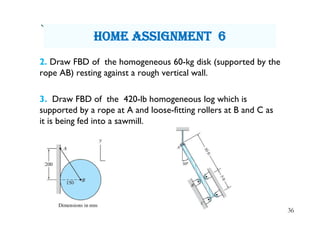
2. Draw FBD of the homogeneous 60-kg disk (supported by the
rope AB) resting against a rough vertical wall.
3. Draw FBD of the 420-lb homogeneous log which is
supported by a rope at A and loose-fitting rollers at B and C as
it is being fed into a sawmill.
36
hOme assignment 6
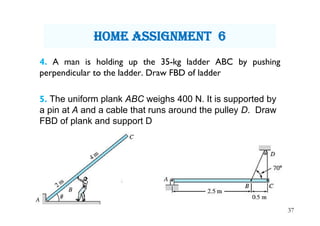
4. A man is holding up the 35-kg ladder ABC by pushing
perpendicular to the ladder. Draw FBD of ladder
5. The uniform plank ABC weighs 400 N. It is supported by
a pin at A and a cable that runs around the pulley D. Draw
FBD of plank and support D
37
hOme assignment 6
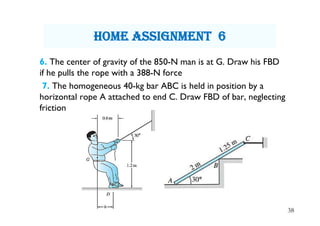
6. The center of gravity of the 850-N man is at G. Draw his FBD
if he pulls the rope with a 388-N force
7. The homogeneous 40-kg bar ABC is held in position by a
horizontal rope A attached to end C. Draw FBD of bar, neglecting
friction
38
hOme assignment 6
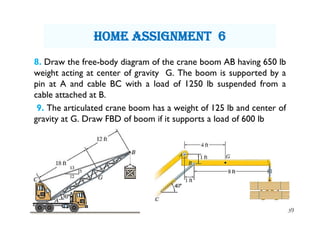
8. Draw the free-body diagram of the crane boom AB having 650 lb
weight acting at center of gravity G. The boom is supported by a
pin at A and cable BC with a load of 1250 lb suspended from a
cable attached at B.
9. The articulated crane boom has a weight of 125 lb and center of
gravity at G. Draw FBD of boom if it supports a load of 600 lb
39
hOme assignment 6
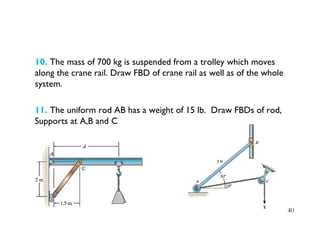
10. The mass of 700 kg is suspended from a trolley which moves
along the crane rail. Draw FBD of crane rail as well as of the whole
system.
11. The uniform rod AB has a weight of 15 lb. Draw FBDs of rod,
Supports at A,B and C
40
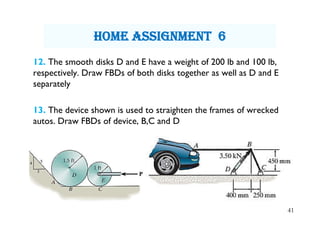
12. The smooth disks D and E have a weight of 200 lb and 100 lb,
respectively. Draw FBDs of both disks together as well as D and E
separately
13. The device shown is used to straighten the frames of wrecked
autos. Draw FBDs of device, B,C and D
41
hOme assignment 6

Module 6 updated

  • 1.
    University of Engineeringand Technology Peshawar, Pakistan CE-117: Engineering Mechanics MODULE 6: Equilibrium of Coplanar force system Free Body Diagram (FBD) concept Prof. Dr. Mohammad Javed & Engr. Mudassir Iqbal mjaved@uetpeshawar.edu.pk mudassiriqbal@uetpeshawar.edu.pk 1
  • 2.
  • 3.
    Lecture Objectives  Tolearn drawing Free Body Diagram (FBD), a key concept to handle problems involving Equilibrium of Force systems
  • 4.
    4 If a systemof forces acting on a body, keeps the body in a state of rest or in a state of uniform motion along a straight line, then the system of forces is said to be in Equilibrium. ALTERNATIVELY, if the resultant of the force system is zero, then, the force system is said to be in equilibrium. equiLibrium
  • 5.
    5 equiLibrium cOnditiOns It waspreviously studied that for Coplanar force systems: Rx = ΣFx, , Ry= ΣFy and MR= ΣM Hence for Equilibrium coplanar force systems: ΣFx =0 , ΣFy =0 and ΣM = 0 The summations in above given Eqs. must, of course, include all the forces that act on the body—both the applied forces and the reactions (the forces provided by supports).
  • 6.
    6 FBD is asketch or drawing of the body of interest separated from all interacting bodies.  FBD includes information about the forces acting on the body, and any significant geometry  The term free implies that all supports have been removed and replaced by the forces (reactions) that they exert on the body Free bOdy diagram (Fbd)
  • 7.
    7 Forces that acton a body can be divided into two general categories: 1. Reactive forces (or, simply, reactions) and 2. Applied forces. • Reactions are those forces that are exerted on a body by the supports to which it is attached. • Forces acting on a body that are not provided by the supports are called Applied forces. All forces, both reactive and applied, must be shown on free- body diagrams. Free bOdy diagram (Fbd)
  • 8.
  • 9.
    9 Step 1: Drawa sketch of the body assuming that all supports (surfaces of contact, supporting cables, etc.) have been removed. Step 2: Draw and label all applied forces on the sketch. Consider weight of the body as an applied force acting at the centre of gravity. Step 3: Draw and label the support reactions on the sketch. If the sense of a reaction is unknown, it should be assumed.All Step 4: Show all the relevant angles and dimensions on the sketch. PrOcedure tO draw F.b.d
  • 10.
    10 The most difficultstep to master in the construction of FBDs is the determination of the support reactions. As a general rule: suPPOrt reactiOns Roller support Pinned or Hinged support Fixed support • If translation of a body is prevented in a given direction, then a force is developed on the body in that direction. • If rotation is prevented, a couple moment is exerted on the body.
  • 11.
  • 12.
  • 13.
  • 14.
  • 15.
    Roller supported Concreteconnection tyPes OF cOnnectiOn – aPPLicatiOns
  • 16.
    Pin support -Steel girder Railway bridge Pin supported Metal connection tyPes OF cOnnectiOn – aPPLicatiOns
  • 17.
    17 Fixed supported Concrete connection17 Fixed supported Metal connection tyPes OF cOnnectiOn – aPPLicatiOns
  • 18.
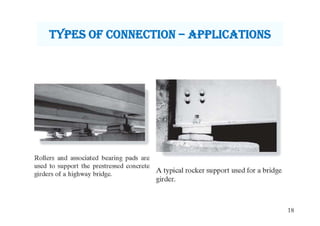
    18 tyPes OF cOnnectiOn– aPPLicatiOns
  • 19.
    19 tiPs tO drawa cOrrect F.b.d Slides 11-14
  • 20.
    20 PrObLem 6.1 The homogeneous6-m bar AB in Figure is supported in the vertical plane by rollers at A and B and by a cable at C. The mass of the bar is 50 kg. Draw the FBD of bar AB. Determine the number of unknowns on the FBD.
  • 21.
    21 G W= 491N RB RA T If thesense of a reaction is unknown, it should be assumed. The solution will determine the correct sense. A positive result indicates that the assumed sense is correct, whereas a negative result means that the correct sense is opposite to the assumed sense. PrObLem 6.1, Fbd OF rOd ab
  • 22.
    Draw the free-bodydiagram of the foot lever shown in Figure. The operator applies a vertical force to the pedal so that the spring is stretched 1.5 in. and the force on the link at B is 20 lb. 22 Assume that the 20 lb force is required to cause 1 in. elongation in spring. PrObLem 6.2
  • 23.
    23 20 lb 30 lb Ax Ay F PrObLem6.2, Fbd OF FOOt Lever
  • 24.
    Draw the free-bodydiagram of the bar, which has a negligible thickness and smooth points of contact at A, B, and C 24 PrObLem 6.3
  • 25.
  • 26.
    26 Draw the free-bodydiagram of the dumpster D of the truck, which has a weight of 5000 lb and a centre of gravity at G. It is supported by a pin at A and a pin-connected hydraulic cylinder BC PrObLem 6.4
  • 27.
  • 28.
    The floor craneand the driver have a total weight of 2500 lb with a center of gravity at G. the crane is required to lift the 500-lb drum. Draw the FBD of: 1. Crane 2. Crane’s boom (assuming 300 lb weight) 28 PrObLem 6.5
  • 29.
  • 30.
    30 500 lb 300 lbCx Cy RD PrObLem6.5, Fbd OF crane’s bOOm
  • 31.
    Two smooth pipes,each having a mass of 300 kg, are supported by the forked tines of the tractor in Figure. Draw the free-body diagrams for: 1. Each pipe and 2. Both pipes together 31 PrObLem 6.6
  • 32.
    32 PrObLem 6.6, FbdsPiPe a & b FBD of pipe A FBD of pipe B
  • 33.
    33 PrObLem 6.6, FbdOF bOth PiPes tOgether
  • 34.
  • 35.
    1. The homogeneousbeam AB weighs 400 lb. For each support condition shown in (a) through (d), draw the FBD of the beam and determine the number of unknowns. 35 exercise 6
  • 36.
    ` 2. Draw FBDof the homogeneous 60-kg disk (supported by the rope AB) resting against a rough vertical wall. 3. Draw FBD of the 420-lb homogeneous log which is supported by a rope at A and loose-fitting rollers at B and C as it is being fed into a sawmill. 36 hOme assignment 6
  • 37.
    4. A manis holding up the 35-kg ladder ABC by pushing perpendicular to the ladder. Draw FBD of ladder 5. The uniform plank ABC weighs 400 N. It is supported by a pin at A and a cable that runs around the pulley D. Draw FBD of plank and support D 37 hOme assignment 6
  • 38.
    6. The centerof gravity of the 850-N man is at G. Draw his FBD if he pulls the rope with a 388-N force 7. The homogeneous 40-kg bar ABC is held in position by a horizontal rope A attached to end C. Draw FBD of bar, neglecting friction 38 hOme assignment 6
  • 39.
    8. Draw thefree-body diagram of the crane boom AB having 650 lb weight acting at center of gravity G. The boom is supported by a pin at A and cable BC with a load of 1250 lb suspended from a cable attached at B. 9. The articulated crane boom has a weight of 125 lb and center of gravity at G. Draw FBD of boom if it supports a load of 600 lb 39 hOme assignment 6
  • 40.
    10. The massof 700 kg is suspended from a trolley which moves along the crane rail. Draw FBD of crane rail as well as of the whole system. 11. The uniform rod AB has a weight of 15 lb. Draw FBDs of rod, Supports at A,B and C 40
  • 41.
    12. The smoothdisks D and E have a weight of 200 lb and 100 lb, respectively. Draw FBDs of both disks together as well as D and E separately 13. The device shown is used to straighten the frames of wrecked autos. Draw FBDs of device, B,C and D 41 hOme assignment 6