UNIVERSITY OF INFORMATION TECHNOLOGY
& SCIENCES
CE 302
 Structural Analysis & Design Lab 1
Civil Engineering
An outlook on
PREPARED BY
MD. IMRAN HOSSAIN (ID:12310177)
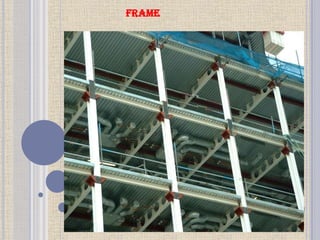
DEFINITION OF FRAME
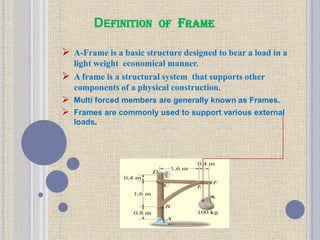
 A-Frame is a basic structure designed to bear a load in a
light weight economical manner.
 A frame is a structural system that supports other
components of a physical construction.
 Multi forced members are generally known as Frames.
 Frames are commonly used to support various external
loads.
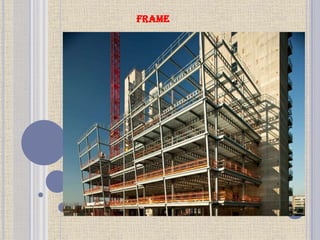
FRAME
FRAME
ANALYSIS OF FRAME
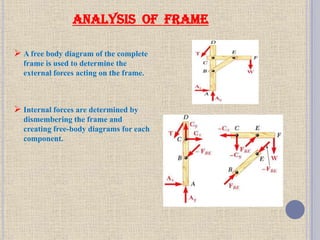
 A free body diagram of the complete
frame is used to determine the
external forces acting on the frame.
 Internal forces are determined by
dismembering the frame and
creating free-body diagrams for each
component.
WHAT IS TRUSS ?
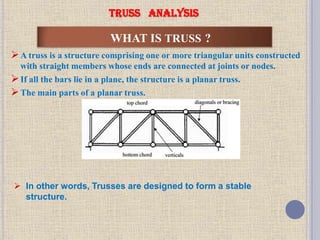
A truss is a structure comprising one or more triangular units constructed
with straight members whose ends are connected at joints or nodes.
If all the bars lie in a plane, the structure is a planar truss.
The main parts of a planar truss.
TRUSS ANALYSIS
 In other words, Trusses are designed to form a stable
structure.
TRUSS ANALYSIS
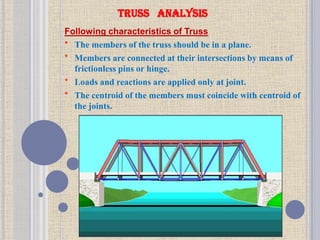
Following characteristics of Truss
* The members of the truss should be in a plane.
* Members are connected at their intersections by means of
frictionless pins or hinge.
* Loads and reactions are applied only at joint.
* The centroid of the members must coincide with centroid of
the joints.
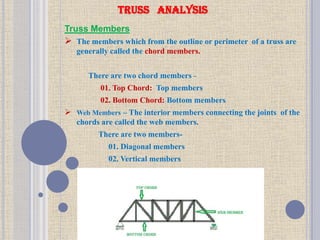
Truss Members
 The members which from the outline or perimeter of a truss are
generally called the chord members.
There are two chord members -
01. Top Chord: Top members
02. Bottom Chord: Bottom members
 Web Members – The interior members connecting the joints of the
chords are called the web members.
There are two members-
01. Diagonal members
02. Vertical members
TRUSS ANALYSIS
TRUSS ANALYSIS
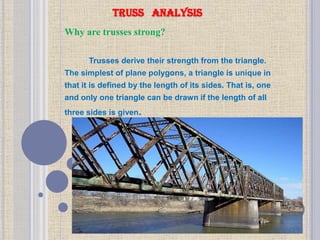
Why are trusses strong?
Trusses derive their strength from the triangle.
The simplest of plane polygons, a triangle is unique in
that it is defined by the length of its sides. That is, one
and only one triangle can be drawn if the length of all
three sides is given.
TRUSS ANALYSIS
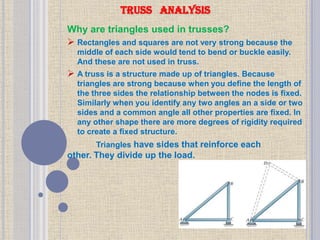
Why are triangles used in trusses?
 Rectangles and squares are not very strong because the
middle of each side would tend to bend or buckle easily.
And these are not used in truss.
 A truss is a structure made up of triangles. Because
triangles are strong because when you define the length of
the three sides the relationship between the nodes is fixed.
Similarly when you identify any two angles an a side or two
sides and a common angle all other properties are fixed. In
any other shape there are more degrees of rigidity required
to create a fixed structure.
Triangles have sides that reinforce each
other. They divide up the load.
TRUSS ANALYSIS
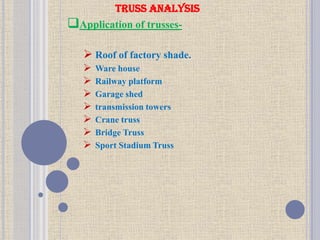
Application of trusses-
 Roof of factory shade.
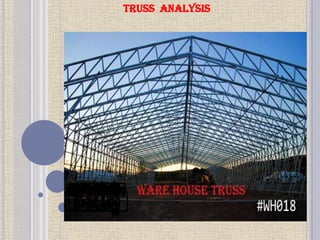
 Ware house
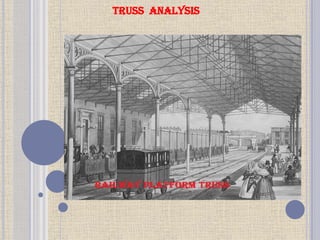
 Railway platform
 Garage shed
 transmission towers
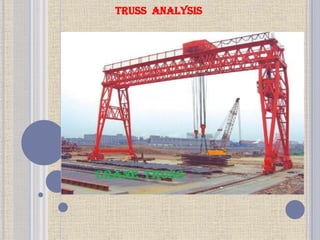
 Crane truss
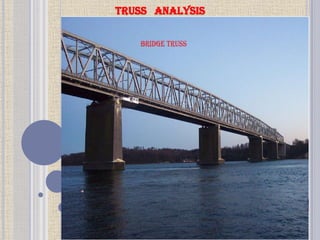
 Bridge Truss
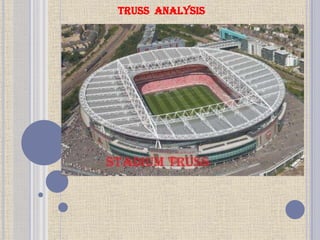
 Sport Stadium Truss
TRUSS ANALYSIS
TRUSS ANALYSIS
TRUSS ANALYSIS
TRUSS ANALYSIS
TRUSS ANALYSIS
TRUSS ANALYSIS
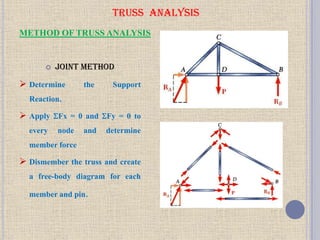
 Joint Method
 Determine the Support
Reaction.
 Apply Fx = 0 and Fy = 0 to
every node and determine
member force
 Dismember the truss and create
a free-body diagram for each
member and pin.
METHOD OF TRUSS ANALYSIS
TRUSS ANALYSIS
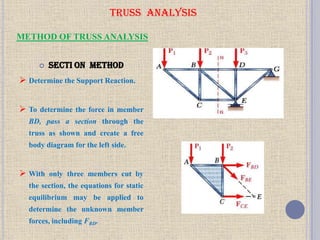
 SECTI ON METHOD
 Determine the Support Reaction.
 To determine the force in member
BD, pass a section through the
truss as shown and create a free
body diagram for the left side.
 With only three members cut by
the section, the equations for static
equilibrium may be applied to
determine the unknown member
forces, including FBD.
METHOD OF TRUSS ANALYSIS
TRUSS ANALYSIS
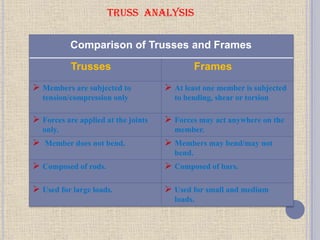
Comparison of Trusses and Frames
Trusses Frames
 Members are subjected to
tension/compression only
 At least one member is subjected
to bending, shear or torsion
 Forces are applied at the joints
only.
 Forces may act anywhere on the
member.
 Member does not bend.  Members may bend/may not
bend.
 Composed of rods.  Composed of bars.
 Used for large loads.  Used for small and medium
loads.
TRUSS ANALYSIS
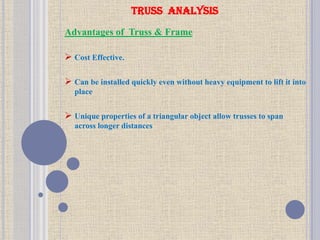
Advantages of Truss & Frame
 Cost Effective.
 Can be installed quickly even without heavy equipment to lift it into
place
 Unique properties of a triangular object allow trusses to span
across longer distances
TRUSS ANALYSIS
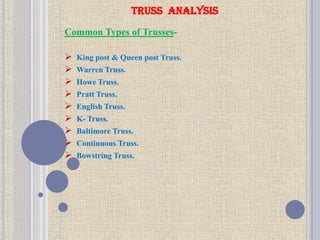
Common Types of Trusses-
 King post & Queen post Truss.
 Warren Truss.
 Howe Truss.
 Pratt Truss.
 English Truss.
 K- Truss.
 Baltimore Truss.
 Continuous Truss.
 Bowstring Truss.
TRUSS ANALYSIS
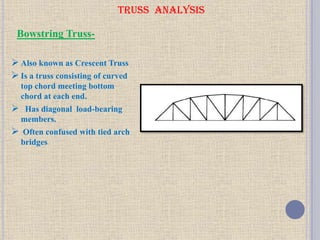
 Also known as Crescent Truss
 Is a truss consisting of curved
top chord meeting bottom
chord at each end.
 Has diagonal load-bearing
members.
 Often confused with tied arch
bridges
Bowstring Truss-
TRUSS ANALYSIS
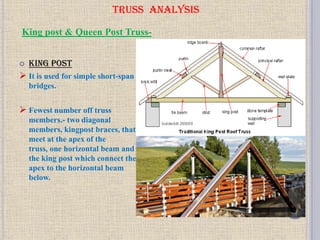
 King post
 It is used for simple short-span
bridges.
 Fewest number off truss
members.- two diagonal
members, kingpost braces, that
meet at the apex of the
truss, one horizontal beam and
the king post which connect the
apex to the horizontal beam
below.
King post & Queen Post Truss-
TRUSS ANALYSIS
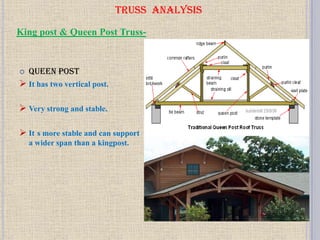
 Queen post
 It has two vertical post.
 Very strong and stable.
 It s more stable and can support
a wider span than a kingpost.
King post & Queen Post Truss-
TRUSS ANALYSIS
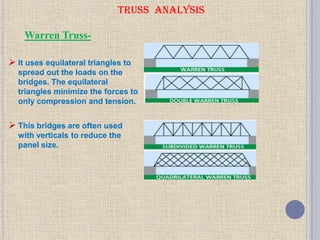
 It uses equilateral triangles to
spread out the loads on the
bridges. The equilateral
triangles minimize the forces to
only compression and tension.
 This bridges are often used
with verticals to reduce the
panel size.
Warren Truss-
TRUSS ANALYSIS
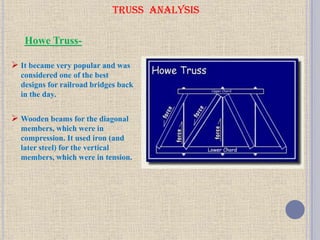
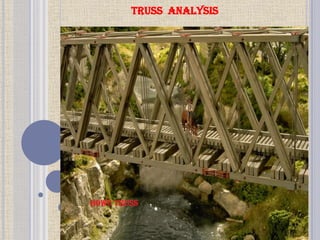
 It became very popular and was
considered one of the best
designs for railroad bridges back
in the day.
 Wooden beams for the diagonal
members, which were in
compression. It used iron (and
later steel) for the vertical
members, which were in tension.
Howe Truss-
TRUSS ANALYSIS
TRUSS ANALYSIS
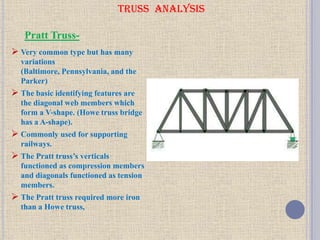
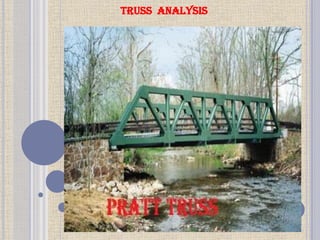
 Very common type but has many
variations
(Baltimore, Pennsylvania, and the
Parker)
 The basic identifying features are
the diagonal web members which
form a V-shape. (Howe truss bridge
has a A-shape).
 Commonly used for supporting
railways.
 The Pratt truss’s verticals
functioned as compression members
and diagonals functioned as tension
members.
 The Pratt truss required more iron
than a Howe truss,
Pratt Truss-
TRUSS ANALYSIS
TRUSS ANALYSIS
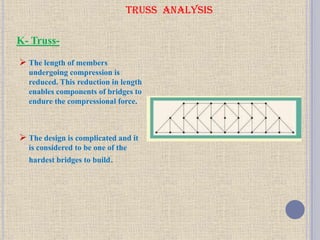
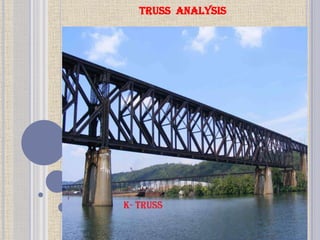
 The length of members
undergoing compression is
reduced. This reduction in length
enables components of bridges to
endure the compressional force.
 The design is complicated and it
is considered to be one of the
hardest bridges to build.
K- Truss-
TRUSS ANALYSIS
TRUSS ANALYSIS
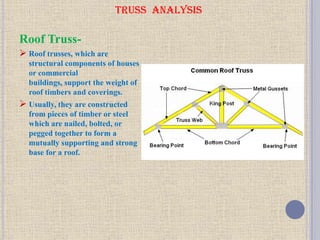
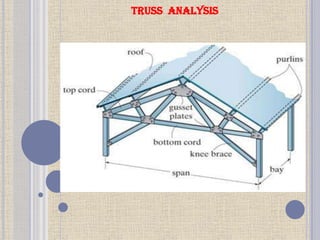
Roof Truss-
 Roof trusses, which are
structural components of houses
or commercial
buildings, support the weight of
roof timbers and coverings.
 Usually, they are constructed
from pieces of timber or steel
which are nailed, bolted, or
pegged together to form a
mutually supporting and strong
base for a roof.
TRUSS ANALYSIS
TRUSS ANALYSIS
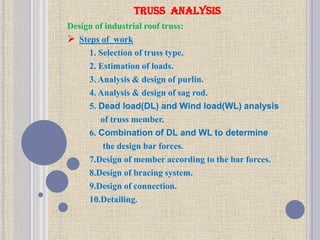
Design of industrial roof truss:
 Steps of work
1. Selection of truss type.
2. Estimation of loads.
3. Analysis & design of purlin.
4. Analysis & design of sag rod.
5. Dead load(DL) and Wind load(WL) analysis
of truss member.
6. Combination of DL and WL to determine
the design bar forces.
7.Design of member according to the bar forces.
8.Design of bracing system.
9.Design of connection.
10.Detailing.
TRUSS ANALYSIS
We will design a Industrial roof truss
TRUSS ANALYSIS
 Design of Purlin
 Then calculating of purlin number and Purlin spacing.
 Then load analysis-
01. Dead load analysis.
02.live load analysis.
 Then we find out member force by grasp software.
 Bracing design-
01. Top chord bracing.
02. Bottom chord bracing.
03. Vertical bracing.
TRUSS ANALYSIS
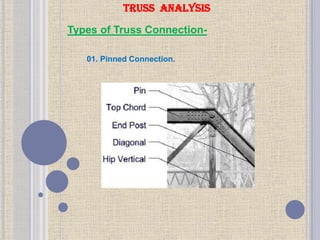
Types of Truss Connection-
01. Pinned Connection.
TRUSS ANALYSIS
Types of Truss Connection-
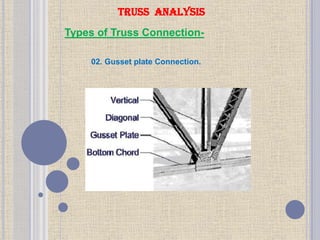
02. Gusset plate Connection.
Presentation (truss) by imran khan.

Presentation (truss) by imran khan.

  • 1.
    UNIVERSITY OF INFORMATIONTECHNOLOGY & SCIENCES
  • 2.
    CE 302  StructuralAnalysis & Design Lab 1
  • 3.
  • 4.
    PREPARED BY MD. IMRANHOSSAIN (ID:12310177)
  • 6.
    DEFINITION OF FRAME A-Frame is a basic structure designed to bear a load in a light weight economical manner.  A frame is a structural system that supports other components of a physical construction.  Multi forced members are generally known as Frames.  Frames are commonly used to support various external loads.
  • 7.
  • 8.
  • 9.
    ANALYSIS OF FRAME A free body diagram of the complete frame is used to determine the external forces acting on the frame.  Internal forces are determined by dismembering the frame and creating free-body diagrams for each component.
  • 11.
    WHAT IS TRUSS? A truss is a structure comprising one or more triangular units constructed with straight members whose ends are connected at joints or nodes. If all the bars lie in a plane, the structure is a planar truss. The main parts of a planar truss. TRUSS ANALYSIS  In other words, Trusses are designed to form a stable structure.
  • 12.
    TRUSS ANALYSIS Following characteristicsof Truss * The members of the truss should be in a plane. * Members are connected at their intersections by means of frictionless pins or hinge. * Loads and reactions are applied only at joint. * The centroid of the members must coincide with centroid of the joints.
  • 13.
    Truss Members  Themembers which from the outline or perimeter of a truss are generally called the chord members. There are two chord members - 01. Top Chord: Top members 02. Bottom Chord: Bottom members  Web Members – The interior members connecting the joints of the chords are called the web members. There are two members- 01. Diagonal members 02. Vertical members TRUSS ANALYSIS
  • 14.
    TRUSS ANALYSIS Why aretrusses strong? Trusses derive their strength from the triangle. The simplest of plane polygons, a triangle is unique in that it is defined by the length of its sides. That is, one and only one triangle can be drawn if the length of all three sides is given.
  • 15.
    TRUSS ANALYSIS Why aretriangles used in trusses?  Rectangles and squares are not very strong because the middle of each side would tend to bend or buckle easily. And these are not used in truss.  A truss is a structure made up of triangles. Because triangles are strong because when you define the length of the three sides the relationship between the nodes is fixed. Similarly when you identify any two angles an a side or two sides and a common angle all other properties are fixed. In any other shape there are more degrees of rigidity required to create a fixed structure. Triangles have sides that reinforce each other. They divide up the load.
  • 16.
    TRUSS ANALYSIS Application oftrusses-  Roof of factory shade.  Ware house  Railway platform  Garage shed  transmission towers  Crane truss  Bridge Truss  Sport Stadium Truss
  • 17.
  • 18.
  • 19.
  • 20.
  • 21.
  • 22.
    TRUSS ANALYSIS  JointMethod  Determine the Support Reaction.  Apply Fx = 0 and Fy = 0 to every node and determine member force  Dismember the truss and create a free-body diagram for each member and pin. METHOD OF TRUSS ANALYSIS
  • 23.
    TRUSS ANALYSIS  SECTION METHOD  Determine the Support Reaction.  To determine the force in member BD, pass a section through the truss as shown and create a free body diagram for the left side.  With only three members cut by the section, the equations for static equilibrium may be applied to determine the unknown member forces, including FBD. METHOD OF TRUSS ANALYSIS
  • 24.
    TRUSS ANALYSIS Comparison ofTrusses and Frames Trusses Frames  Members are subjected to tension/compression only  At least one member is subjected to bending, shear or torsion  Forces are applied at the joints only.  Forces may act anywhere on the member.  Member does not bend.  Members may bend/may not bend.  Composed of rods.  Composed of bars.  Used for large loads.  Used for small and medium loads.
  • 25.
    TRUSS ANALYSIS Advantages ofTruss & Frame  Cost Effective.  Can be installed quickly even without heavy equipment to lift it into place  Unique properties of a triangular object allow trusses to span across longer distances
  • 26.
    TRUSS ANALYSIS Common Typesof Trusses-  King post & Queen post Truss.  Warren Truss.  Howe Truss.  Pratt Truss.  English Truss.  K- Truss.  Baltimore Truss.  Continuous Truss.  Bowstring Truss.
  • 27.
    TRUSS ANALYSIS  Alsoknown as Crescent Truss  Is a truss consisting of curved top chord meeting bottom chord at each end.  Has diagonal load-bearing members.  Often confused with tied arch bridges Bowstring Truss-
  • 28.
    TRUSS ANALYSIS  Kingpost  It is used for simple short-span bridges.  Fewest number off truss members.- two diagonal members, kingpost braces, that meet at the apex of the truss, one horizontal beam and the king post which connect the apex to the horizontal beam below. King post & Queen Post Truss-
  • 29.
    TRUSS ANALYSIS  Queenpost  It has two vertical post.  Very strong and stable.  It s more stable and can support a wider span than a kingpost. King post & Queen Post Truss-
  • 30.
    TRUSS ANALYSIS  Ituses equilateral triangles to spread out the loads on the bridges. The equilateral triangles minimize the forces to only compression and tension.  This bridges are often used with verticals to reduce the panel size. Warren Truss-
  • 31.
    TRUSS ANALYSIS  Itbecame very popular and was considered one of the best designs for railroad bridges back in the day.  Wooden beams for the diagonal members, which were in compression. It used iron (and later steel) for the vertical members, which were in tension. Howe Truss-
  • 32.
  • 33.
    TRUSS ANALYSIS  Verycommon type but has many variations (Baltimore, Pennsylvania, and the Parker)  The basic identifying features are the diagonal web members which form a V-shape. (Howe truss bridge has a A-shape).  Commonly used for supporting railways.  The Pratt truss’s verticals functioned as compression members and diagonals functioned as tension members.  The Pratt truss required more iron than a Howe truss, Pratt Truss-
  • 34.
  • 35.
    TRUSS ANALYSIS  Thelength of members undergoing compression is reduced. This reduction in length enables components of bridges to endure the compressional force.  The design is complicated and it is considered to be one of the hardest bridges to build. K- Truss-
  • 36.
  • 37.
    TRUSS ANALYSIS Roof Truss- Roof trusses, which are structural components of houses or commercial buildings, support the weight of roof timbers and coverings.  Usually, they are constructed from pieces of timber or steel which are nailed, bolted, or pegged together to form a mutually supporting and strong base for a roof.
  • 38.
  • 39.
    TRUSS ANALYSIS Design ofindustrial roof truss:  Steps of work 1. Selection of truss type. 2. Estimation of loads. 3. Analysis & design of purlin. 4. Analysis & design of sag rod. 5. Dead load(DL) and Wind load(WL) analysis of truss member. 6. Combination of DL and WL to determine the design bar forces. 7.Design of member according to the bar forces. 8.Design of bracing system. 9.Design of connection. 10.Detailing.
  • 40.
    TRUSS ANALYSIS We willdesign a Industrial roof truss
  • 41.
    TRUSS ANALYSIS  Designof Purlin  Then calculating of purlin number and Purlin spacing.  Then load analysis- 01. Dead load analysis. 02.live load analysis.  Then we find out member force by grasp software.  Bracing design- 01. Top chord bracing. 02. Bottom chord bracing. 03. Vertical bracing.
  • 42.
    TRUSS ANALYSIS Types ofTruss Connection- 01. Pinned Connection.
  • 43.
    TRUSS ANALYSIS Types ofTruss Connection- 02. Gusset plate Connection.