Q2 FORCES IN EQUILIBRIUM
Engineering Physics 1

Multiple choices: 20 points (30%)

   1. Which of the following is a non-contact force?
          a. Buoyancy                 b. Air resistance                c. Gravity               d. Friction

   2. A 10 kg weight is suspended by a rope from a ceiling. If a horizontal force of 5.80 kg is applied to the weight, the rope
        will make an angle with the vertical equal to:

            a. 60 deg                       b. 30 deg                  c. 45 deg                  d. 75 deg

   3. If the only two forces acting on an object are the same size but acting in opposite directions, the object ...
           a. may be moving at a constant speed or                             c. must be stationary
              stopped
                                                                               d. may be accelerating
           b. must be changing its direction of
                 movement

   4. Which of these statements concerning friction is correct?
         a. friction causes a moving object to increase its speed                        c. friction causes heat to be generated

         b. friction acts in the direction an object is moving                  d. friction is a force acting between two stationary
                 surfaces

   5. A wooden plank “x” meters long has one end leaning on top of a vertical wall 1.5 m high and the other end resting on a
        horizontal ground. Neglecting friction, find x if a force (parallel to the plank) of 100 N is needed to pull a 400 N block
        up the plank.

            a. 6m                           b. 5 m                     c. 4 m                     d. 3 m

   6. A 100 kN block slides down a plane inclined at an angle of 30 deg with the horizontal. Neglecting friction, find the force
        that causes the block to slide.

            a. 86.6 kN                      b. 80 kN                            c. 20 kN                             d. 50 kN

   7. Three forces 20 N, 30 N, and 40 N are in equilibrium. Find the angle between the 30 N and 40 N forces.
          a. 30 deg                  b. 28.96 deg              c. 40 deg             d. 25.97 deg

   8. Two books on a table exert a gravitational force on each other. The books do not appear to move towards each other
        because ...

            a. the movement of the books is so slow we cannot see it happen
            b. there is no friction between the books and the table, so there is no traction to allow movement
            c. the table pushes up on each book with a reaction force which is exactly equal in size to the weight force
            d. the gravitational force is very small and cannot overcome the friction between the books and the table
   9.   A ball rolling along a flat tabletop will eventually come to rest. The ball stops because ...

            a. gravity is a force acting against the rolling motion                      c. friction is a force acting against the rolling
                 motion

            b. there are no forces acting on the rolling ball                            d. there is a gravitational force between the
                 ball and the table

   10.If an object is accelerating, it must be experiencing ____ forces.
          a. Contact          b. unbalanced                   c. downwards                                    d. Balanced
Identification: 20 points (30%)
   1.   ______ is a quantitative description of the interaction between two physical bodies, such as an object and its environment. It is also
        proportional to acceleration.
   2.   ______ states that in order for the motion of an object to change, a force must act upon it, a concept generally called inertia.
   3.   _____ are means by which you can track the different forces acting on an object and, therefore, determine the final acceleration.
   4.   ______ defines the relationship between acceleration, force and mass.
   5. _____ is the ratio of friction to normal force.
   6. _____ is the rotational force or the ability to overcome resistance to rotation.
   7. _____ states that any time a force acts from one object to another, there is equal force acting back on the original object.
   8. _____ is a unit of force and is defined as the force needed to accelerate a 1 kg mass by 1m/s .  2


   9. _____ is the state of an object when no part of the object is accelerating.
   10. _____ is the fundamental unit of mass in metric system of measurement.
Problem Solving: 20 points (40%)
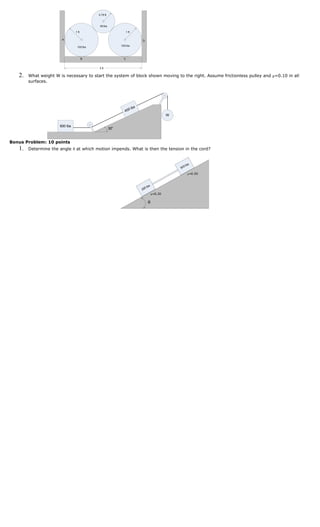
   1.   Three cylindrical objects are laid as shown in the figure. Determine the reactions at A, B, C and D
0.75 ft


                                            50 lbs

                                1 ft                             1 ft

                       A                                                D
                                                           100 lbs
                                 100 lbs


                                       B                     C


                                           5 ft

   2.   What weight W is necessary to start the system of block shown moving to the right. Assume frictionless pulley and μ=0.10 in all
        surfaces.


                                                                  lbs
                                                              400
                                                                                           W


                      600 lbs
                                                     30o


Bonus Problem: 10 points
   1.   Determine the angle θ at which motion impends. What is then the tension in the cord?


                                                                                                  0   lbs
                                                                                               30
                                                                                                       μ=0.50


                                                                              s
                                                                          0 lb
                                                                        20
                                                                                  μ=0.20

                                                                            θ

Q2 physics

  • 1.
    Q2 FORCES INEQUILIBRIUM Engineering Physics 1 Multiple choices: 20 points (30%) 1. Which of the following is a non-contact force? a. Buoyancy b. Air resistance c. Gravity d. Friction 2. A 10 kg weight is suspended by a rope from a ceiling. If a horizontal force of 5.80 kg is applied to the weight, the rope will make an angle with the vertical equal to: a. 60 deg b. 30 deg c. 45 deg d. 75 deg 3. If the only two forces acting on an object are the same size but acting in opposite directions, the object ... a. may be moving at a constant speed or c. must be stationary stopped d. may be accelerating b. must be changing its direction of movement 4. Which of these statements concerning friction is correct? a. friction causes a moving object to increase its speed c. friction causes heat to be generated b. friction acts in the direction an object is moving d. friction is a force acting between two stationary surfaces 5. A wooden plank “x” meters long has one end leaning on top of a vertical wall 1.5 m high and the other end resting on a horizontal ground. Neglecting friction, find x if a force (parallel to the plank) of 100 N is needed to pull a 400 N block up the plank. a. 6m b. 5 m c. 4 m d. 3 m 6. A 100 kN block slides down a plane inclined at an angle of 30 deg with the horizontal. Neglecting friction, find the force that causes the block to slide. a. 86.6 kN b. 80 kN c. 20 kN d. 50 kN 7. Three forces 20 N, 30 N, and 40 N are in equilibrium. Find the angle between the 30 N and 40 N forces. a. 30 deg b. 28.96 deg c. 40 deg d. 25.97 deg 8. Two books on a table exert a gravitational force on each other. The books do not appear to move towards each other because ... a. the movement of the books is so slow we cannot see it happen b. there is no friction between the books and the table, so there is no traction to allow movement c. the table pushes up on each book with a reaction force which is exactly equal in size to the weight force d. the gravitational force is very small and cannot overcome the friction between the books and the table 9. A ball rolling along a flat tabletop will eventually come to rest. The ball stops because ... a. gravity is a force acting against the rolling motion c. friction is a force acting against the rolling motion b. there are no forces acting on the rolling ball d. there is a gravitational force between the ball and the table 10.If an object is accelerating, it must be experiencing ____ forces. a. Contact b. unbalanced c. downwards d. Balanced Identification: 20 points (30%) 1. ______ is a quantitative description of the interaction between two physical bodies, such as an object and its environment. It is also proportional to acceleration. 2. ______ states that in order for the motion of an object to change, a force must act upon it, a concept generally called inertia. 3. _____ are means by which you can track the different forces acting on an object and, therefore, determine the final acceleration. 4. ______ defines the relationship between acceleration, force and mass. 5. _____ is the ratio of friction to normal force. 6. _____ is the rotational force or the ability to overcome resistance to rotation. 7. _____ states that any time a force acts from one object to another, there is equal force acting back on the original object. 8. _____ is a unit of force and is defined as the force needed to accelerate a 1 kg mass by 1m/s . 2 9. _____ is the state of an object when no part of the object is accelerating. 10. _____ is the fundamental unit of mass in metric system of measurement. Problem Solving: 20 points (40%) 1. Three cylindrical objects are laid as shown in the figure. Determine the reactions at A, B, C and D
  • 2.
    0.75 ft 50 lbs 1 ft 1 ft A D 100 lbs 100 lbs B C 5 ft 2. What weight W is necessary to start the system of block shown moving to the right. Assume frictionless pulley and μ=0.10 in all surfaces. lbs 400 W 600 lbs 30o Bonus Problem: 10 points 1. Determine the angle θ at which motion impends. What is then the tension in the cord? 0 lbs 30 μ=0.50 s 0 lb 20 μ=0.20 θ