Analysis of Statically Determinate
Structures

 !   Idealized Structure
 !   Principle of Superposition
 !   Equations of Equilibrium
 !   Determinacy and Stability
     !   Beams
     !   Frames
     !   Gable Frames
 !   Application of the Equations of Equilibrium
 !   Analysis of Simple Diaphragm and Shear
     Wall Systems Problems
                                                   1
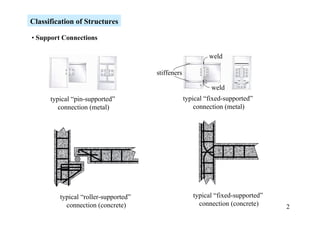
Classification of Structures

• Support Connections

                                                            weld

                                      stiffeners

                                                             weld
      typical “pin-supported”                      typical “fixed-supported”
         connection (metal)                            connection (metal)


         typical “roller-supported”                   typical “fixed-supported”
           connection (concrete)                        connection (concrete)     2
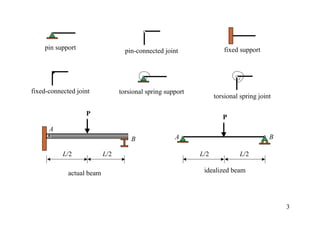
pin support                    pin-connected joint               fixed support


fixed-connected joint            torsional spring support
                                                                  torsional spring joint

                   P
                                                                     P
      A
                                     B               A                                 B

           L/2             L/2                              L/2             L/2

             actual beam                                     idealized beam


                                                                                           3
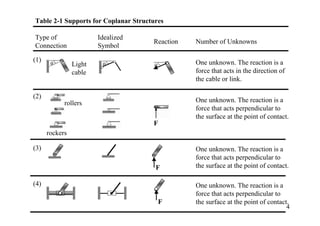
Table 2-1 Supports for Coplanar Structures

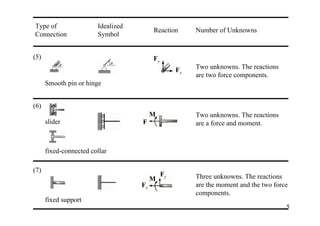
Type of                 Idealized
                                      Reaction   Number of Unknowns
Connection              Symbol

(1)                                              One unknown. The reaction is a
       θ        Light    θ             θ
                cable                            force that acts in the direction of
                                                 the cable or link.

(2)
            rollers                              One unknown. The reaction is a
                                                 force that acts perpendicular to
                                                 the surface at the point of contact.
                                      F
      rockers

(3)                                              One unknown. The reaction is a
                                                 force that acts perpendicular to
                                       F         the surface at the point of contact.

(4)                                              One unknown. The reaction is a
                                                 force that acts perpendicular to
                                           F     the surface at the point of contact.
                                                                                       4
Type of                 Idealized
                                         Reaction       Number of Unknowns
Connection              Symbol


(5)                                      Fy
                                                   Fx   Two unknowns. The reactions
                                                        are two force components.
      Smooth pin or hinge


(6)
                                         M              Two unknowns. The reactions
      slider                        F                   are a force and moment.


      fixed-connected collar

(7)
                                              Fy        Three unknowns. The reactions
                                         M
                                    Fx                  are the moment and the two force
                                                        components.
      fixed support
                                                                                       5
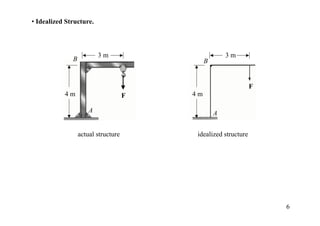
• Idealized Structure.


                          3m                          3m
              B                               B


                                                                F
           4m                        F   4m

                      A                           A


                  actual structure        idealized structure


                                                                    6
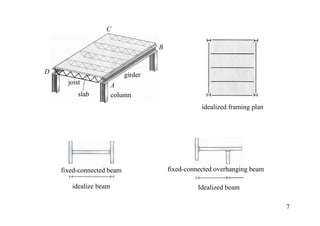
C

                                    B


D                          girder
      joist            A
          slab         column
                                                   idealized framing plan


    fixed-connected beam                fixed-connected overhanging beam

       idealize beam                              Idealized beam

                                                                            7
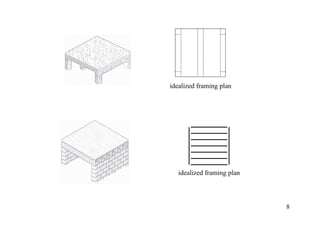
idealized framing plan


   idealized framing plan


                            8
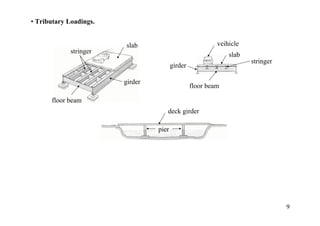
• Tributary Loadings.


                        slab                              veihicle
             stringer
                                                              slab
                                                                     stringer
                                        girder

                        girder
                                                 floor beam

      floor beam
                                    deck girder

                                 pier


                                                                                9
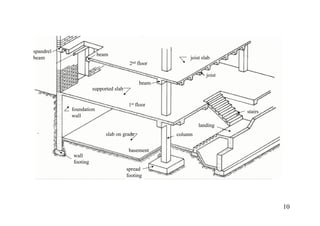
spandrel
                        beam
beam                                                    joist slab
                                       2nd floor

                                                                joist
                                            beam
                     supported slab

                                       1st floor
           foundation                                                   stairs
           wall
                                                            landing
                           slab on grade           column

                                       basement
           wall
           footing
                                      spread
                                      footing


                                                                                 10
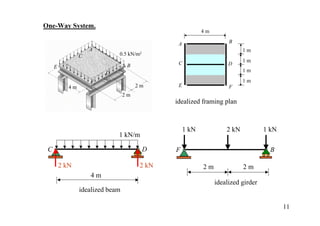
One-Way System.
                                                           4m

                                                A                    B
                     A                                                     1m
                 C            0.5 kN/m2
                                                C                          1m
                                   B                                 D
     E
                          D                                                1m

                     F                                                     1m
            4m                         2m       E                    F
                                  2m
                                               idealized framing plan


                                                    1 kN            2 kN           1 kN
                              1 kN/m

 C                                        D    F                                     B

         2 kN                           2 kN               2m              2m
                     4m
                                                                idealized girder
                 idealized beam

                                                                                          11
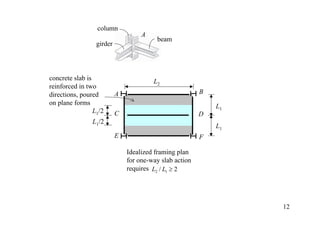
column
                                    A
                                         beam
                  girder


concrete slab is                        L2
reinforced in two
directions, poured         A                             B
on plane forms                                               L1
                 L1/2      C                             D
                L1/2
                                                             L1
                           E                             F

                               Idealized framing plan
                               for one-way slab action
                               requires L2 / L1 ≥ 2


                                                                  12
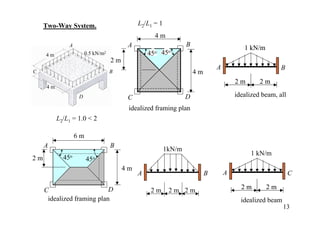
Two-Way System.                           L2/L1 = 1
                                                     4m
              A                            A                       B
                                                                                           1 kN/m
     4m                0.5   kN/m2                 45o   45o
                                     2m
                                                                                A                        B
C                                    B                                 4m
                                                                                        2m       2m
     4m
                   D                       C                       D                    idealized beam, all
                                           idealized framing plan
          L2/L1 = 1.0 < 2

                  6m
     A                               B
                                                           1kN/m
                                                                                              1 kN/m
2m          45o        45o
                                          4m
                                               A                            B       A                         C

     C                      D                       2m      2m 2m                         2m        2m
      idealized framing plan                                                              idealized beam
                                                                                                           13
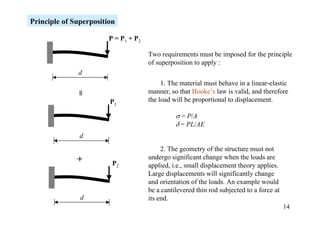
Principle of Superposition

                        P = P1 + P 2

                                       Two requirements must be imposed for the principle
                                       of superposition to apply :
              d
                                            1. The material must behave in a linear-elastic
                                       manner, so that Hooke’s law is valid, and therefore
             =

                        P1             the load will be proportional to displacement.

                                                 σ = P/A
                                                 δ = PL/AE
               d
                                            2. The geometry of the structure must not
              +                        undergo significant change when the loads are
                         P2            applied, i.e., small displacement theory applies.
                                       Large displacements will significantly change
                                       and orientation of the loads. An example would
                                       be a cantilevered thin rod subjected to a force at
               d                       its end.
                                                                                            14
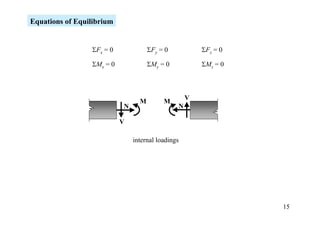
Equations of Equilibrium


                 ΣFx = 0             ΣFy = 0           ΣFz = 0

                 ΣMx = 0             ΣMy = 0           ΣMz = 0


                                                   V
                                 M        M
                           N                   N

                           V

                               internal loadings


                                                                 15
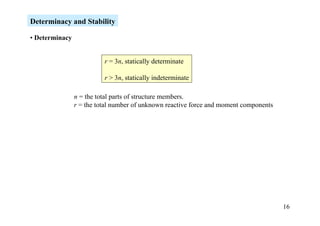
Determinacy and Stability

• Determinacy


                          r = 3n, statically determinate

                          r > 3n, statically indeterminate

                n = the total parts of structure members.
                r = the total number of unknown reactive force and moment components


                                                                                       16
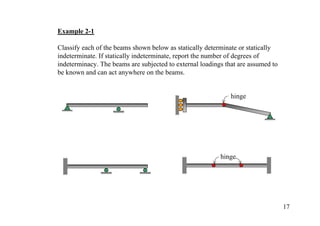
Example 2-1

Classify each of the beams shown below as statically determinate or statically
indeterminate. If statically indeterminate, report the number of degrees of
indeterminacy. The beams are subjected to external loadings that are assumed to
be known and can act anywhere on the beams.


                                                              hinge


                                                          hinge


                                                                                  17
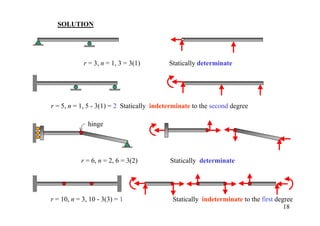
SOLUTION


            r = 3, n = 1, 3 = 3(1)         Statically determinate


r = 5, n = 1, 5 - 3(1) = 2 Statically indeterminate to the second degree

              hinge


           r = 6, n = 2, 6 = 3(2)          Statically determinate


r = 10, n = 3, 10 - 3(3) = 1                Statically indeterminate to the first degree
                                                                                    18
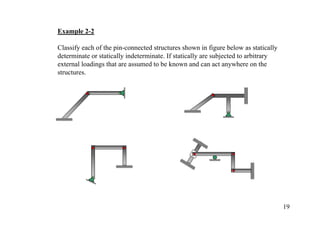
Example 2-2

Classify each of the pin-connected structures shown in figure below as statically
determinate or statically indeterminate. If statically are subjected to arbitrary
external loadings that are assumed to be known and can act anywhere on the
structures.


                                                                                    19
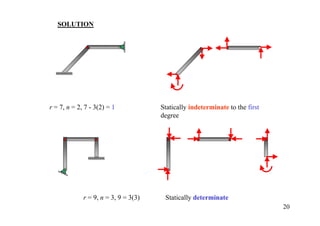
SOLUTION


r = 7, n = 2, 7 - 3(2) = 1            Statically indeterminate to the first
                                      degree


             r = 9, n = 3, 9 = 3(3)    Statically determinate
                                                                              20
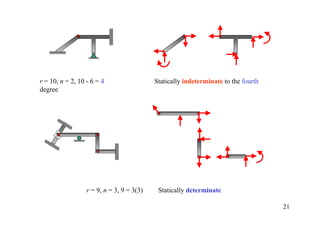
r = 10, n = 2, 10 - 6 = 4                  Statically indeterminate to the fourth
degree


                  r = 9, n = 3, 9 = 3(3)    Statically determinate

                                                                                    21
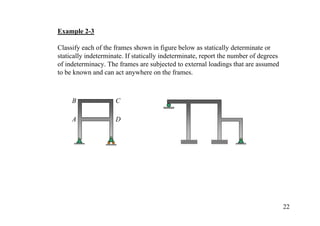
Example 2-3

Classify each of the frames shown in figure below as statically determinate or
statically indeterminate. If statically indeterminate, report the number of degrees
of indeterminacy. The frames are subjected to external loadings that are assumed
to be known and can act anywhere on the frames.


     B               C

     A               D


                                                                                      22
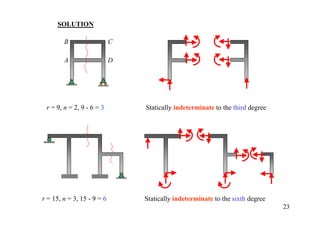
SOLUTION

        B                   C

        A                   D


 r = 9, n = 2, 9 - 6 = 3        Statically indeterminate to the third degree


r = 15, n = 3, 15 - 9 = 6       Statically indeterminate to the sixth degree
                                                                               23
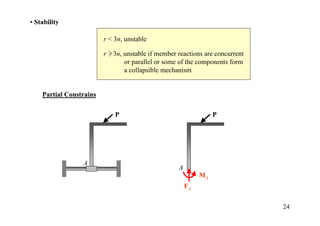
• Stability

                         r < 3n, unstable

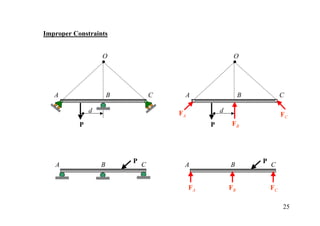
                         r > 3n, unstable if member reactions are concurrent
                                 or parallel or some of the components form
                                 a collapsible mechanism


    Partial Constrains

                             P                                    P


                 A
                                                    A
                                                             MA
                                                        FA


                                                                               24
Improper Constraints


                   O                                      O


   A                   B           C    A                     B            C

               d                       FA            d
                                                                           FC
           P                                     P       FB


                           P                                      P
   A               B           C        A                B            C


                                            FA           FB           FC

                                                                           25
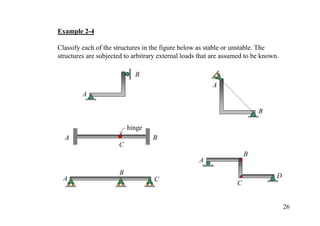
Example 2-4

Classify each of the structures in the figure below as stable or unstable. The
structures are subjected to arbitrary external loads that are assumed to be known.

                            B
                                                         A
         A

                                                                          B

                          hinge
  A                                B
                      C
                                                                      B
                                                    A
                      B                                                          D
  A                                C
                                                                  C


                                                                                     26
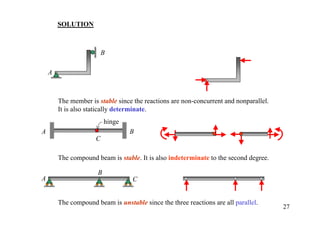
SOLUTION


                         B

    A


        The member is stable since the reactions are non-concurrent and nonparallel.
        It is also statically determinate.
                          hinge
A                                 B
                     C

        The compound beam is stable. It is also indeterminate to the second degree.

                      B
A                                  C


        The compound beam is unstable since the three reactions are all parallel.
                                                                                       27
A


                      B


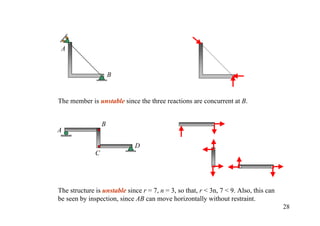
The member is unstable since the three reactions are concurrent at B.


                  B
A

                             D
              C


The structure is unstable since r = 7, n = 3, so that, r < 3n, 7 < 9. Also, this can
be seen by inspection, since AB can move horizontally without restraint.
                                                                                       28
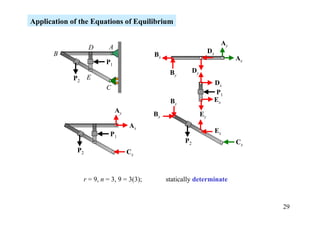
Application of the Equations of Equilibrium

                                                                           Ay
                   D       A
       B                                                             Dx
                                           Bx
                                                                                Ax
                         P1
                                                 By        Dy
            P2     E
                                                                      Dx
                         C
                                                                      P1
                                                 By                   Ex
                               Ay
                                           Bx                   Ey
                                    Ax
                           P1                                             Ex
                                                      P2                        Cx
              P2                    Cx


                 r = 9, n = 3, 9 = 3(3);        statically determinate


                                                                                     29
P1                                       P1    Ay
                   A
B                                  Bx
                                                                 Ax

                                          By
        P2                         Bx
                   C


              P1                                 P2              Cx
                       Ay

    B                                                      Cy
                            Ax


         P2                 Cx

                    Cy
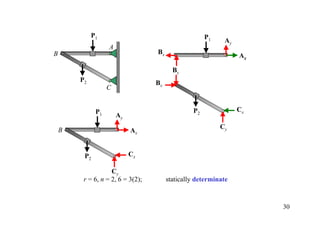
         r = 6, n = 2, 6 = 3(2);        statically determinate


                                                                      30
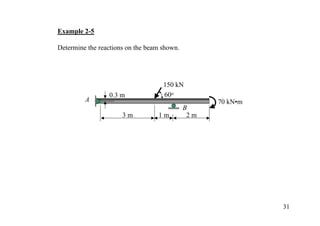
Example 2-5

Determine the reactions on the beam shown.


                                    150 kN
                 0.3 m              60o
         A                                         70 kN•m
                                             B
                      3m          1m          2m


                                                             31
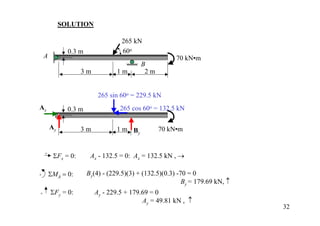
SOLUTION

                                    265 kN
               0.3 m                60o
    A                                                   70 kN•m
                                           B
                   3m             1m        2m


                           265 sin 60o = 229.5 kN
Ax             0.3 m               265 cos 60o = 132.5 kN

        Ay         3m             1 m By         70 kN•m


    + ΣF = 0:           Ax - 132.5 = 0: Ax = 132.5 kN , →
        x


+ ΣMA = 0:             By(4) - (229.5)(3) + (132.5)(0.3) -70 = 0
                                                           By = 179.69 kN, ↑
+       ΣFy = 0:         Ay - 229.5 + 179.69 = 0
                                          Ay = 49.81 kN , ↑
                                                                               32
Example 2-6

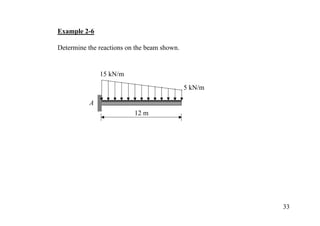
Determine the reactions on the beam shown.


               15 kN/m
                                             5 kN/m

           A
                          12 m


                                                      33
SOLUTION
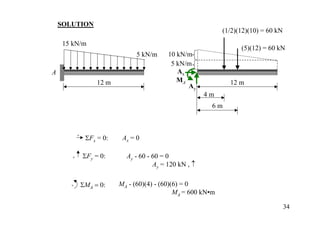
                                                            (1/2)(12)(10) = 60 kN
     15 kN/m
                                                                  (5)(12) = 60 kN
                              5 kN/m     10 kN/m
                                          5 kN/m
A                                           Ax
                 12 m                       MA                12 m
                                               Ay
                                                      4m
                                                        6m


           + ΣF = 0:     Ax = 0
               x


       +    ΣFy = 0:      Ay - 60 - 60 = 0
                                    Ay = 120 kN , ↑

       + ΣMA = 0:       MA - (60)(4) - (60)(6) = 0
                                            MA = 600 kN•m

                                                                                    34
Example 2-7

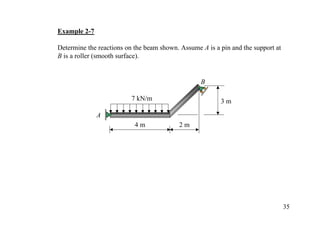
Determine the reactions on the beam shown. Assume A is a pin and the support at
B is a roller (smooth surface).


                                                  B

                          7 kN/m                         3m

              A
                           4m             2m


                                                                                  35
SOLUTION                                     B

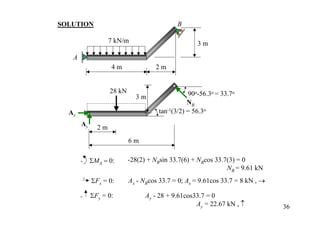
                    7 kN/m                          3m

   A
                    4m               2m


                    28 kN                        90o-56.3o = 33.7o
                              3m
                                                 NB
  Ax                                  tan-1(3/2) = 56.3o
       Ay      2m
                            6m

       + ΣMA = 0:           -28(2) + NBsin 33.7(6) + NBcos 33.7(3) = 0
                                                               NB = 9.61 kN
           + ΣF = 0:        Ax - NBcos 33.7 = 0; Ax = 9.61cos 33.7 = 8 kN , →
               x

       +     ΣFy = 0:             Ay - 28 + 9.61cos33.7 = 0
                                                    Ay = 22.67 kN , ↑           36
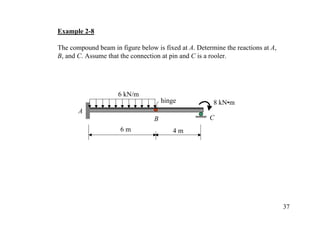
Example 2-8

The compound beam in figure below is fixed at A. Determine the reactions at A,
B, and C. Assume that the connection at pin and C is a rooler.


                     6 kN/m
                                      hinge            8 kN•m
       A
                                  B                   C
                      6m                 4m


                                                                                 37
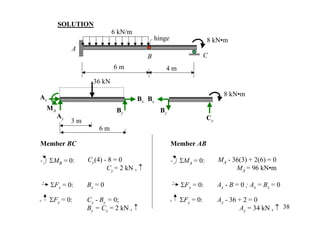
SOLUTION
                              6 kN/m
                                               hinge                    8 kN•m
               A
                                           B                            C
                              6m                  4m
                      36 kN

Ax                                                                             8 kN•m
                                       Bx Bx
     MA                        By                By
          Ay                                                            Cy
               3m
                        6m

Member BC                                              Member AB

+ ΣMB = 0:          Cy(4) - 8 = 0                      + ΣMA = 0:            MA - 36(3) + 2(6) = 0
                           Cy = 2 kN , ↑                                           MA = 96 kN•m

    + ΣF = 0:       Bx = 0                                 + ΣF = 0:         Ax - B = 0 ; Ax = Bx = 0
        x                                                      x

+     ΣFy = 0:      Cy - By = 0;                       +     ΣFy = 0:        Ay - 36 + 2 = 0
                    By = Cy = 2 kN , ↑                                               Ay = 34 kN , ↑     38
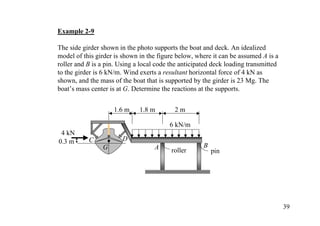
Example 2-9

The side girder shown in the photo supports the boat and deck. An idealized
model of this girder is shown in the figure below, where it can be assumed A is a
roller and B is a pin. Using a local code the anticipated deck loading transmitted
to the girder is 6 kN/m. Wind exerts a resultant horizontal force of 4 kN as
shown, and the mass of the boat that is supported by the girder is 23 Mg. The
boat’s mass center is at G. Determine the reactions at the supports.


                    1.6 m     1.8 m        2m

                                         6 kN/m
 4 kN
0.3 m      C            D
                G                   A                 B
                                          roller          pin


                                                                                     39
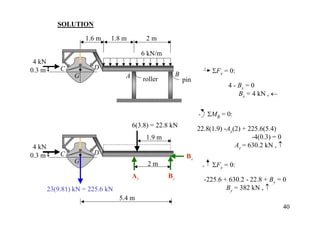
SOLUTION

                     1.6 m   1.8 m           2m

                                            6 kN/m
 4 kN
0.3 m       C          D                                              + ΣF = 0:
                 G                 A                      B               x
                                            roller            pin
                                                                               4 - Bx = 0
                                                                                   Bx = 4 kN , ←

                                                                    + ΣMB = 0:
                                       6(3.8) = 22.8 kN
                                                                    22.8(1.9) -Ay(2) + 225.6(5.4)
                                             1.9 m                                      -4(0.3) = 0
 4 kN                                                                             Ay = 630.2 kN , ↑
0.3 m       C          D
                                                               Bx
                 G                           2m                      +   ΣFy = 0:
                                       Ay            By
                                                                      -225.6 + 630.2 - 22.8 + By = 0
        23(9.81) kN = 225.6 kN                                                By = 382 kN , ↑
                                 5.4 m
                                                                                                      40
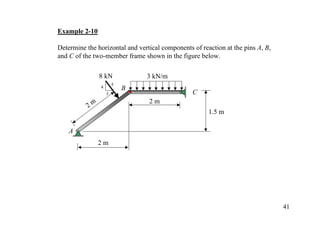
Example 2-10

Determine the horizontal and vertical components of reaction at the pins A, B,
and C of the two-member frame shown in the figure below.

                8 kN            3 kN/m
                        5
                4           B
                    3                            C
                                 2m
           2m
                                                       1.5 m

    A
                2m


                                                                                 41
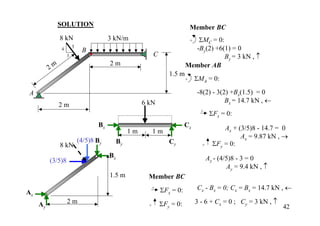
SOLUTION                                                     Member BC
               8 kN                    3 kN/m                               + ΣMC = 0:
                       5
               4            B                                                 -By(2) +6(1) = 0
                   3                                        C                           By = 3 kN , ↑
                                       2m
          2m                                                               Member AB
                                                                   1.5 m
                                                                           + ΣMA = 0:

A                                                                               -8(2) - 3(2) +Bx(1.5) = 0
                                                      6 kN                                 Bx = 14.7 kN , ←
               2m
                                                                                 + ΣF = 0:
                                                                                          x

                                  Bx                                       Cx               Ax + (3/5)8 - 14.7 = 0
                                                 1m         1m
                                                                                                  Ax = 9.87 kN , →
                           (4/5)8 By        By                     Cy                   ΣFy = 0:
               8 kN                                                               +
                                       Bx                                             Ay - (4/5)8 - 3 = 0
          (3/5)8
                                                                                              Ay = 9.4 kN , ↑
                                       1.5 m            Member BC
                                                        + ΣF = 0:               Cx - Bx = 0; Cx = Bx = 14.7 kN , ←
Ax                                                          x

                   2m                                           ΣFy = 0:        3 - 6 + Cx = 0 ; Cy = 3 kN , ↑
     Ay                                                 +                                                        42
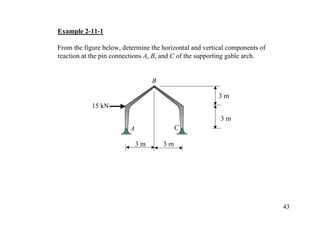
Example 2-11-1

From the figure below, determine the horizontal and vertical components of
reaction at the pin connections A, B, and C of the supporting gable arch.


                                  B

                                                         3m
            15 kN
                                                          3m
                         A                 C

                             3m       3m


                                                                             43
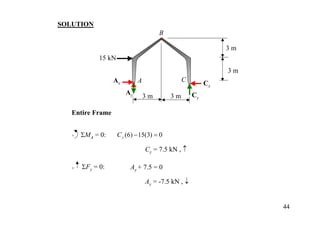
SOLUTION
                                      B

                                                              3m
             15 kN
                                                              3m
                  Ax         A                  C
                                                         Cx
                        Ay                          Cy
                                 3m        3m

   Entire Frame


   + ΣMA = 0:        C y (6) − 15(3) = 0

                                 Cy = 7.5 kN , ↑

   +   ΣFy = 0:           Ay + 7.5 = 0

                                 Ay = -7.5 kN , ↓


                                                                   44
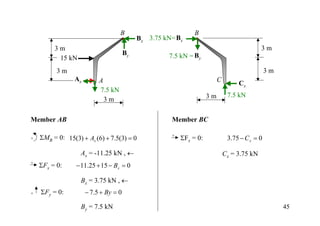
B                        B
                                          Bx 3.75 kN= Bx
        3m                                                                               3m
                                     By            7.5 kN = By
         15 kN
         3m                                                                                 3m
               Ax        A                                            C
                                                                               Cx
                         7.5 kN
                                                                 3m        7.5 kN
                           3m

Member AB                                           Member BC

+ ΣMB = 0: 15(3) + Ax (6) + 7.5(3) = 0              + ΣF = 0:              3.75 − C x = 0
                                                        x

                 Ax = -11.25 kN , ←                                       Cx = 3.75 kN
+ ΣF = 0:       − 11.25 + 15 − Bx = 0
    x

                 Bx = 3.75 kN , ←
+   ΣFy = 0:        − 7.5 + By = 0

                 By = 7.5 kN                                                                     45
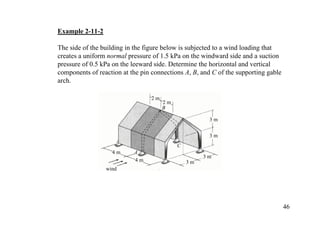
Example 2-11-2

The side of the building in the figure below is subjected to a wind loading that
creates a uniform normal pressure of 1.5 kPa on the windward side and a suction
pressure of 0.5 kPa on the leeward side. Determine the horizontal and vertical
components of reaction at the pin connections A, B, and C of the supporting gable
arch.

                                 2m
                                      2m
                                      B

                                                      3m


                                                      3m
                                           C
                   4m      A
                                                    3m
                           4m                  3m
                 wind


                                                                                    46
SOLUTION
                                          2m
                                               2m
                                               B

                                                                  3m


                                                                  3m
                                                    C
                            4m      A
                                                                 3m
                                    4m                  3m
                          wind


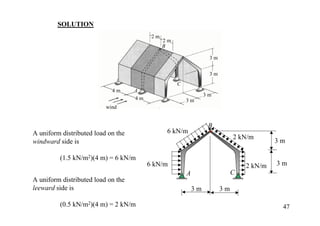
                                                                  B
A uniform distributed load on the               6 kN/m
                                                                            2 kN/m
windward side is                                                                         3m

         (1.5 kN/m2)(4 m) = 6 kN/m
                                         6 kN/m                                 2 kN/m   3m
                                                        A                   C
A uniform distributed load on the
leeward side is                                             3m         3m

         (0.5 kN/m2)(4 m) = 2 kN/m                                                        47
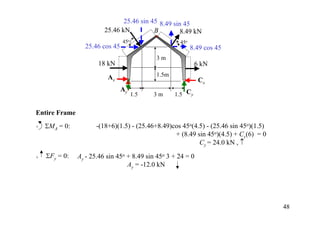
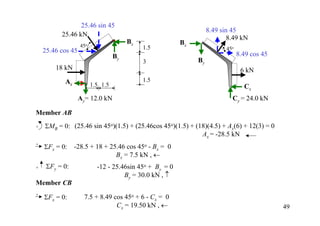
25.46 sin 45 8.49 sin 45
                         25.46 kN          B         8.49 kN
                                45o                  45o
                 25.46 cos 45                              8.49 cos 45
                                            3m
                      18 kN                                 6 kN
                          Ax                1.5m
                                                              Cx
                                Ay
                                      1.5   3m     1.5 Cy


Entire Frame
+ ΣMA = 0:            -(18+6)(1.5) - (25.46+8.49)cos 45o(4.5) - (25.46 sin 45o)(1.5)
                                                  + (8.49 sin 45o)(4.5) + Cy(6) = 0
                                                           Cy = 24.0 kN , ↑

+   ΣFy = 0:   Ay - 25.46 sin 45o + 8.49 sin 45o 3 + 24 = 0
                                  Ay = -12.0 kN


                                                                                       48
25.46 sin 45
                                                                   8.49 sin 45
            25.46 kN
                                                                           8.49 kN
                                        Bx               Bx
                   45o                       1.5
    25.46 cos 45                                                          45o
                                   By                                           8.49 cos 45
                                             3                By
           18 kN                                                                 6 kN
             Ax                              1.5
                         1.5 1.5                                                  Cx
                   Ay= 12.0 kN                                              Cy = 24.0 kN

Member AB
+ ΣMB = 0: (25.46 sin 45o)(1.5) + (25.46cos 45o)(1.5) + (18)(4.5) + Ax(6) + 12(3) = 0
                                                          Ax = -28.5 kN
+ ΣF = 0: -28.5 + 18 + 25.46 cos 45o - B = 0
       x                                           x
                                    Bx = 7.5 kN , ←
+    ΣFy = 0:              -12 - 25.46sin 45o + By = 0
                                     By = 30.0 kN , ↑
Member CB
+ ΣF = 0:            7.5 + 8.49 cos 45o + 6 - Cx = 0
    x
                                 Cx = 19.50 kN , ←                                            49
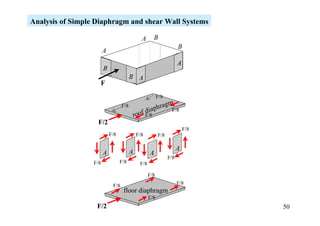
Analysis of Simple Diaphragm and shear Wall Systems

                                                A      B
                                                                       B
                        A
                                                                       A
                        B
                                         B A
                    F
                                                           F/8
                                                          gm
                                   F/8
                                                  dia phra F/8
                                             roof F/8
                   F/2
                                                                           F/8
                            F/8              F/8           F/8


                                         A                             A
                        A                            A
                                                                 F/8
                  F/8             F/8          F/8

                                                     F/8
                             F/8                                       F/8
                                   floor diaphragm
                                                     F/8
                   F/2                                                           50
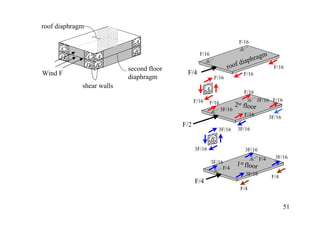
roof diaphragm

                             A                                            F/16
      C                      B                    F/16
                                                                                   gm
      D          C A
                                                                          dia phra
                 D B
                           second floor                            roof                        F/16
Wind F                                     F/4                                F/16
                           diaphragm                        F/16
             shear walls                               A                      F/16
                                                F/16    F/16                          3F/16 F/16
                                                                       2 st   floor
                                                               3F/16
                                                                              F/16
                                                                                             3F/16
                                          F/2
                                                               3F/16    3F/16
                                                           B
                                                3F/16                         3F/16
                                                                                       F/4     3F/16
                                                           3F/16        1 st floor
                                                                F/4
                                                                               3F/16
                                                                                              F/4
                                                F/4
                                                                          F/4


                                                                                                     51
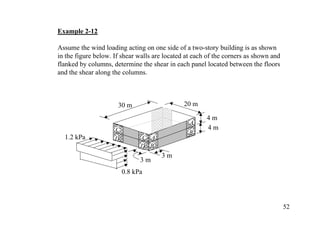
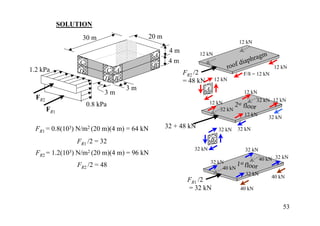
Example 2-12

Assume the wind loading acting on one side of a two-story building is as shown
in the figure below. If shear walls are located at each of the corners as shown and
flanked by columns, determine the shear in each panel located between the floors
and the shear along the columns.


                      30 m                     20 m

                                                       4m
                                                 A
                     C                                 4m
                                                 B
  1.2 kPa            D         C A
                               D B
                                      3m
                               3m
                         0.8 kPa


                                                                                      52
SOLUTION
                    30 m                20 m
                                                                                    12 kN
                                                 4m          12 kN
                                            A                                                gm
                   C                             4m                                 dia phra
1.2 kPa                      C A
                                            B                                roof                  12 kN
                   D                                  FR2 /2                         F/8 = 12 kN
                             D B                      = 48 kN        12 kN
                                   3m                           A
                             3m                                                      12 kN
  FR2                                                                               32 kN 12 kN
                       0.8 kPa                                   12 kN     2 floor
                                                                            st
        FR1                                                          32 kN
                                                                               12 kN
                                                                                         32 kN

  FR1 = 0.8(103) N/m2 (20 m)(4 m) = 64 kN       32 + 48 kN              32 kN   32 kN

                  FR1 /2 = 32                                       B
                                                         32 kN                        32 kN
  FR2 = 1.2(103) N/m2 (20 m)(4 m) = 96 kN
                                                                                              40 kN 32 kN
                                                                    32 kN      1 st floor
                  FR2 /2 = 48                                            40 kN
                                                                                     32 kN
                                                                                                   40 kN
                                                       FR1 /2
                                                       = 32 kN                      40 kN


                                                                                                       53
12 kN
Fv             Fv   4m    + ΣM = 0:

       12 kN                     Fv(3) - 12(4) = 0
                                           Fv = 16 kN
        3m


      32 kN
                         + ΣM = 0:
F´v           F´v   4m
                               F´v(3) - 32(4) = 0
      32 kN                               F´v = 42.7 kN

       3m


                                                          54

Determinate structures

  • 1.
    Analysis of StaticallyDeterminate Structures ! Idealized Structure ! Principle of Superposition ! Equations of Equilibrium ! Determinacy and Stability ! Beams ! Frames ! Gable Frames ! Application of the Equations of Equilibrium ! Analysis of Simple Diaphragm and Shear Wall Systems Problems 1
  • 2.
    Classification of Structures •Support Connections weld stiffeners weld typical “pin-supported” typical “fixed-supported” connection (metal) connection (metal) typical “roller-supported” typical “fixed-supported” connection (concrete) connection (concrete) 2
  • 3.
    pin support pin-connected joint fixed support fixed-connected joint torsional spring support torsional spring joint P P A B A B L/2 L/2 L/2 L/2 actual beam idealized beam 3
  • 4.
    Table 2-1 Supportsfor Coplanar Structures Type of Idealized Reaction Number of Unknowns Connection Symbol (1) One unknown. The reaction is a θ Light θ θ cable force that acts in the direction of the cable or link. (2) rollers One unknown. The reaction is a force that acts perpendicular to the surface at the point of contact. F rockers (3) One unknown. The reaction is a force that acts perpendicular to F the surface at the point of contact. (4) One unknown. The reaction is a force that acts perpendicular to F the surface at the point of contact. 4
  • 5.
    Type of Idealized Reaction Number of Unknowns Connection Symbol (5) Fy Fx Two unknowns. The reactions are two force components. Smooth pin or hinge (6) M Two unknowns. The reactions slider F are a force and moment. fixed-connected collar (7) Fy Three unknowns. The reactions M Fx are the moment and the two force components. fixed support 5
  • 6.
    • Idealized Structure. 3m 3m B B F 4m F 4m A A actual structure idealized structure 6
  • 7.
    C B D girder joist A slab column idealized framing plan fixed-connected beam fixed-connected overhanging beam idealize beam Idealized beam 7
  • 8.
    idealized framing plan idealized framing plan 8
  • 9.
    • Tributary Loadings. slab veihicle stringer slab stringer girder girder floor beam floor beam deck girder pier 9
  • 10.
    spandrel beam beam joist slab 2nd floor joist beam supported slab 1st floor foundation stairs wall landing slab on grade column basement wall footing spread footing 10
  • 11.
    One-Way System. 4m A B A 1m C 0.5 kN/m2 C 1m B D E D 1m F 1m 4m 2m E F 2m idealized framing plan 1 kN 2 kN 1 kN 1 kN/m C D F B 2 kN 2 kN 2m 2m 4m idealized girder idealized beam 11
  • 12.
    column A beam girder concrete slab is L2 reinforced in two directions, poured A B on plane forms L1 L1/2 C D L1/2 L1 E F Idealized framing plan for one-way slab action requires L2 / L1 ≥ 2 12
  • 13.
    Two-Way System. L2/L1 = 1 4m A A B 1 kN/m 4m 0.5 kN/m2 45o 45o 2m A B C B 4m 2m 2m 4m D C D idealized beam, all idealized framing plan L2/L1 = 1.0 < 2 6m A B 1kN/m 1 kN/m 2m 45o 45o 4m A B A C C D 2m 2m 2m 2m 2m idealized framing plan idealized beam 13
  • 14.
    Principle of Superposition P = P1 + P 2 Two requirements must be imposed for the principle of superposition to apply : d 1. The material must behave in a linear-elastic manner, so that Hooke’s law is valid, and therefore = P1 the load will be proportional to displacement. σ = P/A δ = PL/AE d 2. The geometry of the structure must not + undergo significant change when the loads are P2 applied, i.e., small displacement theory applies. Large displacements will significantly change and orientation of the loads. An example would be a cantilevered thin rod subjected to a force at d its end. 14
  • 15.
    Equations of Equilibrium ΣFx = 0 ΣFy = 0 ΣFz = 0 ΣMx = 0 ΣMy = 0 ΣMz = 0 V M M N N V internal loadings 15
  • 16.
    Determinacy and Stability •Determinacy r = 3n, statically determinate r > 3n, statically indeterminate n = the total parts of structure members. r = the total number of unknown reactive force and moment components 16
  • 17.
    Example 2-1 Classify eachof the beams shown below as statically determinate or statically indeterminate. If statically indeterminate, report the number of degrees of indeterminacy. The beams are subjected to external loadings that are assumed to be known and can act anywhere on the beams. hinge hinge 17
  • 18.
    SOLUTION r = 3, n = 1, 3 = 3(1) Statically determinate r = 5, n = 1, 5 - 3(1) = 2 Statically indeterminate to the second degree hinge r = 6, n = 2, 6 = 3(2) Statically determinate r = 10, n = 3, 10 - 3(3) = 1 Statically indeterminate to the first degree 18
  • 19.
    Example 2-2 Classify eachof the pin-connected structures shown in figure below as statically determinate or statically indeterminate. If statically are subjected to arbitrary external loadings that are assumed to be known and can act anywhere on the structures. 19
  • 20.
    SOLUTION r = 7,n = 2, 7 - 3(2) = 1 Statically indeterminate to the first degree r = 9, n = 3, 9 = 3(3) Statically determinate 20
  • 21.
    r = 10,n = 2, 10 - 6 = 4 Statically indeterminate to the fourth degree r = 9, n = 3, 9 = 3(3) Statically determinate 21
  • 22.
    Example 2-3 Classify eachof the frames shown in figure below as statically determinate or statically indeterminate. If statically indeterminate, report the number of degrees of indeterminacy. The frames are subjected to external loadings that are assumed to be known and can act anywhere on the frames. B C A D 22
  • 23.
    SOLUTION B C A D r = 9, n = 2, 9 - 6 = 3 Statically indeterminate to the third degree r = 15, n = 3, 15 - 9 = 6 Statically indeterminate to the sixth degree 23
  • 24.
    • Stability r < 3n, unstable r > 3n, unstable if member reactions are concurrent or parallel or some of the components form a collapsible mechanism Partial Constrains P P A A MA FA 24
  • 25.
    Improper Constraints O O A B C A B C d FA d FC P P FB P P A B C A B C FA FB FC 25
  • 26.
    Example 2-4 Classify eachof the structures in the figure below as stable or unstable. The structures are subjected to arbitrary external loads that are assumed to be known. B A A B hinge A B C B A B D A C C 26
  • 27.
    SOLUTION B A The member is stable since the reactions are non-concurrent and nonparallel. It is also statically determinate. hinge A B C The compound beam is stable. It is also indeterminate to the second degree. B A C The compound beam is unstable since the three reactions are all parallel. 27
  • 28.
    A B The member is unstable since the three reactions are concurrent at B. B A D C The structure is unstable since r = 7, n = 3, so that, r < 3n, 7 < 9. Also, this can be seen by inspection, since AB can move horizontally without restraint. 28
  • 29.
    Application of theEquations of Equilibrium Ay D A B Dx Bx Ax P1 By Dy P2 E Dx C P1 By Ex Ay Bx Ey Ax P1 Ex P2 Cx P2 Cx r = 9, n = 3, 9 = 3(3); statically determinate 29
  • 30.
    P1 P1 Ay A B Bx Ax By P2 Bx C P1 P2 Cx Ay B Cy Ax P2 Cx Cy r = 6, n = 2, 6 = 3(2); statically determinate 30
  • 31.
    Example 2-5 Determine thereactions on the beam shown. 150 kN 0.3 m 60o A 70 kN•m B 3m 1m 2m 31
  • 32.
    SOLUTION 265 kN 0.3 m 60o A 70 kN•m B 3m 1m 2m 265 sin 60o = 229.5 kN Ax 0.3 m 265 cos 60o = 132.5 kN Ay 3m 1 m By 70 kN•m + ΣF = 0: Ax - 132.5 = 0: Ax = 132.5 kN , → x + ΣMA = 0: By(4) - (229.5)(3) + (132.5)(0.3) -70 = 0 By = 179.69 kN, ↑ + ΣFy = 0: Ay - 229.5 + 179.69 = 0 Ay = 49.81 kN , ↑ 32
  • 33.
    Example 2-6 Determine thereactions on the beam shown. 15 kN/m 5 kN/m A 12 m 33
  • 34.
    SOLUTION (1/2)(12)(10) = 60 kN 15 kN/m (5)(12) = 60 kN 5 kN/m 10 kN/m 5 kN/m A Ax 12 m MA 12 m Ay 4m 6m + ΣF = 0: Ax = 0 x + ΣFy = 0: Ay - 60 - 60 = 0 Ay = 120 kN , ↑ + ΣMA = 0: MA - (60)(4) - (60)(6) = 0 MA = 600 kN•m 34
  • 35.
    Example 2-7 Determine thereactions on the beam shown. Assume A is a pin and the support at B is a roller (smooth surface). B 7 kN/m 3m A 4m 2m 35
  • 36.
    SOLUTION B 7 kN/m 3m A 4m 2m 28 kN 90o-56.3o = 33.7o 3m NB Ax tan-1(3/2) = 56.3o Ay 2m 6m + ΣMA = 0: -28(2) + NBsin 33.7(6) + NBcos 33.7(3) = 0 NB = 9.61 kN + ΣF = 0: Ax - NBcos 33.7 = 0; Ax = 9.61cos 33.7 = 8 kN , → x + ΣFy = 0: Ay - 28 + 9.61cos33.7 = 0 Ay = 22.67 kN , ↑ 36
  • 37.
    Example 2-8 The compoundbeam in figure below is fixed at A. Determine the reactions at A, B, and C. Assume that the connection at pin and C is a rooler. 6 kN/m hinge 8 kN•m A B C 6m 4m 37
  • 38.
    SOLUTION 6 kN/m hinge 8 kN•m A B C 6m 4m 36 kN Ax 8 kN•m Bx Bx MA By By Ay Cy 3m 6m Member BC Member AB + ΣMB = 0: Cy(4) - 8 = 0 + ΣMA = 0: MA - 36(3) + 2(6) = 0 Cy = 2 kN , ↑ MA = 96 kN•m + ΣF = 0: Bx = 0 + ΣF = 0: Ax - B = 0 ; Ax = Bx = 0 x x + ΣFy = 0: Cy - By = 0; + ΣFy = 0: Ay - 36 + 2 = 0 By = Cy = 2 kN , ↑ Ay = 34 kN , ↑ 38
  • 39.
    Example 2-9 The sidegirder shown in the photo supports the boat and deck. An idealized model of this girder is shown in the figure below, where it can be assumed A is a roller and B is a pin. Using a local code the anticipated deck loading transmitted to the girder is 6 kN/m. Wind exerts a resultant horizontal force of 4 kN as shown, and the mass of the boat that is supported by the girder is 23 Mg. The boat’s mass center is at G. Determine the reactions at the supports. 1.6 m 1.8 m 2m 6 kN/m 4 kN 0.3 m C D G A B roller pin 39
  • 40.
    SOLUTION 1.6 m 1.8 m 2m 6 kN/m 4 kN 0.3 m C D + ΣF = 0: G A B x roller pin 4 - Bx = 0 Bx = 4 kN , ← + ΣMB = 0: 6(3.8) = 22.8 kN 22.8(1.9) -Ay(2) + 225.6(5.4) 1.9 m -4(0.3) = 0 4 kN Ay = 630.2 kN , ↑ 0.3 m C D Bx G 2m + ΣFy = 0: Ay By -225.6 + 630.2 - 22.8 + By = 0 23(9.81) kN = 225.6 kN By = 382 kN , ↑ 5.4 m 40
  • 41.
    Example 2-10 Determine thehorizontal and vertical components of reaction at the pins A, B, and C of the two-member frame shown in the figure below. 8 kN 3 kN/m 5 4 B 3 C 2m 2m 1.5 m A 2m 41
  • 42.
    SOLUTION Member BC 8 kN 3 kN/m + ΣMC = 0: 5 4 B -By(2) +6(1) = 0 3 C By = 3 kN , ↑ 2m 2m Member AB 1.5 m + ΣMA = 0: A -8(2) - 3(2) +Bx(1.5) = 0 6 kN Bx = 14.7 kN , ← 2m + ΣF = 0: x Bx Cx Ax + (3/5)8 - 14.7 = 0 1m 1m Ax = 9.87 kN , → (4/5)8 By By Cy ΣFy = 0: 8 kN + Bx Ay - (4/5)8 - 3 = 0 (3/5)8 Ay = 9.4 kN , ↑ 1.5 m Member BC + ΣF = 0: Cx - Bx = 0; Cx = Bx = 14.7 kN , ← Ax x 2m ΣFy = 0: 3 - 6 + Cx = 0 ; Cy = 3 kN , ↑ Ay + 42
  • 43.
    Example 2-11-1 From thefigure below, determine the horizontal and vertical components of reaction at the pin connections A, B, and C of the supporting gable arch. B 3m 15 kN 3m A C 3m 3m 43
  • 44.
    SOLUTION B 3m 15 kN 3m Ax A C Cx Ay Cy 3m 3m Entire Frame + ΣMA = 0: C y (6) − 15(3) = 0 Cy = 7.5 kN , ↑ + ΣFy = 0: Ay + 7.5 = 0 Ay = -7.5 kN , ↓ 44
  • 45.
    B B Bx 3.75 kN= Bx 3m 3m By 7.5 kN = By 15 kN 3m 3m Ax A C Cx 7.5 kN 3m 7.5 kN 3m Member AB Member BC + ΣMB = 0: 15(3) + Ax (6) + 7.5(3) = 0 + ΣF = 0: 3.75 − C x = 0 x Ax = -11.25 kN , ← Cx = 3.75 kN + ΣF = 0: − 11.25 + 15 − Bx = 0 x Bx = 3.75 kN , ← + ΣFy = 0: − 7.5 + By = 0 By = 7.5 kN 45
  • 46.
    Example 2-11-2 The sideof the building in the figure below is subjected to a wind loading that creates a uniform normal pressure of 1.5 kPa on the windward side and a suction pressure of 0.5 kPa on the leeward side. Determine the horizontal and vertical components of reaction at the pin connections A, B, and C of the supporting gable arch. 2m 2m B 3m 3m C 4m A 3m 4m 3m wind 46
  • 47.
    SOLUTION 2m 2m B 3m 3m C 4m A 3m 4m 3m wind B A uniform distributed load on the 6 kN/m 2 kN/m windward side is 3m (1.5 kN/m2)(4 m) = 6 kN/m 6 kN/m 2 kN/m 3m A C A uniform distributed load on the leeward side is 3m 3m (0.5 kN/m2)(4 m) = 2 kN/m 47
  • 48.
    25.46 sin 458.49 sin 45 25.46 kN B 8.49 kN 45o 45o 25.46 cos 45 8.49 cos 45 3m 18 kN 6 kN Ax 1.5m Cx Ay 1.5 3m 1.5 Cy Entire Frame + ΣMA = 0: -(18+6)(1.5) - (25.46+8.49)cos 45o(4.5) - (25.46 sin 45o)(1.5) + (8.49 sin 45o)(4.5) + Cy(6) = 0 Cy = 24.0 kN , ↑ + ΣFy = 0: Ay - 25.46 sin 45o + 8.49 sin 45o 3 + 24 = 0 Ay = -12.0 kN 48
  • 49.
    25.46 sin 45 8.49 sin 45 25.46 kN 8.49 kN Bx Bx 45o 1.5 25.46 cos 45 45o By 8.49 cos 45 3 By 18 kN 6 kN Ax 1.5 1.5 1.5 Cx Ay= 12.0 kN Cy = 24.0 kN Member AB + ΣMB = 0: (25.46 sin 45o)(1.5) + (25.46cos 45o)(1.5) + (18)(4.5) + Ax(6) + 12(3) = 0 Ax = -28.5 kN + ΣF = 0: -28.5 + 18 + 25.46 cos 45o - B = 0 x x Bx = 7.5 kN , ← + ΣFy = 0: -12 - 25.46sin 45o + By = 0 By = 30.0 kN , ↑ Member CB + ΣF = 0: 7.5 + 8.49 cos 45o + 6 - Cx = 0 x Cx = 19.50 kN , ← 49
  • 50.
    Analysis of SimpleDiaphragm and shear Wall Systems A B B A A B B A F F/8 gm F/8 dia phra F/8 roof F/8 F/2 F/8 F/8 F/8 F/8 A A A A F/8 F/8 F/8 F/8 F/8 F/8 F/8 floor diaphragm F/8 F/2 50
  • 51.
    roof diaphragm A F/16 C B F/16 gm D C A dia phra D B second floor roof F/16 Wind F F/4 F/16 diaphragm F/16 shear walls A F/16 F/16 F/16 3F/16 F/16 2 st floor 3F/16 F/16 3F/16 F/2 3F/16 3F/16 B 3F/16 3F/16 F/4 3F/16 3F/16 1 st floor F/4 3F/16 F/4 F/4 F/4 51
  • 52.
    Example 2-12 Assume thewind loading acting on one side of a two-story building is as shown in the figure below. If shear walls are located at each of the corners as shown and flanked by columns, determine the shear in each panel located between the floors and the shear along the columns. 30 m 20 m 4m A C 4m B 1.2 kPa D C A D B 3m 3m 0.8 kPa 52
  • 53.
    SOLUTION 30 m 20 m 12 kN 4m 12 kN A gm C 4m dia phra 1.2 kPa C A B roof 12 kN D FR2 /2 F/8 = 12 kN D B = 48 kN 12 kN 3m A 3m 12 kN FR2 32 kN 12 kN 0.8 kPa 12 kN 2 floor st FR1 32 kN 12 kN 32 kN FR1 = 0.8(103) N/m2 (20 m)(4 m) = 64 kN 32 + 48 kN 32 kN 32 kN FR1 /2 = 32 B 32 kN 32 kN FR2 = 1.2(103) N/m2 (20 m)(4 m) = 96 kN 40 kN 32 kN 32 kN 1 st floor FR2 /2 = 48 40 kN 32 kN 40 kN FR1 /2 = 32 kN 40 kN 53
  • 54.
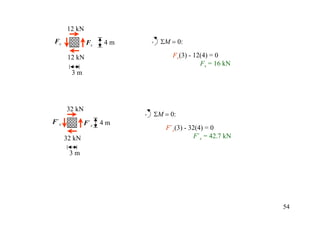
    12 kN Fv Fv 4m + ΣM = 0: 12 kN Fv(3) - 12(4) = 0 Fv = 16 kN 3m 32 kN + ΣM = 0: F´v F´v 4m F´v(3) - 32(4) = 0 32 kN F´v = 42.7 kN 3m 54