Examples
EX (1):
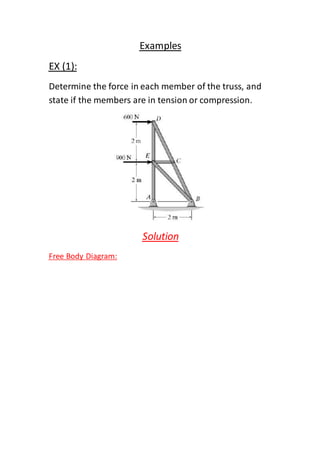
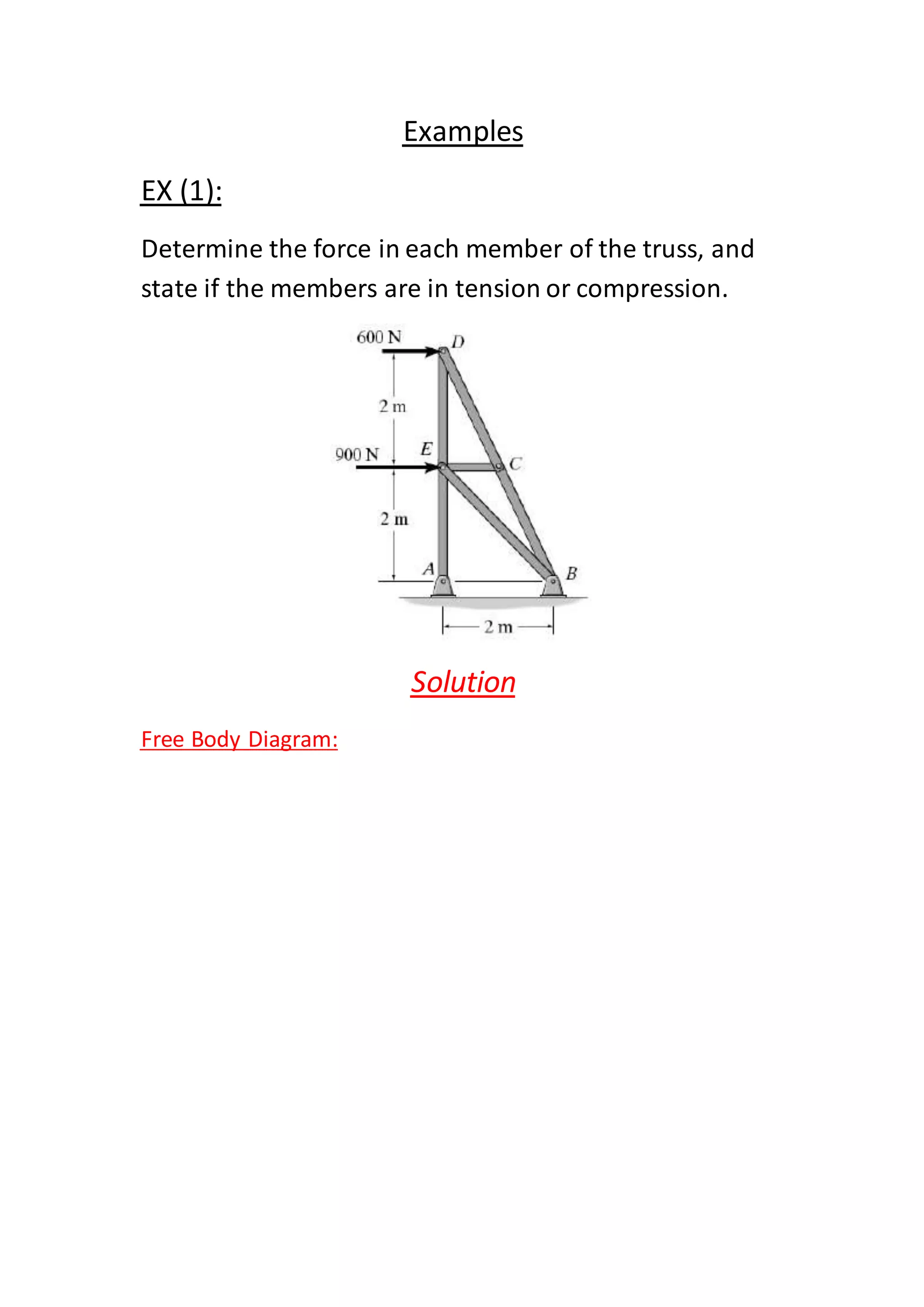
Determine the force in each member of the truss, and
state if the members are in tension or compression.
Solution
Free Body Diagram:
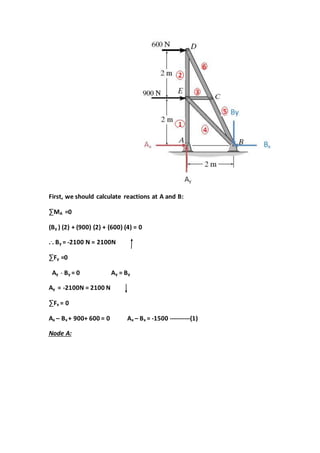
First, we should calculate reactions at A and B:
=0AM∑
) (2) + (900) (2) + (600) (4) = 0y(B
2100 N = 2100N-=y. B.
.
=0yF∑
y= By= 0 AyB-yA
2100N = 2100 N-=yA
= 0xF∑
(1)----------1500-=xB–x+ 900+ 600 = 0 AxB–xA
Node A:
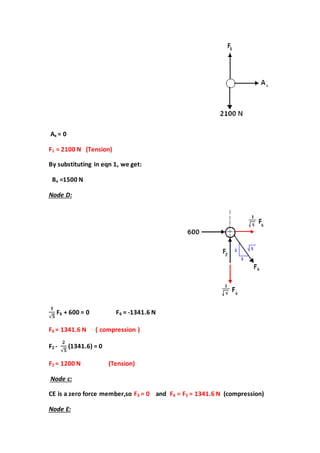
= 0xA
= 2100 N (Tension)1F
By substituting in eqn 1, we get:
=1500 NxB
Node D:
1341.6 N-=6+ 600 = 0 F6F
𝟏
√𝟓
= 1341.6 N ( compression )6F
(1341.6) = 0
𝟐
√𝟓
-2F
(Tension)= 1200 N2F
Node c:
(compression)= 1341.6 N5= F6Fand= 03FCE is a zero force member,so
Node E:
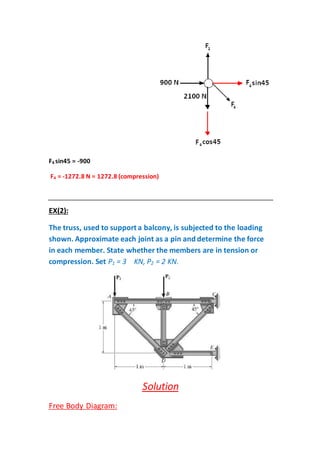
900-sin45 =4F
1272.8 N = 1272.8 (compression)-=4F
EX(2):
The truss, used to support a balcony, is subjected to the loading
shown. Approximate each joint as a pin and determine the force
in each member. State whether the members are in tension or
.2 KN=2KN, P3=1Pcompression. Set
Solution
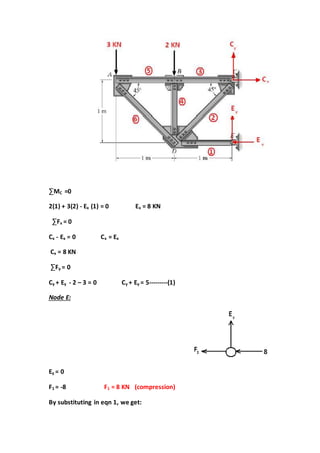
Diagram:Free Body
=0CM∑
= 8 KNx(1) = 0 ExE-2(1) + 3(2)
= 0xF∑
x= Ex= 0 CxE-xC
= 8 KNxC
= 0yF∑
(1)---------= 5y+ Ey3 = 0 C–2-y+ EyC
Node E:
= 0yE
)compression= 8 KN (1F8-=1F
By substituting in eqn 1, we get:
= 5 KNyC
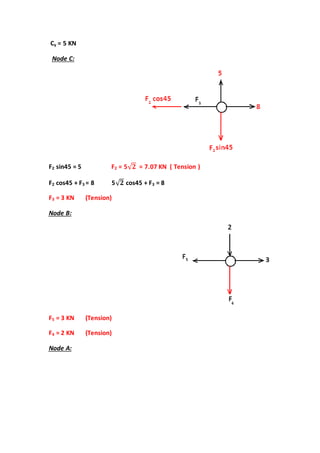
Node C:
= 7.07 KN ( Tension )√ 𝟐= 52Fsin45 = 52F
= 83cos45 + F√ 𝟐= 8 53cos45 + F2F
= 3 KN (Tension)3F
Node B:
= 3 KN (Tension)5F
= 2 KN (Tension)4F
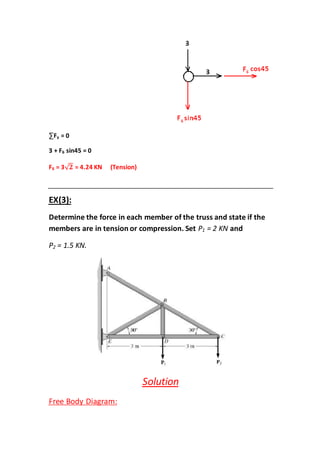
Node A:
= 0yF∑
sin45 = 063 + F
= 4.24 KN (Tension)√ 𝟐= 36F
EX(3):
Determine the force in each member of the truss and state if the
and= 2 KN1Pmembers are in tension or compression. Set
= 1.5 KN.2P
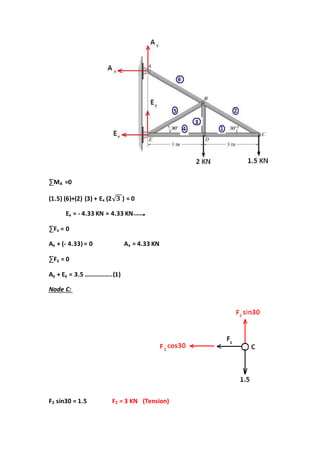
Solution
m:Free Body Diagra
=0AM∑
) = 0√ 𝟑(2x(1.5) (6)+(2) (3) + E
4.33 KN = 4.33 KN-=xE
= 0xF∑
= 4.33 KNx4.33) = 0 A-+ (xA
= 0yF∑
= 3.5 ……………..(1)y+ EyA
Node C:
= 3 KN (Tension)2Fsin30 = 1.52F
2.6 KN=2.6 KN (compression)-=√ 𝟑1.5-=1F+ 3cos30 = 01F
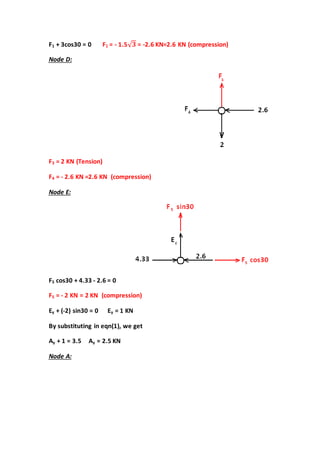
Node D:
= 2 KN (Tension)3F
2.6 KN =2.6 KN (compression)-=4F
Node E:
2.6 = 0-cos30 + 4.335F
2 KN = 2 KN (compression)-=5F
= 1 KNy2) sin30 = 0 E-+ (yE
By substituting in eqn(1), we get
= 2.5 KNy+ 1 = 3.5 AyA
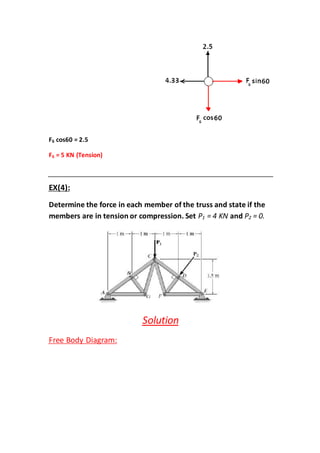
Node A:
cos60 = 2.56F
= 5 KN (Tension)6F
EX(4):
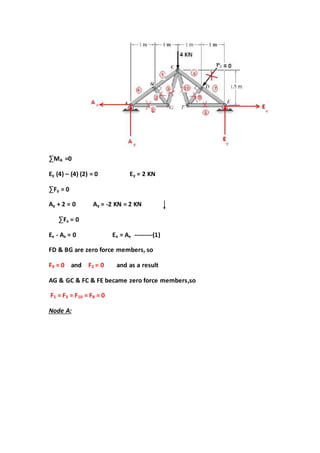
Determine the force in each member of the truss and state if the
= 0.2PandKN4=1Pmembers are in tension or compression. Set
Solution
Free Body Diagram:
=0AM∑
= 2 KNy(4) (2) = 0 E–(4)yE
= 0yF∑
2 KN = 2 KN-=y+ 2 = 0 AyA
= 0xF∑
(1)---------x= Ax= 0 ExA-xE
FD & BG are zero force members, so
and as a result= 02Fand= 09F
AG & GC & FC & FE became zero force members,so
= 08= F10= F3= F1F
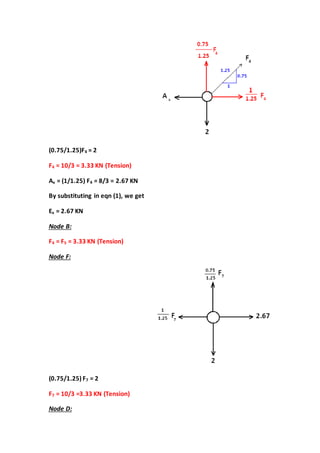
Node A:
= 24(0.75/1.25)F
= 10/3 = 3.33 KN (Tension)4F
= 8/3 = 2.67 KN4= (1/1.25) FxA
By substituting in eqn (1), we get
= 2.67 KNxE
Node B:
= 3.33 KN (Tension)5= F4F
Node F:
= 27(0.75/1.25) F
= 10/3 =3.33 KN (Tension)7F
Node D:
= 3.33 KN (Tension)6= F7F
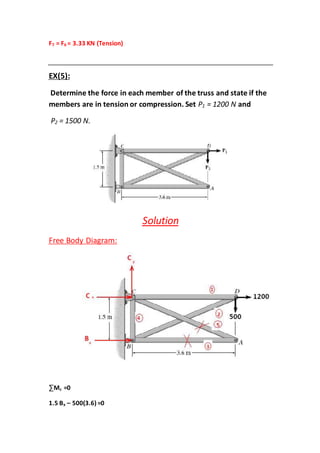
EX(5):
Determine the force in each member of the truss and state if the
andN1200=1Pmembers are in tension or compression. Set
= 1500 N.2P
Solution
Free Body Diagram:
=0cM∑
500(3.6) =0–x1.5 B
= 1200 NxB
=0xF∑
+1200 +1200 =0xC
2400 N-=xC
=0yF∑
= 500 Ny500 = 0 C–yC
Node D:
1300 N = 1300 N (compression)-=2F500-=2(1.5/3.9)F
= 2400 N (Tension)1F= 12002+ (3.6/3.9)F1F
AB & AC are zero force members, so
= 05= F3F
Node B:
500 N = 500 N (compression)-=4F
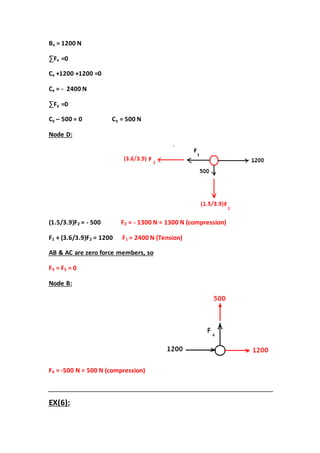
EX(6):
Determine the force in each member of the truss and state if the
members are in tension or compression.
Solution
Free Body Diagram:
=0cM∑
(2.4) = 0yA-3(1.2) + 4.5(3.6)
= 8.25 KNyA
= 0x=0 CxF∑
=0yF∑
= 0.75 KNy= 0 C-4.5–3–+ 8.25yC
BD and EA are zero force members, so
= 08= F3F
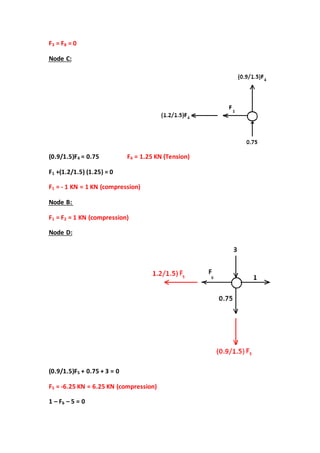
Node C:
= 1.25 KN (Tension)4F= 0.754(0.9/1.5)F
+(1.2/1.5) (1.25) = 01F
1 KN = 1 KN (compression)-=1F
Node B:
= 1 KN (compression)2= F1F
Node D:
+ 0.75 + 3 = 05(0.9/1.5)F
6.25 KN = 6.25 KN (compression)-=5F
5 = 0–6F–1
4 KN = 4KN (compression)-=6F
Node E:
= 4 KN (compression)7= F6F
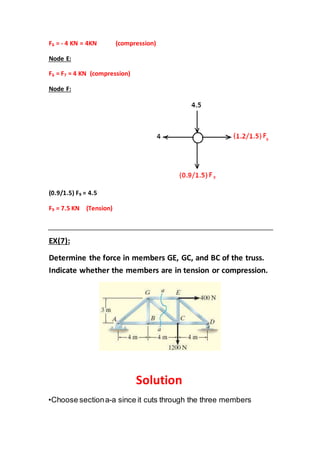
Node F:
= 4.59(0.9/1.5) F
= 7.5 KN (Tension)9F
EX(7):
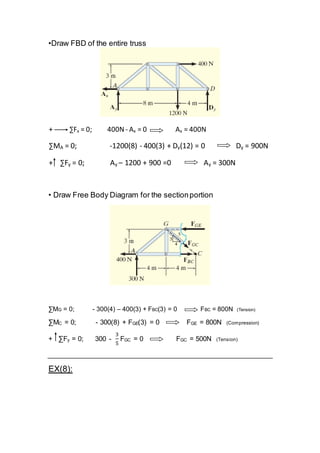
Determine the force in members GE, GC, and BC of the truss.
Indicate whether the members are in tension or compression.
Solution
•Choose sectiona-a since it cuts through the three members
•Draw FBD of the entire truss
= 400Nx= 0 AxA-= 0; 400Nx∑F+
= 900Ny(12) = 0 Dy400(3) + D-1200(8)-= 0;A∑M
= 300Ny1200 + 900 =0 A–y= 0; Ay+ ∑F
• Draw Free Body Diagram for the sectionportion
∑MG = 0; - 300(4) – 400(3) + FBC(3) = 0 FBC = 800N (Tension)
∑MC = 0; - 300(8) + FGE(3) = 0 FGE = 800N (Compression)
+ ∑Fy = 0; 300 -
3
5
FGC = 0 FGC = 500N (Tension)
EX(8):
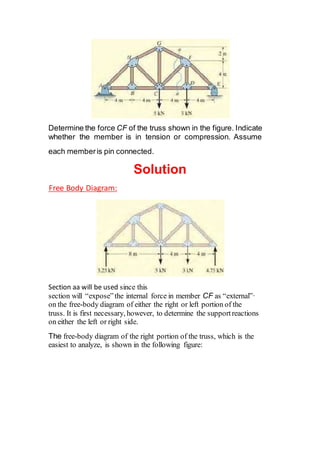
Determine the force CF of the truss shown in the figure. Indicate
whether the member is in tension or compression. Assume
each memberis pin connected.
Solution
Free Body Diagram:
Section aa will be used since this
section will “expose”the internal force in member CF as “external”·
on the free-body diagram of either the right or left portion of the
truss. It is first necessary, however, to determine the supportreactions
on either the left or right side.
The free-body diagram of the right portion of the truss, which is the
easiest to analyze, is shown in the following figure:
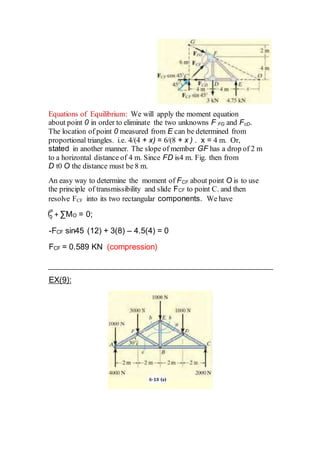
Equations of Equilibrium: We will apply the moment equation
about point 0 in order to eliminate the two unknowns F FG and FcD.
The location of point 0 measured from E can be determined from
proportional triangles. i.e. 4/(4 + x) = 6/(8 + x ) . x = 4 m. Or,
stated in another manner. The slope of member GF has a drop of 2 m
to a horizontal distance of 4 m. Since FD is4 m. Fig. then from
D t0 O the distance must be 8 m.
An easy way to determine the moment of FCF about point O is to use
the principle of transmissibility and slide FCF to point C. and then
resolve FCF into its two rectangular components. We have
= 0;O∑M+
4.5(4) = 0–sin45 (12) + 3(8)CFF-
(compression)= 0.589 KNCFF
EX(9):
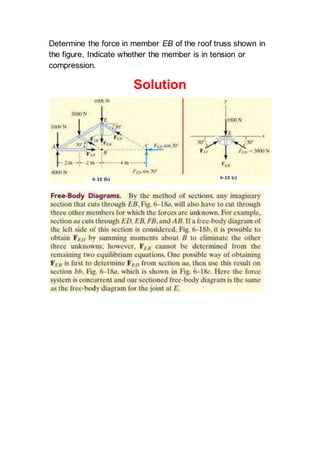
Determine the force in member EB of the roof truss shown in
the figure. Indicate whether the member is in tension or
compression.
Solution
Truss examples

Truss examples

  • 1.
    Examples EX (1): Determine theforce in each member of the truss, and state if the members are in tension or compression. Solution Free Body Diagram:
  • 2.
    First, we shouldcalculate reactions at A and B: =0AM∑ ) (2) + (900) (2) + (600) (4) = 0y(B 2100 N = 2100N-=y. B. . =0yF∑ y= By= 0 AyB-yA 2100N = 2100 N-=yA = 0xF∑ (1)----------1500-=xB–x+ 900+ 600 = 0 AxB–xA Node A:
  • 3.
    = 0xA = 2100N (Tension)1F By substituting in eqn 1, we get: =1500 NxB Node D: 1341.6 N-=6+ 600 = 0 F6F 𝟏 √𝟓 = 1341.6 N ( compression )6F (1341.6) = 0 𝟐 √𝟓 -2F (Tension)= 1200 N2F Node c: (compression)= 1341.6 N5= F6Fand= 03FCE is a zero force member,so Node E:
  • 4.
    900-sin45 =4F 1272.8 N= 1272.8 (compression)-=4F EX(2): The truss, used to support a balcony, is subjected to the loading shown. Approximate each joint as a pin and determine the force in each member. State whether the members are in tension or .2 KN=2KN, P3=1Pcompression. Set Solution Diagram:Free Body
  • 5.
    =0CM∑ = 8 KNx(1)= 0 ExE-2(1) + 3(2) = 0xF∑ x= Ex= 0 CxE-xC = 8 KNxC = 0yF∑ (1)---------= 5y+ Ey3 = 0 C–2-y+ EyC Node E: = 0yE )compression= 8 KN (1F8-=1F By substituting in eqn 1, we get:
  • 6.
    = 5 KNyC NodeC: = 7.07 KN ( Tension )√ 𝟐= 52Fsin45 = 52F = 83cos45 + F√ 𝟐= 8 53cos45 + F2F = 3 KN (Tension)3F Node B: = 3 KN (Tension)5F = 2 KN (Tension)4F Node A:
  • 7.
    = 0yF∑ sin45 =063 + F = 4.24 KN (Tension)√ 𝟐= 36F EX(3): Determine the force in each member of the truss and state if the and= 2 KN1Pmembers are in tension or compression. Set = 1.5 KN.2P Solution m:Free Body Diagra
  • 8.
    =0AM∑ ) = 0√𝟑(2x(1.5) (6)+(2) (3) + E 4.33 KN = 4.33 KN-=xE = 0xF∑ = 4.33 KNx4.33) = 0 A-+ (xA = 0yF∑ = 3.5 ……………..(1)y+ EyA Node C: = 3 KN (Tension)2Fsin30 = 1.52F
  • 9.
    2.6 KN=2.6 KN(compression)-=√ 𝟑1.5-=1F+ 3cos30 = 01F Node D: = 2 KN (Tension)3F 2.6 KN =2.6 KN (compression)-=4F Node E: 2.6 = 0-cos30 + 4.335F 2 KN = 2 KN (compression)-=5F = 1 KNy2) sin30 = 0 E-+ (yE By substituting in eqn(1), we get = 2.5 KNy+ 1 = 3.5 AyA Node A:
  • 10.
    cos60 = 2.56F =5 KN (Tension)6F EX(4): Determine the force in each member of the truss and state if the = 0.2PandKN4=1Pmembers are in tension or compression. Set Solution Free Body Diagram:
  • 11.
    =0AM∑ = 2 KNy(4)(2) = 0 E–(4)yE = 0yF∑ 2 KN = 2 KN-=y+ 2 = 0 AyA = 0xF∑ (1)---------x= Ax= 0 ExA-xE FD & BG are zero force members, so and as a result= 02Fand= 09F AG & GC & FC & FE became zero force members,so = 08= F10= F3= F1F Node A:
  • 12.
    = 24(0.75/1.25)F = 10/3= 3.33 KN (Tension)4F = 8/3 = 2.67 KN4= (1/1.25) FxA By substituting in eqn (1), we get = 2.67 KNxE Node B: = 3.33 KN (Tension)5= F4F Node F: = 27(0.75/1.25) F = 10/3 =3.33 KN (Tension)7F Node D:
  • 13.
    = 3.33 KN(Tension)6= F7F EX(5): Determine the force in each member of the truss and state if the andN1200=1Pmembers are in tension or compression. Set = 1500 N.2P Solution Free Body Diagram: =0cM∑ 500(3.6) =0–x1.5 B
  • 14.
    = 1200 NxB =0xF∑ +1200+1200 =0xC 2400 N-=xC =0yF∑ = 500 Ny500 = 0 C–yC Node D: 1300 N = 1300 N (compression)-=2F500-=2(1.5/3.9)F = 2400 N (Tension)1F= 12002+ (3.6/3.9)F1F AB & AC are zero force members, so = 05= F3F Node B: 500 N = 500 N (compression)-=4F EX(6):
  • 15.
    Determine the forcein each member of the truss and state if the members are in tension or compression. Solution Free Body Diagram: =0cM∑ (2.4) = 0yA-3(1.2) + 4.5(3.6) = 8.25 KNyA = 0x=0 CxF∑ =0yF∑ = 0.75 KNy= 0 C-4.5–3–+ 8.25yC BD and EA are zero force members, so
  • 16.
    = 08= F3F NodeC: = 1.25 KN (Tension)4F= 0.754(0.9/1.5)F +(1.2/1.5) (1.25) = 01F 1 KN = 1 KN (compression)-=1F Node B: = 1 KN (compression)2= F1F Node D: + 0.75 + 3 = 05(0.9/1.5)F 6.25 KN = 6.25 KN (compression)-=5F 5 = 0–6F–1
  • 17.
    4 KN =4KN (compression)-=6F Node E: = 4 KN (compression)7= F6F Node F: = 4.59(0.9/1.5) F = 7.5 KN (Tension)9F EX(7): Determine the force in members GE, GC, and BC of the truss. Indicate whether the members are in tension or compression. Solution •Choose sectiona-a since it cuts through the three members
  • 18.
    •Draw FBD ofthe entire truss = 400Nx= 0 AxA-= 0; 400Nx∑F+ = 900Ny(12) = 0 Dy400(3) + D-1200(8)-= 0;A∑M = 300Ny1200 + 900 =0 A–y= 0; Ay+ ∑F • Draw Free Body Diagram for the sectionportion ∑MG = 0; - 300(4) – 400(3) + FBC(3) = 0 FBC = 800N (Tension) ∑MC = 0; - 300(8) + FGE(3) = 0 FGE = 800N (Compression) + ∑Fy = 0; 300 - 3 5 FGC = 0 FGC = 500N (Tension) EX(8):
  • 19.
    Determine the forceCF of the truss shown in the figure. Indicate whether the member is in tension or compression. Assume each memberis pin connected. Solution Free Body Diagram: Section aa will be used since this section will “expose”the internal force in member CF as “external”· on the free-body diagram of either the right or left portion of the truss. It is first necessary, however, to determine the supportreactions on either the left or right side. The free-body diagram of the right portion of the truss, which is the easiest to analyze, is shown in the following figure:
  • 20.
    Equations of Equilibrium:We will apply the moment equation about point 0 in order to eliminate the two unknowns F FG and FcD. The location of point 0 measured from E can be determined from proportional triangles. i.e. 4/(4 + x) = 6/(8 + x ) . x = 4 m. Or, stated in another manner. The slope of member GF has a drop of 2 m to a horizontal distance of 4 m. Since FD is4 m. Fig. then from D t0 O the distance must be 8 m. An easy way to determine the moment of FCF about point O is to use the principle of transmissibility and slide FCF to point C. and then resolve FCF into its two rectangular components. We have = 0;O∑M+ 4.5(4) = 0–sin45 (12) + 3(8)CFF- (compression)= 0.589 KNCFF EX(9):
  • 21.
    Determine the forcein member EB of the roof truss shown in the figure. Indicate whether the member is in tension or compression. Solution