481
© 2016 Pearson Education, Inc., Upper Saddle River, NJ. All rights reserved. This material is protected under all copyright laws as they currently
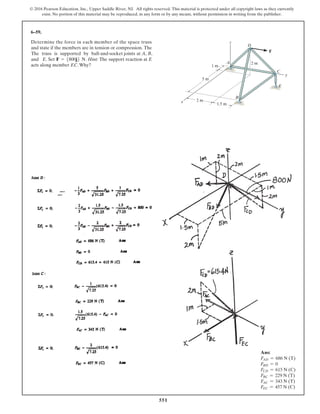
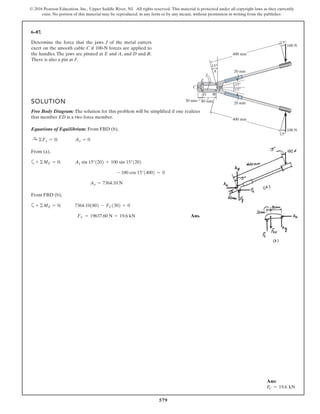
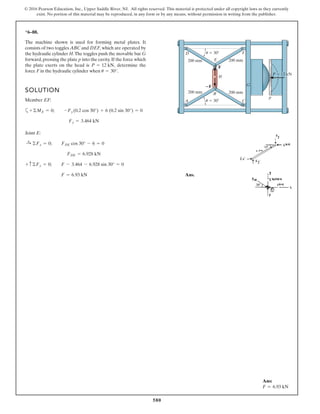
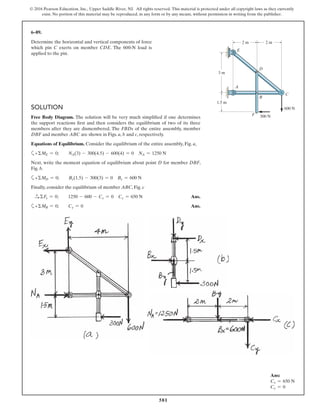
exist. No portion of this material may be reproduced, in any form or by any means, without permission in writing from the publisher.
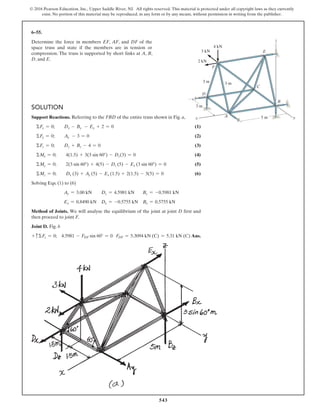
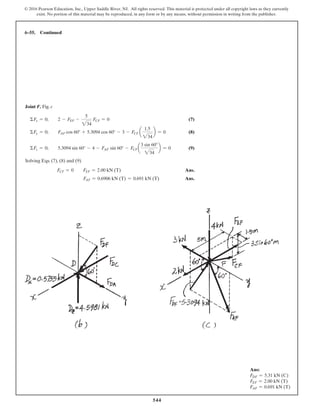
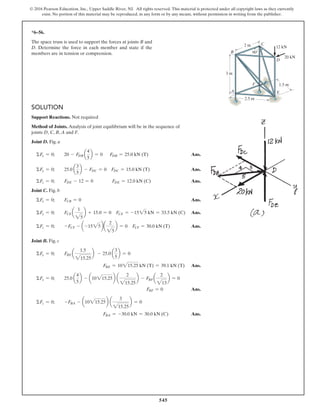
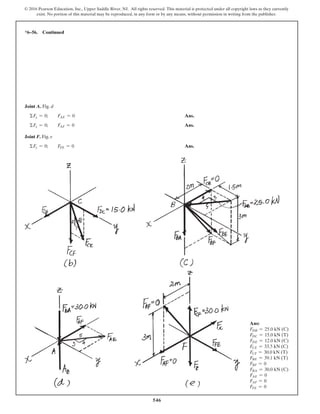
SOLUTION
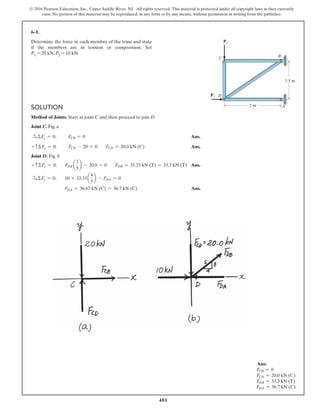
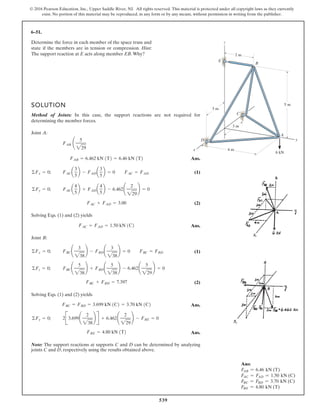
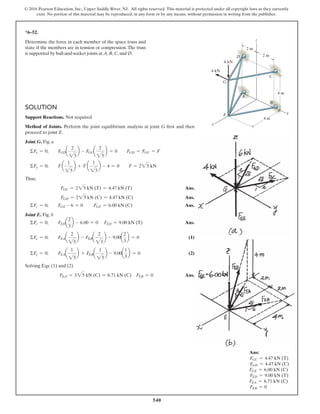
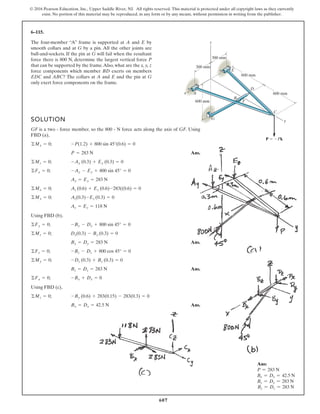
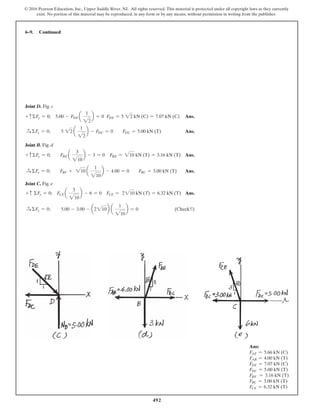
Method of Joints. Start at joint C and then proceed to join D.
Joint C. Fig. a
S+ ΣFx = 0; FCB = 0 Ans.
+ cΣFy = 0; FCD - 20 = 0 FCD = 20.0 kN (C) Ans.
Joint D. Fig. b
+ cΣFy = 0; FDB a
3
5
b - 20.0 = 0 FDB = 33.33 kN (T) = 33.3 kN (T) Ans.
S+ ΣFx = 0; 10 + 33.33 a
4
5
b - FDA = 0
FDA = 36.67 kN (C) = 36.7 kN (C) Ans.
6–1.
Determine the force in each member of the truss and state
if the members are in tension or compression. Set
P1 = 20 kN, P2 = 10 kN.
C
B
A
D
1.5 m
2 m
P1
P2
Ans:
FCB = 0
FCD = 20.0 kN (C)
FDB = 33.3 kN (T)
FDA = 36.7 kN (C)
482
© 2016 Pearson Education, Inc., Upper Saddle River, NJ. All rights reserved. This material is protected under all copyright laws as they currently
exist. No portion of this material may be reproduced, in any form or by any means, without permission in writing from the publisher.
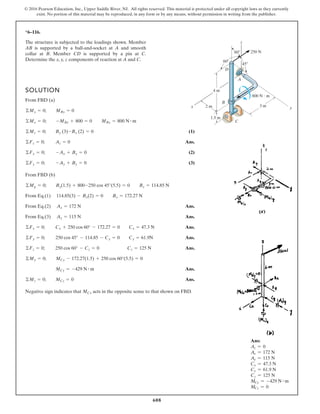
SOLUTION
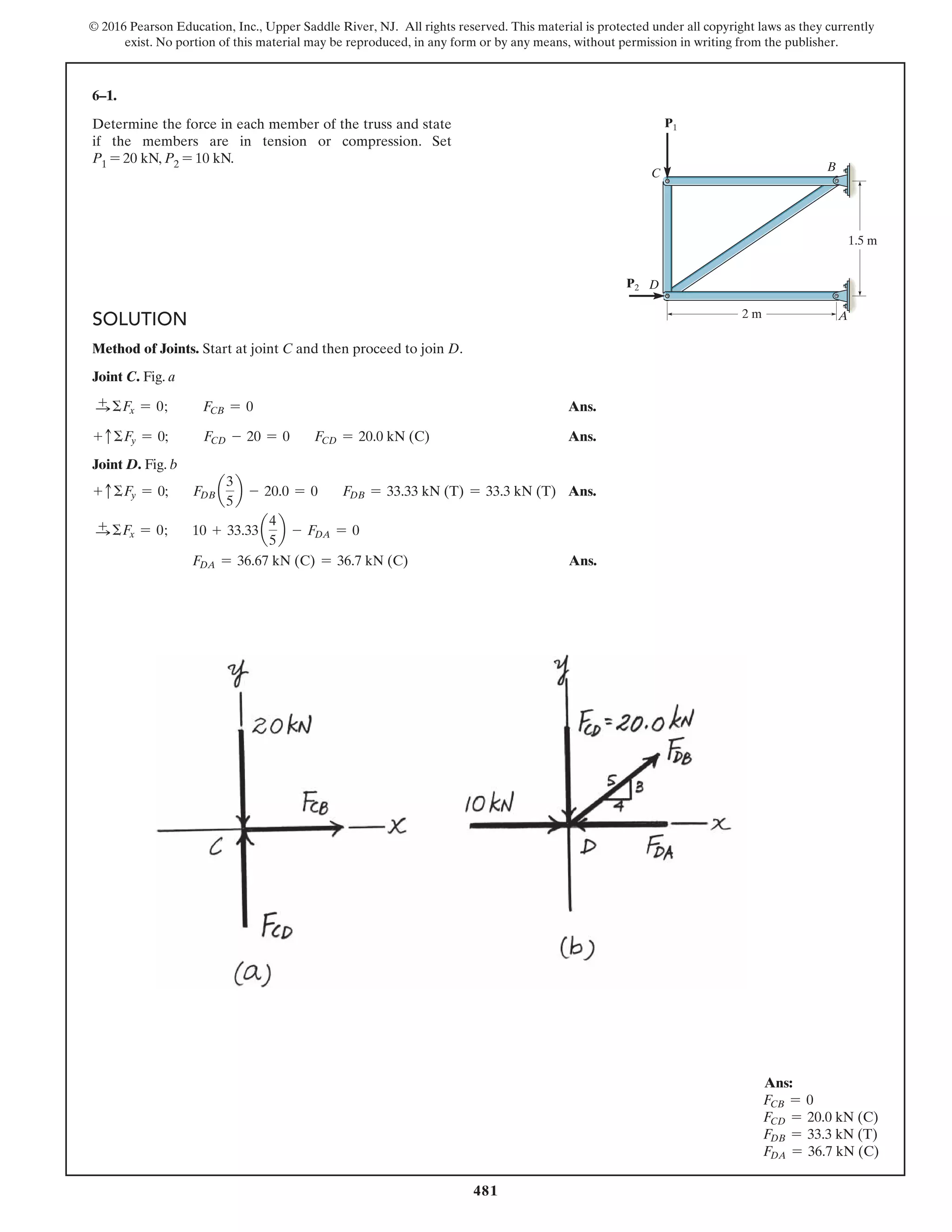
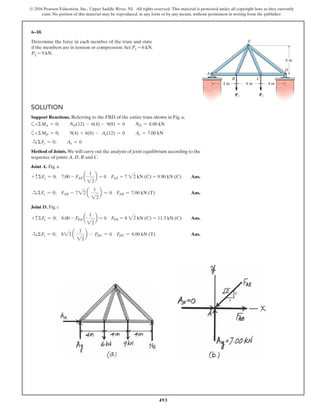
Method of Joints. Start at joint C and then proceed to joint D.
Joint C. Fig. a
S+ ΣFx = 0; FCB = 0 Ans.
+ cΣFy = 0; FCD - 45 = 0 FCD = 45.0 kN (C) Ans.
Joint D. Fig. b
+ cΣFy = 0; FDB a
3
5
b - 45.0 = 0 FDB = 75.0 kN (T) Ans.
S+ ΣFx = 0; 30 + 75.0 a
4
5
b - FDA = 0 FDA = 90.0 kN (C) Ans.
6–2.
Determine the force in each member of the truss and state
if the members are in tension or compression. Set
P1 = 45 kN, P2 = 30 kN.
C
B
A
D
1.5 m
2 m
P1
P2
Ans:
FCB = 0
FCD = 45.0 kN (C)
FDB = 75.0 kN (T)
FDA = 90.0 kN (C)
483
© 2016 Pearson Education, Inc., Upper Saddle River, NJ. All rights reserved. This material is protected under all copyright laws as they currently
exist. No portion of this material may be reproduced, in any form or by any means, without permission in writing from the publisher.
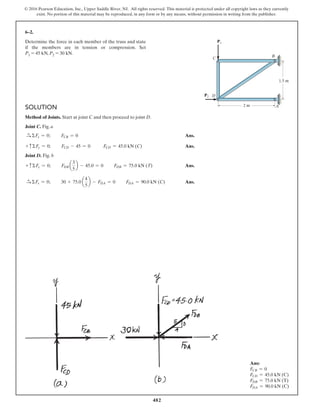
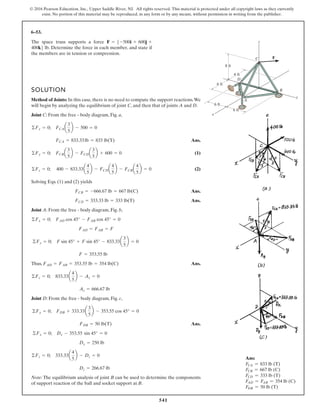
6–3.
SOLUTION
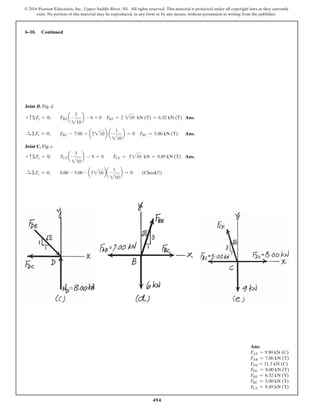
Joint A:
Ans.
Ans.
Joint B:
Ans.
Ans.
Joint C:
Ans.
Ans.
Joint D:
Ans.
Ans.
Joint E:
Ans.FEF = 300 lb (C)
:+ ©Fx = 0; 180 -
3
5
(FEF) = 0
FDF = 230 lb (T)
:+ ©Fx = 0; FDF - 140 -
3
5
(150) = 0
FDE = 120 lb (C)
+ c©Fy = 0; FDE -
4
5
(150) = 0
FCE = 180 lb (C)
:+ ©Fx = 0; -FCE +
3
5
(150) +
3
5
(150) = 0
FCD = 150 lb (T)
+ c ©Fy = 0; a
4
5
b FCD - a
4
5
b 150 = 0
+ c ©Fy = 0; FBC = 0
FBD = 140 lb (T)
:+ ©Fx = 0; FBD - 140 = 0
FAB = 140 lb (T)
:+ ©Fx = 0; FAB -
3
5
(150) -
5
13
(130) = 0
FAC = 150 lb (C)
+ c ©Fy = 0;
4
5
(FAC) -
12
13
(130) = 0
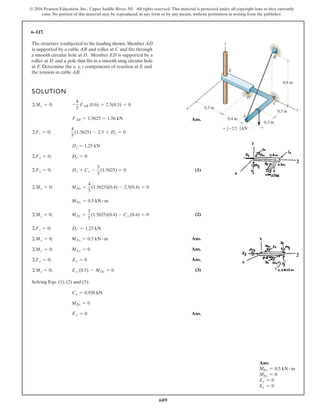
Determine the force in each member of the truss. State if
the members are in tension or compression.
3 ft 3 ft 3 ft
12
5
13
130 lb
A B
C
E
D
F
4 ft 4 ft
Ans:
FAC = 150 lb (C)
FAB = 140 lb (T)
FBD = 140 lb (T)
FBC = 0
FCD = 150 lb (T)
FCE = 180 lb (C)
FDE = 120 lb (C)
FDF = 230 lb (T)
FEF = 300 lb (C)
484
© 2016 Pearson Education, Inc., Upper Saddle River, NJ. All rights reserved. This material is protected under all copyright laws as they currently
exist. No portion of this material may be reproduced, in any form or by any means, without permission in writing from the publisher.
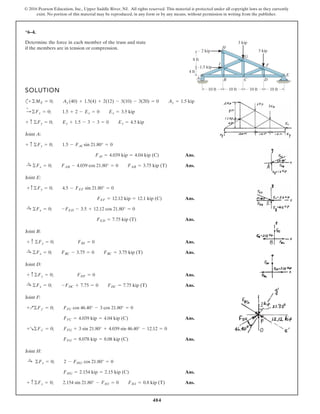
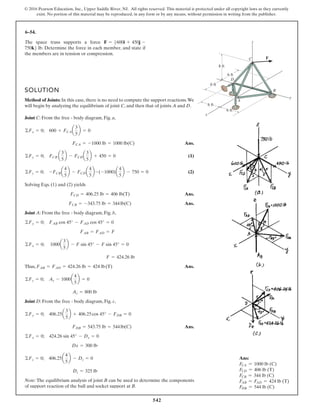
*6–4.
SOLUTION
c
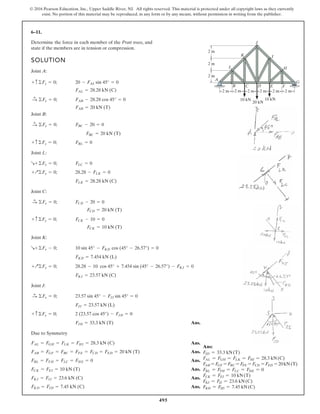
Joint A:
Ans.
Ans.
Joint E:
Ans.
Ans.
Joint B:
Ans.
Ans.
Joint D:
Ans.
Ans.
Joint F:
Ans.
Ans.
Joint H:
Ans.
Ans.+ c©Fy = 0; 2.154 sin 21.80° - FHI = 0 FHI = 0.8 kip (T)
FHG = 2.154 kip = 2.15 kip (C)
:+ ©Fx = 0; 2 - FHG cos 21.80° = 0
FFG = 8.078 kip = 8.08 kip (C)
+R©Fx¿ = 0; FFG + 3 sin 21.80° + 4.039 sin 46.40° - 12.12 = 0
FFC = 4.039 kip = 4.04 kip (C)
+Q©Fy¿ = 0; FFC cos 46.40° - 3 cos 21.80° = 0
:+ ©Fx = 0; -FDC + 7.75 = 0 FDC = 7.75 kip (T)
+ c©Fy = 0; FDF = 0
:+ ©Fx = 0; FBC - 3.75 = 0 FBC = 3.75 kip (T)
+ c ©Fy = 0; FBI = 0
FED = 7.75 kip (T)
:+ ©Fx = 0; -FED - 3.5 + 12.12 cos 21.80° = 0
FEF = 12.12 kip = 12.1 kip (C)
+ c©Fy = 0; 4.5 - FEF sin 21.80° = 0
:+ ©Fx = 0; FAB - 4.039 cos 21.80° = 0 FAB = 3.75 kip (T)
FAl = 4.039 kip = 4.04 kip (C)
+ c ©Fy = 0; 1.5 - FAl sin 21.80° = 0
+ c ©Fy = 0; Ey + 1.5 - 3 - 3 = 0 Ey = 4.5 kip
:
+
©Fx = 0; 1.5 + 2 - Ex = 0 Ex = 3.5 kip
+©ME = 0; Ay (40) + 1.5(4) + 2(12) - 3(10) - 3(20) = 0 Ay = 1.5 kip
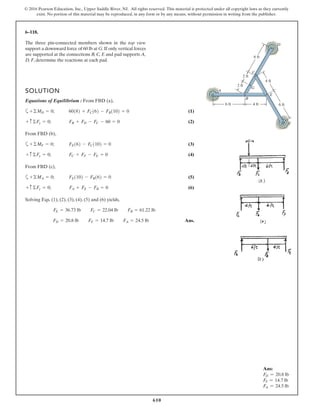
Determine the force in each member of the truss and state
if the members are in tension or compression.
2 kip
1.5 kip
4 ft
10 ft 10 ft 10 ft
3 kip
3 kip
10 ft
A B
I
H
G
F
C D
E
8 ft
485
© 2016 Pearson Education, Inc., Upper Saddle River, NJ. All rights reserved. This material is protected under all copyright laws as they currently
exist. No portion of this material may be reproduced, in any form or by any means, without permission in writing from the publisher.
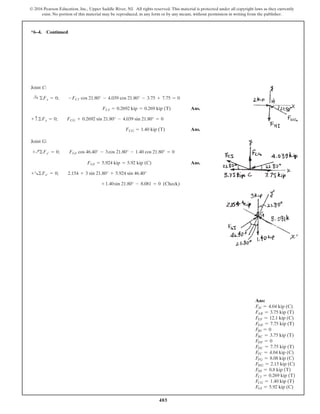
*6–4. Continued
Joint C:
Ans.
Ans.
Joint G:
Ans.
+ 1.40sin 21.80° - 8.081 = 0 (Check)
+R©Fx¿ = 0; 2.154 + 3 sin 21.80° + 5.924 sin 46.40°
FGI = 5.924 kip = 5.92 kip (C)
+Q©Fy¿ = 0; FGI cos 46.40° - 3cos 21.80° - 1.40 cos 21.80° = 0
FCG = 1.40 kip (T)
+ c ©Fy = 0; FCG + 0.2692 sin 21.80° - 4.039 sin 21.80° = 0
FCI = 0.2692 kip = 0.269 kip (T)
:+ ©Fx = 0; -FCI cos 21.80° - 4.039 cos 21.80° - 3.75 + 7.75 = 0
Ans:
FAl = 4.04 kip (C)
FAB = 3.75 kip (T)
FEF = 12.1 kip (C)
FED = 7.75 kip (T)
FBI = 0
FBC = 3.75 kip (T)
FDF = 0
FDC = 7.75 kip (T)
FFC = 4.04 kip (C)
FFG = 8.08 kip (C)
FHG = 2.15 kip (C)
FHI = 0.8 kip (T)
FCI = 0.269 kip (T)
FCG = 1.40 kip (T)
FGI = 5.92 kip (C)
486
© 2016 Pearson Education, Inc., Upper Saddle River, NJ. All rights reserved. This material is protected under all copyright laws as they currently
exist. No portion of this material may be reproduced, in any form or by any means, without permission in writing from the publisher.
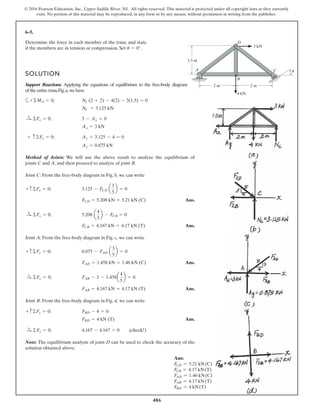
6–5.
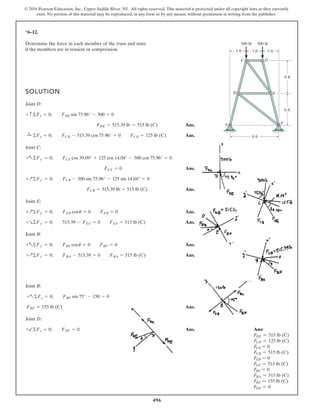
Determine the force in each member of the truss, and state
if the members are in tension or compression. Set .
SOLUTION
Support Reactions: Applying the equations of equilibrium to the free-body diagram
oftheentiretruss,Fig.a,we have
a
Method of Joints: We will use the above result to analyze the equilibrium of
joints C and A, and then proceed to analyze of joint B.
Joint C: From the free-body diagram in Fig. b, we can write
Ans.
Ans.
Joint A: From the free-body diagram in Fig. c, we can write
Ans.
Ans.
Joint B: From the free-body diagram in Fig. d, we can write
Ans.
Note: The equilibrium analysis of joint D can be used to check the accuracy of the
solution obtained above.
4.167 - 4.167 = 0 (check!)©Fx = 0;:
+
FBD = 4 kN (T)
FBD - 4 = 0+ c©Fy = 0;
FAB = 4.167 kN = 4.17 kN (T)
FAB - 3 - 1.458a
4
5
b = 0©Fx = 0;:
+
FAD = 1.458 kN = 1.46 kN (C)
0.875 - FAD a
3
5
b = 0+ c©Fy = 0;
FCB = 4.167 kN = 4.17 kN (T)
5.208 a
4
5
b - FCB = 0©Fx = 0;:+
FCD = 5.208 kN = 5.21 kN (C)
3.125 - FCD a
3
5
b = 0+ c©Fy = 0;
Ay = 0.875 kN
Ay + 3.125 - 4 = 0+ c©Fy = 0;
Ax = 3 kN
3 - Ax = 0©Fx = 0;:
+
NC = 3.125 kN
NC (2 + 2) - 4(2) - 3(1.5) = 0+©MA = 0;
u = 0°
A C
B
D
2 m
4 kN
3 kN
2 m
1.5 m
u
Ans:
FCD = 5.21 kN(C)
FCB = 4.17 kN(T)
FAD = 1.46 kN(C)
FAB = 4.17 kN(T)
FBD = 4 kN(T)
487
© 2016 Pearson Education, Inc., Upper Saddle River, NJ. All rights reserved. This material is protected under all copyright laws as they currently
exist. No portion of this material may be reproduced, in any form or by any means, without permission in writing from the publisher.
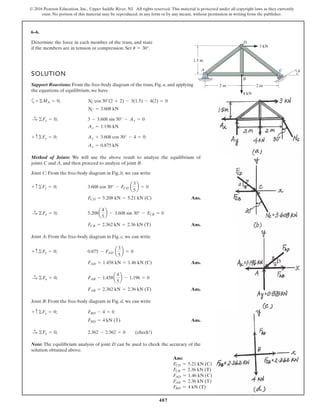
6–6.
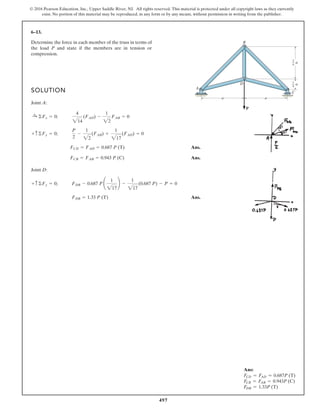
Determine the force in each member of the truss, and state
if the members are in tension or compression. Set .
SOLUTION
Support Reactions: From the free-body diagram of the truss, Fig. a, and applying
the equations of equilibrium, we have
a
Method of Joints: We will use the above result to analyze the equilibrium of
joints C and A, and then proceed to analyze of joint B.
Joint C: From the free-body diagram in Fig. b, we can write
Ans.
Ans.
Joint A: From the free-body diagram in Fig. c, we can write
Ans.
Ans.
Joint B: From the free-body diagram in Fig. d, we can write
Ans.
Note: The equilibrium analysis of joint D can be used to check the accuracy of the
solution obtained above.
2.362 - 2.362 = 0 (check!)©Fx = 0;:
+
FBD = 4 kN (T)
FBD - 4 = 0+ c©Fy = 0;
FAB = 2.362 kN = 2.36 kN (T)
FAB - 1.458a
4
5
b - 1.196 = 0©Fx = 0;:
+
FAD = 1.458 kN = 1.46 kN (C)
0.875 - FAD a
3
5
b = 0+ c ©Fy = 0;
FCB = 2.362 kN = 2.36 kN (T)
5.208a
4
5
b - 3.608 sin 30° - FCB = 0©Fx = 0;:+
FCD = 5.208 kN = 5.21 kN (C)
3.608 cos 30° - FCD a
3
5
b = 0+ c©Fy = 0;
Ay = 0.875 kN
Ay + 3.608 cos 30° - 4 = 0+ c©Fy = 0;
Ax = 1.196 kN
3 - 3.608 sin 30° - Ax = 0©Fx = 0;:
+
NC = 3.608 kN
NC cos 30°(2 + 2) - 3(1.5) - 4(2) = 0+©MA = 0;
u = 30°
A C
B
D
2 m
4 kN
3 kN
2 m
1.5 m
u
Ans:
FCD = 5.21 kN (C)
FCB = 2.36 kN (T)
FAD = 1.46 kN (C)
FAB = 2.36 kN (T)
FBD = 4 kN (T)
488
© 2016 Pearson Education, Inc., Upper Saddle River, NJ. All rights reserved. This material is protected under all copyright laws as they currently
exist. No portion of this material may be reproduced, in any form or by any means, without permission in writing from the publisher.
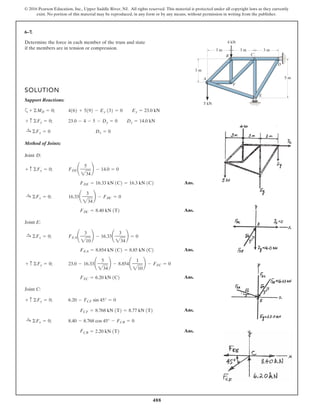
6–7.
SOLUTION
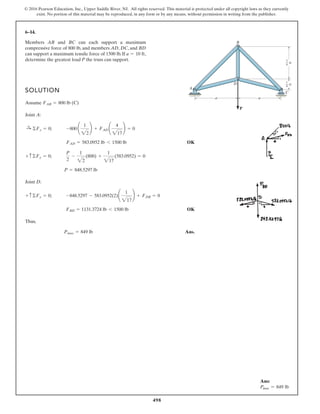
Support Reactions:
a
Method of Joints:
Joint D:
Ans.
Ans.
Joint E :
Ans.
Ans.
Joint C:
Ans.
Ans.FCB = 2.20 kN T
8.40 - 8.768 cos 45° - FCB = 0:+ ©Fx = 0;
FCF = 8.768 kN 1T2 = 8.77 kN 1T2
6.20 - FCF sin 45° = 0+ c ©Fy = 0;
FEC = 6.20 kN 1C2
23.0 - 16.33¢
5
234
≤ - 8.854¢
1
210
≤ - FEC = 0+ c ©Fy = 0;
FEA = 8.854 kN 1C2 = 8.85 kN 1C2
FEA¢
3
210
≤ - 16.33¢
3
234
≤ = 0:+ ©Fx = 0;
FDC = 8.40 kN 1T2
16.33¢
3
234
≤ - FDC = 0:+ ©Fx = 0;
FDE = 16.33 kN 1C2 = 16.3 kN 1C2
FDE¢
5
234
≤ - 14.0 = 0+ c ©Fy = 0;
Dx = 0:+ ©Fx = 0
23.0 - 4 - 5 - Dy = 0 Dy = 14.0 kN+ c ©Fy = 0;
4162 + 5192 - Ey 132 = 0 Ey = 23.0 kN+ ©MD = 0;
Determine the force in each member of the truss and state
if the members are in tension or compression.
E
D
CB
F
A 5 m
3 m
5 kN
4 kN
3 m 3 m 3 m
489
© 2016 Pearson Education, Inc., Upper Saddle River, NJ. All rights reserved. This material is protected under all copyright laws as they currently
exist. No portion of this material may be reproduced, in any form or by any means, without permission in writing from the publisher.
6–7. Continued
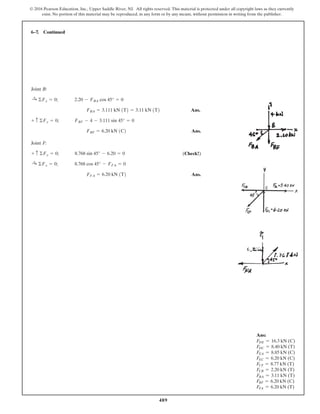
Joint B:
Ans.
Joint F:
(Check!)
Ans.FFA = 6.20 kN 1T2
8.768 cos 45° - FFA = 0:+ ©Fx = 0;
8.768 sin 45° - 6.20 = 0+ c ©Fy = 0;
FBF = 6.20 kN 1C2
FBF - 4 - 3.111 sin 45° = 0+ c ©Fy = 0;
FBA = 3.111 kN 1T2 = 3.11 kN 1T2
2.20 - FBA cos 45° = 0:+ ©Fx = 0;
Ans.
Ans:
FDE = 16.3 kN (C)
FDC = 8.40 kN (T)
FEA = 8.85 kN (C)
FEC = 6.20 kN (C)
FCF = 8.77 kN (T)
FCB = 2.20 kN (T)
FBA = 3.11 kN (T)
FBF = 6.20 kN (C)
FFA = 6.20 kN (T)
490
© 2016 Pearson Education, Inc., Upper Saddle River, NJ. All rights reserved. This material is protected under all copyright laws as they currently
exist. No portion of this material may be reproduced, in any form or by any means, without permission in writing from the publisher.
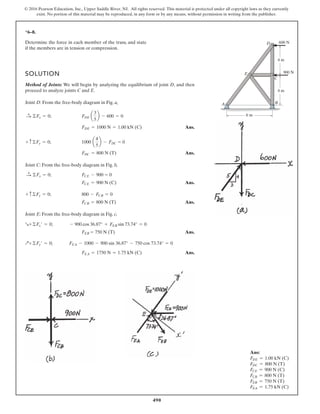
*6–8.
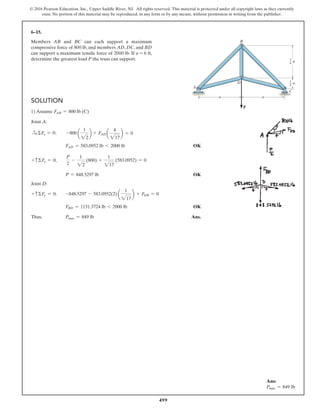
Determine the force in each member of the truss, and state
if the members are in tension or compression.
SOLUTION
Method of Joints: We will begin by analyzing the equilibrium of joint D, and then
proceed to analyze joints C and E.
Joint D: From the free-body diagram in Fig. a,
Ans.
Ans.
Joint C: From the free-body diagram in Fig. b,
Ans.
Ans.
Joint E: From the free-body diagram in Fig. c,
Ans.
Ans.FEA = 1750 N = 1.75 kN (C)
FEA - 1000 - 900 sin 36.87° - 750 cos 73.74° = 0Q+©Fy¿ = 0;
FEB = 750 N (T)
- 900 cos 36.87° + FEB sin 73.74° = 0R+©Fx¿ = 0;
FCB = 800 N (T)
800 - FCB = 0+ c ©Fy = 0;
FCE = 900 N (C)
FCE - 900 = 0©Fx = 0;:+
FDC = 800 N (T)
1000 a
4
5
b - FDC = 0+ c©Fy = 0;
FDE = 1000 N = 1.00 kN (C)
FDE a
3
5
b - 600 = 0©Fx = 0;:
+
B
E
D
A
C
600 N
900 N
4 m
4 m
6 m
Ans:
FDE = 1.00 kN (C)
FDC = 800 N (T)
FCE = 900 N (C)
FCB = 800 N (T)
FEB = 750 N (T)
FEA = 1.75 kN (C)
491
© 2016 Pearson Education, Inc., Upper Saddle River, NJ. All rights reserved. This material is protected under all copyright laws as they currently
exist. No portion of this material may be reproduced, in any form or by any means, without permission in writing from the publisher.
SOLUTION
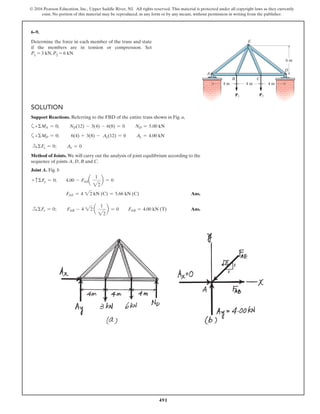
Support Reactions. Referring to the FBD of the entire truss shown in Fig. a,
a+ΣMA = 0; ND(12) - 3(4) - 6(8) = 0 ND = 5.00 kN
a+ΣMD = 0; 6(4) + 3(8) - Ay(12) = 0 Ay = 4.00 kN
S+ ΣFx = 0; Ax = 0
Method of Joints. We will carry out the analysis of joint equilibrium according to the
sequence of joints A, D, B and C.
Joint A. Fig. b
+ cΣFy = 0; 4.00 - FAEa
1
22
b = 0
FAE = 4 22 kN (C) = 5.66 kN (C) Ans.
S+ ΣFx = 0; FAB - 4 22 a
1
22
b = 0 FAB = 4.00 kN (T) Ans.
6–9.
Determine the force in each member of the truss and state
if the members are in tension or compression. Set
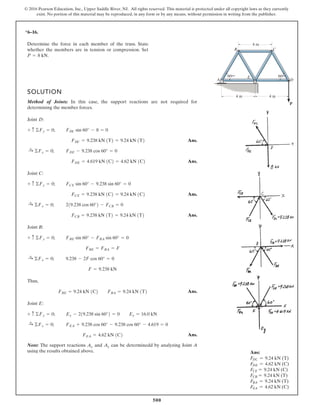
P1 = 3 kN, P2 = 6 kN.
A
D
E
B C
P1 P2
4 m 4 m4 m
6 m
492
© 2016 Pearson Education, Inc., Upper Saddle River, NJ. All rights reserved. This material is protected under all copyright laws as they currently
exist. No portion of this material may be reproduced, in any form or by any means, without permission in writing from the publisher.
6–9. Continued
Joint D. Fig. c
+ cΣFy = 0; 5.00 - FDE a
1
22
b = 0 FDE = 5 22 kN (C) = 7.07 kN (C) Ans.
S+ ΣFx = 0; 5 22 a
1
22
b - FDC = 0 FDC = 5.00 kN (T) Ans.
Joint B. Fig. d
+ cΣFy = 0; FBE a
3
210
b - 3 = 0 FBE = 210 kN (T) = 3.16 kN (T) Ans.
S+ ΣFx = 0; FBC + 210 a
1
210
b - 4.00 = 0 FBC = 3.00 kN (T) Ans.
Joint C. Fig. e
+ c ΣFy = 0; FCE a
3
210
b - 6 = 0 FCE = 2210 kN (T) = 6.32 kN (T) Ans.
S+ ΣFx = 0; 5.00 - 3.00 - a2210b a
1
210
b = 0 (Check!!)
Ans:
FAE = 5.66 kN (C)
FAB = 4.00 kN (T)
FDE = 7.07 kN (C)
FDC = 5.00 kN (T)
FBE = 3.16 kN (T)
FBC = 3.00 kN (T)
FCE = 6.32 kN (T)
493
© 2016 Pearson Education, Inc., Upper Saddle River, NJ. All rights reserved. This material is protected under all copyright laws as they currently
exist. No portion of this material may be reproduced, in any form or by any means, without permission in writing from the publisher.
SOLUTION
Support Reactions. Referring to the FBD of the entire truss shown in Fig. a,
a+ΣMA = 0; ND(12) - 6(4) - 9(8) = 0 ND = 8.00 kN
a+ΣMD = 0; 9(4) + 6(8) - Ay(12) = 0 Ay = 7.00 kN
S+ ΣFx = 0; Ax = 0
Method of Joints. We will carry out the analysis of joint equilibrium according to the
sequence of joints A, D, B and C.
Joint A. Fig. a
+ cΣFy = 0; 7.00 - FAE a
1
22
b = 0 FAE = 7 22 kN (C) = 9.90 kN (C) Ans.
S+ ΣFx = 0; FAB - 722 a
1
22
b = 0 FAB = 7.00 kN (T) Ans.
Joint D. Fig. c
+ cΣFy = 0; 8.00 - FDE a
1
22
b = 0 FDE = 8 22 kN (C) = 11.3 kN (C) Ans.
S+ ΣFx = 0; 822 a
1
22
b - FDC = 0 FDC = 8.00 kN (T) Ans.
6–10.
Determine the force in each member of the truss and state
if the members are in tension or compression. Set P1 = 6 kN,
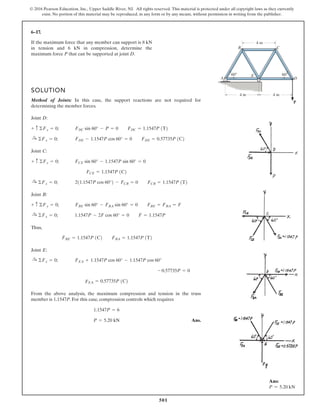
P2 = 9 kN.
A
D
E
B C
P1 P2
4 m 4 m4 m
6 m
494
© 2016 Pearson Education, Inc., Upper Saddle River, NJ. All rights reserved. This material is protected under all copyright laws as they currently
exist. No portion of this material may be reproduced, in any form or by any means, without permission in writing from the publisher.
Joint B. Fig. d
+ cΣFy = 0; FBE a
3
210
b - 6 = 0 FBE = 2 210 kN (T) = 6.32 kN (T) Ans.
S+ ΣFx = 0; FBC - 7.00 + a2210b a
1
210
b = 0 FBC = 5.00 kN (T) Ans.
Joint C. Fig. e
+ cΣFy = 0; FCE a
3
210
b - 9 = 0 FCE = 3210 kN = 9.49 kN (T) Ans.
S+ ΣFx = 0; 8.00 - 5.00 - a3210ba
1
210
b = 0 (Check!!)
6–10. Continued
Ans:
FAE = 9.90 kN (C)
FAB = 7.00 kN (T)
FDE = 11.3 kN (C)
FDC = 8.00 kN (T)
FBE = 6.32 kN (T)
FBC = 5.00 kN (T)
FCE = 9.49 kN (T)
495
© 2016 Pearson Education, Inc., Upper Saddle River, NJ. All rights reserved. This material is protected under all copyright laws as they currently
exist. No portion of this material may be reproduced, in any form or by any means, without permission in writing from the publisher.
6–11.
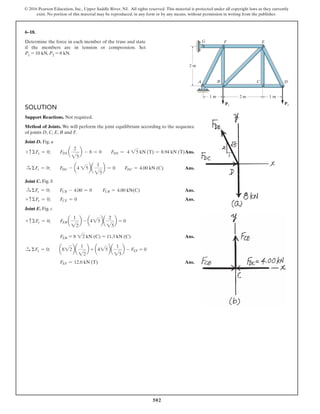
Determine the force in each member of the Pratt truss, and
state if the members are in tension or compression.
SOLUTION
Joint A:
Joint B:
Joint L:
Joint C:
Joint K:
Joint J:
Ans.
Due to Symmetry
Ans.
Ans.
Ans.
Ans.
Ans.
Ans.FKD = FID = 7.45 kN (C)
FKJ = FIJ = 23.6 kN (C)
FCK = FEI = 10 kN (T)
FBL = FFH = FLC = FHE = 0
FAB = FGF = FBC = FFE = FCD = FED = 20 kN (T)
FAL = FGH = FLK = FHI = 28.3 kN (C)
FJD = 33.3 kN (T)
2 (23.57 cos 45°) - FJD = 0+ c ©Fy = 0;
FJI = 23.57 kN (L)
23.57 sin 45° - FJI sin 45° = 0©Fx = 0;:
+
FKJ = 23.57 kN (C)
28.28 - 10 cos 45° + 7.454 sin (45° - 26.57°) - FKJ = 0+Q©Fy = 0;
FKD = 7.454 kN (L)
10 sin 45° - FKD cos (45° - 26.57°) = 0R+©Fx - 0;
FCK = 10 kN (T)
FCK - 10 = 0+ c ©Fy = 0;
FCD = 20 kN (T)
FCD - 20 = 0©Fx = 0;:
+
FLK = 28.28 kN (C)
28.28 - FLK = 0+Q©Fy = 0;
FLC = 0R+©Fx = 0;
FBL = 0+ c©Fy = 0;
FBC = 20 kN (T)
FBC - 20 = 0©Fx = 0;:+
FAB = 20 kN (T)
FAB - 28.28 cos 45° = 0©Fx = 0;:+
FAL = 28.28 kN (C)
20 - FAL sin 45° = 0+ c©Fy = 0;
A
B C D E F
G
H
I
J
K
L
2 m
2 m
2 m 2 m
10 kN 10 kN
20 kN
2 m 2 m 2 m
2 m
2 m
Ans:
FJD = 33.3 kN(T)
FAL = FGH = FLK = FHI = 28.3 kN(C)
FAB = FGF = FBC = FFE = FCD = FED = 20kN(T)
FBL = FFH = FLC = FHE = 0
FCK = FEI = 10 kN(T)
FKJ = FIJ = 23.6 kN(C)
FKD = FID = 7.45 kN(C)
496
© 2016 Pearson Education, Inc., Upper Saddle River, NJ. All rights reserved. This material is protected under all copyright laws as they currently
exist. No portion of this material may be reproduced, in any form or by any means, without permission in writing from the publisher.
*6–12.
SOLUTION
Joint D:
Ans.
Ans.
Joint C:
Ans.
Ans.
Joint E:
Ans.
Ans.
Joint B:
Ans.
Ans.
Joint B:
Ans.
Joint D:
Ans.+b©Fy = 0; FDF = 0
FBF = 155 lb (C)
+a©Fy = 0; FBF sin 75° - 150 = 0
+Q©Fx¿ = 0; FBA - 515.39 = 0 FBA = 515 lb (C)
+a©Fy¿ = 0; FBF cosu = 0 FBF = 0
+R©Fx¿ = 0; 515.39 - FEF = 0 FEF = 515 lb (C)
+Q©Fy¿ = 0; FEB cosu = 0 FEB = 0
FCB = 515.39 lb = 515 lb (C)
+Q©Fx¿ = 0; FCB - 500 sin 75.96° - 125 sin 14.04° = 0
FCE = 0
+a©Fy¿ = 0; FCE cos 39.09° + 125 cos 14.04° - 500 cos 75.96° = 0
:+ ©Fx = 0; FCD - 515.39 cos 75.96° = 0 FCD = 125 lb (C)
FDE = 515.39 lb = 515 lb (C)
+ c ©Fy = 0; FDE sin 75.96° - 500 = 0
Determine the force in each member of the truss and state
if the members are in tension or compression.
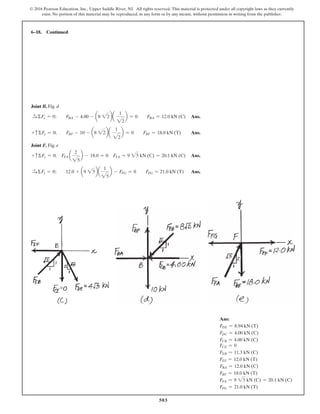
500 lb
3 ft
500 lb
C
B
A F
E
D
9 ft
6 ft
6 ft
3 ft 3 ft
Ans:
FDE = 515 lb (C)
FCD = 125 lb (C)
FCE = 0
FCB = 515 lb (C)
FEB = 0
FEF = 515 lb (C)
FBF = 0
FBA = 515 lb (C)
FBF = 155 lb (C)
FDF = 0
497
© 2016 Pearson Education, Inc., Upper Saddle River, NJ. All rights reserved. This material is protected under all copyright laws as they currently
exist. No portion of this material may be reproduced, in any form or by any means, without permission in writing from the publisher.
6–13.
SOLUTION
Joint A:
Ans.
Ans.
Joint D:
Ans.FDB = 1.33 P (T)
+ c©Fy = 0; FDB - 0.687 P ¢
1
217
≤ -
1
217
(0.687 P) - P = 0
FCB = FAB = 0.943 P (C)
FCD = FAD = 0.687 P (T)
+ c ©Fy = 0;
P
2
-
1
22
(FAB) +
1
217
(FAD) = 0
:+ ©Fx = 0;
4
214
(FAD) -
1
22
FAB = 0
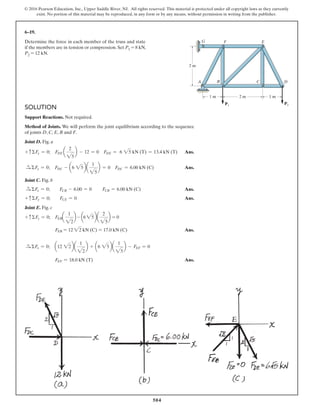
Determine the force in each member of the truss in terms of
the load P and state if the members are in tension or
compression.
B
D
P
A
C
a a
a
a
3—
4
1—
4
Ans:
FCD = FAD = 0.687P (T)
FCB = FAB = 0.943P (C)
FDB = 1.33P (T)
498
© 2016 Pearson Education, Inc., Upper Saddle River, NJ. All rights reserved. This material is protected under all copyright laws as they currently
exist. No portion of this material may be reproduced, in any form or by any means, without permission in writing from the publisher.
6–14.
Members AB and BC can each support a maximum
compressive force of 800 lb, and members AD, DC, and BD
can support a maximum tensile force of 1500 lb. If ,
determine the greatest load P the truss can support.
a = 10 ft
SOLUTION
Assume
Joint A:
OK
Joint D:
OK
Thus,
Ans.Pmax = 849 lb
FBD = 1131.3724 lb 6 1500 lb
+ c©Fy = 0; -848.5297 - 583.0952(2)¢
1
217
≤ + FDB = 0
P = 848.5297 lb
+ c©Fy = 0;
P
2
-
1
22
(800) +
1
217
(583.0952) = 0
FAD = 583.0952 lb 6 1500 lb
:+ ©Fx = 0; -800 ¢
1
22
≤ + FAD ¢
4
217
≤ = 0
FAB = 800 lb (C)
B
D
P
A
C
a a
a
a
3
—
4
1—
4
Ans:
Pmax = 849 lb
499
© 2016 Pearson Education, Inc., Upper Saddle River, NJ. All rights reserved. This material is protected under all copyright laws as they currently
exist. No portion of this material may be reproduced, in any form or by any means, without permission in writing from the publisher.
6–15.
Members AB and BC can each support a maximum
compressive force of 800 lb, and members AD, DC, and BD
can support a maximum tensile force of 2000 lb. If a = 6 ft,
determine the greatest load P the truss can support.
Ans:
Pmax = 849 lb
B
D
A
C
a a
a
a
3—
4
1
—
4
SOLUTION
1) Assume FAB = 800 lb (C)
Joint A:
S+ ΣFx = 0; -800 a
1
22
b + FAD a
4
217
b = 0
FAD = 583.0952 lb 6 2000 lb OK
+ cΣFy = 0;
P
2
-
1
22
(800) +
1
217
(583.0952) = 0
P = 848.5297 lb OK
Joint D:
+ cΣFy = 0; -848.5297 - 583.0952(2) a
1
217
b + FDB = 0
FBD = 1131.3724 lb 6 2000 lb OK
Thus, Pmax = 849 lb Ans.
500
© 2016 Pearson Education, Inc., Upper Saddle River, NJ. All rights reserved. This material is protected under all copyright laws as they currently
exist. No portion of this material may be reproduced, in any form or by any means, without permission in writing from the publisher.
*6–16.
SOLUTION
Method of Joints: In this case, the support reactions are not required for
determining the member forces.
Joint D:
Ans.
Ans.
Joint C:
Ans.
Ans.
Joint B:
Thus,
Ans.
Joint E:
Ans.
Note: The support reactions and can be determinedd by analyzing Joint A
using the results obtained above.
AyAx
FEA = 4.62 kN 1C2
FEA + 9.238 cos 60° - 9.238 cos 60° - 4.619 = 0:+ ©Fx = 0;
Ey - 219.238 sin 60°2 = 0 Ey = 16.0 kN+ c ©Fy = 0;
FBE = 9.24 kN 1C2 FBA = 9.24 kN 1T2
F = 9.238 kN
9.238 - 2F cos 60° = 0:+ ©Fx = 0;
FBE = FBA = F
FBE sin 60° - FBA sin 60° = 0+ c ©Fy = 0;
FCB = 9.238 kN 1T2 = 9.24 kN 1T2
219.238 cos 60°2 - FCB = 0:+ ©Fx = 0;
FCE = 9.238 kN 1C2 = 9.24 kN 1C2
FCE sin 60° - 9.238 sin 60° = 0+ c ©Fy = 0;
FDE = 4.619 kN 1C2 = 4.62 kN 1C2
FDE - 9.238 cos 60° = 0:+ ©Fx = 0;
FDC = 9.238 kN 1T2 = 9.24 kN 1T2
FDC sin 60° - 8 = 0+ c ©Fy = 0;
Determine the force in each member of the truss. State
whether the members are in tension or compression. Set
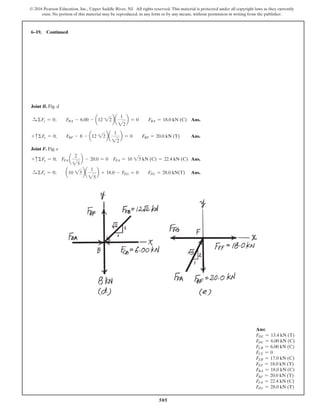
P = 8 kN.
60••60••
4 m 4 m
B
E
D
C
A
4 m
P
Ans:
FDC = 9.24 kN (T)
FDE = 4.62 kN (C)
FCE = 9.24 kN (C)
FCB = 9.24 kN (T)
FBA = 9.24 kN (T)
FEA = 4.62 kN (C)
501
© 2016 Pearson Education, Inc., Upper Saddle River, NJ. All rights reserved. This material is protected under all copyright laws as they currently
exist. No portion of this material may be reproduced, in any form or by any means, without permission in writing from the publisher.
6–17.
If the maximum force that any member can support is 8 kN
in tension and 6 kN in compression, determine the
maximum force P that can be supported at joint D.
SOLUTION
Method of Joints: In this case, the support reactions are not required for
determining the member forces.
Joint D:
Joint C:
Joint B:
Thus,
Joint E:
From the above analysis, the maximum compression and tension in the truss
member is 1.1547P. For this case, compression controls which requires
Ans.P = 5.20 kN
1.1547P = 6
FEA = 0.57735P 1C2
- 0.57735P = 0
FEA + 1.1547P cos 60° - 1.1547P cos 60°:+ ©Fx = 0;
FBE = 1.1547P 1C2 FBA = 1.1547P 1T2
1.1547P - 2F cos 60° = 0 F = 1.1547P:+ ©Fx = 0;
FBE sin 60° - FBA sin 60° = 0 FBE = FBA = F+ c ©Fy = 0;
211.1547P cos 60°2 - FCB = 0 FCB = 1.1547P 1T2:+ ©Fx = 0;
FCE = 1.1547P 1C2
FCE sin 60° - 1.1547P sin 60° = 0+ c ©Fy = 0;
FDE - 1.1547P cos 60° = 0 FDE = 0.57735P 1C2:+ ©Fx = 0;
FDC sin 60° - P = 0 FDC = 1.1547P 1T2+ c ©Fy = 0;
60°60°
4 m 4 m
B
E
D
C
A
4 m
P
Ans:
P = 5.20 kN
502
© 2016 Pearson Education, Inc., Upper Saddle River, NJ. All rights reserved. This material is protected under all copyright laws as they currently
exist. No portion of this material may be reproduced, in any form or by any means, without permission in writing from the publisher.
SOLUTION
Support Reactions. Not required.
Method of Joints. We will perform the joint equilibrium according to the sequence
of joints D, C, E, B and F.
Joint D. Fig. a
+ cΣFy = 0; FDE a
2
25
b - 8 = 0 FDE = 4 25 kN (T) = 8.94 kN (T)Ans.
S+ ΣFx = 0; FDC - a4 25ba
1
25
b = 0 FDC = 4.00 kN (C) Ans.
Joint C. Fig. b
S+ ΣFx = 0; FCB - 4.00 = 0 FCB = 4.00 kN(C) Ans.
+ cΣFy = 0; FCE = 0 Ans.
Joint E. Fig. c
+ cΣFy = 0; FEB a
1
22
b - a425ba
2
25
b = 0
FEB = 8 22 kN (C) = 11.3 kN (C) Ans.
S+ ΣFx = 0; a822ba
1
22
b + a425ba
1
25
b - FEF = 0
FEF = 12.0 kN (T) Ans.
6–18.
Determine the force in each member of the truss and state
if the members are in tension or compression. Set
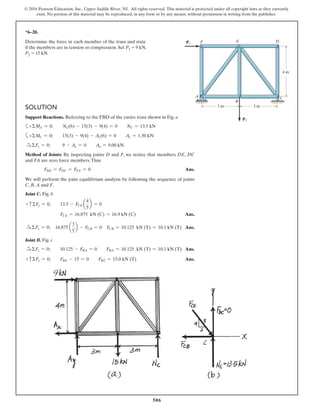
P1 = 10 kN, P2 = 8 kN.
1 m 1 m2 m
2 m
A
F EG
B C D
P1 P2
503
© 2016 Pearson Education, Inc., Upper Saddle River, NJ. All rights reserved. This material is protected under all copyright laws as they currently
exist. No portion of this material may be reproduced, in any form or by any means, without permission in writing from the publisher.
6–18. Continued
Joint B. Fig. d
S+ ΣFx = 0; FBA - 4.00 - a8 22ba
1
22
b = 0 FBA = 12.0 kN (C) Ans.
+ cΣFy = 0; FBF - 10 - a8 22ba
1
22
b = 0 FBF = 18.0 kN (T) Ans.
Joint F. Fig. e
+ cΣFy = 0; FFA a
2
25
b - 18.0 = 0 FFA = 9 25 kN (C) = 20.1 kN (C) Ans.
S+ ΣFx = 0; 12.0 + a9 25ba
1
25
b - FFG = 0 FFG = 21.0 kN (T) Ans.
Ans:
FDE = 8.94 kN (T)
FDC = 4.00 kN (C)
FCB = 4.00 kN (C)
FCE = 0
FEB = 11.3 kN (C)
FEF = 12.0 kN (T)
FBA = 12.0 kN (C)
FBF = 18.0 kN (T)
FFA = 9 25 kN (C) = 20.1 kN (C)
FFG = 21.0 kN (T)
504
© 2016 Pearson Education, Inc., Upper Saddle River, NJ. All rights reserved. This material is protected under all copyright laws as they currently
exist. No portion of this material may be reproduced, in any form or by any means, without permission in writing from the publisher.
6–19.
Determine the force in each member of the truss and state
if the members are in tension or compression. Set P1 = 8 kN,
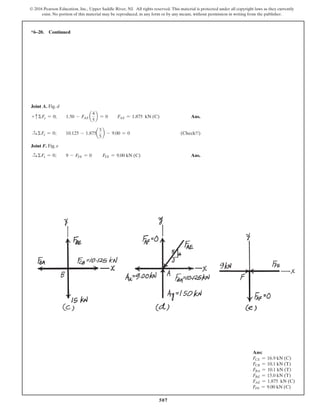
P2 = 12 kN.
1 m 1 m2 m
2 m
A
F EG
B C D
P1 P2
SOLUTION
Support Reactions. Not required.
Method of Joints. We will perform the joint equilibrium according to the sequence
of joints D, C, E, B and F.
Joint D. Fig. a
+ cΣFy = 0; FDE a
2
25
b - 12 = 0 FDE = 6 25 kN (T) = 13.4 kN (T) Ans.
S+ ΣFx = 0; FDC - a6 25ba
1
25
b = 0 FDC = 6.00 kN (C) Ans.
Joint C. Fig. b
S+ ΣFx = 0; FCB - 6.00 = 0 FCB = 6.00 kN (C) Ans.
+ cΣFy = 0; FCE = 0 Ans.
Joint E. Fig. c
+ cΣFy = 0; FEBa
1
22
b - a6 25ba
2
25
b = 0
FEB = 12 22 kN (C) = 17.0 kN (C) Ans.
S+ ΣFx = 0; a12 22ba
1
22
b + a6 25ba
1
25
b - FEF = 0
FEF = 18.0 kN (T) Ans.
505
© 2016 Pearson Education, Inc., Upper Saddle River, NJ. All rights reserved. This material is protected under all copyright laws as they currently
exist. No portion of this material may be reproduced, in any form or by any means, without permission in writing from the publisher.
6–19. Continued
Joint B. Fig. d
S+ ΣFx = 0; FBA - 6.00 - a12 22ba
1
22
b = 0 FBA = 18.0 kN (C) Ans.
+ cΣFy = 0; FBF - 8 - a12 22ba
1
22
b = 0 FBF = 20.0 kN (T) Ans.
Joint F. Fig. e
+ cΣFy = 0; FFA a
2
25
b - 20.0 = 0 FFA = 10 25 kN (C) = 22.4 kN (C) Ans.
S+ ΣFx = 0; a10 25ba
1
25
b + 18.0 - FFG = 0 FFG = 28.0 kN(T) Ans.
Ans:
FDE = 13.4 kN (T)
FDC = 6.00 kN (C)
FCB = 6.00 kN (C)
FCE = 0
FEB = 17.0 kN (C)
FEF = 18.0 kN (T)
FBA = 18.0 kN (C)
FBF = 20.0 kN (T)
FFA = 22.4 kN (C)
FFG = 28.0 kN (T)
506
© 2016 Pearson Education, Inc., Upper Saddle River, NJ. All rights reserved. This material is protected under all copyright laws as they currently
exist. No portion of this material may be reproduced, in any form or by any means, without permission in writing from the publisher.
*6–20.
Determine the force in each member of the truss and state
if the members are in tension or compression. Set P1 = 9 kN,
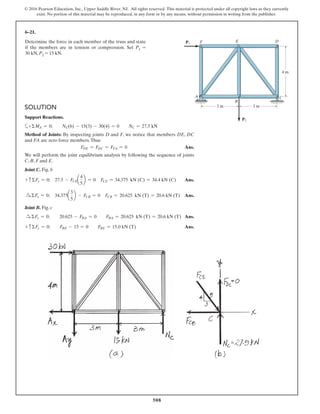
P2 = 15 kN.
3 m
A
B
C
DF E
3 m
4 m
P1
P2
SOLUTION
Support Reactions. Referring to the FBD of the entire truss shown in Fig. a
a+ΣMA = 0; NC(6) - 15(3) - 9(4) = 0 NC = 13.5 kN
a+ΣMC = 0; 15(3) - 9(4) - Ay(6) = 0 Ay = 1.50 kN
S+ ΣFx = 0; 9 - Ax = 0 Ax = 9.00 kN
Method of Joints: By inspecting joints D and F, we notice that members DE, DC
and FA are zero force members.Thus
FDE = FDC = FFA = 0 Ans.
We will perform the joint equilibrium analysis by following the sequence of joints
C, B, A and F.
Joint C. Fig. b
+ cΣFy = 0; 13.5 - FCE a
4
5
b = 0
FCE = 16.875 kN (C) = 16.9 kN (C) Ans.
S+ ΣFx = 0; 16.875 a
3
5
b - FCB = 0 FCB = 10.125 kN (T) = 10.1 kN (T) Ans.
Joint B. Fig. c
S+ ΣFx = 0; 10.125 - FBA = 0 FBA = 10.125 kN (T) = 10.1 kN (T) Ans.
+ cΣFy = 0; FBE - 15 = 0 FBE = 15.0 kN (T) Ans.
507
© 2016 Pearson Education, Inc., Upper Saddle River, NJ. All rights reserved. This material is protected under all copyright laws as they currently
exist. No portion of this material may be reproduced, in any form or by any means, without permission in writing from the publisher.
*6–20. Continued
Joint A. Fig. d
+ cΣFy = 0; 1.50 - FAE a
4
5
b = 0 FAE = 1.875 kN (C) Ans.
S+ ΣFx = 0; 10.125 - 1.875a
3
5
b - 9.00 = 0 (Check!!)
Joint F. Fig. e
S+ ΣFx = 0; 9 - FFE = 0 FFE = 9.00 kN (C) Ans.
Ans:
FCE = 16.9 kN (C)
FCB = 10.1 kN (T)
FBA = 10.1 kN (T)
FBE = 15.0 kN (T)
FAE = 1.875 kN (C)
FFE = 9.00 kN (C)
508
© 2016 Pearson Education, Inc., Upper Saddle River, NJ. All rights reserved. This material is protected under all copyright laws as they currently
exist. No portion of this material may be reproduced, in any form or by any means, without permission in writing from the publisher.
6–21.
Determine the force in each member of the truss and state
if the members are in tension or compression. Set P1 =
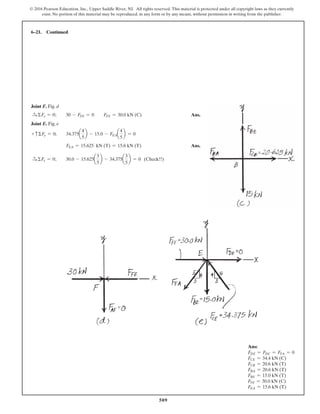
30 kN, P2 = 15 kN.
SOLUTION
Support Reactions.
a+ΣMA = 0; NC(6) - 15(3) - 30(4) = 0 NC = 27.5 kN
Method of Joints: By inspecting joints D and F, we notice that members DE, DC
and FA are zero force members.Thus
FDE = FDC = FFA = 0 Ans.
We will perform the joint equilibrium analysis by following the sequence of joints
C, B, F and E.
Joint C. Fig. b
+ cΣFy = 0; 27.5 - FCEa
4
5
b = 0 FCE = 34.375 kN (C) = 34.4 kN (C) Ans.
S+ ΣFx = 0; 34.375a
3
5
b - FCB = 0 FCB = 20.625 kN (T) = 20.6 kN (T) Ans.
Joint B. Fig. c
S+ ΣFx = 0; 20.625 - FBA = 0 FBA = 20.625 kN (T) = 20.6 kN (T) Ans.
+ cΣFy = 0; FBE - 15 = 0 FBE = 15.0 kN (T) Ans.
3 m
A
B
C
DF E
3 m
4 m
P1
P2
509
© 2016 Pearson Education, Inc., Upper Saddle River, NJ. All rights reserved. This material is protected under all copyright laws as they currently
exist. No portion of this material may be reproduced, in any form or by any means, without permission in writing from the publisher.
Joint F. Fig. d
S+ ΣFx = 0; 30 - FFE = 0 FFE = 30.0 kN (C) Ans.
Joint E. Fig. e
+ cΣFy = 0; 34.375a
4
5
b - 15.0 - FEAa
4
5
b = 0
FEA = 15.625 kN (T) = 15.6 kN (T) Ans.
S+ ΣFx = 0; 30.0 - 15.625a
3
5
b - 34.375a
3
5
b = 0 (Check!!)
6–21. Continued
Ans:
FDE = FDC = FFA = 0
FCE = 34.4 kN (C)
FCB = 20.6 kN (T)
FBA = 20.6 kN (T)
FBE = 15.0 kN (T)
FFE = 30.0 kN (C)
FEA = 15.6 kN (T)
510
© 2016 Pearson Education, Inc., Upper Saddle River, NJ. All rights reserved. This material is protected under all copyright laws as they currently
exist. No portion of this material may be reproduced, in any form or by any means, without permission in writing from the publisher.
6–22.
SOLUTION
c
Joint F:
(1)
Joint C:
Joint A:
From Eq.(1), and Symmetry,
Ans.
Ans.
Ans.
Ans.
Ans.
Ans.
Ans.
Ans.
Ans.FCD = 0.471 P (C)
FEC = 1.41 P (T)
FBD = 1.49 P (C)
FBF = 1.41 P (T)
FAC = 1.49 P (C)
FAE = 1.67 P (T)
FAB = 0.471 P (C)
FFD = 1.67 P (T)
FFE = 0.667 P (T)
FAE =
5
3
P = 1.67 P (T)
:+ ©Fx = 0; FAE -
22
3
Pa
1
22
b -
225
3
Pa
2
25
b = 0
FCD =
22
3
P = 0.4714P = 0.471P (C)
FCA =
225
3
P = 1.4907P = 1.49P(C)
2
25
FCA -
1
22
FCD = P
:+ ©Fx = 0; FCA a
2
25
b - 22Pa
1
22
b - FCDa
1
22
b = 0
FCA
1
25
- 22P
1
22
+ FCD
1
22
= 0
FFD - FFE = P
1
2
FFB = = 1.41 P (T)
:+ ©Fy = 0; FFB a
2
b - = 0
22P
P
:+ ©Fx = 0; FFD - FFE - FFBa
1
22
b = 0
+ c ©Fy = 0; Ay = P
Dy = P
+ ©MA = 0; Pa
L
3
b + Pa
2L
3
b - (Dy)(L) = 0
Determine the force in each member of the double scissors
truss in terms of the load Pand state if the members are in
tension or compression.
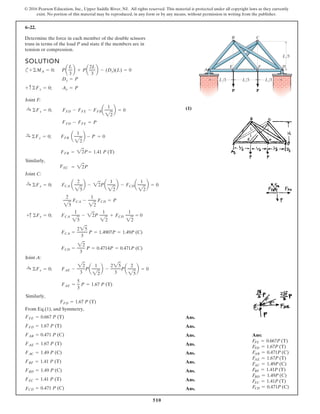
= 22P
Similarly,
FEC
Similarly,
FFD=1.67 P (T)
A
DFE
P P
B C
L/3
L/3L/3L/3
+c ©Fy = 0;
Ans:
FFE = 0.667P (T)
FFD = 1.67P (T)
FAB = 0.471P (C)
FAE = 1.67P (T)
FAC = 1.49P (C)
FBF = 1.41P (T)
FBD = 1.49P (C)
FEC = 1.41P (T)
FCD = 0.471P (C)
511
© 2016 Pearson Education, Inc., Upper Saddle River, NJ. All rights reserved. This material is protected under all copyright laws as they currently
exist. No portion of this material may be reproduced, in any form or by any means, without permission in writing from the publisher.
6–23.
Determine the force in each member of the truss in terms
of the load P and state if the members are in tension or
compression.
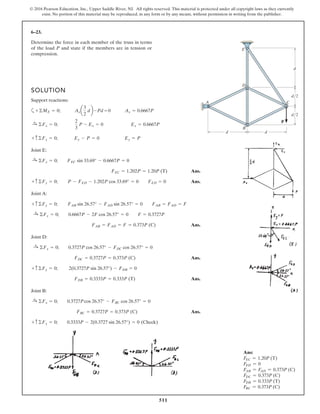
SOLUTION
Support reactions:
a
Joint E:
Ans.
Ans.
Joint A:
Ans.
Joint D:
Ans.
Ans.
Joint B:
Ans.
+ c ©Fy = 0; 0.3333P - 2(0.3727 sin 26.57°) = 0 (Check)
FBC = 0.3727P = 0.373P (C)
:+ ©Fx = 0; 0.3727Pcos 26.57° - FBC cos 26.57° = 0
FDB = 0.3333P = 0.333P (T)
+ c ©Fy = 0; 2(0.3727P sin 26.57°) - FDB = 0
FDC = 0.3727P = 0.373P (C)
:+ ©Fx = 0; 0.3727P cos 26.57° - FDC cos 26.57° = 0
FAB = FAD = F = 0.373P (C)
:+ ©Fx = 0; 0.6667P - 2F cos 26.57° = 0 F = 0.3727P
+ c ©Fy = 0; FAB sin 26.57° - FAD sin 26.57° = 0 FAB = FAD = F
+ c©Fy = 0; P - FED - 1.202P cos 33.69° = 0 FED = 0
FEC = 1.202P = 1.20P (T)
:+ ©Fx = 0; FEC sin 33.69° - 0.6667P = 0
+ c©Fy = 0; Ey - P = 0 Ey = P
:+ ©Fx = 0;
2
3
P - Ex = 0 Ex = 0.6667P
+©ME = 0; Axa
3
2
db -Pd = 0 Ax = 0.6667P
d
A C
B
D
E
d
P
d
d/2
d/2
Ans:
FEC = 1.20P (T)
FED = 0
FAB = FAD = 0.373P (C)
FDC = 0.373P (C)
FDB = 0.333P (T)
FBC = 0.373P (C)
512
© 2016 Pearson Education, Inc., Upper Saddle River, NJ. All rights reserved. This material is protected under all copyright laws as they currently
exist. No portion of this material may be reproduced, in any form or by any means, without permission in writing from the publisher.
*6–24.
The maximum allowable tensile force in the members of the
truss is and the maximum allowable
compressive force is Determine the
maximum magnitude of the load P that can be applied to
the truss.Take d = 2 m.
1Fc2max = 3 kN.
1Ft2max = 5 kN,
SOLUTION
Maximum tension is in member EC.
Maximum compression is in members AB, AD, DC, and BC.
Thus, the maximum allowable load is
Ans.P = 4.16 kN
P = 8.05 kN
F = 0.3727 P = 3
P = 4.16 kN
FEC = 1.202P = 5
d
A C
B
D
E
d
P
d
d/2
d/2
Support reactions:
a
Joint E:
Joint A:
Joint D:
Joint B:
+ c©Fy = 0; 0.3333P - 2(0.3727 sin 26.57°) = 0 (Check)
FBC = 0.3727P = 0.373P (C)
:+ ©Fx = 0; 0.3727Pcos 26.57° - FBC cos 26.57° = 0
FDB = 0.3333P = 0.333P (T)
+ c ©Fy = 0; 2(0.3727P sin 26.57°) - FDB = 0
FDC = 0.3727P = 0.373P (C)
:+ ©Fx = 0; 0.3727P cos 26.57° - FDC cos 26.57° = 0
FAB = FAD = F = 0.373P (C)
:+ ©Fx = 0; 0.6667P - 2F cos 26.57° = 0 F = 0.3727P
+ c©Fy = 0; FAB sin 26.57° - FAD sin 26.57° = 0 FAB = FAD = F
+ c ©Fy = 0; P - FED - 1.202P cos 33.69° = 0 FED = 0
FEC = 1.202P = 1.20P (T)
:+ ©Fx = 0; FEC sin 33.69° - 0.6667P = 0
+ c©Fy = 0; Ey - P = 0 Ey = P
:+ ©Fx = 0;
2
3
P - Ex = 0 Ex = 0.6667P
+©ME = 0; Axa
3
2
db -Pd = 0 Ax = 0.6667P
Ans:
P = 4.16 kN
513
© 2016 Pearson Education, Inc., Upper Saddle River, NJ. All rights reserved. This material is protected under all copyright laws as they currently
exist. No portion of this material may be reproduced, in any form or by any means, without permission in writing from the publisher.
6–25.
Determine the force in each member of the truss in terms of
the external loading and state if the members are in tension
or compression.Take P = 2 kN.
A
B
CD
2 m
2 m
2 m
2 m
P P
30Њ
SOLUTION
Support Reactions. Not required.
Method of Joints: We will start the joint equilibrium analysis at joint C, followed by
joint D and finally joint A.
Joint C. Fig. a
+ cΣFy = 0; FCB sin 60° - 2 = 0 FCB = 2.309 kN (C) = 2.31 kN (C) Ans.
S+ ΣFx = 0; FCD - 2.309 cos 60° = 0 FCD = 1.1547 kN (C) = 1.15 kN (C) Ans.
Joint D. Fig. b
S+ ΣFx = 0; FDB cos 30° - FDA sin 30° - 1.1547 = 0 (1)
+ cΣFy = 0; FDA cos 30° - FDB sin 30° - 2 = 0 (2)
Solving Eqs. (1) and (2)
FDB = 4.00 kN (T) FDA = 4.6188 kN (C) = 4.62 kN (C) Ans.
Joint A. Fig. c
S+ ΣFx = 0; 4.6188 sin 30° - FAB = 0 FAB = 2.3094 kN (C) = 2.31 kN (C) Ans.
+ cΣFy = 0; -4.6188 cos 30° + NA = 0 NA = 4.00 kN
Ans:
FCB = 2.31 kN (C)
FCD = 1.15 kN (C)
FDB = 4.00 kN (T)
FDA = 4.62 kN (C)
FAB = 2.31 kN (C)
514
© 2016 Pearson Education, Inc., Upper Saddle River, NJ. All rights reserved. This material is protected under all copyright laws as they currently
exist. No portion of this material may be reproduced, in any form or by any means, without permission in writing from the publisher.
6–26.
The maximum allowable tensile force in the members of the
truss is (Ft)max = 5 kN, and the maximum allowable
compressive force is (Fc)max = 3 kN. Determine the
maximum magnitude P of the two loads that can be applied
to the truss.
A
B
CD
2 m
2 m
2 m
2 m
P P
30Њ
SOLUTION
Support Reactions. Not required.
Method of Joints: We will start the joint equilibrium analysis at joint C, followed by
joint D and finally joint A.
Joint C. Fig. a
+ cΣFy = 0; FCB sin 60° - P = 0 FCB = 1.1547P (C)
S+ ΣFx = 0; FCD - 1.1547P cos 60° = 0 FCD = 0.5774P (C)
Joint D. Fig. b
S+ ΣFx = 0; FDB cos 30° - FDA sin 30° - 0.5774P = 0 (1)
+ cΣFy = 0; FDA cos 30° - FDB sin 30° - P = 0 (2)
Solving Eqs. (1) and (2),
FDA = 2.3094P (C) FDB = 2.00P (T)
Joint C. Fig. c
S+ ΣFx = 0; 2.3094 P sin 30° - FAB = 0 FAB = 1.1547P (C)
+ cΣFy = 0; NA - 2.3094 p cos 30° = 0 NA = 2.00P
By observation, members DA and DB are subjected to maximum compression and
tension, respectively.Thus, they will reach the limit first.
FDA = (FC)max; 2.3094P = 3 P = 1.299 kN = 1.30 kN (Control!) Ans.
FDB = (FC)max; 2.00P = 5 P = 2.50 kN
Ans:
P = 1.30 kN
515
© 2016 Pearson Education, Inc., Upper Saddle River, NJ. All rights reserved. This material is protected under all copyright laws as they currently
exist. No portion of this material may be reproduced, in any form or by any means, without permission in writing from the publisher.
6–27.
Determine the force in members DC, HC, and HI of the
truss, and state if the members are in tension or
compression.
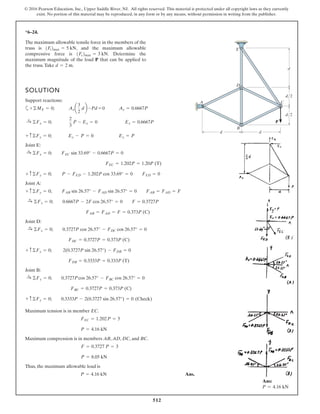
SOLUTION
Support Reactions: Applying the moment equation of equilibrium about point A to
the free - body diagram of the truss, Fig. a,
a
Method of Sections: Using the bottom portion of the free - body diagram, Fig. b.
a
Ans.
a
Ans.
Ans.FDC = 125 kN (C)
+ c©Fy = 0; 32.5 + 42.5 - FDC (
3
5
) = 0
FHC = 100 kN (T)
+©MD = 0; 70(4.5) - 40(3) - 30(1.5) - FHC(1.5) = 0
FHI = 42.5 kN (T)
+©MC = 0; 70(3) - 32.5(2) - 40(1.5) - FHI(2) = 0
+ c©Fy = 0; 57.5 - 40 - 50 + Ay = 0; Ay = 32.5 kN
:+ ©Fx = 0; Ax - 30 - 40 = 0; Ax = 70 kN
Fy = 57.5 kN
+©MA = 0; 40(1.5) + 30(3) + 40(2) - Fy(4) = 0
A
C
G
E D
H
F
I
B
2 m 2 m 2 m
1.5 m
50 kN
40 kN
40 kN
30 kN
1.5 m
1.5 m
Ans:
FHI = 42.5 kN (T)
FHC = 100 kN (T)
FDC = 125 kN (C)
516
© 2016 Pearson Education, Inc., Upper Saddle River, NJ. All rights reserved. This material is protected under all copyright laws as they currently
exist. No portion of this material may be reproduced, in any form or by any means, without permission in writing from the publisher.
*6–28.
SOLUTION
Support Reactions: Applying the moment equation of equilibrium about point A to
the free - body diagram of the truss, Fig. a,
a
Method of Sections: Using the left portion of the free - body diagram, Fig. b.
a
Ans.
a
Ans.
Ans.FEH = 29.2 kN (T)
+ c ©Fy = 0; 57.5 - FEH (
3
5
) - 40 = 0
FED = 100 kN (C)
+©MH = 0; -57.5(4) + FED(1.5) + 40(2) = 0
FGH = 76.7 kN (T)
+©ME = 0; -57.5(2) + FGH(1.5) = 0
+ c©Fy = 0; 57.5 - 40 - 50 + Ay = 0; Ay = 32.5 kN
:+ ©Fx = 0; Ax - 30 - 40 = 0; Ax = 70 kN
Fy = 57.5 kN
+©MA = 0; 40(1.5) + 30(3) + 40(2) - Fy(4) = 0
Determine the force in members ED, EH, and GH of the
truss, and state if the members are in tension or compression.
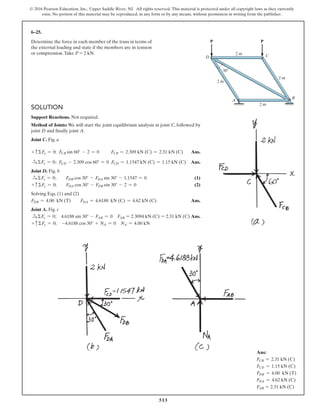
A
C
G
E D
H
F
I
B
2 m 2 m 2 m
1.5 m
50 kN
40 kN
40 kN
30 kN
1.5 m
1.5 m
Ans:
FGH = 76.7 kN (T)
FED = 100 kN (C)
FEH = 29.2 kN (T)
517
© 2016 Pearson Education, Inc., Upper Saddle River, NJ. All rights reserved. This material is protected under all copyright laws as they currently
exist. No portion of this material may be reproduced, in any form or by any means, without permission in writing from the publisher.
6–29.
Determine the force in members HG, HE, and DE of the
truss, and state if the members are in tension or compression.
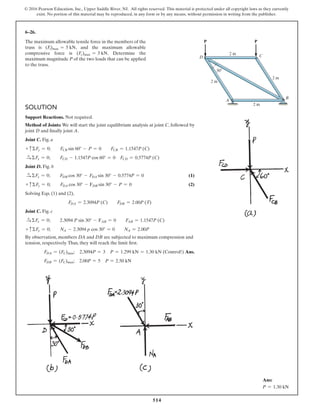
SOLUTION
Method of Sections: The forces in members HG, HE, and DE are exposed by
cutting the truss into two portions through section a–a and using the upper portion
of the free-body diagram, Fig. a. From this free-body diagram, and can be
obtained by writing the moment equations of equilibrium about points E and H,
respectively. can be obtained by writing the force equation of equilibrium along
the y axis.
Joint D: From the free-body diagram in Fig. a,
a
Ans.
a
Ans.
Ans.FEH = 3750 lb (T)
FHEa
4
5
b - 1500 - 1500 = 0+ c©Fy = 0;
FDE = 3375 lb (C)
FDE(4) - 1500(6) - 1500(3) = 0+©MH = 0;
FHG = 1125 lb (T)
FHG(4) - 1500(3) = 0+©ME = 0;
FHE
FDEFHG
A
B C D E F
GHIJK
4 ft
3 ft 3 ft3 ft3 ft3 ft
1500 lb1500 lb1500 lb1500 lb1500 lb
Ans:
FHG = 1125 lb (T)
FDE = 3375 lb (C)
FEH = 3750 lb (T)
518
© 2016 Pearson Education, Inc., Upper Saddle River, NJ. All rights reserved. This material is protected under all copyright laws as they currently
exist. No portion of this material may be reproduced, in any form or by any means, without permission in writing from the publisher.
6–30.
Determine the force in members CD, HI, and CJ of the truss,
and state if the members are in tension or compression.
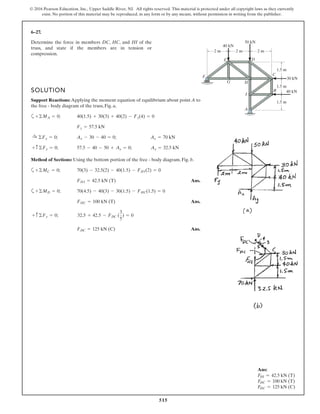
SOLUTION
Method of Sections: The forces in members HI, CH, and CD are exposed by cutting
the truss into two portions through section b–b on the right portion of the free-body
diagram, Fig. a. From this free-body diagram, and can be obtained by writing
the moment equations of equilibrium about points H and C, respectively. can be
obtained by writing the force equation of equilibrium along the y axis.
a
Ans.
a
Ans.
Ans.FCH = 5625 lb (C)
FCHa
4
5
b - 1500 - 1500 = 0+ c©Fy = 0;
FHI = 6750 lb (T)
FHI(4) - 1500(3) - 1500(6) - 1500(9) = 0+©Mc = 0;
FCD = 3375 lb (C)
FCD(4) - 1500(6) - 1500(3) = 0+©MH = 0;
FCH
FHIFCD
A
B C D E F
GHIJK
4 ft
3 ft 3 ft3 ft3 ft3 ft
1500 lb1500 lb1500 lb1500 lb1500 lb
Ans:
FCD = 3375 lb (C)
FHI = 6750 lb (T)
FCH = 5625 lb (C)
519
© 2016 Pearson Education, Inc., Upper Saddle River, NJ. All rights reserved. This material is protected under all copyright laws as they currently
exist. No portion of this material may be reproduced, in any form or by any means, without permission in writing from the publisher.
6–31.
Determine the force in members CD,CJ,KJ, and DJof the
truss which serves to support the deck of a bridge. State if
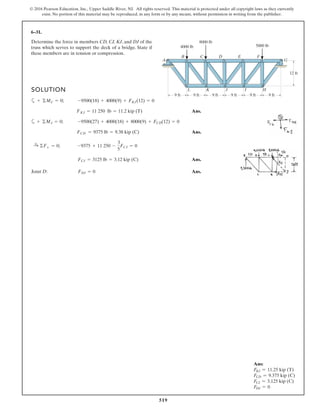
these members are in tension or compression.
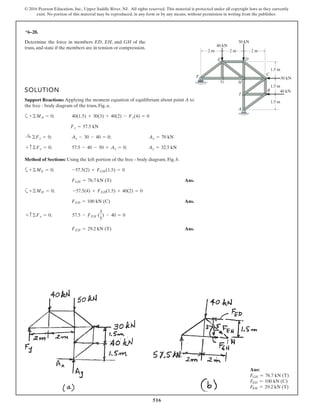
SOLUTION
a
Ans.
a
Ans.
Ans.
Joint D: Ans.FDJ = 0
FCJ = 3125 lb = 3.12 kip (C)
:+ ©Fx = 0; -9375 + 11 250 -
3
5
FCJ = 0
FCD = 9375 lb = 9.38 kip (C)
+ ©MJ = 0; -9500(27) + 4000(18) + 8000(9) + FCD(12) = 0
FKJ = 11 250 lb = 11.2 kip (T)
+ ©MC = 0; -9500(18) + 4000(9) + FKJ(12) = 0
A G
HIJKL
FEDCB
4000 lb
8000 lb
5000 lb
9 ft 9 ft 9 ft 9 ft 9 ft 9 ft
12 ft
Ans:
FKJ = 11.25 kip (T)
FCD = 9.375 kip (C)
FCJ = 3.125 kip (C)
FDJ = 0
520
© 2016 Pearson Education, Inc., Upper Saddle River, NJ. All rights reserved. This material is protected under all copyright laws as they currently
exist. No portion of this material may be reproduced, in any form or by any means, without permission in writing from the publisher.
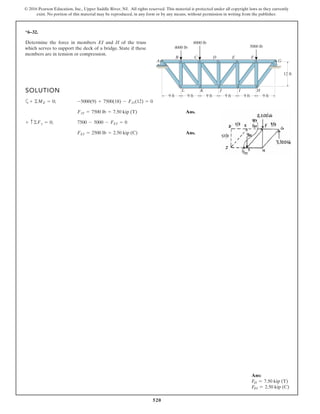
*6–32.
Determine the force in members EI and JI of the truss
which serves to support the deck of a bridge. State if these
members are in tension or compression.
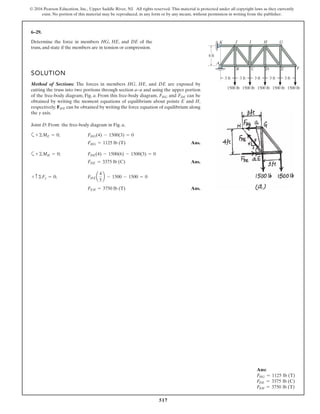
SOLUTION
a
Ans.
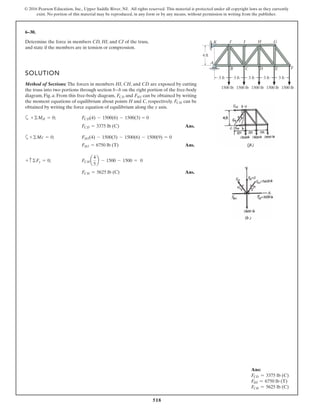
Ans.FEI = 2500 lb = 2.50 kip (C)
+ c©Fy = 0; 7500 - 5000 - FEI = 0
FJI = 7500 lb = 7.50 kip (T)
+ ©ME = 0; -5000(9) + 7500(18) - FJI(12) = 0
A G
HIJKL
FEDCB
4000 lb
8000 lb
5000 lb
9 ft 9 ft 9 ft 9 ft 9 ft 9 ft
12 ft
Ans:
FJI = 7.50 kip (T)
FEI = 2.50 kip (C)
521
© 2016 Pearson Education, Inc., Upper Saddle River, NJ. All rights reserved. This material is protected under all copyright laws as they currently
exist. No portion of this material may be reproduced, in any form or by any means, without permission in writing from the publisher.
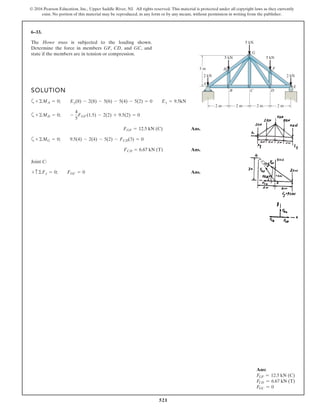
6–33.
SOLUTION
a
a
Ans.
a
Ans.
Joint C:
Ans.+ c©Fy = 0; FGC = 0
FCD = 6.67 kN (T)
+©MG = 0; 9.5(4) - 2(4) - 5(2) - FCD(3) = 0
FGF = 12.5 kN (C)
+©MD = 0; -
4
5
FGF(1.5) - 2(2) + 9.5(2) = 0
+©MA = 0; Ey(8) - 2(8) - 5(6) - 5(4) - 5(2) = 0 Ey = 9.5kN
The Howe truss is subjected to the loading shown.
Determine the force in members GF, CD, and GC, and
state if the members are in tension or compression.
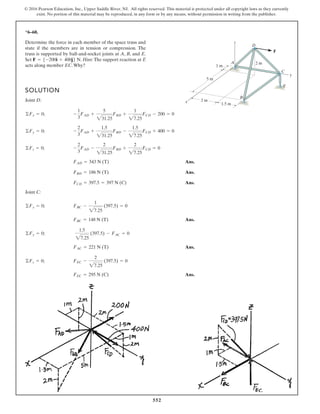
3 m
2 kN
5 kN
5 kN
2 m 2 m 2 m 2 m
A
B C D
F
G
H
E
2 kN
5 kN
Ans:
FGF = 12.5 kN (C)
FCD = 6.67 kN (T)
FGC = 0
522
© 2016 Pearson Education, Inc., Upper Saddle River, NJ. All rights reserved. This material is protected under all copyright laws as they currently
exist. No portion of this material may be reproduced, in any form or by any means, without permission in writing from the publisher.
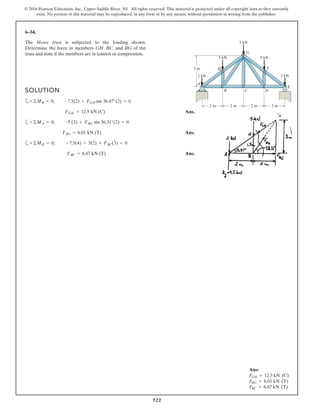
6–34.
The Howe truss is subjected to the loading shown.
Determine the force in members GH, BC, and BG of the
truss and state if the members are in tension or compression.
SOLUTION
a
Ans.
a
Ans.
a
Ans.FBC = 6.67 kN (T)
+©MH = 0; -7.5(4) + 5(2) + FBC(3) = 0
FBG = 6.01 kN (T)
+©MA = 0; -5 (2) + FBG sin 56.31°(2) = 0
FGH = 12.5 kN (C)
+©MB = 0; -7.5(2) + FGH sin 36.87°(2) = 0
3 m
2 kN
5 kN
5 kN
2 m 2 m 2 m 2 m
A
B C D
F
G
H
E
2 kN
5 kN
Ans:
FGH = 12.5 kN (C)
FBG = 6.01 kN (T)
FBC = 6.67 kN (T)
523
© 2016 Pearson Education, Inc., Upper Saddle River, NJ. All rights reserved. This material is protected under all copyright laws as they currently
exist. No portion of this material may be reproduced, in any form or by any means, without permission in writing from the publisher.
6–35.
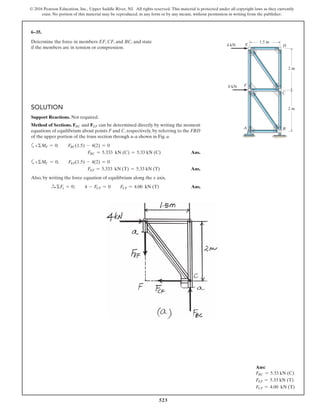
Determine the force in members EF, CF, and BC, and state
if the members are in tension or compression.
2 m
1.5 m
2 m
F
A
8 kN
4 kN E D
C
B
SOLUTION
Support Reactions. Not required.
Method of Sections. FBC and FEF can be determined directly by writing the moment
equations of equilibrium about points F and C, respectively, by referring to the FBD
of the upper portion of the truss section through a–a shown in Fig. a.
a+ΣMF = 0; FBC(1.5) - 4(2) = 0
FBC = 5.333 kN (C) = 5.33 kN (C) Ans.
a+ΣMC = 0; FEF(1.5) - 4(2) = 0
FEF = 5.333 kN (T) = 5.33 kN (T) Ans.
Also, by writing the force equation of equilibrium along the x axis,
S+ ΣFx = 0; 4 - FCF = 0 FCF = 4.00 kN (T) Ans.
Ans:
FBC = 5.33 kN (C)
FEF = 5.33 kN (T)
FCF = 4.00 kN (T)
524
© 2016 Pearson Education, Inc., Upper Saddle River, NJ. All rights reserved. This material is protected under all copyright laws as they currently
exist. No portion of this material may be reproduced, in any form or by any means, without permission in writing from the publisher.
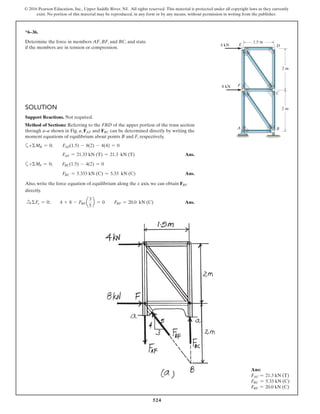
*6–36.
Determine the force in members AF, BF, and BC, and state
if the members are in tension or compression.
2 m
1.5 m
2 m
F
A
8 kN
4 kN E D
C
B
SOLUTION
Support Reactions. Not required.
Method of Sections: Referring to the FBD of the upper portion of the truss section
through a–a shown in Fig. a, FAF and FBC can be determined directly by writing the
moment equations of equilibrium about points B and F, respectively.
a+ΣMB = 0; FAF(1.5) - 8(2) - 4(4) = 0
FAF = 21.33 kN (T) = 21.3 kN (T) Ans.
a+ΣMF = 0; FBC(1.5) - 4(2) = 0
FBC = 5.333 kN (C) = 5.33 kN (C) Ans.
Also, write the force equation of equilibrium along the x axis, we can obtain FBF
directly.
S+ ΣFx = 0; 4 + 8 - FBF a
3
5
b = 0 FBF = 20.0 kN (C) Ans.
Ans:
FAF = 21.3 kN (T)
FBC = 5.33 kN (C)
FBF = 20.0 kN (C)
525
© 2016 Pearson Education, Inc., Upper Saddle River, NJ. All rights reserved. This material is protected under all copyright laws as they currently
exist. No portion of this material may be reproduced, in any form or by any means, without permission in writing from the publisher.
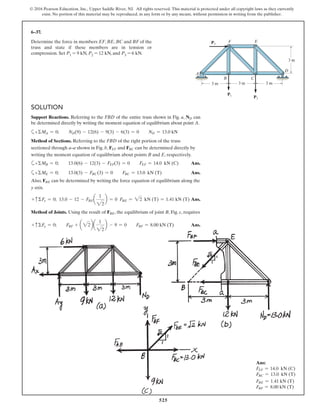
6–37.
Determine the force in members EF, BE, BC and BF of the
truss and state if these members are in tension or
compression. Set P1 = 9 kN, P2 = 12 kN, and P3 = 6 kN.
F E
B
A
D
C
3 m
3 m 3 m 3 m
P1
P2
P3
SOLUTION
Support Reactions. Referring to the FBD of the entire truss shown in Fig. a, ND can
be determined directly by writing the moment equation of equilibrium about point A.
a+ΣMA = 0; ND(9) - 12(6) - 9(3) - 6(3) = 0 ND = 13.0 kN
Method of Sections. Referring to the FBD of the right portion of the truss
sectioned through a–a shown in Fig. b, FEF and FBC can be determined directly by
writing the moment equation of equilibrium about points B and E, respectively.
a+ΣMB = 0; 13.0(6) - 12(3) - FEF(3) = 0 FEF = 14.0 kN (C) Ans.
a+ΣME = 0; 13.0(3) - FBC(3) = 0 FBC = 13.0 kN (T) Ans.
Also, FBE can be determined by writing the force equation of equilibrium along the
y axis.
+ cΣFy = 0; 13.0 - 12 - FBEa
1
22
b = 0 FBE = 22 kN (T) = 1.41 kN (T) Ans.
Method of Joints. Using the result of FBE, the equilibrium of joint B, Fig. c, requires
+ cΣFy = 0; FBF + a22ba
1
22
b - 9 = 0 FBF = 8.00 kN (T) Ans.
Ans:
FEF = 14.0 kN (C)
FBC = 13.0 kN (T)
FBE = 1.41 kN (T)
FBF = 8.00 kN (T)
526
© 2016 Pearson Education, Inc., Upper Saddle River, NJ. All rights reserved. This material is protected under all copyright laws as they currently
exist. No portion of this material may be reproduced, in any form or by any means, without permission in writing from the publisher.
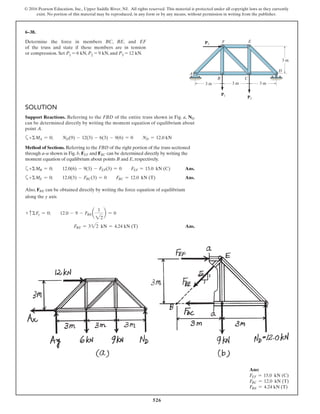
6–38.
Determine the force in members BC, BE, and EF
of the truss and state if these members are in tension
or compression. Set P1 = 6 kN, P2 = 9 kN, and P3 = 12 kN.
F E
B
A
D
C
3 m
3 m 3 m 3 m
P1
P2
P3
SOLUTION
Support Reactions. Referring to the FBD of the entire truss shown in Fig. a, ND
can be determined directly by writing the moment equation of equilibrium about
point A.
a+ΣMA = 0; ND(9) - 12(3) - 6(3) - 9(6) = 0 ND = 12.0 kN
Method of Sections. Referring to the FBD of the right portion of the truss sectioned
through a–a shown in Fig. b, FEF and FBC can be determined directly by writing the
moment equation of equilibrium about points B and E, respectively.
a+ΣMB = 0; 12.0(6) - 9(3) - FEF(3) = 0 FEF = 15.0 kN (C) Ans.
a+ΣME = 0; 12.0(3) - FBC(3) = 0 FBC = 12.0 kN (T) Ans.
Also, FBE can be obtained directly by writing the force equation of equilibrium
along the y axis
+ cΣFy = 0; 12.0 - 9 - FBEa
1
22
b = 0
FBE = 322 kN = 4.24 kN (T) Ans.
Ans:
FEF = 15.0 kN (C)
FBC = 12.0 kN (T)
FBE = 4.24 kN (T)
527
© 2016 Pearson Education, Inc., Upper Saddle River, NJ. All rights reserved. This material is protected under all copyright laws as they currently
exist. No portion of this material may be reproduced, in any form or by any means, without permission in writing from the publisher.
6–39.
SOLUTION
a+ ΣME = 0; -Ay(20) + 2(20) + 4(15) + 4(10) + 5(5) = 0
Ay = 8.25 kN
a+ ΣMH = 0; -8.25(5) + 2(5) + FBC(3) = 0
FBC = 10.4 kN (C) Ans.
a+ ΣMC = 0; -8.25(10) + 2(10) + 4(5) +
5
229
FHG(5) = 0
FHG = 9.155 = 9.16 kN (T) Ans.
a+ ΣMO′ = 0; -2(2.5) + 8.25(2.5) - 4(7.5) +
3
234
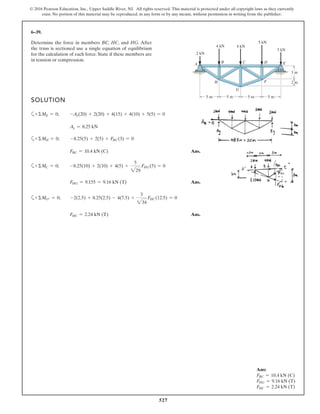
FHC(12.5) = 0
FHC = 2.24 kN (T) Ans.
Determine the force in members BC, HC, and HG. After
the truss is sectioned use a single equation of equilibrium
for the calculation of each force. State if these members are
in tension or compression.
A C D
H
G
F
4 kN
3 m
2 m
5 m5 m5 m 5 m
B E
4 kN
5 kN
3 kN
2 kN
Ans:
FBC = 10.4 kN (C)
FHG = 9.16 kN (T)
FHC = 2.24 kN (T)
528
© 2016 Pearson Education, Inc., Upper Saddle River, NJ. All rights reserved. This material is protected under all copyright laws as they currently
exist. No portion of this material may be reproduced, in any form or by any means, without permission in writing from the publisher.
*6–40.
SOLUTION
S+ ΣFx = 0; Ex = 0
a+ ΣMA = 0; -4(5) - 4(10) - 5(15) - 3(20) + Ey(20) = 0
Ey = 9.75 kN
a+ ΣMC = 0; -5(5) - 3(10) + 9.75(10) -
5
229
FFG(5) = 0
FFG = 9.155 kN (T)
a+ΣMF = 0; -3(5) + 9.75(5) - FCD(3) = 0
FCD = 11.25 = 11.2 kN (C) Ans.
a+ ΣMO′ = 0; -9.75(2.5) + 5(7.5) + 3(2.5) -
3
234
FCF(12.5) = 0
FCF = 3.21 kN (T) Ans.
Joint G:
S+ ΣFx = 0; FGH = 9.155 kN (T)
+ c ΣFy = 0;
2
229
(9.155)(2) - FCG = 0
FCG = 6.80 kN (C) Ans.
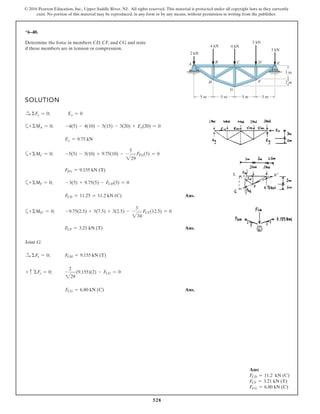
Determine the force in members CD, CF, and CG and state
if these members are in tension or compression.
A C D
H
G
F
4 kN
3 m
2 m
5 m5 m5 m 5 m
B E
4 kN
5 kN
3 kN
2 kN
Ans:
FCD = 11.2 kN (C)
FCF = 3.21 kN (T)
FCG = 6.80 kN (C)
529
© 2016 Pearson Education, Inc., Upper Saddle River, NJ. All rights reserved. This material is protected under all copyright laws as they currently
exist. No portion of this material may be reproduced, in any form or by any means, without permission in writing from the publisher.
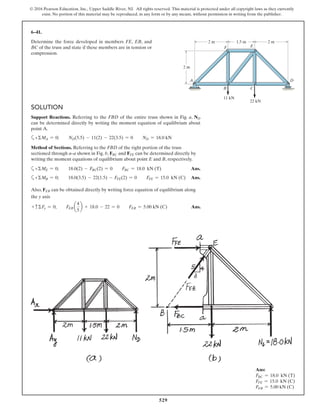
6–41.
Determine the force developed in members FE, EB, and
BC of the truss and state if these members are in tension or
compression.
11 kN
B
A D
C
F E
22 kN
2 m 1.5 m
2 m
2 m
SOLUTION
Support Reactions. Referring to the FBD of the entire truss shown in Fig. a, ND
can be determined directly by writing the moment equation of equilibrium about
point A.
a+ΣMA = 0; ND(5.5) - 11(2) - 22(3.5) = 0 ND = 18.0 kN
Method of Sections. Referring to the FBD of the right portion of the truss
sectioned through a–a shown in Fig. b, FBC and FFE can be determined directly by
writing the moment equations of equilibrium about point E and B, respectively.
a+ΣME = 0; 18.0(2) - FBC(2) = 0 FBC = 18.0 kN (T) Ans.
a+ΣMB = 0; 18.0(3.5) - 22(1.5) - FFE(2) = 0 FFE = 15.0 kN (C) Ans.
Also, FEB can be obtained directly by writing force equation of equilibrium along
the y axis
+ cΣFy = 0; FEB a
4
5
b + 18.0 - 22 = 0 FEB = 5.00 kN (C) Ans.
Ans:
FBC = 18.0 kN (T)
FFE = 15.0 kN (C)
FEB = 5.00 kN (C)
530
© 2016 Pearson Education, Inc., Upper Saddle River, NJ. All rights reserved. This material is protected under all copyright laws as they currently
exist. No portion of this material may be reproduced, in any form or by any means, without permission in writing from the publisher.
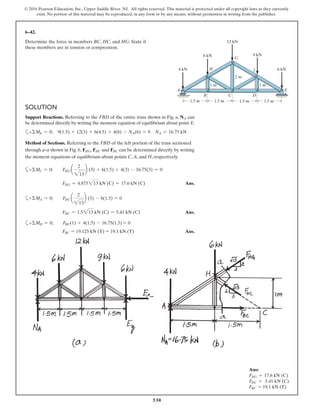
6–42.
Determine the force in members BC, HC, and HG. State if
these members are in tension or compression.
6 kN
12 kN
9 kN
4 kN 6 kN
1.5 m 1.5 m
2 m
1 m 1 m
1.5 m 1.5 m
A E
B
H
G
J
C D
SOLUTION
Support Reactions. Referring to the FBD of the entire truss shown in Fig. a, NA can
be determined directly by writing the moment equation of equilibrium about point E.
a+ΣME = 0; 9(1.5) + 12(3) + 6(4.5) + 4(6) - NA(6) = 0 NA = 16.75 kN
Method of Sections. Referring to the FBD of the left portion of the truss sectioned
through a–a shown in Fig. b, FHG, FHC and FBC can be determined directly by writing
the moment equations of equilibrium about points C, A, and H, respectively.
a+ΣMC = 0; FHG a
2
213
b (3) + 6(1.5) + 4(3) - 16.75(3) = 0
FHG = 4.875213 kN (C) = 17.6 kN (C) Ans.
a+ΣMA = 0; FHC a
2
213
b (3) - 6(1.5) = 0
FHC = 1.5213 kN (C) = 5.41 kN (C) Ans.
a+ΣMH = 0; FBC(1) + 4(1.5) - 16.75(1.5) = 0
FBC = 19.125 kN (T) = 19.1 kN (T) Ans.
Ans:
FHG = 17.6 kN (C)
FHC = 5.41 kN (C)
FBC = 19.1 kN (T)
531
© 2016 Pearson Education, Inc., Upper Saddle River, NJ. All rights reserved. This material is protected under all copyright laws as they currently
exist. No portion of this material may be reproduced, in any form or by any means, without permission in writing from the publisher.
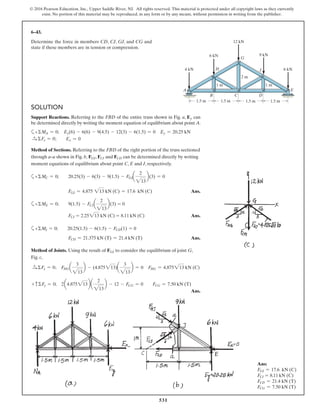
6–43.
Determine the force in members CD, CJ, GJ, and CG and
state if these members are in tension or compression.
6 kN
12 kN
9 kN
4 kN 6 kN
1.5 m 1.5 m
2 m
1 m 1 m
1.5 m 1.5 m
A E
B
H
G
J
C D
SOLUTION
Support Reactions. Referring to the FBD of the entire truss shown in Fig. a, Ey can
be determined directly by writing the moment equation of equilibrium about point A.
a+ΣMA = 0; Ey(6) - 6(6) - 9(4.5) - 12(3) - 6(1.5) = 0 Ey = 20.25 kN
S+ ΣFx = 0; Ex = 0
Method of Sections. Referring to the FBD of the right portion of the truss sectioned
through a–a shown in Fig. b, FGJ, FCJ and FCD can be determined directly by writing
moment equations of equilibrium about point C, E and J, respectively.
a+ΣMC = 0; 20.25(3) - 6(3) - 9(1.5) - FGJa
2
213
b(3) = 0
FGJ = 4.875 213 kN (C) = 17.6 kN (C) Ans.
a+ΣME = 0; 9(1.5) - FCJa
2
213
b(3) = 0
FCJ = 2.25213 kN (C) = 8.11 kN (C) Ans.
a+ΣMJ = 0; 20.25(1.5) - 6(1.5) - FCD(1) = 0
FCD = 21.375 kN (T) = 21.4 kN (T) Ans.
Method of Joints. Using the result of FGJ to consider the equilibrium of joint G,
Fig. c,
S+ ΣFx = 0; FHGa
3
213
b - (4.875213)a
3
213
b = 0 FHG = 4.875213 kN (C)
+ cΣFy = 0; 2a4.875213ba
2
213
b - 12 - FCG = 0 FCG = 7.50 kN (T)
Ans.
Ans:
FGJ = 17.6 kN (C)
FCJ = 8.11 kN (C)
FCD = 21.4 kN (T)
FCG = 7.50 kN (T)
532
© 2016 Pearson Education, Inc., Upper Saddle River, NJ. All rights reserved. This material is protected under all copyright laws as they currently
exist. No portion of this material may be reproduced, in any form or by any means, without permission in writing from the publisher.
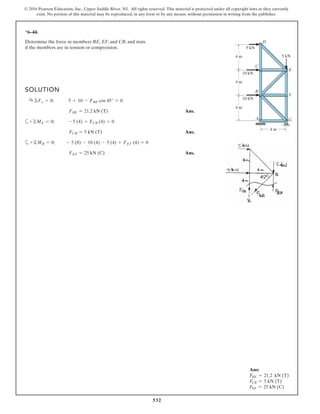
*6–44.
Determine the force in members BE, EF, and CB, and state
if the members are in tension or compression.
SOLUTION
Ans.
a
Ans.
a
Ans.FEF = 25 kN (C)
+©MB = 0; - 5 (8) - 10 (4) - 5 (4) + FEF (4) = 0
FCB = 5 kN (T)
+©ME = 0; - 5 (4) + FCB (4) = 0
FBE = 21.2 kN (T)
:+ ©Fx = 0; 5 + 10 - FBE cos 45° = 0
4 m
4 m
4 m
4 m
B
A
C
F
G
E
D
10 kN
10 kN
5 kN
5 kN
Ans:
FBE = 21.2 kN (T)
FCB = 5 kN (T)
FEF = 25 kN (C)
533
© 2016 Pearson Education, Inc., Upper Saddle River, NJ. All rights reserved. This material is protected under all copyright laws as they currently
exist. No portion of this material may be reproduced, in any form or by any means, without permission in writing from the publisher.
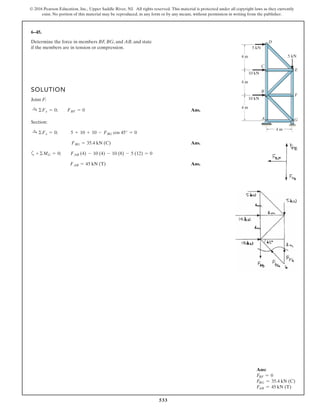
6–45.
Determine the force in members BF, BG, and AB, and state
if the members are in tension or compression.
SOLUTION
Joint F:
Ans.
Section:
Ans.
a
Ans.FAB = 45 kN (T)
+©MG = 0; FAB (4) - 10 (4) - 10 (8) - 5 (12) = 0
FBG = 35.4 kN (C)
:+ ©Fx = 0; 5 + 10 + 10 - FBG cos 45° = 0
:+ ©Fx = 0; FBF = 0
4 m
4 m
4 m
4 m
B
A
C
F
G
E
D
10 kN
10 kN
5 kN
5 kN
Ans:
FBF = 0
FBG = 35.4 kN (C)
FAB = 45 kN (T)
534
© 2016 Pearson Education, Inc., Upper Saddle River, NJ. All rights reserved. This material is protected under all copyright laws as they currently
exist. No portion of this material may be reproduced, in any form or by any means, without permission in writing from the publisher.
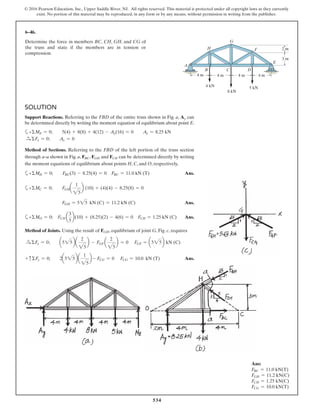
6–46.
Determine the force in members BC, CH, GH, and CG of
the truss and state if the members are in tension or
compression.
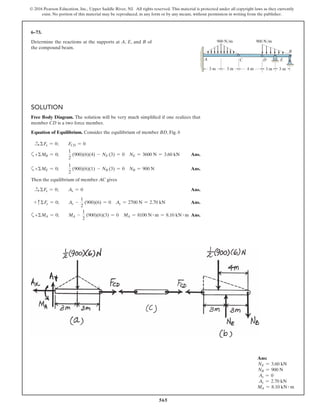
A
C D
H
G
F
8 kN
3 m
2 m
4 m4 m4 m 4 m
B
E
4 kN 5 kN
SOLUTION
Support Reactions. Referring to the FBD of the entire truss shown in Fig. a, Ay can
be determined directly by writing the moment equation of equilibrium about point E.
a+ΣME = 0; 5(4) + 8(8) + 4(12) - Ay(16) = 0 Ay = 8.25 kN
S+ ΣFx = 0; Ax = 0
Method of Sections. Referring to the FBD of the left portion of the truss section
through a–a shown in Fig. a, FBC, FGH and FCH can be determined directly by writing
the moment equations of equilibrium about points H, C, and O, respectively,
a+ΣMH = 0; FBC(3) - 8.25(4) = 0 FBC = 11.0 kN (T) Ans.
a+ΣMC = 0; FGHa
1
25
b (10) + (4)(4) - 8.25(8) = 0
FGH = 525 kN (C) = 11.2 kN (C) Ans.
a+ΣMO = 0; FCH a
3
5
b(10) + (8.25)(2) - 4(6) = 0 FCH = 1.25 kN (C) Ans.
Method of Joints. Using the result of FGH, equilibrium of joint G, Fig. c, requires
S+ ΣFx = 0; a525ba
2
25
b - FGF a
2
25
b = 0 FGF = a525b kN (C)
+ cΣFy = 0; 2a525ba
1
25
b - FCG = 0 FCG = 10.0 kN (T) Ans.
Ans:
FBC = 11.0 kN(T)
FGH = 11.2 kN(C)
FCH = 1.25 kN(C)
FCG = 10.0 kN(T)
535
© 2016 Pearson Education, Inc., Upper Saddle River, NJ. All rights reserved. This material is protected under all copyright laws as they currently
exist. No portion of this material may be reproduced, in any form or by any means, without permission in writing from the publisher.
SOLUTION
Support Reactions. Referring to the FBD of the entire truss shown in Fig. a, Ay
can be determined directly by writing the moment equation of equilibrium about
point G.
a+ΣMG = 0; 6(2) + 6(4) + 6(6) + 6(8) + 6(10) - Ay(12) = 0 Ay = 15.0 kN
S+ ΣFx = 0; Ax = 0
Method of Sections. Referring to the FBD of the left portion of the truss sectioned
through a - a shown in Fig. b, FCD, FCJ and FKJ can be determined directly by writing
the moment equations of equilibrium about points J, A and C, respectively.
a+ΣMJ = 0; FCD(3) + 6(2) + 6(4) - 15.0(6) = 0 FCD = 18.0 kN (T) Ans.
a+ΣMA = 0; FCJa
3
213
b(4) - 6(4) - 6(2) = 0
FCJ = 3213 kN (T) = 10.8 kN (T) Ans.
a+ΣMC = 0; FKJa
1
25
b(4) + 6(2) - 15.0 (4) = 0
FKJ = 1225 kN (C) = 26.8 kN (C) Ans.
6–47.
Determine the force in members CD, CJ, and KJ and state
if these members are in tension or compression.
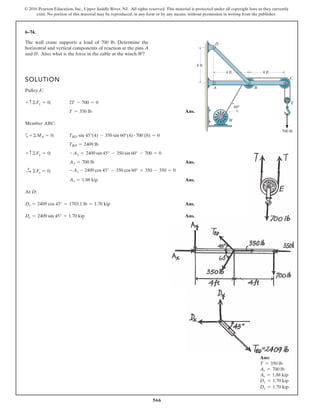
6 kN
A
B C D E
G
I
H
F
12 m, 6 @ 2 m
J
K
L
6 kN
6 kN
6 kN
6 kN
3 m
Ans:
FCD = 18.0 kN (T)
FCJ = 10.8 kN (T)
FKJ = 26.8 kN (T)
536
© 2016 Pearson Education, Inc., Upper Saddle River, NJ. All rights reserved. This material is protected under all copyright laws as they currently
exist. No portion of this material may be reproduced, in any form or by any means, without permission in writing from the publisher.
*6–48.
Determine the force in members JK, CJ, and CD of the truss,
and state if the members are in tension or compression.
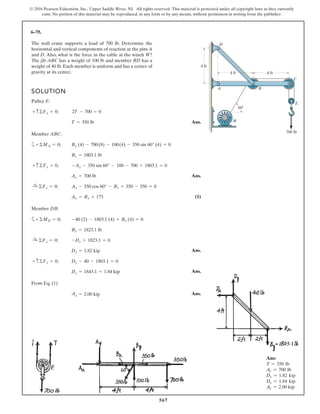
SOLUTION
Method of Joints: Applying the equations of equilibrium to the free - body diagram
of the truss, Fig. a,
a
Method of Sections: Using the left portion of the free - body diagram, Fig. a.
a
Ans.
a
Ans.
Ans.FCJ = 1.602 kN = 1.60 kN (C)
+ c©Fy = 0; 10.33 - 4 - 5 - FCJ sin 56.31° = 0
FCD = 12 kN (T)
+©MJ = 0; FCD(3) + 5(2) + 4(4) - 10.33(6) = 0
FJK = 11.111 kN = 11.1 kN (C)
+©MC = 0; FJK(3) + 4(2) - 10.33(4) = 0
Ay = 10.33 kN
+©MG = 0 6(2) + 8(4) + 5(8) + 4(10) - Ay(12) = 0
:+ ©Fx = 0; Ax = 0
A
B C D FE
G
H
IJ
L
K
6 kN
8 kN
5 kN4 kN
3 m
2 m 2 m 2 m 2 m 2 m 2 m
Ans:
FJK = 11.1 kN (C)
FCD = 12 kN (T)
FCJ = 1.60 kN (C)
537
© 2016 Pearson Education, Inc., Upper Saddle River, NJ. All rights reserved. This material is protected under all copyright laws as they currently
exist. No portion of this material may be reproduced, in any form or by any means, without permission in writing from the publisher.
6–49.
SOLUTION
Support Reactions: Applying the moment equation of equilibrium about point A to
the free - body diagram of the truss, Fig. a,
a
Method of Sections: Using the right portion of the free - body diagram, Fig. b.
a
Ans.
a
Ans.
a
Ans.FHI = 21.11 kN = 21.1 kN (C)
+©MF = 0; 12.67(2) - FHIa
3
5
b(2) = 0
FFI = 7.211 kN = 7.21 kN (T)
+©MG = 0; -FFI sin 56.31°(2) + 6(2) = 0
FEF = 12.89 kN = 12.9 kN (T)
+©MI = 0; 12.67(4) - 6(2) - FEF(3) = 0
NG = 12.67 kN
+©MA = 0; NG(2) - 4(2) - 5(4) - 8(8) - 6(10) = 0
Determine the force in members HI, FI, and EF of the truss,
and state if the members are in tension or compression.
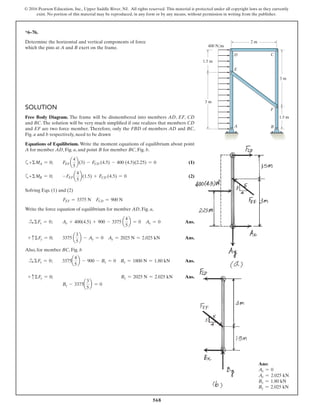
A
B C D FE
G
H
IJ
L
K
6 kN
8 kN
5 kN4 kN
3 m
2 m 2 m 2 m 2 m 2 m 2 m
Ans:
FEF = 12.9 kN (T)
FFI = 7.21 kN (T)
FHI = 21.1 kN (C)
538
© 2016 Pearson Education, Inc., Upper Saddle River, NJ. All rights reserved. This material is protected under all copyright laws as they currently
exist. No portion of this material may be reproduced, in any form or by any means, without permission in writing from the publisher.
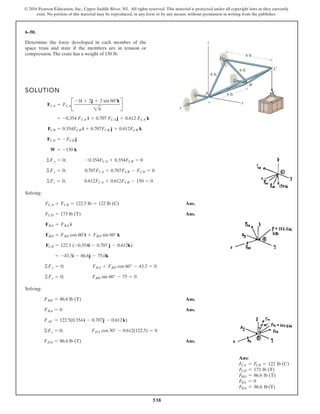
Ans:
FCA = FCB = 122 lb (C)
FCD = 173 lb (T)
FBD = 86.6 lb (T)
FBA = 0
FDA = 86.6 lb(T)
6–50.
SOLUTION
Solving:
Ans.
Ans.
Solving:
Ans.
Ans.
Ans.FDA = 86.6 lb (T)
©Fz = 0; FDA cos 30° - 0.612(122.5) = 0
FAC = 122.5(0.354 i - 0.707j - 0.612k)
FBA = 0
FBD = 86.6 lb (T)
©Fz = 0; FBD sin 60° - 75 = 0
©Fx = 0; FBA + FBD cos 60° - 43.3 = 0
= -43.3i - 86.6j - 75.0k
FCB = 122.5 (-0.354i - 0.707 j - 0.612k)
FBD = FBD cos 60°i + FBD sin 60° k
FBA = FBA i
FCD = 173 lb (T)
FCA = FCB = 122.5 lb = 122 lb (C)
©Fz = 0; 0.612FCA + 0.612FCB - 150 = 0
©Fy = 0; 0.707FCA + 0.707FCB - FCD = 0
©Fx = 0; -0.354FCA + 0.354FCB = 0
W = -150 k
FCD = -FCD j
FCB = 0.354FCB i + 0.707FCB j + 0.612FCB k
= -0.354 FCA i + 0.707 FCA j + 0.612 FCA k
FCA = FCAB
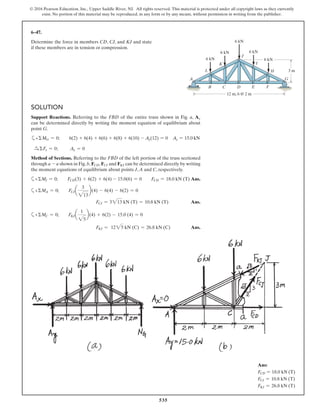
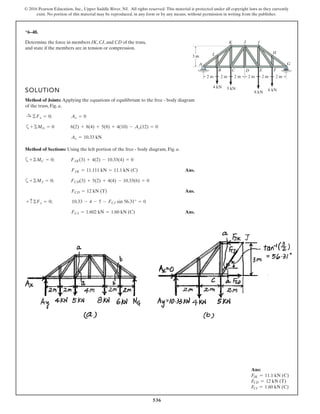
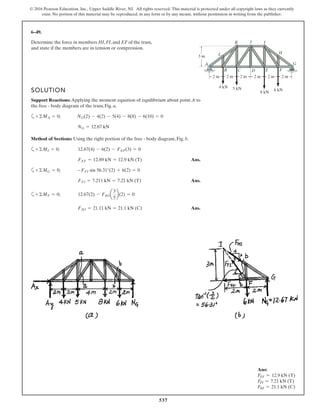
-1i + 2j + 2 sin 60°k
28
R
Determine the force developed in each member of the
space truss and state if the members are in tension or
compression.The crate has a weight of 150 lb.
x
y
z
A
B
C
D
6 ft
6 ft
6 ft
6 ft
539
© 2016 Pearson Education, Inc., Upper Saddle River, NJ. All rights reserved. This material is protected under all copyright laws as they currently
exist. No portion of this material may be reproduced, in any form or by any means, without permission in writing from the publisher.
Ans:
FAB = 6.46 kN (T)
FAC = FAD = 1.50 kN (C)
FBC = FBD = 3.70 kN (C)
FBE = 4.80 kN (T)
6–51.
Determine the force in each member of the space truss and
state if the members are in tension or compression. Hint:
The support reaction at E acts along member EB.Why?
y
x
D
A
6 kN
C
B
E
z
5 m
2 m
4 m
3 m
3 m
SOLUTION
Method of Joints: In this case, the support reactions are not required for
determining the member forces.
Joint A:
Ans.
(1)
(2)
Solving Eqs. (1) and (2) yields
Ans.
Joint B:
(1)
(2)
Solving Eqs. (1) and (2) yields
Ans.
Ans.
Note: The support reactions at supports C and D can be determined by analyzing
joints C and D, respectively using the results obtained above.
FBE = 4.80 kN 1T2
2B3.699¢
2
238
≤ R + 6.462¢
2
229
≤ - FBE = 0©Fy = 0;
FBC = FBD = 3.699 kN 1C2 = 3.70 kN 1C2
FBC + FBD = 7.397
FBC¢
5
238
≤ + FBD ¢
5
238
≤ - 6.462¢
5
229
≤ = 0©Fz = 0;
FBC¢
3
238
≤ - FBD ¢
3
238
≤ = 0 FBC = FBD©Fx = 0;
FAC = FAD = 1.50 kN 1C2
FAC + FAD = 3.00
FACa
4
5
b + FADa
4
5
b - 6.462¢
2
229
≤ = 0©Fy = 0;
FACa
3
5
b - FADa
3
5
b = 0 FAC = FAD©Fx = 0;
FAB = 6.462 kN 1T2 = 6.46 kN 1T2
FAB ¢
5
229
540
© 2016 Pearson Education, Inc., Upper Saddle River, NJ. All rights reserved. This material is protected under all copyright laws as they currently
exist. No portion of this material may be reproduced, in any form or by any means, without permission in writing from the publisher.
SOLUTION
Support Reactions. Not required
Method of Joints. Perform the joint equilibrium analysis at joint G first and then
proceed to joint E.
Joint G. Fig. a
ΣFx = 0; FGDa
2
25
b - FGCa
2
25
b = 0 FGD = FGC = F
ΣFy = 0; F a
1
25
b + F a
1
25
b - 4 = 0 F = 225 kN
Thus,
FGC = 225 kN (T) = 4.47 kN (T) Ans.
FGD = 225 kN (C) = 4.47 kN (C) Ans.
ΣFz = 0; FGE - 6 = 0 FGE = 6.00 kN (C) Ans.
Joint E. Fig. b
ΣFz = 0; FEDa
2
3
b - 6.00 = 0 FED = 9.00 kN (T) Ans.
ΣFx = 0; FEAa
2
25
b - FEBa
2
25
b - 9.00a
2
3
b = 0 (1)
ΣFy = 0; FEAa
1
25
b + FEBa
1
25
b - 9.00a
1
3
b = 0 (2)
Solving Eqs. (1) and (2)
FEA = 325 kN (C) = 6.71 kN (C) FEB = 0 Ans.
*6–52.
Determine the force in each member of the space truss and
state if the members are in tension or compression. The truss
is supported by ball-and-socket joints at A, B, C, and D.
Ans:
FGC = 4.47 kN (T)
FGD = 4.47 kN (C)
FGE = 6.00 kN (C)
FED = 9.00 kN (T)
FEA = 6.71 kN (C)
FEB = 0
G
A
6 kN
4 kN
B
C
E y
z
x
D 2 m
4 m
4 m
2 m
541
© 2016 Pearson Education, Inc., Upper Saddle River, NJ. All rights reserved. This material is protected under all copyright laws as they currently
exist. No portion of this material may be reproduced, in any form or by any means, without permission in writing from the publisher.
6–53.
The space truss supports a force
. Determine the force in each member, and state if
the members are in tension or compression.
400k6 lb
F = 5-500i + 600j +
A
B
C
D
x
y
z
F
8 ft
6 ft
6 ft
6 ft
6 ft
SOLUTION
Method of Joints: In this case, there is no need to compute the support reactions.We
will begin by analyzing the equilibrium of joint C, and then that of joints A and D.
Joint C: From the free - body diagram, Fig. a,
Ans.
(1)
(2)
Solving Eqs. (1) and (2) yields
Ans.
Ans.
Joint A: From the free - body diagram, Fig. b,
Thus, Ans.
Joint D: From the free - body diagram, Fig. c,
Ans.
Note: The equilibrium analysis of joint B can be used to determine the components
of support reaction of the ball and socket support at B.
Dz = 266.67 lb
©Fz = 0; 333.33a
4
5
b - Dz = 0
Dx = 250 lb
©Fx = 0; Dx - 353.55 sin 45° = 0
FDB = 50 lb(T)
©Fy = 0; FDB + 333.33a
3
5
b - 353.55 cos 45° = 0
Az = 666.67 lb
©Fz = 0; 833.33a
4
5
b - Az = 0
FAD = FAB = 353.55 lb = 354 lb(C)
F = 353.55 lb
©Fy = 0; F sin 45° + F sin 45° - 833.33a
3
5
b = 0
FAD = FAB = F
©Fx = 0; FAD cos 45° - FAB cos 45° = 0
FCD = 333.33 lb = 333 lb(T)
FCB = -666.67 lb = 667 lb(C)
©Fz = 0; 400 - 833.33a
4
5
b - FCDa
4
5
b - FCBa
4
5
b = 0
©Fy = 0; FCBa
3
5
b - FCDa
3
5
b + 600 = 0
FCA = 833.33lb = 833 lb(T)
©Fx = 0; FCAa
3
5
b - 500 = 0
Ans:
FCA = 833 lb (T)
FCB = 667 lb (C)
FCD = 333 lb (T)
FAD = FAB = 354 lb (C)
FDB = 50 lb (T)
542
© 2016 Pearson Education, Inc., Upper Saddle River, NJ. All rights reserved. This material is protected under all copyright laws as they currently
exist. No portion of this material may be reproduced, in any form or by any means, without permission in writing from the publisher.
6–54.
SOLUTION
Method of Joints: In this case, there is no need to compute the support reactions.We
will begin by analyzing the equilibrium of joint C, and then that of joints A and D.
Joint C: From the free - body diagram, Fig. a,
Ans.
(1)
(2)
Solving Eqs. (1) and (2) yields
Ans.
Ans.
Joint A: From the free - body diagram, Fig. b,
Thus, Ans.
Joint D: From the free - body diagram, Fig. c,
Ans.
Note: The equilibrium analysis of joint B can be used to determine the components
of support reaction of the ball and socket support at B.
Dz = 325 lb
©Fz = 0; 406.25a
4
5
b - Dz = 0
Dx = 300 lb
©Fx = 0; 424.26 sin 45° - Dx = 0
FDB = 543.75 lb = 544lb(C)
©Fy = 0; 406.25a
3
5
b + 406.25cos 45° - FDB = 0
Az = 800 lb
©Fz = 0; Az - 1000a
4
5
b = 0
FAB = FAD = 424.26 lb = 424 lb(T)
F = 424.26 lb
©Fx = 0; 1000a
3
5
b - F sin 45° - F sin 45° = 0
FAB = FAD = F
©Fy = 0; FAB cos 45° - FAD cos 45° = 0
FCB = -343.75 lb = 344lb(C)
FCD = 406.25 lb = 406 lb(T)
©Fz = 0; -FCBa
4
5
b - FCDa
4
5
b -(-1000)a
4
5
b - 750 = 0
©Fy = 0; FCB a
3
5
b - FCDa
3
5
b + 450 = 0
FCA = -1000 lb = 1000 lb(C)
©Fx = 0; 600 + FCAa
3
5
b = 0
The space truss supports a force
. Determine the force in each member, and state if
the members are in tension or compression.
750k6 lb
F = 5600i + 450j -
A
B
C
D
x
y
z
F
8 ft
6 ft
6 ft
6 ft
6 ft
Ans:
FCA = 1000 lb (C)
FCD = 406 lb (T)
FCB = 344 lb (C)
FAB = FAD = 424 lb (T)
FDB = 544 lb (C)
543
© 2016 Pearson Education, Inc., Upper Saddle River, NJ. All rights reserved. This material is protected under all copyright laws as they currently
exist. No portion of this material may be reproduced, in any form or by any means, without permission in writing from the publisher.
SOLUTION
Support Reactions. Referring to the FBD of the entire truss shown in Fig. a,
ΣFx = 0; Dx - Bx - Ex + 2 = 0 (1)
ΣFy = 0; Ay - 3 = 0 (2)
ΣFz = 0; Dz + Bz - 4 = 0 (3)
ΣMx = 0; 4(1.5) + 3(3 sin 60°) - Dz(3) = 0 (4)
ΣMy = 0; 2(3 sin 60°) + 4(5) - Dz (5) - Ex (3 sin 60°) = 0 (5)
ΣMz = 0; Dx (3) + Ay (5) - Ex (1.5) + 2(1.5) - 3(5) = 0 (6)
Solving Eqs. (1) to (6)
Ay = 3.00 kN Dz = 4.5981 kN Bz = -0.5981 kN
Ex = 0.8490 kN Dx = -0.5755 kN Bx = 0.5755 kN
Method of Joints. We will analyse the equilibrium of the joint at joint D first and
then proceed to joint F.
Joint D. Fig. b
+ cΣFz = 0; 4.5981 - FDF sin 60° = 0 FDF = 5.3094 kN (C) = 5.31 kN (C) Ans.
6–55.
Determine the force in members EF, AF, and DF of the
space truss and state if the members are in tension or
compression. The truss is supported by short links at A, B,
D, and E.
z
x y
3 m
3 m
4 kN
2 kN
3 kN
3 m
5 m
F
A
E
D
B
C
544
© 2016 Pearson Education, Inc., Upper Saddle River, NJ. All rights reserved. This material is protected under all copyright laws as they currently
exist. No portion of this material may be reproduced, in any form or by any means, without permission in writing from the publisher.
Joint F. Fig. c
ΣFx = 0; 2 - FEF -
5
234
FCF = 0 (7)
ΣFy = 0; FAF cos 60° + 5.3094 cos 60° - 3 - FCF a
1.5
234
b = 0 (8)
ΣFz = 0; 5.3094 sin 60° - 4 - FAF sin 60° - FCF a
3 sin 60°
234
b = 0 (9)
Solving Eqs. (7), (8) and (9)
FCF = 0 FEF = 2.00 kN (T) Ans.
FAF = 0.6906 kN (T) = 0.691 kN (T) Ans.
6–55. Continued
Ans:
FDF = 5.31 kN (C)
FEF = 2.00 kN (T)
FAF = 0.691 kN (T)
545
© 2016 Pearson Education, Inc., Upper Saddle River, NJ. All rights reserved. This material is protected under all copyright laws as they currently
exist. No portion of this material may be reproduced, in any form or by any means, without permission in writing from the publisher.
SOLUTION
Support Reactions. Not required
Method of Joints. Analysis of joint equilibrium will be in the sequence of
joints D, C, B, A and F.
Joint D. Fig. a
ΣFx = 0; 20 - FDB a
4
5
b = 0 FDB = 25.0 kN (T) Ans.
ΣFy = 0; 25.0 a
3
5
b - FDC = 0 FDC = 15.0 kN (T) Ans.
ΣFz = 0; FDE - 12 = 0 FDE = 12.0 kN (C) Ans.
Joint C. Fig. b
ΣFx = 0; FCB = 0 Ans.
ΣFy = 0; FCE a
1
25
b + 15.0 = 0 FCE = -1525 kN = 33.5 kN (C) Ans.
ΣFz = 0; -FCF - a-1525ba
2
25
b = 0 FCF = 30.0 kN (T) Ans.
Joint B. Fig. c
ΣFy = 0; FBE a
1.5
215.25
b - 25.0 a
3
5
b = 0
FBE = 10215.25 kN (T) = 39.1 kN (T) Ans.
ΣFx = 0; 25.0 a
4
5
b - a10215.25b a
2
215.25
b - FBF a
2
213
b = 0
FBF = 0 Ans.
ΣFz = 0; -FBA - a10215.25b a
3
215.25
b = 0
FBA = -30.0 kN = 30.0 kN (C) Ans.
*6–56.
The space truss is used to support the forces at joints B and
D. Determine the force in each member and state if the
members are in tension or compression.
C
D
E
F
B
A
12 kN
20 kN
2 m
90Њ
3 m
2.5 m
1.5 m
546
© 2016 Pearson Education, Inc., Upper Saddle River, NJ. All rights reserved. This material is protected under all copyright laws as they currently
exist. No portion of this material may be reproduced, in any form or by any means, without permission in writing from the publisher.
Joint A. Fig. d
ΣFy = 0; FAE = 0 Ans.
ΣFx = 0; FAF = 0 Ans.
Joint F. Fig. e
ΣFy = 0; FFE = 0 Ans.
*6–56. Continued
Ans:
FDB = 25.0 kN (C)
FDC = 15.0 kN (T)
FDE = 12.0 kN (C)
FCE = 33.5 kN (C)
FCF = 30.0 kN (T)
FBE = 39.1 kN (T)
FBF = 0
FBA = 30.0 kN (C)
FAE = 0
FAF = 0
FFE = 0
547
© 2016 Pearson Education, Inc., Upper Saddle River, NJ. All rights reserved. This material is protected under all copyright laws as they currently
exist. No portion of this material may be reproduced, in any form or by any means, without permission in writing from the publisher.
6–57.
The space truss is supported by a ball-and-socket joint at D
and short links at C and E. Determine the force in each
member and state if the members are in tension or
compression.Take and F2 = 5400j6 lb.F1 = 5-500k6 lb
SOLUTION
Joint F: Ans.
Joint B:
Ans.
Ans.
Ans.
Joint A:
Ans.
Ans.
Ans.
Joint E:
Ans.
Ans.FEF = 300 lb (C)
©Fx = 0; FEF -
3
5
(500) = 0
©Fz = 0; FDE = 0
FAE = 667 lb (C)
©Fy = 0; FAE -
4
5
(333.3) -
4
234
(583.1) = 0
FAD = 333 lb (T)
©Fz = 0;
3
234
(583.1) - 500 +
3
5
FAD = 0
FAC = 583.1 = 583 lb (T)
©Fx = 0; 300 -
3
234
FAC = 0
FAB = 300 lb (C)
©Fx = 0; FAB -
3
5
(500) = 0
FBE = 500 lb (T)
©Fy = 0; 400 -
4
5
FBE = 0
©Fz = 0; FBC = 0
©Fy = 0; FBF = 0
©My = 0; Cz = 0
©Fx = 0; Dx = 0
Cy = -400 lb
©Mz = 0; -Cy (3) - 400(3) = 0
3 ft4 ft
3 ft
x
y
z
C
D
E
A
B
F
F2
F1
548
© 2016 Pearson Education, Inc., Upper Saddle River, NJ. All rights reserved. This material is protected under all copyright laws as they currently
exist. No portion of this material may be reproduced, in any form or by any means, without permission in writing from the publisher.
6–57. Continued
Joint C:
ΣFx = 0;
3
234
(583.1) - FCD = 0
FCD = 300 lb (C) Ans.
ΣFz = 0; FCF -
3
234
(583.1) = 0
FCF = 300 lb (C) Ans.
ΣFy = 0;
4
234
(583.1) - 400 = 0 Check!
Joint F:
ΣFx = 0;
3
218
FDF - 300 = 0
FDF = 424 lb (T) Ans.
ΣFz = 0;
3
218
(424.3) - 300 = 0 Check!
Ans:
FBF = 0
FBC = 0
FBE = 500 lb (T)
FAB = 300 lb (C)
FAC = 583 lb (T)
FAD = 333 lb (T)
FAE = 667 lb (C)
FDE = 0
FEF = 300 lb (C)
FCD = 300 lb (C)
FCF = 300 lb (C)
FDF = 424 lb (T)
549
© 2016 Pearson Education, Inc., Upper Saddle River, NJ. All rights reserved. This material is protected under all copyright laws as they currently
exist. No portion of this material may be reproduced, in any form or by any means, without permission in writing from the publisher.
6–58.
SOLUTION
Joint F: Ans.
Joint B:
Ans.
Ans.
Ans.
Joint A:
Ans.
Ans.
Ans.
Joint E:
Ans.
Ans.FEF = 300 lb (C)
©Fx = 0; FEF -
3
5
(500) = 0
©Fz = 0; FDE = 0
FAE = 367 lb (C)
©Fy = 0; FAE + 300 -
4
234
(971.8) = 0
FAD = 0
©Fz = 0;
3
234
(971.8) - 500 +
3
5
FAD = 0
FAC = 971.8 = 972 lb (T)
©Fx = 0; 300 + 200 -
3
234
FAC = 0
FAB = 300 lb (C)
©Fx = 0; FAB -
3
5
(500) = 0
FBE = 500 lb (T)
©Fy = 0; 400 -
4
5
FBE = 0
©Fz = 0; FBC = 0
FBF = 0
Cz = 200 lb
©My = 0; Cz (3) - 200(3) = 0
Cy = - 666.7 lb
©Mz = 0; -Cy (3) - 400(3) - 200(4) = 0
Dx = - 200 lb
©Fx = 0; Dx + 200 = 0
The space truss is supported by a ball-and-socket joint at D
and short links at C and E. Determine the force in each
member and state if the members are in tension or
compression. Take and
F2 = 5400j6 lb.
F1 = 5200i + 300j - 500k6lb
3 ft4 ft
3 ft
x
y
z
C
D
E
A
B
F
F2
F1
550
© 2016 Pearson Education, Inc., Upper Saddle River, NJ. All rights reserved. This material is protected under all copyright laws as they currently
exist. No portion of this material may be reproduced, in any form or by any means, without permission in writing from the publisher.
Joint C:
Ans.
Ans.
Joint F:
Ans.FDF = 424 lb (T)
©Fx = 0;
3
218
FDF - 300 = 0
©Fy = 0;
4
234
(971.8) - 666.7 = 0 Check!
FCF = 300 lb (C)
©Fz = 0; FCF -
3
234
(971.8) + 200 = 0
FCD = 500 lb (C)
©Fx = 0;
3
234
(971.8) - FCD = 0
6–58. Continued
Ans:
FBF = 0
FBC = 0
FBE = 500 lb (T)
FAB = 300 lb (C)
FAC = 972 lb (T)
FAD = 0
FAE = 367 lb (C)
FDE = 0
FEF = 300 lb (C)
FCD = 500 lb (C)
FCF = 300 lb (C)
FDF = 424 lb (T)
551
© 2016 Pearson Education, Inc., Upper Saddle River, NJ. All rights reserved. This material is protected under all copyright laws as they currently
exist. No portion of this material may be reproduced, in any form or by any means, without permission in writing from the publisher.
6–59.
Determine the force in each member of the space truss
and state if the members are in tension or compression. The
The truss is supported by ball-and-socket joints at A, B,
and E. Set . Hint: The support reaction at E
acts along member EC.Why?
F = 5800j6 N
F
D
A
z
2 m
x
y
B
C
E
5 m
1 m
2 m
1.5 m
Ans:
FAD = 686 N (T)
FBD = 0
FCD = 615 N (C)
FBC = 229 N (T)
FAC = 343 N (T)
FEC = 457 N (C)
552
© 2016 Pearson Education, Inc., Upper Saddle River, NJ. All rights reserved. This material is protected under all copyright laws as they currently
exist. No portion of this material may be reproduced, in any form or by any means, without permission in writing from the publisher.
*6–60.
Determine the force in each member of the space truss and
state if the members are in tension or compression. The
truss is supported by ball-and-socket joints at A, B, and E.
Set . Hint: The support reaction at E
acts along member EC.Why?
F = 5-200i + 400j6 N
F
D
A
z
2 m
x
y
B
C
E
5 m
1 m
2 m
1.5 m
SOLUTION
Joint D:
Ans.
Ans.
Ans.
Joint C:
Ans.
Ans.
Ans.FEC = 295 N (C)
©Fz = 0; FEC -
2
27.25
(397.5) = 0
FAC = 221 N (T)
©Fy = 0;
1.5
27.25
(397.5) - FAC = 0
FBC = 148 N (T)
©Fx = 0; FBC -
1
27.25
(397.5) = 0
FCD = 397.5 = 397 N (C)
FBD = 186 N (T)
FAD = 343 N (T)
©Fz = 0; -
2
3
FAD -
2
231.25
FBD +
2
27.25
FCD = 0
©Fy = 0; -
2
3
FAD +
1.5
231.25
FBD -
1.5
27.25
FCD + 400 = 0
©Fx = 0; -
1
3
FAD +
5
231.25
FBD +
1
27.25
FCD - 200 = 0
553
© 2016 Pearson Education, Inc., Upper Saddle River, NJ. All rights reserved. This material is protected under all copyright laws as they currently
exist. No portion of this material may be reproduced, in any form or by any means, without permission in writing from the publisher.
6–61.
Determine the force required to hold the
100-lb weight in equilibrium.
P
SOLUTION
Equations of Equilibrium: Applying the force equation of equilibrium along the
y axis of pulley A on the free - body diagram, Fig. a,
Applying to the free - body diagram of pulley B, Fig. b,
From the free - body diagram of pulley C, Fig. c,
Ans.+ c©Fy = 0; 2P - 25 = 0 P = 12.5 lb
+ c©Fy = 0; 2TB - 50 = 0 TB = 25 lb
©Fy = 0
+ c ©Fy = 0; 2TA - 100 = 0 TA = 50 lb
P
A
B
C
D
Ans:
P = 12.5 lb
554
© 2016 Pearson Education, Inc., Upper Saddle River, NJ. All rights reserved. This material is protected under all copyright laws as they currently
exist. No portion of this material may be reproduced, in any form or by any means, without permission in writing from the publisher.
6–62.
SOLUTION
Equations of Equilibrium:
a)
Ans.
b)
Ans.
c)
Ans.P = 11.1 lb
3P - 33.33 = 0+ c ©Fy = 0;
P¿ = 33.33 lb
3P¿ - 100 = 0+ c ©Fy = 0;
P = 33.3 lb
3P - 100 = 0+ c ©Fy = 0;
P = 25.0 lb
4P - 100 = 0+ c ©Fy = 0;
In each case, determine the force P required to maintain
equilibrium.The block weighs 100 lb.
P
(a) (b) (c)
P
P
Ans:
P = 25.0 lb
P = 33.3 lb
P = 11.1 lb
555
© 2016 Pearson Education, Inc., Upper Saddle River, NJ. All rights reserved. This material is protected under all copyright laws as they currently
exist. No portion of this material may be reproduced, in any form or by any means, without permission in writing from the publisher.
6–63.
Determine the force required to hold the 50-kg mass in
equilibrium.
P
SOLUTION
Equations of Equilibrium: Applying the force equation of equilibrium along the
y axis of each pulley.
Ans.
Substituting Eqs.(1) and (2) into Eq.(3) and solving for P,
Ans.P = 18.9 N
2P + 2(3P) + 2(9P) = 50(9.81)
+ c©Fy = 0; 2P + 2R + 2T - 50(9.81) = 0
+ c©Fy = 0; T - 3R = 0; T = 3R = 9P
+ c©Fy = 0; R - 3P = 0; R = 3P
P
A
B
C
Ans:
P = 18.9 N
556
© 2016 Pearson Education, Inc., Upper Saddle River, NJ. All rights reserved. This material is protected under all copyright laws as they currently
exist. No portion of this material may be reproduced, in any form or by any means, without permission in writing from the publisher.
*6–64.
SOLUTION
Equations of Equilibrium: Applying the force equation of equilibrium along the
y axis of pulley A on the free - body diagram, Fig. a,
Using the above result and writing the force equation of equilibrium along the
axis of pulley C on the free - body diagram in Fig. b,
Ans.©Fy¿ = 0; 735.75 - 2P = 0 P = 367.88 N = 368 N
y¿
+ c ©Fy = 0; 2TA - 150(9.81) = 0 TA = 735.75 N
Determine the force required to hold the 150-kg crate
in equilibrium.
P
P
A
B
C
Ans:
P = 368 N
557
© 2016 Pearson Education, Inc., Upper Saddle River, NJ. All rights reserved. This material is protected under all copyright laws as they currently
exist. No portion of this material may be reproduced, in any form or by any means, without permission in writing from the publisher.
SOLUTION
Free Body Diagram. The frame will be dismembered into members BC and AC.
The solution will be very much simplified if one recognizes that member AC is a
two force member. The FBDs of member BC and pin A are shown in Figs. a and b,
respectively.
Equations of Equilibrium. Consider the equilibrium of member BC, Fig. a,
a+ΣMB = 0; 2(4)(2) - FAC a
3
5
b(4) = 0 FAC = 6.6667 kN
a+ΣMC = 0; Bx (4) - 2(4)(2) = 0 Bx = 4.00 kN Ans.
+ cΣFy = 0; 6.6667 a
4
5
b - By = 0 By = 5.333 kN = 5.33 kN Ans.
Then, the equilibrium of pin A gives
S+ ΣFx = 0; Ax - 6.6667 a
3
5
b = 0 Ax = 4.00 kN Ans.
+ cΣFy = 0; Ay - 6.6667 a
4
5
b = 0 Ay = 5.333 kN = 5.33 kN Ans.
6–65.
Determine the horizontal and vertical components of force
that pins A and B exert on the frame.
4 m
3 m
2 kN/m
A
C
B
Ans:
Bx = 4.00 kN
By = 5.33 kN
Ax = 4.00 kN
Ay = 5.33 kN
558
© 2016 Pearson Education, Inc., Upper Saddle River, NJ. All rights reserved. This material is protected under all copyright laws as they currently
exist. No portion of this material may be reproduced, in any form or by any means, without permission in writing from the publisher.
SOLUTION
Free Body Diagram. The assembly will be dismembered into member AC, BD and
pulley E. The solution will be very much simplified if one recognizes that member
BD is a two force member.The FBD of pulley E and member AC are shown in Fig. a
and b respectively.
Equations of Equilibrium. Consider the equilibrium of pulley E, Fig. a,
+ cΣFy = 0; 2T - 12 = 0 T = 6.00 kN
Then, the equilibrium of member AC gives
a+ΣMA = 0; FBD a
4
5
b(1.5) + 6(0.3) - 6(3) - 6(3.3) = 0
FBD = 30.0 kN
S+ ΣFx = 0; Ax - 30.0 a
3
5
b - 6 = 0 Ax = 24.0 kN Ans.
+ cΣFy = 0; 30.0 a
4
5
b - 6 - 6 - Ay = 0 Ay = 12.0 kN Ans.
Thus,
FA = 2Ax
2
+ Ay
2
= 224.02
+ 12.02
= 26.83 kN = 26.8 kN
FB = FBD = 30.0 kN
Dx =
3
5
(30) = 18.0 kN Ans.
Dy =
4
5
(30) = 24.0 kN Ans.
6–66.
Determine the horizontal and vertical components of force
at pins A and D.
1.5 m
D
A B
C
E
1.5 m
0.3 m
12 kN
2 m
Ans:
Ax = 24.0 kN
Ay = 12.0 kN
Dx = 18.0 kN
Dy = 24.0 kN
559
© 2016 Pearson Education, Inc., Upper Saddle River, NJ. All rights reserved. This material is protected under all copyright laws as they currently
exist. No portion of this material may be reproduced, in any form or by any means, without permission in writing from the publisher.
6–67.
SOLUTION
a
Ans.
Ans.
a
Ans.NC = 15.0 lb
+©MB = 0; -NC (4) + 120(0.5) = 0
+ c©Fy = 0; Ay = 0
:+ ©Fx = 0; Ax = 120 lb
Dx = 120 lb
+©MA = 0; -60 + Dx (0.5) = 0
Determine the force that the smooth roller C exerts on
member AB. Also, what are the horizontal and vertical
components of reaction at pin A? Neglect the weight of the
frame and roller.
C
0.5 ft
3 ft
A
60 lb ft
4 ft
B
D
Ans:
Ax = 120 lb
Ay = 0
NC = 15.0 lb
560
© 2016 Pearson Education, Inc., Upper Saddle River, NJ. All rights reserved. This material is protected under all copyright laws as they currently
exist. No portion of this material may be reproduced, in any form or by any means, without permission in writing from the publisher.
*6–68.
SOLUTION
For segment BD:
a Ans.
Ans.
Ans.
For segment ABC:
a Ans.
Ans.
Ans.
For segment DEF:
a Ans.
Ans.
Ans.+ c©Fy = 0; -Ey + 135 - 2(15) - 30 = 0 Ey = 75 kip
:+ ©Fx = 0; Ex = 0
+ ©Mg = 0; -Fy(5) + 2(15)(7.5) + 30(15) = 0 Fy = 135 kip
+ c©Fy = 0; -Ay + 135 - 2(15) - 30 = 0 Ay = 75 kip
:+ ©Fx = 0; Ax = 0
+ ©MA = 0; Cy (5) - 2(15)(7.5) - 30(15) = 0 Cy = 135kip
+ c©Fy = 0; Dy + 30 - 2(30) = 0 Dy = 30 kip
:+ ©Fx = 0; Dx = 0
+ ©MD = 0; 2(30)(15) - By (30) = 0 By = 30 kip
The bridge frame consists of three segments which can be
considered pinned at A, D, and E, rocker supported at C
and F, and roller supported at B. Determine the horizontal
and vertical components of reaction at all these supports
due to the loading shown. 15 ft
20 ft
5 ft 5 ft
15 ft
2 kip/ft
30 ft
A
B
C F
D
E
Ans:
By = 30 kip
Dx = 0
Dy = 30 kip
Cy = 135 kip
Ay = 75 kip
Fy = 135 kip
Ex = 0
Ey = 75 kip
561
© 2016 Pearson Education, Inc., Upper Saddle River, NJ. All rights reserved. This material is protected under all copyright laws as they currently
exist. No portion of this material may be reproduced, in any form or by any means, without permission in writing from the publisher.
6–69.
Determine the reactions at supports A and B.
SOLUTION
Member DB:
a
Ans.
Ans.
Member AC:
Ans.
Ans.
a
Ans.MA = 43.2 kip # ft
+©MA = 0; MA - 3(6) - 3.50 a
3
5
b(12) = 0
Ay = 5.10 kip
+ c ©Fy = 0; Ay - 3 - 3.50 a
3
5
b = 0
Ax = 2.80 kip
:+ ©Fx = 0; Ax - 3.50a
4
5
b = 0
By = 1.05 kip
+ c ©Fy = 0; By - 3.15 + 3.50a
3
5
b = 0
Bx = 2.80 kip
:+ ©Fx = 0; -Bx + 3.50a
4
5
b = 0
FCD = 3.50 kip
+©MB = 0; 3.15 (6) - FCDa
3
5
b (9) = 0
6 ft
500 lb/ft
6 ft
8 ft
9 ft
700 lb/ft
6 ft
A C
D
B
Ans:
Bx = 2.80 kip
By = 1.05 kip
Ax = 2.80 kip
Ay = 5.10 kip
MA = 43.2 kip # ft
562
© 2016 Pearson Education, Inc., Upper Saddle River, NJ. All rights reserved. This material is protected under all copyright laws as they currently
exist. No portion of this material may be reproduced, in any form or by any means, without permission in writing from the publisher.
SOLUTION
Free Body Diagram. The solution will be very much simplified if one realizes that
member AB is a two force member. Also, the tension in the cable is equal to the
weight of the cylinder and is constant throughout the cable.
Equations of Equilibrium. Consider the equilibrium of member BC by referring to
its FBD, Fig. a,
a+ΣMC = 0; FAB a
3
5
b(2) + 75(9.81)(0.3) - 75(9.81)(2.8) = 0
FAB = 1532.81 N
a+ΣMB = 0; Cy (2) + 75(9.81)(0.3) - 75(9.81)(0.8) = 0
Cy = 183.94 N = 184 N Ans.
S+ ΣFx = 0; 1532.81a
4
5
b - 75(9.81) - Cx = 0
Cx = 490.5 N Ans.
Thus,
FB = FAB = 1532.81 N
Bx =
4
5
(1532.81) = 1226.25 N = 1.23 kN Ans.
By =
3
5
(1532.81) = 919.69 N = 920 kN Ans.
6–70.
Determine the horizontal and vertical components of force
at pins B and C.The suspended cylinder has a mass of 75 kg.
A
BC
1.5 m
0.3 m
2 m
0.5 m
Ans:
Cy = 184 N
Cx = 490.5 N
Bx = 1.23 kN
By = 920 kN
563
© 2016 Pearson Education, Inc., Upper Saddle River, NJ. All rights reserved. This material is protected under all copyright laws as they currently
exist. No portion of this material may be reproduced, in any form or by any means, without permission in writing from the publisher.
SOLUTION
Free Body Diagram. The compound beam is being dismembered into members AB,
BD and DE of which their respective FBDs are shown in Fig. a, b and c.
Equations of Equilibrium. Equilibrium of member DE will be considered first by
referring to Fig. c.
a+ΣMD = 0; NE(6) - 12(9) = 0 NE = 18.0 kN Ans.
a+ΣME = 0; Dy(6) - 12(3) = 0 Dy = 6.00 kN
S+ ΣFx = 0; Dx = 0
Next, member BD, Fig. b.
a+ΣMC = 0; 6.00(2) + 3(6)(1) - By(4) = 0 By = 7.50 kN
a+ΣMB = 0; NC(4) + 6.00(6) - 3(6)(3) = 0 NC = 4.50 kN Ans.
S+ ΣFx = 0; Bx = 0
Finally, member AB, Fig. a
S+ ΣFx = 0; Ax = 0 Ans.
+ cΣFy = 0; Ay - 7 -50 = 0 Ay = 7.50 kN Ans.
a+ΣMA = 0; MA - 7.50(3) = 0 MA = 22.5 kN # m Ans.
6–71.
Determine the reactions at the supports A, C, and E of the
compound beam.
4 m 3 m3 m 6 m
2 m
A DB EC
3 kN/m
12 kN
Ans:
NE = 18.0 kN
NC = 4.50 kN
Ax = 0
Ay = 7.50 kN
MA = 22.5 kN # m
564
© 2016 Pearson Education, Inc., Upper Saddle River, NJ. All rights reserved. This material is protected under all copyright laws as they currently
exist. No portion of this material may be reproduced, in any form or by any means, without permission in writing from the publisher.
SOLUTION
Free Body Diagram. The frame is being dismembered into members AC and BC of
which their respective FBDs are shown in Fig. a and b.
Equations of Equilibrium. Write the moment equation of equilibrium about point A
for member AC, Fig. a and point B for member BC, Fig. b.
a+ΣMA = 0; Cy a
2
tan 60°
b + Cx (2) - 200 a
2
sin 60°
ba
1
sin 60°
b = 0 (1)
a+ΣMB = 0; Cy(2) - Cx(2) + 800(2) = 0 (2)
Solving Eqs. (1) and (2)
Cy = -338.12 N Cx = 461.88 N
The negative sign indicates that Cy acts in the sense opposite to that shown in the
FBD write the force equation of equilibrium for member AC, Fig. a,
S+ ΣFx = 0; Ax + 200 a
2
sin 60°
b sin 60° - 461.88 = 0 Ax = 61.88 N
+ cΣFy = 0; Ay + (-338.12) - 200 a
2
sin 60°
b cos 60° = 0 Ay = 569.06 N
Also, for member BC, Fig. b
S+ ΣFx = 0; Bx + 461.88 - 800 = 0 Bx = 338.12 N
+ cΣFy = 0; -By - (-338.12) = 0 By = 338.12 N
Thus,
FC = 2Cx
2
+ Cy
2
= 2461.882
+ (-338.12)2
= 572.41 N = 572 N Ans.
FA = 2Ax
2
+ Ay
2
= 261.882
+ 569.062
= 572.41 N = 572 N Ans.
FB = 2Bx
2
+ By
2
= 2338.122
+ 338.122
= 478.17 N = 478 N Ans.
*6–72.
Determine the resultant force at pins A, B, and C on the
three-member frame.
200 N/ m
60Њ
2 m
800 N
2 m
B
C
A
Ans:
FC = 572 N
FA = 572 N
FB = 478 N
565
© 2016 Pearson Education, Inc., Upper Saddle River, NJ. All rights reserved. This material is protected under all copyright laws as they currently
exist. No portion of this material may be reproduced, in any form or by any means, without permission in writing from the publisher.
SOLUTION
Free Body Diagram. The solution will be very much simplified if one realizes that
member CD is a two force member.
Equation of Equilibrium. Consider the equilibrium of member BD, Fig. b
S+ ΣFx = 0; FCD = 0
a+ΣMB = 0;
1
2
(900)(6)(4) - NE (3) = 0 NE = 3600 N = 3.60 kN Ans.
a+ΣME = 0;
1
2
(900)(6)(1) - NB (3) = 0 NB = 900 N Ans.
Then the equilibrium of member AC gives
S+ ΣFx = 0; Ax = 0 Ans.
+ cΣFy = 0; Ay -
1
2
(900)(6) = 0 Ay = 2700 N = 2.70 kN Ans.
a+ΣMA = 0; MA -
1
2
(900)(6)(3) = 0 MA = 8100 N # m = 8.10 kN # m Ans.
6–73.
Determine the reactions at the supports at A, E, and B of
the compound beam.
3 m
900 N/m 900 N/m
4 m3 m
A C D
B
3 m 3 m
E
Ans:
NE = 3.60 kN
NB = 900 N
Ax = 0
Ay = 2.70 kN
MA = 8.10 kN # m
566
© 2016 Pearson Education, Inc., Upper Saddle River, NJ. All rights reserved. This material is protected under all copyright laws as they currently
exist. No portion of this material may be reproduced, in any form or by any means, without permission in writing from the publisher.
6–74.
The wall crane supports a load of 700 lb. Determine the
horizontal and vertical components of reaction at the pins A
and D. Also, what is the force in the cable at the winch W?
SOLUTION
Pulley E:
Ans.
Member ABC:
a
Ans.
Ans.
At D:
Ans.
Ans.Dy = 2409 sin 45° = 1.70 kip
Dx = 2409 cos 45° = 1703.1 lb = 1.70 kip
Ax = 1.88 kip
-Ay - 2409 cos 45° - 350 cos 60° + 350 - 350 = 0+
: ©Fx = 0;
Ay = 700 lb
-Ay + 2409 sin 45° - 350 sin 60° - 700 = 0+ c©Fy = 0;
TBD = 2409 lb
TBD sin 45°(4) - 350 sin 60°(4) # 700 (8) = 0+©MA = 0;
T = 350 lb
2T - 700 = 0+ c©Fy = 0;
4 ft
D
A B
C
E
W
4 ft
700 lb
60
4 ft
Ans:
T = 350 lb
Ay = 700 lb
Ax = 1.88 kip
Dx = 1.70 kip
Dy = 1.70 kip
567
© 2016 Pearson Education, Inc., Upper Saddle River, NJ. All rights reserved. This material is protected under all copyright laws as they currently
exist. No portion of this material may be reproduced, in any form or by any means, without permission in writing from the publisher.
6–75.
The wall crane supports a load of 700 lb. Determine the
horizontal and vertical components of reaction at the pins A
and D. Also, what is the force in the cable at the winch W?
The jib ABC has a weight of 100 lb and member BD has a
weight of 40 lb. Each member is uniform and has a center of
gravity at its center. 4 ft
D
A B
C
E
W
4 ft
700 lb
60
4 ft
SOLUTION
Pulley E:
Ans.
Member ABC:
a
Ans.
(1)
Member DB:
a
Ans.
Ans.
From Eq. (1)
Ans.Ax = 2.00 kip
Dy = 1843.1 = 1.84 kip
+ c ©Fy = 0; Dy - 40 - 1803.1 = 0
Dx = 1.82 kip
:+ ©Fx = 0; -Dx + 1823.1 = 0
Bx = 1823.1 lb
+ ©MD = 0; -40 (2) - 1803.1 (4) + Bx (4) = 0
Ax = Bx + 175
:+ ©Fx = 0; Ax - 350 cos 60° - Bx + 350 - 350 = 0
Ay = 700 lb
+ c©Fy = 0; -Ay - 350 sin 60° - 100 - 700 + 1803.1 = 0
By = 1803.1 lb
+ ©MA = 0; By (4) - 700(8) - 100(4) - 350 sin 60° (4) = 0
T = 350 lb
+ c ©Fy = 0; 2T - 700 = 0
Ans:
T = 350 lb
Ay = 700 lb
Dx = 1.82 kip
Dy = 1.84 kip
Ax = 2.00 kip
568
© 2016 Pearson Education, Inc., Upper Saddle River, NJ. All rights reserved. This material is protected under all copyright laws as they currently
exist. No portion of this material may be reproduced, in any form or by any means, without permission in writing from the publisher.
SOLUTION
Free Body Diagram. The frame will be dismembered into members AD, EF, CD
and BC. The solution will be very much simplified if one realizes that members CD
and EF are two force member. Therefore, only the FBD of members AD and BC,
Fig. a and b respectively, need to be drawn
Equations of Equilibrium. Write the moment equations of equilibrium about point
A for member AD, Fig. a, and point B for member BC, Fig. b.
a+ΣMA = 0; FEF a
4
5
b(3) - FCD (4.5) - 400 (4.5)(2.25) = 0 (1)
a+ΣMB = 0; -FEF a
4
5
b(1.5) + FCD (4.5) = 0 (2)
Solving Eqs. (1) and (2)
FEF = 3375 N FCD = 900 N
Write the force equation of equilibrium for member AD, Fig. a,
S+ ΣFx = 0; Ax + 400(4.5) + 900 - 3375 a
4
5
b = 0 Ax = 0 Ans.
+ cΣFy = 0; 3375 a
3
5
b - Ay = 0 Ay = 2025 N = 2.025 kN Ans.
Also, for member BC, Fig. b
S+ ΣFx = 0; 3375a
4
5
b - 900 - Bx = 0 Bx = 1800 N = 1.80 kN Ans.
+ cΣFy = 0;
By - 3375a
3
5
b = 0
By = 2025 N = 2.025 kN Ans.
*6–76.
Determine the horizontal and vertical components of force
which the pins at A and B exert on the frame. 400 N/m
1.5 m
2 m
3 m
3 m
1.5 m
A
F
E
D
B
C
Ans:
Ax = 0
Ay = 2.025 kN
Bx = 1.80 kN
By = 2.025 kN
569
© 2016 Pearson Education, Inc., Upper Saddle River, NJ. All rights reserved. This material is protected under all copyright laws as they currently
exist. No portion of this material may be reproduced, in any form or by any means, without permission in writing from the publisher.
6–77.
SOLUTION
Member AC:
a
Ans.
Ans.
Member BDE:
a
Ans.
Ans.
Ans.Ey = 1608 lb = 1.61 kip
+ c ©Fy = 0; -500 - 120 a
3
5
b + 2180 - Ey = 0
Ex = 96 lb
:+ ©Fx = 0; -Ex + 120a
4
5
b = 0
Dy = 2180 lb = 2.18 kip
+©Mg = 0; 500 (8) + 120a
3
5
b (5) - Dy (2) = 0
Ay = 72 lb
+ c ©Fy = 0; -Ay + 120a
3
5
b = 0
Ax = 96 lb
:+ ©Fx = 0; Ax - 120a
4
5
b = 0
NC = 120 lb
+©MA = 0; NC (5) - 600 = 0
The two-member structure is connected at C by a pin, which
is fixed to BDE and passes through the smooth slot in
member AC. Determine the horizontal and vertical
components of reaction at the supports.
3 ft 3 ft 2 ft
4 ft
A
B
C D
E
600 lb ft
500 lb
Ans:
Ax = 96 lb
Ay = 72 lb
Dy = 2.18 kip
Ex = 96.0 lb
Ey = 1.61 kip
570
© 2016 Pearson Education, Inc., Upper Saddle River, NJ. All rights reserved. This material is protected under all copyright laws as they currently
exist. No portion of this material may be reproduced, in any form or by any means, without permission in writing from the publisher.
SOLUTION
Free Body Diagram. The compound beam will be dismembered into members ABD
and CD of which their respective FBD are shown in Fig. a and b.
Equations of Equilibrium. First, consider the equilibrium of member CD, Fig. b,
a+ΣMD = 0; NC (3) - 2(3)(1.5) = 0 NC = 3.00 kN Ans.
a+ΣMC = 0; 2(3)(1.5) - Dy (3) = 0 Dy = 3.00 kN Ans.
S+ ΣFx = 0; Dx = 0
Next, the equilibrium of member ABD gives,
a+ΣMB = 0; 2(9)(1.5) - 3.00(3) - NA(6) = 0 NA = 3.00 kN Ans.
a+ΣMA = 0; By (6) - 2(9)(4.5) - 3.00(9) = 0 By = 18.0 kN Ans.
S+ ΣFx = 0; Bx = 0 Ans.
6–78.
The compound beam is pin supported at B and supported
by rockers at A and C.There is a hinge (pin) at D.Determine
the reactions at the supports.
C
DB
A
6 m 3 m
2 kN/m
3 m
Ans:
NC = 3.00 kN
NA = 3.00 kN
By = 18.0 kN
Bx = 0
571
© 2016 Pearson Education, Inc., Upper Saddle River, NJ. All rights reserved. This material is protected under all copyright laws as they currently
exist. No portion of this material may be reproduced, in any form or by any means, without permission in writing from the publisher.
6–79.
The toggle clamp is subjected to a force F at the handle.
Determine the vertical clamping force acting at E.
1.5 a
1.5 a
60
a/2
a/2
a/2E
C
D
F
B
A
SOLUTION
Free Body Diagram: The solution for this problem will be simplified if one realizes
that member CD is a two force member.
Equations of Equilibrium: From FBD (a),
a
From (b),
a
Ans.FE = 3.64F
5.464F1a2 - FE 11.5a2 = 0+ ©MA = 0;
Bx = 5.464F
Bx - 10.93 sin 30° = 0:+ ©Fx = 0;
FCD = 10.93F
FCD cos 30°a
a
2
b - FCD sin 30°a
a
2
b - F12a2 = 0+ ©MB = 0;
Ans:
NC = ND = 2 lb
572
© 2016 Pearson Education, Inc., Upper Saddle River, NJ. All rights reserved. This material is protected under all copyright laws as they currently
exist. No portion of this material may be reproduced, in any form or by any means, without permission in writing from the publisher.
*6–80.
When a force of 2 lb is applied to the handles of the brad
squeezer, it pulls in the smooth rod AB. Determine the force
P exerted on each of the smooth brads at C and D.
SOLUTION
Equations of Equilibrium: Applying the moment equation of equilibrium
about point E to the free-body diagram of the lower handle in Fig.a,we have
Using the result of FAB and considering the free-body diagram in Fig. b,
(1)
(2)
Solving Eqs. (1) and (2) yields
Ans.NC = ND = 2 lb
4 - NC - ND = 0©Fx = 0;:
+
NC = ND
NC(1.5) - ND(1.5) = 0+©MB = 0;
FAB = 4 lb
2(2) - FAB(1) = 0+©ME = 0;
A
C
D
2 lb
1 in.
2 lb
2 in.
2 in.
0.25 in.
1.5 in.
1.5 in.
E
B
P
P
Ans:
NC = ND = 2 1b
573
© 2016 Pearson Education, Inc., Upper Saddle River, NJ. All rights reserved. This material is protected under all copyright laws as they currently
exist. No portion of this material may be reproduced, in any form or by any means, without permission in writing from the publisher.
6–81.
C
D
EF
G
H
2 m
1 m
1 m
2 m1 m
2 m
A B
The hoist supports the 125-kg engine. Determine the force
the load creates in member DB and in member FB, which
contains the hydraulic cylinder H.
SOLUTION
Free Body Diagrams: The solution for this problem will be simplified if one realizes
that members FB and DB are two-force members.
Equations of Equilibrium: For FBD(a),
a
Ans.
From FBD (b),
a
Ans.FBD = 2601.27 N = 2.60 kN
+©MC = 0; 613.125(3) - FBD sin 45°(1) = 0
Ex = 613.125 N
:+ ©Fx = 0; Ex - 1938.87¢
1
210
≤ = 0
Ey = 613.125N
+ c©Fy = 0; 1938.87¢
3
210
≤ - 1226.25 - Ey = 0
FFB = 1938.87 N = 1.94 kN
+©ME = 0; 1226.25(3) - FFB¢
3
210
≤(2) = 0
Ans:
FFB = 1.94 kN
FBD = 2.60 kN
574
© 2016 Pearson Education, Inc., Upper Saddle River, NJ. All rights reserved. This material is protected under all copyright laws as they currently
exist. No portion of this material may be reproduced, in any form or by any means, without permission in writing from the publisher.
6–82.
A 5-lb force is applied to the handles of the vise grip.
Determine the compressive force developed on the smooth
bolt shank A at the jaws.
5 lb
5 lb
3 in.1 in.1.5 in.
20Њ
A
B
E
C
D
1 in.
0.75 in.
SOLUTION
From FBD (a)
a
From FBD (b)
a
Ans.NA = 36.0 lb
+©MB = 0; NA sin 20°(0.75) + NA cos 20°(1.5) - 34.286(1.75) = 0
:+ ©Fx = 0; Ex - 39.693 cos 30.26° = 0 Ex = 34.286 lb
+©ME = 0; 5(4) - FCD sin 30.26°(1) = 0 FCD = 39.693 lb
Ans:
NA = 36.0 lb
575
© 2016 Pearson Education, Inc., Upper Saddle River, NJ. All rights reserved. This material is protected under all copyright laws as they currently
exist. No portion of this material may be reproduced, in any form or by any means, without permission in writing from the publisher.
SOLUTION
Free Body Diagram. The assembly will be dismembered into members GFE, EDC,
FD, BD and ABC. The solution will be very much simplified if one recognizes
members FD and BD are two force members. The FBDs of members GFE, EDC
and ABC are shown in Figs. a, b and c respectively.
Equations of Equilibrium. First, consider the equilibrium of member GFE, Fig. a,
a+ΣME = 0; 6(3) - FFD a
2
25
b(1) = 0 FFD = 925 kN = 20.1 kN Ans.
a+ΣMF = 0; 6(2) - Ey (1) = 0 Ey = 12.0 kN
S+ ΣFx = 0; Ex - a925ba
1
25
b = 0 Ex = 9.00 kN
Next, for member EDC, Fig. b,
a+ΣMC = 0; 9.00(3) - a925b a
1
25
b(1) - FBD a
1
22
b(1) = 0
FBD = 1822 kN = 25.5 kN Ans.
a+ΣMD = 0; 9.00(2) - C′x(1) = 0 C′x = 18.0 kN Ans.
+ cΣFy = 0; 12.0 + a1822ba
1
22
b - a925ba
2
25
b - C′y = 0
C′y = 12.0 kN Ans.
Finally, for member ABC, Fig. c
a+ΣMA = 0; C″y (3) - a1822b a
1
22
b(2) = 0 Cy″ = 12.0 kN Ans.
S+ ΣFx = 0; Cx″ - a1822ba
1
22
b = 0 Cx″ = 18.0 kN Ans.
6–83.
Determine the force in members FD and DB of the frame.
Also, find the horizontal and vertical components of
reaction the pin at C exerts on member ABC and
member EDC.
Ans:
FFD = 20.1 kN
FBD = 25.5 kN
Cx″ = 18.0 kN
Cy″ = 12.0 kN
B
A
G
F
E
D
C
2 m
6 kN
1 m
2 m 1 m
576
© 2016 Pearson Education, Inc., Upper Saddle River, NJ. All rights reserved. This material is protected under all copyright laws as they currently
exist. No portion of this material may be reproduced, in any form or by any means, without permission in writing from the publisher.
SOLUTION
Free Body Diagram. The FBDs of the entire assembly, member CDB and the
cylinder are shown in Figs. a, b and c, respectively.
Equations of Equilibrium. First consider the equilibrium of the entire assembly,
Fig. a,
a+ΣMA = 0; ND(1) - 20(9.81)(1.5) = 0 ND = 294.3 N
S+ ΣFx = 0; Ax - 294.3 = 0 Ax = 294.3 N = 294 N Ans.
+ cΣFy = 0; Ay - 20(9.81) = 0 Ay = 196.2 N = 196 N Ans.
Next, for member CDB, Fig. b
a+ΣMB = 0; 294.3(1) - NC (2) = 0 NC = 147.15 N = 147 N Ans.
Finally for the cylinder, Fig. c
+ cΣFy = 0; NE - 20(9.81) - 147.15 = 0 NE = 343.35 N = 343 N Ans.
*6–84.
Determine the force that the smooth 20-kg cylinder exerts
on members AB and CDB. Also, what are the horizontal
and vertical components of reaction at pin A?
C
1 m
1.5 m
A
2 m
BE
D
Ans:
Ax = 294 N
Ay = 196 N
NC = 147 N
NE = 343 N
577
© 2016 Pearson Education, Inc., Upper Saddle River, NJ. All rights reserved. This material is protected under all copyright laws as they currently
exist. No portion of this material may be reproduced, in any form or by any means, without permission in writing from the publisher.
6–85.
The three power lines exert the forces shown on the truss
joints, which in turn are pin-connected to the poles AH and
EG. Determine the force in the guy cable AI and the pin
reaction at the support H.
125 ft
20 ft
A E
B
800 lb
800 lb 800 lb
I F
C D
H G
20 ft20 ft
40 ft40 ft
30 ft30 ft 30 ft 30 ft 50 ft50 ft
SOLUTION
AH is a two - force member.
Joint B:
Joint C:
Joint A:
Solving,
Ans.
Ans.FH = FG = 3.99 kip
TAI = TEF = 2.88 kip
-TAI(0.9285) + FH(0.97239) = 1200
TAI(0.3714) + FH(0.2334) = 2000
+ c©Fy = 0; -TAI cos 21.801° + FH sin 76.504° - 1131.37 sin 45° - 1264.91 sin 18.435° = 0
:+ ©Fx = 0; -TAI sin 21.801° - FH cos 76.504° + 1264.91 cos 18.435° + 1131.37 cos 45° = 0
FCA = 1264.91 lb
+ c ©Fy = 0; 2FCA sin 18.435° - 800 = 0
FAB = 1131.37 lb
+ c ©Fy = 0; FAB sin 45° - 800 = 0
Ans:
TAI = 2.88 kip
FH = 3.99 kip
578
© 2016 Pearson Education, Inc., Upper Saddle River, NJ. All rights reserved. This material is protected under all copyright laws as they currently
exist. No portion of this material may be reproduced, in any form or by any means, without permission in writing from the publisher.
6–86.
The pumping unit is used to recover oil. When the walking
beam ABC is horizontal, the force acting in the wireline at
the well head is 250 lb. Determine the torque M which must
be exerted by the motor in order to overcome this load. The
horse-head C weighs 60 lb and has a center of gravity at
The walking beam ABC has a weight of 130 lb and a center
of gravity at , and the counterweight has a weight of
200 lb and a center of gravity at The pitman, D, is pin
connected at its ends and has negligible weight.
GW.
GB
GC.
GB
20°
250 lb
70°
5 ft
3 ft 2.5 ft
6 ft 1 ft
Gw
GC
D
A B
E
C
M
SOLUTION
Free-Body Diagram: The solution for this problem will be simplified if one realizes
that the pitman AD is a two force member.
Equations of Equilibrium: From FBD (a),
a
From (b),
a
Ans.M = 314 lb # ft
449.08132 - 200 cos 20°15.52 - M = 0+ ©ME = 0;
FAD = 449.08 lb
FAD sin 70°152 - 60162 - 250172 = 0+ ©MB = 0;
A
Ans:
M = 314 lb # ft
579
© 2016 Pearson Education, Inc., Upper Saddle River, NJ. All rights reserved. This material is protected under all copyright laws as they currently
exist. No portion of this material may be reproduced, in any form or by any means, without permission in writing from the publisher.
6–87.
Determine the force that the jaws J of the metal cutters
exert on the smooth cable C if 100-N forces are applied to
the handles. The jaws are pinned at E and A, and D and B.
There is also a pin at F.
F 15
15
15
20 mm
20 mm
30 mm 80 mm
B
J
C
D
E
A
15
15
400 mm
400 mm
100 N
100 N
SOLUTION
Free Body Diagram: The solution for this problem will be simplified if one realizes
that member ED is a two force member.
Equations of Equilibrium: From FBD (b),
From (a),
a
From FBD (b),
a
Ans.FC = 19637.60 N = 19.6 kN
7364.101802 - FC1302 = 0+ ©ME = 0;
Ay = 7364.10 N
- 100 cos 15°14002 = 0
Ay sin 15°1202 + 100 sin 15°1202+ ©MF = 0;
Ax = 0:+ ©Fx = 0;
Ans:
FC = 19.6 kN
580
© 2016 Pearson Education, Inc., Upper Saddle River, NJ. All rights reserved. This material is protected under all copyright laws as they currently
exist. No portion of this material may be reproduced, in any form or by any means, without permission in writing from the publisher.
*6–88.
The machine shown is used for forming metal plates. It
consists of two toggles ABC and DEF, which are operated by
the hydraulic cylinder H.The toggles push the movable bar G
forward,pressing the plate p into the cavity.If the force which
the plate exerts on the head is determine the
force F in the hydraulic cylinder when u = 30°.
P = 12 kN,
200 mm
؊F
F
P ϭ 12 kN
H
F
C
G
A
D
E
B
p
200 mm
200 mm
200 mm
u ϭ 30Њ
u ϭ 30Њ
SOLUTION
Member EF:
a
Joint E:
Ans.F = 6.93 kN
+ c©Fy = 0; F - 3.464 - 6.928 sin 30° = 0
FDE = 6.928 kN
:+ ©Fx = 0; FDE cos 30° - 6 = 0
Fy = 3.464 kN
+©ME = 0; -Fy (0.2 cos 30°) + 6 (0.2 sin 30°) = 0
Ans:
F = 6.93 kN
581
© 2016 Pearson Education, Inc., Upper Saddle River, NJ. All rights reserved. This material is protected under all copyright laws as they currently
exist. No portion of this material may be reproduced, in any form or by any means, without permission in writing from the publisher.
SOLUTION
Free Body Diagram. The solution will be very much simplified if one determines
the support reactions first and then considers the equilibrium of two of its three
members after they are dismembered. The FBDs of the entire assembly, member
DBF and member ABC are shown in Figs. a, b and c, respectively.
Equations of Equilibrium. Consider the equilibrium of the entire assembly, Fig. a,
a+ΣME = 0; NA(3) - 300(4.5) - 600(4) = 0 NA = 1250 N
Next, write the moment equation of equilibrium about point D for member DBF,
Fig. b.
a+ΣMD = 0; Bx(1.5) - 300(3) = 0 Bx = 600 N
Finally, consider the equilibrium of member ABC, Fig. c
S+ ΣFx = 0; 1250 - 600 - Cx = 0 Cx = 650 N Ans.
a+ΣMB = 0; Cy = 0 Ans.
6–89.
Determine the horizontal and vertical components of force
which pin C exerts on member CDE. The 600-N load is
applied to the pin.
Ans:
Cx = 650 N
Cy = 0
1.5 m
2 m 2 m
3 m
A
F
C
D
E
B
600 N
300 N
582
© 2016 Pearson Education, Inc., Upper Saddle River, NJ. All rights reserved. This material is protected under all copyright laws as they currently
exist. No portion of this material may be reproduced, in any form or by any means, without permission in writing from the publisher.
6–90.
The pipe cutter is clamped around the pipe P. If the wheel
at A exerts a normal force of on the pipe,
determine the normal forces of wheels B and C on
the pipe. The three wheels each have a radius of 7 mm and
the pipe has an outer radius of 10 mm.
FA = 80 N
10 mm
10 mm
P
C
B
A
SOLUTION
Equations of Equilibrium:
Ans.NB = NC = 49.5 N
:+ ©Fx = 0; 80 - NC cos 36.03° - NC cos 36.03° = 0
NB = NC
+ c©Fy = 0; NB sin 36.03° - NC sin 36.03° = 0
u = sin -1
a
10
17
b = 36.03°
Ans:
NB = NC = 49.5 N
583
© 2016 Pearson Education, Inc., Upper Saddle River, NJ. All rights reserved. This material is protected under all copyright laws as they currently
exist. No portion of this material may be reproduced, in any form or by any means, without permission in writing from the publisher.
6–91.
Determine the force created in the hydraulic cylinders EF
and AD in order to hold the shovel in equilibrium. The
shovel load has a mass of 1.25 Mg and a center of gravity at
G.All joints are pin connected.
0.5 m
0.25 m
0.25 m
1.5 m
30Њ
10Њ
H
G
D
E
C
F
60Њ
2 m
A
SOLUTION
Assembly FHG:
a
Ans.
Assembly CEFHG:
a
Ans.FAD = 158 130 N = 158 kN (C)
+©MC = 0; FAD cos 40° (0.25) - 1250(9.81) (2 cos 10° + 0.5) = 0
FEF = 8175 N = 8.18 kN (T)
+©MH = 0; - 1250(9.81) (0.5) + FEF (1.5 sin 30°) = 0
Ans:
FEF = 8.18 kN (T)
FAD = 158 kN (C)
584
© 2016 Pearson Education, Inc., Upper Saddle River, NJ. All rights reserved. This material is protected under all copyright laws as they currently
exist. No portion of this material may be reproduced, in any form or by any means, without permission in writing from the publisher.
*6–92.
Determine the horizontal and vertical components of force
at pin B and the normal force the pin at C exerts on the
smooth slot. Also, determine the moment and horizontal
and vertical reactions of force at A. There is a pulley at E.
SOLUTION
BCE:
a
Ans.
Ans.
Ans.
ACD:
Ans.
Ans.
a
Ans.MA = 336 lb # ft
+©MA = 0; MA + 20a
4
5
b(4) - 50(8) = 0
Ay = 12 lb
+ c©Fy = 0; -Ay + 20a
3
5
b = 0
Ax = 34 lb
©Fx = 0; -Ax - 20a
4
5
b + 50 = 0
By = 62 lb
+ c©Fy = 0; By - 20a
3
5
b - 50 = 0
Bx = 34 lb
:+ ©Fx = 0; Bx + 20a
4
5
b - 50 = 0
NC = 20 lb
+©MB = 0; -50(6) - NC(5) + 50(8) = 0
3 ft3 ft
4 ft
4 ft
A
B
C
D E
50 ft
:+
Ans:
Nc = 20 lb
Bx = 34 lb
By = 62 lb
Ax = 34 lb
Ay = 12 lb
MA = 336 lb ~ ft
585
© 2016 Pearson Education, Inc., Upper Saddle River, NJ. All rights reserved. This material is protected under all copyright laws as they currently
exist. No portion of this material may be reproduced, in any form or by any means, without permission in writing from the publisher.
6–93.
The constant moment of is applied to the crank
shaft. Determine the compressive force P that is exerted on
the piston for equilibrium as a function of Plot the results
of P (ordinate) versus (abscissa) for 0° … u … 90°.u
u.
50 N # m
SOLUTION
Member AB:
a
Piston:
(1)
(2)
Select , solve for in Eq. (2), then P in Eq. (1).
Ans.=
250 22.252
- cos2
u
sin u cos u + 22.252
- cos2
u # cos u
P(u) =
250 cos csin-1
a
cos u
2.25
b d
sin u cos u
2.25
+ cos csin-1
a
cos u
2.25
b d # cos u
fu
f = sin-1
a
cos u
2.25
b
d = 0.2 cos u = 0.45 sin f
P =
250 cos f
(sin f sin u + cos f cos u)
:+ ©Fx = 0; FBC cos f-P = 0
FBC =
250
(sin f sin u + cos f cos u)
+©MA = 0; FBC sin f(0.2 sin u) + FBC cos f(0.2 cos f)-50 = 0
P
0.45 m
0.2 m
u
A
B
C
50 N и m
Ans:
P(u) =
250 22.252
- cos2
u
sin u cos u + 22.252
- cos2
u # cos u
586
© 2016 Pearson Education, Inc., Upper Saddle River, NJ. All rights reserved. This material is protected under all copyright laws as they currently
exist. No portion of this material may be reproduced, in any form or by any means, without permission in writing from the publisher.
6–94.
Five coins are stacked in the smooth plastic container
shown. If each coin weighs 0.0235 lb, determine the normal
reactions of the bottom coin on the container at points A
and B.
SOLUTION
All coins:
Ans.
Bottom coin:
Ans.NA = 0.0705 lb
:+ ©Fx = 0; NA - 0.1175 a
3
5
b = 0
N = 0.1175 lb
+ c©Fy = 0; 0.1175 - 0.0235 - Na
4
5
b = 0
NB = 0.1175 lb
+ c ©Fy = 0; NB - 5 (0.0235) = 0
3
4
3
3
5
5
5
5
4
4
3
4
A
B
Ans:
NB = 0.1175 lb
NA = 0.0705 lb
587
© 2016 Pearson Education, Inc., Upper Saddle River, NJ. All rights reserved. This material is protected under all copyright laws as they currently
exist. No portion of this material may be reproduced, in any form or by any means, without permission in writing from the publisher.
6–95.
The nail cutter consists of the handle and the two cutting
blades.Assuming the blades are pin connected at B and the
surface at D is smooth, determine the normal force on the
fingernail when a force of 1 lb is applied to the handles as
shown.The pin AC slides through a smooth hole at A and is
attached to the bottom member at C.
SOLUTION
Handle:
a
Top blade:
a
Ans.
Or bottom blade:
a
Ans.FN = 5.25 lb
+©MB = 0; FN (2) - 6 (1.75) = 0
FN = 5.25 lb
+©MB = 0; 7(1.5) - FN (2) = 0
ND = 7 lb
+ c ©Fy = 0; ND - 1 - 6 = 0
FA = 6 lb
+©MD = 0; FA (0.25) - 1(1.5) = 0
1.5 in.
A
D
C
B
1 lb
1 lb
0.25 in.0.25 in.
Ans:
FN = 5.25 lb
588
© 2016 Pearson Education, Inc., Upper Saddle River, NJ. All rights reserved. This material is protected under all copyright laws as they currently
exist. No portion of this material may be reproduced, in any form or by any means, without permission in writing from the publisher.
*6–96.
A man having a weight of 175 lb attempts to hold himself
using one of the two methods shown. Determine the total
force he must exert on bar AB in each case and
the normal reaction he exerts on the platform at C. Neglect
the weight of the platform.
C C
A B
A B
(a) (b)
SOLUTION
(a)
Bar:
Ans.
Man:
Ans.
(b)
Bar:
Ans.
Man:
Ans.NC = 87.5 lb
+ c©Fy = 0; NC - 175 + 2(43.75) = 0
F = 87.5 lb
+ c©Fy = 0; 2(43.75) - 2(F>2) = 0
NC = 350 lb
+ c©Fy = 0; NC - 175 - 2(87.5) = 0
F = 175 lb
+ c©Fy = 0; 2(F>2) - 2(87.5) = 0
Ans:
F = 175 lb
Nc = 350 lb
F = 87.5 lb
Nc = 87.5 lb
589
© 2016 Pearson Education, Inc., Upper Saddle River, NJ. All rights reserved. This material is protected under all copyright laws as they currently
exist. No portion of this material may be reproduced, in any form or by any means, without permission in writing from the publisher.
6–97.
A man having a weight of 175 lb attempts to hold himself
using one of the two methods shown. Determine the total
force he must exert on bar AB in each case and the normal
reaction he exerts on the platform at C. The platform has a
weight of 30 lb.
C C
A B
A B
(a) (b)
SOLUTION
(a)
Bar:
Ans.
Man:
Ans.
(b)
Bar:
Ans.
Man:
Ans.NC = 72.5 lb
+ c©Fy = 0; NC - 175 + 51.25 + 51.25 = 0
F = 102 lb
+ c©Fy = 0; 2(F>2) - 51.25 - 51.25 = 0
NC = 380 lb
+ c©Fy = 0; NC - 175 - 102.5 - 102.5 = 0
F = 205 lb
+ c©Fy = 0; 2(F>2) - 102.5 - 102.5 = 0
Ans:
F = 205 lb
NC = 380 lb
F = 102 lb
NC = 72.5 lb
590
© 2016 Pearson Education, Inc., Upper Saddle River, NJ. All rights reserved. This material is protected under all copyright laws as they currently
exist. No portion of this material may be reproduced, in any form or by any means, without permission in writing from the publisher.
SOLUTION
Free Body Diagram. The frame will be dismembered into members BD and AC, of
which their respective FBDs are shown in Figs. a and b.
Equations of Equilibrium. Write the moment equation of equilibrium about point B
for member BD, Fig. a, and about point A for member AC, Fig. b,
a+ΣMB = 0; Ey(0.5) - Ex(0.5) + 500(2) = 0 (1)
a+ΣMA = 0; Ey (0.5) + Ex (0.5) - 500(2) - 500(2) = 0 (2)
Solving Eqs. (1) and (2),
Ey = 1000 N = 1.00 kN Ex = 3000 N = 3.00 kN Ans.
Write the force equations of equilibrium for member BD, Fig. a.
S+ ΣFx = 0; Bx + 500 - 3000 = 0 Bx = 2500 N = 2.50 kN Ans.
+ cΣFy = 0; By - 1000 = 0 By = 1000 N = 1.00 kN Ans.
Also, for member AC, Fig. b
S+ ΣFx = 0; 3000 - 500 - Ax = 0 Ax = 2500 N = 2.50 kN Ans.
+ cΣFy = 0; 1000 - 500 - Ay = 0 Ay = 500 N Ans.
6–98.
The two-member frame is pin connected at E. The cable is
attached to D,passes over the smooth peg at C, and supports
the 500-N load. Determine the horizontal and vertical
reactions at each pin. 0.5 m0.5 m
500 N500 N
1 m1 m 1 m1 m
0.5 m0.5 m 0.5 m0.5 m
AA
BB
CC
DD
EE
Ans:
Ey = 1.00 kN
Ex = 3.00 kN
Bx = 2.50 kN
By = 1.00 kN
Ax = 2.50 kN
Ay = 500 N
591
© 2016 Pearson Education, Inc., Upper Saddle River, NJ. All rights reserved. This material is protected under all copyright laws as they currently
exist. No portion of this material may be reproduced, in any form or by any means, without permission in writing from the publisher.
6–99.
SOLUTION
Equations of Equilibrium: From the free - body diagram of segment CAE in Fig. a,
a
Ans.
Ans.
Ans.
Using the results for Ax and Ay obtained above and applying the moment equation
of equilibrium about point B on the free - body diagram of segment BAD, Fig. b,
a
Ans.ND = 1045.14 N = 1.05 kN
+©MB = 0; 12 743.56(60) - 2943(100) - ND(450) = 0
Ay = 2943 N = 2.94kN
+ c©Fy = 0; 300(9.81) - Ay = 0
Ax = 12 743.56 N = 12.7 kN
:+ ©Fx = 0; Ax - 12 743.56 = 0
NC = 12 743.56 N = 12.7 kN
+©MA = 0; 300(9.81)(600cos 30°) - NC(120) = 0
If the 300-kg drum has a center of mass at point G,
determine the horizontal and vertical components of force
acting at pin A and the reactions on the smooth pads C
and D. The grip at B on member DAB resists both
horizontal and vertical components of force at the rim of
the drum.
P
390 mm
100 mm
60 mm
60 mm
600 mm
30Њ
B
A
C
D G
E
Ans:
NC = 12.7 kN
Ax = 12.7 kN
Ay = 2.94 kN
ND = 1.05 kN
592
© 2016 Pearson Education, Inc., Upper Saddle River, NJ. All rights reserved. This material is protected under all copyright laws as they currently
exist. No portion of this material may be reproduced, in any form or by any means, without permission in writing from the publisher.
*6–100.
Operation of exhaust and intake valves in an automobile
engine consists of the cam C, push rod DE, rocker arm EFG
which is pinned at F, and a spring and valve, V. If the
compression in the spring is 20 mm when the valve is open
as shown, determine the normal force acting on the cam
lobe at C. Assume the cam and bearings at H, I, and J are
smooth.The spring has a stiffness of .300 N>m
SOLUTION
a
Ans.T = 9.60 N
+©MF = 0; - 6(40) + T(25) = 0
FG = 6 N
+ c©Fy = 0; - FG + 6 = 0
Fs = kx; Fs = 300 (0.02) = 6 N
25 mm
40 mm
E
F
G
H
I
J
V
D
C
Ans:
T = 9.60 N
593
© 2016 Pearson Education, Inc., Upper Saddle River, NJ. All rights reserved. This material is protected under all copyright laws as they currently
exist. No portion of this material may be reproduced, in any form or by any means, without permission in writing from the publisher.
6–101.
If a clamping force of is required at A, determine the
amount of force F that must be applied to the handle of the
toggle clamp.
300 N
275 mm30
30
235 mm
30 mm
30 mm
70 mm
F
C
E
B
D
A
a
(1)
(2)
Solving Eqs. (1) and (2) yields
Ans.
FBE = 2719.69N
F = 369.69 N = 370 N
0.5FBE - 0.5F = 1175
:+ ©Fx = 0; 1175 + F sin 30° - FBE sin 30° = 0
45.62FBE - 335.62F = 0
-F sin 30°(275 sin 30°) = 0
+ ©MC = 0; FBE cos 30°(70) - FBE sin 30°(30) - F cos 30°(275 cos 30° + 70)
SOLUTION
Equations of Equilibrium:First, we will consider the free-body diagram of the clamp in
Fig. a.Writing the moment equation of equilibrium about point D,
a
Subsequently, the free - body diagram of the handle in Fig. b will be considered.
Cx = 1175 N
+ ©MD = 0; Cx (60) - 300(235) = 0
Ans:
F = 370 N
594
© 2016 Pearson Education, Inc., Upper Saddle River, NJ. All rights reserved. This material is protected under all copyright laws as they currently
exist. No portion of this material may be reproduced, in any form or by any means, without permission in writing from the publisher.
6–102.
If a force of is applied to the handle of the toggle
clamp, determine the resulting clamping force at A.
F = 350 N
275 mm30
30
235 mm
30 mm
30 mm
70 mm
F
C
E
B
D
A
SOLUTION
Equations of Equilibrium:First, we will consider the free-body diagram of the handle
in Fig. a.
a
Cx = 1112.41 N
:+ ©Fx = 0; Cx - 2574.81 sin 30° + 350 sin 30° = 0
FBE = 2574.81 N
-350 sin 30°(275 sin 30°) = 0
+©MC = 0; FBE cos 30°(70) - FBE sin 30°(30) - 350 cos 30°(275 cos 30° + 70)
Subsequently,, the free-body diagram of the clamp in Fig. b will be considered.
Using the result of Cx and writing the moment equation of equilibrium about
point D,
a
Ans.NA = 284.01 N = 284 N
+©MD = 0; 1112.41(60)-NA (235) = 0
Ans:
NA = 284 N
595
© 2016 Pearson Education, Inc., Upper Saddle River, NJ. All rights reserved. This material is protected under all copyright laws as they currently
exist. No portion of this material may be reproduced, in any form or by any means, without permission in writing from the publisher.
SOLUTION
Free Body Diagram. The assembly will be dismembered into members
BC, CD, CE and AD. The solution will be very much simplified if one
recognizes member CE is a two force member. The FBDs of members
CD, BC and AD are shown in Figs. a, b and c, respectively.
Equations of Equilibrium. First, consider the equilibrium of member CD, Fig. a.
a+ΣMC = 0; 3(3) - Dx (4) = 0 Dx = 2.25 kN
a+ΣMD = 0; Cx (4) - 3(1) = 0 Cx = 0.75 kN
+ cΣFy = 0; Cy - Dy = 0 Cy = Dy
Next write the moment equation of equilibrium about point B for member BC,
Fig. b and about point A for member AD, Fig. c,
a+ΣMB = 0; 2(2) + 4(4) + Dy (6) - FCE a
4
5
b(6) = 0 (1)
a+ΣMA = 0; FCE a
4
5
b(3) - Dy(6) = 0 (2)
Solving Eqs. (1) and (2)
FCE = 8.3333 kN Dy = 3.3333 kN
Finally, write the force equation of equilibrium for member BC, Fig. b,
+ cΣFy = 0; By + 8.3333 a
4
5
b - 3.3333 - 4 -2 = 0
By = 2.6667 kN = 2.67 kN Ans.
S+ ΣFx = 0; Bx + 0.75 - 8.3333 a
3
5
b = 0 Bx = 4.25 kN Ans.
Also, for member AD, Fig. c.
+ cΣFy = 0; Ay + 3.3333 - 8.3333 a
4
5
b = 0 Ay = 3.3333 kN = 3.33 kN Ans.
S+ ΣFx = 0; 2.25 + 8.3333 a
3
5
b - Ax = 0 Ax = 7.25 kN Ans.
6–103.
Determine the horizontal and vertical components of force
that the pins at A and B exert on the frame.
Ans:
By = 2.67 kN
Bx = 4.25 kN
Ay = 3.33 kN
Ax = 7.25 kN
2 m
1 m
3 m3 m
2 m 2 m
3 m
2 kN
3 kN
4 kN
D E
C
A
B
596
© 2016 Pearson Education, Inc., Upper Saddle River, NJ. All rights reserved. This material is protected under all copyright laws as they currently
exist. No portion of this material may be reproduced, in any form or by any means, without permission in writing from the publisher.
*6–104.
The hydraulic crane is used to lift the 1400-lb load.
Determine the force in the hydraulic cylinder AB and the
force in links AC and AD when the load is held in the
position shown.
8 ft
30
120
70
1 ft
1 ft
1 ft
B
A
D
C
7 ft
SOLUTION
a
Ans.
Ans.
Ans.FAD = 2389.86 lb = 2.39 kip
:+ ©Fx = 0; -11 918.79cos 70° + 12 932.65 cos 60° - FAD = 0
FAB = 11 918.79 lb = 11.9 kip
+ c©Fy = 0; 12 932.65sin 60° - FAB sin 70° = 0
FCA = 12 932.65 lb = 12.9 kip
+©MD = 0; FCA(sin 60°)(1) - 1400(8) = 0
Ans:
FCA = 12.9 kip
FAB = 11.9 kip
FAD = 2.39 kip
597
© 2016 Pearson Education, Inc., Upper Saddle River, NJ. All rights reserved. This material is protected under all copyright laws as they currently
exist. No portion of this material may be reproduced, in any form or by any means, without permission in writing from the publisher.
SOLUTION
Free Body Diagram. The assembly will be dismembered into members ACF, CDE
and BD. The solution will be very much simplified if one recognizes member BD
is a two force member. Here, the spring force is FSP = kx = 600(0.025) = 150 N.
The FBDs of members ACF and CDE are shown in Figs. a and b, respectively.
Equations of Equilibrium. Write the moment equation of equilibrium about point A
for member ACF, Fig. a,
a+ΣMA = 0; Cy (0.2) + Cx (0.2) - 150(1) = 0 (1)
Next, consider the equilibrium of member CDE
a+ΣMC = 0; FBD sin 30°(0.2) - P (0.35) = 0 (2)
S+ ΣFx = 0; Cx + P - FBD sin 30° = 0 (3)
+ cΣFy = 0; FBD cos 30° - Cy = 0 (4)
Solving Eqs. (1) to (4),
Cx = 148.77 N Cy = 601.23 N FBD = 694.24 N
P = 198.36 N = 198 N Ans.
6–105.
Determine force P on the cable if the spring is compressed
0.025 m when the mechanism is in the position shown. The
spring has a stiffness of k = 6 kN>m.
P
150 mm
200 mm
200 mm
200 mm
800 mm
A
C
D
E
B
F
30Њ
k
Ans:
P = 198 N
598
© 2016 Pearson Education, Inc., Upper Saddle River, NJ. All rights reserved. This material is protected under all copyright laws as they currently
exist. No portion of this material may be reproduced, in any form or by any means, without permission in writing from the publisher.
6–106.
If and the spring has an unstretched length of 1 ft,
determine the force F required for equilibrium.
SOLUTION
Spring Force Formula: The elongation of the spring is x = 2(0.75) - 1 = 0.5 ft.
Thus, the force in the spring is given by
Equations of Equilibrium: First, we will analyze the equilibrium of joint B. From the
free-body diagram in Fig. a,
From the free-body diagram in Fig. b, using the result , and
analyzing the equilibrium of joint C, we have
Ans.F = 66.14 lb = 66.1 lb
2(50 cos 48.59°) - F = 0©Fx = 0;:
+
FCD sin 48.59° - 50 sin 48.59° = 0 FCD = 50 lb+ c ©Fy = 0;
FBC = F¿ = 50 lb
F¿ = 50 lb
2F¿ sin 48.59° - 75 = 0+ c ©Fy = 0;
FAB = FBC = F¿
FAB cos 48.59° - FBC cos 48.59° = 0©Fx = 0;:
+
Fsp = kx = 150(0.5) = 75 lb
d = 0.75 ft
d
d
A C
B
D
1 ft
1 ft
1 ft
1 ft
k 150 lb/ft
F F
Ans:
F = 66.1 lb
599
© 2016 Pearson Education, Inc., Upper Saddle River, NJ. All rights reserved. This material is protected under all copyright laws as they currently
exist. No portion of this material may be reproduced, in any form or by any means, without permission in writing from the publisher.
6–107.
If a force of is applied to the pads at A and C,
determine the smallest dimension d required for equilibrium if
the spring has an unstretched length of 1 ft.
SOLUTION
Geometry: From the geometry shown in Fig. a, we can write
Spring Force Formula: The elongation of the spring is . Thus, the force
in the spring is given by
Equations of Equilibrium: First, we will analyze the equilibrium of joint B. From the
free-body diagram in Fig. b,
From the free-body diagram in Fig. c, using the result FBC = , and
analyzing the equilibrium of joint C, we have
Solving the above equation using a graphing utility,we obtain Ans.
or d = 0.9334 ft = 0.933 ft0.6381 ft = 0.638 ftd =
2c a
150d - 75
d
b a 11-d2b d -50 = 0©Fx = 0;:
+
FCD =
150d - 75
d
FCD sin u - a
150d - 75
d
b sin u = 0+ c©Fy = 0;
F¿ =
150d - 75
d
F¿ =
150d - 75
d
2F¿(d) - 150(2d - 1) = 0+ c©Fy = 0;
FAB cos u - FBC cos u = 0 FAB = FBC = F¿©Fx = 0;:
+
Fsp = kx = 150(2d - 1)
x = 2d - 1
sin u = d cos u = 21 - d2
F = 50 lb
d
d
A C
B
D
1 ft
1 ft
1 ft
1 ft
k 150 lb/ft
F F
Ans:
d = 0.638 ft
600
© 2016 Pearson Education, Inc., Upper Saddle River, NJ. All rights reserved. This material is protected under all copyright laws as they currently
exist. No portion of this material may be reproduced, in any form or by any means, without permission in writing from the publisher.
*6–108.
The skid steer loader has a mass of 1.18 Mg, and in the
position shown the center of mass is at If there is a 300-kg
stone in the bucket, with center of mass at determine the
reactions of each pair of wheels A and B on the ground and
the force in the hydraulic cylinder CD and at the pin E.There
is a similar linkage on each side of the loader.
G2,
G1.
1.5 m
1.25 m
A B
C
D
G1
G2
E
0.5 m
0.75 m
0.15 m
30Њ
SOLUTION
Entire system:
a
Ans.
Ans.
Upper member:
a
Ans.
Since there are two members,
Ans.FE
¿
=
FE
2
=
11 757
2
= 5.88 kN
FE = 2(11 214)2
+ (3532)2
= 11 757 N
Ey = 3532 N
+ c ©Fy = 0; -Ey - 300(9.81) + 12 949 sin 30° = 0
Ex = 11 214 N
:+ ©Fx = 0; Ex - 12 949 cos 30° = 0
F¿CD =
FCD
2
=
12 949
2
= 6.47 kN
FCD = 12 949 N = 12.9 kN
+©ME = 0; 300(9.81)(2.75)-FCD sin 30°(1.25) = 0
NA = 11.1 kN (Both wheels)
+ c ©Fy = 0; 3374.6-300(9.81)-1.18(103
)(9.81)+NA = 0
NB = 3374.6 N = 3.37 kN (Both wheels)
+©MA = 0; 300(9.81)(1.5)-1.18(103
)(9.81)(0.6)+NB (0.75) = 0
Ans:
NA = 11.1 kN (Both wheels)
F′CD = 6.47 kN
F′E = 5.88 kN
601
© 2016 Pearson Education, Inc., Upper Saddle River, NJ. All rights reserved. This material is protected under all copyright laws as they currently
exist. No portion of this material may be reproduced, in any form or by any means, without permission in writing from the publisher.
6–109.
Determine the force P on the cable if the spring is
compressed 0.5 in. when the mechanism is in the position
shown.The spring has a stiffness of k = 800 lb>ft.
SOLUTION
a
(1)
a
(2)
(3)
a
Thus from Eq. (3)
Using Eqs. (1) and (2):
Ans.P = 46.9 lb
2.8867 P + 0.6667 P = 166.67
Bx = 2.8867 P
FCD = 3.333 P
+©MB = 0; FCD sin 30°(6) - P(10) = 0
:+ ©Fx = 0; -Bx + FCD cos 30° = 0
By = 0.6667P
+©MD = 0; By (6) - P(4) = 0
Bx + By = 166.67 lb
+©MA = 0; Bx (6) + By (6) - 33.33(30) = 0
FE = ks = 800 a
0.5
12
b = 33.33 lb
P
6 in.
24 in.
6 in. 6 in. 4 in.
A
C
D
E
B
30Њ
k
Ans:
P = 46.9 lb
602
© 2016 Pearson Education, Inc., Upper Saddle River, NJ. All rights reserved. This material is protected under all copyright laws as they currently
exist. No portion of this material may be reproduced, in any form or by any means, without permission in writing from the publisher.
SOLUTION
Free Body Diagram. The assembly is being dismembered into members
AB and BC of which their respective FBD are shown in Fig. b and a.
Here, the spring stretches x = 2(2 sin u) - 0.3 = 4 sin u - 0.3. Thus,
FSP = kx = 150 (4 sin u - 0.3) = 600 sin u - 45.
Equations of Equilibrium. Considered the equilibrium of member BC, Fig. a,
a+ΣMC = 0; By (2 cos u) - Bx (2 sin u) - 20(9.81) cos u = 0 (1)
Also, member AB, Fig. b
a+ΣMA = 0; -By(2 cos u) - Bx(2 sin u) - 20(9.81) cos u = 0 (2)
+ cΣFy = 0; (600 sin u - 45) -20(9.81) - By = 0 (3)
Solving Eq. (1) and (2)
By = 0 Bx = -
9.81 cos u
sin u
Substitute the result of By = 0 into Eq. (3)
600 sin u - 45 - 20(9.81) = 0
sin u = 0.402
u = 23.7° Ans.
6–110.
The spring has an unstretched length of 0.3 m. Determine
the angle u for equilibrium if the uniform bars each have a
mass of 20 kg.
Ans:
u = 23.7°
2 m
k ϭ 150 N/m
A
B
C
u
u
603
© 2016 Pearson Education, Inc., Upper Saddle River, NJ. All rights reserved. This material is protected under all copyright laws as they currently
exist. No portion of this material may be reproduced, in any form or by any means, without permission in writing from the publisher.
SOLUTION
Free Body Diagram. The assembly is being dismembered into members AB and BC
of which their respective FBD are shown in Fig. b and a. Here, the spring stretches
x = 2(2 sin 30°) - 0.3 = 1.7 m.Thus, FSP = kx = 150(1.7) = 255 N.
Equations of Equilibrium. Consider the equilibrium of member BC, Fig. a,
a+ΣMC = 0; Bx (2 sin 30°) + By (2 cos 30°) - m(9.81) cos 30° = 0 (1)
Also, member AB, Fig. b
a+ΣMA = 0; Bx (2 sin 30°) - By (2 cos 30°) - m(9.81) cos 30° = 0 (2)
+ cΣFy = 0; 255 - m(9.81) - By = 0 (3)
Solving Eqs. (1) and (2)
Bx = 8.4957 m By = 0
Substitute the result of By = 0 into Eq. (3)
255 - m(9.81) = 0
m = 26.0 kg Ans.
6–111.
The spring has an unstretched length of 0.3 m. Determine
the mass m of each uniform bar if each angle u = 30° for
equilibrium. 2 m
k ϭ 150 N/m
A
B
C
u
u
Ans:
m = 26.0 kg
604
© 2016 Pearson Education, Inc., Upper Saddle River, NJ. All rights reserved. This material is protected under all copyright laws as they currently
exist. No portion of this material may be reproduced, in any form or by any means, without permission in writing from the publisher.
*6–112.
The piston C moves vertically between the two smooth
walls. If the spring has a stiffness of and is
unstretched when determine the couple M that
must be applied to AB to hold the mechanism in
equilibrium when u = 30°.
u = 0°,
k = 15 lb>in.,
SOLUTION
Geometry:
Free Body Diagram: The solution for this problem will be simplified if one
realizes that member CB is a two force member. Since the spring
. the spring force is
.
Equations of Equilibrium: Using the method of joints, [FBD (a)],
From FBD (b),
Ans.M = 170.08 lb # in = 14.2 lb # ft
a+©MA = 0; 27.97cos 40.53° (8) - M = 0
FCB = 27.97 lb
+ c©Fy = 0; FCB cos 19.47° - 26.37 = 0
Fsp = kx = 15 (1.758) = 26.37 lb
stretches x = lAC - l¿AC = 20 - 18.242 = 1.758 in
l¿AC
sin 130.53°
=
12
sin 30°
l¿AC = 18.242 in.
f = 180° - 30° - 19.47 = 130.53°
sin c
8
=
sin 30°
12
c = 19.47°
A
M
u
B
8 in.
12 in.
C
k = 15 lb/in.
Ans:
M = 14.2 lb # ft
605
© 2016 Pearson Education, Inc., Upper Saddle River, NJ. All rights reserved. This material is protected under all copyright laws as they currently
exist. No portion of this material may be reproduced, in any form or by any means, without permission in writing from the publisher.
6–113.
The platform scale consists of a combination of third and first
class levers so that the load on one lever becomes the effort
that moves the next lever.Through this arrangement, a small
weight can balance a massive object. If ,
determine the required mass of the counterweight S required
to balance a 90-kg load, L.
x = 450 mm
SOLUTION
Equations of Equilibrium: Applying the moment equation of equilibrium about
point A to the free - body diagram of member AB in Fig. a,
a
Using the result of FBG and writing the moment equation of equilibrium about
point F on the free - body diagram of member EFG in Fig. b,
a
Using the result of FED and writing the moment equation of equilibrium about
point C on the free - body diagram of member CDI in Fig. c,
a
Ans.mS = 1.705 kg = 1.71 kg
+©MC = 0; 158.922(100) - mS(9.81)(950) = 0
FED = 158.922 N
+©MF = 0; FED (250) - 264.87(150) = 0
FBG = 264.87 N
+©MA = 0; FBG (500) - 90(9.81)(150) = 0
350 mm
150 mm
150 mm100 mm
250 mm
B
A
C D
E F
H
G
x
L
S
Ans:
mS = 1.71 kg
606
© 2016 Pearson Education, Inc., Upper Saddle River, NJ. All rights reserved. This material is protected under all copyright laws as they currently
exist. No portion of this material may be reproduced, in any form or by any means, without permission in writing from the publisher.
6–114.
SOLUTION
Equations of Equilibrium: Applying the moment equation of equilibrium about
point A to the free - body diagram of member AB in Fig. a,
a
Using the result of and writing the moment equation of equilibrium about
point F on the free - body diagram of member EFG in Fig. b,
a
Using the result of and writing the moment equation of equilibrium about
point C on the free - body diagram of member CDI in Fig. c,
a
Ans.mL = 105.56 kg = 106 kg
+©MC = 0; 1.7658mL(100) - 2(9.81)(950) = 0
FED
FED = 1.7658mL
+©MF = 0; FED (250) - 2.943mL(150) = 0
FBG
FBG = 2.943 lb
+©MA = 0; FBG (500) - ML(9.81)(150) = 0
The platform scale consists of a combination of third and
first class levers so that the load on one lever becomes the
effort that moves the next lever.Through this arrangement,
a small weight can balance a massive object. If
and, the mass of the counterweight S is 2 kg, determine the
mass of the load L required to maintain the balance.
x = 450 mm
350 mm
150 mm
150 mm100 mm
250 mm
B
A
C D
E F
H
G
x
L
S
Ans:
mL = 106 kg
607
© 2016 Pearson Education, Inc., Upper Saddle River, NJ. All rights reserved. This material is protected under all copyright laws as they currently
exist. No portion of this material may be reproduced, in any form or by any means, without permission in writing from the publisher.
6–115.
The four-member “A” frame is supported at A and E by
smooth collars and at G by a pin. All the other joints are
ball-and-sockets. If the pin at G will fail when the resultant
force there is 800 N, determine the largest vertical force P
that can be supported by the frame.Also, what are the x, y, z
force components which member BD exerts on members
EDC and ABC? The collars at A and E and the pin at G
only exert force components on the frame.
x
y
C
D
B
F
G
E
A
P Pk
z
300 mm
300 mm
600 mm
600 mm
600 mm
SOLUTION
GF is a two - force member, so the 800 - N force acts along the axis of GF. Using
FBD (a),
Ans.
Using FBD (b),
Ans.
Ans.
Using FBD (c),
Ans.Bx = Dx = 42.5 N
©Mz = 0; -By (0.6) + 283(0.15) - 283(0.3) = 0
©Fx = 0; -Bx + Dx = 0
Bz = Dz = 283 N
©My = 0; -Dz (0.3) + Bz (0.3) = 0
©Fz = 0; -Bz - Dz + 800 cos 45° = 0
By = Dy = 283 N
©Mz = 0; Dy(0.3) - By (0.3) = 0
©Fy = 0; -By - Dy + 800 sin 45° = 0
Az = Ez = 118 N
©My = 0; Az(0.3)-Ez (0.3) = 0
©Mx = 0; Az (0.6) + Ez (0.6)-283((0.6) = 0
Ay = Ey = 283 N
©Fy = 0; -Ay - Ey + 800 sin 45° = 0
©Mz = 0; -Ay (0.3) + Ey (0.3) = 0
P = 283 N
©Mx = 0; -P(1.2) + 800 sin 45°(0.6) = 0
Ans:
P = 283 N
Bx = Dx = 42.5 N
By = Dy = 283 N
Bz = Dz = 283 N
608
© 2016 Pearson Education, Inc., Upper Saddle River, NJ. All rights reserved. This material is protected under all copyright laws as they currently
exist. No portion of this material may be reproduced, in any form or by any means, without permission in writing from the publisher.
*6–116.
SOLUTION
From FBD (a)
(1)
Ans.
(2)
(3)
From FBD (b)
From Eq.(1)
From Eq.(2) Ans.
From Eq.(3) Ans.
Ans.
Ans.
Ans.
Ans.
Ans.
Negative sign indicates that acts in the opposite sense to that shown on FBD.MCy
©Mz = 0; MCz = 0
MCy = -429 N # m
©My = 0; MCy - 172.27(1.5) + 250 cos 60°(5.5) = 0
©Fz = 0; 250 cos 60° - Cz = 0 Cz = 125 N
©Fy = 0; 250 cos 45° - 114.85 - Cy = 0 Cy = 61.9N
©Fx = 0; Cx + 250 cos 60° - 172.27 = 0 Cx = 47.3 N
Ay = 115 N
Ax = 172 N
114.85(3) - Bx(2) = 0 Bx = 172.27 N
©Mg = 0; By(1.5) + 800-250 cos 45°(5.5) = 0 By = 114.85 N
©Fy = 0; -Ay + By = 0
©Fx = 0; -Ax + Bx = 0
©Fz = 0; Az = 0
©Mz = 0; By (3)-Bx (2) = 0
©Mx = 0; -MBx + 800 = 0 MBx = 800 N # m
©My = 0; MBy = 0
The structure is subjected to the loadings shown. Member
AB is supported by a ball-and-socket at A and smooth
collar at B. Member CD is supported by a pin at C.
Determine the x, y, z components of reaction at A and C.
2 m 3 m y
4 m
1.5 m
B
800 N и m
A
250 N
D
45Њ
60Њ
60Њ
z
x
C
Ans:
Az = 0
Ax = 172 N
Ay = 115 N
Cx = 47.3 N
Cy = 61.9 N
Cz = 125 N
MCy = -429 N # m
MCz = 0
609
© 2016 Pearson Education, Inc., Upper Saddle River, NJ. All rights reserved. This material is protected under all copyright laws as they currently
exist. No portion of this material may be reproduced, in any form or by any means, without permission in writing from the publisher.
6–117.
SOLUTION
Ans.
(1)
(2)
Ans.
Ans.
Ans.
Ans.
(3)
Solving Eqs. (1),(2) and (3):
©Fz = 0;
4
5
(1.5625) - 2.5 + Dz = 0
Ex = 0
MDz = 0
Cx = 0.938 kN
©Mz = 0; Ex (0.5) - MDz = 0
©Fy = 0; Ey = 0
©My = 0; MEy = 0
©Mx = 0; MEx = 0.5 kN # m
©Fz = 0; Dz¿ = 1.25 kN
©Mz = 0; MDz +
3
5
(1.5625)(0.4) - Cx (0.4) = 0
MDx = 0.5 kN # m
©Mx = 0; MDx +
4
5
(1.5625)(0.4) - 2.5(0.4) = 0
©Fx = 0; Dx + Cx -
3
5
(1.5625) = 0
©Fy = 0; Dy = 0
Dz = 1.25 kN
FAB = 1.5625 = 1.56 kN
©My = 0; -
4
5
FAB (0.6) + 2.5(0.3) = 0
The structure issubjected to the loading shown. Member AD
is supported by a cable AB and roller at C and fits through
a smooth circular hole at D. Member ED is supported by a
roller at D and a pole that fits in a smooth snug circular hole
at E.Determine the x, y,z components of reaction at E and
the tension in cable AB.
z
C
A
D
B
E
0.3 m y
0.3 m
0.5 m
0.4 m
{ 2.5 } kN
x
0.8 m
Ans.
Ans:
MEx = 0.5 kN # m
MEy = 0
Ey = 0
Ex = 0
610
© 2016 Pearson Education, Inc., Upper Saddle River, NJ. All rights reserved. This material is protected under all copyright laws as they currently
exist. No portion of this material may be reproduced, in any form or by any means, without permission in writing from the publisher.
6–118.
SOLUTION
Equations of Equilibrium : From FBD (a),
a (1)
(2)
From FBD (b),
a (3)
(4)
From FBD (c),
a (5)
(6)
Solving Eqs. (1), (2), (3), (4), (5) and (6) yields,
Ans.FD = 20.8 lb FF = 14.7 lb FA = 24.5 lb
FE = 36.73 lb FC = 22.04 lb FB = 61.22 lb
FA + FE - FB = 0+ c©Fy = 0;
FE1102 - FB162 = 0+©MA = 0;
FC + FF - FE = 0+ c©Fy = 0;
FE162 - FC1102 = 0+©MF = 0;
FB + FD - FC - 60 = 0+ c©Fy = 0;
60182 + FC162 - FB1102 = 0+©MD = 0;
The three pin-connected members shown in the top view
support a downward force of 60 lb at G.If only vertical forces
are supported at the connections B, C, E and pad supports A,
D, F, determine the reactions at each pad.
D
B
E
G
F
A
C
6 ft 6 ft
6 ft
2 ft
2 ft
4 ft
4 ft
Ans:
FD = 20.8 lb
FF = 14.7 lb
FA = 24.5 lb

Chapter 6-structural-analysis-8th-edition-solution

  • 1.
    481 © 2016 PearsonEducation, Inc., Upper Saddle River, NJ. All rights reserved. This material is protected under all copyright laws as they currently exist. No portion of this material may be reproduced, in any form or by any means, without permission in writing from the publisher. SOLUTION Method of Joints. Start at joint C and then proceed to join D. Joint C. Fig. a S+ ΣFx = 0; FCB = 0 Ans. + cΣFy = 0; FCD - 20 = 0 FCD = 20.0 kN (C) Ans. Joint D. Fig. b + cΣFy = 0; FDB a 3 5 b - 20.0 = 0 FDB = 33.33 kN (T) = 33.3 kN (T) Ans. S+ ΣFx = 0; 10 + 33.33 a 4 5 b - FDA = 0 FDA = 36.67 kN (C) = 36.7 kN (C) Ans. 6–1. Determine the force in each member of the truss and state if the members are in tension or compression. Set P1 = 20 kN, P2 = 10 kN. C B A D 1.5 m 2 m P1 P2 Ans: FCB = 0 FCD = 20.0 kN (C) FDB = 33.3 kN (T) FDA = 36.7 kN (C)
  • 2.
    482 © 2016 PearsonEducation, Inc., Upper Saddle River, NJ. All rights reserved. This material is protected under all copyright laws as they currently exist. No portion of this material may be reproduced, in any form or by any means, without permission in writing from the publisher. SOLUTION Method of Joints. Start at joint C and then proceed to joint D. Joint C. Fig. a S+ ΣFx = 0; FCB = 0 Ans. + cΣFy = 0; FCD - 45 = 0 FCD = 45.0 kN (C) Ans. Joint D. Fig. b + cΣFy = 0; FDB a 3 5 b - 45.0 = 0 FDB = 75.0 kN (T) Ans. S+ ΣFx = 0; 30 + 75.0 a 4 5 b - FDA = 0 FDA = 90.0 kN (C) Ans. 6–2. Determine the force in each member of the truss and state if the members are in tension or compression. Set P1 = 45 kN, P2 = 30 kN. C B A D 1.5 m 2 m P1 P2 Ans: FCB = 0 FCD = 45.0 kN (C) FDB = 75.0 kN (T) FDA = 90.0 kN (C)
  • 3.
    483 © 2016 PearsonEducation, Inc., Upper Saddle River, NJ. All rights reserved. This material is protected under all copyright laws as they currently exist. No portion of this material may be reproduced, in any form or by any means, without permission in writing from the publisher. 6–3. SOLUTION Joint A: Ans. Ans. Joint B: Ans. Ans. Joint C: Ans. Ans. Joint D: Ans. Ans. Joint E: Ans.FEF = 300 lb (C) :+ ©Fx = 0; 180 - 3 5 (FEF) = 0 FDF = 230 lb (T) :+ ©Fx = 0; FDF - 140 - 3 5 (150) = 0 FDE = 120 lb (C) + c©Fy = 0; FDE - 4 5 (150) = 0 FCE = 180 lb (C) :+ ©Fx = 0; -FCE + 3 5 (150) + 3 5 (150) = 0 FCD = 150 lb (T) + c ©Fy = 0; a 4 5 b FCD - a 4 5 b 150 = 0 + c ©Fy = 0; FBC = 0 FBD = 140 lb (T) :+ ©Fx = 0; FBD - 140 = 0 FAB = 140 lb (T) :+ ©Fx = 0; FAB - 3 5 (150) - 5 13 (130) = 0 FAC = 150 lb (C) + c ©Fy = 0; 4 5 (FAC) - 12 13 (130) = 0 Determine the force in each member of the truss. State if the members are in tension or compression. 3 ft 3 ft 3 ft 12 5 13 130 lb A B C E D F 4 ft 4 ft Ans: FAC = 150 lb (C) FAB = 140 lb (T) FBD = 140 lb (T) FBC = 0 FCD = 150 lb (T) FCE = 180 lb (C) FDE = 120 lb (C) FDF = 230 lb (T) FEF = 300 lb (C)
  • 4.
    484 © 2016 PearsonEducation, Inc., Upper Saddle River, NJ. All rights reserved. This material is protected under all copyright laws as they currently exist. No portion of this material may be reproduced, in any form or by any means, without permission in writing from the publisher. *6–4. SOLUTION c Joint A: Ans. Ans. Joint E: Ans. Ans. Joint B: Ans. Ans. Joint D: Ans. Ans. Joint F: Ans. Ans. Joint H: Ans. Ans.+ c©Fy = 0; 2.154 sin 21.80° - FHI = 0 FHI = 0.8 kip (T) FHG = 2.154 kip = 2.15 kip (C) :+ ©Fx = 0; 2 - FHG cos 21.80° = 0 FFG = 8.078 kip = 8.08 kip (C) +R©Fx¿ = 0; FFG + 3 sin 21.80° + 4.039 sin 46.40° - 12.12 = 0 FFC = 4.039 kip = 4.04 kip (C) +Q©Fy¿ = 0; FFC cos 46.40° - 3 cos 21.80° = 0 :+ ©Fx = 0; -FDC + 7.75 = 0 FDC = 7.75 kip (T) + c©Fy = 0; FDF = 0 :+ ©Fx = 0; FBC - 3.75 = 0 FBC = 3.75 kip (T) + c ©Fy = 0; FBI = 0 FED = 7.75 kip (T) :+ ©Fx = 0; -FED - 3.5 + 12.12 cos 21.80° = 0 FEF = 12.12 kip = 12.1 kip (C) + c©Fy = 0; 4.5 - FEF sin 21.80° = 0 :+ ©Fx = 0; FAB - 4.039 cos 21.80° = 0 FAB = 3.75 kip (T) FAl = 4.039 kip = 4.04 kip (C) + c ©Fy = 0; 1.5 - FAl sin 21.80° = 0 + c ©Fy = 0; Ey + 1.5 - 3 - 3 = 0 Ey = 4.5 kip : + ©Fx = 0; 1.5 + 2 - Ex = 0 Ex = 3.5 kip +©ME = 0; Ay (40) + 1.5(4) + 2(12) - 3(10) - 3(20) = 0 Ay = 1.5 kip Determine the force in each member of the truss and state if the members are in tension or compression. 2 kip 1.5 kip 4 ft 10 ft 10 ft 10 ft 3 kip 3 kip 10 ft A B I H G F C D E 8 ft
  • 5.
    485 © 2016 PearsonEducation, Inc., Upper Saddle River, NJ. All rights reserved. This material is protected under all copyright laws as they currently exist. No portion of this material may be reproduced, in any form or by any means, without permission in writing from the publisher. *6–4. Continued Joint C: Ans. Ans. Joint G: Ans. + 1.40sin 21.80° - 8.081 = 0 (Check) +R©Fx¿ = 0; 2.154 + 3 sin 21.80° + 5.924 sin 46.40° FGI = 5.924 kip = 5.92 kip (C) +Q©Fy¿ = 0; FGI cos 46.40° - 3cos 21.80° - 1.40 cos 21.80° = 0 FCG = 1.40 kip (T) + c ©Fy = 0; FCG + 0.2692 sin 21.80° - 4.039 sin 21.80° = 0 FCI = 0.2692 kip = 0.269 kip (T) :+ ©Fx = 0; -FCI cos 21.80° - 4.039 cos 21.80° - 3.75 + 7.75 = 0 Ans: FAl = 4.04 kip (C) FAB = 3.75 kip (T) FEF = 12.1 kip (C) FED = 7.75 kip (T) FBI = 0 FBC = 3.75 kip (T) FDF = 0 FDC = 7.75 kip (T) FFC = 4.04 kip (C) FFG = 8.08 kip (C) FHG = 2.15 kip (C) FHI = 0.8 kip (T) FCI = 0.269 kip (T) FCG = 1.40 kip (T) FGI = 5.92 kip (C)
  • 6.
    486 © 2016 PearsonEducation, Inc., Upper Saddle River, NJ. All rights reserved. This material is protected under all copyright laws as they currently exist. No portion of this material may be reproduced, in any form or by any means, without permission in writing from the publisher. 6–5. Determine the force in each member of the truss, and state if the members are in tension or compression. Set . SOLUTION Support Reactions: Applying the equations of equilibrium to the free-body diagram oftheentiretruss,Fig.a,we have a Method of Joints: We will use the above result to analyze the equilibrium of joints C and A, and then proceed to analyze of joint B. Joint C: From the free-body diagram in Fig. b, we can write Ans. Ans. Joint A: From the free-body diagram in Fig. c, we can write Ans. Ans. Joint B: From the free-body diagram in Fig. d, we can write Ans. Note: The equilibrium analysis of joint D can be used to check the accuracy of the solution obtained above. 4.167 - 4.167 = 0 (check!)©Fx = 0;: + FBD = 4 kN (T) FBD - 4 = 0+ c©Fy = 0; FAB = 4.167 kN = 4.17 kN (T) FAB - 3 - 1.458a 4 5 b = 0©Fx = 0;: + FAD = 1.458 kN = 1.46 kN (C) 0.875 - FAD a 3 5 b = 0+ c©Fy = 0; FCB = 4.167 kN = 4.17 kN (T) 5.208 a 4 5 b - FCB = 0©Fx = 0;:+ FCD = 5.208 kN = 5.21 kN (C) 3.125 - FCD a 3 5 b = 0+ c©Fy = 0; Ay = 0.875 kN Ay + 3.125 - 4 = 0+ c©Fy = 0; Ax = 3 kN 3 - Ax = 0©Fx = 0;: + NC = 3.125 kN NC (2 + 2) - 4(2) - 3(1.5) = 0+©MA = 0; u = 0° A C B D 2 m 4 kN 3 kN 2 m 1.5 m u Ans: FCD = 5.21 kN(C) FCB = 4.17 kN(T) FAD = 1.46 kN(C) FAB = 4.17 kN(T) FBD = 4 kN(T)
  • 7.
    487 © 2016 PearsonEducation, Inc., Upper Saddle River, NJ. All rights reserved. This material is protected under all copyright laws as they currently exist. No portion of this material may be reproduced, in any form or by any means, without permission in writing from the publisher. 6–6. Determine the force in each member of the truss, and state if the members are in tension or compression. Set . SOLUTION Support Reactions: From the free-body diagram of the truss, Fig. a, and applying the equations of equilibrium, we have a Method of Joints: We will use the above result to analyze the equilibrium of joints C and A, and then proceed to analyze of joint B. Joint C: From the free-body diagram in Fig. b, we can write Ans. Ans. Joint A: From the free-body diagram in Fig. c, we can write Ans. Ans. Joint B: From the free-body diagram in Fig. d, we can write Ans. Note: The equilibrium analysis of joint D can be used to check the accuracy of the solution obtained above. 2.362 - 2.362 = 0 (check!)©Fx = 0;: + FBD = 4 kN (T) FBD - 4 = 0+ c©Fy = 0; FAB = 2.362 kN = 2.36 kN (T) FAB - 1.458a 4 5 b - 1.196 = 0©Fx = 0;: + FAD = 1.458 kN = 1.46 kN (C) 0.875 - FAD a 3 5 b = 0+ c ©Fy = 0; FCB = 2.362 kN = 2.36 kN (T) 5.208a 4 5 b - 3.608 sin 30° - FCB = 0©Fx = 0;:+ FCD = 5.208 kN = 5.21 kN (C) 3.608 cos 30° - FCD a 3 5 b = 0+ c©Fy = 0; Ay = 0.875 kN Ay + 3.608 cos 30° - 4 = 0+ c©Fy = 0; Ax = 1.196 kN 3 - 3.608 sin 30° - Ax = 0©Fx = 0;: + NC = 3.608 kN NC cos 30°(2 + 2) - 3(1.5) - 4(2) = 0+©MA = 0; u = 30° A C B D 2 m 4 kN 3 kN 2 m 1.5 m u Ans: FCD = 5.21 kN (C) FCB = 2.36 kN (T) FAD = 1.46 kN (C) FAB = 2.36 kN (T) FBD = 4 kN (T)
  • 8.
    488 © 2016 PearsonEducation, Inc., Upper Saddle River, NJ. All rights reserved. This material is protected under all copyright laws as they currently exist. No portion of this material may be reproduced, in any form or by any means, without permission in writing from the publisher. 6–7. SOLUTION Support Reactions: a Method of Joints: Joint D: Ans. Ans. Joint E : Ans. Ans. Joint C: Ans. Ans.FCB = 2.20 kN T 8.40 - 8.768 cos 45° - FCB = 0:+ ©Fx = 0; FCF = 8.768 kN 1T2 = 8.77 kN 1T2 6.20 - FCF sin 45° = 0+ c ©Fy = 0; FEC = 6.20 kN 1C2 23.0 - 16.33¢ 5 234 ≤ - 8.854¢ 1 210 ≤ - FEC = 0+ c ©Fy = 0; FEA = 8.854 kN 1C2 = 8.85 kN 1C2 FEA¢ 3 210 ≤ - 16.33¢ 3 234 ≤ = 0:+ ©Fx = 0; FDC = 8.40 kN 1T2 16.33¢ 3 234 ≤ - FDC = 0:+ ©Fx = 0; FDE = 16.33 kN 1C2 = 16.3 kN 1C2 FDE¢ 5 234 ≤ - 14.0 = 0+ c ©Fy = 0; Dx = 0:+ ©Fx = 0 23.0 - 4 - 5 - Dy = 0 Dy = 14.0 kN+ c ©Fy = 0; 4162 + 5192 - Ey 132 = 0 Ey = 23.0 kN+ ©MD = 0; Determine the force in each member of the truss and state if the members are in tension or compression. E D CB F A 5 m 3 m 5 kN 4 kN 3 m 3 m 3 m
  • 9.
    489 © 2016 PearsonEducation, Inc., Upper Saddle River, NJ. All rights reserved. This material is protected under all copyright laws as they currently exist. No portion of this material may be reproduced, in any form or by any means, without permission in writing from the publisher. 6–7. Continued Joint B: Ans. Joint F: (Check!) Ans.FFA = 6.20 kN 1T2 8.768 cos 45° - FFA = 0:+ ©Fx = 0; 8.768 sin 45° - 6.20 = 0+ c ©Fy = 0; FBF = 6.20 kN 1C2 FBF - 4 - 3.111 sin 45° = 0+ c ©Fy = 0; FBA = 3.111 kN 1T2 = 3.11 kN 1T2 2.20 - FBA cos 45° = 0:+ ©Fx = 0; Ans. Ans: FDE = 16.3 kN (C) FDC = 8.40 kN (T) FEA = 8.85 kN (C) FEC = 6.20 kN (C) FCF = 8.77 kN (T) FCB = 2.20 kN (T) FBA = 3.11 kN (T) FBF = 6.20 kN (C) FFA = 6.20 kN (T)
  • 10.
    490 © 2016 PearsonEducation, Inc., Upper Saddle River, NJ. All rights reserved. This material is protected under all copyright laws as they currently exist. No portion of this material may be reproduced, in any form or by any means, without permission in writing from the publisher. *6–8. Determine the force in each member of the truss, and state if the members are in tension or compression. SOLUTION Method of Joints: We will begin by analyzing the equilibrium of joint D, and then proceed to analyze joints C and E. Joint D: From the free-body diagram in Fig. a, Ans. Ans. Joint C: From the free-body diagram in Fig. b, Ans. Ans. Joint E: From the free-body diagram in Fig. c, Ans. Ans.FEA = 1750 N = 1.75 kN (C) FEA - 1000 - 900 sin 36.87° - 750 cos 73.74° = 0Q+©Fy¿ = 0; FEB = 750 N (T) - 900 cos 36.87° + FEB sin 73.74° = 0R+©Fx¿ = 0; FCB = 800 N (T) 800 - FCB = 0+ c ©Fy = 0; FCE = 900 N (C) FCE - 900 = 0©Fx = 0;:+ FDC = 800 N (T) 1000 a 4 5 b - FDC = 0+ c©Fy = 0; FDE = 1000 N = 1.00 kN (C) FDE a 3 5 b - 600 = 0©Fx = 0;: + B E D A C 600 N 900 N 4 m 4 m 6 m Ans: FDE = 1.00 kN (C) FDC = 800 N (T) FCE = 900 N (C) FCB = 800 N (T) FEB = 750 N (T) FEA = 1.75 kN (C)
  • 11.
    491 © 2016 PearsonEducation, Inc., Upper Saddle River, NJ. All rights reserved. This material is protected under all copyright laws as they currently exist. No portion of this material may be reproduced, in any form or by any means, without permission in writing from the publisher. SOLUTION Support Reactions. Referring to the FBD of the entire truss shown in Fig. a, a+ΣMA = 0; ND(12) - 3(4) - 6(8) = 0 ND = 5.00 kN a+ΣMD = 0; 6(4) + 3(8) - Ay(12) = 0 Ay = 4.00 kN S+ ΣFx = 0; Ax = 0 Method of Joints. We will carry out the analysis of joint equilibrium according to the sequence of joints A, D, B and C. Joint A. Fig. b + cΣFy = 0; 4.00 - FAEa 1 22 b = 0 FAE = 4 22 kN (C) = 5.66 kN (C) Ans. S+ ΣFx = 0; FAB - 4 22 a 1 22 b = 0 FAB = 4.00 kN (T) Ans. 6–9. Determine the force in each member of the truss and state if the members are in tension or compression. Set P1 = 3 kN, P2 = 6 kN. A D E B C P1 P2 4 m 4 m4 m 6 m
  • 12.
    492 © 2016 PearsonEducation, Inc., Upper Saddle River, NJ. All rights reserved. This material is protected under all copyright laws as they currently exist. No portion of this material may be reproduced, in any form or by any means, without permission in writing from the publisher. 6–9. Continued Joint D. Fig. c + cΣFy = 0; 5.00 - FDE a 1 22 b = 0 FDE = 5 22 kN (C) = 7.07 kN (C) Ans. S+ ΣFx = 0; 5 22 a 1 22 b - FDC = 0 FDC = 5.00 kN (T) Ans. Joint B. Fig. d + cΣFy = 0; FBE a 3 210 b - 3 = 0 FBE = 210 kN (T) = 3.16 kN (T) Ans. S+ ΣFx = 0; FBC + 210 a 1 210 b - 4.00 = 0 FBC = 3.00 kN (T) Ans. Joint C. Fig. e + c ΣFy = 0; FCE a 3 210 b - 6 = 0 FCE = 2210 kN (T) = 6.32 kN (T) Ans. S+ ΣFx = 0; 5.00 - 3.00 - a2210b a 1 210 b = 0 (Check!!) Ans: FAE = 5.66 kN (C) FAB = 4.00 kN (T) FDE = 7.07 kN (C) FDC = 5.00 kN (T) FBE = 3.16 kN (T) FBC = 3.00 kN (T) FCE = 6.32 kN (T)
  • 13.
    493 © 2016 PearsonEducation, Inc., Upper Saddle River, NJ. All rights reserved. This material is protected under all copyright laws as they currently exist. No portion of this material may be reproduced, in any form or by any means, without permission in writing from the publisher. SOLUTION Support Reactions. Referring to the FBD of the entire truss shown in Fig. a, a+ΣMA = 0; ND(12) - 6(4) - 9(8) = 0 ND = 8.00 kN a+ΣMD = 0; 9(4) + 6(8) - Ay(12) = 0 Ay = 7.00 kN S+ ΣFx = 0; Ax = 0 Method of Joints. We will carry out the analysis of joint equilibrium according to the sequence of joints A, D, B and C. Joint A. Fig. a + cΣFy = 0; 7.00 - FAE a 1 22 b = 0 FAE = 7 22 kN (C) = 9.90 kN (C) Ans. S+ ΣFx = 0; FAB - 722 a 1 22 b = 0 FAB = 7.00 kN (T) Ans. Joint D. Fig. c + cΣFy = 0; 8.00 - FDE a 1 22 b = 0 FDE = 8 22 kN (C) = 11.3 kN (C) Ans. S+ ΣFx = 0; 822 a 1 22 b - FDC = 0 FDC = 8.00 kN (T) Ans. 6–10. Determine the force in each member of the truss and state if the members are in tension or compression. Set P1 = 6 kN, P2 = 9 kN. A D E B C P1 P2 4 m 4 m4 m 6 m
  • 14.
    494 © 2016 PearsonEducation, Inc., Upper Saddle River, NJ. All rights reserved. This material is protected under all copyright laws as they currently exist. No portion of this material may be reproduced, in any form or by any means, without permission in writing from the publisher. Joint B. Fig. d + cΣFy = 0; FBE a 3 210 b - 6 = 0 FBE = 2 210 kN (T) = 6.32 kN (T) Ans. S+ ΣFx = 0; FBC - 7.00 + a2210b a 1 210 b = 0 FBC = 5.00 kN (T) Ans. Joint C. Fig. e + cΣFy = 0; FCE a 3 210 b - 9 = 0 FCE = 3210 kN = 9.49 kN (T) Ans. S+ ΣFx = 0; 8.00 - 5.00 - a3210ba 1 210 b = 0 (Check!!) 6–10. Continued Ans: FAE = 9.90 kN (C) FAB = 7.00 kN (T) FDE = 11.3 kN (C) FDC = 8.00 kN (T) FBE = 6.32 kN (T) FBC = 5.00 kN (T) FCE = 9.49 kN (T)
  • 15.
    495 © 2016 PearsonEducation, Inc., Upper Saddle River, NJ. All rights reserved. This material is protected under all copyright laws as they currently exist. No portion of this material may be reproduced, in any form or by any means, without permission in writing from the publisher. 6–11. Determine the force in each member of the Pratt truss, and state if the members are in tension or compression. SOLUTION Joint A: Joint B: Joint L: Joint C: Joint K: Joint J: Ans. Due to Symmetry Ans. Ans. Ans. Ans. Ans. Ans.FKD = FID = 7.45 kN (C) FKJ = FIJ = 23.6 kN (C) FCK = FEI = 10 kN (T) FBL = FFH = FLC = FHE = 0 FAB = FGF = FBC = FFE = FCD = FED = 20 kN (T) FAL = FGH = FLK = FHI = 28.3 kN (C) FJD = 33.3 kN (T) 2 (23.57 cos 45°) - FJD = 0+ c ©Fy = 0; FJI = 23.57 kN (L) 23.57 sin 45° - FJI sin 45° = 0©Fx = 0;: + FKJ = 23.57 kN (C) 28.28 - 10 cos 45° + 7.454 sin (45° - 26.57°) - FKJ = 0+Q©Fy = 0; FKD = 7.454 kN (L) 10 sin 45° - FKD cos (45° - 26.57°) = 0R+©Fx - 0; FCK = 10 kN (T) FCK - 10 = 0+ c ©Fy = 0; FCD = 20 kN (T) FCD - 20 = 0©Fx = 0;: + FLK = 28.28 kN (C) 28.28 - FLK = 0+Q©Fy = 0; FLC = 0R+©Fx = 0; FBL = 0+ c©Fy = 0; FBC = 20 kN (T) FBC - 20 = 0©Fx = 0;:+ FAB = 20 kN (T) FAB - 28.28 cos 45° = 0©Fx = 0;:+ FAL = 28.28 kN (C) 20 - FAL sin 45° = 0+ c©Fy = 0; A B C D E F G H I J K L 2 m 2 m 2 m 2 m 10 kN 10 kN 20 kN 2 m 2 m 2 m 2 m 2 m Ans: FJD = 33.3 kN(T) FAL = FGH = FLK = FHI = 28.3 kN(C) FAB = FGF = FBC = FFE = FCD = FED = 20kN(T) FBL = FFH = FLC = FHE = 0 FCK = FEI = 10 kN(T) FKJ = FIJ = 23.6 kN(C) FKD = FID = 7.45 kN(C)
  • 16.
    496 © 2016 PearsonEducation, Inc., Upper Saddle River, NJ. All rights reserved. This material is protected under all copyright laws as they currently exist. No portion of this material may be reproduced, in any form or by any means, without permission in writing from the publisher. *6–12. SOLUTION Joint D: Ans. Ans. Joint C: Ans. Ans. Joint E: Ans. Ans. Joint B: Ans. Ans. Joint B: Ans. Joint D: Ans.+b©Fy = 0; FDF = 0 FBF = 155 lb (C) +a©Fy = 0; FBF sin 75° - 150 = 0 +Q©Fx¿ = 0; FBA - 515.39 = 0 FBA = 515 lb (C) +a©Fy¿ = 0; FBF cosu = 0 FBF = 0 +R©Fx¿ = 0; 515.39 - FEF = 0 FEF = 515 lb (C) +Q©Fy¿ = 0; FEB cosu = 0 FEB = 0 FCB = 515.39 lb = 515 lb (C) +Q©Fx¿ = 0; FCB - 500 sin 75.96° - 125 sin 14.04° = 0 FCE = 0 +a©Fy¿ = 0; FCE cos 39.09° + 125 cos 14.04° - 500 cos 75.96° = 0 :+ ©Fx = 0; FCD - 515.39 cos 75.96° = 0 FCD = 125 lb (C) FDE = 515.39 lb = 515 lb (C) + c ©Fy = 0; FDE sin 75.96° - 500 = 0 Determine the force in each member of the truss and state if the members are in tension or compression. 500 lb 3 ft 500 lb C B A F E D 9 ft 6 ft 6 ft 3 ft 3 ft Ans: FDE = 515 lb (C) FCD = 125 lb (C) FCE = 0 FCB = 515 lb (C) FEB = 0 FEF = 515 lb (C) FBF = 0 FBA = 515 lb (C) FBF = 155 lb (C) FDF = 0
  • 17.
    497 © 2016 PearsonEducation, Inc., Upper Saddle River, NJ. All rights reserved. This material is protected under all copyright laws as they currently exist. No portion of this material may be reproduced, in any form or by any means, without permission in writing from the publisher. 6–13. SOLUTION Joint A: Ans. Ans. Joint D: Ans.FDB = 1.33 P (T) + c©Fy = 0; FDB - 0.687 P ¢ 1 217 ≤ - 1 217 (0.687 P) - P = 0 FCB = FAB = 0.943 P (C) FCD = FAD = 0.687 P (T) + c ©Fy = 0; P 2 - 1 22 (FAB) + 1 217 (FAD) = 0 :+ ©Fx = 0; 4 214 (FAD) - 1 22 FAB = 0 Determine the force in each member of the truss in terms of the load P and state if the members are in tension or compression. B D P A C a a a a 3— 4 1— 4 Ans: FCD = FAD = 0.687P (T) FCB = FAB = 0.943P (C) FDB = 1.33P (T)
  • 18.
    498 © 2016 PearsonEducation, Inc., Upper Saddle River, NJ. All rights reserved. This material is protected under all copyright laws as they currently exist. No portion of this material may be reproduced, in any form or by any means, without permission in writing from the publisher. 6–14. Members AB and BC can each support a maximum compressive force of 800 lb, and members AD, DC, and BD can support a maximum tensile force of 1500 lb. If , determine the greatest load P the truss can support. a = 10 ft SOLUTION Assume Joint A: OK Joint D: OK Thus, Ans.Pmax = 849 lb FBD = 1131.3724 lb 6 1500 lb + c©Fy = 0; -848.5297 - 583.0952(2)¢ 1 217 ≤ + FDB = 0 P = 848.5297 lb + c©Fy = 0; P 2 - 1 22 (800) + 1 217 (583.0952) = 0 FAD = 583.0952 lb 6 1500 lb :+ ©Fx = 0; -800 ¢ 1 22 ≤ + FAD ¢ 4 217 ≤ = 0 FAB = 800 lb (C) B D P A C a a a a 3 — 4 1— 4 Ans: Pmax = 849 lb
  • 19.
    499 © 2016 PearsonEducation, Inc., Upper Saddle River, NJ. All rights reserved. This material is protected under all copyright laws as they currently exist. No portion of this material may be reproduced, in any form or by any means, without permission in writing from the publisher. 6–15. Members AB and BC can each support a maximum compressive force of 800 lb, and members AD, DC, and BD can support a maximum tensile force of 2000 lb. If a = 6 ft, determine the greatest load P the truss can support. Ans: Pmax = 849 lb B D A C a a a a 3— 4 1 — 4 SOLUTION 1) Assume FAB = 800 lb (C) Joint A: S+ ΣFx = 0; -800 a 1 22 b + FAD a 4 217 b = 0 FAD = 583.0952 lb 6 2000 lb OK + cΣFy = 0; P 2 - 1 22 (800) + 1 217 (583.0952) = 0 P = 848.5297 lb OK Joint D: + cΣFy = 0; -848.5297 - 583.0952(2) a 1 217 b + FDB = 0 FBD = 1131.3724 lb 6 2000 lb OK Thus, Pmax = 849 lb Ans.
  • 20.
    500 © 2016 PearsonEducation, Inc., Upper Saddle River, NJ. All rights reserved. This material is protected under all copyright laws as they currently exist. No portion of this material may be reproduced, in any form or by any means, without permission in writing from the publisher. *6–16. SOLUTION Method of Joints: In this case, the support reactions are not required for determining the member forces. Joint D: Ans. Ans. Joint C: Ans. Ans. Joint B: Thus, Ans. Joint E: Ans. Note: The support reactions and can be determinedd by analyzing Joint A using the results obtained above. AyAx FEA = 4.62 kN 1C2 FEA + 9.238 cos 60° - 9.238 cos 60° - 4.619 = 0:+ ©Fx = 0; Ey - 219.238 sin 60°2 = 0 Ey = 16.0 kN+ c ©Fy = 0; FBE = 9.24 kN 1C2 FBA = 9.24 kN 1T2 F = 9.238 kN 9.238 - 2F cos 60° = 0:+ ©Fx = 0; FBE = FBA = F FBE sin 60° - FBA sin 60° = 0+ c ©Fy = 0; FCB = 9.238 kN 1T2 = 9.24 kN 1T2 219.238 cos 60°2 - FCB = 0:+ ©Fx = 0; FCE = 9.238 kN 1C2 = 9.24 kN 1C2 FCE sin 60° - 9.238 sin 60° = 0+ c ©Fy = 0; FDE = 4.619 kN 1C2 = 4.62 kN 1C2 FDE - 9.238 cos 60° = 0:+ ©Fx = 0; FDC = 9.238 kN 1T2 = 9.24 kN 1T2 FDC sin 60° - 8 = 0+ c ©Fy = 0; Determine the force in each member of the truss. State whether the members are in tension or compression. Set P = 8 kN. 60••60•• 4 m 4 m B E D C A 4 m P Ans: FDC = 9.24 kN (T) FDE = 4.62 kN (C) FCE = 9.24 kN (C) FCB = 9.24 kN (T) FBA = 9.24 kN (T) FEA = 4.62 kN (C)
  • 21.
    501 © 2016 PearsonEducation, Inc., Upper Saddle River, NJ. All rights reserved. This material is protected under all copyright laws as they currently exist. No portion of this material may be reproduced, in any form or by any means, without permission in writing from the publisher. 6–17. If the maximum force that any member can support is 8 kN in tension and 6 kN in compression, determine the maximum force P that can be supported at joint D. SOLUTION Method of Joints: In this case, the support reactions are not required for determining the member forces. Joint D: Joint C: Joint B: Thus, Joint E: From the above analysis, the maximum compression and tension in the truss member is 1.1547P. For this case, compression controls which requires Ans.P = 5.20 kN 1.1547P = 6 FEA = 0.57735P 1C2 - 0.57735P = 0 FEA + 1.1547P cos 60° - 1.1547P cos 60°:+ ©Fx = 0; FBE = 1.1547P 1C2 FBA = 1.1547P 1T2 1.1547P - 2F cos 60° = 0 F = 1.1547P:+ ©Fx = 0; FBE sin 60° - FBA sin 60° = 0 FBE = FBA = F+ c ©Fy = 0; 211.1547P cos 60°2 - FCB = 0 FCB = 1.1547P 1T2:+ ©Fx = 0; FCE = 1.1547P 1C2 FCE sin 60° - 1.1547P sin 60° = 0+ c ©Fy = 0; FDE - 1.1547P cos 60° = 0 FDE = 0.57735P 1C2:+ ©Fx = 0; FDC sin 60° - P = 0 FDC = 1.1547P 1T2+ c ©Fy = 0; 60°60° 4 m 4 m B E D C A 4 m P Ans: P = 5.20 kN
  • 22.
    502 © 2016 PearsonEducation, Inc., Upper Saddle River, NJ. All rights reserved. This material is protected under all copyright laws as they currently exist. No portion of this material may be reproduced, in any form or by any means, without permission in writing from the publisher. SOLUTION Support Reactions. Not required. Method of Joints. We will perform the joint equilibrium according to the sequence of joints D, C, E, B and F. Joint D. Fig. a + cΣFy = 0; FDE a 2 25 b - 8 = 0 FDE = 4 25 kN (T) = 8.94 kN (T)Ans. S+ ΣFx = 0; FDC - a4 25ba 1 25 b = 0 FDC = 4.00 kN (C) Ans. Joint C. Fig. b S+ ΣFx = 0; FCB - 4.00 = 0 FCB = 4.00 kN(C) Ans. + cΣFy = 0; FCE = 0 Ans. Joint E. Fig. c + cΣFy = 0; FEB a 1 22 b - a425ba 2 25 b = 0 FEB = 8 22 kN (C) = 11.3 kN (C) Ans. S+ ΣFx = 0; a822ba 1 22 b + a425ba 1 25 b - FEF = 0 FEF = 12.0 kN (T) Ans. 6–18. Determine the force in each member of the truss and state if the members are in tension or compression. Set P1 = 10 kN, P2 = 8 kN. 1 m 1 m2 m 2 m A F EG B C D P1 P2
  • 23.
    503 © 2016 PearsonEducation, Inc., Upper Saddle River, NJ. All rights reserved. This material is protected under all copyright laws as they currently exist. No portion of this material may be reproduced, in any form or by any means, without permission in writing from the publisher. 6–18. Continued Joint B. Fig. d S+ ΣFx = 0; FBA - 4.00 - a8 22ba 1 22 b = 0 FBA = 12.0 kN (C) Ans. + cΣFy = 0; FBF - 10 - a8 22ba 1 22 b = 0 FBF = 18.0 kN (T) Ans. Joint F. Fig. e + cΣFy = 0; FFA a 2 25 b - 18.0 = 0 FFA = 9 25 kN (C) = 20.1 kN (C) Ans. S+ ΣFx = 0; 12.0 + a9 25ba 1 25 b - FFG = 0 FFG = 21.0 kN (T) Ans. Ans: FDE = 8.94 kN (T) FDC = 4.00 kN (C) FCB = 4.00 kN (C) FCE = 0 FEB = 11.3 kN (C) FEF = 12.0 kN (T) FBA = 12.0 kN (C) FBF = 18.0 kN (T) FFA = 9 25 kN (C) = 20.1 kN (C) FFG = 21.0 kN (T)
  • 24.
    504 © 2016 PearsonEducation, Inc., Upper Saddle River, NJ. All rights reserved. This material is protected under all copyright laws as they currently exist. No portion of this material may be reproduced, in any form or by any means, without permission in writing from the publisher. 6–19. Determine the force in each member of the truss and state if the members are in tension or compression. Set P1 = 8 kN, P2 = 12 kN. 1 m 1 m2 m 2 m A F EG B C D P1 P2 SOLUTION Support Reactions. Not required. Method of Joints. We will perform the joint equilibrium according to the sequence of joints D, C, E, B and F. Joint D. Fig. a + cΣFy = 0; FDE a 2 25 b - 12 = 0 FDE = 6 25 kN (T) = 13.4 kN (T) Ans. S+ ΣFx = 0; FDC - a6 25ba 1 25 b = 0 FDC = 6.00 kN (C) Ans. Joint C. Fig. b S+ ΣFx = 0; FCB - 6.00 = 0 FCB = 6.00 kN (C) Ans. + cΣFy = 0; FCE = 0 Ans. Joint E. Fig. c + cΣFy = 0; FEBa 1 22 b - a6 25ba 2 25 b = 0 FEB = 12 22 kN (C) = 17.0 kN (C) Ans. S+ ΣFx = 0; a12 22ba 1 22 b + a6 25ba 1 25 b - FEF = 0 FEF = 18.0 kN (T) Ans.
  • 25.
    505 © 2016 PearsonEducation, Inc., Upper Saddle River, NJ. All rights reserved. This material is protected under all copyright laws as they currently exist. No portion of this material may be reproduced, in any form or by any means, without permission in writing from the publisher. 6–19. Continued Joint B. Fig. d S+ ΣFx = 0; FBA - 6.00 - a12 22ba 1 22 b = 0 FBA = 18.0 kN (C) Ans. + cΣFy = 0; FBF - 8 - a12 22ba 1 22 b = 0 FBF = 20.0 kN (T) Ans. Joint F. Fig. e + cΣFy = 0; FFA a 2 25 b - 20.0 = 0 FFA = 10 25 kN (C) = 22.4 kN (C) Ans. S+ ΣFx = 0; a10 25ba 1 25 b + 18.0 - FFG = 0 FFG = 28.0 kN(T) Ans. Ans: FDE = 13.4 kN (T) FDC = 6.00 kN (C) FCB = 6.00 kN (C) FCE = 0 FEB = 17.0 kN (C) FEF = 18.0 kN (T) FBA = 18.0 kN (C) FBF = 20.0 kN (T) FFA = 22.4 kN (C) FFG = 28.0 kN (T)
  • 26.
    506 © 2016 PearsonEducation, Inc., Upper Saddle River, NJ. All rights reserved. This material is protected under all copyright laws as they currently exist. No portion of this material may be reproduced, in any form or by any means, without permission in writing from the publisher. *6–20. Determine the force in each member of the truss and state if the members are in tension or compression. Set P1 = 9 kN, P2 = 15 kN. 3 m A B C DF E 3 m 4 m P1 P2 SOLUTION Support Reactions. Referring to the FBD of the entire truss shown in Fig. a a+ΣMA = 0; NC(6) - 15(3) - 9(4) = 0 NC = 13.5 kN a+ΣMC = 0; 15(3) - 9(4) - Ay(6) = 0 Ay = 1.50 kN S+ ΣFx = 0; 9 - Ax = 0 Ax = 9.00 kN Method of Joints: By inspecting joints D and F, we notice that members DE, DC and FA are zero force members.Thus FDE = FDC = FFA = 0 Ans. We will perform the joint equilibrium analysis by following the sequence of joints C, B, A and F. Joint C. Fig. b + cΣFy = 0; 13.5 - FCE a 4 5 b = 0 FCE = 16.875 kN (C) = 16.9 kN (C) Ans. S+ ΣFx = 0; 16.875 a 3 5 b - FCB = 0 FCB = 10.125 kN (T) = 10.1 kN (T) Ans. Joint B. Fig. c S+ ΣFx = 0; 10.125 - FBA = 0 FBA = 10.125 kN (T) = 10.1 kN (T) Ans. + cΣFy = 0; FBE - 15 = 0 FBE = 15.0 kN (T) Ans.
  • 27.
    507 © 2016 PearsonEducation, Inc., Upper Saddle River, NJ. All rights reserved. This material is protected under all copyright laws as they currently exist. No portion of this material may be reproduced, in any form or by any means, without permission in writing from the publisher. *6–20. Continued Joint A. Fig. d + cΣFy = 0; 1.50 - FAE a 4 5 b = 0 FAE = 1.875 kN (C) Ans. S+ ΣFx = 0; 10.125 - 1.875a 3 5 b - 9.00 = 0 (Check!!) Joint F. Fig. e S+ ΣFx = 0; 9 - FFE = 0 FFE = 9.00 kN (C) Ans. Ans: FCE = 16.9 kN (C) FCB = 10.1 kN (T) FBA = 10.1 kN (T) FBE = 15.0 kN (T) FAE = 1.875 kN (C) FFE = 9.00 kN (C)
  • 28.
    508 © 2016 PearsonEducation, Inc., Upper Saddle River, NJ. All rights reserved. This material is protected under all copyright laws as they currently exist. No portion of this material may be reproduced, in any form or by any means, without permission in writing from the publisher. 6–21. Determine the force in each member of the truss and state if the members are in tension or compression. Set P1 = 30 kN, P2 = 15 kN. SOLUTION Support Reactions. a+ΣMA = 0; NC(6) - 15(3) - 30(4) = 0 NC = 27.5 kN Method of Joints: By inspecting joints D and F, we notice that members DE, DC and FA are zero force members.Thus FDE = FDC = FFA = 0 Ans. We will perform the joint equilibrium analysis by following the sequence of joints C, B, F and E. Joint C. Fig. b + cΣFy = 0; 27.5 - FCEa 4 5 b = 0 FCE = 34.375 kN (C) = 34.4 kN (C) Ans. S+ ΣFx = 0; 34.375a 3 5 b - FCB = 0 FCB = 20.625 kN (T) = 20.6 kN (T) Ans. Joint B. Fig. c S+ ΣFx = 0; 20.625 - FBA = 0 FBA = 20.625 kN (T) = 20.6 kN (T) Ans. + cΣFy = 0; FBE - 15 = 0 FBE = 15.0 kN (T) Ans. 3 m A B C DF E 3 m 4 m P1 P2
  • 29.
    509 © 2016 PearsonEducation, Inc., Upper Saddle River, NJ. All rights reserved. This material is protected under all copyright laws as they currently exist. No portion of this material may be reproduced, in any form or by any means, without permission in writing from the publisher. Joint F. Fig. d S+ ΣFx = 0; 30 - FFE = 0 FFE = 30.0 kN (C) Ans. Joint E. Fig. e + cΣFy = 0; 34.375a 4 5 b - 15.0 - FEAa 4 5 b = 0 FEA = 15.625 kN (T) = 15.6 kN (T) Ans. S+ ΣFx = 0; 30.0 - 15.625a 3 5 b - 34.375a 3 5 b = 0 (Check!!) 6–21. Continued Ans: FDE = FDC = FFA = 0 FCE = 34.4 kN (C) FCB = 20.6 kN (T) FBA = 20.6 kN (T) FBE = 15.0 kN (T) FFE = 30.0 kN (C) FEA = 15.6 kN (T)
  • 30.
    510 © 2016 PearsonEducation, Inc., Upper Saddle River, NJ. All rights reserved. This material is protected under all copyright laws as they currently exist. No portion of this material may be reproduced, in any form or by any means, without permission in writing from the publisher. 6–22. SOLUTION c Joint F: (1) Joint C: Joint A: From Eq.(1), and Symmetry, Ans. Ans. Ans. Ans. Ans. Ans. Ans. Ans. Ans.FCD = 0.471 P (C) FEC = 1.41 P (T) FBD = 1.49 P (C) FBF = 1.41 P (T) FAC = 1.49 P (C) FAE = 1.67 P (T) FAB = 0.471 P (C) FFD = 1.67 P (T) FFE = 0.667 P (T) FAE = 5 3 P = 1.67 P (T) :+ ©Fx = 0; FAE - 22 3 Pa 1 22 b - 225 3 Pa 2 25 b = 0 FCD = 22 3 P = 0.4714P = 0.471P (C) FCA = 225 3 P = 1.4907P = 1.49P(C) 2 25 FCA - 1 22 FCD = P :+ ©Fx = 0; FCA a 2 25 b - 22Pa 1 22 b - FCDa 1 22 b = 0 FCA 1 25 - 22P 1 22 + FCD 1 22 = 0 FFD - FFE = P 1 2 FFB = = 1.41 P (T) :+ ©Fy = 0; FFB a 2 b - = 0 22P P :+ ©Fx = 0; FFD - FFE - FFBa 1 22 b = 0 + c ©Fy = 0; Ay = P Dy = P + ©MA = 0; Pa L 3 b + Pa 2L 3 b - (Dy)(L) = 0 Determine the force in each member of the double scissors truss in terms of the load Pand state if the members are in tension or compression. = 22P Similarly, FEC Similarly, FFD=1.67 P (T) A DFE P P B C L/3 L/3L/3L/3 +c ©Fy = 0; Ans: FFE = 0.667P (T) FFD = 1.67P (T) FAB = 0.471P (C) FAE = 1.67P (T) FAC = 1.49P (C) FBF = 1.41P (T) FBD = 1.49P (C) FEC = 1.41P (T) FCD = 0.471P (C)
  • 31.
    511 © 2016 PearsonEducation, Inc., Upper Saddle River, NJ. All rights reserved. This material is protected under all copyright laws as they currently exist. No portion of this material may be reproduced, in any form or by any means, without permission in writing from the publisher. 6–23. Determine the force in each member of the truss in terms of the load P and state if the members are in tension or compression. SOLUTION Support reactions: a Joint E: Ans. Ans. Joint A: Ans. Joint D: Ans. Ans. Joint B: Ans. + c ©Fy = 0; 0.3333P - 2(0.3727 sin 26.57°) = 0 (Check) FBC = 0.3727P = 0.373P (C) :+ ©Fx = 0; 0.3727Pcos 26.57° - FBC cos 26.57° = 0 FDB = 0.3333P = 0.333P (T) + c ©Fy = 0; 2(0.3727P sin 26.57°) - FDB = 0 FDC = 0.3727P = 0.373P (C) :+ ©Fx = 0; 0.3727P cos 26.57° - FDC cos 26.57° = 0 FAB = FAD = F = 0.373P (C) :+ ©Fx = 0; 0.6667P - 2F cos 26.57° = 0 F = 0.3727P + c ©Fy = 0; FAB sin 26.57° - FAD sin 26.57° = 0 FAB = FAD = F + c©Fy = 0; P - FED - 1.202P cos 33.69° = 0 FED = 0 FEC = 1.202P = 1.20P (T) :+ ©Fx = 0; FEC sin 33.69° - 0.6667P = 0 + c©Fy = 0; Ey - P = 0 Ey = P :+ ©Fx = 0; 2 3 P - Ex = 0 Ex = 0.6667P +©ME = 0; Axa 3 2 db -Pd = 0 Ax = 0.6667P d A C B D E d P d d/2 d/2 Ans: FEC = 1.20P (T) FED = 0 FAB = FAD = 0.373P (C) FDC = 0.373P (C) FDB = 0.333P (T) FBC = 0.373P (C)
  • 32.
    512 © 2016 PearsonEducation, Inc., Upper Saddle River, NJ. All rights reserved. This material is protected under all copyright laws as they currently exist. No portion of this material may be reproduced, in any form or by any means, without permission in writing from the publisher. *6–24. The maximum allowable tensile force in the members of the truss is and the maximum allowable compressive force is Determine the maximum magnitude of the load P that can be applied to the truss.Take d = 2 m. 1Fc2max = 3 kN. 1Ft2max = 5 kN, SOLUTION Maximum tension is in member EC. Maximum compression is in members AB, AD, DC, and BC. Thus, the maximum allowable load is Ans.P = 4.16 kN P = 8.05 kN F = 0.3727 P = 3 P = 4.16 kN FEC = 1.202P = 5 d A C B D E d P d d/2 d/2 Support reactions: a Joint E: Joint A: Joint D: Joint B: + c©Fy = 0; 0.3333P - 2(0.3727 sin 26.57°) = 0 (Check) FBC = 0.3727P = 0.373P (C) :+ ©Fx = 0; 0.3727Pcos 26.57° - FBC cos 26.57° = 0 FDB = 0.3333P = 0.333P (T) + c ©Fy = 0; 2(0.3727P sin 26.57°) - FDB = 0 FDC = 0.3727P = 0.373P (C) :+ ©Fx = 0; 0.3727P cos 26.57° - FDC cos 26.57° = 0 FAB = FAD = F = 0.373P (C) :+ ©Fx = 0; 0.6667P - 2F cos 26.57° = 0 F = 0.3727P + c©Fy = 0; FAB sin 26.57° - FAD sin 26.57° = 0 FAB = FAD = F + c ©Fy = 0; P - FED - 1.202P cos 33.69° = 0 FED = 0 FEC = 1.202P = 1.20P (T) :+ ©Fx = 0; FEC sin 33.69° - 0.6667P = 0 + c©Fy = 0; Ey - P = 0 Ey = P :+ ©Fx = 0; 2 3 P - Ex = 0 Ex = 0.6667P +©ME = 0; Axa 3 2 db -Pd = 0 Ax = 0.6667P Ans: P = 4.16 kN
  • 33.
    513 © 2016 PearsonEducation, Inc., Upper Saddle River, NJ. All rights reserved. This material is protected under all copyright laws as they currently exist. No portion of this material may be reproduced, in any form or by any means, without permission in writing from the publisher. 6–25. Determine the force in each member of the truss in terms of the external loading and state if the members are in tension or compression.Take P = 2 kN. A B CD 2 m 2 m 2 m 2 m P P 30Њ SOLUTION Support Reactions. Not required. Method of Joints: We will start the joint equilibrium analysis at joint C, followed by joint D and finally joint A. Joint C. Fig. a + cΣFy = 0; FCB sin 60° - 2 = 0 FCB = 2.309 kN (C) = 2.31 kN (C) Ans. S+ ΣFx = 0; FCD - 2.309 cos 60° = 0 FCD = 1.1547 kN (C) = 1.15 kN (C) Ans. Joint D. Fig. b S+ ΣFx = 0; FDB cos 30° - FDA sin 30° - 1.1547 = 0 (1) + cΣFy = 0; FDA cos 30° - FDB sin 30° - 2 = 0 (2) Solving Eqs. (1) and (2) FDB = 4.00 kN (T) FDA = 4.6188 kN (C) = 4.62 kN (C) Ans. Joint A. Fig. c S+ ΣFx = 0; 4.6188 sin 30° - FAB = 0 FAB = 2.3094 kN (C) = 2.31 kN (C) Ans. + cΣFy = 0; -4.6188 cos 30° + NA = 0 NA = 4.00 kN Ans: FCB = 2.31 kN (C) FCD = 1.15 kN (C) FDB = 4.00 kN (T) FDA = 4.62 kN (C) FAB = 2.31 kN (C)
  • 34.
    514 © 2016 PearsonEducation, Inc., Upper Saddle River, NJ. All rights reserved. This material is protected under all copyright laws as they currently exist. No portion of this material may be reproduced, in any form or by any means, without permission in writing from the publisher. 6–26. The maximum allowable tensile force in the members of the truss is (Ft)max = 5 kN, and the maximum allowable compressive force is (Fc)max = 3 kN. Determine the maximum magnitude P of the two loads that can be applied to the truss. A B CD 2 m 2 m 2 m 2 m P P 30Њ SOLUTION Support Reactions. Not required. Method of Joints: We will start the joint equilibrium analysis at joint C, followed by joint D and finally joint A. Joint C. Fig. a + cΣFy = 0; FCB sin 60° - P = 0 FCB = 1.1547P (C) S+ ΣFx = 0; FCD - 1.1547P cos 60° = 0 FCD = 0.5774P (C) Joint D. Fig. b S+ ΣFx = 0; FDB cos 30° - FDA sin 30° - 0.5774P = 0 (1) + cΣFy = 0; FDA cos 30° - FDB sin 30° - P = 0 (2) Solving Eqs. (1) and (2), FDA = 2.3094P (C) FDB = 2.00P (T) Joint C. Fig. c S+ ΣFx = 0; 2.3094 P sin 30° - FAB = 0 FAB = 1.1547P (C) + cΣFy = 0; NA - 2.3094 p cos 30° = 0 NA = 2.00P By observation, members DA and DB are subjected to maximum compression and tension, respectively.Thus, they will reach the limit first. FDA = (FC)max; 2.3094P = 3 P = 1.299 kN = 1.30 kN (Control!) Ans. FDB = (FC)max; 2.00P = 5 P = 2.50 kN Ans: P = 1.30 kN
  • 35.
    515 © 2016 PearsonEducation, Inc., Upper Saddle River, NJ. All rights reserved. This material is protected under all copyright laws as they currently exist. No portion of this material may be reproduced, in any form or by any means, without permission in writing from the publisher. 6–27. Determine the force in members DC, HC, and HI of the truss, and state if the members are in tension or compression. SOLUTION Support Reactions: Applying the moment equation of equilibrium about point A to the free - body diagram of the truss, Fig. a, a Method of Sections: Using the bottom portion of the free - body diagram, Fig. b. a Ans. a Ans. Ans.FDC = 125 kN (C) + c©Fy = 0; 32.5 + 42.5 - FDC ( 3 5 ) = 0 FHC = 100 kN (T) +©MD = 0; 70(4.5) - 40(3) - 30(1.5) - FHC(1.5) = 0 FHI = 42.5 kN (T) +©MC = 0; 70(3) - 32.5(2) - 40(1.5) - FHI(2) = 0 + c©Fy = 0; 57.5 - 40 - 50 + Ay = 0; Ay = 32.5 kN :+ ©Fx = 0; Ax - 30 - 40 = 0; Ax = 70 kN Fy = 57.5 kN +©MA = 0; 40(1.5) + 30(3) + 40(2) - Fy(4) = 0 A C G E D H F I B 2 m 2 m 2 m 1.5 m 50 kN 40 kN 40 kN 30 kN 1.5 m 1.5 m Ans: FHI = 42.5 kN (T) FHC = 100 kN (T) FDC = 125 kN (C)
  • 36.
    516 © 2016 PearsonEducation, Inc., Upper Saddle River, NJ. All rights reserved. This material is protected under all copyright laws as they currently exist. No portion of this material may be reproduced, in any form or by any means, without permission in writing from the publisher. *6–28. SOLUTION Support Reactions: Applying the moment equation of equilibrium about point A to the free - body diagram of the truss, Fig. a, a Method of Sections: Using the left portion of the free - body diagram, Fig. b. a Ans. a Ans. Ans.FEH = 29.2 kN (T) + c ©Fy = 0; 57.5 - FEH ( 3 5 ) - 40 = 0 FED = 100 kN (C) +©MH = 0; -57.5(4) + FED(1.5) + 40(2) = 0 FGH = 76.7 kN (T) +©ME = 0; -57.5(2) + FGH(1.5) = 0 + c©Fy = 0; 57.5 - 40 - 50 + Ay = 0; Ay = 32.5 kN :+ ©Fx = 0; Ax - 30 - 40 = 0; Ax = 70 kN Fy = 57.5 kN +©MA = 0; 40(1.5) + 30(3) + 40(2) - Fy(4) = 0 Determine the force in members ED, EH, and GH of the truss, and state if the members are in tension or compression. A C G E D H F I B 2 m 2 m 2 m 1.5 m 50 kN 40 kN 40 kN 30 kN 1.5 m 1.5 m Ans: FGH = 76.7 kN (T) FED = 100 kN (C) FEH = 29.2 kN (T)
  • 37.
    517 © 2016 PearsonEducation, Inc., Upper Saddle River, NJ. All rights reserved. This material is protected under all copyright laws as they currently exist. No portion of this material may be reproduced, in any form or by any means, without permission in writing from the publisher. 6–29. Determine the force in members HG, HE, and DE of the truss, and state if the members are in tension or compression. SOLUTION Method of Sections: The forces in members HG, HE, and DE are exposed by cutting the truss into two portions through section a–a and using the upper portion of the free-body diagram, Fig. a. From this free-body diagram, and can be obtained by writing the moment equations of equilibrium about points E and H, respectively. can be obtained by writing the force equation of equilibrium along the y axis. Joint D: From the free-body diagram in Fig. a, a Ans. a Ans. Ans.FEH = 3750 lb (T) FHEa 4 5 b - 1500 - 1500 = 0+ c©Fy = 0; FDE = 3375 lb (C) FDE(4) - 1500(6) - 1500(3) = 0+©MH = 0; FHG = 1125 lb (T) FHG(4) - 1500(3) = 0+©ME = 0; FHE FDEFHG A B C D E F GHIJK 4 ft 3 ft 3 ft3 ft3 ft3 ft 1500 lb1500 lb1500 lb1500 lb1500 lb Ans: FHG = 1125 lb (T) FDE = 3375 lb (C) FEH = 3750 lb (T)
  • 38.
    518 © 2016 PearsonEducation, Inc., Upper Saddle River, NJ. All rights reserved. This material is protected under all copyright laws as they currently exist. No portion of this material may be reproduced, in any form or by any means, without permission in writing from the publisher. 6–30. Determine the force in members CD, HI, and CJ of the truss, and state if the members are in tension or compression. SOLUTION Method of Sections: The forces in members HI, CH, and CD are exposed by cutting the truss into two portions through section b–b on the right portion of the free-body diagram, Fig. a. From this free-body diagram, and can be obtained by writing the moment equations of equilibrium about points H and C, respectively. can be obtained by writing the force equation of equilibrium along the y axis. a Ans. a Ans. Ans.FCH = 5625 lb (C) FCHa 4 5 b - 1500 - 1500 = 0+ c©Fy = 0; FHI = 6750 lb (T) FHI(4) - 1500(3) - 1500(6) - 1500(9) = 0+©Mc = 0; FCD = 3375 lb (C) FCD(4) - 1500(6) - 1500(3) = 0+©MH = 0; FCH FHIFCD A B C D E F GHIJK 4 ft 3 ft 3 ft3 ft3 ft3 ft 1500 lb1500 lb1500 lb1500 lb1500 lb Ans: FCD = 3375 lb (C) FHI = 6750 lb (T) FCH = 5625 lb (C)
  • 39.
    519 © 2016 PearsonEducation, Inc., Upper Saddle River, NJ. All rights reserved. This material is protected under all copyright laws as they currently exist. No portion of this material may be reproduced, in any form or by any means, without permission in writing from the publisher. 6–31. Determine the force in members CD,CJ,KJ, and DJof the truss which serves to support the deck of a bridge. State if these members are in tension or compression. SOLUTION a Ans. a Ans. Ans. Joint D: Ans.FDJ = 0 FCJ = 3125 lb = 3.12 kip (C) :+ ©Fx = 0; -9375 + 11 250 - 3 5 FCJ = 0 FCD = 9375 lb = 9.38 kip (C) + ©MJ = 0; -9500(27) + 4000(18) + 8000(9) + FCD(12) = 0 FKJ = 11 250 lb = 11.2 kip (T) + ©MC = 0; -9500(18) + 4000(9) + FKJ(12) = 0 A G HIJKL FEDCB 4000 lb 8000 lb 5000 lb 9 ft 9 ft 9 ft 9 ft 9 ft 9 ft 12 ft Ans: FKJ = 11.25 kip (T) FCD = 9.375 kip (C) FCJ = 3.125 kip (C) FDJ = 0
  • 40.
    520 © 2016 PearsonEducation, Inc., Upper Saddle River, NJ. All rights reserved. This material is protected under all copyright laws as they currently exist. No portion of this material may be reproduced, in any form or by any means, without permission in writing from the publisher. *6–32. Determine the force in members EI and JI of the truss which serves to support the deck of a bridge. State if these members are in tension or compression. SOLUTION a Ans. Ans.FEI = 2500 lb = 2.50 kip (C) + c©Fy = 0; 7500 - 5000 - FEI = 0 FJI = 7500 lb = 7.50 kip (T) + ©ME = 0; -5000(9) + 7500(18) - FJI(12) = 0 A G HIJKL FEDCB 4000 lb 8000 lb 5000 lb 9 ft 9 ft 9 ft 9 ft 9 ft 9 ft 12 ft Ans: FJI = 7.50 kip (T) FEI = 2.50 kip (C)
  • 41.
    521 © 2016 PearsonEducation, Inc., Upper Saddle River, NJ. All rights reserved. This material is protected under all copyright laws as they currently exist. No portion of this material may be reproduced, in any form or by any means, without permission in writing from the publisher. 6–33. SOLUTION a a Ans. a Ans. Joint C: Ans.+ c©Fy = 0; FGC = 0 FCD = 6.67 kN (T) +©MG = 0; 9.5(4) - 2(4) - 5(2) - FCD(3) = 0 FGF = 12.5 kN (C) +©MD = 0; - 4 5 FGF(1.5) - 2(2) + 9.5(2) = 0 +©MA = 0; Ey(8) - 2(8) - 5(6) - 5(4) - 5(2) = 0 Ey = 9.5kN The Howe truss is subjected to the loading shown. Determine the force in members GF, CD, and GC, and state if the members are in tension or compression. 3 m 2 kN 5 kN 5 kN 2 m 2 m 2 m 2 m A B C D F G H E 2 kN 5 kN Ans: FGF = 12.5 kN (C) FCD = 6.67 kN (T) FGC = 0
  • 42.
    522 © 2016 PearsonEducation, Inc., Upper Saddle River, NJ. All rights reserved. This material is protected under all copyright laws as they currently exist. No portion of this material may be reproduced, in any form or by any means, without permission in writing from the publisher. 6–34. The Howe truss is subjected to the loading shown. Determine the force in members GH, BC, and BG of the truss and state if the members are in tension or compression. SOLUTION a Ans. a Ans. a Ans.FBC = 6.67 kN (T) +©MH = 0; -7.5(4) + 5(2) + FBC(3) = 0 FBG = 6.01 kN (T) +©MA = 0; -5 (2) + FBG sin 56.31°(2) = 0 FGH = 12.5 kN (C) +©MB = 0; -7.5(2) + FGH sin 36.87°(2) = 0 3 m 2 kN 5 kN 5 kN 2 m 2 m 2 m 2 m A B C D F G H E 2 kN 5 kN Ans: FGH = 12.5 kN (C) FBG = 6.01 kN (T) FBC = 6.67 kN (T)
  • 43.
    523 © 2016 PearsonEducation, Inc., Upper Saddle River, NJ. All rights reserved. This material is protected under all copyright laws as they currently exist. No portion of this material may be reproduced, in any form or by any means, without permission in writing from the publisher. 6–35. Determine the force in members EF, CF, and BC, and state if the members are in tension or compression. 2 m 1.5 m 2 m F A 8 kN 4 kN E D C B SOLUTION Support Reactions. Not required. Method of Sections. FBC and FEF can be determined directly by writing the moment equations of equilibrium about points F and C, respectively, by referring to the FBD of the upper portion of the truss section through a–a shown in Fig. a. a+ΣMF = 0; FBC(1.5) - 4(2) = 0 FBC = 5.333 kN (C) = 5.33 kN (C) Ans. a+ΣMC = 0; FEF(1.5) - 4(2) = 0 FEF = 5.333 kN (T) = 5.33 kN (T) Ans. Also, by writing the force equation of equilibrium along the x axis, S+ ΣFx = 0; 4 - FCF = 0 FCF = 4.00 kN (T) Ans. Ans: FBC = 5.33 kN (C) FEF = 5.33 kN (T) FCF = 4.00 kN (T)
  • 44.
    524 © 2016 PearsonEducation, Inc., Upper Saddle River, NJ. All rights reserved. This material is protected under all copyright laws as they currently exist. No portion of this material may be reproduced, in any form or by any means, without permission in writing from the publisher. *6–36. Determine the force in members AF, BF, and BC, and state if the members are in tension or compression. 2 m 1.5 m 2 m F A 8 kN 4 kN E D C B SOLUTION Support Reactions. Not required. Method of Sections: Referring to the FBD of the upper portion of the truss section through a–a shown in Fig. a, FAF and FBC can be determined directly by writing the moment equations of equilibrium about points B and F, respectively. a+ΣMB = 0; FAF(1.5) - 8(2) - 4(4) = 0 FAF = 21.33 kN (T) = 21.3 kN (T) Ans. a+ΣMF = 0; FBC(1.5) - 4(2) = 0 FBC = 5.333 kN (C) = 5.33 kN (C) Ans. Also, write the force equation of equilibrium along the x axis, we can obtain FBF directly. S+ ΣFx = 0; 4 + 8 - FBF a 3 5 b = 0 FBF = 20.0 kN (C) Ans. Ans: FAF = 21.3 kN (T) FBC = 5.33 kN (C) FBF = 20.0 kN (C)
  • 45.
    525 © 2016 PearsonEducation, Inc., Upper Saddle River, NJ. All rights reserved. This material is protected under all copyright laws as they currently exist. No portion of this material may be reproduced, in any form or by any means, without permission in writing from the publisher. 6–37. Determine the force in members EF, BE, BC and BF of the truss and state if these members are in tension or compression. Set P1 = 9 kN, P2 = 12 kN, and P3 = 6 kN. F E B A D C 3 m 3 m 3 m 3 m P1 P2 P3 SOLUTION Support Reactions. Referring to the FBD of the entire truss shown in Fig. a, ND can be determined directly by writing the moment equation of equilibrium about point A. a+ΣMA = 0; ND(9) - 12(6) - 9(3) - 6(3) = 0 ND = 13.0 kN Method of Sections. Referring to the FBD of the right portion of the truss sectioned through a–a shown in Fig. b, FEF and FBC can be determined directly by writing the moment equation of equilibrium about points B and E, respectively. a+ΣMB = 0; 13.0(6) - 12(3) - FEF(3) = 0 FEF = 14.0 kN (C) Ans. a+ΣME = 0; 13.0(3) - FBC(3) = 0 FBC = 13.0 kN (T) Ans. Also, FBE can be determined by writing the force equation of equilibrium along the y axis. + cΣFy = 0; 13.0 - 12 - FBEa 1 22 b = 0 FBE = 22 kN (T) = 1.41 kN (T) Ans. Method of Joints. Using the result of FBE, the equilibrium of joint B, Fig. c, requires + cΣFy = 0; FBF + a22ba 1 22 b - 9 = 0 FBF = 8.00 kN (T) Ans. Ans: FEF = 14.0 kN (C) FBC = 13.0 kN (T) FBE = 1.41 kN (T) FBF = 8.00 kN (T)
  • 46.
    526 © 2016 PearsonEducation, Inc., Upper Saddle River, NJ. All rights reserved. This material is protected under all copyright laws as they currently exist. No portion of this material may be reproduced, in any form or by any means, without permission in writing from the publisher. 6–38. Determine the force in members BC, BE, and EF of the truss and state if these members are in tension or compression. Set P1 = 6 kN, P2 = 9 kN, and P3 = 12 kN. F E B A D C 3 m 3 m 3 m 3 m P1 P2 P3 SOLUTION Support Reactions. Referring to the FBD of the entire truss shown in Fig. a, ND can be determined directly by writing the moment equation of equilibrium about point A. a+ΣMA = 0; ND(9) - 12(3) - 6(3) - 9(6) = 0 ND = 12.0 kN Method of Sections. Referring to the FBD of the right portion of the truss sectioned through a–a shown in Fig. b, FEF and FBC can be determined directly by writing the moment equation of equilibrium about points B and E, respectively. a+ΣMB = 0; 12.0(6) - 9(3) - FEF(3) = 0 FEF = 15.0 kN (C) Ans. a+ΣME = 0; 12.0(3) - FBC(3) = 0 FBC = 12.0 kN (T) Ans. Also, FBE can be obtained directly by writing the force equation of equilibrium along the y axis + cΣFy = 0; 12.0 - 9 - FBEa 1 22 b = 0 FBE = 322 kN = 4.24 kN (T) Ans. Ans: FEF = 15.0 kN (C) FBC = 12.0 kN (T) FBE = 4.24 kN (T)
  • 47.
    527 © 2016 PearsonEducation, Inc., Upper Saddle River, NJ. All rights reserved. This material is protected under all copyright laws as they currently exist. No portion of this material may be reproduced, in any form or by any means, without permission in writing from the publisher. 6–39. SOLUTION a+ ΣME = 0; -Ay(20) + 2(20) + 4(15) + 4(10) + 5(5) = 0 Ay = 8.25 kN a+ ΣMH = 0; -8.25(5) + 2(5) + FBC(3) = 0 FBC = 10.4 kN (C) Ans. a+ ΣMC = 0; -8.25(10) + 2(10) + 4(5) + 5 229 FHG(5) = 0 FHG = 9.155 = 9.16 kN (T) Ans. a+ ΣMO′ = 0; -2(2.5) + 8.25(2.5) - 4(7.5) + 3 234 FHC(12.5) = 0 FHC = 2.24 kN (T) Ans. Determine the force in members BC, HC, and HG. After the truss is sectioned use a single equation of equilibrium for the calculation of each force. State if these members are in tension or compression. A C D H G F 4 kN 3 m 2 m 5 m5 m5 m 5 m B E 4 kN 5 kN 3 kN 2 kN Ans: FBC = 10.4 kN (C) FHG = 9.16 kN (T) FHC = 2.24 kN (T)
  • 48.
    528 © 2016 PearsonEducation, Inc., Upper Saddle River, NJ. All rights reserved. This material is protected under all copyright laws as they currently exist. No portion of this material may be reproduced, in any form or by any means, without permission in writing from the publisher. *6–40. SOLUTION S+ ΣFx = 0; Ex = 0 a+ ΣMA = 0; -4(5) - 4(10) - 5(15) - 3(20) + Ey(20) = 0 Ey = 9.75 kN a+ ΣMC = 0; -5(5) - 3(10) + 9.75(10) - 5 229 FFG(5) = 0 FFG = 9.155 kN (T) a+ΣMF = 0; -3(5) + 9.75(5) - FCD(3) = 0 FCD = 11.25 = 11.2 kN (C) Ans. a+ ΣMO′ = 0; -9.75(2.5) + 5(7.5) + 3(2.5) - 3 234 FCF(12.5) = 0 FCF = 3.21 kN (T) Ans. Joint G: S+ ΣFx = 0; FGH = 9.155 kN (T) + c ΣFy = 0; 2 229 (9.155)(2) - FCG = 0 FCG = 6.80 kN (C) Ans. Determine the force in members CD, CF, and CG and state if these members are in tension or compression. A C D H G F 4 kN 3 m 2 m 5 m5 m5 m 5 m B E 4 kN 5 kN 3 kN 2 kN Ans: FCD = 11.2 kN (C) FCF = 3.21 kN (T) FCG = 6.80 kN (C)
  • 49.
    529 © 2016 PearsonEducation, Inc., Upper Saddle River, NJ. All rights reserved. This material is protected under all copyright laws as they currently exist. No portion of this material may be reproduced, in any form or by any means, without permission in writing from the publisher. 6–41. Determine the force developed in members FE, EB, and BC of the truss and state if these members are in tension or compression. 11 kN B A D C F E 22 kN 2 m 1.5 m 2 m 2 m SOLUTION Support Reactions. Referring to the FBD of the entire truss shown in Fig. a, ND can be determined directly by writing the moment equation of equilibrium about point A. a+ΣMA = 0; ND(5.5) - 11(2) - 22(3.5) = 0 ND = 18.0 kN Method of Sections. Referring to the FBD of the right portion of the truss sectioned through a–a shown in Fig. b, FBC and FFE can be determined directly by writing the moment equations of equilibrium about point E and B, respectively. a+ΣME = 0; 18.0(2) - FBC(2) = 0 FBC = 18.0 kN (T) Ans. a+ΣMB = 0; 18.0(3.5) - 22(1.5) - FFE(2) = 0 FFE = 15.0 kN (C) Ans. Also, FEB can be obtained directly by writing force equation of equilibrium along the y axis + cΣFy = 0; FEB a 4 5 b + 18.0 - 22 = 0 FEB = 5.00 kN (C) Ans. Ans: FBC = 18.0 kN (T) FFE = 15.0 kN (C) FEB = 5.00 kN (C)
  • 50.
    530 © 2016 PearsonEducation, Inc., Upper Saddle River, NJ. All rights reserved. This material is protected under all copyright laws as they currently exist. No portion of this material may be reproduced, in any form or by any means, without permission in writing from the publisher. 6–42. Determine the force in members BC, HC, and HG. State if these members are in tension or compression. 6 kN 12 kN 9 kN 4 kN 6 kN 1.5 m 1.5 m 2 m 1 m 1 m 1.5 m 1.5 m A E B H G J C D SOLUTION Support Reactions. Referring to the FBD of the entire truss shown in Fig. a, NA can be determined directly by writing the moment equation of equilibrium about point E. a+ΣME = 0; 9(1.5) + 12(3) + 6(4.5) + 4(6) - NA(6) = 0 NA = 16.75 kN Method of Sections. Referring to the FBD of the left portion of the truss sectioned through a–a shown in Fig. b, FHG, FHC and FBC can be determined directly by writing the moment equations of equilibrium about points C, A, and H, respectively. a+ΣMC = 0; FHG a 2 213 b (3) + 6(1.5) + 4(3) - 16.75(3) = 0 FHG = 4.875213 kN (C) = 17.6 kN (C) Ans. a+ΣMA = 0; FHC a 2 213 b (3) - 6(1.5) = 0 FHC = 1.5213 kN (C) = 5.41 kN (C) Ans. a+ΣMH = 0; FBC(1) + 4(1.5) - 16.75(1.5) = 0 FBC = 19.125 kN (T) = 19.1 kN (T) Ans. Ans: FHG = 17.6 kN (C) FHC = 5.41 kN (C) FBC = 19.1 kN (T)
  • 51.
    531 © 2016 PearsonEducation, Inc., Upper Saddle River, NJ. All rights reserved. This material is protected under all copyright laws as they currently exist. No portion of this material may be reproduced, in any form or by any means, without permission in writing from the publisher. 6–43. Determine the force in members CD, CJ, GJ, and CG and state if these members are in tension or compression. 6 kN 12 kN 9 kN 4 kN 6 kN 1.5 m 1.5 m 2 m 1 m 1 m 1.5 m 1.5 m A E B H G J C D SOLUTION Support Reactions. Referring to the FBD of the entire truss shown in Fig. a, Ey can be determined directly by writing the moment equation of equilibrium about point A. a+ΣMA = 0; Ey(6) - 6(6) - 9(4.5) - 12(3) - 6(1.5) = 0 Ey = 20.25 kN S+ ΣFx = 0; Ex = 0 Method of Sections. Referring to the FBD of the right portion of the truss sectioned through a–a shown in Fig. b, FGJ, FCJ and FCD can be determined directly by writing moment equations of equilibrium about point C, E and J, respectively. a+ΣMC = 0; 20.25(3) - 6(3) - 9(1.5) - FGJa 2 213 b(3) = 0 FGJ = 4.875 213 kN (C) = 17.6 kN (C) Ans. a+ΣME = 0; 9(1.5) - FCJa 2 213 b(3) = 0 FCJ = 2.25213 kN (C) = 8.11 kN (C) Ans. a+ΣMJ = 0; 20.25(1.5) - 6(1.5) - FCD(1) = 0 FCD = 21.375 kN (T) = 21.4 kN (T) Ans. Method of Joints. Using the result of FGJ to consider the equilibrium of joint G, Fig. c, S+ ΣFx = 0; FHGa 3 213 b - (4.875213)a 3 213 b = 0 FHG = 4.875213 kN (C) + cΣFy = 0; 2a4.875213ba 2 213 b - 12 - FCG = 0 FCG = 7.50 kN (T) Ans. Ans: FGJ = 17.6 kN (C) FCJ = 8.11 kN (C) FCD = 21.4 kN (T) FCG = 7.50 kN (T)
  • 52.
    532 © 2016 PearsonEducation, Inc., Upper Saddle River, NJ. All rights reserved. This material is protected under all copyright laws as they currently exist. No portion of this material may be reproduced, in any form or by any means, without permission in writing from the publisher. *6–44. Determine the force in members BE, EF, and CB, and state if the members are in tension or compression. SOLUTION Ans. a Ans. a Ans.FEF = 25 kN (C) +©MB = 0; - 5 (8) - 10 (4) - 5 (4) + FEF (4) = 0 FCB = 5 kN (T) +©ME = 0; - 5 (4) + FCB (4) = 0 FBE = 21.2 kN (T) :+ ©Fx = 0; 5 + 10 - FBE cos 45° = 0 4 m 4 m 4 m 4 m B A C F G E D 10 kN 10 kN 5 kN 5 kN Ans: FBE = 21.2 kN (T) FCB = 5 kN (T) FEF = 25 kN (C)
  • 53.
    533 © 2016 PearsonEducation, Inc., Upper Saddle River, NJ. All rights reserved. This material is protected under all copyright laws as they currently exist. No portion of this material may be reproduced, in any form or by any means, without permission in writing from the publisher. 6–45. Determine the force in members BF, BG, and AB, and state if the members are in tension or compression. SOLUTION Joint F: Ans. Section: Ans. a Ans.FAB = 45 kN (T) +©MG = 0; FAB (4) - 10 (4) - 10 (8) - 5 (12) = 0 FBG = 35.4 kN (C) :+ ©Fx = 0; 5 + 10 + 10 - FBG cos 45° = 0 :+ ©Fx = 0; FBF = 0 4 m 4 m 4 m 4 m B A C F G E D 10 kN 10 kN 5 kN 5 kN Ans: FBF = 0 FBG = 35.4 kN (C) FAB = 45 kN (T)
  • 54.
    534 © 2016 PearsonEducation, Inc., Upper Saddle River, NJ. All rights reserved. This material is protected under all copyright laws as they currently exist. No portion of this material may be reproduced, in any form or by any means, without permission in writing from the publisher. 6–46. Determine the force in members BC, CH, GH, and CG of the truss and state if the members are in tension or compression. A C D H G F 8 kN 3 m 2 m 4 m4 m4 m 4 m B E 4 kN 5 kN SOLUTION Support Reactions. Referring to the FBD of the entire truss shown in Fig. a, Ay can be determined directly by writing the moment equation of equilibrium about point E. a+ΣME = 0; 5(4) + 8(8) + 4(12) - Ay(16) = 0 Ay = 8.25 kN S+ ΣFx = 0; Ax = 0 Method of Sections. Referring to the FBD of the left portion of the truss section through a–a shown in Fig. a, FBC, FGH and FCH can be determined directly by writing the moment equations of equilibrium about points H, C, and O, respectively, a+ΣMH = 0; FBC(3) - 8.25(4) = 0 FBC = 11.0 kN (T) Ans. a+ΣMC = 0; FGHa 1 25 b (10) + (4)(4) - 8.25(8) = 0 FGH = 525 kN (C) = 11.2 kN (C) Ans. a+ΣMO = 0; FCH a 3 5 b(10) + (8.25)(2) - 4(6) = 0 FCH = 1.25 kN (C) Ans. Method of Joints. Using the result of FGH, equilibrium of joint G, Fig. c, requires S+ ΣFx = 0; a525ba 2 25 b - FGF a 2 25 b = 0 FGF = a525b kN (C) + cΣFy = 0; 2a525ba 1 25 b - FCG = 0 FCG = 10.0 kN (T) Ans. Ans: FBC = 11.0 kN(T) FGH = 11.2 kN(C) FCH = 1.25 kN(C) FCG = 10.0 kN(T)
  • 55.
    535 © 2016 PearsonEducation, Inc., Upper Saddle River, NJ. All rights reserved. This material is protected under all copyright laws as they currently exist. No portion of this material may be reproduced, in any form or by any means, without permission in writing from the publisher. SOLUTION Support Reactions. Referring to the FBD of the entire truss shown in Fig. a, Ay can be determined directly by writing the moment equation of equilibrium about point G. a+ΣMG = 0; 6(2) + 6(4) + 6(6) + 6(8) + 6(10) - Ay(12) = 0 Ay = 15.0 kN S+ ΣFx = 0; Ax = 0 Method of Sections. Referring to the FBD of the left portion of the truss sectioned through a - a shown in Fig. b, FCD, FCJ and FKJ can be determined directly by writing the moment equations of equilibrium about points J, A and C, respectively. a+ΣMJ = 0; FCD(3) + 6(2) + 6(4) - 15.0(6) = 0 FCD = 18.0 kN (T) Ans. a+ΣMA = 0; FCJa 3 213 b(4) - 6(4) - 6(2) = 0 FCJ = 3213 kN (T) = 10.8 kN (T) Ans. a+ΣMC = 0; FKJa 1 25 b(4) + 6(2) - 15.0 (4) = 0 FKJ = 1225 kN (C) = 26.8 kN (C) Ans. 6–47. Determine the force in members CD, CJ, and KJ and state if these members are in tension or compression. 6 kN A B C D E G I H F 12 m, 6 @ 2 m J K L 6 kN 6 kN 6 kN 6 kN 3 m Ans: FCD = 18.0 kN (T) FCJ = 10.8 kN (T) FKJ = 26.8 kN (T)
  • 56.
    536 © 2016 PearsonEducation, Inc., Upper Saddle River, NJ. All rights reserved. This material is protected under all copyright laws as they currently exist. No portion of this material may be reproduced, in any form or by any means, without permission in writing from the publisher. *6–48. Determine the force in members JK, CJ, and CD of the truss, and state if the members are in tension or compression. SOLUTION Method of Joints: Applying the equations of equilibrium to the free - body diagram of the truss, Fig. a, a Method of Sections: Using the left portion of the free - body diagram, Fig. a. a Ans. a Ans. Ans.FCJ = 1.602 kN = 1.60 kN (C) + c©Fy = 0; 10.33 - 4 - 5 - FCJ sin 56.31° = 0 FCD = 12 kN (T) +©MJ = 0; FCD(3) + 5(2) + 4(4) - 10.33(6) = 0 FJK = 11.111 kN = 11.1 kN (C) +©MC = 0; FJK(3) + 4(2) - 10.33(4) = 0 Ay = 10.33 kN +©MG = 0 6(2) + 8(4) + 5(8) + 4(10) - Ay(12) = 0 :+ ©Fx = 0; Ax = 0 A B C D FE G H IJ L K 6 kN 8 kN 5 kN4 kN 3 m 2 m 2 m 2 m 2 m 2 m 2 m Ans: FJK = 11.1 kN (C) FCD = 12 kN (T) FCJ = 1.60 kN (C)
  • 57.
    537 © 2016 PearsonEducation, Inc., Upper Saddle River, NJ. All rights reserved. This material is protected under all copyright laws as they currently exist. No portion of this material may be reproduced, in any form or by any means, without permission in writing from the publisher. 6–49. SOLUTION Support Reactions: Applying the moment equation of equilibrium about point A to the free - body diagram of the truss, Fig. a, a Method of Sections: Using the right portion of the free - body diagram, Fig. b. a Ans. a Ans. a Ans.FHI = 21.11 kN = 21.1 kN (C) +©MF = 0; 12.67(2) - FHIa 3 5 b(2) = 0 FFI = 7.211 kN = 7.21 kN (T) +©MG = 0; -FFI sin 56.31°(2) + 6(2) = 0 FEF = 12.89 kN = 12.9 kN (T) +©MI = 0; 12.67(4) - 6(2) - FEF(3) = 0 NG = 12.67 kN +©MA = 0; NG(2) - 4(2) - 5(4) - 8(8) - 6(10) = 0 Determine the force in members HI, FI, and EF of the truss, and state if the members are in tension or compression. A B C D FE G H IJ L K 6 kN 8 kN 5 kN4 kN 3 m 2 m 2 m 2 m 2 m 2 m 2 m Ans: FEF = 12.9 kN (T) FFI = 7.21 kN (T) FHI = 21.1 kN (C)
  • 58.
    538 © 2016 PearsonEducation, Inc., Upper Saddle River, NJ. All rights reserved. This material is protected under all copyright laws as they currently exist. No portion of this material may be reproduced, in any form or by any means, without permission in writing from the publisher. Ans: FCA = FCB = 122 lb (C) FCD = 173 lb (T) FBD = 86.6 lb (T) FBA = 0 FDA = 86.6 lb(T) 6–50. SOLUTION Solving: Ans. Ans. Solving: Ans. Ans. Ans.FDA = 86.6 lb (T) ©Fz = 0; FDA cos 30° - 0.612(122.5) = 0 FAC = 122.5(0.354 i - 0.707j - 0.612k) FBA = 0 FBD = 86.6 lb (T) ©Fz = 0; FBD sin 60° - 75 = 0 ©Fx = 0; FBA + FBD cos 60° - 43.3 = 0 = -43.3i - 86.6j - 75.0k FCB = 122.5 (-0.354i - 0.707 j - 0.612k) FBD = FBD cos 60°i + FBD sin 60° k FBA = FBA i FCD = 173 lb (T) FCA = FCB = 122.5 lb = 122 lb (C) ©Fz = 0; 0.612FCA + 0.612FCB - 150 = 0 ©Fy = 0; 0.707FCA + 0.707FCB - FCD = 0 ©Fx = 0; -0.354FCA + 0.354FCB = 0 W = -150 k FCD = -FCD j FCB = 0.354FCB i + 0.707FCB j + 0.612FCB k = -0.354 FCA i + 0.707 FCA j + 0.612 FCA k FCA = FCAB -1i + 2j + 2 sin 60°k 28 R Determine the force developed in each member of the space truss and state if the members are in tension or compression.The crate has a weight of 150 lb. x y z A B C D 6 ft 6 ft 6 ft 6 ft
  • 59.
    539 © 2016 PearsonEducation, Inc., Upper Saddle River, NJ. All rights reserved. This material is protected under all copyright laws as they currently exist. No portion of this material may be reproduced, in any form or by any means, without permission in writing from the publisher. Ans: FAB = 6.46 kN (T) FAC = FAD = 1.50 kN (C) FBC = FBD = 3.70 kN (C) FBE = 4.80 kN (T) 6–51. Determine the force in each member of the space truss and state if the members are in tension or compression. Hint: The support reaction at E acts along member EB.Why? y x D A 6 kN C B E z 5 m 2 m 4 m 3 m 3 m SOLUTION Method of Joints: In this case, the support reactions are not required for determining the member forces. Joint A: Ans. (1) (2) Solving Eqs. (1) and (2) yields Ans. Joint B: (1) (2) Solving Eqs. (1) and (2) yields Ans. Ans. Note: The support reactions at supports C and D can be determined by analyzing joints C and D, respectively using the results obtained above. FBE = 4.80 kN 1T2 2B3.699¢ 2 238 ≤ R + 6.462¢ 2 229 ≤ - FBE = 0©Fy = 0; FBC = FBD = 3.699 kN 1C2 = 3.70 kN 1C2 FBC + FBD = 7.397 FBC¢ 5 238 ≤ + FBD ¢ 5 238 ≤ - 6.462¢ 5 229 ≤ = 0©Fz = 0; FBC¢ 3 238 ≤ - FBD ¢ 3 238 ≤ = 0 FBC = FBD©Fx = 0; FAC = FAD = 1.50 kN 1C2 FAC + FAD = 3.00 FACa 4 5 b + FADa 4 5 b - 6.462¢ 2 229 ≤ = 0©Fy = 0; FACa 3 5 b - FADa 3 5 b = 0 FAC = FAD©Fx = 0; FAB = 6.462 kN 1T2 = 6.46 kN 1T2 FAB ¢ 5 229
  • 60.
    540 © 2016 PearsonEducation, Inc., Upper Saddle River, NJ. All rights reserved. This material is protected under all copyright laws as they currently exist. No portion of this material may be reproduced, in any form or by any means, without permission in writing from the publisher. SOLUTION Support Reactions. Not required Method of Joints. Perform the joint equilibrium analysis at joint G first and then proceed to joint E. Joint G. Fig. a ΣFx = 0; FGDa 2 25 b - FGCa 2 25 b = 0 FGD = FGC = F ΣFy = 0; F a 1 25 b + F a 1 25 b - 4 = 0 F = 225 kN Thus, FGC = 225 kN (T) = 4.47 kN (T) Ans. FGD = 225 kN (C) = 4.47 kN (C) Ans. ΣFz = 0; FGE - 6 = 0 FGE = 6.00 kN (C) Ans. Joint E. Fig. b ΣFz = 0; FEDa 2 3 b - 6.00 = 0 FED = 9.00 kN (T) Ans. ΣFx = 0; FEAa 2 25 b - FEBa 2 25 b - 9.00a 2 3 b = 0 (1) ΣFy = 0; FEAa 1 25 b + FEBa 1 25 b - 9.00a 1 3 b = 0 (2) Solving Eqs. (1) and (2) FEA = 325 kN (C) = 6.71 kN (C) FEB = 0 Ans. *6–52. Determine the force in each member of the space truss and state if the members are in tension or compression. The truss is supported by ball-and-socket joints at A, B, C, and D. Ans: FGC = 4.47 kN (T) FGD = 4.47 kN (C) FGE = 6.00 kN (C) FED = 9.00 kN (T) FEA = 6.71 kN (C) FEB = 0 G A 6 kN 4 kN B C E y z x D 2 m 4 m 4 m 2 m
  • 61.
    541 © 2016 PearsonEducation, Inc., Upper Saddle River, NJ. All rights reserved. This material is protected under all copyright laws as they currently exist. No portion of this material may be reproduced, in any form or by any means, without permission in writing from the publisher. 6–53. The space truss supports a force . Determine the force in each member, and state if the members are in tension or compression. 400k6 lb F = 5-500i + 600j + A B C D x y z F 8 ft 6 ft 6 ft 6 ft 6 ft SOLUTION Method of Joints: In this case, there is no need to compute the support reactions.We will begin by analyzing the equilibrium of joint C, and then that of joints A and D. Joint C: From the free - body diagram, Fig. a, Ans. (1) (2) Solving Eqs. (1) and (2) yields Ans. Ans. Joint A: From the free - body diagram, Fig. b, Thus, Ans. Joint D: From the free - body diagram, Fig. c, Ans. Note: The equilibrium analysis of joint B can be used to determine the components of support reaction of the ball and socket support at B. Dz = 266.67 lb ©Fz = 0; 333.33a 4 5 b - Dz = 0 Dx = 250 lb ©Fx = 0; Dx - 353.55 sin 45° = 0 FDB = 50 lb(T) ©Fy = 0; FDB + 333.33a 3 5 b - 353.55 cos 45° = 0 Az = 666.67 lb ©Fz = 0; 833.33a 4 5 b - Az = 0 FAD = FAB = 353.55 lb = 354 lb(C) F = 353.55 lb ©Fy = 0; F sin 45° + F sin 45° - 833.33a 3 5 b = 0 FAD = FAB = F ©Fx = 0; FAD cos 45° - FAB cos 45° = 0 FCD = 333.33 lb = 333 lb(T) FCB = -666.67 lb = 667 lb(C) ©Fz = 0; 400 - 833.33a 4 5 b - FCDa 4 5 b - FCBa 4 5 b = 0 ©Fy = 0; FCBa 3 5 b - FCDa 3 5 b + 600 = 0 FCA = 833.33lb = 833 lb(T) ©Fx = 0; FCAa 3 5 b - 500 = 0 Ans: FCA = 833 lb (T) FCB = 667 lb (C) FCD = 333 lb (T) FAD = FAB = 354 lb (C) FDB = 50 lb (T)
  • 62.
    542 © 2016 PearsonEducation, Inc., Upper Saddle River, NJ. All rights reserved. This material is protected under all copyright laws as they currently exist. No portion of this material may be reproduced, in any form or by any means, without permission in writing from the publisher. 6–54. SOLUTION Method of Joints: In this case, there is no need to compute the support reactions.We will begin by analyzing the equilibrium of joint C, and then that of joints A and D. Joint C: From the free - body diagram, Fig. a, Ans. (1) (2) Solving Eqs. (1) and (2) yields Ans. Ans. Joint A: From the free - body diagram, Fig. b, Thus, Ans. Joint D: From the free - body diagram, Fig. c, Ans. Note: The equilibrium analysis of joint B can be used to determine the components of support reaction of the ball and socket support at B. Dz = 325 lb ©Fz = 0; 406.25a 4 5 b - Dz = 0 Dx = 300 lb ©Fx = 0; 424.26 sin 45° - Dx = 0 FDB = 543.75 lb = 544lb(C) ©Fy = 0; 406.25a 3 5 b + 406.25cos 45° - FDB = 0 Az = 800 lb ©Fz = 0; Az - 1000a 4 5 b = 0 FAB = FAD = 424.26 lb = 424 lb(T) F = 424.26 lb ©Fx = 0; 1000a 3 5 b - F sin 45° - F sin 45° = 0 FAB = FAD = F ©Fy = 0; FAB cos 45° - FAD cos 45° = 0 FCB = -343.75 lb = 344lb(C) FCD = 406.25 lb = 406 lb(T) ©Fz = 0; -FCBa 4 5 b - FCDa 4 5 b -(-1000)a 4 5 b - 750 = 0 ©Fy = 0; FCB a 3 5 b - FCDa 3 5 b + 450 = 0 FCA = -1000 lb = 1000 lb(C) ©Fx = 0; 600 + FCAa 3 5 b = 0 The space truss supports a force . Determine the force in each member, and state if the members are in tension or compression. 750k6 lb F = 5600i + 450j - A B C D x y z F 8 ft 6 ft 6 ft 6 ft 6 ft Ans: FCA = 1000 lb (C) FCD = 406 lb (T) FCB = 344 lb (C) FAB = FAD = 424 lb (T) FDB = 544 lb (C)
  • 63.
    543 © 2016 PearsonEducation, Inc., Upper Saddle River, NJ. All rights reserved. This material is protected under all copyright laws as they currently exist. No portion of this material may be reproduced, in any form or by any means, without permission in writing from the publisher. SOLUTION Support Reactions. Referring to the FBD of the entire truss shown in Fig. a, ΣFx = 0; Dx - Bx - Ex + 2 = 0 (1) ΣFy = 0; Ay - 3 = 0 (2) ΣFz = 0; Dz + Bz - 4 = 0 (3) ΣMx = 0; 4(1.5) + 3(3 sin 60°) - Dz(3) = 0 (4) ΣMy = 0; 2(3 sin 60°) + 4(5) - Dz (5) - Ex (3 sin 60°) = 0 (5) ΣMz = 0; Dx (3) + Ay (5) - Ex (1.5) + 2(1.5) - 3(5) = 0 (6) Solving Eqs. (1) to (6) Ay = 3.00 kN Dz = 4.5981 kN Bz = -0.5981 kN Ex = 0.8490 kN Dx = -0.5755 kN Bx = 0.5755 kN Method of Joints. We will analyse the equilibrium of the joint at joint D first and then proceed to joint F. Joint D. Fig. b + cΣFz = 0; 4.5981 - FDF sin 60° = 0 FDF = 5.3094 kN (C) = 5.31 kN (C) Ans. 6–55. Determine the force in members EF, AF, and DF of the space truss and state if the members are in tension or compression. The truss is supported by short links at A, B, D, and E. z x y 3 m 3 m 4 kN 2 kN 3 kN 3 m 5 m F A E D B C
  • 64.
    544 © 2016 PearsonEducation, Inc., Upper Saddle River, NJ. All rights reserved. This material is protected under all copyright laws as they currently exist. No portion of this material may be reproduced, in any form or by any means, without permission in writing from the publisher. Joint F. Fig. c ΣFx = 0; 2 - FEF - 5 234 FCF = 0 (7) ΣFy = 0; FAF cos 60° + 5.3094 cos 60° - 3 - FCF a 1.5 234 b = 0 (8) ΣFz = 0; 5.3094 sin 60° - 4 - FAF sin 60° - FCF a 3 sin 60° 234 b = 0 (9) Solving Eqs. (7), (8) and (9) FCF = 0 FEF = 2.00 kN (T) Ans. FAF = 0.6906 kN (T) = 0.691 kN (T) Ans. 6–55. Continued Ans: FDF = 5.31 kN (C) FEF = 2.00 kN (T) FAF = 0.691 kN (T)
  • 65.
    545 © 2016 PearsonEducation, Inc., Upper Saddle River, NJ. All rights reserved. This material is protected under all copyright laws as they currently exist. No portion of this material may be reproduced, in any form or by any means, without permission in writing from the publisher. SOLUTION Support Reactions. Not required Method of Joints. Analysis of joint equilibrium will be in the sequence of joints D, C, B, A and F. Joint D. Fig. a ΣFx = 0; 20 - FDB a 4 5 b = 0 FDB = 25.0 kN (T) Ans. ΣFy = 0; 25.0 a 3 5 b - FDC = 0 FDC = 15.0 kN (T) Ans. ΣFz = 0; FDE - 12 = 0 FDE = 12.0 kN (C) Ans. Joint C. Fig. b ΣFx = 0; FCB = 0 Ans. ΣFy = 0; FCE a 1 25 b + 15.0 = 0 FCE = -1525 kN = 33.5 kN (C) Ans. ΣFz = 0; -FCF - a-1525ba 2 25 b = 0 FCF = 30.0 kN (T) Ans. Joint B. Fig. c ΣFy = 0; FBE a 1.5 215.25 b - 25.0 a 3 5 b = 0 FBE = 10215.25 kN (T) = 39.1 kN (T) Ans. ΣFx = 0; 25.0 a 4 5 b - a10215.25b a 2 215.25 b - FBF a 2 213 b = 0 FBF = 0 Ans. ΣFz = 0; -FBA - a10215.25b a 3 215.25 b = 0 FBA = -30.0 kN = 30.0 kN (C) Ans. *6–56. The space truss is used to support the forces at joints B and D. Determine the force in each member and state if the members are in tension or compression. C D E F B A 12 kN 20 kN 2 m 90Њ 3 m 2.5 m 1.5 m
  • 66.
    546 © 2016 PearsonEducation, Inc., Upper Saddle River, NJ. All rights reserved. This material is protected under all copyright laws as they currently exist. No portion of this material may be reproduced, in any form or by any means, without permission in writing from the publisher. Joint A. Fig. d ΣFy = 0; FAE = 0 Ans. ΣFx = 0; FAF = 0 Ans. Joint F. Fig. e ΣFy = 0; FFE = 0 Ans. *6–56. Continued Ans: FDB = 25.0 kN (C) FDC = 15.0 kN (T) FDE = 12.0 kN (C) FCE = 33.5 kN (C) FCF = 30.0 kN (T) FBE = 39.1 kN (T) FBF = 0 FBA = 30.0 kN (C) FAE = 0 FAF = 0 FFE = 0
  • 67.
    547 © 2016 PearsonEducation, Inc., Upper Saddle River, NJ. All rights reserved. This material is protected under all copyright laws as they currently exist. No portion of this material may be reproduced, in any form or by any means, without permission in writing from the publisher. 6–57. The space truss is supported by a ball-and-socket joint at D and short links at C and E. Determine the force in each member and state if the members are in tension or compression.Take and F2 = 5400j6 lb.F1 = 5-500k6 lb SOLUTION Joint F: Ans. Joint B: Ans. Ans. Ans. Joint A: Ans. Ans. Ans. Joint E: Ans. Ans.FEF = 300 lb (C) ©Fx = 0; FEF - 3 5 (500) = 0 ©Fz = 0; FDE = 0 FAE = 667 lb (C) ©Fy = 0; FAE - 4 5 (333.3) - 4 234 (583.1) = 0 FAD = 333 lb (T) ©Fz = 0; 3 234 (583.1) - 500 + 3 5 FAD = 0 FAC = 583.1 = 583 lb (T) ©Fx = 0; 300 - 3 234 FAC = 0 FAB = 300 lb (C) ©Fx = 0; FAB - 3 5 (500) = 0 FBE = 500 lb (T) ©Fy = 0; 400 - 4 5 FBE = 0 ©Fz = 0; FBC = 0 ©Fy = 0; FBF = 0 ©My = 0; Cz = 0 ©Fx = 0; Dx = 0 Cy = -400 lb ©Mz = 0; -Cy (3) - 400(3) = 0 3 ft4 ft 3 ft x y z C D E A B F F2 F1
  • 68.
    548 © 2016 PearsonEducation, Inc., Upper Saddle River, NJ. All rights reserved. This material is protected under all copyright laws as they currently exist. No portion of this material may be reproduced, in any form or by any means, without permission in writing from the publisher. 6–57. Continued Joint C: ΣFx = 0; 3 234 (583.1) - FCD = 0 FCD = 300 lb (C) Ans. ΣFz = 0; FCF - 3 234 (583.1) = 0 FCF = 300 lb (C) Ans. ΣFy = 0; 4 234 (583.1) - 400 = 0 Check! Joint F: ΣFx = 0; 3 218 FDF - 300 = 0 FDF = 424 lb (T) Ans. ΣFz = 0; 3 218 (424.3) - 300 = 0 Check! Ans: FBF = 0 FBC = 0 FBE = 500 lb (T) FAB = 300 lb (C) FAC = 583 lb (T) FAD = 333 lb (T) FAE = 667 lb (C) FDE = 0 FEF = 300 lb (C) FCD = 300 lb (C) FCF = 300 lb (C) FDF = 424 lb (T)
  • 69.
    549 © 2016 PearsonEducation, Inc., Upper Saddle River, NJ. All rights reserved. This material is protected under all copyright laws as they currently exist. No portion of this material may be reproduced, in any form or by any means, without permission in writing from the publisher. 6–58. SOLUTION Joint F: Ans. Joint B: Ans. Ans. Ans. Joint A: Ans. Ans. Ans. Joint E: Ans. Ans.FEF = 300 lb (C) ©Fx = 0; FEF - 3 5 (500) = 0 ©Fz = 0; FDE = 0 FAE = 367 lb (C) ©Fy = 0; FAE + 300 - 4 234 (971.8) = 0 FAD = 0 ©Fz = 0; 3 234 (971.8) - 500 + 3 5 FAD = 0 FAC = 971.8 = 972 lb (T) ©Fx = 0; 300 + 200 - 3 234 FAC = 0 FAB = 300 lb (C) ©Fx = 0; FAB - 3 5 (500) = 0 FBE = 500 lb (T) ©Fy = 0; 400 - 4 5 FBE = 0 ©Fz = 0; FBC = 0 FBF = 0 Cz = 200 lb ©My = 0; Cz (3) - 200(3) = 0 Cy = - 666.7 lb ©Mz = 0; -Cy (3) - 400(3) - 200(4) = 0 Dx = - 200 lb ©Fx = 0; Dx + 200 = 0 The space truss is supported by a ball-and-socket joint at D and short links at C and E. Determine the force in each member and state if the members are in tension or compression. Take and F2 = 5400j6 lb. F1 = 5200i + 300j - 500k6lb 3 ft4 ft 3 ft x y z C D E A B F F2 F1
  • 70.
    550 © 2016 PearsonEducation, Inc., Upper Saddle River, NJ. All rights reserved. This material is protected under all copyright laws as they currently exist. No portion of this material may be reproduced, in any form or by any means, without permission in writing from the publisher. Joint C: Ans. Ans. Joint F: Ans.FDF = 424 lb (T) ©Fx = 0; 3 218 FDF - 300 = 0 ©Fy = 0; 4 234 (971.8) - 666.7 = 0 Check! FCF = 300 lb (C) ©Fz = 0; FCF - 3 234 (971.8) + 200 = 0 FCD = 500 lb (C) ©Fx = 0; 3 234 (971.8) - FCD = 0 6–58. Continued Ans: FBF = 0 FBC = 0 FBE = 500 lb (T) FAB = 300 lb (C) FAC = 972 lb (T) FAD = 0 FAE = 367 lb (C) FDE = 0 FEF = 300 lb (C) FCD = 500 lb (C) FCF = 300 lb (C) FDF = 424 lb (T)
  • 71.
    551 © 2016 PearsonEducation, Inc., Upper Saddle River, NJ. All rights reserved. This material is protected under all copyright laws as they currently exist. No portion of this material may be reproduced, in any form or by any means, without permission in writing from the publisher. 6–59. Determine the force in each member of the space truss and state if the members are in tension or compression. The The truss is supported by ball-and-socket joints at A, B, and E. Set . Hint: The support reaction at E acts along member EC.Why? F = 5800j6 N F D A z 2 m x y B C E 5 m 1 m 2 m 1.5 m Ans: FAD = 686 N (T) FBD = 0 FCD = 615 N (C) FBC = 229 N (T) FAC = 343 N (T) FEC = 457 N (C)
  • 72.
    552 © 2016 PearsonEducation, Inc., Upper Saddle River, NJ. All rights reserved. This material is protected under all copyright laws as they currently exist. No portion of this material may be reproduced, in any form or by any means, without permission in writing from the publisher. *6–60. Determine the force in each member of the space truss and state if the members are in tension or compression. The truss is supported by ball-and-socket joints at A, B, and E. Set . Hint: The support reaction at E acts along member EC.Why? F = 5-200i + 400j6 N F D A z 2 m x y B C E 5 m 1 m 2 m 1.5 m SOLUTION Joint D: Ans. Ans. Ans. Joint C: Ans. Ans. Ans.FEC = 295 N (C) ©Fz = 0; FEC - 2 27.25 (397.5) = 0 FAC = 221 N (T) ©Fy = 0; 1.5 27.25 (397.5) - FAC = 0 FBC = 148 N (T) ©Fx = 0; FBC - 1 27.25 (397.5) = 0 FCD = 397.5 = 397 N (C) FBD = 186 N (T) FAD = 343 N (T) ©Fz = 0; - 2 3 FAD - 2 231.25 FBD + 2 27.25 FCD = 0 ©Fy = 0; - 2 3 FAD + 1.5 231.25 FBD - 1.5 27.25 FCD + 400 = 0 ©Fx = 0; - 1 3 FAD + 5 231.25 FBD + 1 27.25 FCD - 200 = 0
  • 73.
    553 © 2016 PearsonEducation, Inc., Upper Saddle River, NJ. All rights reserved. This material is protected under all copyright laws as they currently exist. No portion of this material may be reproduced, in any form or by any means, without permission in writing from the publisher. 6–61. Determine the force required to hold the 100-lb weight in equilibrium. P SOLUTION Equations of Equilibrium: Applying the force equation of equilibrium along the y axis of pulley A on the free - body diagram, Fig. a, Applying to the free - body diagram of pulley B, Fig. b, From the free - body diagram of pulley C, Fig. c, Ans.+ c©Fy = 0; 2P - 25 = 0 P = 12.5 lb + c©Fy = 0; 2TB - 50 = 0 TB = 25 lb ©Fy = 0 + c ©Fy = 0; 2TA - 100 = 0 TA = 50 lb P A B C D Ans: P = 12.5 lb
  • 74.
    554 © 2016 PearsonEducation, Inc., Upper Saddle River, NJ. All rights reserved. This material is protected under all copyright laws as they currently exist. No portion of this material may be reproduced, in any form or by any means, without permission in writing from the publisher. 6–62. SOLUTION Equations of Equilibrium: a) Ans. b) Ans. c) Ans.P = 11.1 lb 3P - 33.33 = 0+ c ©Fy = 0; P¿ = 33.33 lb 3P¿ - 100 = 0+ c ©Fy = 0; P = 33.3 lb 3P - 100 = 0+ c ©Fy = 0; P = 25.0 lb 4P - 100 = 0+ c ©Fy = 0; In each case, determine the force P required to maintain equilibrium.The block weighs 100 lb. P (a) (b) (c) P P Ans: P = 25.0 lb P = 33.3 lb P = 11.1 lb
  • 75.
    555 © 2016 PearsonEducation, Inc., Upper Saddle River, NJ. All rights reserved. This material is protected under all copyright laws as they currently exist. No portion of this material may be reproduced, in any form or by any means, without permission in writing from the publisher. 6–63. Determine the force required to hold the 50-kg mass in equilibrium. P SOLUTION Equations of Equilibrium: Applying the force equation of equilibrium along the y axis of each pulley. Ans. Substituting Eqs.(1) and (2) into Eq.(3) and solving for P, Ans.P = 18.9 N 2P + 2(3P) + 2(9P) = 50(9.81) + c©Fy = 0; 2P + 2R + 2T - 50(9.81) = 0 + c©Fy = 0; T - 3R = 0; T = 3R = 9P + c©Fy = 0; R - 3P = 0; R = 3P P A B C Ans: P = 18.9 N
  • 76.
    556 © 2016 PearsonEducation, Inc., Upper Saddle River, NJ. All rights reserved. This material is protected under all copyright laws as they currently exist. No portion of this material may be reproduced, in any form or by any means, without permission in writing from the publisher. *6–64. SOLUTION Equations of Equilibrium: Applying the force equation of equilibrium along the y axis of pulley A on the free - body diagram, Fig. a, Using the above result and writing the force equation of equilibrium along the axis of pulley C on the free - body diagram in Fig. b, Ans.©Fy¿ = 0; 735.75 - 2P = 0 P = 367.88 N = 368 N y¿ + c ©Fy = 0; 2TA - 150(9.81) = 0 TA = 735.75 N Determine the force required to hold the 150-kg crate in equilibrium. P P A B C Ans: P = 368 N
  • 77.
    557 © 2016 PearsonEducation, Inc., Upper Saddle River, NJ. All rights reserved. This material is protected under all copyright laws as they currently exist. No portion of this material may be reproduced, in any form or by any means, without permission in writing from the publisher. SOLUTION Free Body Diagram. The frame will be dismembered into members BC and AC. The solution will be very much simplified if one recognizes that member AC is a two force member. The FBDs of member BC and pin A are shown in Figs. a and b, respectively. Equations of Equilibrium. Consider the equilibrium of member BC, Fig. a, a+ΣMB = 0; 2(4)(2) - FAC a 3 5 b(4) = 0 FAC = 6.6667 kN a+ΣMC = 0; Bx (4) - 2(4)(2) = 0 Bx = 4.00 kN Ans. + cΣFy = 0; 6.6667 a 4 5 b - By = 0 By = 5.333 kN = 5.33 kN Ans. Then, the equilibrium of pin A gives S+ ΣFx = 0; Ax - 6.6667 a 3 5 b = 0 Ax = 4.00 kN Ans. + cΣFy = 0; Ay - 6.6667 a 4 5 b = 0 Ay = 5.333 kN = 5.33 kN Ans. 6–65. Determine the horizontal and vertical components of force that pins A and B exert on the frame. 4 m 3 m 2 kN/m A C B Ans: Bx = 4.00 kN By = 5.33 kN Ax = 4.00 kN Ay = 5.33 kN
  • 78.
    558 © 2016 PearsonEducation, Inc., Upper Saddle River, NJ. All rights reserved. This material is protected under all copyright laws as they currently exist. No portion of this material may be reproduced, in any form or by any means, without permission in writing from the publisher. SOLUTION Free Body Diagram. The assembly will be dismembered into member AC, BD and pulley E. The solution will be very much simplified if one recognizes that member BD is a two force member.The FBD of pulley E and member AC are shown in Fig. a and b respectively. Equations of Equilibrium. Consider the equilibrium of pulley E, Fig. a, + cΣFy = 0; 2T - 12 = 0 T = 6.00 kN Then, the equilibrium of member AC gives a+ΣMA = 0; FBD a 4 5 b(1.5) + 6(0.3) - 6(3) - 6(3.3) = 0 FBD = 30.0 kN S+ ΣFx = 0; Ax - 30.0 a 3 5 b - 6 = 0 Ax = 24.0 kN Ans. + cΣFy = 0; 30.0 a 4 5 b - 6 - 6 - Ay = 0 Ay = 12.0 kN Ans. Thus, FA = 2Ax 2 + Ay 2 = 224.02 + 12.02 = 26.83 kN = 26.8 kN FB = FBD = 30.0 kN Dx = 3 5 (30) = 18.0 kN Ans. Dy = 4 5 (30) = 24.0 kN Ans. 6–66. Determine the horizontal and vertical components of force at pins A and D. 1.5 m D A B C E 1.5 m 0.3 m 12 kN 2 m Ans: Ax = 24.0 kN Ay = 12.0 kN Dx = 18.0 kN Dy = 24.0 kN
  • 79.
    559 © 2016 PearsonEducation, Inc., Upper Saddle River, NJ. All rights reserved. This material is protected under all copyright laws as they currently exist. No portion of this material may be reproduced, in any form or by any means, without permission in writing from the publisher. 6–67. SOLUTION a Ans. Ans. a Ans.NC = 15.0 lb +©MB = 0; -NC (4) + 120(0.5) = 0 + c©Fy = 0; Ay = 0 :+ ©Fx = 0; Ax = 120 lb Dx = 120 lb +©MA = 0; -60 + Dx (0.5) = 0 Determine the force that the smooth roller C exerts on member AB. Also, what are the horizontal and vertical components of reaction at pin A? Neglect the weight of the frame and roller. C 0.5 ft 3 ft A 60 lb ft 4 ft B D Ans: Ax = 120 lb Ay = 0 NC = 15.0 lb
  • 80.
    560 © 2016 PearsonEducation, Inc., Upper Saddle River, NJ. All rights reserved. This material is protected under all copyright laws as they currently exist. No portion of this material may be reproduced, in any form or by any means, without permission in writing from the publisher. *6–68. SOLUTION For segment BD: a Ans. Ans. Ans. For segment ABC: a Ans. Ans. Ans. For segment DEF: a Ans. Ans. Ans.+ c©Fy = 0; -Ey + 135 - 2(15) - 30 = 0 Ey = 75 kip :+ ©Fx = 0; Ex = 0 + ©Mg = 0; -Fy(5) + 2(15)(7.5) + 30(15) = 0 Fy = 135 kip + c©Fy = 0; -Ay + 135 - 2(15) - 30 = 0 Ay = 75 kip :+ ©Fx = 0; Ax = 0 + ©MA = 0; Cy (5) - 2(15)(7.5) - 30(15) = 0 Cy = 135kip + c©Fy = 0; Dy + 30 - 2(30) = 0 Dy = 30 kip :+ ©Fx = 0; Dx = 0 + ©MD = 0; 2(30)(15) - By (30) = 0 By = 30 kip The bridge frame consists of three segments which can be considered pinned at A, D, and E, rocker supported at C and F, and roller supported at B. Determine the horizontal and vertical components of reaction at all these supports due to the loading shown. 15 ft 20 ft 5 ft 5 ft 15 ft 2 kip/ft 30 ft A B C F D E Ans: By = 30 kip Dx = 0 Dy = 30 kip Cy = 135 kip Ay = 75 kip Fy = 135 kip Ex = 0 Ey = 75 kip
  • 81.
    561 © 2016 PearsonEducation, Inc., Upper Saddle River, NJ. All rights reserved. This material is protected under all copyright laws as they currently exist. No portion of this material may be reproduced, in any form or by any means, without permission in writing from the publisher. 6–69. Determine the reactions at supports A and B. SOLUTION Member DB: a Ans. Ans. Member AC: Ans. Ans. a Ans.MA = 43.2 kip # ft +©MA = 0; MA - 3(6) - 3.50 a 3 5 b(12) = 0 Ay = 5.10 kip + c ©Fy = 0; Ay - 3 - 3.50 a 3 5 b = 0 Ax = 2.80 kip :+ ©Fx = 0; Ax - 3.50a 4 5 b = 0 By = 1.05 kip + c ©Fy = 0; By - 3.15 + 3.50a 3 5 b = 0 Bx = 2.80 kip :+ ©Fx = 0; -Bx + 3.50a 4 5 b = 0 FCD = 3.50 kip +©MB = 0; 3.15 (6) - FCDa 3 5 b (9) = 0 6 ft 500 lb/ft 6 ft 8 ft 9 ft 700 lb/ft 6 ft A C D B Ans: Bx = 2.80 kip By = 1.05 kip Ax = 2.80 kip Ay = 5.10 kip MA = 43.2 kip # ft
  • 82.
    562 © 2016 PearsonEducation, Inc., Upper Saddle River, NJ. All rights reserved. This material is protected under all copyright laws as they currently exist. No portion of this material may be reproduced, in any form or by any means, without permission in writing from the publisher. SOLUTION Free Body Diagram. The solution will be very much simplified if one realizes that member AB is a two force member. Also, the tension in the cable is equal to the weight of the cylinder and is constant throughout the cable. Equations of Equilibrium. Consider the equilibrium of member BC by referring to its FBD, Fig. a, a+ΣMC = 0; FAB a 3 5 b(2) + 75(9.81)(0.3) - 75(9.81)(2.8) = 0 FAB = 1532.81 N a+ΣMB = 0; Cy (2) + 75(9.81)(0.3) - 75(9.81)(0.8) = 0 Cy = 183.94 N = 184 N Ans. S+ ΣFx = 0; 1532.81a 4 5 b - 75(9.81) - Cx = 0 Cx = 490.5 N Ans. Thus, FB = FAB = 1532.81 N Bx = 4 5 (1532.81) = 1226.25 N = 1.23 kN Ans. By = 3 5 (1532.81) = 919.69 N = 920 kN Ans. 6–70. Determine the horizontal and vertical components of force at pins B and C.The suspended cylinder has a mass of 75 kg. A BC 1.5 m 0.3 m 2 m 0.5 m Ans: Cy = 184 N Cx = 490.5 N Bx = 1.23 kN By = 920 kN
  • 83.
    563 © 2016 PearsonEducation, Inc., Upper Saddle River, NJ. All rights reserved. This material is protected under all copyright laws as they currently exist. No portion of this material may be reproduced, in any form or by any means, without permission in writing from the publisher. SOLUTION Free Body Diagram. The compound beam is being dismembered into members AB, BD and DE of which their respective FBDs are shown in Fig. a, b and c. Equations of Equilibrium. Equilibrium of member DE will be considered first by referring to Fig. c. a+ΣMD = 0; NE(6) - 12(9) = 0 NE = 18.0 kN Ans. a+ΣME = 0; Dy(6) - 12(3) = 0 Dy = 6.00 kN S+ ΣFx = 0; Dx = 0 Next, member BD, Fig. b. a+ΣMC = 0; 6.00(2) + 3(6)(1) - By(4) = 0 By = 7.50 kN a+ΣMB = 0; NC(4) + 6.00(6) - 3(6)(3) = 0 NC = 4.50 kN Ans. S+ ΣFx = 0; Bx = 0 Finally, member AB, Fig. a S+ ΣFx = 0; Ax = 0 Ans. + cΣFy = 0; Ay - 7 -50 = 0 Ay = 7.50 kN Ans. a+ΣMA = 0; MA - 7.50(3) = 0 MA = 22.5 kN # m Ans. 6–71. Determine the reactions at the supports A, C, and E of the compound beam. 4 m 3 m3 m 6 m 2 m A DB EC 3 kN/m 12 kN Ans: NE = 18.0 kN NC = 4.50 kN Ax = 0 Ay = 7.50 kN MA = 22.5 kN # m
  • 84.
    564 © 2016 PearsonEducation, Inc., Upper Saddle River, NJ. All rights reserved. This material is protected under all copyright laws as they currently exist. No portion of this material may be reproduced, in any form or by any means, without permission in writing from the publisher. SOLUTION Free Body Diagram. The frame is being dismembered into members AC and BC of which their respective FBDs are shown in Fig. a and b. Equations of Equilibrium. Write the moment equation of equilibrium about point A for member AC, Fig. a and point B for member BC, Fig. b. a+ΣMA = 0; Cy a 2 tan 60° b + Cx (2) - 200 a 2 sin 60° ba 1 sin 60° b = 0 (1) a+ΣMB = 0; Cy(2) - Cx(2) + 800(2) = 0 (2) Solving Eqs. (1) and (2) Cy = -338.12 N Cx = 461.88 N The negative sign indicates that Cy acts in the sense opposite to that shown in the FBD write the force equation of equilibrium for member AC, Fig. a, S+ ΣFx = 0; Ax + 200 a 2 sin 60° b sin 60° - 461.88 = 0 Ax = 61.88 N + cΣFy = 0; Ay + (-338.12) - 200 a 2 sin 60° b cos 60° = 0 Ay = 569.06 N Also, for member BC, Fig. b S+ ΣFx = 0; Bx + 461.88 - 800 = 0 Bx = 338.12 N + cΣFy = 0; -By - (-338.12) = 0 By = 338.12 N Thus, FC = 2Cx 2 + Cy 2 = 2461.882 + (-338.12)2 = 572.41 N = 572 N Ans. FA = 2Ax 2 + Ay 2 = 261.882 + 569.062 = 572.41 N = 572 N Ans. FB = 2Bx 2 + By 2 = 2338.122 + 338.122 = 478.17 N = 478 N Ans. *6–72. Determine the resultant force at pins A, B, and C on the three-member frame. 200 N/ m 60Њ 2 m 800 N 2 m B C A Ans: FC = 572 N FA = 572 N FB = 478 N
  • 85.
    565 © 2016 PearsonEducation, Inc., Upper Saddle River, NJ. All rights reserved. This material is protected under all copyright laws as they currently exist. No portion of this material may be reproduced, in any form or by any means, without permission in writing from the publisher. SOLUTION Free Body Diagram. The solution will be very much simplified if one realizes that member CD is a two force member. Equation of Equilibrium. Consider the equilibrium of member BD, Fig. b S+ ΣFx = 0; FCD = 0 a+ΣMB = 0; 1 2 (900)(6)(4) - NE (3) = 0 NE = 3600 N = 3.60 kN Ans. a+ΣME = 0; 1 2 (900)(6)(1) - NB (3) = 0 NB = 900 N Ans. Then the equilibrium of member AC gives S+ ΣFx = 0; Ax = 0 Ans. + cΣFy = 0; Ay - 1 2 (900)(6) = 0 Ay = 2700 N = 2.70 kN Ans. a+ΣMA = 0; MA - 1 2 (900)(6)(3) = 0 MA = 8100 N # m = 8.10 kN # m Ans. 6–73. Determine the reactions at the supports at A, E, and B of the compound beam. 3 m 900 N/m 900 N/m 4 m3 m A C D B 3 m 3 m E Ans: NE = 3.60 kN NB = 900 N Ax = 0 Ay = 2.70 kN MA = 8.10 kN # m
  • 86.
    566 © 2016 PearsonEducation, Inc., Upper Saddle River, NJ. All rights reserved. This material is protected under all copyright laws as they currently exist. No portion of this material may be reproduced, in any form or by any means, without permission in writing from the publisher. 6–74. The wall crane supports a load of 700 lb. Determine the horizontal and vertical components of reaction at the pins A and D. Also, what is the force in the cable at the winch W? SOLUTION Pulley E: Ans. Member ABC: a Ans. Ans. At D: Ans. Ans.Dy = 2409 sin 45° = 1.70 kip Dx = 2409 cos 45° = 1703.1 lb = 1.70 kip Ax = 1.88 kip -Ay - 2409 cos 45° - 350 cos 60° + 350 - 350 = 0+ : ©Fx = 0; Ay = 700 lb -Ay + 2409 sin 45° - 350 sin 60° - 700 = 0+ c©Fy = 0; TBD = 2409 lb TBD sin 45°(4) - 350 sin 60°(4) # 700 (8) = 0+©MA = 0; T = 350 lb 2T - 700 = 0+ c©Fy = 0; 4 ft D A B C E W 4 ft 700 lb 60 4 ft Ans: T = 350 lb Ay = 700 lb Ax = 1.88 kip Dx = 1.70 kip Dy = 1.70 kip
  • 87.
    567 © 2016 PearsonEducation, Inc., Upper Saddle River, NJ. All rights reserved. This material is protected under all copyright laws as they currently exist. No portion of this material may be reproduced, in any form or by any means, without permission in writing from the publisher. 6–75. The wall crane supports a load of 700 lb. Determine the horizontal and vertical components of reaction at the pins A and D. Also, what is the force in the cable at the winch W? The jib ABC has a weight of 100 lb and member BD has a weight of 40 lb. Each member is uniform and has a center of gravity at its center. 4 ft D A B C E W 4 ft 700 lb 60 4 ft SOLUTION Pulley E: Ans. Member ABC: a Ans. (1) Member DB: a Ans. Ans. From Eq. (1) Ans.Ax = 2.00 kip Dy = 1843.1 = 1.84 kip + c ©Fy = 0; Dy - 40 - 1803.1 = 0 Dx = 1.82 kip :+ ©Fx = 0; -Dx + 1823.1 = 0 Bx = 1823.1 lb + ©MD = 0; -40 (2) - 1803.1 (4) + Bx (4) = 0 Ax = Bx + 175 :+ ©Fx = 0; Ax - 350 cos 60° - Bx + 350 - 350 = 0 Ay = 700 lb + c©Fy = 0; -Ay - 350 sin 60° - 100 - 700 + 1803.1 = 0 By = 1803.1 lb + ©MA = 0; By (4) - 700(8) - 100(4) - 350 sin 60° (4) = 0 T = 350 lb + c ©Fy = 0; 2T - 700 = 0 Ans: T = 350 lb Ay = 700 lb Dx = 1.82 kip Dy = 1.84 kip Ax = 2.00 kip
  • 88.
    568 © 2016 PearsonEducation, Inc., Upper Saddle River, NJ. All rights reserved. This material is protected under all copyright laws as they currently exist. No portion of this material may be reproduced, in any form or by any means, without permission in writing from the publisher. SOLUTION Free Body Diagram. The frame will be dismembered into members AD, EF, CD and BC. The solution will be very much simplified if one realizes that members CD and EF are two force member. Therefore, only the FBD of members AD and BC, Fig. a and b respectively, need to be drawn Equations of Equilibrium. Write the moment equations of equilibrium about point A for member AD, Fig. a, and point B for member BC, Fig. b. a+ΣMA = 0; FEF a 4 5 b(3) - FCD (4.5) - 400 (4.5)(2.25) = 0 (1) a+ΣMB = 0; -FEF a 4 5 b(1.5) + FCD (4.5) = 0 (2) Solving Eqs. (1) and (2) FEF = 3375 N FCD = 900 N Write the force equation of equilibrium for member AD, Fig. a, S+ ΣFx = 0; Ax + 400(4.5) + 900 - 3375 a 4 5 b = 0 Ax = 0 Ans. + cΣFy = 0; 3375 a 3 5 b - Ay = 0 Ay = 2025 N = 2.025 kN Ans. Also, for member BC, Fig. b S+ ΣFx = 0; 3375a 4 5 b - 900 - Bx = 0 Bx = 1800 N = 1.80 kN Ans. + cΣFy = 0; By - 3375a 3 5 b = 0 By = 2025 N = 2.025 kN Ans. *6–76. Determine the horizontal and vertical components of force which the pins at A and B exert on the frame. 400 N/m 1.5 m 2 m 3 m 3 m 1.5 m A F E D B C Ans: Ax = 0 Ay = 2.025 kN Bx = 1.80 kN By = 2.025 kN
  • 89.
    569 © 2016 PearsonEducation, Inc., Upper Saddle River, NJ. All rights reserved. This material is protected under all copyright laws as they currently exist. No portion of this material may be reproduced, in any form or by any means, without permission in writing from the publisher. 6–77. SOLUTION Member AC: a Ans. Ans. Member BDE: a Ans. Ans. Ans.Ey = 1608 lb = 1.61 kip + c ©Fy = 0; -500 - 120 a 3 5 b + 2180 - Ey = 0 Ex = 96 lb :+ ©Fx = 0; -Ex + 120a 4 5 b = 0 Dy = 2180 lb = 2.18 kip +©Mg = 0; 500 (8) + 120a 3 5 b (5) - Dy (2) = 0 Ay = 72 lb + c ©Fy = 0; -Ay + 120a 3 5 b = 0 Ax = 96 lb :+ ©Fx = 0; Ax - 120a 4 5 b = 0 NC = 120 lb +©MA = 0; NC (5) - 600 = 0 The two-member structure is connected at C by a pin, which is fixed to BDE and passes through the smooth slot in member AC. Determine the horizontal and vertical components of reaction at the supports. 3 ft 3 ft 2 ft 4 ft A B C D E 600 lb ft 500 lb Ans: Ax = 96 lb Ay = 72 lb Dy = 2.18 kip Ex = 96.0 lb Ey = 1.61 kip
  • 90.
    570 © 2016 PearsonEducation, Inc., Upper Saddle River, NJ. All rights reserved. This material is protected under all copyright laws as they currently exist. No portion of this material may be reproduced, in any form or by any means, without permission in writing from the publisher. SOLUTION Free Body Diagram. The compound beam will be dismembered into members ABD and CD of which their respective FBD are shown in Fig. a and b. Equations of Equilibrium. First, consider the equilibrium of member CD, Fig. b, a+ΣMD = 0; NC (3) - 2(3)(1.5) = 0 NC = 3.00 kN Ans. a+ΣMC = 0; 2(3)(1.5) - Dy (3) = 0 Dy = 3.00 kN Ans. S+ ΣFx = 0; Dx = 0 Next, the equilibrium of member ABD gives, a+ΣMB = 0; 2(9)(1.5) - 3.00(3) - NA(6) = 0 NA = 3.00 kN Ans. a+ΣMA = 0; By (6) - 2(9)(4.5) - 3.00(9) = 0 By = 18.0 kN Ans. S+ ΣFx = 0; Bx = 0 Ans. 6–78. The compound beam is pin supported at B and supported by rockers at A and C.There is a hinge (pin) at D.Determine the reactions at the supports. C DB A 6 m 3 m 2 kN/m 3 m Ans: NC = 3.00 kN NA = 3.00 kN By = 18.0 kN Bx = 0
  • 91.
    571 © 2016 PearsonEducation, Inc., Upper Saddle River, NJ. All rights reserved. This material is protected under all copyright laws as they currently exist. No portion of this material may be reproduced, in any form or by any means, without permission in writing from the publisher. 6–79. The toggle clamp is subjected to a force F at the handle. Determine the vertical clamping force acting at E. 1.5 a 1.5 a 60 a/2 a/2 a/2E C D F B A SOLUTION Free Body Diagram: The solution for this problem will be simplified if one realizes that member CD is a two force member. Equations of Equilibrium: From FBD (a), a From (b), a Ans.FE = 3.64F 5.464F1a2 - FE 11.5a2 = 0+ ©MA = 0; Bx = 5.464F Bx - 10.93 sin 30° = 0:+ ©Fx = 0; FCD = 10.93F FCD cos 30°a a 2 b - FCD sin 30°a a 2 b - F12a2 = 0+ ©MB = 0; Ans: NC = ND = 2 lb
  • 92.
    572 © 2016 PearsonEducation, Inc., Upper Saddle River, NJ. All rights reserved. This material is protected under all copyright laws as they currently exist. No portion of this material may be reproduced, in any form or by any means, without permission in writing from the publisher. *6–80. When a force of 2 lb is applied to the handles of the brad squeezer, it pulls in the smooth rod AB. Determine the force P exerted on each of the smooth brads at C and D. SOLUTION Equations of Equilibrium: Applying the moment equation of equilibrium about point E to the free-body diagram of the lower handle in Fig.a,we have Using the result of FAB and considering the free-body diagram in Fig. b, (1) (2) Solving Eqs. (1) and (2) yields Ans.NC = ND = 2 lb 4 - NC - ND = 0©Fx = 0;: + NC = ND NC(1.5) - ND(1.5) = 0+©MB = 0; FAB = 4 lb 2(2) - FAB(1) = 0+©ME = 0; A C D 2 lb 1 in. 2 lb 2 in. 2 in. 0.25 in. 1.5 in. 1.5 in. E B P P Ans: NC = ND = 2 1b
  • 93.
    573 © 2016 PearsonEducation, Inc., Upper Saddle River, NJ. All rights reserved. This material is protected under all copyright laws as they currently exist. No portion of this material may be reproduced, in any form or by any means, without permission in writing from the publisher. 6–81. C D EF G H 2 m 1 m 1 m 2 m1 m 2 m A B The hoist supports the 125-kg engine. Determine the force the load creates in member DB and in member FB, which contains the hydraulic cylinder H. SOLUTION Free Body Diagrams: The solution for this problem will be simplified if one realizes that members FB and DB are two-force members. Equations of Equilibrium: For FBD(a), a Ans. From FBD (b), a Ans.FBD = 2601.27 N = 2.60 kN +©MC = 0; 613.125(3) - FBD sin 45°(1) = 0 Ex = 613.125 N :+ ©Fx = 0; Ex - 1938.87¢ 1 210 ≤ = 0 Ey = 613.125N + c©Fy = 0; 1938.87¢ 3 210 ≤ - 1226.25 - Ey = 0 FFB = 1938.87 N = 1.94 kN +©ME = 0; 1226.25(3) - FFB¢ 3 210 ≤(2) = 0 Ans: FFB = 1.94 kN FBD = 2.60 kN
  • 94.
    574 © 2016 PearsonEducation, Inc., Upper Saddle River, NJ. All rights reserved. This material is protected under all copyright laws as they currently exist. No portion of this material may be reproduced, in any form or by any means, without permission in writing from the publisher. 6–82. A 5-lb force is applied to the handles of the vise grip. Determine the compressive force developed on the smooth bolt shank A at the jaws. 5 lb 5 lb 3 in.1 in.1.5 in. 20Њ A B E C D 1 in. 0.75 in. SOLUTION From FBD (a) a From FBD (b) a Ans.NA = 36.0 lb +©MB = 0; NA sin 20°(0.75) + NA cos 20°(1.5) - 34.286(1.75) = 0 :+ ©Fx = 0; Ex - 39.693 cos 30.26° = 0 Ex = 34.286 lb +©ME = 0; 5(4) - FCD sin 30.26°(1) = 0 FCD = 39.693 lb Ans: NA = 36.0 lb
  • 95.
    575 © 2016 PearsonEducation, Inc., Upper Saddle River, NJ. All rights reserved. This material is protected under all copyright laws as they currently exist. No portion of this material may be reproduced, in any form or by any means, without permission in writing from the publisher. SOLUTION Free Body Diagram. The assembly will be dismembered into members GFE, EDC, FD, BD and ABC. The solution will be very much simplified if one recognizes members FD and BD are two force members. The FBDs of members GFE, EDC and ABC are shown in Figs. a, b and c respectively. Equations of Equilibrium. First, consider the equilibrium of member GFE, Fig. a, a+ΣME = 0; 6(3) - FFD a 2 25 b(1) = 0 FFD = 925 kN = 20.1 kN Ans. a+ΣMF = 0; 6(2) - Ey (1) = 0 Ey = 12.0 kN S+ ΣFx = 0; Ex - a925ba 1 25 b = 0 Ex = 9.00 kN Next, for member EDC, Fig. b, a+ΣMC = 0; 9.00(3) - a925b a 1 25 b(1) - FBD a 1 22 b(1) = 0 FBD = 1822 kN = 25.5 kN Ans. a+ΣMD = 0; 9.00(2) - C′x(1) = 0 C′x = 18.0 kN Ans. + cΣFy = 0; 12.0 + a1822ba 1 22 b - a925ba 2 25 b - C′y = 0 C′y = 12.0 kN Ans. Finally, for member ABC, Fig. c a+ΣMA = 0; C″y (3) - a1822b a 1 22 b(2) = 0 Cy″ = 12.0 kN Ans. S+ ΣFx = 0; Cx″ - a1822ba 1 22 b = 0 Cx″ = 18.0 kN Ans. 6–83. Determine the force in members FD and DB of the frame. Also, find the horizontal and vertical components of reaction the pin at C exerts on member ABC and member EDC. Ans: FFD = 20.1 kN FBD = 25.5 kN Cx″ = 18.0 kN Cy″ = 12.0 kN B A G F E D C 2 m 6 kN 1 m 2 m 1 m
  • 96.
    576 © 2016 PearsonEducation, Inc., Upper Saddle River, NJ. All rights reserved. This material is protected under all copyright laws as they currently exist. No portion of this material may be reproduced, in any form or by any means, without permission in writing from the publisher. SOLUTION Free Body Diagram. The FBDs of the entire assembly, member CDB and the cylinder are shown in Figs. a, b and c, respectively. Equations of Equilibrium. First consider the equilibrium of the entire assembly, Fig. a, a+ΣMA = 0; ND(1) - 20(9.81)(1.5) = 0 ND = 294.3 N S+ ΣFx = 0; Ax - 294.3 = 0 Ax = 294.3 N = 294 N Ans. + cΣFy = 0; Ay - 20(9.81) = 0 Ay = 196.2 N = 196 N Ans. Next, for member CDB, Fig. b a+ΣMB = 0; 294.3(1) - NC (2) = 0 NC = 147.15 N = 147 N Ans. Finally for the cylinder, Fig. c + cΣFy = 0; NE - 20(9.81) - 147.15 = 0 NE = 343.35 N = 343 N Ans. *6–84. Determine the force that the smooth 20-kg cylinder exerts on members AB and CDB. Also, what are the horizontal and vertical components of reaction at pin A? C 1 m 1.5 m A 2 m BE D Ans: Ax = 294 N Ay = 196 N NC = 147 N NE = 343 N
  • 97.
    577 © 2016 PearsonEducation, Inc., Upper Saddle River, NJ. All rights reserved. This material is protected under all copyright laws as they currently exist. No portion of this material may be reproduced, in any form or by any means, without permission in writing from the publisher. 6–85. The three power lines exert the forces shown on the truss joints, which in turn are pin-connected to the poles AH and EG. Determine the force in the guy cable AI and the pin reaction at the support H. 125 ft 20 ft A E B 800 lb 800 lb 800 lb I F C D H G 20 ft20 ft 40 ft40 ft 30 ft30 ft 30 ft 30 ft 50 ft50 ft SOLUTION AH is a two - force member. Joint B: Joint C: Joint A: Solving, Ans. Ans.FH = FG = 3.99 kip TAI = TEF = 2.88 kip -TAI(0.9285) + FH(0.97239) = 1200 TAI(0.3714) + FH(0.2334) = 2000 + c©Fy = 0; -TAI cos 21.801° + FH sin 76.504° - 1131.37 sin 45° - 1264.91 sin 18.435° = 0 :+ ©Fx = 0; -TAI sin 21.801° - FH cos 76.504° + 1264.91 cos 18.435° + 1131.37 cos 45° = 0 FCA = 1264.91 lb + c ©Fy = 0; 2FCA sin 18.435° - 800 = 0 FAB = 1131.37 lb + c ©Fy = 0; FAB sin 45° - 800 = 0 Ans: TAI = 2.88 kip FH = 3.99 kip
  • 98.
    578 © 2016 PearsonEducation, Inc., Upper Saddle River, NJ. All rights reserved. This material is protected under all copyright laws as they currently exist. No portion of this material may be reproduced, in any form or by any means, without permission in writing from the publisher. 6–86. The pumping unit is used to recover oil. When the walking beam ABC is horizontal, the force acting in the wireline at the well head is 250 lb. Determine the torque M which must be exerted by the motor in order to overcome this load. The horse-head C weighs 60 lb and has a center of gravity at The walking beam ABC has a weight of 130 lb and a center of gravity at , and the counterweight has a weight of 200 lb and a center of gravity at The pitman, D, is pin connected at its ends and has negligible weight. GW. GB GC. GB 20° 250 lb 70° 5 ft 3 ft 2.5 ft 6 ft 1 ft Gw GC D A B E C M SOLUTION Free-Body Diagram: The solution for this problem will be simplified if one realizes that the pitman AD is a two force member. Equations of Equilibrium: From FBD (a), a From (b), a Ans.M = 314 lb # ft 449.08132 - 200 cos 20°15.52 - M = 0+ ©ME = 0; FAD = 449.08 lb FAD sin 70°152 - 60162 - 250172 = 0+ ©MB = 0; A Ans: M = 314 lb # ft
  • 99.
    579 © 2016 PearsonEducation, Inc., Upper Saddle River, NJ. All rights reserved. This material is protected under all copyright laws as they currently exist. No portion of this material may be reproduced, in any form or by any means, without permission in writing from the publisher. 6–87. Determine the force that the jaws J of the metal cutters exert on the smooth cable C if 100-N forces are applied to the handles. The jaws are pinned at E and A, and D and B. There is also a pin at F. F 15 15 15 20 mm 20 mm 30 mm 80 mm B J C D E A 15 15 400 mm 400 mm 100 N 100 N SOLUTION Free Body Diagram: The solution for this problem will be simplified if one realizes that member ED is a two force member. Equations of Equilibrium: From FBD (b), From (a), a From FBD (b), a Ans.FC = 19637.60 N = 19.6 kN 7364.101802 - FC1302 = 0+ ©ME = 0; Ay = 7364.10 N - 100 cos 15°14002 = 0 Ay sin 15°1202 + 100 sin 15°1202+ ©MF = 0; Ax = 0:+ ©Fx = 0; Ans: FC = 19.6 kN
  • 100.
    580 © 2016 PearsonEducation, Inc., Upper Saddle River, NJ. All rights reserved. This material is protected under all copyright laws as they currently exist. No portion of this material may be reproduced, in any form or by any means, without permission in writing from the publisher. *6–88. The machine shown is used for forming metal plates. It consists of two toggles ABC and DEF, which are operated by the hydraulic cylinder H.The toggles push the movable bar G forward,pressing the plate p into the cavity.If the force which the plate exerts on the head is determine the force F in the hydraulic cylinder when u = 30°. P = 12 kN, 200 mm ؊F F P ϭ 12 kN H F C G A D E B p 200 mm 200 mm 200 mm u ϭ 30Њ u ϭ 30Њ SOLUTION Member EF: a Joint E: Ans.F = 6.93 kN + c©Fy = 0; F - 3.464 - 6.928 sin 30° = 0 FDE = 6.928 kN :+ ©Fx = 0; FDE cos 30° - 6 = 0 Fy = 3.464 kN +©ME = 0; -Fy (0.2 cos 30°) + 6 (0.2 sin 30°) = 0 Ans: F = 6.93 kN
  • 101.
    581 © 2016 PearsonEducation, Inc., Upper Saddle River, NJ. All rights reserved. This material is protected under all copyright laws as they currently exist. No portion of this material may be reproduced, in any form or by any means, without permission in writing from the publisher. SOLUTION Free Body Diagram. The solution will be very much simplified if one determines the support reactions first and then considers the equilibrium of two of its three members after they are dismembered. The FBDs of the entire assembly, member DBF and member ABC are shown in Figs. a, b and c, respectively. Equations of Equilibrium. Consider the equilibrium of the entire assembly, Fig. a, a+ΣME = 0; NA(3) - 300(4.5) - 600(4) = 0 NA = 1250 N Next, write the moment equation of equilibrium about point D for member DBF, Fig. b. a+ΣMD = 0; Bx(1.5) - 300(3) = 0 Bx = 600 N Finally, consider the equilibrium of member ABC, Fig. c S+ ΣFx = 0; 1250 - 600 - Cx = 0 Cx = 650 N Ans. a+ΣMB = 0; Cy = 0 Ans. 6–89. Determine the horizontal and vertical components of force which pin C exerts on member CDE. The 600-N load is applied to the pin. Ans: Cx = 650 N Cy = 0 1.5 m 2 m 2 m 3 m A F C D E B 600 N 300 N
  • 102.
    582 © 2016 PearsonEducation, Inc., Upper Saddle River, NJ. All rights reserved. This material is protected under all copyright laws as they currently exist. No portion of this material may be reproduced, in any form or by any means, without permission in writing from the publisher. 6–90. The pipe cutter is clamped around the pipe P. If the wheel at A exerts a normal force of on the pipe, determine the normal forces of wheels B and C on the pipe. The three wheels each have a radius of 7 mm and the pipe has an outer radius of 10 mm. FA = 80 N 10 mm 10 mm P C B A SOLUTION Equations of Equilibrium: Ans.NB = NC = 49.5 N :+ ©Fx = 0; 80 - NC cos 36.03° - NC cos 36.03° = 0 NB = NC + c©Fy = 0; NB sin 36.03° - NC sin 36.03° = 0 u = sin -1 a 10 17 b = 36.03° Ans: NB = NC = 49.5 N
  • 103.
    583 © 2016 PearsonEducation, Inc., Upper Saddle River, NJ. All rights reserved. This material is protected under all copyright laws as they currently exist. No portion of this material may be reproduced, in any form or by any means, without permission in writing from the publisher. 6–91. Determine the force created in the hydraulic cylinders EF and AD in order to hold the shovel in equilibrium. The shovel load has a mass of 1.25 Mg and a center of gravity at G.All joints are pin connected. 0.5 m 0.25 m 0.25 m 1.5 m 30Њ 10Њ H G D E C F 60Њ 2 m A SOLUTION Assembly FHG: a Ans. Assembly CEFHG: a Ans.FAD = 158 130 N = 158 kN (C) +©MC = 0; FAD cos 40° (0.25) - 1250(9.81) (2 cos 10° + 0.5) = 0 FEF = 8175 N = 8.18 kN (T) +©MH = 0; - 1250(9.81) (0.5) + FEF (1.5 sin 30°) = 0 Ans: FEF = 8.18 kN (T) FAD = 158 kN (C)
  • 104.
    584 © 2016 PearsonEducation, Inc., Upper Saddle River, NJ. All rights reserved. This material is protected under all copyright laws as they currently exist. No portion of this material may be reproduced, in any form or by any means, without permission in writing from the publisher. *6–92. Determine the horizontal and vertical components of force at pin B and the normal force the pin at C exerts on the smooth slot. Also, determine the moment and horizontal and vertical reactions of force at A. There is a pulley at E. SOLUTION BCE: a Ans. Ans. Ans. ACD: Ans. Ans. a Ans.MA = 336 lb # ft +©MA = 0; MA + 20a 4 5 b(4) - 50(8) = 0 Ay = 12 lb + c©Fy = 0; -Ay + 20a 3 5 b = 0 Ax = 34 lb ©Fx = 0; -Ax - 20a 4 5 b + 50 = 0 By = 62 lb + c©Fy = 0; By - 20a 3 5 b - 50 = 0 Bx = 34 lb :+ ©Fx = 0; Bx + 20a 4 5 b - 50 = 0 NC = 20 lb +©MB = 0; -50(6) - NC(5) + 50(8) = 0 3 ft3 ft 4 ft 4 ft A B C D E 50 ft :+ Ans: Nc = 20 lb Bx = 34 lb By = 62 lb Ax = 34 lb Ay = 12 lb MA = 336 lb ~ ft
  • 105.
    585 © 2016 PearsonEducation, Inc., Upper Saddle River, NJ. All rights reserved. This material is protected under all copyright laws as they currently exist. No portion of this material may be reproduced, in any form or by any means, without permission in writing from the publisher. 6–93. The constant moment of is applied to the crank shaft. Determine the compressive force P that is exerted on the piston for equilibrium as a function of Plot the results of P (ordinate) versus (abscissa) for 0° … u … 90°.u u. 50 N # m SOLUTION Member AB: a Piston: (1) (2) Select , solve for in Eq. (2), then P in Eq. (1). Ans.= 250 22.252 - cos2 u sin u cos u + 22.252 - cos2 u # cos u P(u) = 250 cos csin-1 a cos u 2.25 b d sin u cos u 2.25 + cos csin-1 a cos u 2.25 b d # cos u fu f = sin-1 a cos u 2.25 b d = 0.2 cos u = 0.45 sin f P = 250 cos f (sin f sin u + cos f cos u) :+ ©Fx = 0; FBC cos f-P = 0 FBC = 250 (sin f sin u + cos f cos u) +©MA = 0; FBC sin f(0.2 sin u) + FBC cos f(0.2 cos f)-50 = 0 P 0.45 m 0.2 m u A B C 50 N и m Ans: P(u) = 250 22.252 - cos2 u sin u cos u + 22.252 - cos2 u # cos u
  • 106.
    586 © 2016 PearsonEducation, Inc., Upper Saddle River, NJ. All rights reserved. This material is protected under all copyright laws as they currently exist. No portion of this material may be reproduced, in any form or by any means, without permission in writing from the publisher. 6–94. Five coins are stacked in the smooth plastic container shown. If each coin weighs 0.0235 lb, determine the normal reactions of the bottom coin on the container at points A and B. SOLUTION All coins: Ans. Bottom coin: Ans.NA = 0.0705 lb :+ ©Fx = 0; NA - 0.1175 a 3 5 b = 0 N = 0.1175 lb + c©Fy = 0; 0.1175 - 0.0235 - Na 4 5 b = 0 NB = 0.1175 lb + c ©Fy = 0; NB - 5 (0.0235) = 0 3 4 3 3 5 5 5 5 4 4 3 4 A B Ans: NB = 0.1175 lb NA = 0.0705 lb
  • 107.
    587 © 2016 PearsonEducation, Inc., Upper Saddle River, NJ. All rights reserved. This material is protected under all copyright laws as they currently exist. No portion of this material may be reproduced, in any form or by any means, without permission in writing from the publisher. 6–95. The nail cutter consists of the handle and the two cutting blades.Assuming the blades are pin connected at B and the surface at D is smooth, determine the normal force on the fingernail when a force of 1 lb is applied to the handles as shown.The pin AC slides through a smooth hole at A and is attached to the bottom member at C. SOLUTION Handle: a Top blade: a Ans. Or bottom blade: a Ans.FN = 5.25 lb +©MB = 0; FN (2) - 6 (1.75) = 0 FN = 5.25 lb +©MB = 0; 7(1.5) - FN (2) = 0 ND = 7 lb + c ©Fy = 0; ND - 1 - 6 = 0 FA = 6 lb +©MD = 0; FA (0.25) - 1(1.5) = 0 1.5 in. A D C B 1 lb 1 lb 0.25 in.0.25 in. Ans: FN = 5.25 lb
  • 108.
    588 © 2016 PearsonEducation, Inc., Upper Saddle River, NJ. All rights reserved. This material is protected under all copyright laws as they currently exist. No portion of this material may be reproduced, in any form or by any means, without permission in writing from the publisher. *6–96. A man having a weight of 175 lb attempts to hold himself using one of the two methods shown. Determine the total force he must exert on bar AB in each case and the normal reaction he exerts on the platform at C. Neglect the weight of the platform. C C A B A B (a) (b) SOLUTION (a) Bar: Ans. Man: Ans. (b) Bar: Ans. Man: Ans.NC = 87.5 lb + c©Fy = 0; NC - 175 + 2(43.75) = 0 F = 87.5 lb + c©Fy = 0; 2(43.75) - 2(F>2) = 0 NC = 350 lb + c©Fy = 0; NC - 175 - 2(87.5) = 0 F = 175 lb + c©Fy = 0; 2(F>2) - 2(87.5) = 0 Ans: F = 175 lb Nc = 350 lb F = 87.5 lb Nc = 87.5 lb
  • 109.
    589 © 2016 PearsonEducation, Inc., Upper Saddle River, NJ. All rights reserved. This material is protected under all copyright laws as they currently exist. No portion of this material may be reproduced, in any form or by any means, without permission in writing from the publisher. 6–97. A man having a weight of 175 lb attempts to hold himself using one of the two methods shown. Determine the total force he must exert on bar AB in each case and the normal reaction he exerts on the platform at C. The platform has a weight of 30 lb. C C A B A B (a) (b) SOLUTION (a) Bar: Ans. Man: Ans. (b) Bar: Ans. Man: Ans.NC = 72.5 lb + c©Fy = 0; NC - 175 + 51.25 + 51.25 = 0 F = 102 lb + c©Fy = 0; 2(F>2) - 51.25 - 51.25 = 0 NC = 380 lb + c©Fy = 0; NC - 175 - 102.5 - 102.5 = 0 F = 205 lb + c©Fy = 0; 2(F>2) - 102.5 - 102.5 = 0 Ans: F = 205 lb NC = 380 lb F = 102 lb NC = 72.5 lb
  • 110.
    590 © 2016 PearsonEducation, Inc., Upper Saddle River, NJ. All rights reserved. This material is protected under all copyright laws as they currently exist. No portion of this material may be reproduced, in any form or by any means, without permission in writing from the publisher. SOLUTION Free Body Diagram. The frame will be dismembered into members BD and AC, of which their respective FBDs are shown in Figs. a and b. Equations of Equilibrium. Write the moment equation of equilibrium about point B for member BD, Fig. a, and about point A for member AC, Fig. b, a+ΣMB = 0; Ey(0.5) - Ex(0.5) + 500(2) = 0 (1) a+ΣMA = 0; Ey (0.5) + Ex (0.5) - 500(2) - 500(2) = 0 (2) Solving Eqs. (1) and (2), Ey = 1000 N = 1.00 kN Ex = 3000 N = 3.00 kN Ans. Write the force equations of equilibrium for member BD, Fig. a. S+ ΣFx = 0; Bx + 500 - 3000 = 0 Bx = 2500 N = 2.50 kN Ans. + cΣFy = 0; By - 1000 = 0 By = 1000 N = 1.00 kN Ans. Also, for member AC, Fig. b S+ ΣFx = 0; 3000 - 500 - Ax = 0 Ax = 2500 N = 2.50 kN Ans. + cΣFy = 0; 1000 - 500 - Ay = 0 Ay = 500 N Ans. 6–98. The two-member frame is pin connected at E. The cable is attached to D,passes over the smooth peg at C, and supports the 500-N load. Determine the horizontal and vertical reactions at each pin. 0.5 m0.5 m 500 N500 N 1 m1 m 1 m1 m 0.5 m0.5 m 0.5 m0.5 m AA BB CC DD EE Ans: Ey = 1.00 kN Ex = 3.00 kN Bx = 2.50 kN By = 1.00 kN Ax = 2.50 kN Ay = 500 N
  • 111.
    591 © 2016 PearsonEducation, Inc., Upper Saddle River, NJ. All rights reserved. This material is protected under all copyright laws as they currently exist. No portion of this material may be reproduced, in any form or by any means, without permission in writing from the publisher. 6–99. SOLUTION Equations of Equilibrium: From the free - body diagram of segment CAE in Fig. a, a Ans. Ans. Ans. Using the results for Ax and Ay obtained above and applying the moment equation of equilibrium about point B on the free - body diagram of segment BAD, Fig. b, a Ans.ND = 1045.14 N = 1.05 kN +©MB = 0; 12 743.56(60) - 2943(100) - ND(450) = 0 Ay = 2943 N = 2.94kN + c©Fy = 0; 300(9.81) - Ay = 0 Ax = 12 743.56 N = 12.7 kN :+ ©Fx = 0; Ax - 12 743.56 = 0 NC = 12 743.56 N = 12.7 kN +©MA = 0; 300(9.81)(600cos 30°) - NC(120) = 0 If the 300-kg drum has a center of mass at point G, determine the horizontal and vertical components of force acting at pin A and the reactions on the smooth pads C and D. The grip at B on member DAB resists both horizontal and vertical components of force at the rim of the drum. P 390 mm 100 mm 60 mm 60 mm 600 mm 30Њ B A C D G E Ans: NC = 12.7 kN Ax = 12.7 kN Ay = 2.94 kN ND = 1.05 kN
  • 112.
    592 © 2016 PearsonEducation, Inc., Upper Saddle River, NJ. All rights reserved. This material is protected under all copyright laws as they currently exist. No portion of this material may be reproduced, in any form or by any means, without permission in writing from the publisher. *6–100. Operation of exhaust and intake valves in an automobile engine consists of the cam C, push rod DE, rocker arm EFG which is pinned at F, and a spring and valve, V. If the compression in the spring is 20 mm when the valve is open as shown, determine the normal force acting on the cam lobe at C. Assume the cam and bearings at H, I, and J are smooth.The spring has a stiffness of .300 N>m SOLUTION a Ans.T = 9.60 N +©MF = 0; - 6(40) + T(25) = 0 FG = 6 N + c©Fy = 0; - FG + 6 = 0 Fs = kx; Fs = 300 (0.02) = 6 N 25 mm 40 mm E F G H I J V D C Ans: T = 9.60 N
  • 113.
    593 © 2016 PearsonEducation, Inc., Upper Saddle River, NJ. All rights reserved. This material is protected under all copyright laws as they currently exist. No portion of this material may be reproduced, in any form or by any means, without permission in writing from the publisher. 6–101. If a clamping force of is required at A, determine the amount of force F that must be applied to the handle of the toggle clamp. 300 N 275 mm30 30 235 mm 30 mm 30 mm 70 mm F C E B D A a (1) (2) Solving Eqs. (1) and (2) yields Ans. FBE = 2719.69N F = 369.69 N = 370 N 0.5FBE - 0.5F = 1175 :+ ©Fx = 0; 1175 + F sin 30° - FBE sin 30° = 0 45.62FBE - 335.62F = 0 -F sin 30°(275 sin 30°) = 0 + ©MC = 0; FBE cos 30°(70) - FBE sin 30°(30) - F cos 30°(275 cos 30° + 70) SOLUTION Equations of Equilibrium:First, we will consider the free-body diagram of the clamp in Fig. a.Writing the moment equation of equilibrium about point D, a Subsequently, the free - body diagram of the handle in Fig. b will be considered. Cx = 1175 N + ©MD = 0; Cx (60) - 300(235) = 0 Ans: F = 370 N
  • 114.
    594 © 2016 PearsonEducation, Inc., Upper Saddle River, NJ. All rights reserved. This material is protected under all copyright laws as they currently exist. No portion of this material may be reproduced, in any form or by any means, without permission in writing from the publisher. 6–102. If a force of is applied to the handle of the toggle clamp, determine the resulting clamping force at A. F = 350 N 275 mm30 30 235 mm 30 mm 30 mm 70 mm F C E B D A SOLUTION Equations of Equilibrium:First, we will consider the free-body diagram of the handle in Fig. a. a Cx = 1112.41 N :+ ©Fx = 0; Cx - 2574.81 sin 30° + 350 sin 30° = 0 FBE = 2574.81 N -350 sin 30°(275 sin 30°) = 0 +©MC = 0; FBE cos 30°(70) - FBE sin 30°(30) - 350 cos 30°(275 cos 30° + 70) Subsequently,, the free-body diagram of the clamp in Fig. b will be considered. Using the result of Cx and writing the moment equation of equilibrium about point D, a Ans.NA = 284.01 N = 284 N +©MD = 0; 1112.41(60)-NA (235) = 0 Ans: NA = 284 N
  • 115.
    595 © 2016 PearsonEducation, Inc., Upper Saddle River, NJ. All rights reserved. This material is protected under all copyright laws as they currently exist. No portion of this material may be reproduced, in any form or by any means, without permission in writing from the publisher. SOLUTION Free Body Diagram. The assembly will be dismembered into members BC, CD, CE and AD. The solution will be very much simplified if one recognizes member CE is a two force member. The FBDs of members CD, BC and AD are shown in Figs. a, b and c, respectively. Equations of Equilibrium. First, consider the equilibrium of member CD, Fig. a. a+ΣMC = 0; 3(3) - Dx (4) = 0 Dx = 2.25 kN a+ΣMD = 0; Cx (4) - 3(1) = 0 Cx = 0.75 kN + cΣFy = 0; Cy - Dy = 0 Cy = Dy Next write the moment equation of equilibrium about point B for member BC, Fig. b and about point A for member AD, Fig. c, a+ΣMB = 0; 2(2) + 4(4) + Dy (6) - FCE a 4 5 b(6) = 0 (1) a+ΣMA = 0; FCE a 4 5 b(3) - Dy(6) = 0 (2) Solving Eqs. (1) and (2) FCE = 8.3333 kN Dy = 3.3333 kN Finally, write the force equation of equilibrium for member BC, Fig. b, + cΣFy = 0; By + 8.3333 a 4 5 b - 3.3333 - 4 -2 = 0 By = 2.6667 kN = 2.67 kN Ans. S+ ΣFx = 0; Bx + 0.75 - 8.3333 a 3 5 b = 0 Bx = 4.25 kN Ans. Also, for member AD, Fig. c. + cΣFy = 0; Ay + 3.3333 - 8.3333 a 4 5 b = 0 Ay = 3.3333 kN = 3.33 kN Ans. S+ ΣFx = 0; 2.25 + 8.3333 a 3 5 b - Ax = 0 Ax = 7.25 kN Ans. 6–103. Determine the horizontal and vertical components of force that the pins at A and B exert on the frame. Ans: By = 2.67 kN Bx = 4.25 kN Ay = 3.33 kN Ax = 7.25 kN 2 m 1 m 3 m3 m 2 m 2 m 3 m 2 kN 3 kN 4 kN D E C A B
  • 116.
    596 © 2016 PearsonEducation, Inc., Upper Saddle River, NJ. All rights reserved. This material is protected under all copyright laws as they currently exist. No portion of this material may be reproduced, in any form or by any means, without permission in writing from the publisher. *6–104. The hydraulic crane is used to lift the 1400-lb load. Determine the force in the hydraulic cylinder AB and the force in links AC and AD when the load is held in the position shown. 8 ft 30 120 70 1 ft 1 ft 1 ft B A D C 7 ft SOLUTION a Ans. Ans. Ans.FAD = 2389.86 lb = 2.39 kip :+ ©Fx = 0; -11 918.79cos 70° + 12 932.65 cos 60° - FAD = 0 FAB = 11 918.79 lb = 11.9 kip + c©Fy = 0; 12 932.65sin 60° - FAB sin 70° = 0 FCA = 12 932.65 lb = 12.9 kip +©MD = 0; FCA(sin 60°)(1) - 1400(8) = 0 Ans: FCA = 12.9 kip FAB = 11.9 kip FAD = 2.39 kip
  • 117.
    597 © 2016 PearsonEducation, Inc., Upper Saddle River, NJ. All rights reserved. This material is protected under all copyright laws as they currently exist. No portion of this material may be reproduced, in any form or by any means, without permission in writing from the publisher. SOLUTION Free Body Diagram. The assembly will be dismembered into members ACF, CDE and BD. The solution will be very much simplified if one recognizes member BD is a two force member. Here, the spring force is FSP = kx = 600(0.025) = 150 N. The FBDs of members ACF and CDE are shown in Figs. a and b, respectively. Equations of Equilibrium. Write the moment equation of equilibrium about point A for member ACF, Fig. a, a+ΣMA = 0; Cy (0.2) + Cx (0.2) - 150(1) = 0 (1) Next, consider the equilibrium of member CDE a+ΣMC = 0; FBD sin 30°(0.2) - P (0.35) = 0 (2) S+ ΣFx = 0; Cx + P - FBD sin 30° = 0 (3) + cΣFy = 0; FBD cos 30° - Cy = 0 (4) Solving Eqs. (1) to (4), Cx = 148.77 N Cy = 601.23 N FBD = 694.24 N P = 198.36 N = 198 N Ans. 6–105. Determine force P on the cable if the spring is compressed 0.025 m when the mechanism is in the position shown. The spring has a stiffness of k = 6 kN>m. P 150 mm 200 mm 200 mm 200 mm 800 mm A C D E B F 30Њ k Ans: P = 198 N
  • 118.
    598 © 2016 PearsonEducation, Inc., Upper Saddle River, NJ. All rights reserved. This material is protected under all copyright laws as they currently exist. No portion of this material may be reproduced, in any form or by any means, without permission in writing from the publisher. 6–106. If and the spring has an unstretched length of 1 ft, determine the force F required for equilibrium. SOLUTION Spring Force Formula: The elongation of the spring is x = 2(0.75) - 1 = 0.5 ft. Thus, the force in the spring is given by Equations of Equilibrium: First, we will analyze the equilibrium of joint B. From the free-body diagram in Fig. a, From the free-body diagram in Fig. b, using the result , and analyzing the equilibrium of joint C, we have Ans.F = 66.14 lb = 66.1 lb 2(50 cos 48.59°) - F = 0©Fx = 0;: + FCD sin 48.59° - 50 sin 48.59° = 0 FCD = 50 lb+ c ©Fy = 0; FBC = F¿ = 50 lb F¿ = 50 lb 2F¿ sin 48.59° - 75 = 0+ c ©Fy = 0; FAB = FBC = F¿ FAB cos 48.59° - FBC cos 48.59° = 0©Fx = 0;: + Fsp = kx = 150(0.5) = 75 lb d = 0.75 ft d d A C B D 1 ft 1 ft 1 ft 1 ft k 150 lb/ft F F Ans: F = 66.1 lb
  • 119.
    599 © 2016 PearsonEducation, Inc., Upper Saddle River, NJ. All rights reserved. This material is protected under all copyright laws as they currently exist. No portion of this material may be reproduced, in any form or by any means, without permission in writing from the publisher. 6–107. If a force of is applied to the pads at A and C, determine the smallest dimension d required for equilibrium if the spring has an unstretched length of 1 ft. SOLUTION Geometry: From the geometry shown in Fig. a, we can write Spring Force Formula: The elongation of the spring is . Thus, the force in the spring is given by Equations of Equilibrium: First, we will analyze the equilibrium of joint B. From the free-body diagram in Fig. b, From the free-body diagram in Fig. c, using the result FBC = , and analyzing the equilibrium of joint C, we have Solving the above equation using a graphing utility,we obtain Ans. or d = 0.9334 ft = 0.933 ft0.6381 ft = 0.638 ftd = 2c a 150d - 75 d b a 11-d2b d -50 = 0©Fx = 0;: + FCD = 150d - 75 d FCD sin u - a 150d - 75 d b sin u = 0+ c©Fy = 0; F¿ = 150d - 75 d F¿ = 150d - 75 d 2F¿(d) - 150(2d - 1) = 0+ c©Fy = 0; FAB cos u - FBC cos u = 0 FAB = FBC = F¿©Fx = 0;: + Fsp = kx = 150(2d - 1) x = 2d - 1 sin u = d cos u = 21 - d2 F = 50 lb d d A C B D 1 ft 1 ft 1 ft 1 ft k 150 lb/ft F F Ans: d = 0.638 ft
  • 120.
    600 © 2016 PearsonEducation, Inc., Upper Saddle River, NJ. All rights reserved. This material is protected under all copyright laws as they currently exist. No portion of this material may be reproduced, in any form or by any means, without permission in writing from the publisher. *6–108. The skid steer loader has a mass of 1.18 Mg, and in the position shown the center of mass is at If there is a 300-kg stone in the bucket, with center of mass at determine the reactions of each pair of wheels A and B on the ground and the force in the hydraulic cylinder CD and at the pin E.There is a similar linkage on each side of the loader. G2, G1. 1.5 m 1.25 m A B C D G1 G2 E 0.5 m 0.75 m 0.15 m 30Њ SOLUTION Entire system: a Ans. Ans. Upper member: a Ans. Since there are two members, Ans.FE ¿ = FE 2 = 11 757 2 = 5.88 kN FE = 2(11 214)2 + (3532)2 = 11 757 N Ey = 3532 N + c ©Fy = 0; -Ey - 300(9.81) + 12 949 sin 30° = 0 Ex = 11 214 N :+ ©Fx = 0; Ex - 12 949 cos 30° = 0 F¿CD = FCD 2 = 12 949 2 = 6.47 kN FCD = 12 949 N = 12.9 kN +©ME = 0; 300(9.81)(2.75)-FCD sin 30°(1.25) = 0 NA = 11.1 kN (Both wheels) + c ©Fy = 0; 3374.6-300(9.81)-1.18(103 )(9.81)+NA = 0 NB = 3374.6 N = 3.37 kN (Both wheels) +©MA = 0; 300(9.81)(1.5)-1.18(103 )(9.81)(0.6)+NB (0.75) = 0 Ans: NA = 11.1 kN (Both wheels) F′CD = 6.47 kN F′E = 5.88 kN
  • 121.
    601 © 2016 PearsonEducation, Inc., Upper Saddle River, NJ. All rights reserved. This material is protected under all copyright laws as they currently exist. No portion of this material may be reproduced, in any form or by any means, without permission in writing from the publisher. 6–109. Determine the force P on the cable if the spring is compressed 0.5 in. when the mechanism is in the position shown.The spring has a stiffness of k = 800 lb>ft. SOLUTION a (1) a (2) (3) a Thus from Eq. (3) Using Eqs. (1) and (2): Ans.P = 46.9 lb 2.8867 P + 0.6667 P = 166.67 Bx = 2.8867 P FCD = 3.333 P +©MB = 0; FCD sin 30°(6) - P(10) = 0 :+ ©Fx = 0; -Bx + FCD cos 30° = 0 By = 0.6667P +©MD = 0; By (6) - P(4) = 0 Bx + By = 166.67 lb +©MA = 0; Bx (6) + By (6) - 33.33(30) = 0 FE = ks = 800 a 0.5 12 b = 33.33 lb P 6 in. 24 in. 6 in. 6 in. 4 in. A C D E B 30Њ k Ans: P = 46.9 lb
  • 122.
    602 © 2016 PearsonEducation, Inc., Upper Saddle River, NJ. All rights reserved. This material is protected under all copyright laws as they currently exist. No portion of this material may be reproduced, in any form or by any means, without permission in writing from the publisher. SOLUTION Free Body Diagram. The assembly is being dismembered into members AB and BC of which their respective FBD are shown in Fig. b and a. Here, the spring stretches x = 2(2 sin u) - 0.3 = 4 sin u - 0.3. Thus, FSP = kx = 150 (4 sin u - 0.3) = 600 sin u - 45. Equations of Equilibrium. Considered the equilibrium of member BC, Fig. a, a+ΣMC = 0; By (2 cos u) - Bx (2 sin u) - 20(9.81) cos u = 0 (1) Also, member AB, Fig. b a+ΣMA = 0; -By(2 cos u) - Bx(2 sin u) - 20(9.81) cos u = 0 (2) + cΣFy = 0; (600 sin u - 45) -20(9.81) - By = 0 (3) Solving Eq. (1) and (2) By = 0 Bx = - 9.81 cos u sin u Substitute the result of By = 0 into Eq. (3) 600 sin u - 45 - 20(9.81) = 0 sin u = 0.402 u = 23.7° Ans. 6–110. The spring has an unstretched length of 0.3 m. Determine the angle u for equilibrium if the uniform bars each have a mass of 20 kg. Ans: u = 23.7° 2 m k ϭ 150 N/m A B C u u
  • 123.
    603 © 2016 PearsonEducation, Inc., Upper Saddle River, NJ. All rights reserved. This material is protected under all copyright laws as they currently exist. No portion of this material may be reproduced, in any form or by any means, without permission in writing from the publisher. SOLUTION Free Body Diagram. The assembly is being dismembered into members AB and BC of which their respective FBD are shown in Fig. b and a. Here, the spring stretches x = 2(2 sin 30°) - 0.3 = 1.7 m.Thus, FSP = kx = 150(1.7) = 255 N. Equations of Equilibrium. Consider the equilibrium of member BC, Fig. a, a+ΣMC = 0; Bx (2 sin 30°) + By (2 cos 30°) - m(9.81) cos 30° = 0 (1) Also, member AB, Fig. b a+ΣMA = 0; Bx (2 sin 30°) - By (2 cos 30°) - m(9.81) cos 30° = 0 (2) + cΣFy = 0; 255 - m(9.81) - By = 0 (3) Solving Eqs. (1) and (2) Bx = 8.4957 m By = 0 Substitute the result of By = 0 into Eq. (3) 255 - m(9.81) = 0 m = 26.0 kg Ans. 6–111. The spring has an unstretched length of 0.3 m. Determine the mass m of each uniform bar if each angle u = 30° for equilibrium. 2 m k ϭ 150 N/m A B C u u Ans: m = 26.0 kg
  • 124.
    604 © 2016 PearsonEducation, Inc., Upper Saddle River, NJ. All rights reserved. This material is protected under all copyright laws as they currently exist. No portion of this material may be reproduced, in any form or by any means, without permission in writing from the publisher. *6–112. The piston C moves vertically between the two smooth walls. If the spring has a stiffness of and is unstretched when determine the couple M that must be applied to AB to hold the mechanism in equilibrium when u = 30°. u = 0°, k = 15 lb>in., SOLUTION Geometry: Free Body Diagram: The solution for this problem will be simplified if one realizes that member CB is a two force member. Since the spring . the spring force is . Equations of Equilibrium: Using the method of joints, [FBD (a)], From FBD (b), Ans.M = 170.08 lb # in = 14.2 lb # ft a+©MA = 0; 27.97cos 40.53° (8) - M = 0 FCB = 27.97 lb + c©Fy = 0; FCB cos 19.47° - 26.37 = 0 Fsp = kx = 15 (1.758) = 26.37 lb stretches x = lAC - l¿AC = 20 - 18.242 = 1.758 in l¿AC sin 130.53° = 12 sin 30° l¿AC = 18.242 in. f = 180° - 30° - 19.47 = 130.53° sin c 8 = sin 30° 12 c = 19.47° A M u B 8 in. 12 in. C k = 15 lb/in. Ans: M = 14.2 lb # ft
  • 125.
    605 © 2016 PearsonEducation, Inc., Upper Saddle River, NJ. All rights reserved. This material is protected under all copyright laws as they currently exist. No portion of this material may be reproduced, in any form or by any means, without permission in writing from the publisher. 6–113. The platform scale consists of a combination of third and first class levers so that the load on one lever becomes the effort that moves the next lever.Through this arrangement, a small weight can balance a massive object. If , determine the required mass of the counterweight S required to balance a 90-kg load, L. x = 450 mm SOLUTION Equations of Equilibrium: Applying the moment equation of equilibrium about point A to the free - body diagram of member AB in Fig. a, a Using the result of FBG and writing the moment equation of equilibrium about point F on the free - body diagram of member EFG in Fig. b, a Using the result of FED and writing the moment equation of equilibrium about point C on the free - body diagram of member CDI in Fig. c, a Ans.mS = 1.705 kg = 1.71 kg +©MC = 0; 158.922(100) - mS(9.81)(950) = 0 FED = 158.922 N +©MF = 0; FED (250) - 264.87(150) = 0 FBG = 264.87 N +©MA = 0; FBG (500) - 90(9.81)(150) = 0 350 mm 150 mm 150 mm100 mm 250 mm B A C D E F H G x L S Ans: mS = 1.71 kg
  • 126.
    606 © 2016 PearsonEducation, Inc., Upper Saddle River, NJ. All rights reserved. This material is protected under all copyright laws as they currently exist. No portion of this material may be reproduced, in any form or by any means, without permission in writing from the publisher. 6–114. SOLUTION Equations of Equilibrium: Applying the moment equation of equilibrium about point A to the free - body diagram of member AB in Fig. a, a Using the result of and writing the moment equation of equilibrium about point F on the free - body diagram of member EFG in Fig. b, a Using the result of and writing the moment equation of equilibrium about point C on the free - body diagram of member CDI in Fig. c, a Ans.mL = 105.56 kg = 106 kg +©MC = 0; 1.7658mL(100) - 2(9.81)(950) = 0 FED FED = 1.7658mL +©MF = 0; FED (250) - 2.943mL(150) = 0 FBG FBG = 2.943 lb +©MA = 0; FBG (500) - ML(9.81)(150) = 0 The platform scale consists of a combination of third and first class levers so that the load on one lever becomes the effort that moves the next lever.Through this arrangement, a small weight can balance a massive object. If and, the mass of the counterweight S is 2 kg, determine the mass of the load L required to maintain the balance. x = 450 mm 350 mm 150 mm 150 mm100 mm 250 mm B A C D E F H G x L S Ans: mL = 106 kg
  • 127.
    607 © 2016 PearsonEducation, Inc., Upper Saddle River, NJ. All rights reserved. This material is protected under all copyright laws as they currently exist. No portion of this material may be reproduced, in any form or by any means, without permission in writing from the publisher. 6–115. The four-member “A” frame is supported at A and E by smooth collars and at G by a pin. All the other joints are ball-and-sockets. If the pin at G will fail when the resultant force there is 800 N, determine the largest vertical force P that can be supported by the frame.Also, what are the x, y, z force components which member BD exerts on members EDC and ABC? The collars at A and E and the pin at G only exert force components on the frame. x y C D B F G E A P Pk z 300 mm 300 mm 600 mm 600 mm 600 mm SOLUTION GF is a two - force member, so the 800 - N force acts along the axis of GF. Using FBD (a), Ans. Using FBD (b), Ans. Ans. Using FBD (c), Ans.Bx = Dx = 42.5 N ©Mz = 0; -By (0.6) + 283(0.15) - 283(0.3) = 0 ©Fx = 0; -Bx + Dx = 0 Bz = Dz = 283 N ©My = 0; -Dz (0.3) + Bz (0.3) = 0 ©Fz = 0; -Bz - Dz + 800 cos 45° = 0 By = Dy = 283 N ©Mz = 0; Dy(0.3) - By (0.3) = 0 ©Fy = 0; -By - Dy + 800 sin 45° = 0 Az = Ez = 118 N ©My = 0; Az(0.3)-Ez (0.3) = 0 ©Mx = 0; Az (0.6) + Ez (0.6)-283((0.6) = 0 Ay = Ey = 283 N ©Fy = 0; -Ay - Ey + 800 sin 45° = 0 ©Mz = 0; -Ay (0.3) + Ey (0.3) = 0 P = 283 N ©Mx = 0; -P(1.2) + 800 sin 45°(0.6) = 0 Ans: P = 283 N Bx = Dx = 42.5 N By = Dy = 283 N Bz = Dz = 283 N
  • 128.
    608 © 2016 PearsonEducation, Inc., Upper Saddle River, NJ. All rights reserved. This material is protected under all copyright laws as they currently exist. No portion of this material may be reproduced, in any form or by any means, without permission in writing from the publisher. *6–116. SOLUTION From FBD (a) (1) Ans. (2) (3) From FBD (b) From Eq.(1) From Eq.(2) Ans. From Eq.(3) Ans. Ans. Ans. Ans. Ans. Ans. Negative sign indicates that acts in the opposite sense to that shown on FBD.MCy ©Mz = 0; MCz = 0 MCy = -429 N # m ©My = 0; MCy - 172.27(1.5) + 250 cos 60°(5.5) = 0 ©Fz = 0; 250 cos 60° - Cz = 0 Cz = 125 N ©Fy = 0; 250 cos 45° - 114.85 - Cy = 0 Cy = 61.9N ©Fx = 0; Cx + 250 cos 60° - 172.27 = 0 Cx = 47.3 N Ay = 115 N Ax = 172 N 114.85(3) - Bx(2) = 0 Bx = 172.27 N ©Mg = 0; By(1.5) + 800-250 cos 45°(5.5) = 0 By = 114.85 N ©Fy = 0; -Ay + By = 0 ©Fx = 0; -Ax + Bx = 0 ©Fz = 0; Az = 0 ©Mz = 0; By (3)-Bx (2) = 0 ©Mx = 0; -MBx + 800 = 0 MBx = 800 N # m ©My = 0; MBy = 0 The structure is subjected to the loadings shown. Member AB is supported by a ball-and-socket at A and smooth collar at B. Member CD is supported by a pin at C. Determine the x, y, z components of reaction at A and C. 2 m 3 m y 4 m 1.5 m B 800 N и m A 250 N D 45Њ 60Њ 60Њ z x C Ans: Az = 0 Ax = 172 N Ay = 115 N Cx = 47.3 N Cy = 61.9 N Cz = 125 N MCy = -429 N # m MCz = 0
  • 129.
    609 © 2016 PearsonEducation, Inc., Upper Saddle River, NJ. All rights reserved. This material is protected under all copyright laws as they currently exist. No portion of this material may be reproduced, in any form or by any means, without permission in writing from the publisher. 6–117. SOLUTION Ans. (1) (2) Ans. Ans. Ans. Ans. (3) Solving Eqs. (1),(2) and (3): ©Fz = 0; 4 5 (1.5625) - 2.5 + Dz = 0 Ex = 0 MDz = 0 Cx = 0.938 kN ©Mz = 0; Ex (0.5) - MDz = 0 ©Fy = 0; Ey = 0 ©My = 0; MEy = 0 ©Mx = 0; MEx = 0.5 kN # m ©Fz = 0; Dz¿ = 1.25 kN ©Mz = 0; MDz + 3 5 (1.5625)(0.4) - Cx (0.4) = 0 MDx = 0.5 kN # m ©Mx = 0; MDx + 4 5 (1.5625)(0.4) - 2.5(0.4) = 0 ©Fx = 0; Dx + Cx - 3 5 (1.5625) = 0 ©Fy = 0; Dy = 0 Dz = 1.25 kN FAB = 1.5625 = 1.56 kN ©My = 0; - 4 5 FAB (0.6) + 2.5(0.3) = 0 The structure issubjected to the loading shown. Member AD is supported by a cable AB and roller at C and fits through a smooth circular hole at D. Member ED is supported by a roller at D and a pole that fits in a smooth snug circular hole at E.Determine the x, y,z components of reaction at E and the tension in cable AB. z C A D B E 0.3 m y 0.3 m 0.5 m 0.4 m { 2.5 } kN x 0.8 m Ans. Ans: MEx = 0.5 kN # m MEy = 0 Ey = 0 Ex = 0
  • 130.
    610 © 2016 PearsonEducation, Inc., Upper Saddle River, NJ. All rights reserved. This material is protected under all copyright laws as they currently exist. No portion of this material may be reproduced, in any form or by any means, without permission in writing from the publisher. 6–118. SOLUTION Equations of Equilibrium : From FBD (a), a (1) (2) From FBD (b), a (3) (4) From FBD (c), a (5) (6) Solving Eqs. (1), (2), (3), (4), (5) and (6) yields, Ans.FD = 20.8 lb FF = 14.7 lb FA = 24.5 lb FE = 36.73 lb FC = 22.04 lb FB = 61.22 lb FA + FE - FB = 0+ c©Fy = 0; FE1102 - FB162 = 0+©MA = 0; FC + FF - FE = 0+ c©Fy = 0; FE162 - FC1102 = 0+©MF = 0; FB + FD - FC - 60 = 0+ c©Fy = 0; 60182 + FC162 - FB1102 = 0+©MD = 0; The three pin-connected members shown in the top view support a downward force of 60 lb at G.If only vertical forces are supported at the connections B, C, E and pad supports A, D, F, determine the reactions at each pad. D B E G F A C 6 ft 6 ft 6 ft 2 ft 2 ft 4 ft 4 ft Ans: FD = 20.8 lb FF = 14.7 lb FA = 24.5 lb