Lecture 8 – Rigid bodies: Equilibrium 3D
What you will learn for today?
1. Equilibrium condition in 3D for rigid bodies
2. FBD for 3D rigid bodies
3. Analysis approach
4. Example and exercise
By: Ts. Dr. Muhammad Hanif Ramlee
Credit to: Prof. Dato’ Ir. Dr. Mohammed Rafiq Abdul Kadir
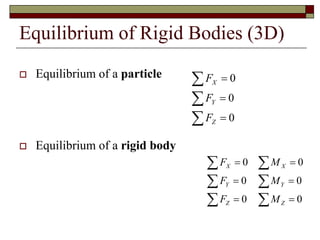
Equilibrium of Rigid Bodies (3D)
 Equilibrium of a particle
 Equilibrium of a rigid body
0
0
0






Z
Y
X
F
F
F






0
0
0
Z
Y
X
F
F
F






0
0
0
Z
Y
X
M
M
M
Procedure for drawing FBD
 Draw the boundary of the chosen section and detach /
separate it from all other bodies.
 For body with a mass, put the weight = mg acting at the
centre of gravity (G) of the body in the vertically
downwards direction.
 Input all external forces acting on the body.
 For system involving cables, the force of the cable must act
outwards of the body, i.e. the cable must be in tension.
 Put the reaction/s where the body touches or connected
to a different rigid body.
 The FBD should also include dimensions for the process
of taking moment.
Reactions at support and connections
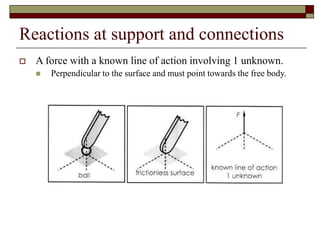
 A force with a known line of action involving 1 unknown.
 Perpendicular to the surface and must point towards the free body.
Reactions at support and connections
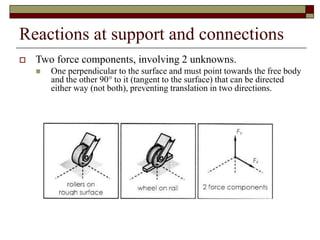
 Two force components, involving 2 unknowns.
 One perpendicular to the surface and must point towards the free body
and the other 90° to it (tangent to the surface) that can be directed
either way (not both), preventing translation in two directions.
Reactions at support and connections
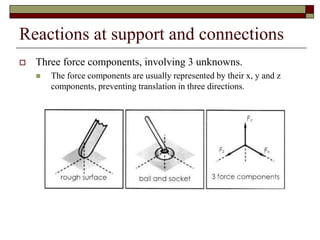
 Three force components, involving 3 unknowns.
 The force components are usually represented by their x, y and z
components, preventing translation in three directions.
Reactions at support and connections
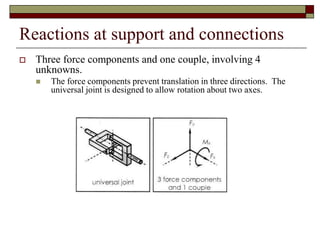
 Three force components and one couple, involving 4
unknowns.
 The force components prevent translation in three directions. The
universal joint is designed to allow rotation about two axes.
Reactions at support and connections
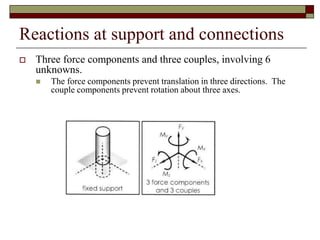
 Three force components and three couples, involving 6
unknowns.
 The force components prevent translation in three directions. The
couple components prevent rotation about three axes.
Reactions at support and connections
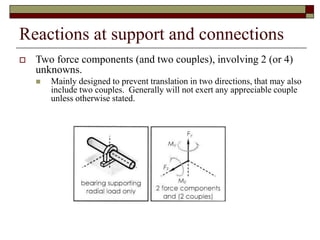
 Two force components (and two couples), involving 2 (or 4)
unknowns.
 Mainly designed to prevent translation in two directions, that may also
include two couples. Generally will not exert any appreciable couple
unless otherwise stated.
Reactions at support and connections
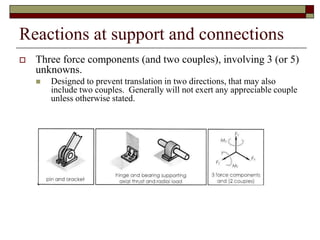
 Three force components (and two couples), involving 3 (or 5)
unknowns.
 Designed to prevent translation in two directions, that may also
include two couples. Generally will not exert any appreciable couple
unless otherwise stated.
IMPORTANTS
 FBD must be drawn for every solution.
 Knowledge on determination of force
components, reactions and ‘cross and dot
products’ (for taking moments) are essential.
 Since there are 6 equations, there can be up to
6 unknowns. For problems with more
unknowns, solve using moment about an axis.
 More than 3 equations, then matrix form is a
best solution of method.
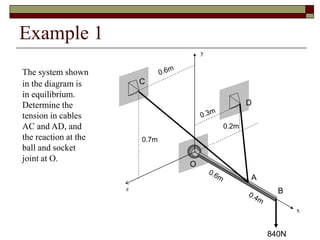
Example 1
The system shown
in the diagram is
in equilibrium.
Determine the
tension in cables
AC and AD, and
the reaction at the
ball and socket
joint at O.
840N
0.2m
A
B
O
C
D
0.7m
x
y
z
Example 1
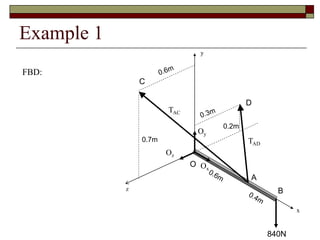
FBD:
840N
0.2m
A
B
O
C
D
0.7m
x
y
z
TAD
TAC
Ox
Oy
Oz
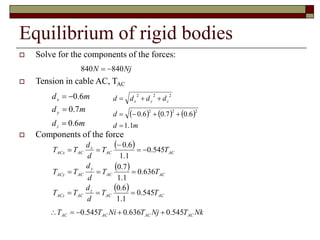
Equilibrium of rigid bodies
Nj
N 840
840 

 Tension in cable AC, TAC
 
 
 
AC
AC
z
AC
ACz
AC
AC
y
AC
ACy
AC
AC
x
AC
ACx
T
T
d
d
T
T
T
T
d
d
T
T
T
T
d
d
T
T
545
.
0
1
.
1
6
.
0
636
.
0
1
.
1
7
.
0
545
.
0
1
.
1
6
.
0











m
d
m
d
m
d
z
y
x
6
.
0
7
.
0
6
.
0




Nk
T
Nj
T
Ni
T
T AC
AC
AC
AC 545
.
0
636
.
0
545
.
0 




 Solve for the components of the forces:
     
m
d
d
d
d
d
d z
y
x
1
.
1
6
.
0
7
.
0
6
.
0
2
2
2
2
2
2








 Components of the force
Equilibrium of rigid bodies
     
m
d
d
d
d
d
d z
y
x
7
.
0
3
.
0
2
.
0
6
.
0
2
2
2
2
2
2









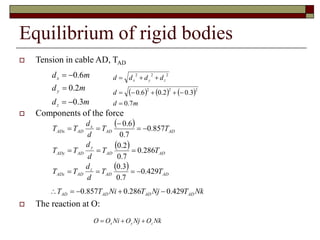
 Tension in cable AD, TAD
 
 
 
AD
AD
z
AD
ADz
AD
AD
y
AD
ADy
AD
AD
x
AD
ADx
T
T
d
d
T
T
T
T
d
d
T
T
T
T
d
d
T
T
429
.
0
7
.
0
3
.
0
286
.
0
7
.
0
2
.
0
857
.
0
7
.
0
6
.
0












m
d
m
d
m
d
z
y
x
3
.
0
2
.
0
6
.
0





Nk
T
Nj
T
Ni
T
T AD
AD
AD
AD 429
.
0
286
.
0
857
.
0 




 Components of the force
 The reaction at O:
Nk
O
Nj
O
Ni
O
O z
y
x 


Equilibrium of rigid bodies
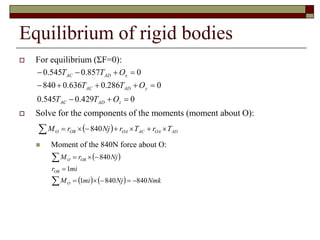
 For equilibrium (ΣF=0):
  AD
OA
AC
OA
OB
O T
r
T
r
Nj
r
M 






 840
0
429
.
0
545
.
0
0
286
.
0
636
.
0
840
0
857
.
0
545
.
0












z
AD
AC
y
AD
AC
x
AD
AC
O
T
T
O
T
T
O
T
T
 Solve for the components of the moments (moment about O):
 Moment of the 840N force about O:
 
    Nmk
Nj
mi
M
mi
r
Nj
r
M
O
OB
OB
O
840
840
1
1
840











Equilibrium of rigid bodies
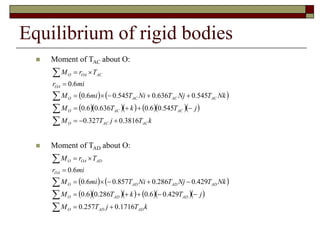
 Moment of TAC about O:
   
       
k
T
j
T
M
j
T
k
T
M
Nk
T
Nj
T
Ni
T
mi
M
mi
r
T
r
M
AC
AC
O
AC
AC
O
AC
AC
AC
O
OA
AC
OA
O
3816
.
0
327
.
0
545
.
0
6
.
0
636
.
0
6
.
0
545
.
0
636
.
0
545
.
0
6
.
0
6
.
0



















 Moment of TAD about O:
   
       
k
T
j
T
M
j
T
k
T
M
Nk
T
Nj
T
Ni
T
mi
M
mi
r
T
r
M
AD
AD
O
AD
AD
O
AD
AD
AD
O
OA
AD
OA
O
1716
.
0
257
.
0
429
.
0
6
.
0
286
.
0
6
.
0
429
.
0
286
.
0
857
.
0
6
.
0
6
.
0



















Equilibrium of rigid bodies
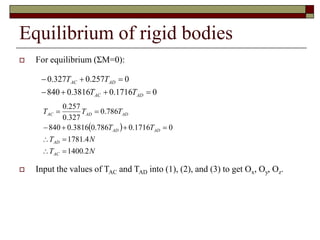
 For equilibrium (ΣM=0):
 
N
T
N
T
T
T
T
T
T
AC
AD
AD
AD
AD
AD
AC
2
.
1400
4
.
1781
0
1716
.
0
786
.
0
3816
.
0
840
786
.
0
327
.
0
257
.
0










0
1716
.
0
3816
.
0
840
0
257
.
0
327
.
0







AD
AC
AD
AC
T
T
T
T
 Input the values of TAC and TAD into (1), (2), and (3) to get Ox, Oy, Oz.
Announcement
 ePPP (Online evaluation for teaching)
 Start from 26 Dec 2022 until 10 Feb 2023
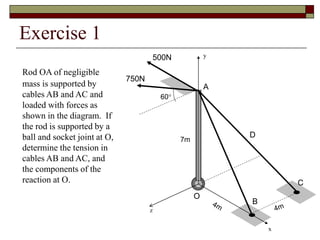
Exercise 1
Rod OA of negligible
mass is supported by
cables AB and AC and
loaded with forces as
shown in the diagram. If
the rod is supported by a
ball and socket joint at O,
determine the tension in
cables AB and AC, and
the components of the
reaction at O.
500N
C
B
O
A
D
7m
x
y
z
750N
60°

Lecture 8- Rigid Bodies- Equilibrium 3D.ppt

  • 1.
    Lecture 8 –Rigid bodies: Equilibrium 3D What you will learn for today? 1. Equilibrium condition in 3D for rigid bodies 2. FBD for 3D rigid bodies 3. Analysis approach 4. Example and exercise By: Ts. Dr. Muhammad Hanif Ramlee Credit to: Prof. Dato’ Ir. Dr. Mohammed Rafiq Abdul Kadir
  • 2.
    Equilibrium of RigidBodies (3D)  Equilibrium of a particle  Equilibrium of a rigid body 0 0 0       Z Y X F F F       0 0 0 Z Y X F F F       0 0 0 Z Y X M M M
  • 3.
    Procedure for drawingFBD  Draw the boundary of the chosen section and detach / separate it from all other bodies.  For body with a mass, put the weight = mg acting at the centre of gravity (G) of the body in the vertically downwards direction.  Input all external forces acting on the body.  For system involving cables, the force of the cable must act outwards of the body, i.e. the cable must be in tension.  Put the reaction/s where the body touches or connected to a different rigid body.  The FBD should also include dimensions for the process of taking moment.
  • 4.
    Reactions at supportand connections  A force with a known line of action involving 1 unknown.  Perpendicular to the surface and must point towards the free body.
  • 5.
    Reactions at supportand connections  Two force components, involving 2 unknowns.  One perpendicular to the surface and must point towards the free body and the other 90° to it (tangent to the surface) that can be directed either way (not both), preventing translation in two directions.
  • 6.
    Reactions at supportand connections  Three force components, involving 3 unknowns.  The force components are usually represented by their x, y and z components, preventing translation in three directions.
  • 7.
    Reactions at supportand connections  Three force components and one couple, involving 4 unknowns.  The force components prevent translation in three directions. The universal joint is designed to allow rotation about two axes.
  • 8.
    Reactions at supportand connections  Three force components and three couples, involving 6 unknowns.  The force components prevent translation in three directions. The couple components prevent rotation about three axes.
  • 9.
    Reactions at supportand connections  Two force components (and two couples), involving 2 (or 4) unknowns.  Mainly designed to prevent translation in two directions, that may also include two couples. Generally will not exert any appreciable couple unless otherwise stated.
  • 10.
    Reactions at supportand connections  Three force components (and two couples), involving 3 (or 5) unknowns.  Designed to prevent translation in two directions, that may also include two couples. Generally will not exert any appreciable couple unless otherwise stated.
  • 11.
    IMPORTANTS  FBD mustbe drawn for every solution.  Knowledge on determination of force components, reactions and ‘cross and dot products’ (for taking moments) are essential.  Since there are 6 equations, there can be up to 6 unknowns. For problems with more unknowns, solve using moment about an axis.  More than 3 equations, then matrix form is a best solution of method.
  • 12.
    Example 1 The systemshown in the diagram is in equilibrium. Determine the tension in cables AC and AD, and the reaction at the ball and socket joint at O. 840N 0.2m A B O C D 0.7m x y z
  • 13.
  • 14.
    Equilibrium of rigidbodies Nj N 840 840    Tension in cable AC, TAC       AC AC z AC ACz AC AC y AC ACy AC AC x AC ACx T T d d T T T T d d T T T T d d T T 545 . 0 1 . 1 6 . 0 636 . 0 1 . 1 7 . 0 545 . 0 1 . 1 6 . 0            m d m d m d z y x 6 . 0 7 . 0 6 . 0     Nk T Nj T Ni T T AC AC AC AC 545 . 0 636 . 0 545 . 0       Solve for the components of the forces:       m d d d d d d z y x 1 . 1 6 . 0 7 . 0 6 . 0 2 2 2 2 2 2          Components of the force
  • 15.
    Equilibrium of rigidbodies       m d d d d d d z y x 7 . 0 3 . 0 2 . 0 6 . 0 2 2 2 2 2 2           Tension in cable AD, TAD       AD AD z AD ADz AD AD y AD ADy AD AD x AD ADx T T d d T T T T d d T T T T d d T T 429 . 0 7 . 0 3 . 0 286 . 0 7 . 0 2 . 0 857 . 0 7 . 0 6 . 0             m d m d m d z y x 3 . 0 2 . 0 6 . 0      Nk T Nj T Ni T T AD AD AD AD 429 . 0 286 . 0 857 . 0       Components of the force  The reaction at O: Nk O Nj O Ni O O z y x   
  • 16.
    Equilibrium of rigidbodies  For equilibrium (ΣF=0):   AD OA AC OA OB O T r T r Nj r M         840 0 429 . 0 545 . 0 0 286 . 0 636 . 0 840 0 857 . 0 545 . 0             z AD AC y AD AC x AD AC O T T O T T O T T  Solve for the components of the moments (moment about O):  Moment of the 840N force about O:       Nmk Nj mi M mi r Nj r M O OB OB O 840 840 1 1 840           
  • 17.
    Equilibrium of rigidbodies  Moment of TAC about O:             k T j T M j T k T M Nk T Nj T Ni T mi M mi r T r M AC AC O AC AC O AC AC AC O OA AC OA O 3816 . 0 327 . 0 545 . 0 6 . 0 636 . 0 6 . 0 545 . 0 636 . 0 545 . 0 6 . 0 6 . 0                     Moment of TAD about O:             k T j T M j T k T M Nk T Nj T Ni T mi M mi r T r M AD AD O AD AD O AD AD AD O OA AD OA O 1716 . 0 257 . 0 429 . 0 6 . 0 286 . 0 6 . 0 429 . 0 286 . 0 857 . 0 6 . 0 6 . 0                   
  • 18.
    Equilibrium of rigidbodies  For equilibrium (ΣM=0):   N T N T T T T T T AC AD AD AD AD AD AC 2 . 1400 4 . 1781 0 1716 . 0 786 . 0 3816 . 0 840 786 . 0 327 . 0 257 . 0           0 1716 . 0 3816 . 0 840 0 257 . 0 327 . 0        AD AC AD AC T T T T  Input the values of TAC and TAD into (1), (2), and (3) to get Ox, Oy, Oz.
  • 19.
    Announcement  ePPP (Onlineevaluation for teaching)  Start from 26 Dec 2022 until 10 Feb 2023
  • 20.
    Exercise 1 Rod OAof negligible mass is supported by cables AB and AC and loaded with forces as shown in the diagram. If the rod is supported by a ball and socket joint at O, determine the tension in cables AB and AC, and the components of the reaction at O. 500N C B O A D 7m x y z 750N 60°