Condition 1: No net Force
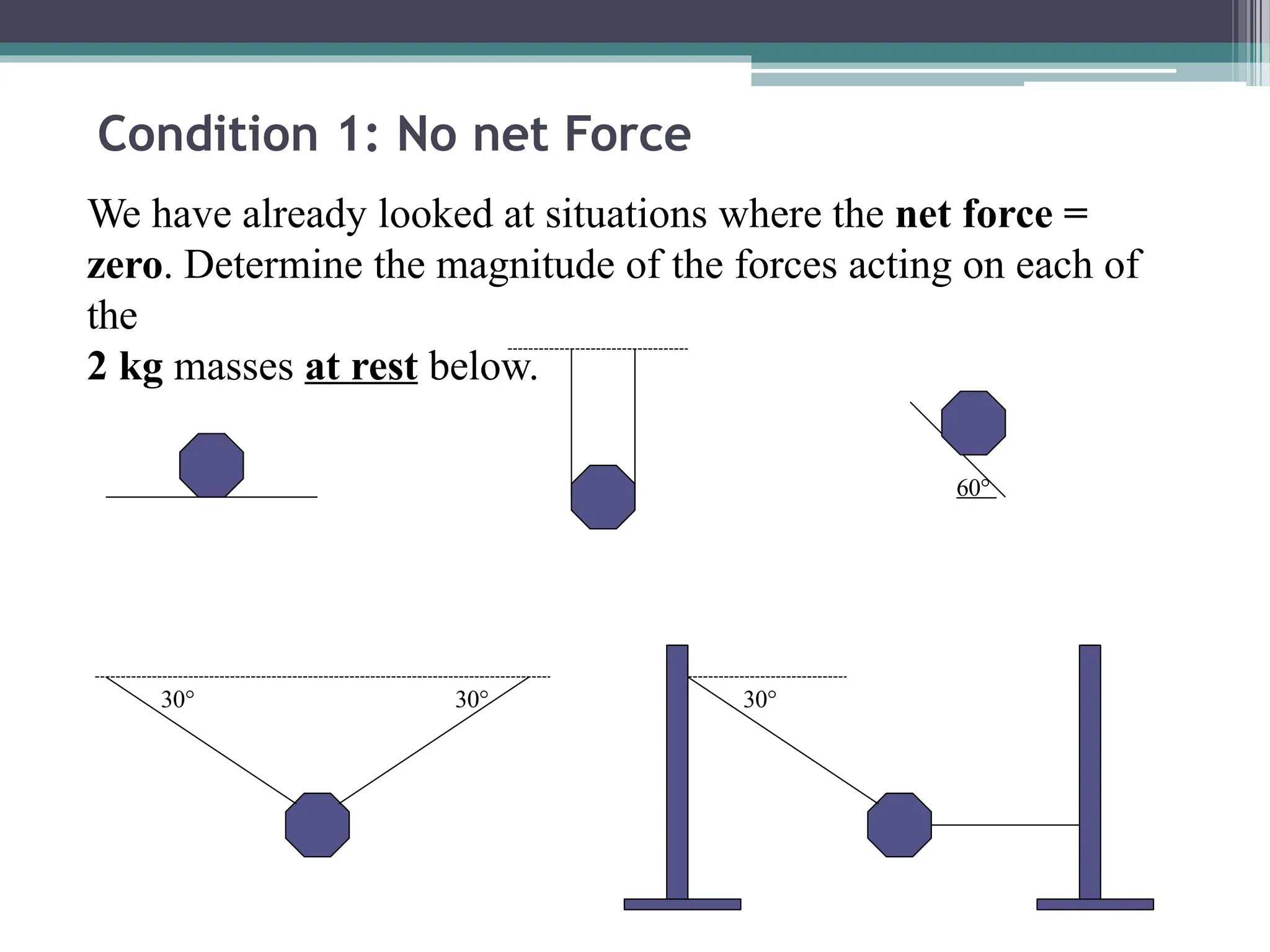
We have already looked at situations where the net force =
zero. Determine the magnitude of the forces acting on each of
the
2 kg masses at rest below.
60°
30°
30° 30°
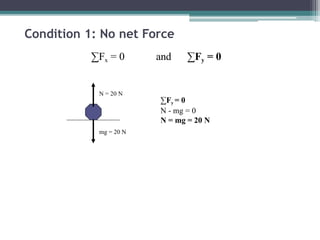
Condition 1: No net Force
∑Fx = 0 and ∑Fy = 0
N = 20 N
∑Fy = 0
N - mg = 0
N = mg = 20 N
mg = 20 N
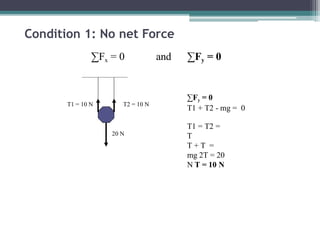
Condition 1: No net Force
∑Fx = 0 and ∑Fy = 0
∑Fy = 0
T1 + T2 - mg = 0
T1 = T2 =
T
T + T =
mg 2T = 20
N T = 10 N
T1 = 10 N
20 N
T2 = 10 N
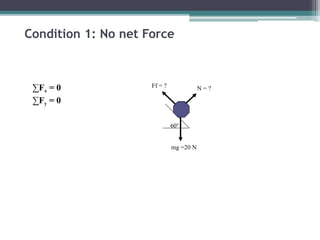
Condition 1: No net Force
60°
mg =20 N
Ff = ? N = ?
∑Fx = 0
∑Fy = 0
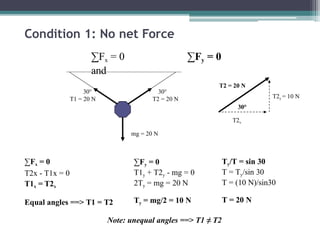
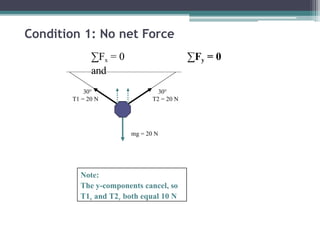
Condition 1: No net Force
∑Fy = 0
∑Fx = 0
and
30° 30°
mg = 20 N
T1 = 20 N T2 = 20 N
∑Fy = 0
T1y + T2y - mg = 0
2Ty = mg = 20 N
Ty = mg/2 = 10 N
T2 = 20 N
30°
T2x
T2y = 10 N
Ty/T = sin 30
T = Ty/sin 30
T = (10 N)/sin30
T = 20 N
∑Fx = 0
T2x - T1x = 0
T1x = T2x
Equal angles ==> T1 = T2
Note: unequal angles ==> T1 ≠ T2
Condition 1: No net Force
∑Fy = 0
Note:
The y-components cancel, so
T1y and T2y both equal 10 N
∑Fx = 0
and
30° 30°
mg = 20 N
T1 = 20 N T2 = 20 N
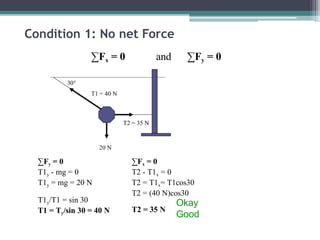
Condition 1: No net Force
∑Fx = 0 and ∑Fy = 0
30°
T1 = 40 N
T2 = 35 N
20 N
∑Fy = 0
T1y - mg = 0
T1y = mg = 20 N
T1y/T1 = sin 30
T1 = Ty/sin 30 = 40 N
∑Fx = 0
T2 - T1x = 0
T2 = T1x= T1cos30
T2 = (40 N)cos30
T2 = 35 N
Okay
Good
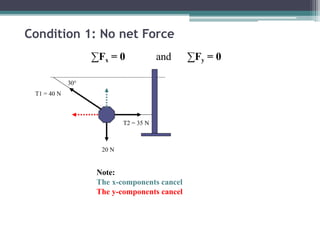
Condition 1: No net Force
∑Fx = 0 and ∑Fy = 0
20 N
Note:
The x-components cancel
The y-components cancel
30°
T1 = 40 N
T2 = 35 N
30°
60°
Condition 1: No net Force
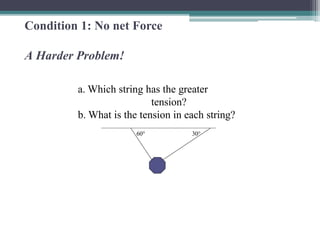
A Harder Problem!
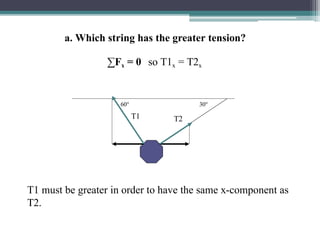
a. Which string has the greater
tension?
b. What is the tension in each string?
a. Which string has the greater tension?
∑Fx = 0 so T1x = T2x
30°
60°
T1 T2
T1 must be greater in order to have the same x-component as
T2.
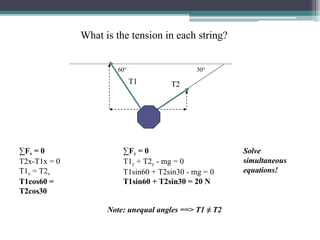
∑Fy = 0
T1y + T2y - mg = 0
T1sin60 + T2sin30 - mg = 0
T1sin60 + T2sin30 = 20 N
Solve
simultaneous
equations!
∑Fx = 0
T2x-T1x = 0
T1x = T2x
T1cos60 =
T2cos30
30°
60°
T1 T2
Note: unequal angles ==> T1 ≠ T2
What is the tension in each string?
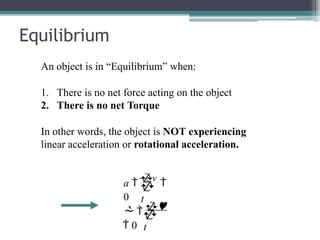
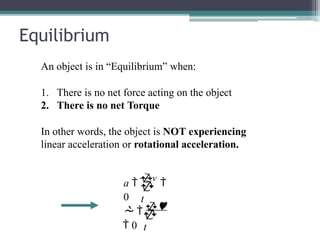
Equilibrium
An object is in “Equilibrium” when:
1. There is no net force acting on the object
2. There is no net Torque
In other words, the object is NOT experiencing
linear acceleration or rotational acceleration.

t
a 
v

0

t
  
 0
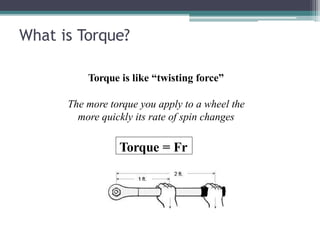
What is Torque?
Torque is like “twisting force”
The more torque you apply to a wheel the
more quickly its rate of spin changes
Torque = Fr
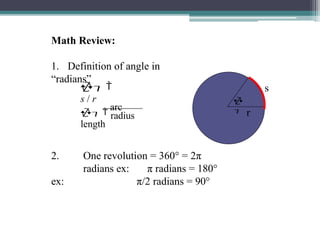
Math Review:
1. Definition of angle in
“radians”
2. One revolution = 360° = 2π
radians ex: π radians = 180°
ex: π/2 radians = 90°
 
s / r
 
arc
length
radius


s
r
Torque
Torque is like “twisting force”
The more torque you apply to a
wheel, the more quickly its rate
of spin changes
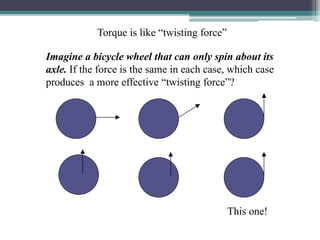
Torque is like “twisting force”
Imagine a bicycle wheel that can only spin about its
axle. If the force is the same in each case, which case
produces a more effective “twisting force”?
This one!
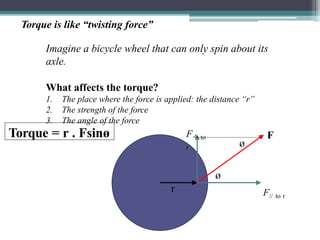
Torque is like “twisting force”
Imagine a bicycle wheel that can only spin about its
axle.
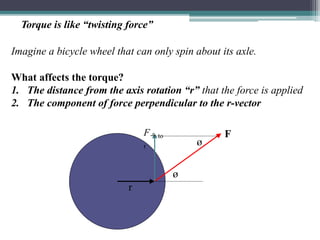
What affects the torque?
1. The place where the force is applied: the distance “r”
2. The strength of the force
3. The angle of the force
r
ø
F
F// to r
F to
r ø
Torque = r . Fsinø
Torque is like “twisting force”
Imagine a bicycle wheel that can only spin about its axle.
What affects the torque?
1. The distance from the axis rotation “r” that the force is applied
2. The component of force perpendicular to the r-vector
ø
r
F
F to
r ø
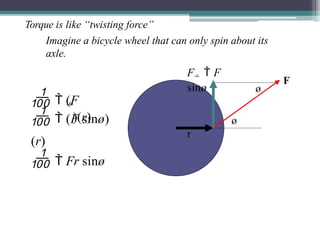
Torque is like “twisting force”
Imagine a bicycle wheel that can only spin about its
axle.
r
ø
F
F  F
sinø ø

  (F
)(r)
  (F sinø)
(r)
  Fr sinø
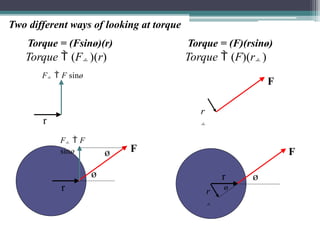
Torque = (Fsinø)(r)
Torque  (F )(r)
F  F sinø
Two different ways of looking at torque
r
ø
F
F  F
sinø ø
ø
F
r

r
ø
r
r

Torque = (F)(rsinø)
Torque  (F)(r )
F
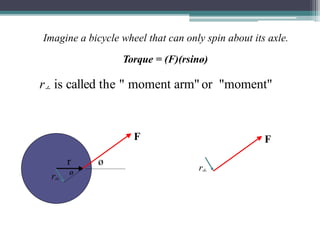
Imagine a bicycle wheel that can only spin about its axle.
Torque = (F)(rsinø)
r is called the " moment arm" or "moment"
ø
F
r
r
ø
r
F
Equilibrium
An object is in “Equilibrium” when:
1. There is no net force acting on the object
2. There is no net Torque
In other words, the object is NOT experiencing
linear acceleration or rotational acceleration.

t
a 
v

0

t
  
 0
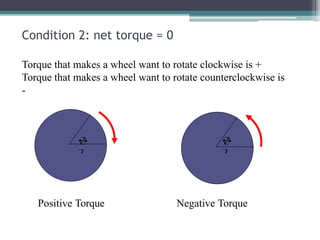
Condition 2: net torque = 0
Torque that makes a wheel want to rotate clockwise is +
Torque that makes a wheel want to rotate counterclockwise is
-




Positive Torque Negative Torque
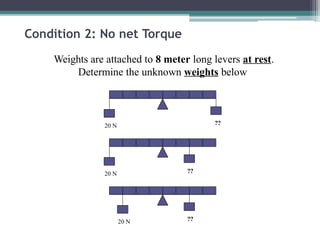
Condition 2: No net Torque
Weights are attached to 8 meter long levers at rest.
Determine the unknown weights below
20 N ??
20 N ??
20 N ??
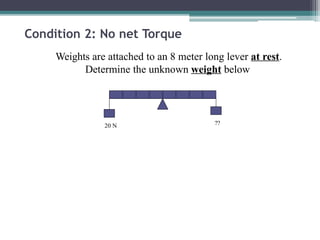
Condition 2: No net Torque
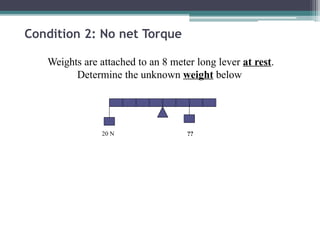
Weights are attached to an 8 meter long lever at rest.
Determine the unknown weight below
20 N ??
Condition 2: No net Torque
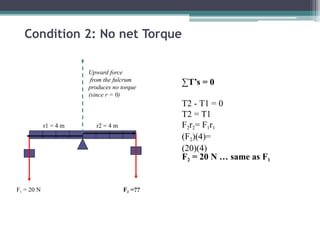
F1 = 20 N
r1 = 4 m r2 = 4 m
F2 =??
∑T’s = 0
T2 - T1 = 0
T2 = T1
F2r2= F1r1
(F2)(4)=
(20)(4)
F2 = 20 N … same as F1
Upward force
from the fulcrum
produces no torque
(since r = 0)
Condition 2: No net Torque
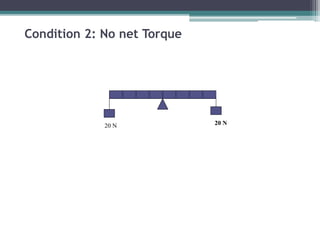
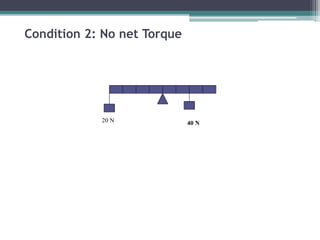
20 N 20 N
Condition 2: No net Torque
20 N ??
Weights are attached to an 8 meter long lever at rest.
Determine the unknown weight below
Condition 2: No net Torque
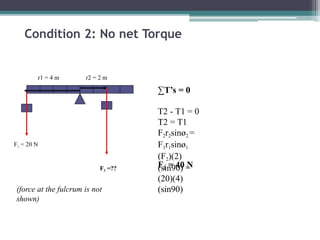
∑T’s = 0
T2 - T1 = 0
T2 = T1
F2r2sinø2 =
F1r1sinø1
(F2)(2)
(sin90) =
(20)(4)
(sin90)
F2 = 40 N
F2 =??
(force at the fulcrum is not
shown)
F1 = 20 N
r1 = 4 m r2 = 2 m
Condition 2: No net Torque
20 N 40 N
Condition 2: No net Torque
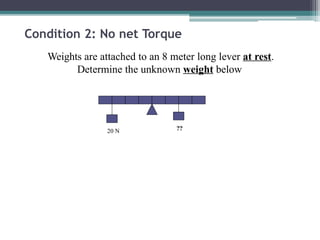
20 N ??
Weights are attached to an 8 meter long lever at rest.
Determine the unknown weight below
Condition 2: No net Torque
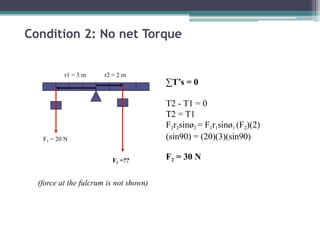
F2 =??
1
F = 20 N
r1 = 3 m r2 = 2 m
∑T’s = 0
T2 - T1 = 0
T2 = T1
F2r2sinø2 = F1r1sinø1 (F2)(2)
(sin90) = (20)(3)(sin90)
F2 = 30 N
(force at the fulcrum is not shown)
Condition 2: No net Torque
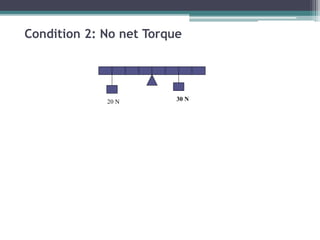
20 N 30 N
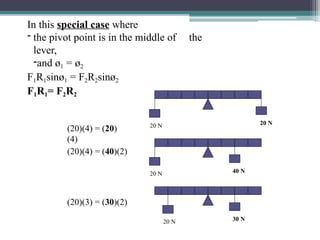
In this special case where
- the pivot point is in the middle of the
lever,
-and ø1 = ø2
F1R1sinø1 = F2R2sinø2
F1R1= F2R2
(20)(4) = (20)
(4)
20 N 20 N
20 N 40 N
20 N 30 N
(20)(4) = (40)(2)
(20)(3) = (30)(2)
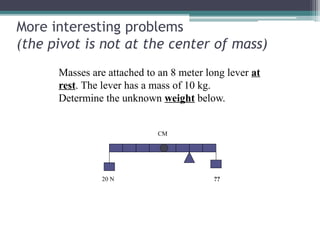
More interesting problems
(the pivot is not at the center of mass)
Masses are attached to an 8 meter long lever at
rest. The lever has a mass of 10 kg.
Determine the unknown weight below.
20 N ??
CM
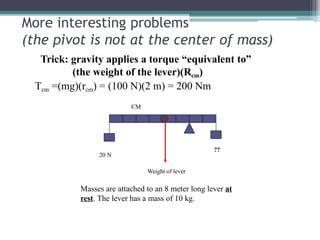
More interesting problems
(the pivot is not at the center of mass)
Trick: gravity applies a torque “equivalent to”
(the weight of the lever)(Rcm)
Tcm =(mg)(rcm) = (100 N)(2 m) = 200 Nm
CM
??
20 N
Weight of lever
Masses are attached to an 8 meter long lever at
rest. The lever has a mass of 10 kg.
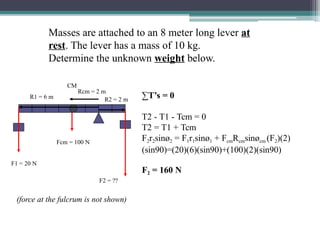
Masses are attached to an 8 meter long lever at
rest. The lever has a mass of 10 kg.
Determine the unknown weight below.
F1 = 20 N
CM
R1 = 6 m
Rcm = 2 m
R2 = 2 m
Fcm = 100 N
F2 = 160 N
F2 = ??
∑T’s = 0
T2 - T1 - Tcm = 0
T2 = T1 + Tcm
F2r2sinø2 = F1r1sinø1 + FcmRcmsinøcm (F2)(2)
(sin90)=(20)(6)(sin90)+(100)(2)(sin90)
(force at the fulcrum is not shown)
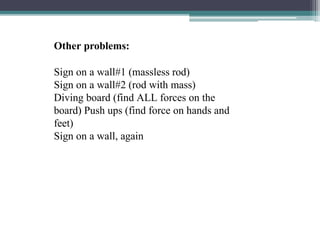
Other problems:
Sign on a wall#1 (massless rod)
Sign on a wall#2 (rod with mass)
Diving board (find ALL forces on the
board) Push ups (find force on hands and
feet)
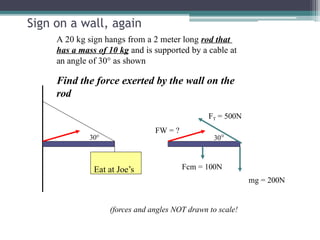
Sign on a wall, again
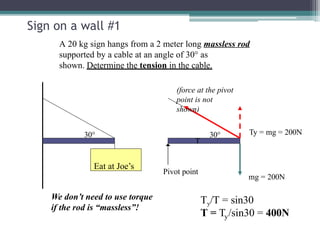
Sign on a wall #1
Eat at Joe’s
30° 30°
Pivot point
A 20 kg sign hangs from a 2 meter long massless rod
supported by a cable at an angle of 30° as
shown. Determine the tension in the cable.
(force at the pivot
point is not
shown)
Ty = mg = 200N
T
mg = 200N
Ty/T = sin30
y
T = T /sin30 = 400N
We don’t need to use torque
if the rod is “massless”!
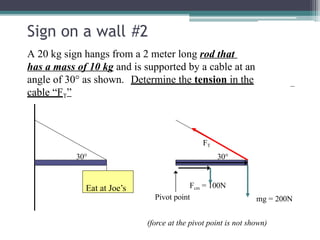
Sign on a wall #2
Eat at Joe’s
30°
A 20 kg sign hangs from a 2 meter long rod that
has a mass of 10 kg and is supported by a cable at an
angle of 30° as shown. Determine the tension in the
cable “FT”
30°
FT
mg = 200N
Fcm = 100N
Pivot point
(force at the pivot point is not shown)
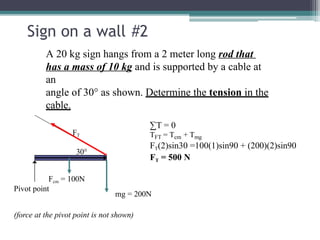
Sign on a wall #2
A 20 kg sign hangs from a 2 meter long rod that
has a mass of 10 kg and is supported by a cable at
an
angle of 30° as shown. Determine the tension in the
cable.
30°
FT
mg = 200N
Fcm = 100N
Pivot point
∑T = 0
TFT = Tcm + Tmg
FT(2)sin30 =100(1)sin90 + (200)(2)sin90
FT = 500 N
(force at the pivot point is not shown)
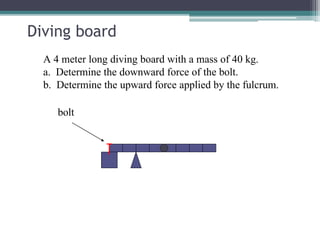
Diving board
A 4 meter long diving board with a mass of 40 kg.
a. Determine the downward force of the bolt.
b. Determine the upward force applied by the fulcrum.
bolt
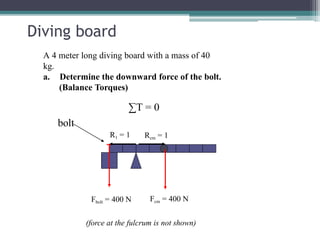
Diving board
A 4 meter long diving board with a mass of 40
kg.
a. Determine the downward force of the bolt.
(Balance Torques)
∑T = 0
bolt
Rcm = 1
R1 = 1
Fcm = 400 N
Fbolt = 400 N
(force at the fulcrum is not shown)
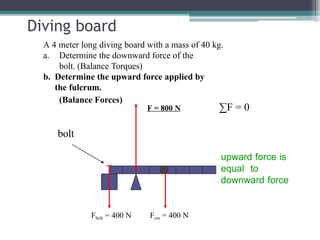
Diving board
A 4 meter long diving board with a mass of 40 kg.
a. Determine the downward force of the
bolt. (Balance Torques)
b. Determine the upward force applied by
the fulcrum.
(Balance Forces)
bolt
Fcm = 400 N
Fbolt = 400 N
F = 800 N ∑F = 0
upward force is
equal to
downward force
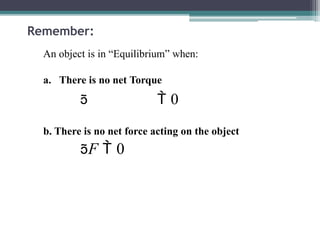
Remember:
An object is in “Equilibrium” when:
a. There is no net Torque
  0
b. There is no net force acting on the object
F  0
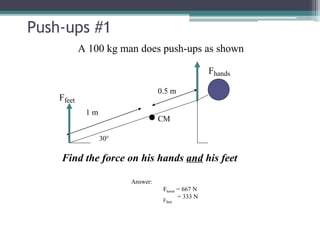
Push-ups #1
Find the force on his hands and his feet
1 m
0.5 m
30°
A 100 kg man does push-ups as shown
Fhands
Ffeet
CM
Answer:
Fhands = 667 N
Ffeet
= 333 N
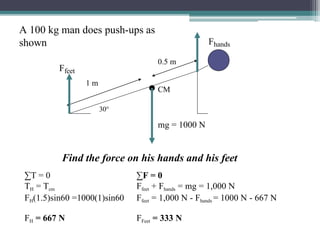
A 100 kg man does push-ups as
shown
∑T = 0
TH = Tcm
FH(1.5)sin60 =1000(1)sin60
Find the force on his hands and his feet
∑F = 0
FH = 667 N
Ffeet + Fhands = mg = 1,000 N
Ffeet = 1,000 N - Fhands = 1000 N - 667 N
FFeet = 333 N
1 m
0.5 m
30°
Fhands
Ffeet
CM
mg = 1000 N
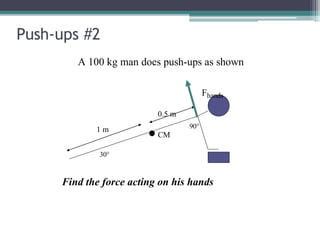
Push-ups #2
Find the force acting on his hands
1 m
30°
A 100 kg man does push-ups as shown
Fhands
0.5 m
CM
90°
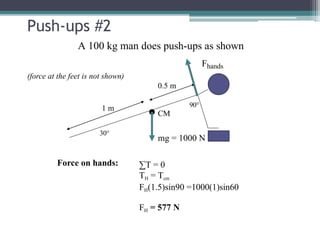
Push-ups #2
∑T = 0
TH = Tcm
FH(1.5)sin90 =1000(1)sin60
FH = 577 N
1 m
30°
CM
90°
mg = 1000 N
A 100 kg man does push-ups as shown
Fhands
(force at the feet is not shown)
0.5 m
Force on hands:
Sign on a wall, again
A 20 kg sign hangs from a 2 meter long rod that
has a mass of 10 kg and is supported by a cable at
an angle of 30° as shown
Find the force exerted by the wall on the
rod
Eat at Joe’s
30° 30°
mg = 200N
Fcm = 100N
FT = 500N
FW = ?
(forces and angles NOT drawn to scale!
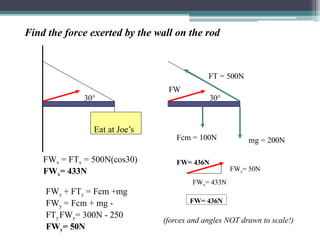
Find the force exerted by the wall on the rod
FWx = FTx = 500N(cos30)
FWx= 433N
FWy + FTy = Fcm +mg
FWy = Fcm + mg -
FTy FWy= 300N - 250
FWy= 50N
(forces and angles NOT drawn to scale!)
Eat at Joe’s
30° 30°
mg = 200N
Fcm = 100N
FT = 500N
FW
FWy= 50N
FWx= 433N
FW= 436N
FW= 436N

STATIC EQUILIBRIUM FOR MIDTERM.pptx-engr.puno

  • 1.
    Condition 1: Nonet Force We have already looked at situations where the net force = zero. Determine the magnitude of the forces acting on each of the 2 kg masses at rest below. 60° 30° 30° 30°
  • 2.
    Condition 1: Nonet Force ∑Fx = 0 and ∑Fy = 0 N = 20 N ∑Fy = 0 N - mg = 0 N = mg = 20 N mg = 20 N
  • 3.
    Condition 1: Nonet Force ∑Fx = 0 and ∑Fy = 0 ∑Fy = 0 T1 + T2 - mg = 0 T1 = T2 = T T + T = mg 2T = 20 N T = 10 N T1 = 10 N 20 N T2 = 10 N
  • 4.
    Condition 1: Nonet Force 60° mg =20 N Ff = ? N = ? ∑Fx = 0 ∑Fy = 0
  • 5.
    Condition 1: Nonet Force ∑Fy = 0 ∑Fx = 0 and 30° 30° mg = 20 N T1 = 20 N T2 = 20 N ∑Fy = 0 T1y + T2y - mg = 0 2Ty = mg = 20 N Ty = mg/2 = 10 N T2 = 20 N 30° T2x T2y = 10 N Ty/T = sin 30 T = Ty/sin 30 T = (10 N)/sin30 T = 20 N ∑Fx = 0 T2x - T1x = 0 T1x = T2x Equal angles ==> T1 = T2 Note: unequal angles ==> T1 ≠ T2
  • 6.
    Condition 1: Nonet Force ∑Fy = 0 Note: The y-components cancel, so T1y and T2y both equal 10 N ∑Fx = 0 and 30° 30° mg = 20 N T1 = 20 N T2 = 20 N
  • 7.
    Condition 1: Nonet Force ∑Fx = 0 and ∑Fy = 0 30° T1 = 40 N T2 = 35 N 20 N ∑Fy = 0 T1y - mg = 0 T1y = mg = 20 N T1y/T1 = sin 30 T1 = Ty/sin 30 = 40 N ∑Fx = 0 T2 - T1x = 0 T2 = T1x= T1cos30 T2 = (40 N)cos30 T2 = 35 N Okay Good
  • 8.
    Condition 1: Nonet Force ∑Fx = 0 and ∑Fy = 0 20 N Note: The x-components cancel The y-components cancel 30° T1 = 40 N T2 = 35 N
  • 9.
    30° 60° Condition 1: Nonet Force A Harder Problem! a. Which string has the greater tension? b. What is the tension in each string?
  • 10.
    a. Which stringhas the greater tension? ∑Fx = 0 so T1x = T2x 30° 60° T1 T2 T1 must be greater in order to have the same x-component as T2.
  • 11.
    ∑Fy = 0 T1y+ T2y - mg = 0 T1sin60 + T2sin30 - mg = 0 T1sin60 + T2sin30 = 20 N Solve simultaneous equations! ∑Fx = 0 T2x-T1x = 0 T1x = T2x T1cos60 = T2cos30 30° 60° T1 T2 Note: unequal angles ==> T1 ≠ T2 What is the tension in each string?
  • 12.
    Equilibrium An object isin “Equilibrium” when: 1. There is no net force acting on the object 2. There is no net Torque In other words, the object is NOT experiencing linear acceleration or rotational acceleration.  t a  v  0  t     0
  • 13.
    What is Torque? Torqueis like “twisting force” The more torque you apply to a wheel the more quickly its rate of spin changes Torque = Fr
  • 14.
    Math Review: 1. Definitionof angle in “radians” 2. One revolution = 360° = 2π radians ex: π radians = 180° ex: π/2 radians = 90°   s / r   arc length radius   s r
  • 15.
    Torque Torque is like“twisting force” The more torque you apply to a wheel, the more quickly its rate of spin changes
  • 16.
    Torque is like“twisting force” Imagine a bicycle wheel that can only spin about its axle. If the force is the same in each case, which case produces a more effective “twisting force”? This one!
  • 17.
    Torque is like“twisting force” Imagine a bicycle wheel that can only spin about its axle. What affects the torque? 1. The place where the force is applied: the distance “r” 2. The strength of the force 3. The angle of the force r ø F F// to r F to r ø Torque = r . Fsinø
  • 18.
    Torque is like“twisting force” Imagine a bicycle wheel that can only spin about its axle. What affects the torque? 1. The distance from the axis rotation “r” that the force is applied 2. The component of force perpendicular to the r-vector ø r F F to r ø
  • 19.
    Torque is like“twisting force” Imagine a bicycle wheel that can only spin about its axle. r ø F F  F sinø ø    (F )(r)   (F sinø) (r)   Fr sinø
  • 20.
    Torque = (Fsinø)(r) Torque (F )(r) F  F sinø Two different ways of looking at torque r ø F F  F sinø ø ø F r  r ø r r  Torque = (F)(rsinø) Torque  (F)(r ) F
  • 21.
    Imagine a bicyclewheel that can only spin about its axle. Torque = (F)(rsinø) r is called the " moment arm" or "moment" ø F r r ø r F
  • 22.
    Equilibrium An object isin “Equilibrium” when: 1. There is no net force acting on the object 2. There is no net Torque In other words, the object is NOT experiencing linear acceleration or rotational acceleration.  t a  v  0  t     0
  • 23.
    Condition 2: nettorque = 0 Torque that makes a wheel want to rotate clockwise is + Torque that makes a wheel want to rotate counterclockwise is -     Positive Torque Negative Torque
  • 24.
    Condition 2: Nonet Torque Weights are attached to 8 meter long levers at rest. Determine the unknown weights below 20 N ?? 20 N ?? 20 N ??
  • 25.
    Condition 2: Nonet Torque Weights are attached to an 8 meter long lever at rest. Determine the unknown weight below 20 N ??
  • 26.
    Condition 2: Nonet Torque F1 = 20 N r1 = 4 m r2 = 4 m F2 =?? ∑T’s = 0 T2 - T1 = 0 T2 = T1 F2r2= F1r1 (F2)(4)= (20)(4) F2 = 20 N … same as F1 Upward force from the fulcrum produces no torque (since r = 0)
  • 27.
    Condition 2: Nonet Torque 20 N 20 N
  • 28.
    Condition 2: Nonet Torque 20 N ?? Weights are attached to an 8 meter long lever at rest. Determine the unknown weight below
  • 29.
    Condition 2: Nonet Torque ∑T’s = 0 T2 - T1 = 0 T2 = T1 F2r2sinø2 = F1r1sinø1 (F2)(2) (sin90) = (20)(4) (sin90) F2 = 40 N F2 =?? (force at the fulcrum is not shown) F1 = 20 N r1 = 4 m r2 = 2 m
  • 30.
    Condition 2: Nonet Torque 20 N 40 N
  • 31.
    Condition 2: Nonet Torque 20 N ?? Weights are attached to an 8 meter long lever at rest. Determine the unknown weight below
  • 32.
    Condition 2: Nonet Torque F2 =?? 1 F = 20 N r1 = 3 m r2 = 2 m ∑T’s = 0 T2 - T1 = 0 T2 = T1 F2r2sinø2 = F1r1sinø1 (F2)(2) (sin90) = (20)(3)(sin90) F2 = 30 N (force at the fulcrum is not shown)
  • 33.
    Condition 2: Nonet Torque 20 N 30 N
  • 34.
    In this specialcase where - the pivot point is in the middle of the lever, -and ø1 = ø2 F1R1sinø1 = F2R2sinø2 F1R1= F2R2 (20)(4) = (20) (4) 20 N 20 N 20 N 40 N 20 N 30 N (20)(4) = (40)(2) (20)(3) = (30)(2)
  • 35.
    More interesting problems (thepivot is not at the center of mass) Masses are attached to an 8 meter long lever at rest. The lever has a mass of 10 kg. Determine the unknown weight below. 20 N ?? CM
  • 36.
    More interesting problems (thepivot is not at the center of mass) Trick: gravity applies a torque “equivalent to” (the weight of the lever)(Rcm) Tcm =(mg)(rcm) = (100 N)(2 m) = 200 Nm CM ?? 20 N Weight of lever Masses are attached to an 8 meter long lever at rest. The lever has a mass of 10 kg.
  • 37.
    Masses are attachedto an 8 meter long lever at rest. The lever has a mass of 10 kg. Determine the unknown weight below. F1 = 20 N CM R1 = 6 m Rcm = 2 m R2 = 2 m Fcm = 100 N F2 = 160 N F2 = ?? ∑T’s = 0 T2 - T1 - Tcm = 0 T2 = T1 + Tcm F2r2sinø2 = F1r1sinø1 + FcmRcmsinøcm (F2)(2) (sin90)=(20)(6)(sin90)+(100)(2)(sin90) (force at the fulcrum is not shown)
  • 38.
    Other problems: Sign ona wall#1 (massless rod) Sign on a wall#2 (rod with mass) Diving board (find ALL forces on the board) Push ups (find force on hands and feet) Sign on a wall, again
  • 39.
    Sign on awall #1 Eat at Joe’s 30° 30° Pivot point A 20 kg sign hangs from a 2 meter long massless rod supported by a cable at an angle of 30° as shown. Determine the tension in the cable. (force at the pivot point is not shown) Ty = mg = 200N T mg = 200N Ty/T = sin30 y T = T /sin30 = 400N We don’t need to use torque if the rod is “massless”!
  • 40.
    Sign on awall #2 Eat at Joe’s 30° A 20 kg sign hangs from a 2 meter long rod that has a mass of 10 kg and is supported by a cable at an angle of 30° as shown. Determine the tension in the cable “FT” 30° FT mg = 200N Fcm = 100N Pivot point (force at the pivot point is not shown)
  • 41.
    Sign on awall #2 A 20 kg sign hangs from a 2 meter long rod that has a mass of 10 kg and is supported by a cable at an angle of 30° as shown. Determine the tension in the cable. 30° FT mg = 200N Fcm = 100N Pivot point ∑T = 0 TFT = Tcm + Tmg FT(2)sin30 =100(1)sin90 + (200)(2)sin90 FT = 500 N (force at the pivot point is not shown)
  • 42.
    Diving board A 4meter long diving board with a mass of 40 kg. a. Determine the downward force of the bolt. b. Determine the upward force applied by the fulcrum. bolt
  • 43.
    Diving board A 4meter long diving board with a mass of 40 kg. a. Determine the downward force of the bolt. (Balance Torques) ∑T = 0 bolt Rcm = 1 R1 = 1 Fcm = 400 N Fbolt = 400 N (force at the fulcrum is not shown)
  • 44.
    Diving board A 4meter long diving board with a mass of 40 kg. a. Determine the downward force of the bolt. (Balance Torques) b. Determine the upward force applied by the fulcrum. (Balance Forces) bolt Fcm = 400 N Fbolt = 400 N F = 800 N ∑F = 0 upward force is equal to downward force
  • 45.
    Remember: An object isin “Equilibrium” when: a. There is no net Torque   0 b. There is no net force acting on the object F  0
  • 46.
    Push-ups #1 Find theforce on his hands and his feet 1 m 0.5 m 30° A 100 kg man does push-ups as shown Fhands Ffeet CM Answer: Fhands = 667 N Ffeet = 333 N
  • 47.
    A 100 kgman does push-ups as shown ∑T = 0 TH = Tcm FH(1.5)sin60 =1000(1)sin60 Find the force on his hands and his feet ∑F = 0 FH = 667 N Ffeet + Fhands = mg = 1,000 N Ffeet = 1,000 N - Fhands = 1000 N - 667 N FFeet = 333 N 1 m 0.5 m 30° Fhands Ffeet CM mg = 1000 N
  • 48.
    Push-ups #2 Find theforce acting on his hands 1 m 30° A 100 kg man does push-ups as shown Fhands 0.5 m CM 90°
  • 49.
    Push-ups #2 ∑T =0 TH = Tcm FH(1.5)sin90 =1000(1)sin60 FH = 577 N 1 m 30° CM 90° mg = 1000 N A 100 kg man does push-ups as shown Fhands (force at the feet is not shown) 0.5 m Force on hands:
  • 50.
    Sign on awall, again A 20 kg sign hangs from a 2 meter long rod that has a mass of 10 kg and is supported by a cable at an angle of 30° as shown Find the force exerted by the wall on the rod Eat at Joe’s 30° 30° mg = 200N Fcm = 100N FT = 500N FW = ? (forces and angles NOT drawn to scale!
  • 51.
    Find the forceexerted by the wall on the rod FWx = FTx = 500N(cos30) FWx= 433N FWy + FTy = Fcm +mg FWy = Fcm + mg - FTy FWy= 300N - 250 FWy= 50N (forces and angles NOT drawn to scale!) Eat at Joe’s 30° 30° mg = 200N Fcm = 100N FT = 500N FW FWy= 50N FWx= 433N FW= 436N FW= 436N