Presentedby
Jayprakashkumar
Mtech(CAD-CAM)
AC machining originated out of research in
early 1960 sponsored by U.S Air Force.
Initial adaptive system are based on analog
type devices.
DEFINITION
The term ac denotes a control system that
measures certain o/p variables and uses
these to control speed and/or feed.
The typical measures of performance in
machining have been metal removal rate
and cost per volume of metal removal.
Adaptive control systems
It is a logical extension of the NC AND CNC.
Improvement of the cutting process by automatic online
determination of the feed and cutting speed.
Basically a feedback system in which the cutting speed and feed
automatically adopt themselves to the actual conditions of the
process.
The cutting speed and feed have to be varied in such a way as to
improve the performance level.
AC hardware components
Sensor mounted on the spindle to measure force.
Sensor to measure spindle motor current which is
used to provide indication of power consumption.
Control unit and display panel to operate the
system.
Interface hardware to connect AC system to existing
NC or CNC control unit .
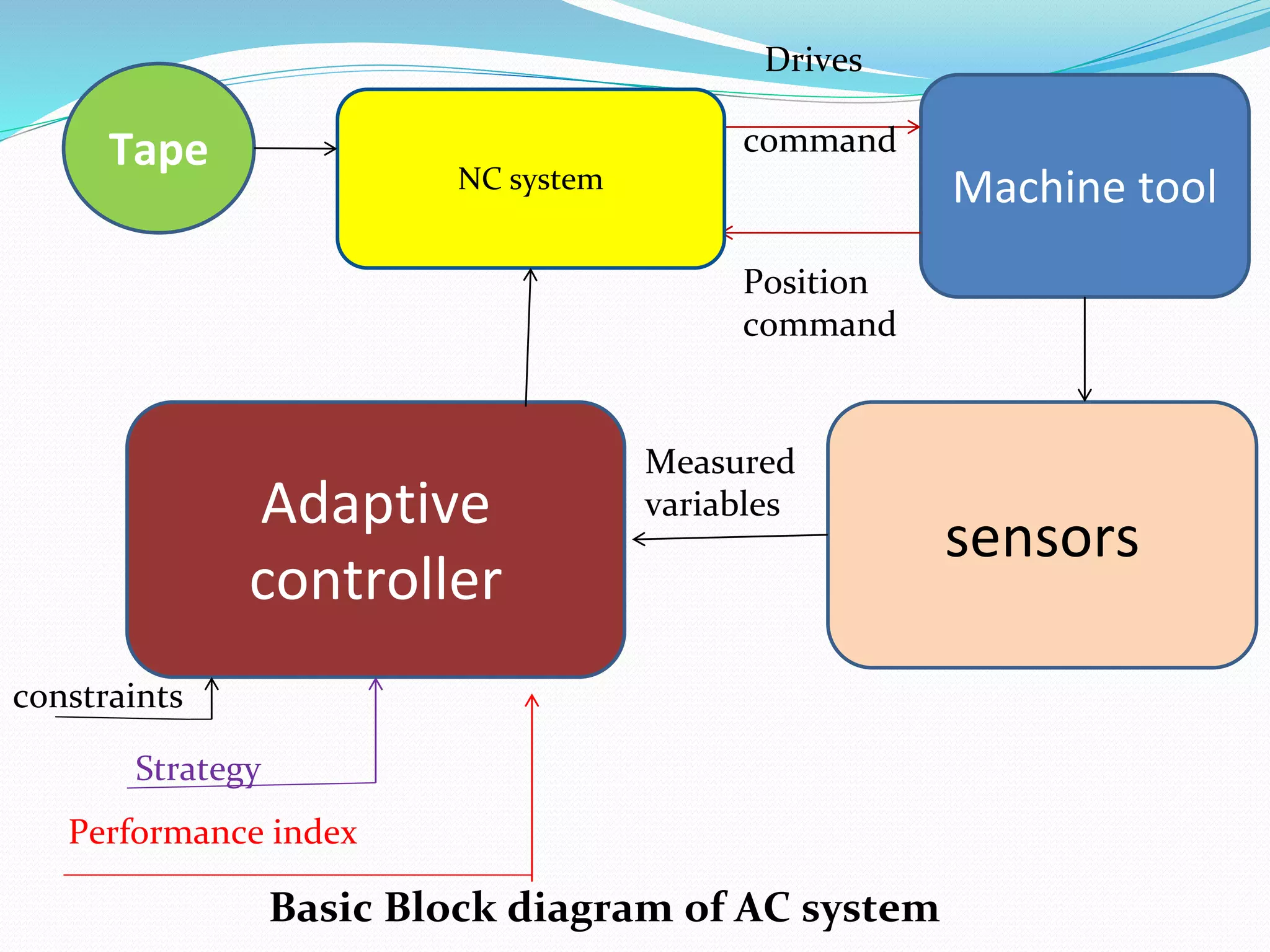
Tape
Machine tool
sensors
Adaptive
controller
Drives
command
Position
command
Measured
variables
constraints
Strategy
Performance index
Basic Block diagram of AC system
NC system
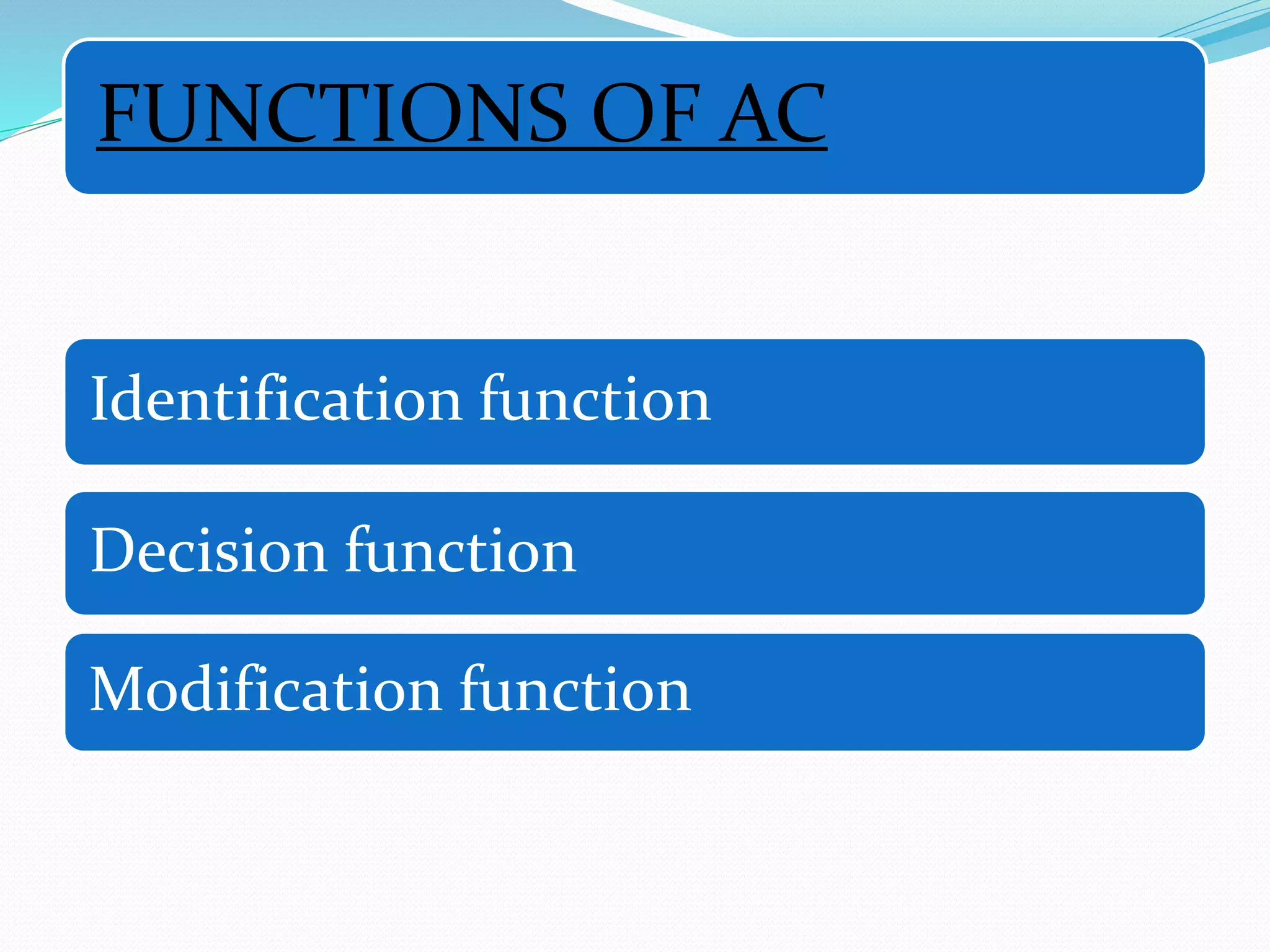
FUNCTIONS OF AC
Identification function
Decision function
Modification function
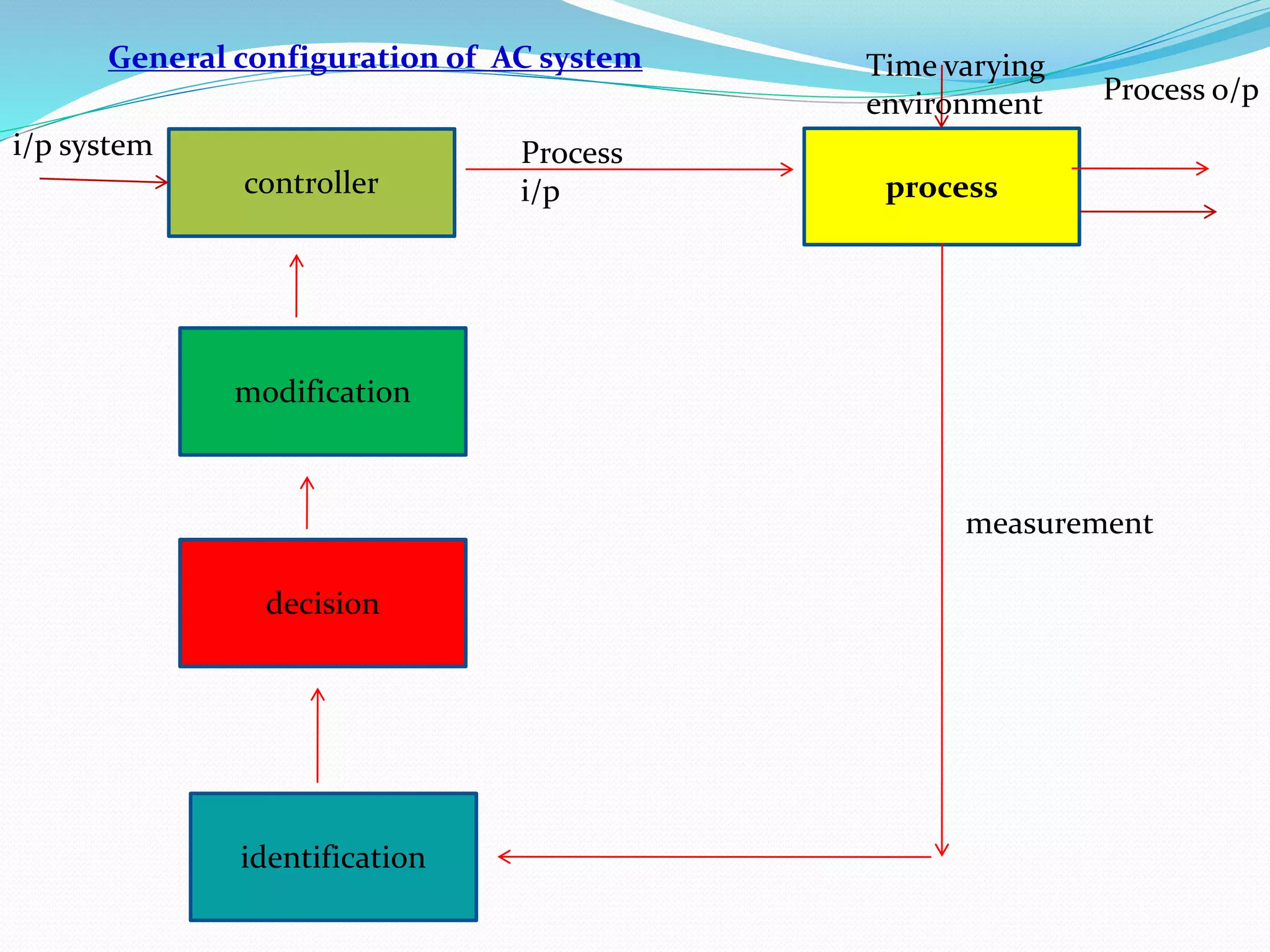
controller process
modification
decision
identification
Process
i/p
i/p system
measurement
General configuration of AC system
Process o/p
Time varying
environment
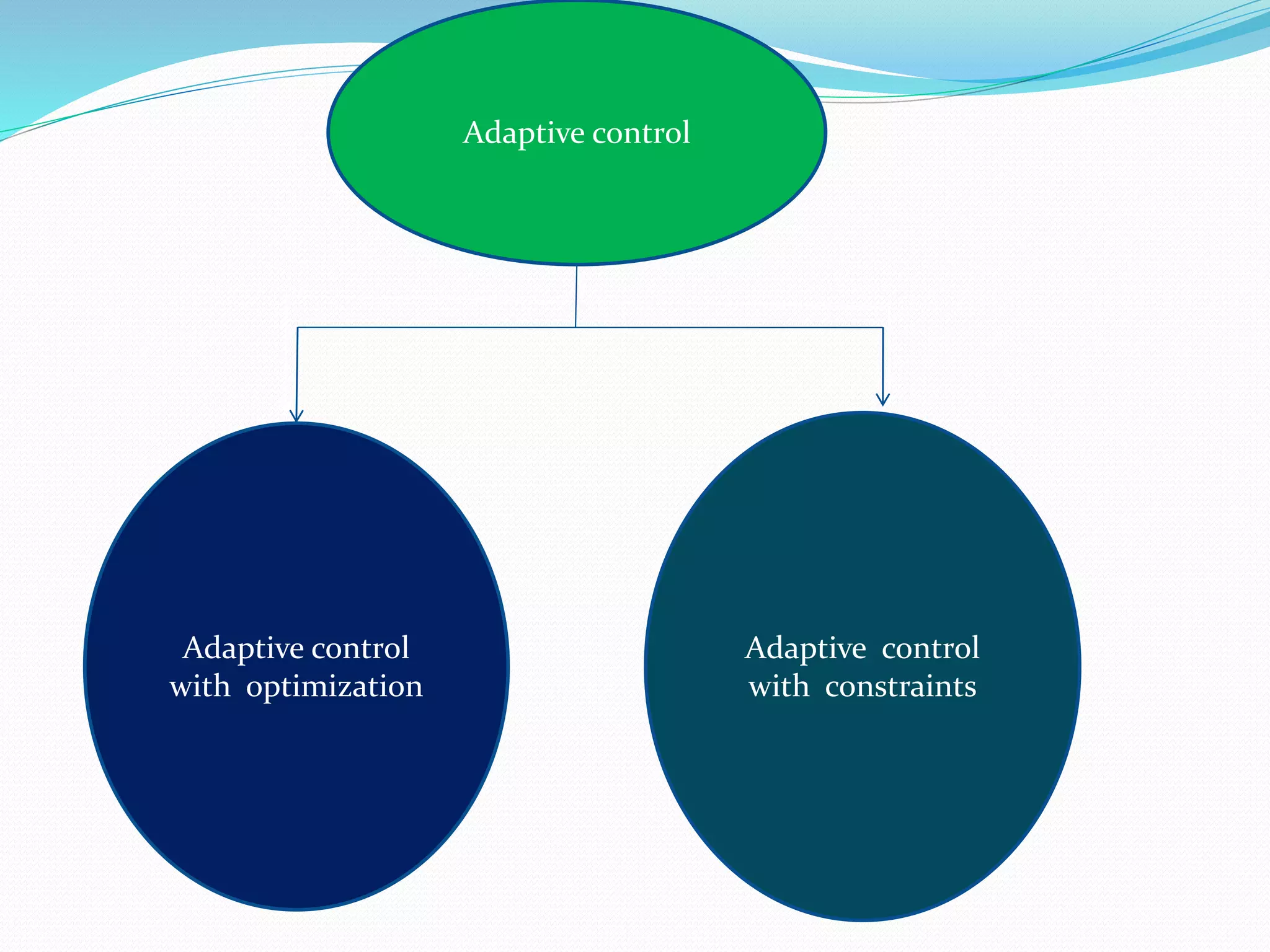
Adaptive control
with optimization
Adaptive control
with constraints
Adaptive control
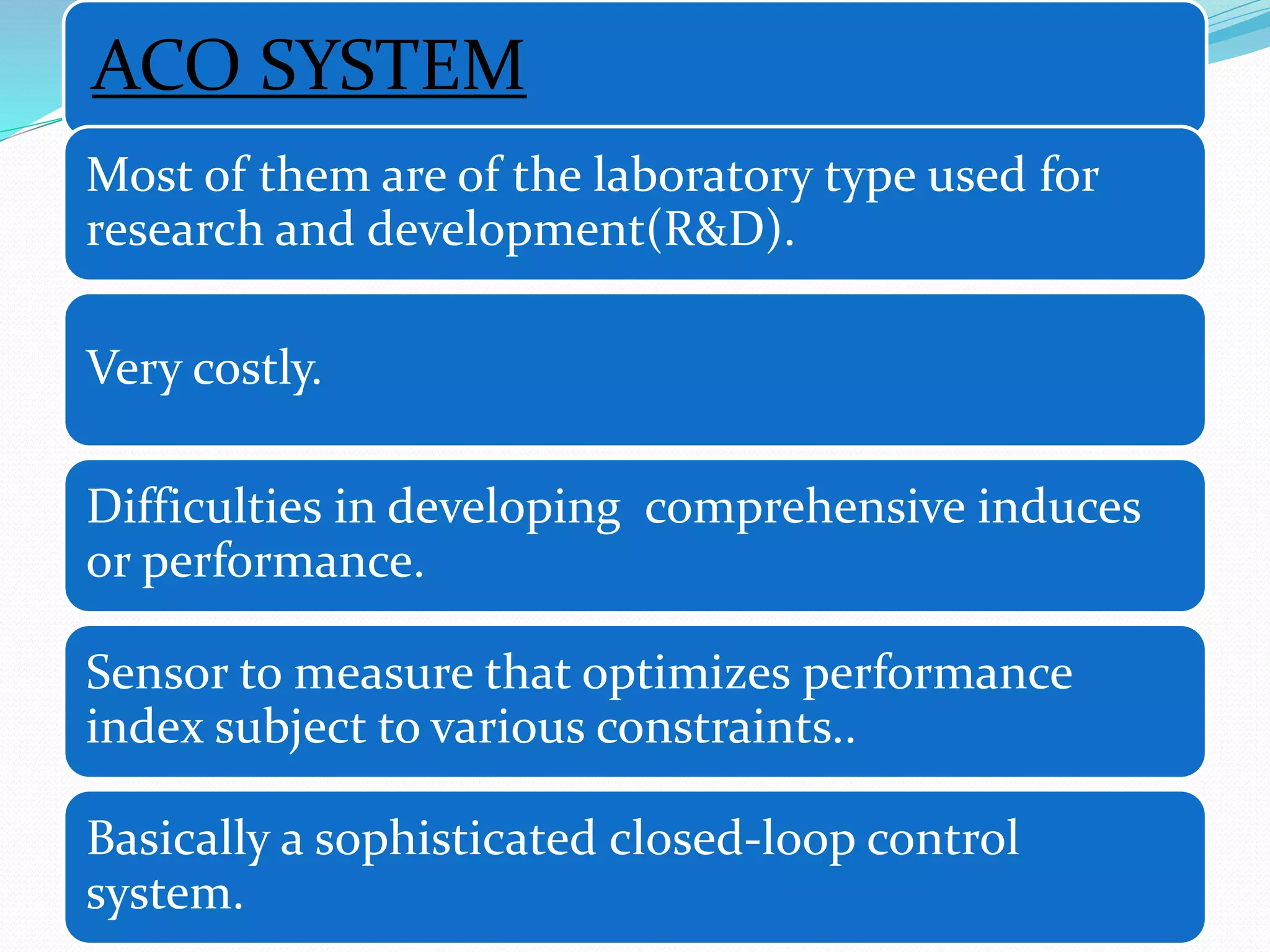
ACO SYSTEM
Most of them are of the laboratory type used for
research and development(R&D).
Very costly.
Difficulties in developing comprehensive induces
or performance.
Sensor to measure that optimizes performance
index subject to various constraints..
Basically a sophisticated closed-loop control
system.
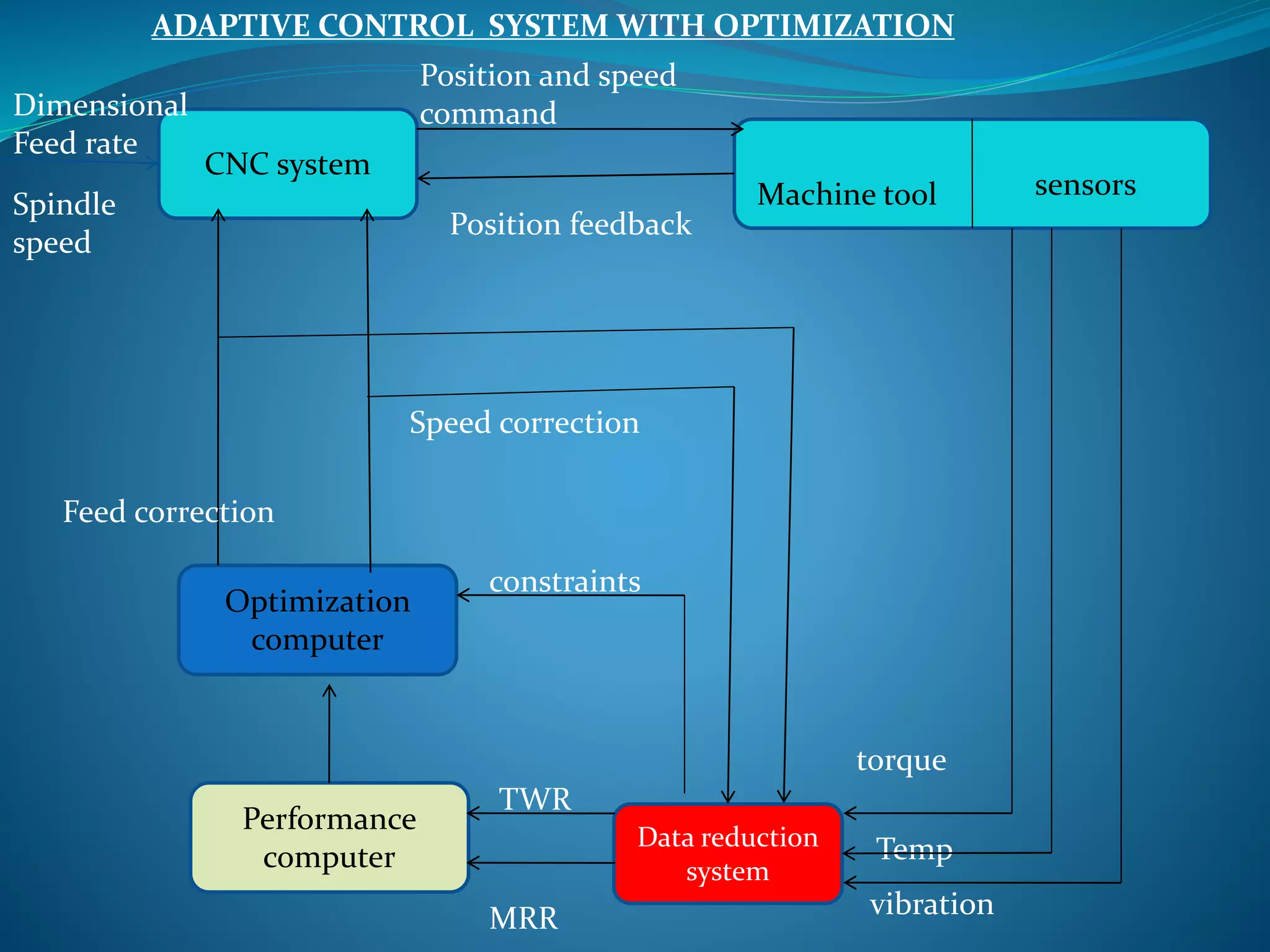
CNC system
Optimization
computer
Performance
computer
Data reduction
system
Machine tool
Dimensional
Feed rate
Spindle
speed
torque
vibration
TWR
MRR
Temp
ADAPTIVE CONTROL SYSTEM WITH OPTIMIZATION
Speed correction
Feed correction
Position and speed
command
Position feedback
constraints
sensors
ACC SYSTEM
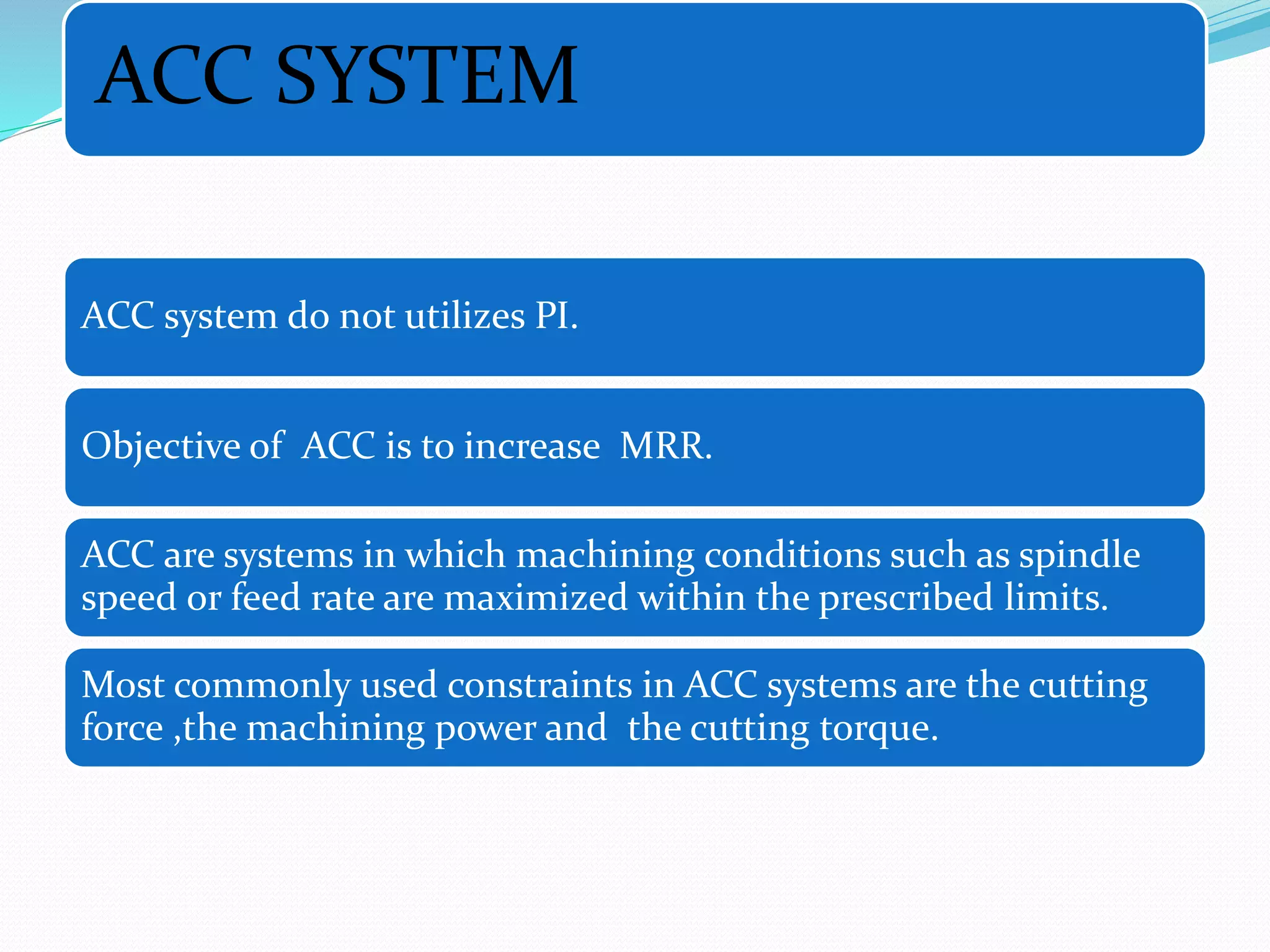
ACC system do not utilizes PI.
Objective of ACC is to increase MRR.
ACC are systems in which machining conditions such as spindle
speed or feed rate are maximized within the prescribed limits.
Most commonly used constraints in ACC systems are the cutting
force ,the machining power and the cutting torque.
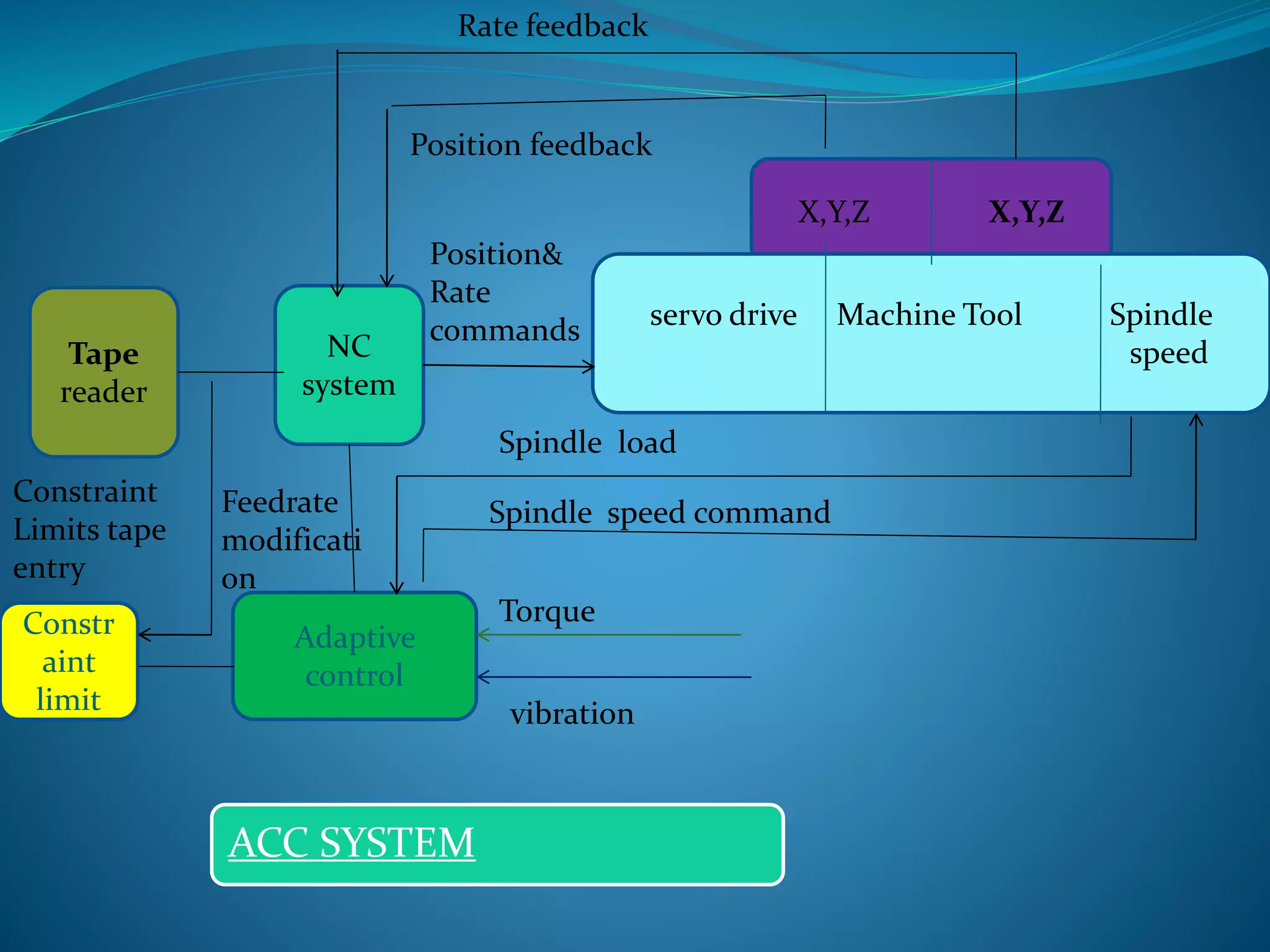
ACC SYSTEM
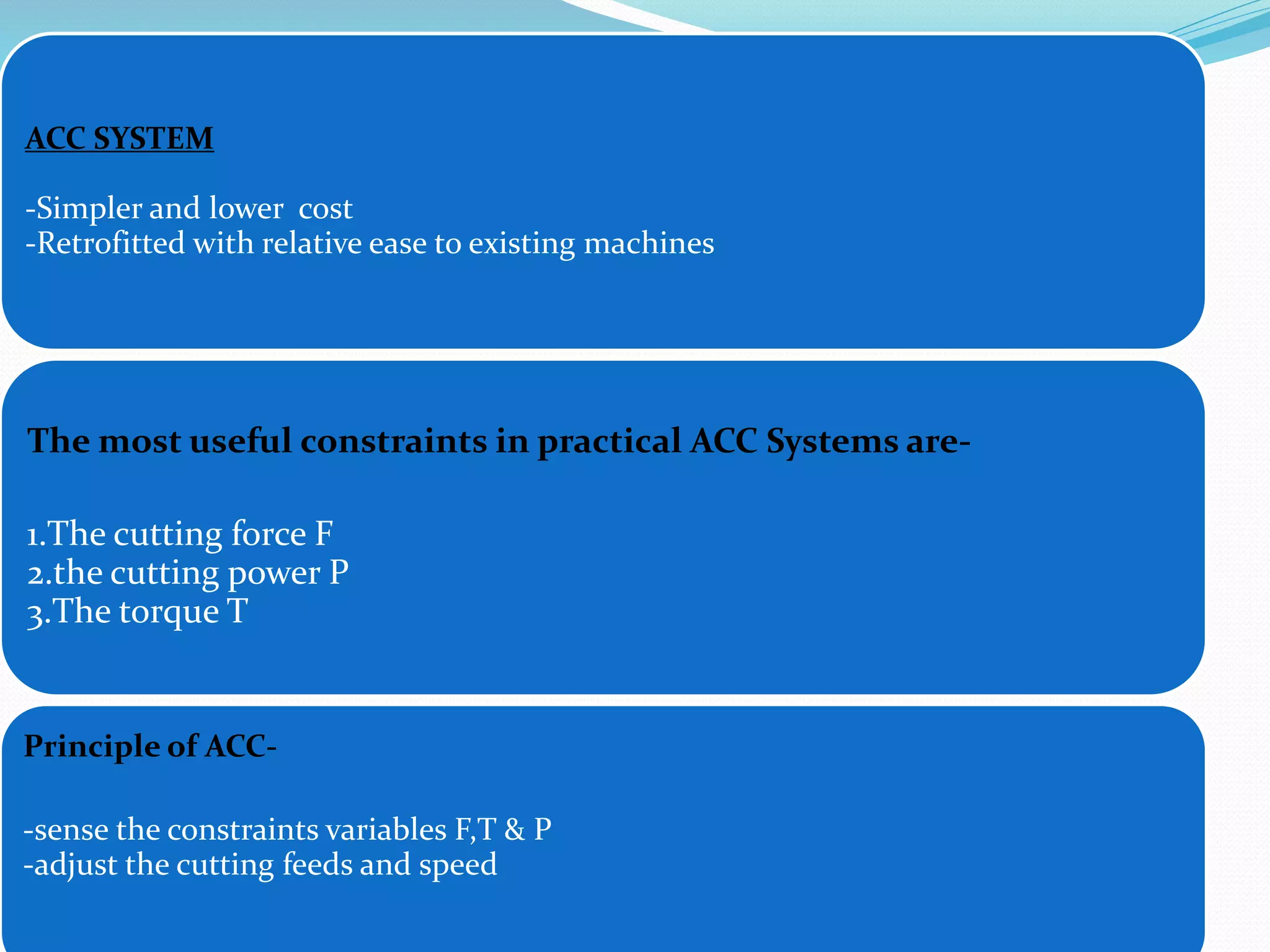
-Simpler and lower cost
-Retrofitted with relative ease to existing machines
The most useful constraints in practical ACC Systems are-
1.The cutting force F
2.the cutting power P
3.The torque T
Principle of ACC-
-sense the constraints variables F,T & P
-adjust the cutting feeds and speed
X,Y,Z X,Y,Z
servo drive Machine Tool Spindle
speedNC
system
Tape
reader
Adaptive
control
Constr
aint
limit
Position&
Rate
commands
Torque
vibration
Rate feedback
Position feedback
Spindle speed command
Constraint
Limits tape
entry
ACC SYSTEM
Spindle load
Feedrate
modificati
on
WHERE TO USE AC
One of the principle reasons for using nc is that it
reduces the nonproductive time in a machining
operation.
Ac determines the proper speeds and feeds during
machining as a function of variables in such factors
as work material hardness, width or depth of cut,
air gaps in the part geometry and so on
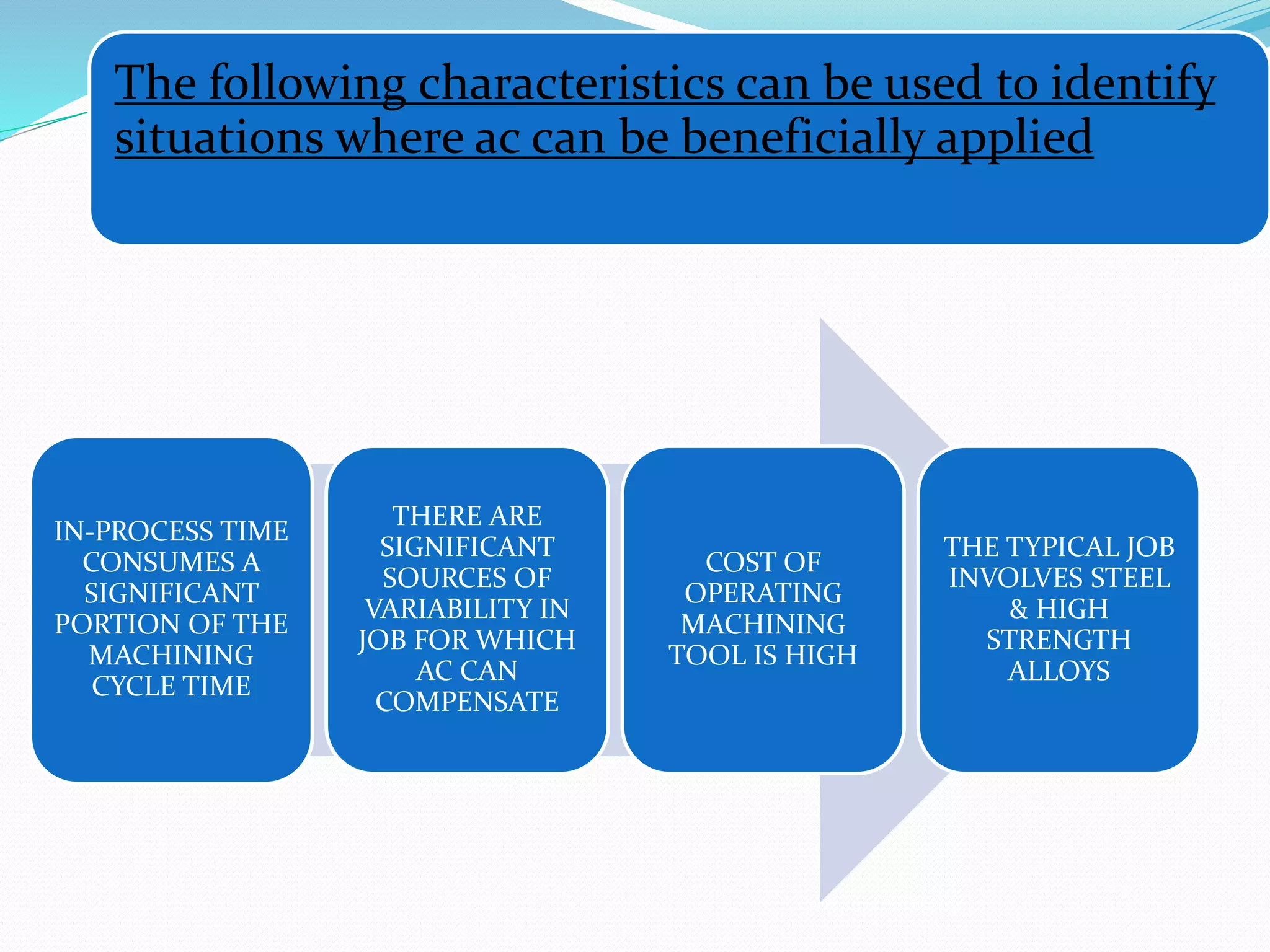
The following characteristics can be used to identify
situations where ac can be beneficially applied
IN-PROCESS TIME
CONSUMES A
SIGNIFICANT
PORTION OF THE
MACHINING
CYCLE TIME
THERE ARE
SIGNIFICANT
SOURCES OF
VARIABILITY IN
JOB FOR WHICH
AC CAN
COMPENSATE
COST OF
OPERATING
MACHINING
TOOL IS HIGH
THE TYPICAL JOB
INVOLVES STEEL
& HIGH
STRENGTH
ALLOYS
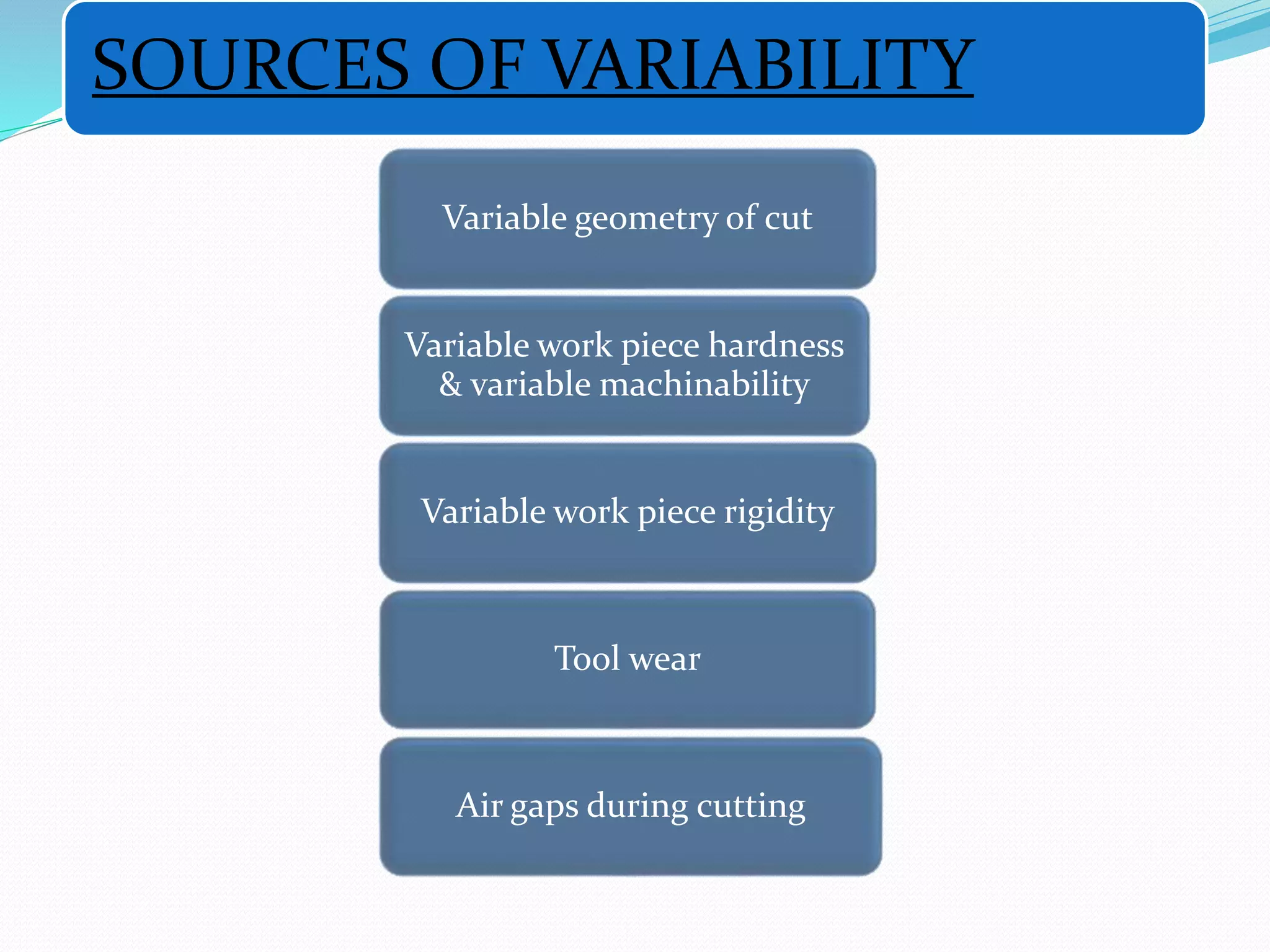
SOURCES OF VARIABILITY
Variable geometry of cut
Variable work piece hardness
& variable machinability
Variable work piece rigidity
Tool wear
Air gaps during cutting
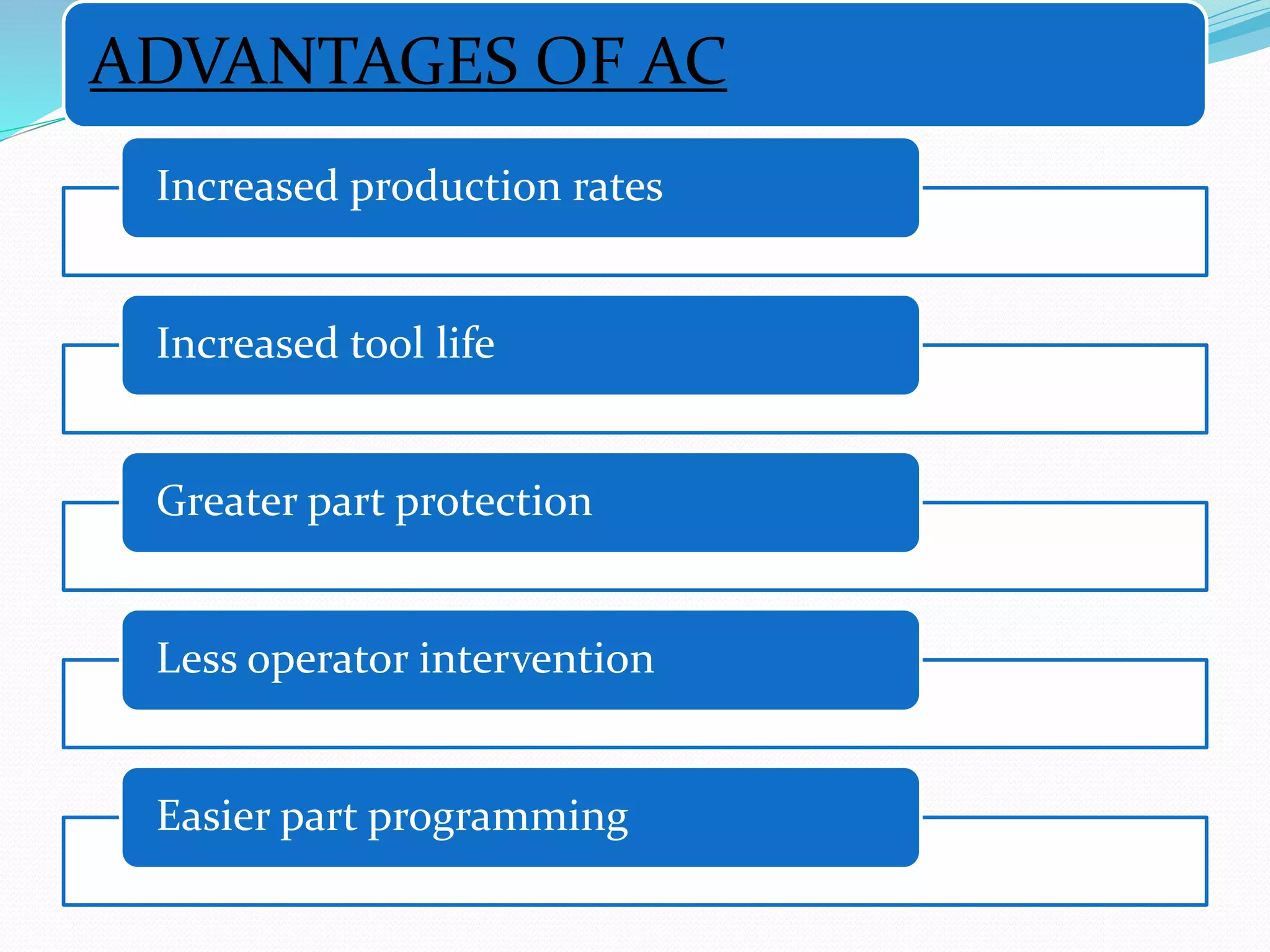
ADVANTAGES OF AC
Increased production rates
Increased tool life
Greater part protection
Less operator intervention
Easier part programming
LIMITATION OF AC
Unavailability of suitable
sensors that have reliable
operation in a
manufacturing
environment.
CONCLUSION
For a machining operation ac is the best
method for controlling the process
It has been established that it was possible
to increase the metal removing rate by 35%
to 45% by using ac techniques
THANK YOU

cAdaptive control

  • 1.
  • 2.
    AC machining originatedout of research in early 1960 sponsored by U.S Air Force. Initial adaptive system are based on analog type devices.
  • 3.
    DEFINITION The term acdenotes a control system that measures certain o/p variables and uses these to control speed and/or feed. The typical measures of performance in machining have been metal removal rate and cost per volume of metal removal.
  • 4.
    Adaptive control systems Itis a logical extension of the NC AND CNC. Improvement of the cutting process by automatic online determination of the feed and cutting speed. Basically a feedback system in which the cutting speed and feed automatically adopt themselves to the actual conditions of the process. The cutting speed and feed have to be varied in such a way as to improve the performance level.
  • 5.
    AC hardware components Sensormounted on the spindle to measure force. Sensor to measure spindle motor current which is used to provide indication of power consumption. Control unit and display panel to operate the system. Interface hardware to connect AC system to existing NC or CNC control unit .
  • 6.
  • 7.
    FUNCTIONS OF AC Identificationfunction Decision function Modification function
  • 8.
  • 9.
    Adaptive control with optimization Adaptivecontrol with constraints Adaptive control
  • 10.
    ACO SYSTEM Most ofthem are of the laboratory type used for research and development(R&D). Very costly. Difficulties in developing comprehensive induces or performance. Sensor to measure that optimizes performance index subject to various constraints.. Basically a sophisticated closed-loop control system.
  • 11.
    CNC system Optimization computer Performance computer Data reduction system Machinetool Dimensional Feed rate Spindle speed torque vibration TWR MRR Temp ADAPTIVE CONTROL SYSTEM WITH OPTIMIZATION Speed correction Feed correction Position and speed command Position feedback constraints sensors
  • 12.
    ACC SYSTEM ACC systemdo not utilizes PI. Objective of ACC is to increase MRR. ACC are systems in which machining conditions such as spindle speed or feed rate are maximized within the prescribed limits. Most commonly used constraints in ACC systems are the cutting force ,the machining power and the cutting torque.
  • 13.
    ACC SYSTEM -Simpler andlower cost -Retrofitted with relative ease to existing machines The most useful constraints in practical ACC Systems are- 1.The cutting force F 2.the cutting power P 3.The torque T Principle of ACC- -sense the constraints variables F,T & P -adjust the cutting feeds and speed
  • 14.
    X,Y,Z X,Y,Z servo driveMachine Tool Spindle speedNC system Tape reader Adaptive control Constr aint limit Position& Rate commands Torque vibration Rate feedback Position feedback Spindle speed command Constraint Limits tape entry ACC SYSTEM Spindle load Feedrate modificati on
  • 15.
    WHERE TO USEAC One of the principle reasons for using nc is that it reduces the nonproductive time in a machining operation. Ac determines the proper speeds and feeds during machining as a function of variables in such factors as work material hardness, width or depth of cut, air gaps in the part geometry and so on
  • 16.
    The following characteristicscan be used to identify situations where ac can be beneficially applied IN-PROCESS TIME CONSUMES A SIGNIFICANT PORTION OF THE MACHINING CYCLE TIME THERE ARE SIGNIFICANT SOURCES OF VARIABILITY IN JOB FOR WHICH AC CAN COMPENSATE COST OF OPERATING MACHINING TOOL IS HIGH THE TYPICAL JOB INVOLVES STEEL & HIGH STRENGTH ALLOYS
  • 17.
    SOURCES OF VARIABILITY Variablegeometry of cut Variable work piece hardness & variable machinability Variable work piece rigidity Tool wear Air gaps during cutting
  • 18.
    ADVANTAGES OF AC Increasedproduction rates Increased tool life Greater part protection Less operator intervention Easier part programming
  • 19.
    LIMITATION OF AC Unavailabilityof suitable sensors that have reliable operation in a manufacturing environment.
  • 20.
    CONCLUSION For a machiningoperation ac is the best method for controlling the process It has been established that it was possible to increase the metal removing rate by 35% to 45% by using ac techniques
  • 21.