
Adaptive Control Machining systems
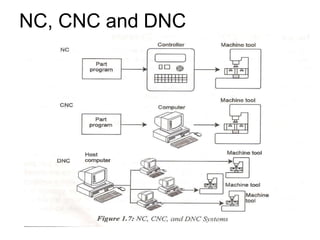
NC, CNC and DNC
Introduction
1. Adaptive control machining has been developed to
optimize machining characteristics
2. The AC machining is an evolutionary out growth of
numerical control.
3. It is a control system that measures certain output
process variables and uses these to control speed and
/ or feed.
4. Some of the process variables that have been used in
adaptive control machining systems include spindle
deflection or force, torque , cutting temperature,
vibration amplitude , metal removable rate cost per
volume of metal removed and horse power.
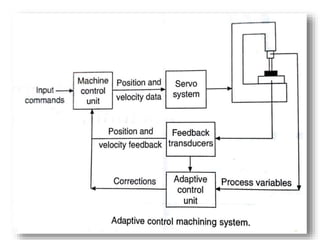
1.The adaptive control feedback provides sensory
information on machining process variables such as
1.Spindle deflection or force,
2.Torque,
3.Cutting temperature,
4.Work piece tool air gaps,
5.Material property variations,
6.Vibration amplitude,
7.Metal removable rate cost per volume of metal
removed
8.Horsepower.
2. The data is processed by an adaptive controller that
converts the process information into feedback data to
be incorporated into the machine control unit as shown
in figure.
1. The main advantage of NC/CNC is that reduces the non-productive time in
machining operation.
2. This time saving is achieved by reducing work piece handling time , set-up of
the job, Tool changes , and other source of operator and machine delay.
3.If these non- productive elements are reduced relative to the total production time, a
large proportion of the time can be spent in actually machining work piece.
4. The NC/CNC controls the sequence of tool positions during machining.
5. There is every possibility of spindle deflection or increasing of cutting temperature,
or work piece tool air gaps, or material property variations or machine tool vibration,
this process parameters waste production time
5. The most promising means of reducing the productive time is
the USE OF ADAPTIVE CONTROL
6. AC determines proper speed and feed during machining as functions of variations
in process variables such as Work-material hardness ,width or depth cut , air gaps in
the part geometry
Where to use adaptive control ?
Adaptive Control
 A control system that measures certain output
process variables like spindle deflection, force,
torque, cutting temperature, vibration amplitude,
horse power and uses them to control speed or
feed
 NC reduces non productive time in a
machining operation.
 AC determines proper speeds and feeds during
machining as a function of variation in work
piece hardness, width or depth of cut, air
gaps in part geometry etc.
 Increased metal removal rate and reduced cost
per volume of metal removed
Where to use adaptive control?
Application:
1. In-process time consumes significant
portion of the machining cycle time.
(>40%)
2. Significant sources of variability in the job
3. Higher cost of operation of machine tool
4. Work material – steel, titanium, high
strengh alloys
Sources of variability in
machining
1. Variable depth/width of cut
2. Variable workpiece hardness and
variable machinability
3. Variable workpiece rigidity
4. Toolwear
5. Air gaps during cutting
Elements of an adaptive control machining system.
1. The machining process is affected by many process variables.
2. In addition to cutting to cutting forces and position and velocity
feedback, the AC monitors vibrations, cutting temperature and spindle
horse power
3. In order to fulfill these requirements , AC requires sophisticated
transducers and sensor.
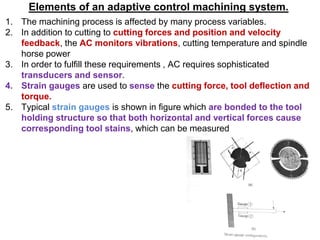
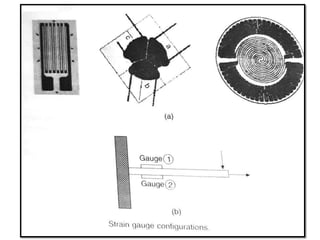
4. Strain gauges are used to sense the cutting force, tool deflection and
torque.
5. Typical strain gauges is shown in figure which are bonded to the tool
holding structure so that both horizontal and vertical forces cause
corresponding tool stains, which can be measured
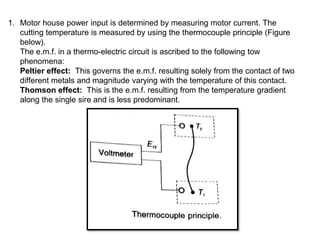
1. Motor house power input is determined by measuring motor current. The
cutting temperature is measured by using the thermocouple principle (Figure
below).
The e.m.f. in a thermo-electric circuit is ascribed to the following tow
phenomena:
Peltier effect: This governs the e.m.f. resulting solely from the contact of two
different metals and magnitude varying with the temperature of this contact.
Thomson effect: This is the e.m.f. resulting from the temperature gradient
along the single sire and is less predominant.
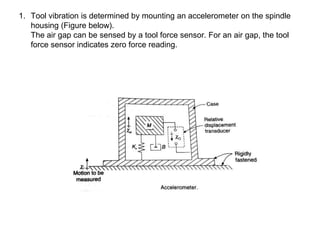
1. Tool vibration is determined by mounting an accelerometer on the spindle
housing (Figure below).
The air gap can be sensed by a tool force sensor. For an air gap, the tool
force sensor indicates zero force reading.
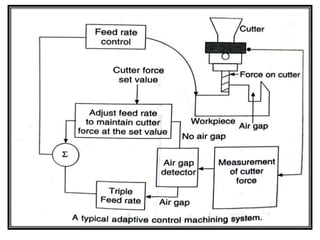
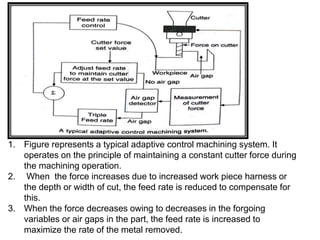
1. Figure represents a typical adaptive control machining system. It
operates on the principle of maintaining a constant cutter force during
the machining operation.
2. When the force increases due to increased work piece harness or
the depth or width of cut, the feed rate is reduced to compensate for
this.
3. When the force decreases owing to decreases in the forgoing
variables or air gaps in the part, the feed rate is increased to
maximize the rate of the metal removed.
1. Figure shows the presence of an air gap over-ride feature which monitor
the cutter force and determines if the cutter is moving through air or
through metal.
2. This is usually sensed by means of a low threshold value of cutter force. If
the actual cutter force is below this threshold level, the controller assumes
that the cutter is passing through an air gap, the feed reverts to the cutter
force mode of control.
3. More than one process variable may be measured in an AC machining
system.
4. Originally, attempts were made to employ three measured signals in the
Bendix system: temperature, torque, and vibration.
5. The Mactech system has used both cutter load and horsepower generated
at the machine motor.
6. The purpose of the power sensor is to protect the motor from the overload
when the metal removal rate is constrained by spindle horsepower rather
than spindle force.
Types of Adaptive controls
1. Adaptive control Optimisation (ACO)
2. Adaptive control Constraint (ACC)
Adaptive Control Optimization
(ACO)
 Index of performance is a measure of overall
process performance such as production rate or
cost per volume of metal removed.
 Objective is to optimize the index of performance
by manipulating speed or feed in the operation
 IP = MRR/TWR
MRR – Material removal rate
TWR – Tool wear rate
 Sensors for measuring IP not available
1. ACO optimises the over all efficiency of the production process or
selected process parameters.
2. In this form of adaptive control, a figure–of-merit, M is specified for the
system.
3. The figure–of–merit, M is specified for the system. The figure–of–merit is
called merit function, which is a numerical measure of efficiency.
4. The magnitude of figure-of-merit indicates the merit or desirability of a
given combination of process variables.
5. The figure of merit indicates the merit or desirability of a given
combination of process variables.
6. The figure-of- merit is the production rate or cost per volume of metal
removed.
7. The objective of the adaptive controller is to optimise the figure-of-merit
by manipulating speed/feed in the operation.
1. Most adaptive control optimisation systems attempt to maximise the ratio
material removal rate to the tool wear rate.
2. In other words , the figure-of-merit is: M=f(MRR,TWR) where
MRR=material removal rate
TWR=tool wear rate
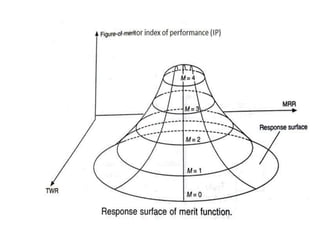
1. It is possible to visualize the merit function as a three-dimensional
response surface, consisting of a two- dimensional parameter plane and
a third axis representing the figure-of-merit.
2. Various optimisation techniques are available to generate merit function
response surfaces.
3. The merit function can be maximized by using the hill climbing technique.
4. The response surface is ascended along the steepest gradient.
5. At each operating point, the local slope is evaluated and the next
operating point is determined one step closer to the maximum.
6. A three- dimensional response surface is shown in figure
7. The procedure is repeated till the slope becomes zero.
Adaptive control Constraint (ACC)
 Nearly all AC systems is of this type
 Less sophisticated and less expensive
than research ACO systems
 Objective is to manipulate speed or feed
so that measured process variables are
maintained at or below their constraint limit
values.
Adaptive control constraint (ACC)
1. The objective of the controller is to manipulate speed/feed to maintain
the measured variables at or below their constraint limit values.
2. Constraints define the permissible range of operation.
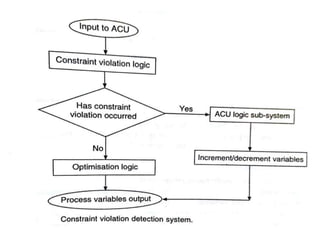
3. The constraints violation detection logic determines whether the process
variable exceeded the pre- defined limit or not.
4. If constraint violation has occurred, the ACU logic sub- system
increments or decrements the value of the ACU output such that the
process variable is within the pre- defined limits.
5. The flowchart of a constraint violation detection system is shown in
figure.
6. If dangerous conditions are found the constraint violation detection
system stops the machining operations and shuts down the machine
tool.
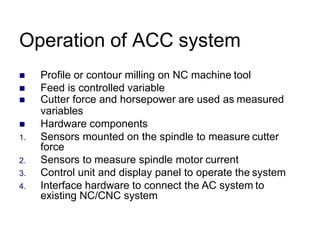
Operation of ACC system
 Profile or contour milling on NC machine tool
 Feed is controlled variable
 Cutter force and horsepower are used as measured
variables
 Hardware components
1. Sensors mounted on the spindle to measure cutter
force
2. Sensors to measure spindle motor current
3. Control unit and display panel to operate the system
4. Interface hardware to connect the AC system to
existing NC/CNC system
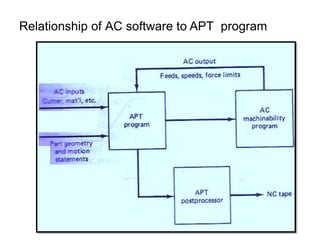
Relationship of AC software to APT program
Benefits of AC
1. Increased production rate
2. Increased tool life
3. Greater part protection
4. Increases machine life
5. Less operator intervention
6. Easier part programming
Thank you
Boshalla Narsaiah

Adaptive control machine process

  • 1.
  • 2.
  • 3.
    Introduction 1. Adaptive controlmachining has been developed to optimize machining characteristics 2. The AC machining is an evolutionary out growth of numerical control. 3. It is a control system that measures certain output process variables and uses these to control speed and / or feed. 4. Some of the process variables that have been used in adaptive control machining systems include spindle deflection or force, torque , cutting temperature, vibration amplitude , metal removable rate cost per volume of metal removed and horse power.
  • 4.
    1.The adaptive controlfeedback provides sensory information on machining process variables such as 1.Spindle deflection or force, 2.Torque, 3.Cutting temperature, 4.Work piece tool air gaps, 5.Material property variations, 6.Vibration amplitude, 7.Metal removable rate cost per volume of metal removed 8.Horsepower. 2. The data is processed by an adaptive controller that converts the process information into feedback data to be incorporated into the machine control unit as shown in figure.
  • 6.
    1. The mainadvantage of NC/CNC is that reduces the non-productive time in machining operation. 2. This time saving is achieved by reducing work piece handling time , set-up of the job, Tool changes , and other source of operator and machine delay. 3.If these non- productive elements are reduced relative to the total production time, a large proportion of the time can be spent in actually machining work piece. 4. The NC/CNC controls the sequence of tool positions during machining. 5. There is every possibility of spindle deflection or increasing of cutting temperature, or work piece tool air gaps, or material property variations or machine tool vibration, this process parameters waste production time 5. The most promising means of reducing the productive time is the USE OF ADAPTIVE CONTROL 6. AC determines proper speed and feed during machining as functions of variations in process variables such as Work-material hardness ,width or depth cut , air gaps in the part geometry Where to use adaptive control ?
  • 7.
    Adaptive Control  Acontrol system that measures certain output process variables like spindle deflection, force, torque, cutting temperature, vibration amplitude, horse power and uses them to control speed or feed  NC reduces non productive time in a machining operation.  AC determines proper speeds and feeds during machining as a function of variation in work piece hardness, width or depth of cut, air gaps in part geometry etc.  Increased metal removal rate and reduced cost per volume of metal removed
  • 8.
    Where to useadaptive control? Application: 1. In-process time consumes significant portion of the machining cycle time. (>40%) 2. Significant sources of variability in the job 3. Higher cost of operation of machine tool 4. Work material – steel, titanium, high strengh alloys
  • 9.
    Sources of variabilityin machining 1. Variable depth/width of cut 2. Variable workpiece hardness and variable machinability 3. Variable workpiece rigidity 4. Toolwear 5. Air gaps during cutting
  • 11.
    Elements of anadaptive control machining system. 1. The machining process is affected by many process variables. 2. In addition to cutting to cutting forces and position and velocity feedback, the AC monitors vibrations, cutting temperature and spindle horse power 3. In order to fulfill these requirements , AC requires sophisticated transducers and sensor. 4. Strain gauges are used to sense the cutting force, tool deflection and torque. 5. Typical strain gauges is shown in figure which are bonded to the tool holding structure so that both horizontal and vertical forces cause corresponding tool stains, which can be measured
  • 13.
    1. Motor housepower input is determined by measuring motor current. The cutting temperature is measured by using the thermocouple principle (Figure below). The e.m.f. in a thermo-electric circuit is ascribed to the following tow phenomena: Peltier effect: This governs the e.m.f. resulting solely from the contact of two different metals and magnitude varying with the temperature of this contact. Thomson effect: This is the e.m.f. resulting from the temperature gradient along the single sire and is less predominant.
  • 14.
    1. Tool vibrationis determined by mounting an accelerometer on the spindle housing (Figure below). The air gap can be sensed by a tool force sensor. For an air gap, the tool force sensor indicates zero force reading.
  • 15.
    1. Figure representsa typical adaptive control machining system. It operates on the principle of maintaining a constant cutter force during the machining operation. 2. When the force increases due to increased work piece harness or the depth or width of cut, the feed rate is reduced to compensate for this. 3. When the force decreases owing to decreases in the forgoing variables or air gaps in the part, the feed rate is increased to maximize the rate of the metal removed.
  • 16.
    1. Figure showsthe presence of an air gap over-ride feature which monitor the cutter force and determines if the cutter is moving through air or through metal. 2. This is usually sensed by means of a low threshold value of cutter force. If the actual cutter force is below this threshold level, the controller assumes that the cutter is passing through an air gap, the feed reverts to the cutter force mode of control. 3. More than one process variable may be measured in an AC machining system. 4. Originally, attempts were made to employ three measured signals in the Bendix system: temperature, torque, and vibration. 5. The Mactech system has used both cutter load and horsepower generated at the machine motor. 6. The purpose of the power sensor is to protect the motor from the overload when the metal removal rate is constrained by spindle horsepower rather than spindle force.
  • 17.
    Types of Adaptivecontrols 1. Adaptive control Optimisation (ACO) 2. Adaptive control Constraint (ACC)
  • 18.
    Adaptive Control Optimization (ACO) Index of performance is a measure of overall process performance such as production rate or cost per volume of metal removed.  Objective is to optimize the index of performance by manipulating speed or feed in the operation  IP = MRR/TWR MRR – Material removal rate TWR – Tool wear rate  Sensors for measuring IP not available
  • 19.
    1. ACO optimisesthe over all efficiency of the production process or selected process parameters. 2. In this form of adaptive control, a figure–of-merit, M is specified for the system. 3. The figure–of–merit, M is specified for the system. The figure–of–merit is called merit function, which is a numerical measure of efficiency. 4. The magnitude of figure-of-merit indicates the merit or desirability of a given combination of process variables. 5. The figure of merit indicates the merit or desirability of a given combination of process variables. 6. The figure-of- merit is the production rate or cost per volume of metal removed. 7. The objective of the adaptive controller is to optimise the figure-of-merit by manipulating speed/feed in the operation.
  • 20.
    1. Most adaptivecontrol optimisation systems attempt to maximise the ratio material removal rate to the tool wear rate. 2. In other words , the figure-of-merit is: M=f(MRR,TWR) where MRR=material removal rate TWR=tool wear rate 1. It is possible to visualize the merit function as a three-dimensional response surface, consisting of a two- dimensional parameter plane and a third axis representing the figure-of-merit. 2. Various optimisation techniques are available to generate merit function response surfaces. 3. The merit function can be maximized by using the hill climbing technique. 4. The response surface is ascended along the steepest gradient. 5. At each operating point, the local slope is evaluated and the next operating point is determined one step closer to the maximum. 6. A three- dimensional response surface is shown in figure 7. The procedure is repeated till the slope becomes zero.
  • 22.
    Adaptive control Constraint(ACC)  Nearly all AC systems is of this type  Less sophisticated and less expensive than research ACO systems  Objective is to manipulate speed or feed so that measured process variables are maintained at or below their constraint limit values.
  • 23.
    Adaptive control constraint(ACC) 1. The objective of the controller is to manipulate speed/feed to maintain the measured variables at or below their constraint limit values. 2. Constraints define the permissible range of operation. 3. The constraints violation detection logic determines whether the process variable exceeded the pre- defined limit or not. 4. If constraint violation has occurred, the ACU logic sub- system increments or decrements the value of the ACU output such that the process variable is within the pre- defined limits. 5. The flowchart of a constraint violation detection system is shown in figure. 6. If dangerous conditions are found the constraint violation detection system stops the machining operations and shuts down the machine tool.
  • 25.
    Operation of ACCsystem  Profile or contour milling on NC machine tool  Feed is controlled variable  Cutter force and horsepower are used as measured variables  Hardware components 1. Sensors mounted on the spindle to measure cutter force 2. Sensors to measure spindle motor current 3. Control unit and display panel to operate the system 4. Interface hardware to connect the AC system to existing NC/CNC system
  • 26.
    Relationship of ACsoftware to APT program
  • 27.
    Benefits of AC 1.Increased production rate 2. Increased tool life 3. Greater part protection 4. Increases machine life 5. Less operator intervention 6. Easier part programming
  • 28.