Adaptive Control Machining systems
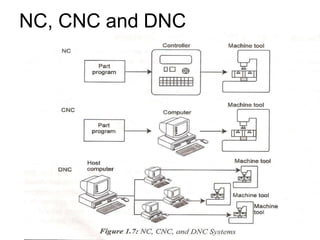
NC, CNC and DNC
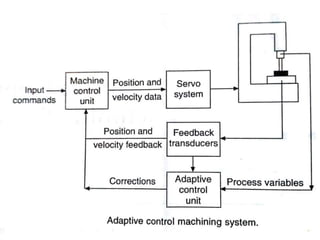
1.The adaptive control feedback provides sensory
information on machining process variables such as
1.Spindle deflection or force,
2.Torque,
3.Cutting temperature,
4.Work piece tool air gaps,
5.Material property variations,
6.Vibration amplitude,
7.Metal removable rate cost per volume of metal
removed
8.Horsepower.
2. The data is processed by an adaptive controller that
converts the process information into feedback data to
be incorporated into the machine control unit
1. The main advantage of NC/CNC is that reduces the non-
productive time in machining operation.
2. This time saving is achieved by reducing work piece handling
time , set-up of the job, Tool changes , and other source of
operator and machine delay.
3. The NC/CNC controls the sequence of tool positions during
machining.
4. There is every possibility of spindle deflection or increasing of
cutting temperature, or work piece tool air gaps, or material property
variations or machine tool vibration, this process parameters waste
production time
5. The most promising means of reducing the productive time is
the USE OF ADAPTIVE CONTROL
6. AC determines proper speed and feed during machining as functions of
variations in process variables such as Work-material hardness ,width or
depth cut , air gaps in the part geometry
Adaptive Control
 A control system that measures certain output
process variables like spindle deflection, force,
torque, cutting temperature, vibration amplitude,
horse power and uses them to control speed or
feed
 NC reduces non productive time in a
machining operation.
 AC determines proper speeds and feeds during
machining as a function of variation in work
piece hardness, width or depth of cut, air
gaps in part geometry etc.
 Increased metal removal rate and reduced cost
per volume of metal removed
Where to use adaptive control?
Application:
1. In-process time consumes significant
portion of the machining cycle time.
(>40%)
2. Significant sources of variability in the
job
3. Higher cost of operation of machine tool
4. Work material – steel, titanium, high
strengh alloys
Sources of variability in machining
1. Variable depth/width of cut
2. Variable workpiece hardness and
variable machinability
3. Variable workpiece rigidity
4. Toolwear
5. Air gaps during cutting
Types of Adaptive controls
1. Adaptive control Optimisation (ACO)
2. Adaptive control Constraint (ACC)
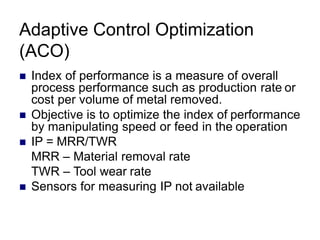
Adaptive Control Optimization
(ACO)
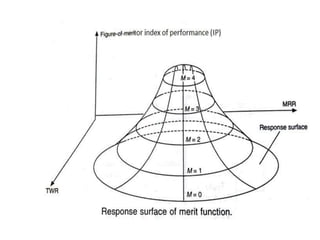
 Index of performance is a measure of overall
process performance such as production rate or
cost per volume of metal removed.
 Objective is to optimize the index of performance
by manipulating speed or feed in the operation
 IP = MRR/TWR
MRR – Material removal rate
TWR – Tool wear rate
 Sensors for measuring IP not available
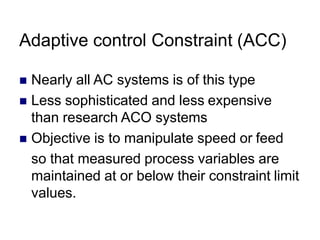
Adaptive control Constraint (ACC)
 Nearly all AC systems is of this type
 Less sophisticated and less expensive
than research ACO systems
 Objective is to manipulate speed or feed
so that measured process variables are
maintained at or below their constraint limit
values.
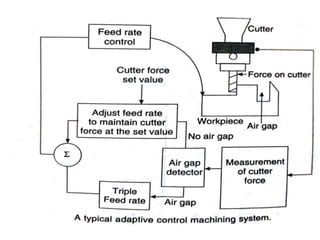
Operation of ACC system
 Profile or contour milling on NC machine tool
 Feed is controlled variable
 Cutter force and horsepower are used as measured
variables
 Hardware components
1. Sensors mounted on the spindle to measure cutter
force
2. Sensors to measure spindle motor current
3. Control unit and display panel to operate the system
4. Interface hardware to connect the AC system to
existing NC/CNC system
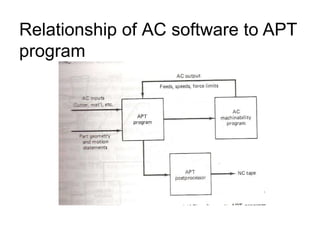
Relationship of AC software to APT
program
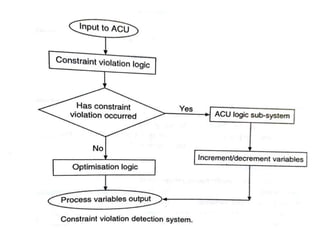
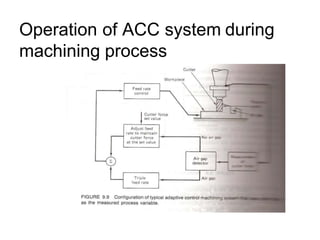
Operation of ACC system during
machining process
Benefits of AC
1. Increased production rate
2. Increased tool life
3. Greater part protection
4. Increases machine life
5. Less operator intervention
6. Easier part programming

Adaptivecontrol

  • 1.
  • 2.
  • 3.
    1.The adaptive controlfeedback provides sensory information on machining process variables such as 1.Spindle deflection or force, 2.Torque, 3.Cutting temperature, 4.Work piece tool air gaps, 5.Material property variations, 6.Vibration amplitude, 7.Metal removable rate cost per volume of metal removed 8.Horsepower. 2. The data is processed by an adaptive controller that converts the process information into feedback data to be incorporated into the machine control unit
  • 5.
    1. The mainadvantage of NC/CNC is that reduces the non- productive time in machining operation. 2. This time saving is achieved by reducing work piece handling time , set-up of the job, Tool changes , and other source of operator and machine delay. 3. The NC/CNC controls the sequence of tool positions during machining. 4. There is every possibility of spindle deflection or increasing of cutting temperature, or work piece tool air gaps, or material property variations or machine tool vibration, this process parameters waste production time 5. The most promising means of reducing the productive time is the USE OF ADAPTIVE CONTROL 6. AC determines proper speed and feed during machining as functions of variations in process variables such as Work-material hardness ,width or depth cut , air gaps in the part geometry
  • 6.
    Adaptive Control  Acontrol system that measures certain output process variables like spindle deflection, force, torque, cutting temperature, vibration amplitude, horse power and uses them to control speed or feed  NC reduces non productive time in a machining operation.  AC determines proper speeds and feeds during machining as a function of variation in work piece hardness, width or depth of cut, air gaps in part geometry etc.  Increased metal removal rate and reduced cost per volume of metal removed
  • 7.
    Where to useadaptive control? Application: 1. In-process time consumes significant portion of the machining cycle time. (>40%) 2. Significant sources of variability in the job 3. Higher cost of operation of machine tool 4. Work material – steel, titanium, high strengh alloys
  • 8.
    Sources of variabilityin machining 1. Variable depth/width of cut 2. Variable workpiece hardness and variable machinability 3. Variable workpiece rigidity 4. Toolwear 5. Air gaps during cutting
  • 10.
    Types of Adaptivecontrols 1. Adaptive control Optimisation (ACO) 2. Adaptive control Constraint (ACC)
  • 11.
    Adaptive Control Optimization (ACO) Index of performance is a measure of overall process performance such as production rate or cost per volume of metal removed.  Objective is to optimize the index of performance by manipulating speed or feed in the operation  IP = MRR/TWR MRR – Material removal rate TWR – Tool wear rate  Sensors for measuring IP not available
  • 13.
    Adaptive control Constraint(ACC)  Nearly all AC systems is of this type  Less sophisticated and less expensive than research ACO systems  Objective is to manipulate speed or feed so that measured process variables are maintained at or below their constraint limit values.
  • 15.
    Operation of ACCsystem  Profile or contour milling on NC machine tool  Feed is controlled variable  Cutter force and horsepower are used as measured variables  Hardware components 1. Sensors mounted on the spindle to measure cutter force 2. Sensors to measure spindle motor current 3. Control unit and display panel to operate the system 4. Interface hardware to connect the AC system to existing NC/CNC system
  • 16.
    Relationship of ACsoftware to APT program
  • 17.
    Operation of ACCsystem during machining process
  • 18.
    Benefits of AC 1.Increased production rate 2. Increased tool life 3. Greater part protection 4. Increases machine life 5. Less operator intervention 6. Easier part programming