ADAPTIVE CONTROL SYSTEMS
SUBMITTED TO :-
Dr. B.S. PABLA
PROFESSOR
MECHANICAL ENGG.
NITTTR CHANDIGARH
SUBMITTED BY:-
SUMIT ATTRI
ROLL NO. 152225
3rd
SEM M.E.
MECHANICAL ENGG.
NITTTR CHANDIGARH
Introduction
Adaptive control system is a logical extension of the CNC-
mechanism.
In CNC mechanism the cutting speed and feed rates are
prescribed by the part programmer.
The determination of these operating parameters depends
on the Knowledge and experience of programmer
regarding the work piece, tool materials, coolant conditions
and other factors.
By contrast in adaptive control machining, there is
improvement in the production rate and reduction in the
machining cost as a result of calculating and setting of optimal
parameters during machining.
Origin
Adaptive control (AC) machining originated out of
research in early 1970’s sponsored by U.S Air
Force.
The initial adaptive control systems were based on
analog devices, representing the technology at that
time.
 Today adaptive control uses microprocessor
based controls and is typically integrated with an
existing CNC system.
DEFINITION OF AC MACHINING
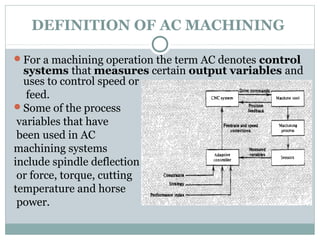
For a machining operation the term AC denotes control
systems that measures certain output variables and
uses to control speed or
feed.
Some of the process
variables that have
been used in AC
machining systems
include spindle deflection
or force, torque, cutting
temperature and horse
power.
The adaptive control is basically a feedback
system that treats the CNC as an internal unit and
in which the machining variables automatically
adapt themselves to the actual conditions of the
machining process.
Note:- IP (Performance Index) is usually an
economic function such as max production rate or
minimum machining cost.
Functions of AC
The three functions of adaptive control are:
• Identification function.
• Decision function.
• Modification function.
• The main idea of AC is the improvement of the cutting
process by automatic on line determination of speed
and/or cutting.
• The AC is basically a feedback system in which cutting
speed and feed automatically adapt themselves to
the actual condition of the process and are varied
accordingly to the changes in the work conditions as work
progresses.
IDENTIFICATION FUNCTIONS
This involves determining the current
performance of the process or system .
The identification function is concerned with
determining the current value of this
performance measure by making use of the
feedback data from the process.
DECISION FUNCTION
Once the system performance is determined, the
next function is to decide how the control
mechanism should be adjusted to improve
process performance.
The decision procedure is carried out by means of a
pre-programmed logic provided by the designer.

MODIFICATION FUNCTION
The third AC function is to implement the decision.
While the decision function is a logic function,
modification is concerned with a physical or
mechanical change in the system.
The modification involves changing the
system parameters or variables so as to drive
the process towards a more optimal state.
WHERE TO USE ADAPTIVE CONTROL
Adaptive control is not suitable for every machining
situation.
In general, the following characteristics can be used to
identify situations where adaptive control can be
beneficially applied.
The in-process time consumes a significant portion of
the machining cycle time.
There are significant sources of variability in the job
for which AC can compensate.
 The cost of operating the machine tool is high.
 The typical jobs involve steels, titanium and high
strength alloys.
Classification of AC systems
In practice the AC system of machine tools can be
classified into two types:
AC with optimization (ACO)
AC with constrains (ACC)
Geometric Adaptive Control (GAC)
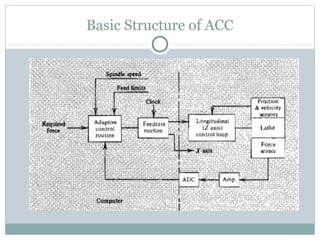
ACC
ACC are systems in which machining conditions such as
spindle speed or feed rate are maximized within the
prescribed limits of machines and tool constrains such as
maximum torque, force or horse power.
In AC system the correct feed and speed are automatically
found and it is not necessary to spend efforts on calculations
of optimum feeds and speeds.
ACC systems do not utilize a performance index and are based
on maximizing a machining variable (e.g., feed rate)
subject to process and machine constraints (e.g., allowable
cutting force on the tool, or maximum power of the machine).
The objective of most ACC types of systems is to increase the
MRR during rough cutting operations.
Basic Structure of ACC
ACC Example
 For example, to maximize the machining feedrate while maintaining
a constant load on the cutter, despite variations in width and depth of
cut.
 In a normal CNC system, the feedrate is programmed to
accommodate the largest width and depth in a particular cut, and this
small feedrate is maintained along the entire cut. As a result the
machining rate is reduced.
 By contrast, with the ACC system, the maximum allowable load
(e.g., cutting force) on the cutter is programmed.
 As a result, when the width or depth of cut are small the feedrate is
high; when either the width or depth of cut (or both) are increased,
the feedrate is automatically reduced, and consequently the allowable
load on the cutter is not exceeded.
 The result is, the average feed with ACC is much larger than its
programmed counterpart.
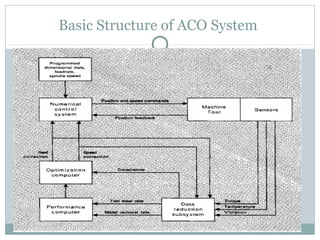
ACO System
The ACO Systems for N/C machine tools is a control
system that optimizes performance index
subjects to various constraints.
 It is basically a sophisticated closed loop control
system, which automatically works in optimum
conditions, even in the presences of work piece and
tools materials variations.
Basic Structure of ACO System
Drawback of ACO
The main problem is that this require on-line measurement
of tool wear.
So far there have been no industrially acceptable
methods developed for the direct measurement of tool wear.
Indirect measurement assumes that tool wear is proportional
to other measurable variables such as cutting forces and
temperatures.
 The drawback of using these indirect measurements
is that variations in their values can be caused by process
variations other than tool wear, such as workpiece hardness
or cutting conditions.
Thus making it difficult to identify the tool wear effect from
the effect of the other parameter variations on the
measurements.
GEOMETRIC ADAPTIVE CONTROL
GAC are typically used in finish machining
operations.
In GACs the part quality is maintained in real time by
compensating for the deflection and wear of cutting tools.
The objective of GAC is to achieve:-
 (1) the required dimensional accuracy and
 (2) a consistency of surface finish of machined parts
despite tool wear or tool deflection
Drawback of GAC
Both the dimensional accuracy and the
surface finish are affected by the flank wear and the
crater wear of the tools which deteriorate during
cutting.
These variables cannot be measured in real time;
neither can they be accurately predicted from off-line
tool testing.
Benefits of AC
Increased production rates.
Increased tool life.
Greater part protection.
Less operator intervention.
Limitations
A major drawback is the unavailability of suitable
sensors that have a reliable operation in a
manufacturing environment . (Tool wear sensor).
Another problem is the interface of an AC system
with CNC units. As yet, manufacturers have not
standardized interfaces.
Sources
Adaptive Control Systems for Machining by YORMI KOREN
Dept of Mechanical Engineering and Applied Mechanics,
The University of Michigan.
CAD/CAM Computer aided design and Manufacturing,
M.P.Groover
Adaptive control System

Adaptive control System

  • 1.
    ADAPTIVE CONTROL SYSTEMS SUBMITTEDTO :- Dr. B.S. PABLA PROFESSOR MECHANICAL ENGG. NITTTR CHANDIGARH SUBMITTED BY:- SUMIT ATTRI ROLL NO. 152225 3rd SEM M.E. MECHANICAL ENGG. NITTTR CHANDIGARH
  • 2.
    Introduction Adaptive control systemis a logical extension of the CNC- mechanism. In CNC mechanism the cutting speed and feed rates are prescribed by the part programmer. The determination of these operating parameters depends on the Knowledge and experience of programmer regarding the work piece, tool materials, coolant conditions and other factors. By contrast in adaptive control machining, there is improvement in the production rate and reduction in the machining cost as a result of calculating and setting of optimal parameters during machining.
  • 3.
    Origin Adaptive control (AC)machining originated out of research in early 1970’s sponsored by U.S Air Force. The initial adaptive control systems were based on analog devices, representing the technology at that time.  Today adaptive control uses microprocessor based controls and is typically integrated with an existing CNC system.
  • 4.
    DEFINITION OF ACMACHINING For a machining operation the term AC denotes control systems that measures certain output variables and uses to control speed or feed. Some of the process variables that have been used in AC machining systems include spindle deflection or force, torque, cutting temperature and horse power.
  • 5.
    The adaptive controlis basically a feedback system that treats the CNC as an internal unit and in which the machining variables automatically adapt themselves to the actual conditions of the machining process. Note:- IP (Performance Index) is usually an economic function such as max production rate or minimum machining cost.
  • 6.
    Functions of AC Thethree functions of adaptive control are: • Identification function. • Decision function. • Modification function. • The main idea of AC is the improvement of the cutting process by automatic on line determination of speed and/or cutting. • The AC is basically a feedback system in which cutting speed and feed automatically adapt themselves to the actual condition of the process and are varied accordingly to the changes in the work conditions as work progresses.
  • 7.
    IDENTIFICATION FUNCTIONS This involvesdetermining the current performance of the process or system . The identification function is concerned with determining the current value of this performance measure by making use of the feedback data from the process.
  • 8.
    DECISION FUNCTION Once thesystem performance is determined, the next function is to decide how the control mechanism should be adjusted to improve process performance. The decision procedure is carried out by means of a pre-programmed logic provided by the designer. 
  • 9.
    MODIFICATION FUNCTION The thirdAC function is to implement the decision. While the decision function is a logic function, modification is concerned with a physical or mechanical change in the system. The modification involves changing the system parameters or variables so as to drive the process towards a more optimal state.
  • 10.
    WHERE TO USEADAPTIVE CONTROL Adaptive control is not suitable for every machining situation. In general, the following characteristics can be used to identify situations where adaptive control can be beneficially applied. The in-process time consumes a significant portion of the machining cycle time. There are significant sources of variability in the job for which AC can compensate.  The cost of operating the machine tool is high.  The typical jobs involve steels, titanium and high strength alloys.
  • 11.
    Classification of ACsystems In practice the AC system of machine tools can be classified into two types: AC with optimization (ACO) AC with constrains (ACC) Geometric Adaptive Control (GAC)
  • 12.
    ACC ACC are systemsin which machining conditions such as spindle speed or feed rate are maximized within the prescribed limits of machines and tool constrains such as maximum torque, force or horse power. In AC system the correct feed and speed are automatically found and it is not necessary to spend efforts on calculations of optimum feeds and speeds. ACC systems do not utilize a performance index and are based on maximizing a machining variable (e.g., feed rate) subject to process and machine constraints (e.g., allowable cutting force on the tool, or maximum power of the machine). The objective of most ACC types of systems is to increase the MRR during rough cutting operations.
  • 13.
  • 14.
    ACC Example  Forexample, to maximize the machining feedrate while maintaining a constant load on the cutter, despite variations in width and depth of cut.  In a normal CNC system, the feedrate is programmed to accommodate the largest width and depth in a particular cut, and this small feedrate is maintained along the entire cut. As a result the machining rate is reduced.  By contrast, with the ACC system, the maximum allowable load (e.g., cutting force) on the cutter is programmed.  As a result, when the width or depth of cut are small the feedrate is high; when either the width or depth of cut (or both) are increased, the feedrate is automatically reduced, and consequently the allowable load on the cutter is not exceeded.  The result is, the average feed with ACC is much larger than its programmed counterpart.
  • 15.
    ACO System The ACOSystems for N/C machine tools is a control system that optimizes performance index subjects to various constraints.  It is basically a sophisticated closed loop control system, which automatically works in optimum conditions, even in the presences of work piece and tools materials variations.
  • 16.
  • 17.
    Drawback of ACO Themain problem is that this require on-line measurement of tool wear. So far there have been no industrially acceptable methods developed for the direct measurement of tool wear. Indirect measurement assumes that tool wear is proportional to other measurable variables such as cutting forces and temperatures.  The drawback of using these indirect measurements is that variations in their values can be caused by process variations other than tool wear, such as workpiece hardness or cutting conditions. Thus making it difficult to identify the tool wear effect from the effect of the other parameter variations on the measurements.
  • 18.
    GEOMETRIC ADAPTIVE CONTROL GACare typically used in finish machining operations. In GACs the part quality is maintained in real time by compensating for the deflection and wear of cutting tools. The objective of GAC is to achieve:-  (1) the required dimensional accuracy and  (2) a consistency of surface finish of machined parts despite tool wear or tool deflection
  • 19.
    Drawback of GAC Boththe dimensional accuracy and the surface finish are affected by the flank wear and the crater wear of the tools which deteriorate during cutting. These variables cannot be measured in real time; neither can they be accurately predicted from off-line tool testing.
  • 20.
    Benefits of AC Increasedproduction rates. Increased tool life. Greater part protection. Less operator intervention.
  • 21.
    Limitations A major drawbackis the unavailability of suitable sensors that have a reliable operation in a manufacturing environment . (Tool wear sensor). Another problem is the interface of an AC system with CNC units. As yet, manufacturers have not standardized interfaces.
  • 22.
    Sources Adaptive Control Systemsfor Machining by YORMI KOREN Dept of Mechanical Engineering and Applied Mechanics, The University of Michigan. CAD/CAM Computer aided design and Manufacturing, M.P.Groover