Department of Mechanical Engineering
JSS Academy of Technical Education, Bangalore-560060
MECHATRONICS
(Course Code:15ME753)
MECHATRONICS
CHAPTER 7: Electrical Actuation systems
TEXT BOOKS
• Mechatronics Electronic control system in Mechanical and Electrical Engineering, W Bolton,
Pearson Education, 1st Ed., 2005.
REFERENCE BOOKS:
• Mechatronics by HMT Ltd. - Tata McGraw-Hill, 1st Edition, 2000
Further Reference:
National Programme on Technology Enhanced Learning (NPTEL)
https://nptel.ac.in/courses/112103174/1 by Dr. S. N. Joshi (IITG)
• Evaluate the operational characteristics of electrical actuation systems like
relays, solid-state switches, solenoids, D.C & A . C. motors.
Learning Objectives
Module 4
Electrical systems, Mechanical switches, Solenoids, Relays, DC/ AC Motors,
Principle of Stepper Motor & Servomotor.
The electrical systems used as actuators for control.
1. Switching devices: Mechanical switches to control signal electrical device (e.g. Motor, heater
etc.) e.g. relays, and solid-state switches, e.g. diodes, thyristors, and transistors.
2. Solenoid-type devices: Current through a solenoid is used to actuate / operate hydraulic /
pneumatic valve to control the flow.
3. Drive systems: D.C. and A.C. motors. (current through motor is used to produce rotation).
Introduction
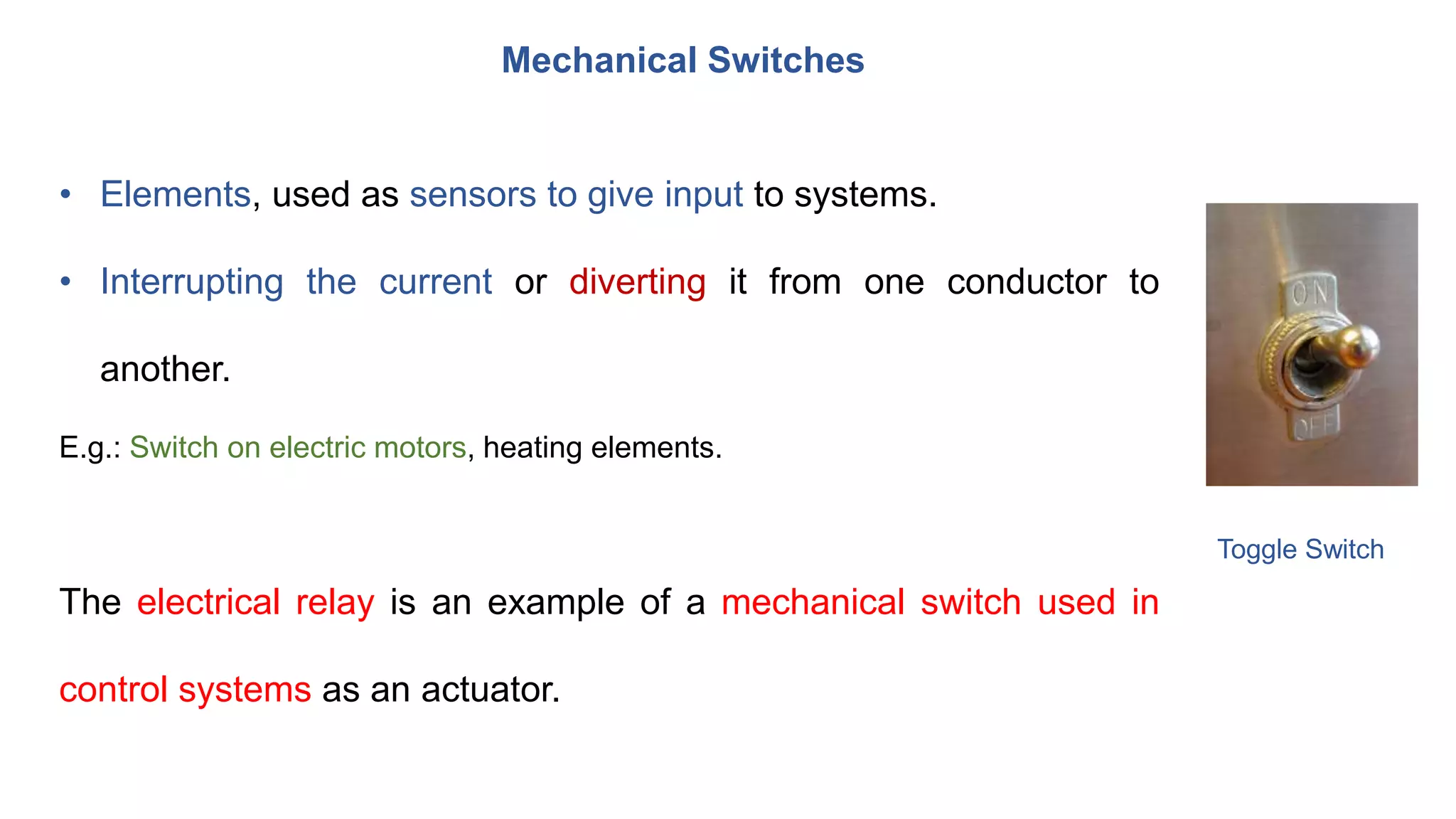
• Elements, used as sensors to give input to systems.
• Interrupting the current or diverting it from one conductor to
another.
E.g.: Switch on electric motors, heating elements.
The electrical relay is an example of a mechanical switch used in
control systems as an actuator.
Mechanical Switches
Toggle Switch
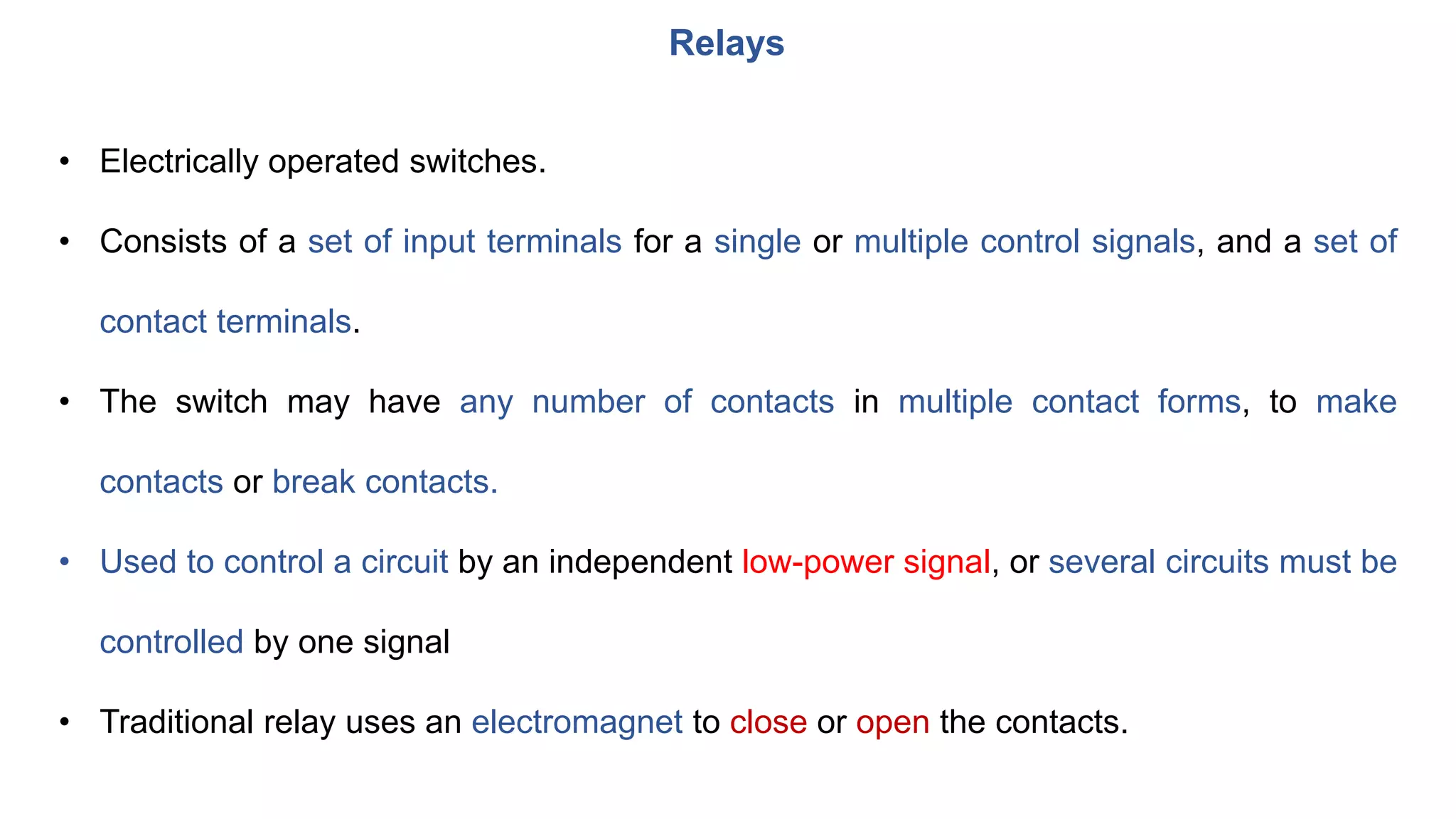
• Electrically operated switches.
• Consists of a set of input terminals for a single or multiple control signals, and a set of
contact terminals.
• The switch may have any number of contacts in multiple contact forms, to make
contacts or break contacts.
• Used to control a circuit by an independent low-power signal, or several circuits must be
controlled by one signal
• Traditional relay uses an electromagnet to close or open the contacts.
Relays
• A relay has electrical and mechanical components, hence it is
an electromechanical device.
• It consists of three contact terminal known as
• common (COM),
• normally closed (NC)
• normally opened(NO).
• In order to control the electric circuit, the relays close and open
these contacts.
• An electromechanical relay consists of three terminals namely
common (COM), normally closed (NC) and normally opened
(NO) contacts.
• These can either get opened or closed when the relay is in
operation.
Relays
• Electromechanical relays can work on both AC and DC supply.
• Relays work on the principle of electromagnetic induction.
• One major differences is that the AC relays have special circuit arrangement to provide
continuous magnetic field as in an AC relay, the demagnetization of coil happens each time
it reaches the current zero position.
Relays
Relays
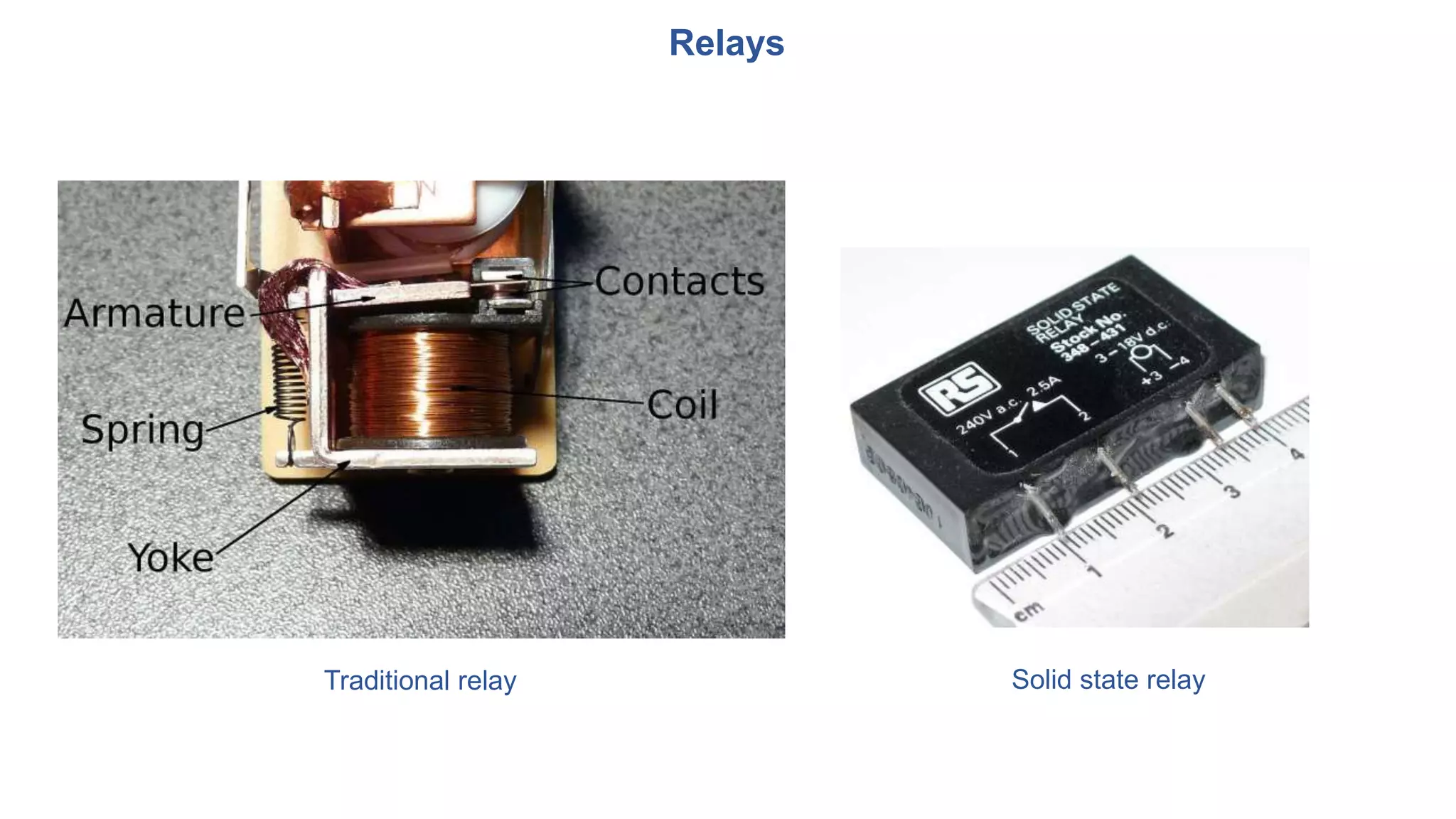
Traditional relay Solid state relay
• Changing a current in one electric circuit, switches a current on or off in another circuit.
Relays
Current through the solenoid relay produces magnetic field, which attracts the iron armature, moves
the push rod.
• Closes the normally open (NO) switch contacts
• Opens the normally closed (NC) switch contacts.
• Relays are inductances, generate a back voltage, when the energising current
is switched off or when the input switches from a high to low signal, results in a
damaging the circuit.
• To overcome this, a diode is connected across the relay.
• When the back e.m.f. occurs, the diode conducts and shorts it out, such a diode
is termed a free-wheeling or flyback diode.
Limitation of Relay
Applications / selection of Relay
Applications based on criterion like,
• Rating of contacts
• No. & type of contacts
• Voltage rating of contacts.
• Operating lifetime
• Coil voltage & current etc. so on.
• Used in power system networks for controlling purpose, automation purpose,
and protection purpose.
Solenoids
• Solenoids consist of a coil with an armature.
• When a current passes through it, armature is attracted to the coil and produces a magnetic field.
• When the current ceases, armature contracts a return spring, which then allows the armature to
return to its original position.
Electromagnetic actuator that converts
an electrical signal into a magnetic field
Solenoids
• The solenoids can be linear or rotary, on/off or variable positioning and are
operated by D.C. or A.C.
• Used as electrically operated actuators for short stroke devices, up to 25 mm.
Solenoids
• The basic forms of linear solenoids with (a) disk, (b) plunger, (c) conical
plunger, (d) ball forms of armature
(a) disk (b) plunger (c) conical plunger
Solenoids
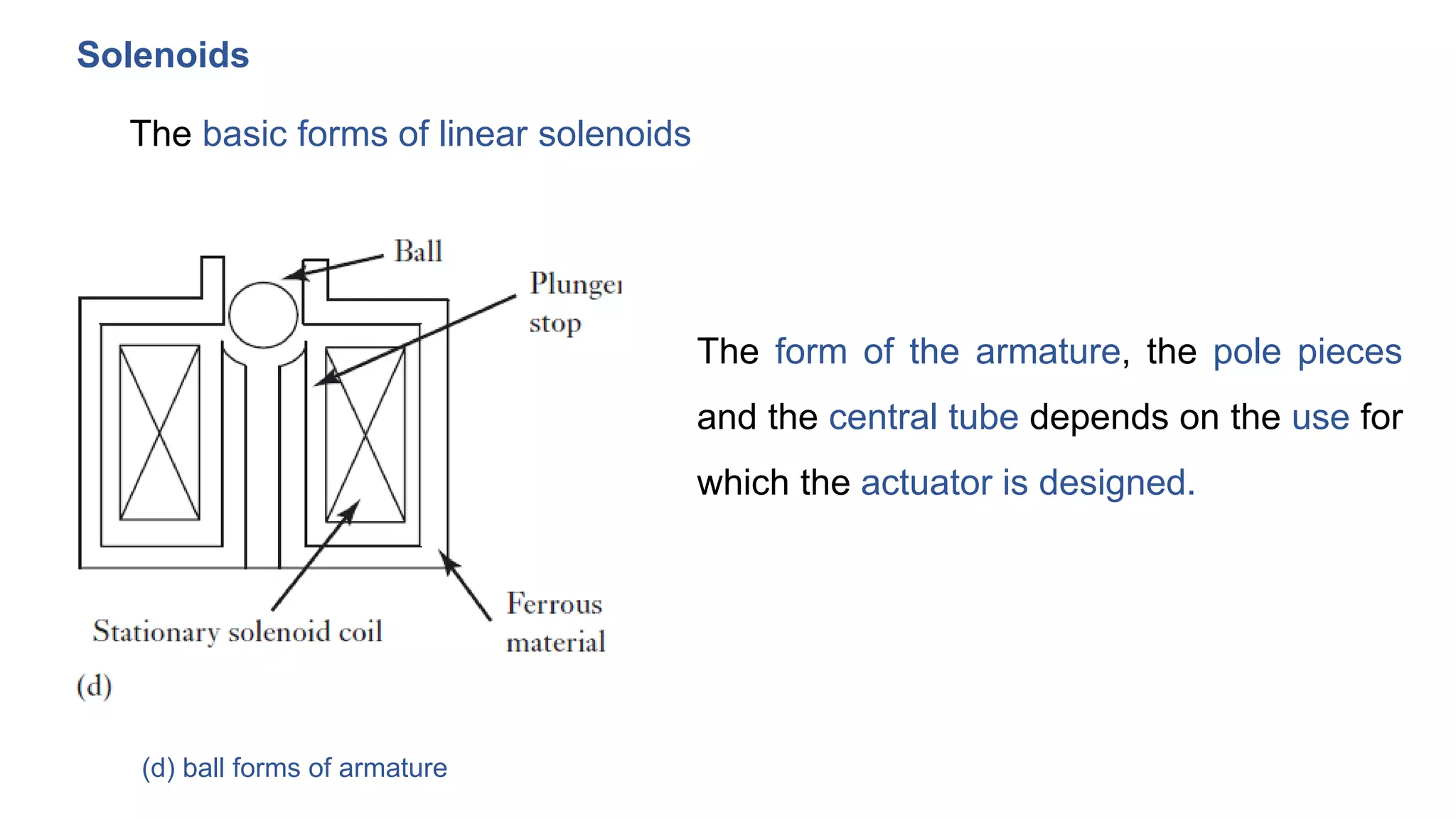
The basic forms of linear solenoids
(d) ball forms of armature
The form of the armature, the pole pieces
and the central tube depends on the use for
which the actuator is designed.
Solenoids
1. Disk armatures: Useful for small distances of travel and fast action are required.
2. Plunger armatures: Used for small distances of travel and fast action.
3. Conical armatures: Used for long-stroke applications
e.g.: automotive door lock mechanism.
4. Ball armatures: Used with fluid control applications
e.g.: air bag deployment
Electric motors
Electric motors, used as control element in positional and speed control systems.
Motors classification:
1. D. C Motors (brushless and brush type)
2. A.C. Motors
• In modern control systems D.C. motors are being used.
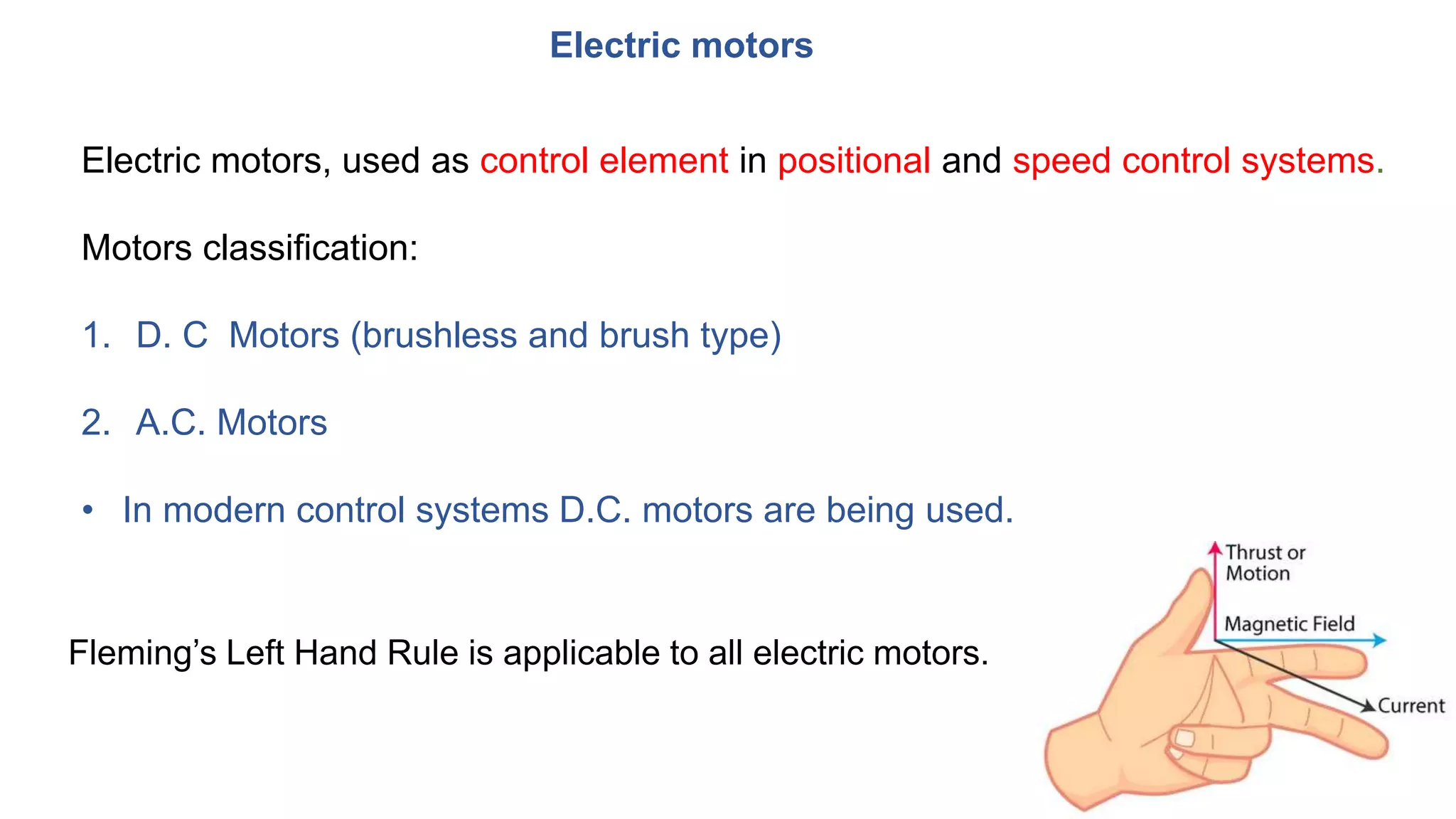
Fleming’s Left Hand Rule is applicable to all electric motors.
Electric motors
Motors can be classified into two main categories:
1. D.C. motors
2. A.C. motors
D.C. motors into two main groups; 1. Brush type and 2. Brushless type
• Brush type: Use brushes to make contact with a commutator ring assembly on the rotor to switch
the current from one rotor winding to another.
• Brush type of motor, the rotor has the coil winding and the stator can be either a permanent
magnet or an electromagnet.
• Brushless type: The arrangement is reversed in that the rotor is a permanent magnet and the
stator has the coil winding.
Classification
Motors classification:
Direct Current (DC) Motors
Working Principle:
• When current carrying conductor is kept in a Magnetic field a mechanical force
acts on the conductor, tends to rotate it in direction of force.
• The direction of force is given by Fleming’s left hand rule and the magnitude of
the force is given by equation;
F = BIL N (Newton)
B= flux density, wb/m²
I= current, Ampere
L= length of conductor, meter
Direct current motors
Brush-type d.c. motor
A brush-type d.c. motor is a coil of wire, free to
rotate (rotor), in the field of a permanent magnet
(stator).
Direct current motorsBrush-type d.c. motor
• For the rotation to continue, when the coil passes through the
vertical position the current direction through the coil has to
be reversed.
• This is done by use of brushes making contact with a
commutator.
• The commutator reverses the current in each coil as it moves
between the field poles for the rotation to continue.
• The direction of rotation can be reversed by reversing either
the armature current or the field current
Direct current motorsClassification
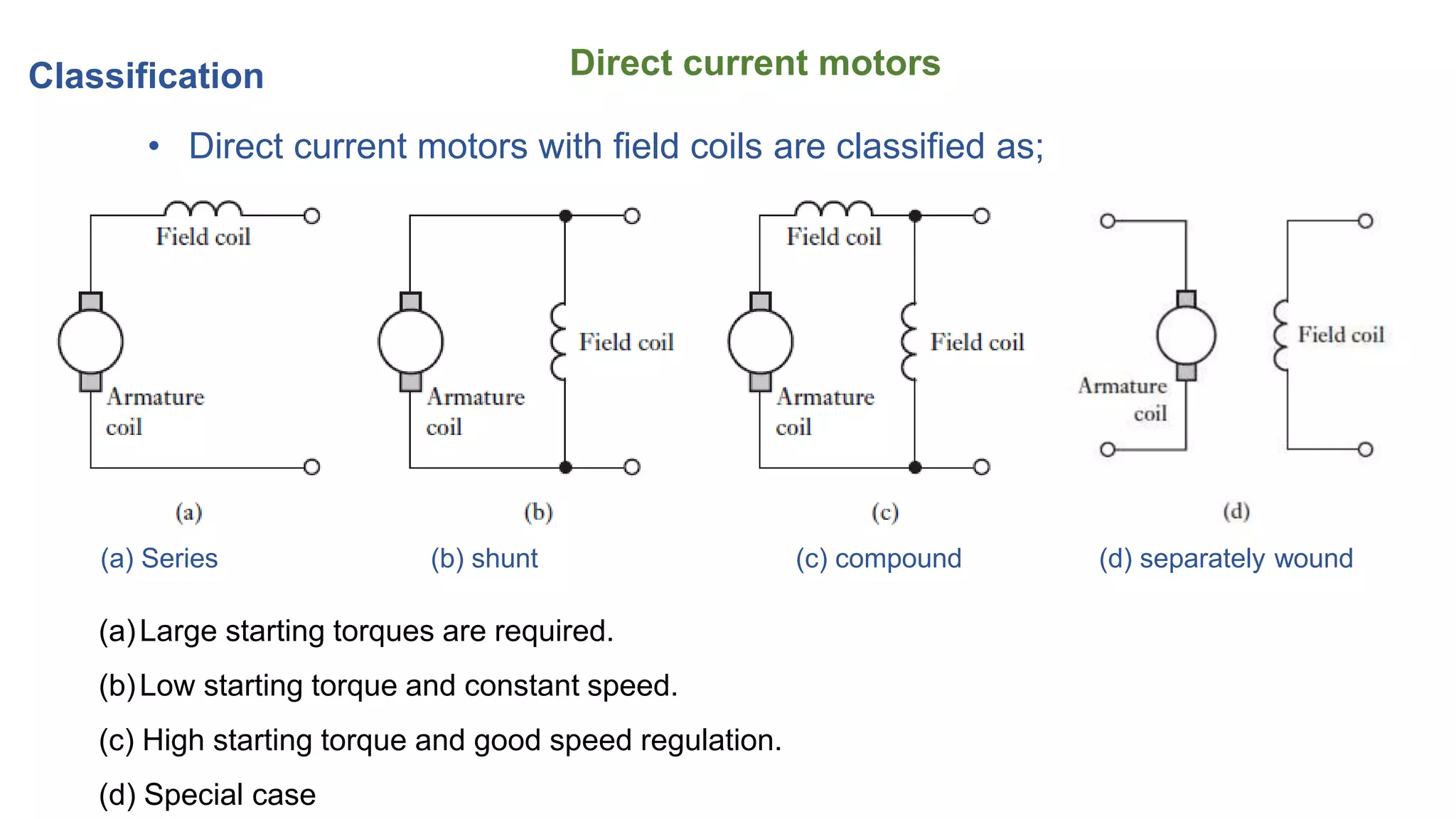
• Direct current motors with field coils are classified as;
(a) Series (b) shunt (c) compound (d) separately wound
(a)Large starting torques are required.
(b)Low starting torque and constant speed.
(c) High starting torque and good speed regulation.
(d) Special case
Principle
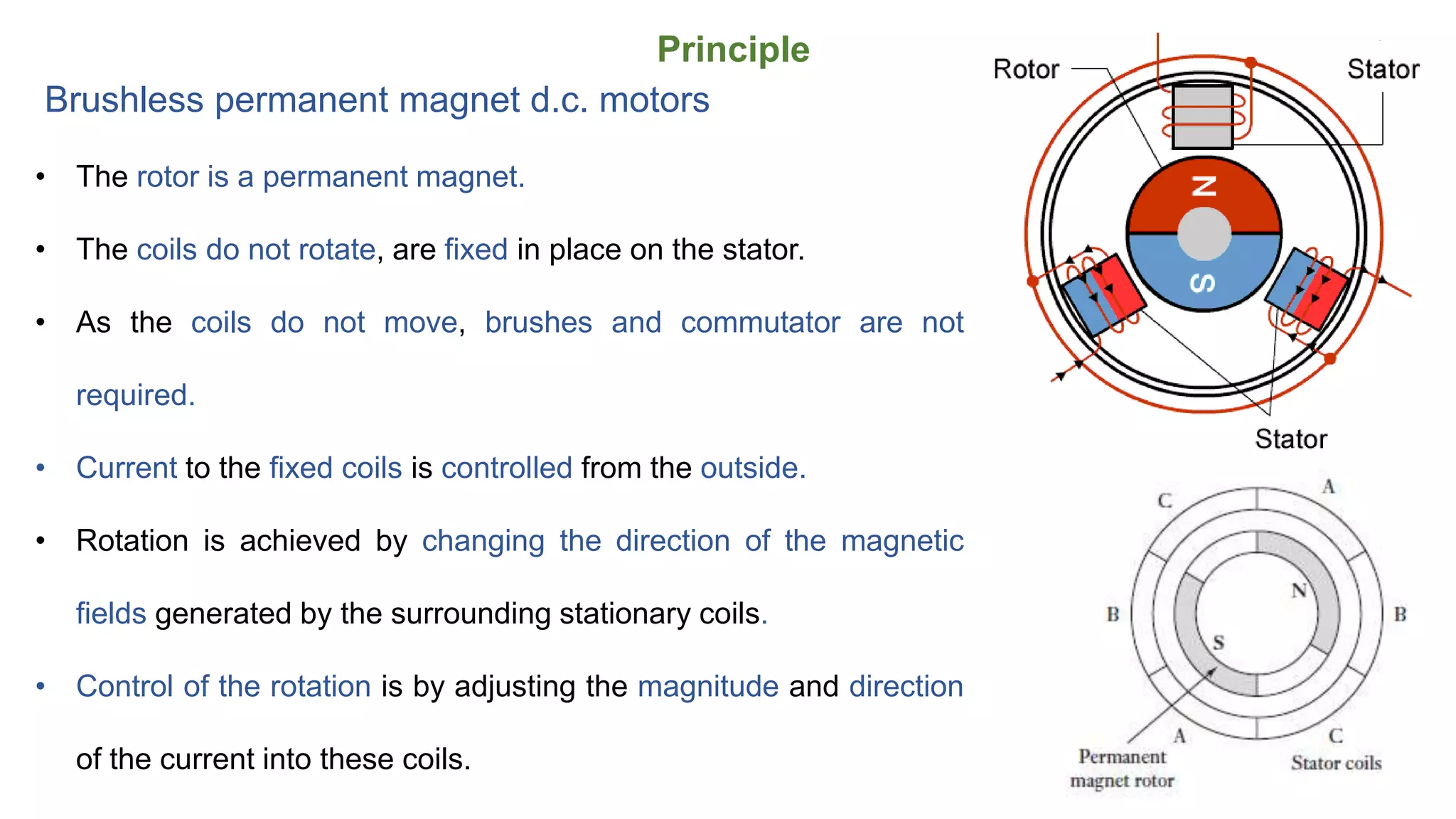
Brushless permanent magnet d.c. motors
• The rotor is a permanent magnet.
• The coils do not rotate, are fixed in place on the stator.
• As the coils do not move, brushes and commutator are not
required.
• Current to the fixed coils is controlled from the outside.
• Rotation is achieved by changing the direction of the magnetic
fields generated by the surrounding stationary coils.
• Control of the rotation is by adjusting the magnitude and direction
of the current into these coils.
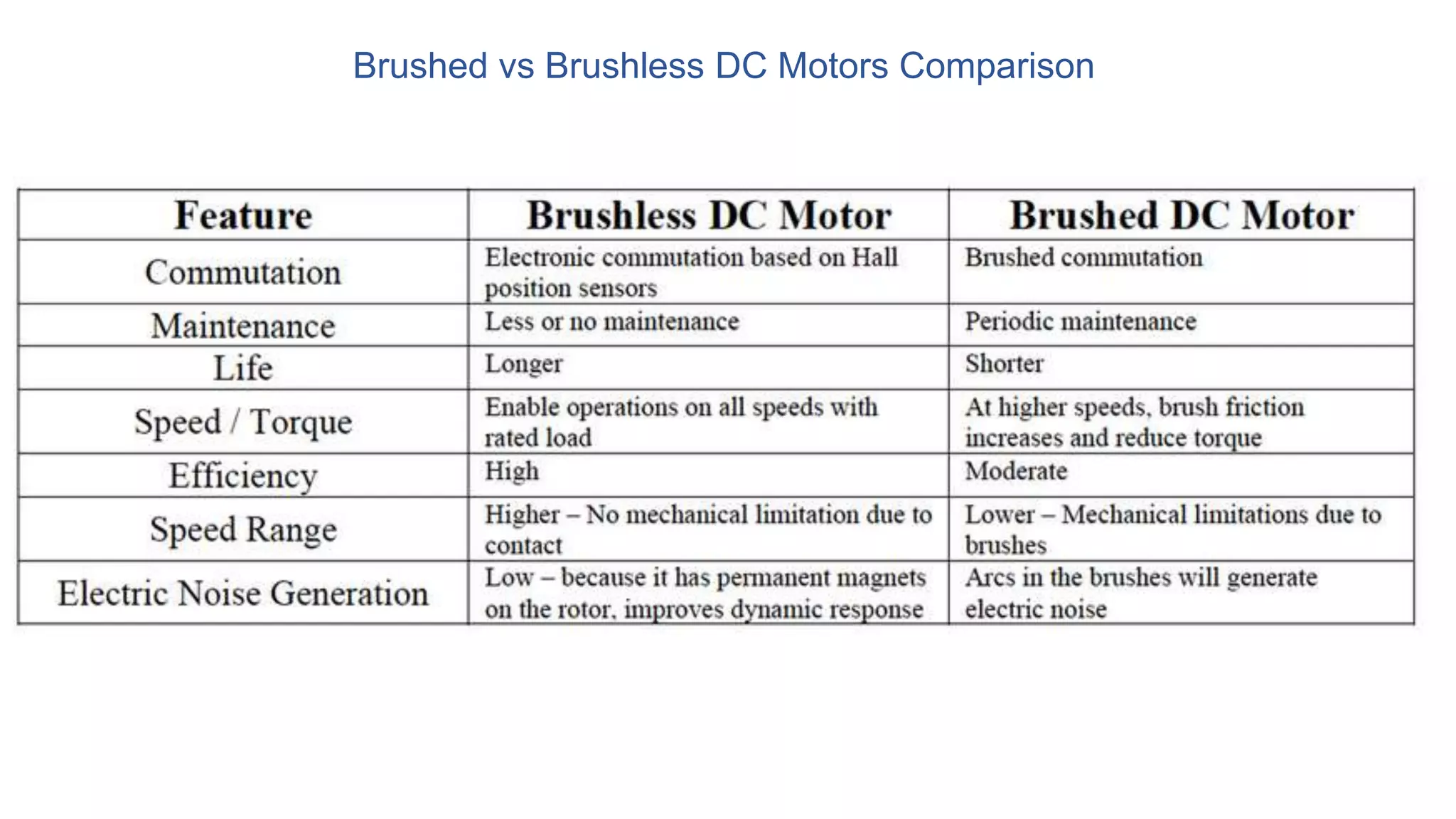
Brushed vs Brushless DC Motors Comparison
Principle
A C Motors
• The motor that converts the alternating current into mechanical power by using an electromagnetic
induction phenomenon.
• The stator and rotor are the two most important parts of the AC motors.
• The AC motor may be single phase or three phase (polyphase).
• In the case of DC motor, a current is passed through the coil, generating a torque on the coil. Typical
components include a stator and a rotor.
• The armature of rotor is a magnet unlike DC motors and the stator is formed by electromagnets
similar to DC motors.
Principle
A C Motors - Limitations
• The main limitation of AC motors over DC motors is speed control is more difficult.
• To overcome this limitation, AC motors are equipped with variable frequency drives but the
improved speed control comes together with a reduced power quality.
Principle A C Motors
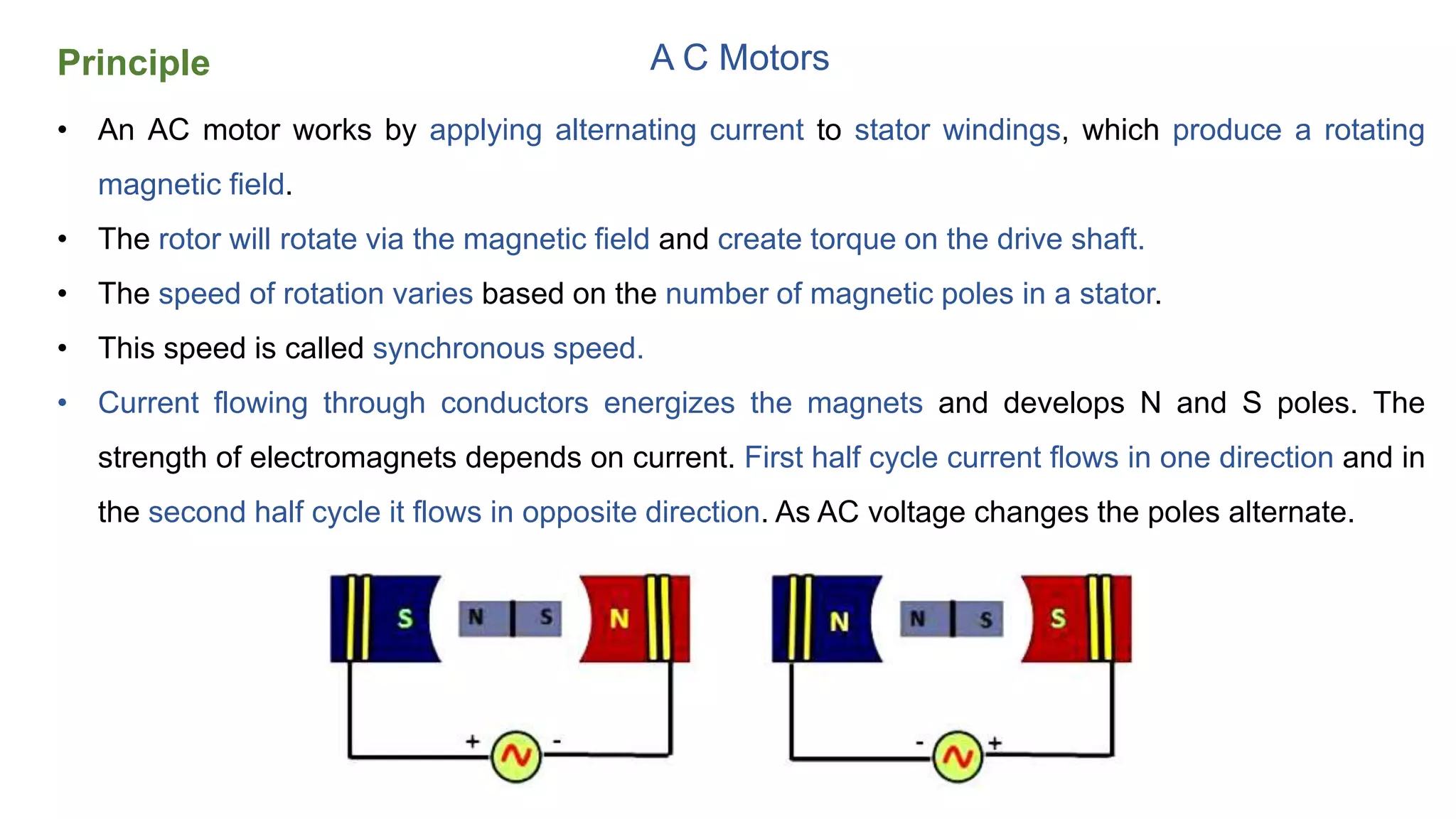
• An AC motor works by applying alternating current to stator windings, which produce a rotating
magnetic field.
• The rotor will rotate via the magnetic field and create torque on the drive shaft.
• The speed of rotation varies based on the number of magnetic poles in a stator.
• This speed is called synchronous speed.
• Current flowing through conductors energizes the magnets and develops N and S poles. The
strength of electromagnets depends on current. First half cycle current flows in one direction and in
the second half cycle it flows in opposite direction. As AC voltage changes the poles alternate.
Principle
A C Motors classification
Difference Between Single Phase and Three Phase AC Power Supplies
• A single phase AC has peak voltage at 90⁰ and 270⁰, in a complete cycle of 360⁰.
• With the peaks and dips in voltage, power is not delivered at a constant rate.
• In a single phase system, there is one neutral wire and one power wire with current
flowing between them.
Difference Between Single Phase and Three Phase AC Power Supplies
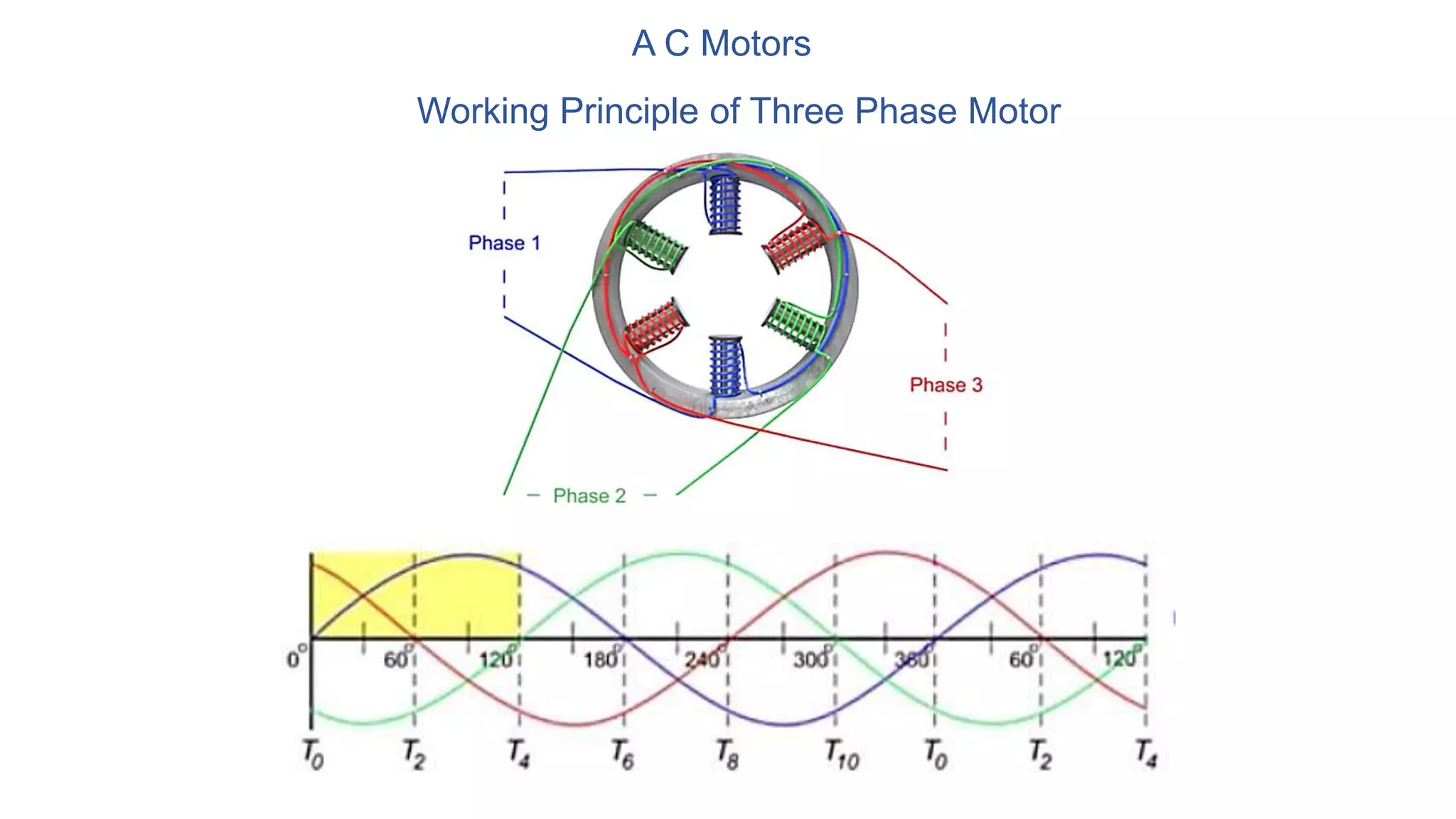
• In a 3 phase system there are three power wires, each 120⁰ out of phase with each other.
• Delta and wye are the two types of circuits use to maintain equal load across three phase
system, each resulting in different wire configurations.
• In the delta configuration, no neutral wire is used.
• The wye configuration uses both a neutral and a ground wire.
• In three phases, power enters the cycle by 120⁰.
• In a cycle of 360⁰, three phases of power have each peak voltage twice.
• A steady power is delivered at a constant rate, making it possible to carry more load.
Difference Between Single Phase and Three Phase AC Power Supplies
A C Motors
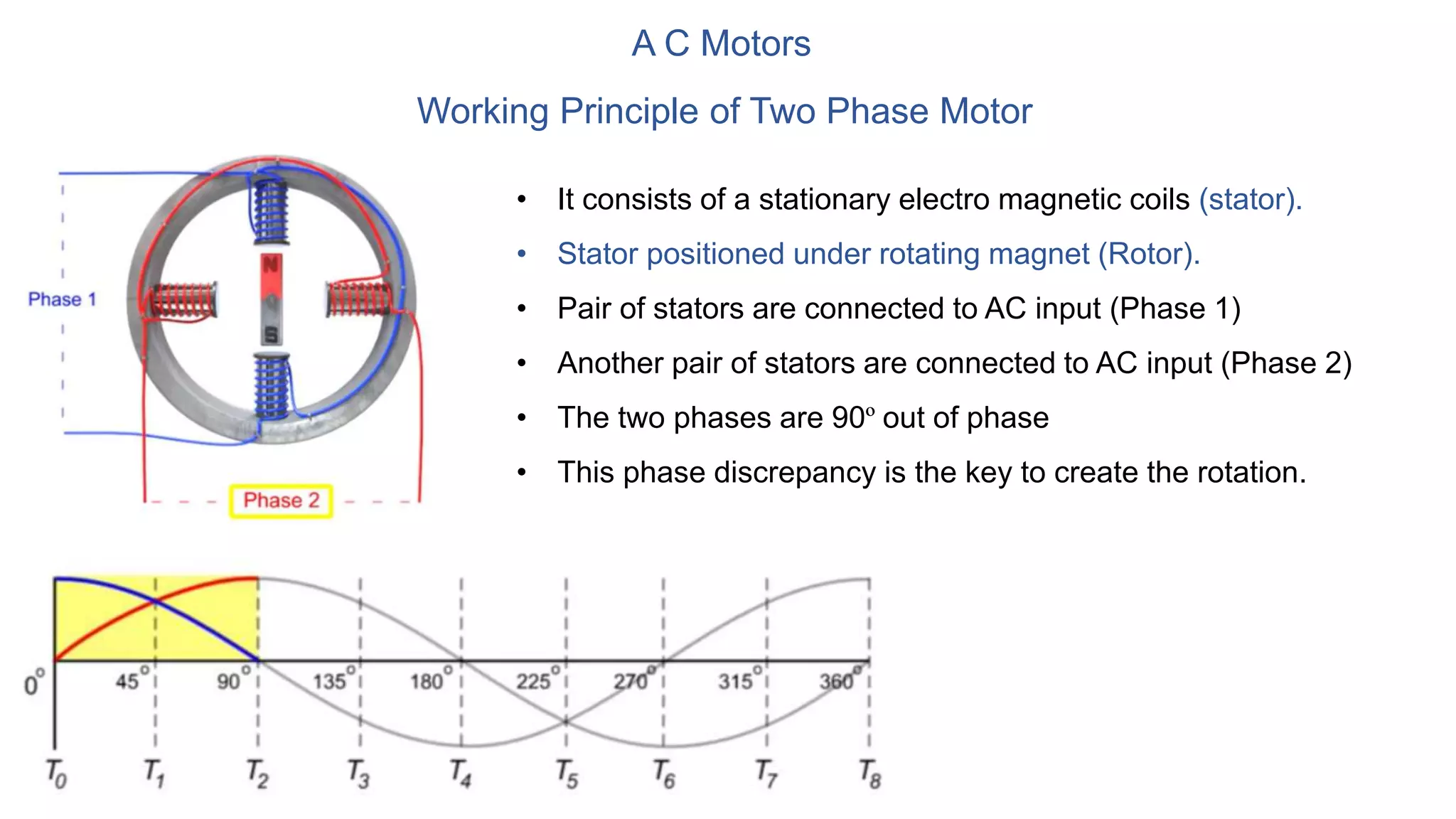
Working Principle of Two Phase Motor
• It consists of a stationary electro magnetic coils (stator).
• Stator positioned under rotating magnet (Rotor).
• Pair of stators are connected to AC input (Phase 1)
• Another pair of stators are connected to AC input (Phase 2)
• The two phases are 90º out of phase
• This phase discrepancy is the key to create the rotation.
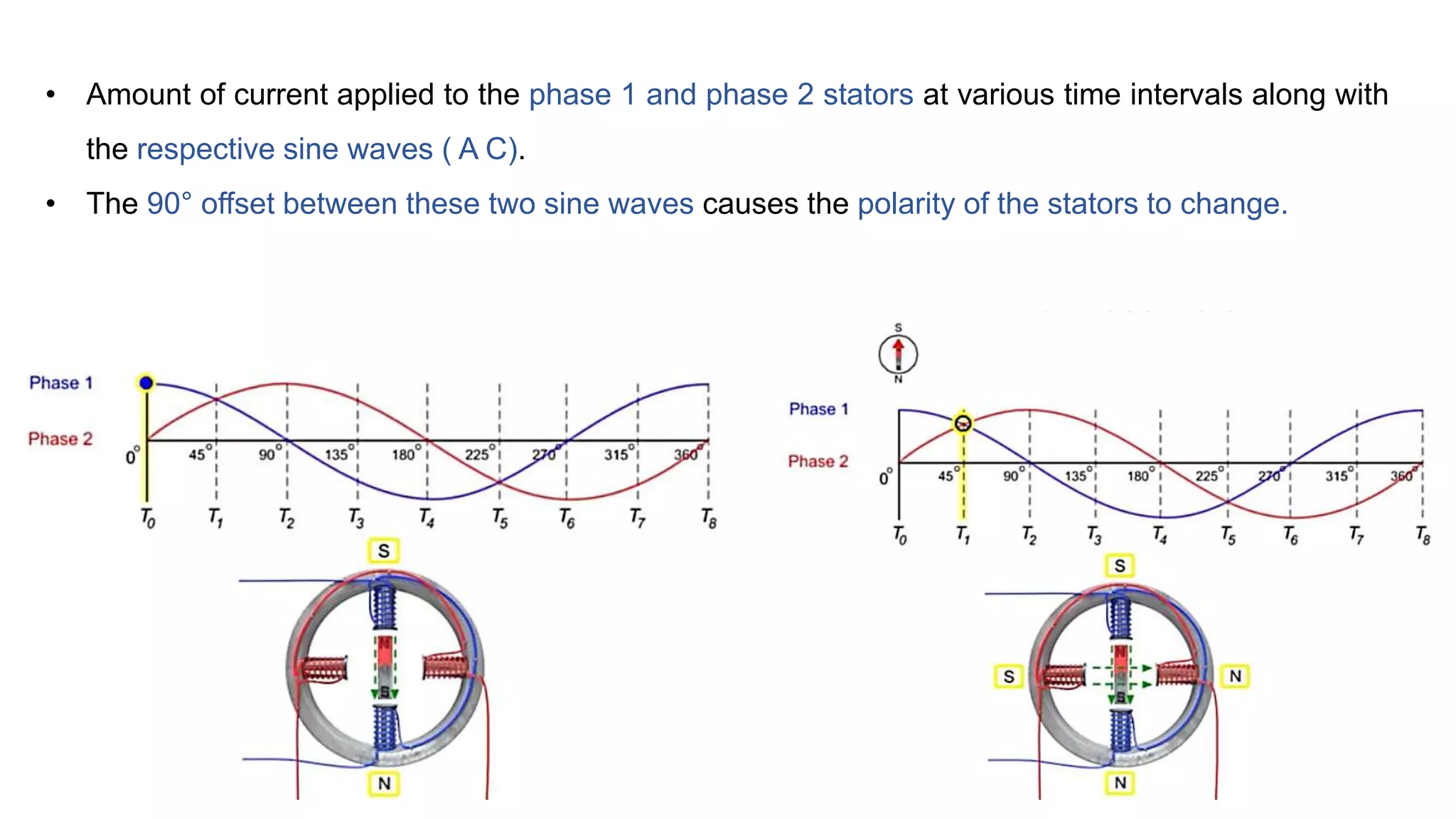
• Amount of current applied to the phase 1 and phase 2 stators at various time intervals along with
the respective sine waves ( A C).
• The 90° offset between these two sine waves causes the polarity of the stators to change.
Working Principle of Two Phase Motor
A C Motors
Working Principle of Three Phase Motor
Working Principle of Synchronous motor
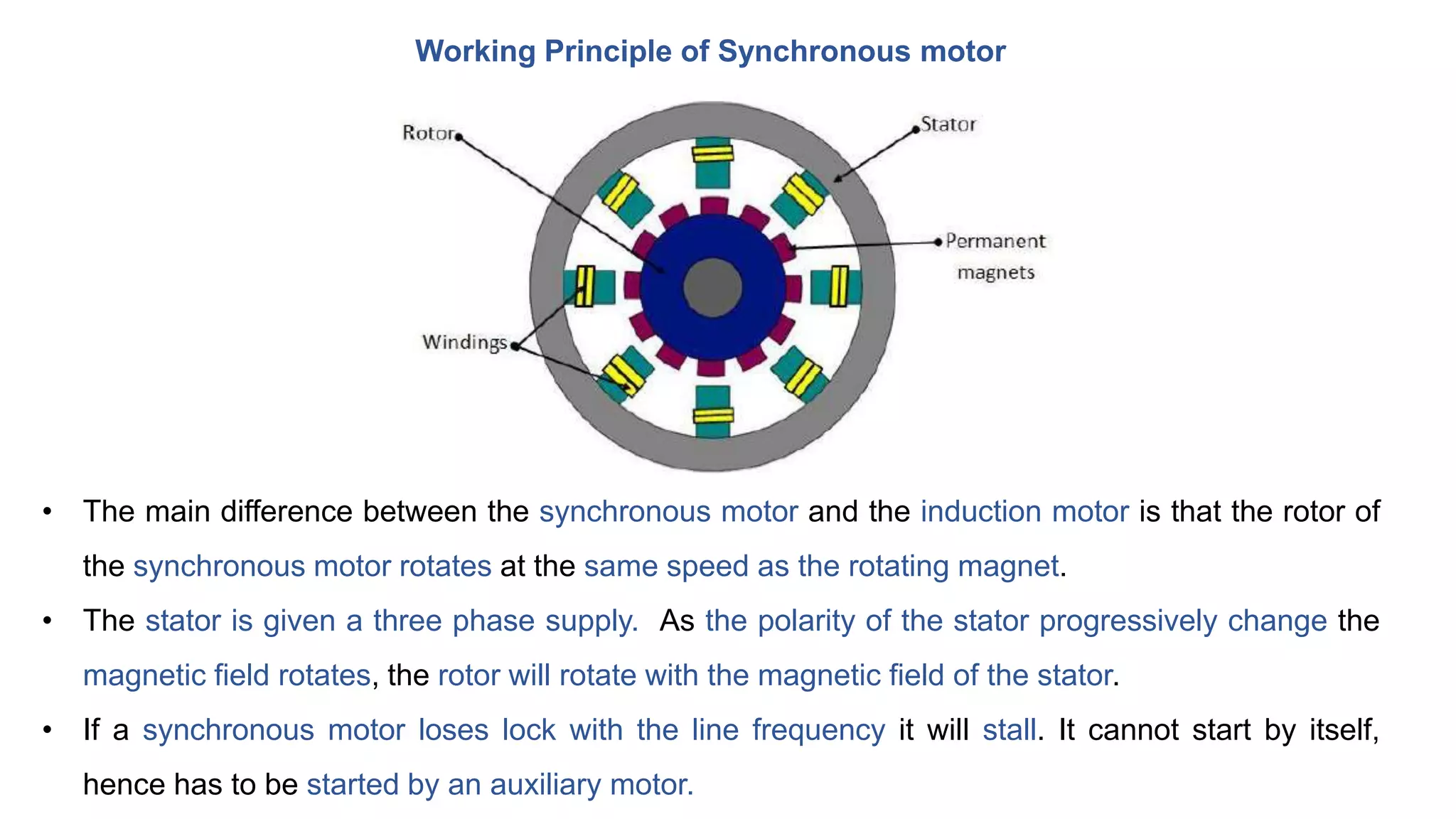
• A synchronous motor is an AC motor, runs at constant speed fixed by frequency of the system.
• It requires direct current (DC) for excitation and has low starting torque.
• It has two basic electrical parts i.e. stator and rotor as shown in fig.
• The stator consists of individual wounded electro-magnets arranged in such a way that they form a
hollow cylinder.
• The stator produces a rotating magnetic field that is proportional to the frequency supplied.
• The rotor consists of a permanent magnets arranged around a cylinder, with the poles facing
toward the stator poles.
Synchronous motor
Working Principle of Synchronous motor
• The main difference between the synchronous motor and the induction motor is that the rotor of
the synchronous motor rotates at the same speed as the rotating magnet.
• The stator is given a three phase supply. As the polarity of the stator progressively change the
magnetic field rotates, the rotor will rotate with the magnetic field of the stator.
• If a synchronous motor loses lock with the line frequency it will stall. It cannot start by itself,
hence has to be started by an auxiliary motor.
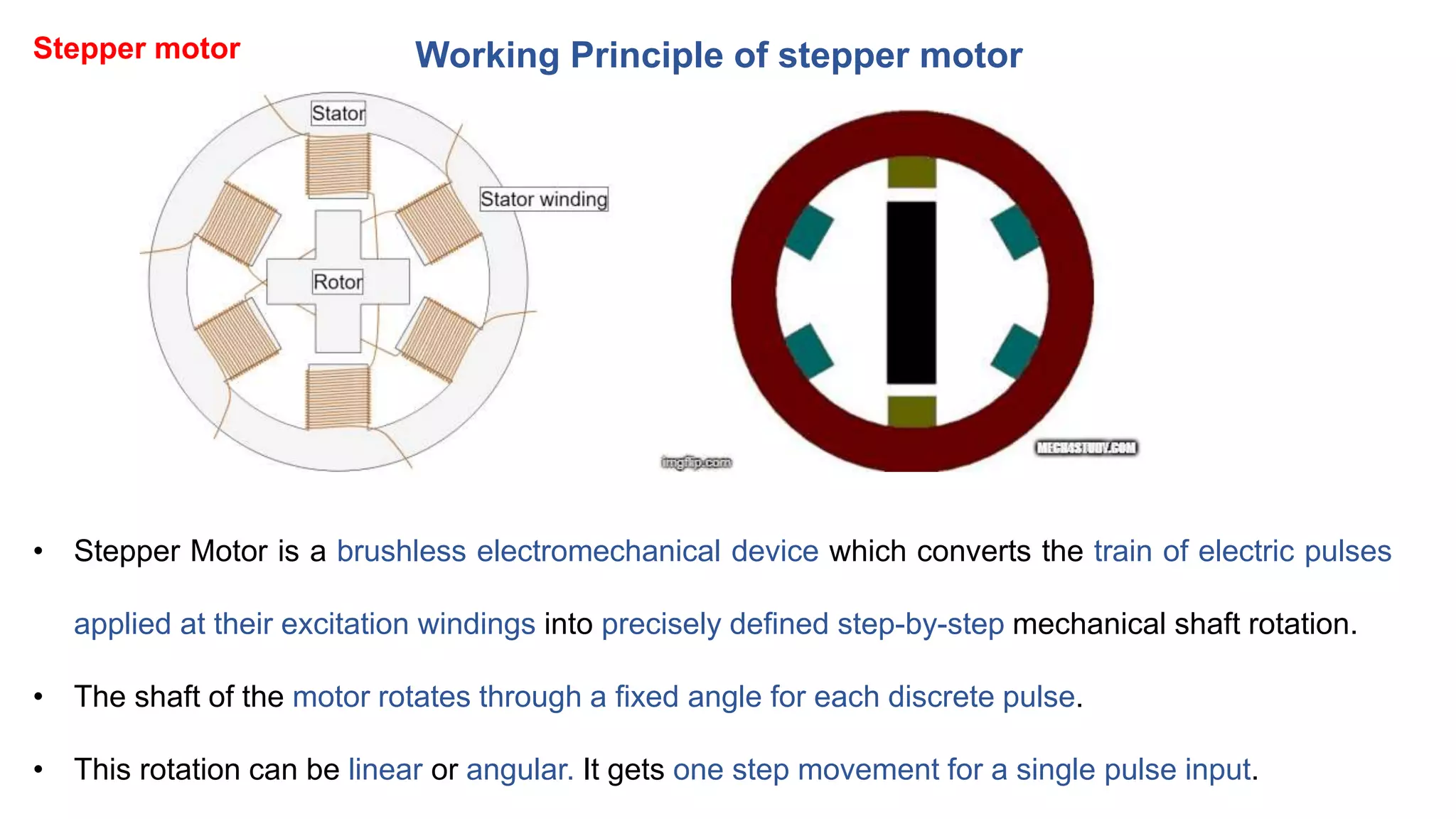
Working Principle of stepper motor
• Stepper Motor is a brushless electromechanical device which converts the train of electric pulses
applied at their excitation windings into precisely defined step-by-step mechanical shaft rotation.
• The shaft of the motor rotates through a fixed angle for each discrete pulse.
• This rotation can be linear or angular. It gets one step movement for a single pulse input.
Stepper motor
Working Principle of stepper motor
• At the beginning, coil A is energized and the rotor is aligned with the magnetic field it produces.
• When coil B is energized, the rotor rotates clockwise by 60° to align with the new magnetic field.
• The same happens when coil C is energized.
Stepper motor
Classification / Types of Stepper motor
1. Variable reluctance stepper motor.
2. Permanent magnet stepper motor.
3. Hybrid stepper motor.
Stepper Motors Advantages and Disadvantages
• Due to their internal structure, stepper motors do not require a sensor to detect the motor position.
Since the motor moves by “steps,” by simply counting these steps, you can obtain the motor
position at a given time.
• Stepper motor control is pretty simple.
• Stepper motors offer good torque at low speeds, are great for holding position, and also tend to
have a long lifespan.
Advantages
Stepper Motors Advantages and Disadvantages
• They can miss a step if the load torque is too high.
• These motors always drain maximum current even when still, which makes efficiency worse and
can cause overheating.
• Stepper motors have low torque and become noisy at high speeds
• Stepper motors have low power density and a low torque-to-inertia ratio
Disadvantages
• Factory automation
• Packaging
• Material handling
• Aerospace industry
• Laser measurements
• Robotics
Stepper Motors - Applications
• Servomotors are special electromechanical devices that produce precise degrees of rotation.
• A servo motor is a DC or AC or brushless DC motor combined with a position sensing device.
• Servomotors are also called control motors as they are involved in controlling a mechanical
system.
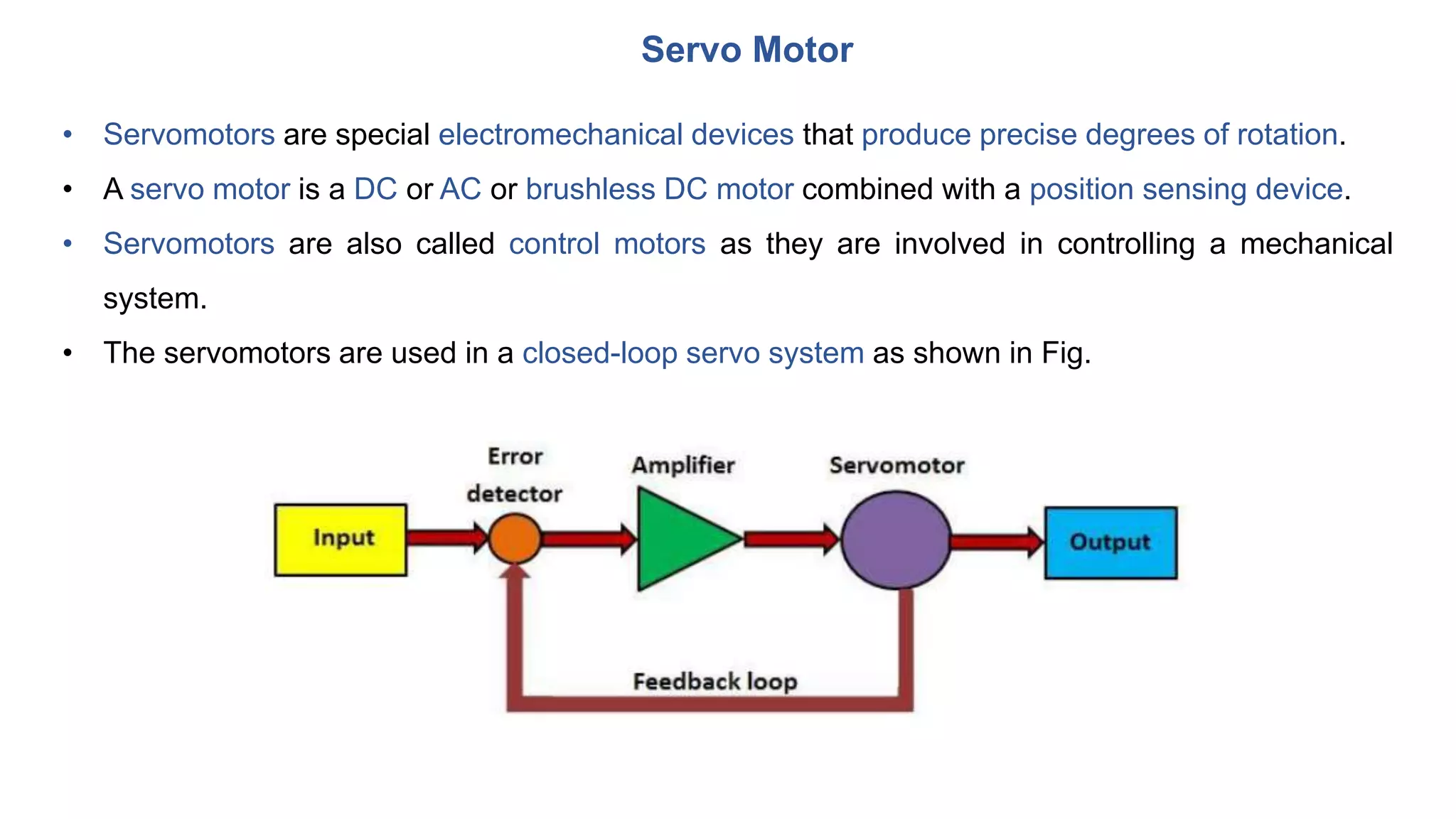
• The servomotors are used in a closed-loop servo system as shown in Fig.
Servo Motor
• A reference input is sent to the servo amplifier, which controls the speed of the servomotor.
• A feedback device is mounted on the machine, which is either an encoder or resolver. This device changes
mechanical motion into electrical signals and is used as a feedback.
• This feedback is sent to the error detector, which compares the actual operation with that of the reference
input.
• If there is an error, that error is fed directly to the amplifier, which will be used to make necessary
corrections in control action.
• In many servo systems, both velocity and position are monitored.
• Servomotors provide accurate speed, torque, and have ability of direction control.
Servo Motor
• Provides high intermittent torque, high torque to inertia ratio, and high speeds.
• Work well for velocity control.
• Available in all sizes.
• Quiet in operation.
• Smoother rotation at lower speeds.
Advantages of servo motors
• More expensive than stepper motors.
• Require tuning of control loop parameters.
• Not suitable for hazardous environments or in vacuum
• Excessive current can result in partial demagnetization of DC type servo motor
Disadvantages of servo motors
End

L6 Electrical Actuation system

  • 1.
    Department of MechanicalEngineering JSS Academy of Technical Education, Bangalore-560060 MECHATRONICS (Course Code:15ME753)
  • 2.
  • 3.
    TEXT BOOKS • MechatronicsElectronic control system in Mechanical and Electrical Engineering, W Bolton, Pearson Education, 1st Ed., 2005. REFERENCE BOOKS: • Mechatronics by HMT Ltd. - Tata McGraw-Hill, 1st Edition, 2000 Further Reference: National Programme on Technology Enhanced Learning (NPTEL) https://nptel.ac.in/courses/112103174/1 by Dr. S. N. Joshi (IITG)
  • 4.
    • Evaluate theoperational characteristics of electrical actuation systems like relays, solid-state switches, solenoids, D.C & A . C. motors. Learning Objectives
  • 5.
    Module 4 Electrical systems,Mechanical switches, Solenoids, Relays, DC/ AC Motors, Principle of Stepper Motor & Servomotor.
  • 6.
    The electrical systemsused as actuators for control. 1. Switching devices: Mechanical switches to control signal electrical device (e.g. Motor, heater etc.) e.g. relays, and solid-state switches, e.g. diodes, thyristors, and transistors. 2. Solenoid-type devices: Current through a solenoid is used to actuate / operate hydraulic / pneumatic valve to control the flow. 3. Drive systems: D.C. and A.C. motors. (current through motor is used to produce rotation). Introduction
  • 7.
    • Elements, usedas sensors to give input to systems. • Interrupting the current or diverting it from one conductor to another. E.g.: Switch on electric motors, heating elements. The electrical relay is an example of a mechanical switch used in control systems as an actuator. Mechanical Switches Toggle Switch
  • 8.
    • Electrically operatedswitches. • Consists of a set of input terminals for a single or multiple control signals, and a set of contact terminals. • The switch may have any number of contacts in multiple contact forms, to make contacts or break contacts. • Used to control a circuit by an independent low-power signal, or several circuits must be controlled by one signal • Traditional relay uses an electromagnet to close or open the contacts. Relays
  • 9.
    • A relayhas electrical and mechanical components, hence it is an electromechanical device. • It consists of three contact terminal known as • common (COM), • normally closed (NC) • normally opened(NO). • In order to control the electric circuit, the relays close and open these contacts. • An electromechanical relay consists of three terminals namely common (COM), normally closed (NC) and normally opened (NO) contacts. • These can either get opened or closed when the relay is in operation. Relays
  • 10.
    • Electromechanical relayscan work on both AC and DC supply. • Relays work on the principle of electromagnetic induction. • One major differences is that the AC relays have special circuit arrangement to provide continuous magnetic field as in an AC relay, the demagnetization of coil happens each time it reaches the current zero position. Relays
  • 11.
  • 12.
    • Changing acurrent in one electric circuit, switches a current on or off in another circuit. Relays Current through the solenoid relay produces magnetic field, which attracts the iron armature, moves the push rod. • Closes the normally open (NO) switch contacts • Opens the normally closed (NC) switch contacts.
  • 13.
    • Relays areinductances, generate a back voltage, when the energising current is switched off or when the input switches from a high to low signal, results in a damaging the circuit. • To overcome this, a diode is connected across the relay. • When the back e.m.f. occurs, the diode conducts and shorts it out, such a diode is termed a free-wheeling or flyback diode. Limitation of Relay
  • 14.
    Applications / selectionof Relay Applications based on criterion like, • Rating of contacts • No. & type of contacts • Voltage rating of contacts. • Operating lifetime • Coil voltage & current etc. so on. • Used in power system networks for controlling purpose, automation purpose, and protection purpose.
  • 15.
    Solenoids • Solenoids consistof a coil with an armature. • When a current passes through it, armature is attracted to the coil and produces a magnetic field. • When the current ceases, armature contracts a return spring, which then allows the armature to return to its original position. Electromagnetic actuator that converts an electrical signal into a magnetic field
  • 16.
    Solenoids • The solenoidscan be linear or rotary, on/off or variable positioning and are operated by D.C. or A.C. • Used as electrically operated actuators for short stroke devices, up to 25 mm.
  • 17.
    Solenoids • The basicforms of linear solenoids with (a) disk, (b) plunger, (c) conical plunger, (d) ball forms of armature (a) disk (b) plunger (c) conical plunger
  • 18.
    Solenoids The basic formsof linear solenoids (d) ball forms of armature The form of the armature, the pole pieces and the central tube depends on the use for which the actuator is designed.
  • 19.
    Solenoids 1. Disk armatures:Useful for small distances of travel and fast action are required. 2. Plunger armatures: Used for small distances of travel and fast action. 3. Conical armatures: Used for long-stroke applications e.g.: automotive door lock mechanism. 4. Ball armatures: Used with fluid control applications e.g.: air bag deployment
  • 20.
    Electric motors Electric motors,used as control element in positional and speed control systems. Motors classification: 1. D. C Motors (brushless and brush type) 2. A.C. Motors • In modern control systems D.C. motors are being used. Fleming’s Left Hand Rule is applicable to all electric motors.
  • 21.
    Electric motors Motors canbe classified into two main categories: 1. D.C. motors 2. A.C. motors D.C. motors into two main groups; 1. Brush type and 2. Brushless type • Brush type: Use brushes to make contact with a commutator ring assembly on the rotor to switch the current from one rotor winding to another. • Brush type of motor, the rotor has the coil winding and the stator can be either a permanent magnet or an electromagnet. • Brushless type: The arrangement is reversed in that the rotor is a permanent magnet and the stator has the coil winding.
  • 22.
  • 23.
    Direct Current (DC)Motors Working Principle: • When current carrying conductor is kept in a Magnetic field a mechanical force acts on the conductor, tends to rotate it in direction of force. • The direction of force is given by Fleming’s left hand rule and the magnitude of the force is given by equation; F = BIL N (Newton) B= flux density, wb/m² I= current, Ampere L= length of conductor, meter
  • 24.
    Direct current motors Brush-typed.c. motor A brush-type d.c. motor is a coil of wire, free to rotate (rotor), in the field of a permanent magnet (stator).
  • 25.
    Direct current motorsBrush-typed.c. motor • For the rotation to continue, when the coil passes through the vertical position the current direction through the coil has to be reversed. • This is done by use of brushes making contact with a commutator. • The commutator reverses the current in each coil as it moves between the field poles for the rotation to continue. • The direction of rotation can be reversed by reversing either the armature current or the field current
  • 26.
    Direct current motorsClassification •Direct current motors with field coils are classified as; (a) Series (b) shunt (c) compound (d) separately wound (a)Large starting torques are required. (b)Low starting torque and constant speed. (c) High starting torque and good speed regulation. (d) Special case
  • 27.
    Principle Brushless permanent magnetd.c. motors • The rotor is a permanent magnet. • The coils do not rotate, are fixed in place on the stator. • As the coils do not move, brushes and commutator are not required. • Current to the fixed coils is controlled from the outside. • Rotation is achieved by changing the direction of the magnetic fields generated by the surrounding stationary coils. • Control of the rotation is by adjusting the magnitude and direction of the current into these coils.
  • 29.
    Brushed vs BrushlessDC Motors Comparison
  • 30.
    Principle A C Motors •The motor that converts the alternating current into mechanical power by using an electromagnetic induction phenomenon. • The stator and rotor are the two most important parts of the AC motors. • The AC motor may be single phase or three phase (polyphase). • In the case of DC motor, a current is passed through the coil, generating a torque on the coil. Typical components include a stator and a rotor. • The armature of rotor is a magnet unlike DC motors and the stator is formed by electromagnets similar to DC motors.
  • 31.
    Principle A C Motors- Limitations • The main limitation of AC motors over DC motors is speed control is more difficult. • To overcome this limitation, AC motors are equipped with variable frequency drives but the improved speed control comes together with a reduced power quality.
  • 32.
    Principle A CMotors • An AC motor works by applying alternating current to stator windings, which produce a rotating magnetic field. • The rotor will rotate via the magnetic field and create torque on the drive shaft. • The speed of rotation varies based on the number of magnetic poles in a stator. • This speed is called synchronous speed. • Current flowing through conductors energizes the magnets and develops N and S poles. The strength of electromagnets depends on current. First half cycle current flows in one direction and in the second half cycle it flows in opposite direction. As AC voltage changes the poles alternate.
  • 33.
    Principle A C Motorsclassification
  • 34.
    Difference Between SinglePhase and Three Phase AC Power Supplies • A single phase AC has peak voltage at 90⁰ and 270⁰, in a complete cycle of 360⁰. • With the peaks and dips in voltage, power is not delivered at a constant rate. • In a single phase system, there is one neutral wire and one power wire with current flowing between them.
  • 35.
    Difference Between SinglePhase and Three Phase AC Power Supplies • In a 3 phase system there are three power wires, each 120⁰ out of phase with each other. • Delta and wye are the two types of circuits use to maintain equal load across three phase system, each resulting in different wire configurations. • In the delta configuration, no neutral wire is used. • The wye configuration uses both a neutral and a ground wire. • In three phases, power enters the cycle by 120⁰. • In a cycle of 360⁰, three phases of power have each peak voltage twice. • A steady power is delivered at a constant rate, making it possible to carry more load.
  • 36.
    Difference Between SinglePhase and Three Phase AC Power Supplies
  • 37.
    A C Motors WorkingPrinciple of Two Phase Motor • It consists of a stationary electro magnetic coils (stator). • Stator positioned under rotating magnet (Rotor). • Pair of stators are connected to AC input (Phase 1) • Another pair of stators are connected to AC input (Phase 2) • The two phases are 90º out of phase • This phase discrepancy is the key to create the rotation.
  • 38.
    • Amount ofcurrent applied to the phase 1 and phase 2 stators at various time intervals along with the respective sine waves ( A C). • The 90° offset between these two sine waves causes the polarity of the stators to change.
  • 39.
    Working Principle ofTwo Phase Motor
  • 40.
    A C Motors WorkingPrinciple of Three Phase Motor
  • 42.
    Working Principle ofSynchronous motor • A synchronous motor is an AC motor, runs at constant speed fixed by frequency of the system. • It requires direct current (DC) for excitation and has low starting torque. • It has two basic electrical parts i.e. stator and rotor as shown in fig. • The stator consists of individual wounded electro-magnets arranged in such a way that they form a hollow cylinder. • The stator produces a rotating magnetic field that is proportional to the frequency supplied. • The rotor consists of a permanent magnets arranged around a cylinder, with the poles facing toward the stator poles. Synchronous motor
  • 43.
    Working Principle ofSynchronous motor • The main difference between the synchronous motor and the induction motor is that the rotor of the synchronous motor rotates at the same speed as the rotating magnet. • The stator is given a three phase supply. As the polarity of the stator progressively change the magnetic field rotates, the rotor will rotate with the magnetic field of the stator. • If a synchronous motor loses lock with the line frequency it will stall. It cannot start by itself, hence has to be started by an auxiliary motor.
  • 44.
    Working Principle ofstepper motor • Stepper Motor is a brushless electromechanical device which converts the train of electric pulses applied at their excitation windings into precisely defined step-by-step mechanical shaft rotation. • The shaft of the motor rotates through a fixed angle for each discrete pulse. • This rotation can be linear or angular. It gets one step movement for a single pulse input. Stepper motor
  • 45.
    Working Principle ofstepper motor • At the beginning, coil A is energized and the rotor is aligned with the magnetic field it produces. • When coil B is energized, the rotor rotates clockwise by 60° to align with the new magnetic field. • The same happens when coil C is energized. Stepper motor
  • 46.
    Classification / Typesof Stepper motor 1. Variable reluctance stepper motor. 2. Permanent magnet stepper motor. 3. Hybrid stepper motor.
  • 47.
    Stepper Motors Advantagesand Disadvantages • Due to their internal structure, stepper motors do not require a sensor to detect the motor position. Since the motor moves by “steps,” by simply counting these steps, you can obtain the motor position at a given time. • Stepper motor control is pretty simple. • Stepper motors offer good torque at low speeds, are great for holding position, and also tend to have a long lifespan. Advantages
  • 48.
    Stepper Motors Advantagesand Disadvantages • They can miss a step if the load torque is too high. • These motors always drain maximum current even when still, which makes efficiency worse and can cause overheating. • Stepper motors have low torque and become noisy at high speeds • Stepper motors have low power density and a low torque-to-inertia ratio Disadvantages
  • 49.
    • Factory automation •Packaging • Material handling • Aerospace industry • Laser measurements • Robotics Stepper Motors - Applications
  • 50.
    • Servomotors arespecial electromechanical devices that produce precise degrees of rotation. • A servo motor is a DC or AC or brushless DC motor combined with a position sensing device. • Servomotors are also called control motors as they are involved in controlling a mechanical system. • The servomotors are used in a closed-loop servo system as shown in Fig. Servo Motor
  • 51.
    • A referenceinput is sent to the servo amplifier, which controls the speed of the servomotor. • A feedback device is mounted on the machine, which is either an encoder or resolver. This device changes mechanical motion into electrical signals and is used as a feedback. • This feedback is sent to the error detector, which compares the actual operation with that of the reference input. • If there is an error, that error is fed directly to the amplifier, which will be used to make necessary corrections in control action. • In many servo systems, both velocity and position are monitored. • Servomotors provide accurate speed, torque, and have ability of direction control. Servo Motor
  • 52.
    • Provides highintermittent torque, high torque to inertia ratio, and high speeds. • Work well for velocity control. • Available in all sizes. • Quiet in operation. • Smoother rotation at lower speeds. Advantages of servo motors
  • 53.
    • More expensivethan stepper motors. • Require tuning of control loop parameters. • Not suitable for hazardous environments or in vacuum • Excessive current can result in partial demagnetization of DC type servo motor Disadvantages of servo motors
  • 54.