PREJUDICE SW 6103:  Human Behaviour and Social Environment Group- ”D”
Synopsis Concept and Characteristics –   Ms. Sarita Origin and Process of Prejudice –   Mr. Rupesh Sources of Prejudice –   Mr. Ravi Applicability in Social Work –   Ms. Sakshi Concluding Remarks –   Mr. Ravi
Prejudice…Negative Attitude “ Prejudice decides our perception of reality”
Concept Prejudice is an attitude that predisposes a person to think, perceive, feel and act in favorable or unfavorable way In social psychology ...is defined as a negative attitude
Characteristics … required … has emotional terms … directed towards the group as a whole … based on rigid/inflexible generalizations … not factual Prejudice
Origin and Process Prejudice is learned Develops during Socialization Views expressed by parents, friends, teachers and others Early Experience: The Role of Social Learning
Early Experience: The Role of Social Learning Social Norms of groups:   “If the members of my group dislike the person ‘X’, many children seem to reason, ‘then I should too!” Mass Media
Origin and Process contd… Direct Intergroup Conflict “ Competition as a source of Prejudice”
Origin and Process contd… Things people want and value most are always in short supply Realistic Conflict Theory:  Prejudices stems from competition among social groups over valued commodities or opportunities As such competition continues – members of group involved come to view each other in increasingly negative terms
Social Categorization: The ‘Us’ vs. ‘Them’ Effect Origin and Process contd… View other person as belonging either to their own group (ingroup) or another group (outgroup) Commonly based on gender, religion, age, ethnic background, occupation, income… People view ‘Us’ category in favorable terms – ‘Them’ category – perceived more negatively
Social Cognition:  ways in which we think about others and make judgements about them Stereotypes:  allow us to make quick and dirty judgements about others without engaging in complex and more effortful thought Origin and Process contd…
Sources of Prejudice Social Emotional Cognitive   An outcome of the intricate interplay of three distinct sources:
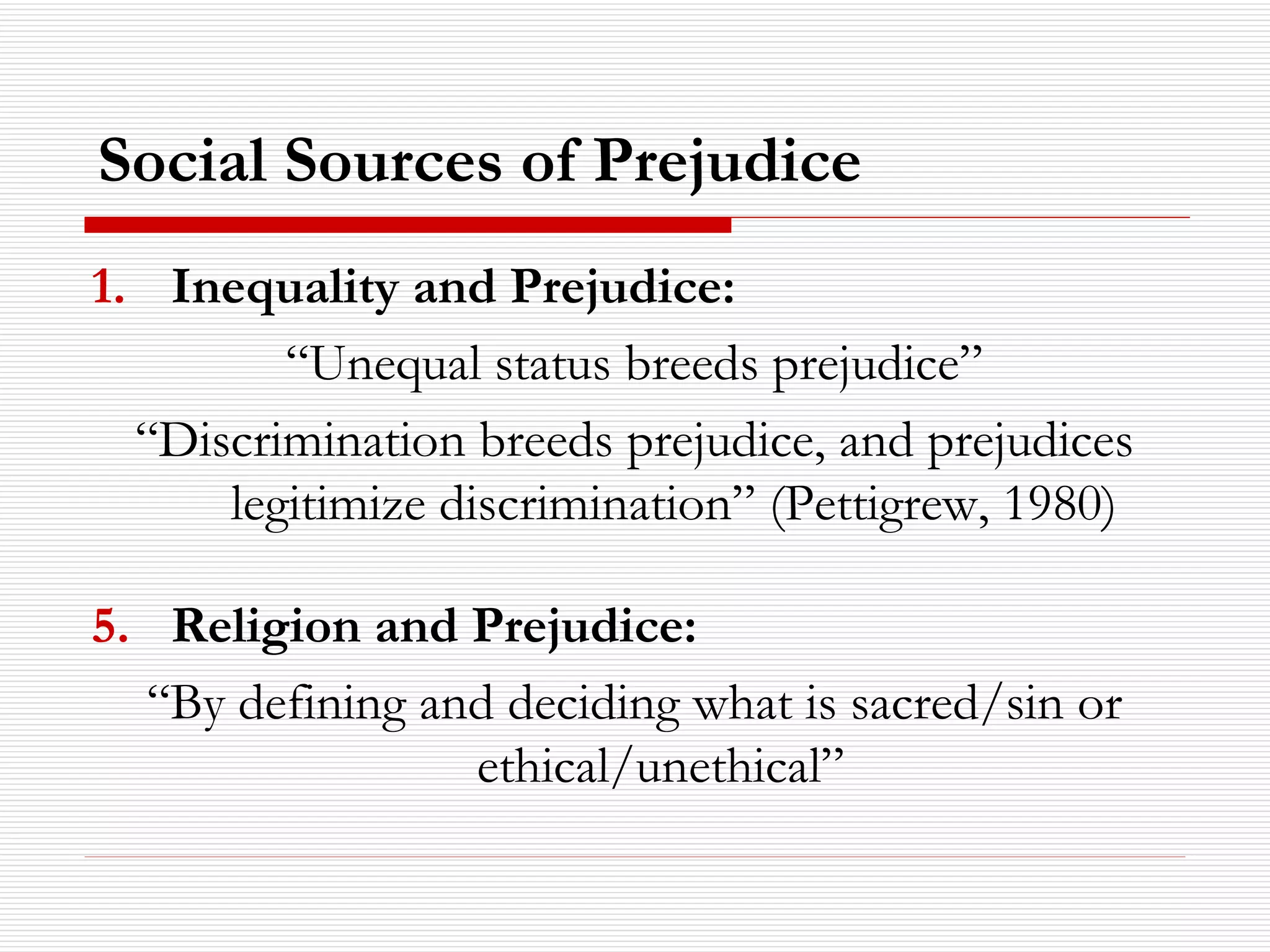
Social Sources of Prejudice   Inequality and Prejudice: “ Unequal status breeds prejudice” “ Discrimination breeds prejudice, and prejudices legitimize discrimination” (Pettigrew, 1980) Religion and Prejudice: “ By defining and deciding what is sacred/sin or ethical/unethical”
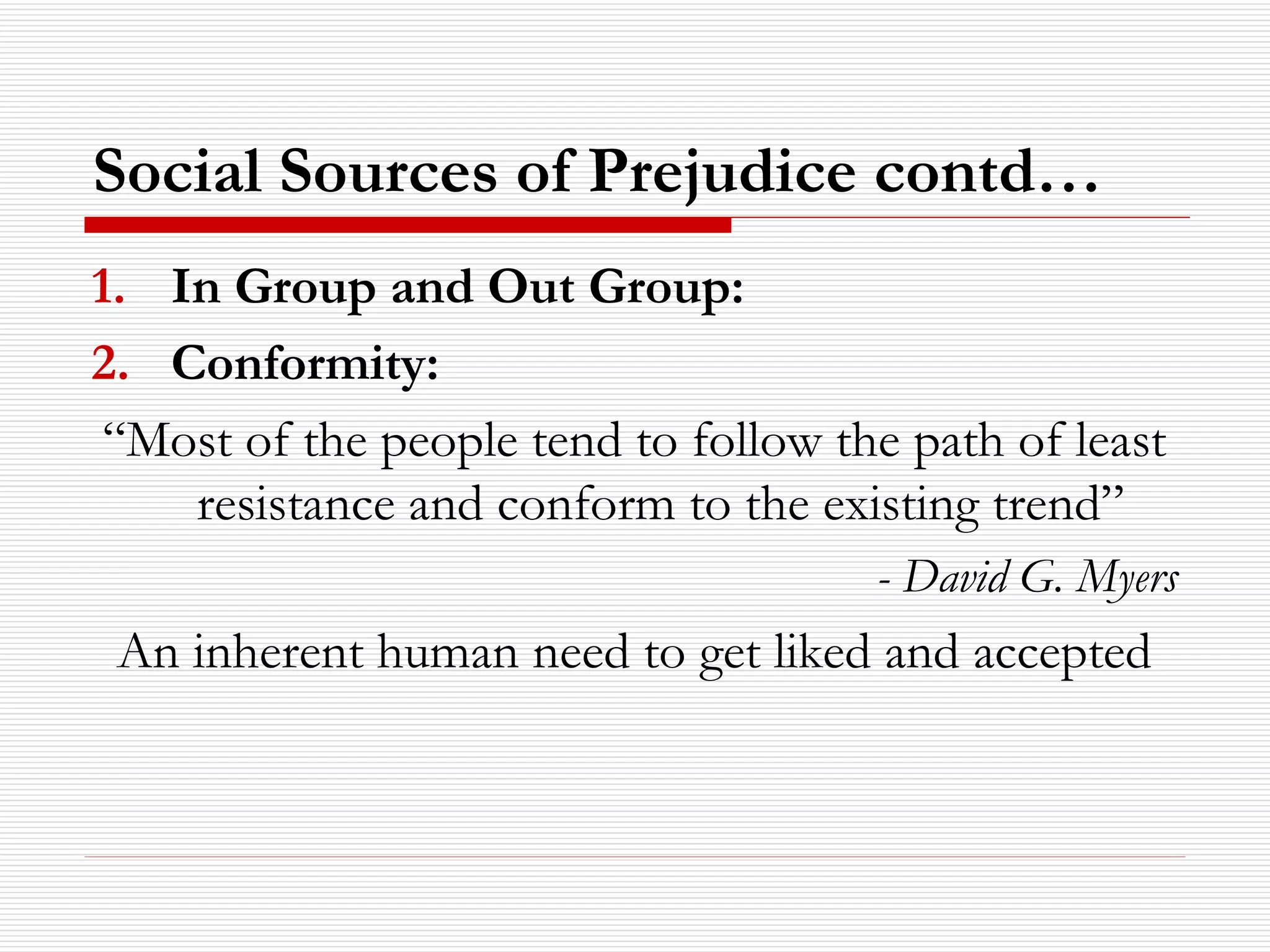
Social Sources of Prejudice contd… In Group and Out Group: Conformity: “ Most of the people tend to follow the path of least resistance and conform to the existing trend”  - David G. Myers An inherent human need to get liked and accepted
Self fulfilling Prophecy: Social beliefs tend to be self confirming Institutional Support: Socio-political Institutions [schools, governments, media etc] reflect and reinforce prevailing attitudes  Social Sources of Prejudice contd…
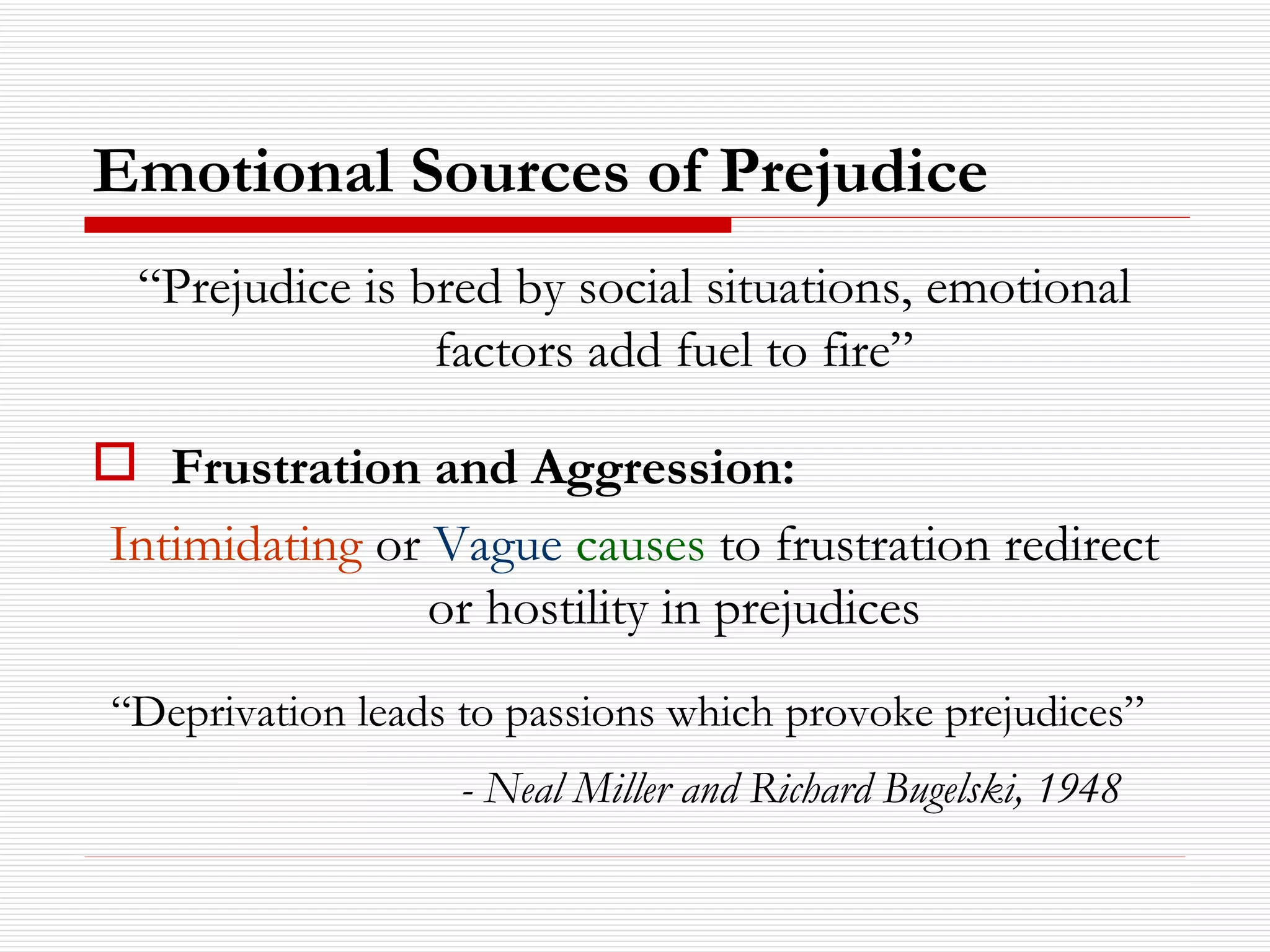
Emotional Sources of Prejudice “ Prejudice is bred by social situations, emotional factors add fuel to fire” Frustration and Aggression:   Intimidating  or  Vague   causes  to frustration redirect or hostility in prejudices “ Deprivation leads to passions which provoke prejudices”   - Neal Miller and Richard Bugelski, 1948
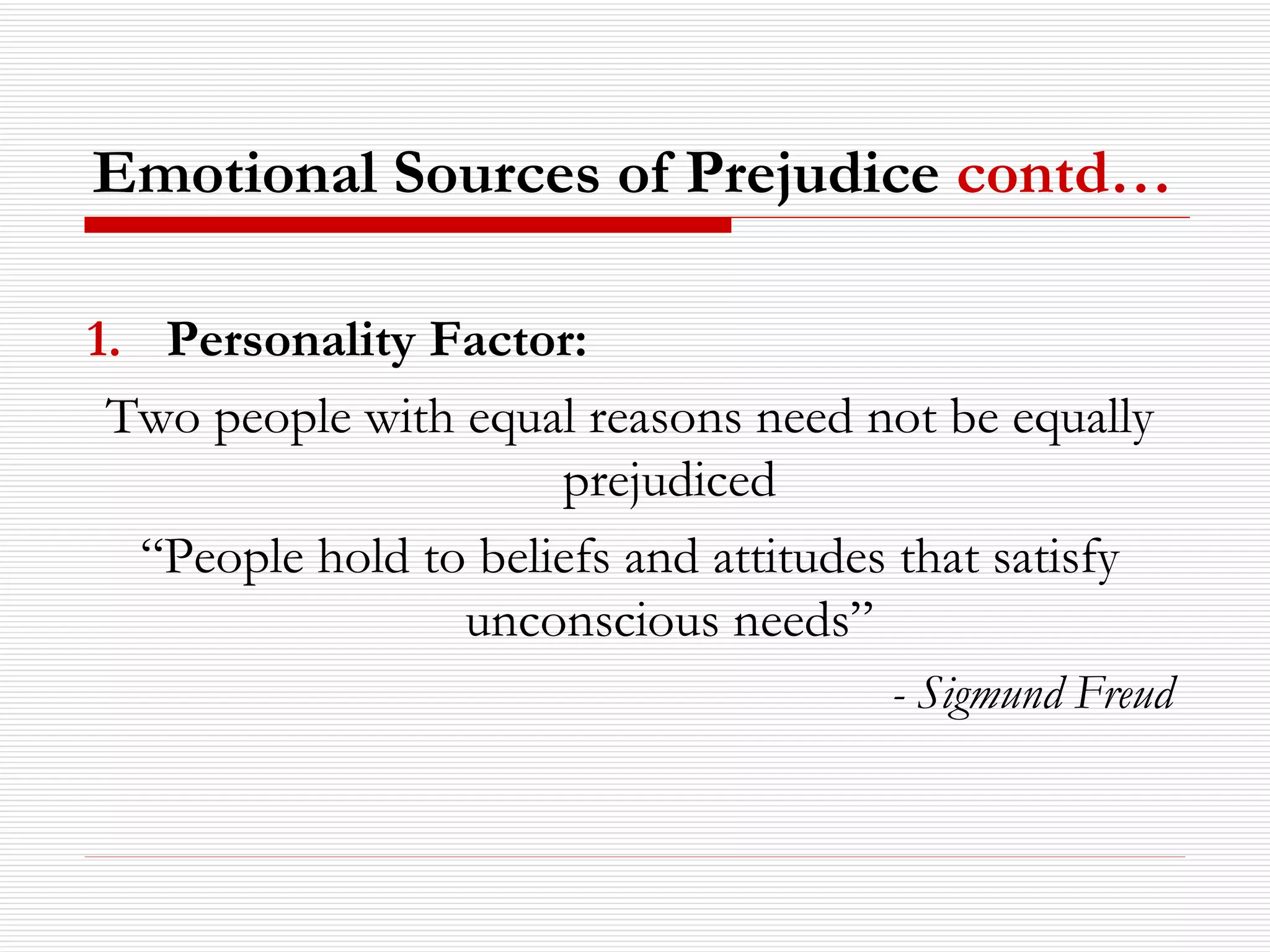
Personality Factor: Two people with equal reasons need not be equally prejudiced “ People hold to beliefs and attitudes that satisfy unconscious needs” - Sigmund Freud Emotional Sources of Prejudice  contd…
Need for status:   to perceive ourselves as having status, we need people below us “ Prejudice is often  greater  among those  low  or slipping on the  socio-economic ladder  and among those whose positive self image is being threatened” - Lemyre & Smith, 1985; Thompson & Crocker, 1985 Emotional Sources of Prejudice  contd…
The Authoritarian Personality “ Authoritarian People often are harshly disciplined…leading them to repress their hostilities and impulses…makes them to  project  these onto outgroups” David G. Myers Emotional Sources of Prejudice contd…
Cognitive Sources of Prejudices Prejudice is also a by-product of normal thinking process Categorization:  to organize the world by clustering objects into groups…exaggerating the uniformity within a group and the differences among groups
Distinctive Stimuli:  Distinctive cases fuel stereotypes …assumes a correlation between group membership and individual’s characteristics Ultimate attribution Error: Assigning outgroup members’ negative behaviour to their natural character - Thomas Pettigrew (1979, ’80) Cognitive Sources of Prejudices
Prejudices and social work practice Principles of social work seek to help the social worker adopt an objective approach while dealing with the client. The social worker has to rise above his own prejudices and stereotypes to be effective in helping the client. We have to learn to accept the person as s/he is irrespective of his/her cultural, social, economic background.
Discrimination based on prejudice is not acceptable, especially not in social work or any public service. Discrimination  founded on a professional judgment on a presenting issue, based on knowledge, assessed evidence and interpretation,  is at the heart of good social work practice.  Prejudices and social work practice contd…
"These anxieties about discrimination have deep roots, we argue - in social work training, professional identity and organizational cultures - and the remedies for these go beyond the remit of any single council or inquiry report” The social worker should understand the cultural context which gives rise to prejudices. Prejudices and social work practice contd…
Personal Field Experience… All the practitioners working in this field [HIV and AIDS] have to be cautious to keep themselves protected . Even doctors who have been associated to the field of HIV and AIDS have been unable to rise from their prejudices about such people. Cases of discrimination have been reported from various hospitals etc.
It is equally important for a person to know how the disease is not spread as it is for a person to know how it is spread because incorrect knowledge gives rise to prejudices and discrimination The major cause of transmission of the disease is through sexual route therefore people living with hiv and aids fear discrimination and stigmatization. Personal Field Experience…
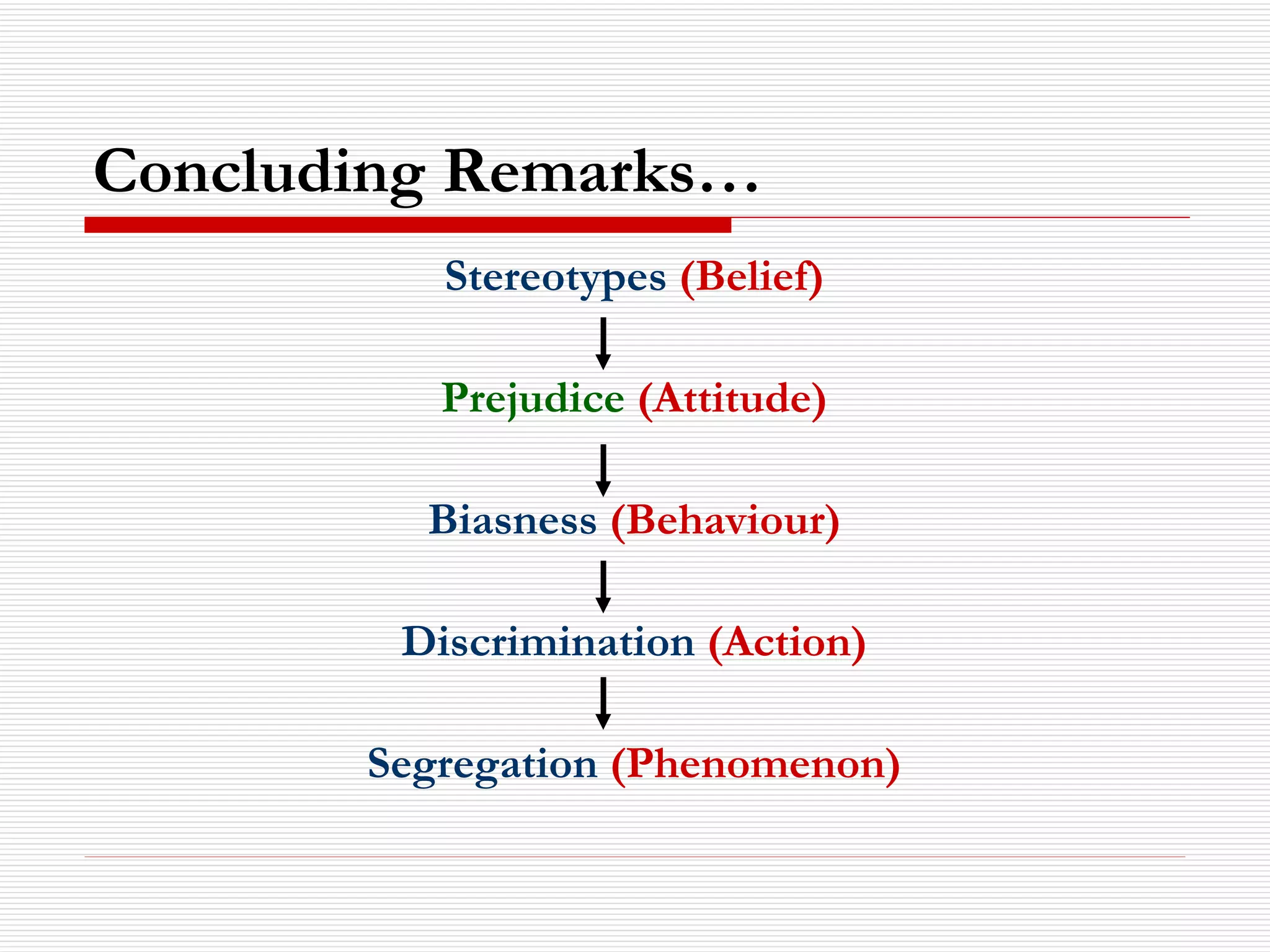
Concluding Remarks… Stereotypes  (Belief) Prejudice  (Attitude) Biasness  (Behaviour) Discrimination  (Action) Segregation  (Phenomenon)
References Baron, R.A. & Byrne, D., 1999. Social Psychology (8thEdition), Prentice Hall, New Delhi Kuppuswamy, B., 1980. Introduction to Social Psychology, Asia Publishing House (P.) Ltd., New Delhi Myers, David G., 2000. Social Psychology, Mc Graw-Hill, Inc, London

C3 Prejudice

  • 1.
    PREJUDICE SW 6103: Human Behaviour and Social Environment Group- ”D”
  • 2.
    Synopsis Concept andCharacteristics – Ms. Sarita Origin and Process of Prejudice – Mr. Rupesh Sources of Prejudice – Mr. Ravi Applicability in Social Work – Ms. Sakshi Concluding Remarks – Mr. Ravi
  • 3.
    Prejudice…Negative Attitude “Prejudice decides our perception of reality”
  • 4.
    Concept Prejudice isan attitude that predisposes a person to think, perceive, feel and act in favorable or unfavorable way In social psychology ...is defined as a negative attitude
  • 5.
    Characteristics … required… has emotional terms … directed towards the group as a whole … based on rigid/inflexible generalizations … not factual Prejudice
  • 6.
    Origin and ProcessPrejudice is learned Develops during Socialization Views expressed by parents, friends, teachers and others Early Experience: The Role of Social Learning
  • 7.
    Early Experience: TheRole of Social Learning Social Norms of groups: “If the members of my group dislike the person ‘X’, many children seem to reason, ‘then I should too!” Mass Media
  • 8.
    Origin and Processcontd… Direct Intergroup Conflict “ Competition as a source of Prejudice”
  • 9.
    Origin and Processcontd… Things people want and value most are always in short supply Realistic Conflict Theory: Prejudices stems from competition among social groups over valued commodities or opportunities As such competition continues – members of group involved come to view each other in increasingly negative terms
  • 10.
    Social Categorization: The‘Us’ vs. ‘Them’ Effect Origin and Process contd… View other person as belonging either to their own group (ingroup) or another group (outgroup) Commonly based on gender, religion, age, ethnic background, occupation, income… People view ‘Us’ category in favorable terms – ‘Them’ category – perceived more negatively
  • 11.
    Social Cognition: ways in which we think about others and make judgements about them Stereotypes: allow us to make quick and dirty judgements about others without engaging in complex and more effortful thought Origin and Process contd…
  • 12.
    Sources of PrejudiceSocial Emotional Cognitive An outcome of the intricate interplay of three distinct sources:
  • 13.
    Social Sources ofPrejudice Inequality and Prejudice: “ Unequal status breeds prejudice” “ Discrimination breeds prejudice, and prejudices legitimize discrimination” (Pettigrew, 1980) Religion and Prejudice: “ By defining and deciding what is sacred/sin or ethical/unethical”
  • 14.
    Social Sources ofPrejudice contd… In Group and Out Group: Conformity: “ Most of the people tend to follow the path of least resistance and conform to the existing trend” - David G. Myers An inherent human need to get liked and accepted
  • 15.
    Self fulfilling Prophecy:Social beliefs tend to be self confirming Institutional Support: Socio-political Institutions [schools, governments, media etc] reflect and reinforce prevailing attitudes Social Sources of Prejudice contd…
  • 16.
    Emotional Sources ofPrejudice “ Prejudice is bred by social situations, emotional factors add fuel to fire” Frustration and Aggression: Intimidating or Vague causes to frustration redirect or hostility in prejudices “ Deprivation leads to passions which provoke prejudices” - Neal Miller and Richard Bugelski, 1948
  • 17.
    Personality Factor: Twopeople with equal reasons need not be equally prejudiced “ People hold to beliefs and attitudes that satisfy unconscious needs” - Sigmund Freud Emotional Sources of Prejudice contd…
  • 18.
    Need for status: to perceive ourselves as having status, we need people below us “ Prejudice is often greater among those low or slipping on the socio-economic ladder and among those whose positive self image is being threatened” - Lemyre & Smith, 1985; Thompson & Crocker, 1985 Emotional Sources of Prejudice contd…
  • 19.
    The Authoritarian Personality“ Authoritarian People often are harshly disciplined…leading them to repress their hostilities and impulses…makes them to project these onto outgroups” David G. Myers Emotional Sources of Prejudice contd…
  • 20.
    Cognitive Sources ofPrejudices Prejudice is also a by-product of normal thinking process Categorization: to organize the world by clustering objects into groups…exaggerating the uniformity within a group and the differences among groups
  • 21.
    Distinctive Stimuli: Distinctive cases fuel stereotypes …assumes a correlation between group membership and individual’s characteristics Ultimate attribution Error: Assigning outgroup members’ negative behaviour to their natural character - Thomas Pettigrew (1979, ’80) Cognitive Sources of Prejudices
  • 22.
    Prejudices and socialwork practice Principles of social work seek to help the social worker adopt an objective approach while dealing with the client. The social worker has to rise above his own prejudices and stereotypes to be effective in helping the client. We have to learn to accept the person as s/he is irrespective of his/her cultural, social, economic background.
  • 23.
    Discrimination based onprejudice is not acceptable, especially not in social work or any public service. Discrimination founded on a professional judgment on a presenting issue, based on knowledge, assessed evidence and interpretation, is at the heart of good social work practice. Prejudices and social work practice contd…
  • 24.
    "These anxieties aboutdiscrimination have deep roots, we argue - in social work training, professional identity and organizational cultures - and the remedies for these go beyond the remit of any single council or inquiry report” The social worker should understand the cultural context which gives rise to prejudices. Prejudices and social work practice contd…
  • 25.
    Personal Field Experience…All the practitioners working in this field [HIV and AIDS] have to be cautious to keep themselves protected . Even doctors who have been associated to the field of HIV and AIDS have been unable to rise from their prejudices about such people. Cases of discrimination have been reported from various hospitals etc.
  • 26.
    It is equallyimportant for a person to know how the disease is not spread as it is for a person to know how it is spread because incorrect knowledge gives rise to prejudices and discrimination The major cause of transmission of the disease is through sexual route therefore people living with hiv and aids fear discrimination and stigmatization. Personal Field Experience…
  • 27.
    Concluding Remarks… Stereotypes (Belief) Prejudice (Attitude) Biasness (Behaviour) Discrimination (Action) Segregation (Phenomenon)
  • 28.
    References Baron, R.A.& Byrne, D., 1999. Social Psychology (8thEdition), Prentice Hall, New Delhi Kuppuswamy, B., 1980. Introduction to Social Psychology, Asia Publishing House (P.) Ltd., New Delhi Myers, David G., 2000. Social Psychology, Mc Graw-Hill, Inc, London