SOCIAL COGNITION
• Oursocial environment influences our thoughts, emotions and behaviour in complex ways.
• Social influences, people form views, or Attitudes about people, and about different issues
in life, that exist in the form of behavioural tendencies.
• When we meet people, we make inferences about their personal qualities. This is called
Impression Formation.
• we assign causes to the behaviour shown in specific social situations. This process is called
Attribution.
• These three processes are examples of mental activities related to the gathering and
interpretation of information about the social world, collectively called social cognition.
3.
SOCIAL COGNITION
• socialcognition is activated by cognitive units called Schemas.
• social influence on observable behavior:
• Social Facilitation/ Inhibition, i.e. the improvement/decline in
performance in the presence of others.
• Pro-social Behaviour, i.e. responding to others who are in need or distress.
4.
ATTITUDES
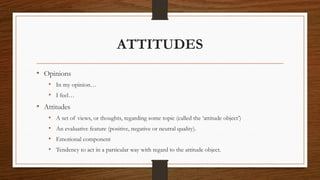
• Opinions
• Inmy opinion…
• I feel…
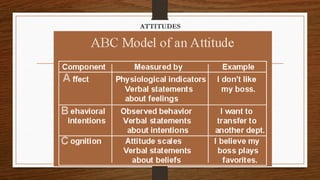
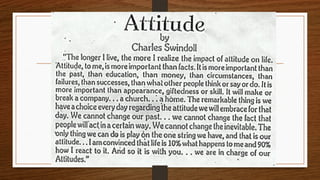
• Attitudes
• A set of views, or thoughts, regarding some topic (called the ‘attitude object’)
• An evaluative feature (positive, negative or neutral quality).
• Emotional component
• Tendency to act in a particular way with regard to the attitude object.
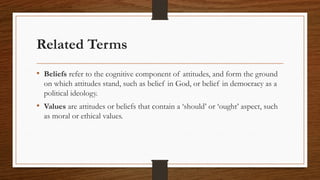
Related Terms
• Beliefsrefer to the cognitive component of attitudes, and form the ground
on which attitudes stand, such as belief in God, or belief in democracy as a
political ideology.
• Values are attitudes or beliefs that contain a ‘should’ or ‘ought’ aspect, such
as moral or ethical values.
8.
Features of Attitudes
•Valence (positivity or negativity),
• Extremeness
• Simplicity / Complexity (multiplexity)
• Centrality
9.
Attitude Formation
• Learningattitudes by association
• Learning attitudes by being rewarded
• Learning attitudes through modelling (observing others)
• Learning attitudes through group or cultural norms
• Learning through exposure to information
10.
Factors that InfluenceAttitude Formation
• 1. Family and School Environment
• 2. Reference Groups
• 3. Personal Experiences
• 4. Media-related Influences
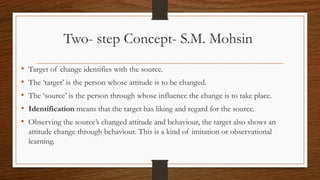
Two- step Concept-S.M. Mohsin
• Target of change identifies with the source.
• The ‘target’ is the person whose attitude is to be changed.
• The ‘source’ is the person through whose influence the change is to take place.
• Identification means that the target has liking and regard for the source.
• Observing the source’s changed attitude and behaviour, the target also shows an
attitude change through behaviour. This is a kind of imitation or observational
learning.
16.
Factors Influencing AttitudeChange
1. Characteristics of the existing attitude
• Valence (positivity or negativity), extremeness, simplicity or complexity
(multiplexity), and centrality
• Congruent/Incongruent — it may change in the same direction as the existing
attitude
2. Source characteristics
• Credibility and Attractiveness
17.
Factors Influencing AttitudeChange
3. Message characteristics
• Rational or an emotional appeal
• Motives and mode of spreading the message (Direct vs Indirect).
4. Target characteristics
• Persuasibility, Strong prejudices, Self-esteem, and Intelligence
18.
Attitude-Behaviour Relationship
Consistency betweenattitudes and behaviour when:
• The attitude is strong, and occupies a central place in the attitude system,
• The person is aware of her/his attitude,
• There is very little or no external pressure for the person to behave in a particular way.
For example, when there is no group pressure to follow a particular norm.
• The person’s behaviour is not being watched or evaluated by others, and
• The person thinks that the behavior would have a positive consequence, and therefore,
intends to engage in that behaviour.
19.
PREJUDICE AND
DISCRIMINATION
• Prejudicesare examples of attitudes towards a particular group.
• Stereotypes- cluster of ideas regarding the characteristics of a specific group.
• All members belonging to this group are assumed to possess these characteristics lead
to negative attitudes or prejudices towards members of specific groups.
• A B C of Stereotypes…???
• Prejudices can exist without being shown in the form of discrimination (B)…though
A and C are hard to change.
20.
Sources of Prejudice
•Learning association, reward and punishment, observing others, group or cultural
norms and exposure to information that encourages prejudice.
• A strong social identity and ingroup bias Individuals who have a strong sense of
social identity and have a very positive attitude towards their own group boost this
attitude by holding negative attitudes towards other groups.
• Scapegoating group based way of expressing frustration, and it often results in
negative attitudes or prejudice against the weaker group.
• Kernel of truth concept (no smoke without fire)
• Self-fulfilling prophecy (living up to the roles/labels)
21.
Strategies for HandlingPrejudice
• Prevention is better than cure:
(a) Minimising opportunities for learning prejudices
(b) Changing such attitudes,
(c) De-emphasising a narrow social identity based on the in group, and
(d) Discouraging the tendency towards self fulfilling prophecy among the victims of
prejudice.
22.
Strategies for HandlingPrejudice
How??
• Education and information dissemination
• Increasing intergroup contact
• Highlighting individual identity rather than group identity
23.
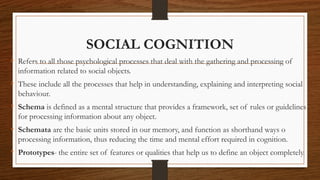
SOCIAL COGNITION
• Refersto all those psychological processes that deal with the gathering and processing of
information related to social objects.
• These include all the processes that help in understanding, explaining and interpreting social
behaviour.
• Schema is defined as a mental structure that provides a framework, set of rules or guidelines
for processing information about any object.
• Schemata are the basic units stored in our memory, and function as shorthand ways o
processing information, thus reducing the time and mental effort required in cognition.
• Prototypes- the entire set of features or qualities that help us to define an object completely.
24.
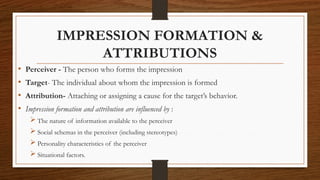
IMPRESSION FORMATION &
ATTRIBUTIONS
•Perceiver - The person who forms the impression
• Target- The individual about whom the impression is formed
• Attribution- Attaching or assigning a cause for the target’s behavior.
• Impression formation and attribution are influenced by :
The nature of information available to the perceiver
Social schemas in the perceiver (including stereotypes)
Personality characteristics of the perceiver
Situational factors.
25.
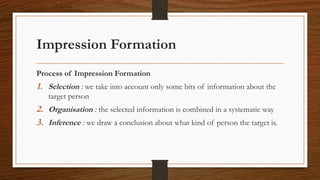
Impression Formation
Process ofImpression Formation
1. Selection : we take into account only some bits of information about the
target person
2. Organisation : the selected information is combined in a systematic way
3. Inference : we draw a conclusion about what kind of person the target is.
26.
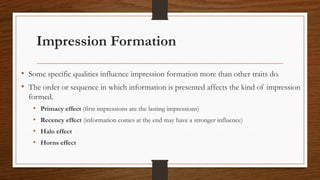
Impression Formation
• Somespecific qualities influence impression formation more than other traits do.
• The order or sequence in which information is presented affects the kind of impression
formed.
• Primacy effect (first impressions are the lasting impressions)
• Recency effect (information comes at the end may have a stronger influence)
• Halo effect
• Horns effect
27.
Attribution of Causality
•Attribution- After forming an impression, we often go through the process
of assigning causes to a person’s behaviour.
ASPECTS OF ATTRIBUTION
1. Internal vs External Attributions
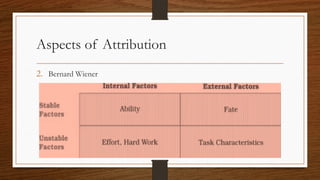
Aspects of Attribution
3.Fundamental Attribution Error
People's tendency to place an undue emphasis on internal characteristics to
explain someone else's behavior in a given situation, rather than considering
external factors.
Example- “You are lazy that’s why you don’t wanna come with me rather
than you are tired from the day’s work.”
30.
Aspects of Attribution
4.Difference between the attribution made for success, and the attribution
made for failure.
Success- Internal factors
Failure- External factors
5. Actor-Observer Effect
I slip , you fell.
31.
BEHAVIOUR IN THEPRESENCE OF
OTHERS
SOCIAL FACILITATION VS. SOCIAL INHIBITION
Influencing Factors:
• Better performance in the presence of others is because the person experiences arousal,
which makes the person react in a more intense manner. (Zajonc)
• Evaluation Apprehension- The person will be praised if the performance is good
(reward), or criticised if it is bad (punishment).
• Nature of the task- Simple/Familiar Task Vs. Complex/New Task
• Co-action- Others performing the same task as well.
• Social loafing, based on diffusion of responsibility.
32.
PRO-SOCIAL BEHAVIOUR
Prosocial behaviouris very similar to ‘ALTRUISM’, which means doing something for or
thinking about the welfare of others without any self-interest.
Characteristics of Prosocial Behaviour:
• Aim to benefit or do good to another person or other persons,
• Be done without expecting anything in return
• Be done willingly by the person, and not because of any kind of pressure
• Involve some difficulty or ‘cost’ to the person giving help.
33.
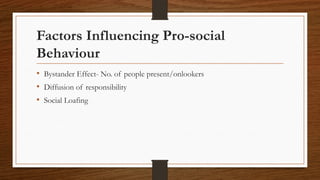
Factors Influencing Pro-social
Behaviour
•Pro-social behaviour is based on an inborn, natural tendency in human beings to help
other members of their own species.
• Pro-social behaviour is influenced by learning.
• Cultural factors influence pro-social behaviour. Some cultures actively encourage
people to help the needy and distressed.
• Pro-social behaviour is affected by the expected reactions of the person who is being
helped.
34.
Factors Influencing Pro-social
Behaviour
•Pro-social behaviour is expressed when the situation activates certain social norms
• The norm of social responsibility
• The norm of reciprocity
• The norm of equity (fairness)
• Pro-social behaviour is more likely to be shown by individuals who have a high level of
empathy.
• Pro-social behaviour may be reduced by factors such as a bad mood, being busy with
one’s own problems, or feeling that the person to be helped is responsible for her/his
own situation
 Most read
 Most read
 Most read