Unit IV: Attitude,
Stereotypes, Prejudice,
Discrimination
and Attribution Dr Juhi Garg
Definition
Attitude is psychological tendency. It is an
hypothetical construct which can only be inferred
through the behavior of an individual.
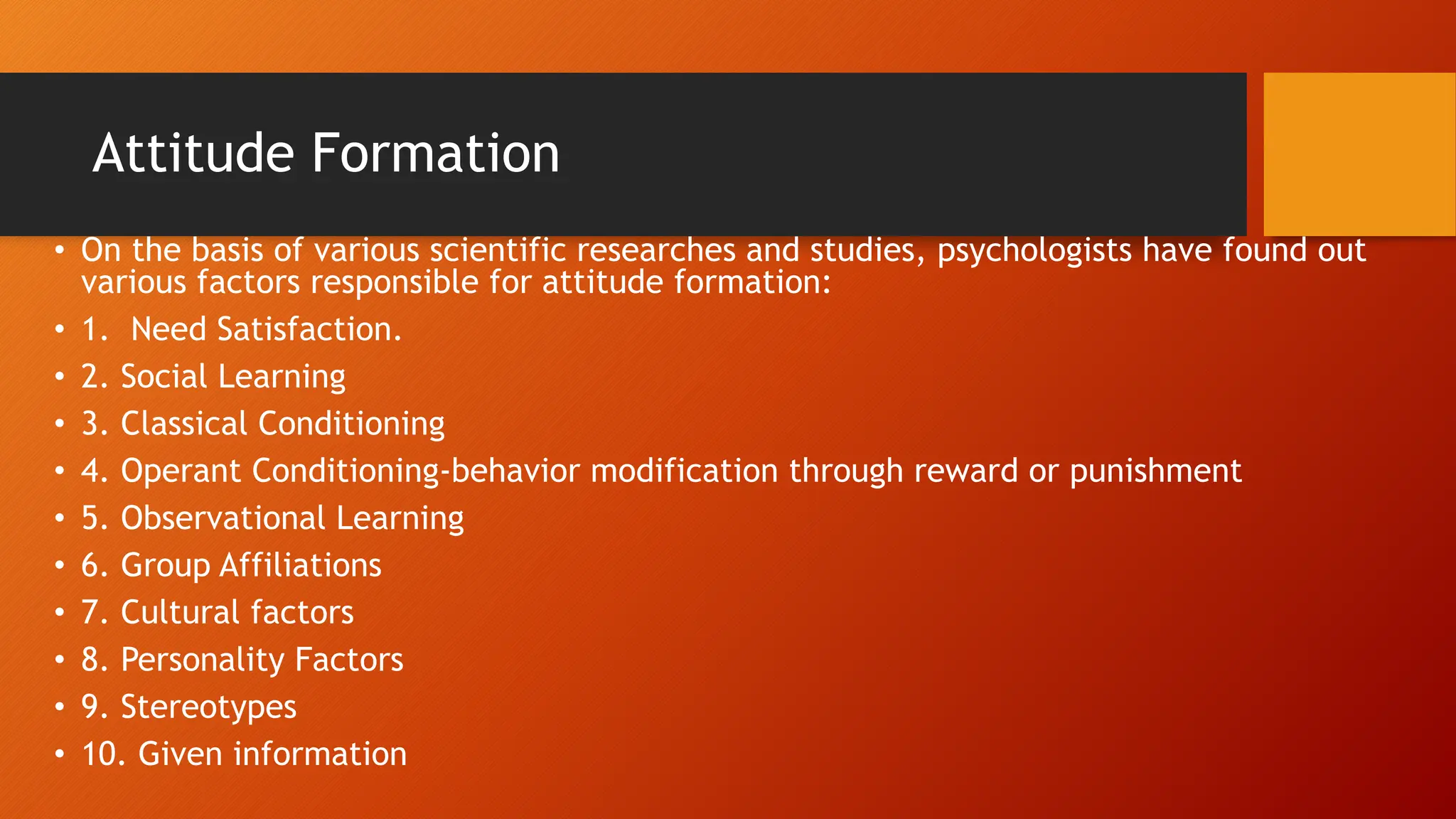
Attitude Formation
• On the basis of various scientific researches and studies, psychologists have found out
various factors responsible for attitude formation:
• 1. Need Satisfaction.
• 2. Social Learning
• 3. Classical Conditioning
• 4. Operant Conditioning-behavior modification through reward or punishment
• 5. Observational Learning
• 6. Group Affiliations
• 7. Cultural factors
• 8. Personality Factors
• 9. Stereotypes
• 10. Given information
Attitude Change
Types: Congruent and Incongruent
Factors that change attitude
• 1. Changing reference groups
• 2. changing group affiliations
• 3. Additional information
• 4. Persuasive communication
• 5. Source of communication
• 6. Characteristics' and content of communication
• 7. Channel
• 8. Creditability of communicator
• 9. Attractiveness of communicator
Stereotypes
• A stereotypes is a cluster of beliefs usually lacking a rational basis
regarding the members of some groups.
• “Stereotypes is a belief about some particular trait being
prevalent among all members of a social group. Whatever be the
characteristic it is assumed to vest all people in that category.
Therefore, all members of the group are perceived and
understood alike”-Albrecht, Thomas & Chadwick (1980)
Characteristics' of stereotypes
• 1. Mental pictures about people or community or category on the
basis of which we ascertain their traits etc.
• 2. It is a widely agreed view about people or community or
category
• 3. It involves gross or exaggerated generalisations
• 4. It is generally not amendable to change despite of information
and evidence to the contrary.
• 5. It can have both positive and negative direction.
Development and Maintenance of Stereotypes
• 1. Socialization
• 2. Imitation
• 3. Tradition and Folkways
• 4. Social and Cultural distance
Stereotypes and Social Life/functions
• Stereotypes play a important role, it works as a heuristic.
• 1. Help understand social behavior.
• 2. Helps control social behavior
• 3. Helps in prediction
Difference between Stereotypes and
Prejudice
• In stereotype, all members of a community are treated alike as they are
believed to have same characteristics while prejudice can take any direction
it can be positive or negative both.
• Prejudice is a type of an attitude and has all three components i.e.
affective, cognitive and behavioral (ABC).
• However, stereotypes is cognition and expectations from person simply
because he is a member of a particular group or community.
• Stereotypes are more stable than prejudice.
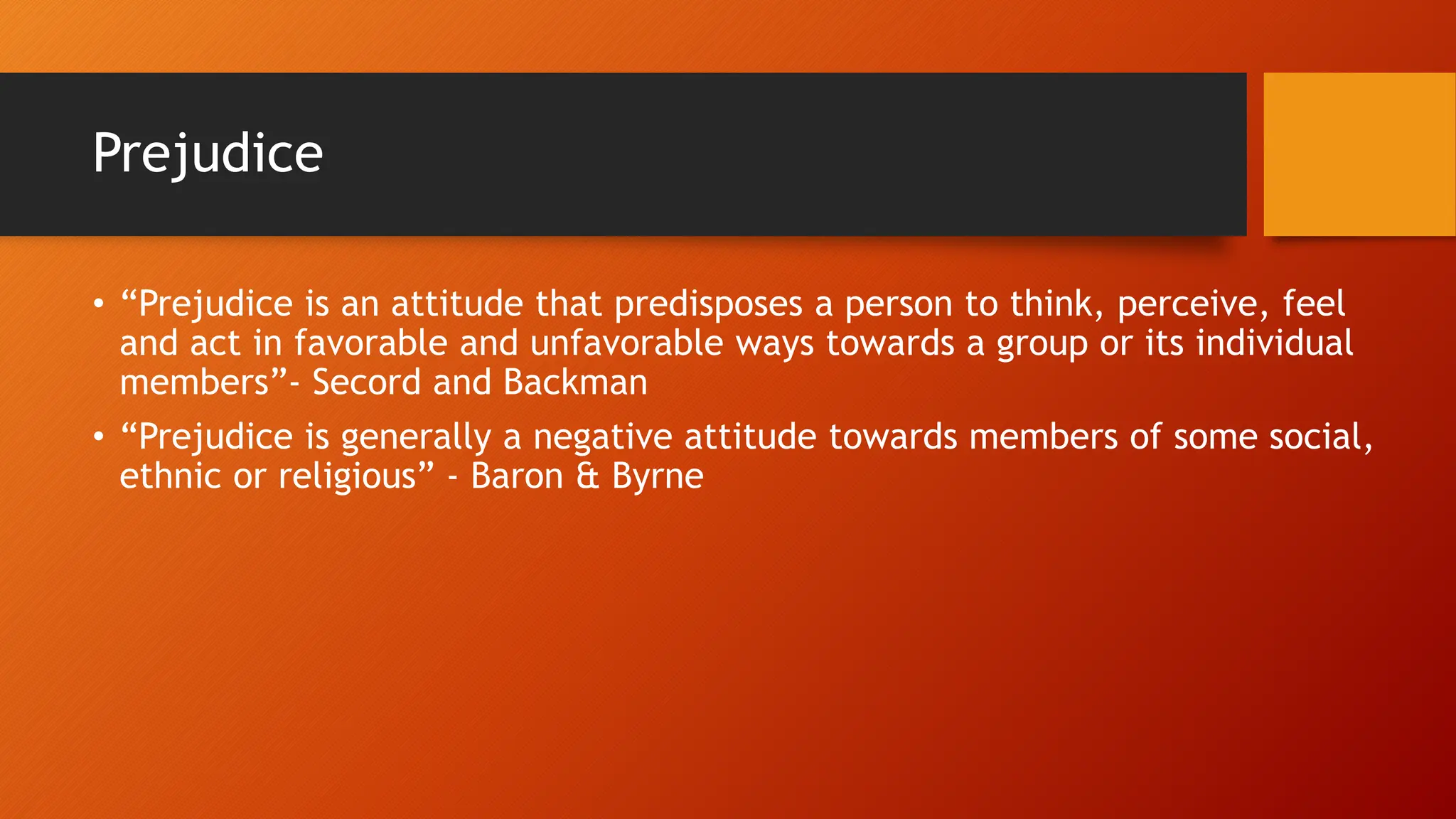
Prejudice
• “Prejudice is an attitude that predisposes a person to think, perceive, feel
and act in favorable and unfavorable ways towards a group or its individual
members”- Secord and Backman
• “Prejudice is generally a negative attitude towards members of some social,
ethnic or religious” - Baron & Byrne
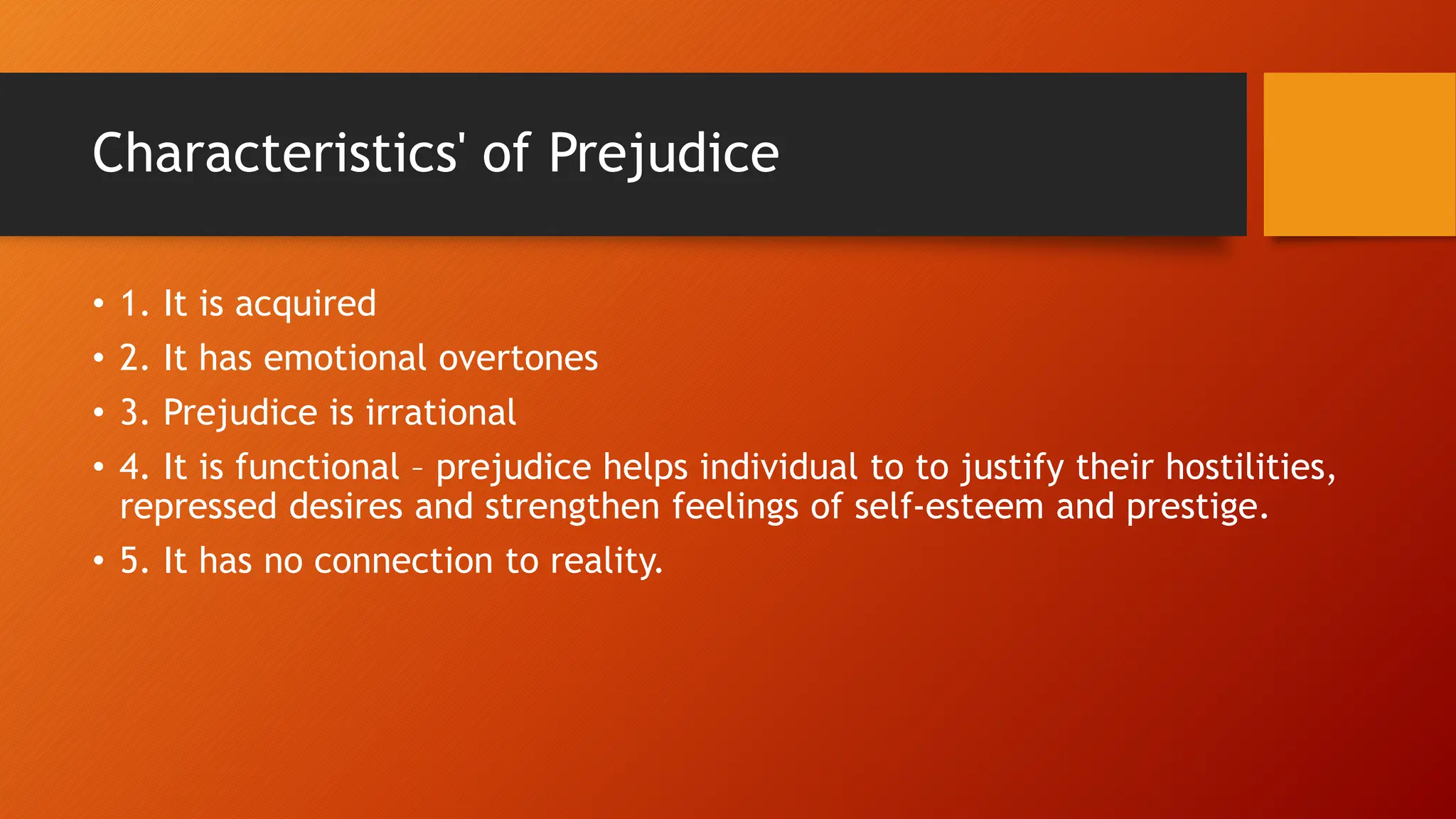
Characteristics' of Prejudice
• 1. It is acquired
• 2. It has emotional overtones
• 3. Prejudice is irrational
• 4. It is functional – prejudice helps individual to to justify their hostilities,
repressed desires and strengthen feelings of self-esteem and prestige.
• 5. It has no connection to reality.
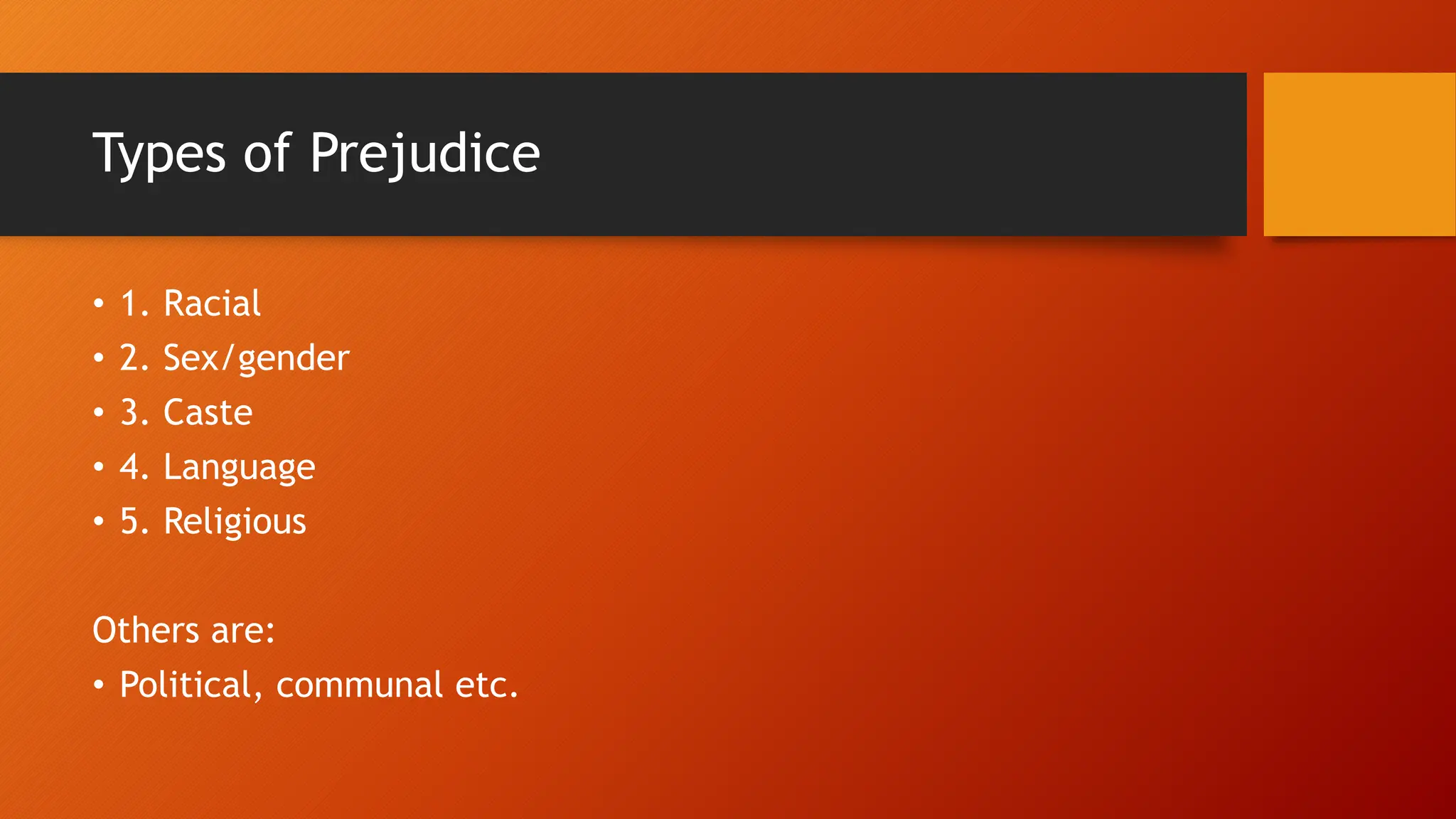
Types of Prejudice
• 1. Racial
• 2. Sex/gender
• 3. Caste
• 4. Language
• 5. Religious
Others are:
• Political, communal etc.
Discrimination
• Discrimination is the differential treatment of individuals belonging to
a particular social group or community or religion.
• It is generally overt or behavioral expression of prejudice.
• Generally the person or the discriminated group is denied some
privilege or right that is accorded to other members of society who do
not belong to the minority group.
Development and Maintenance of Prejudice
and Discrimination
1. Status and power structure
2. Historical facts
3. Situational factors
4. Job competition
5. Conformity to norms
6. Interaction patterns
7. Psychodynamic factors
8. Frustration and aggression
9. Authoritarian Personality
10. Personality needs
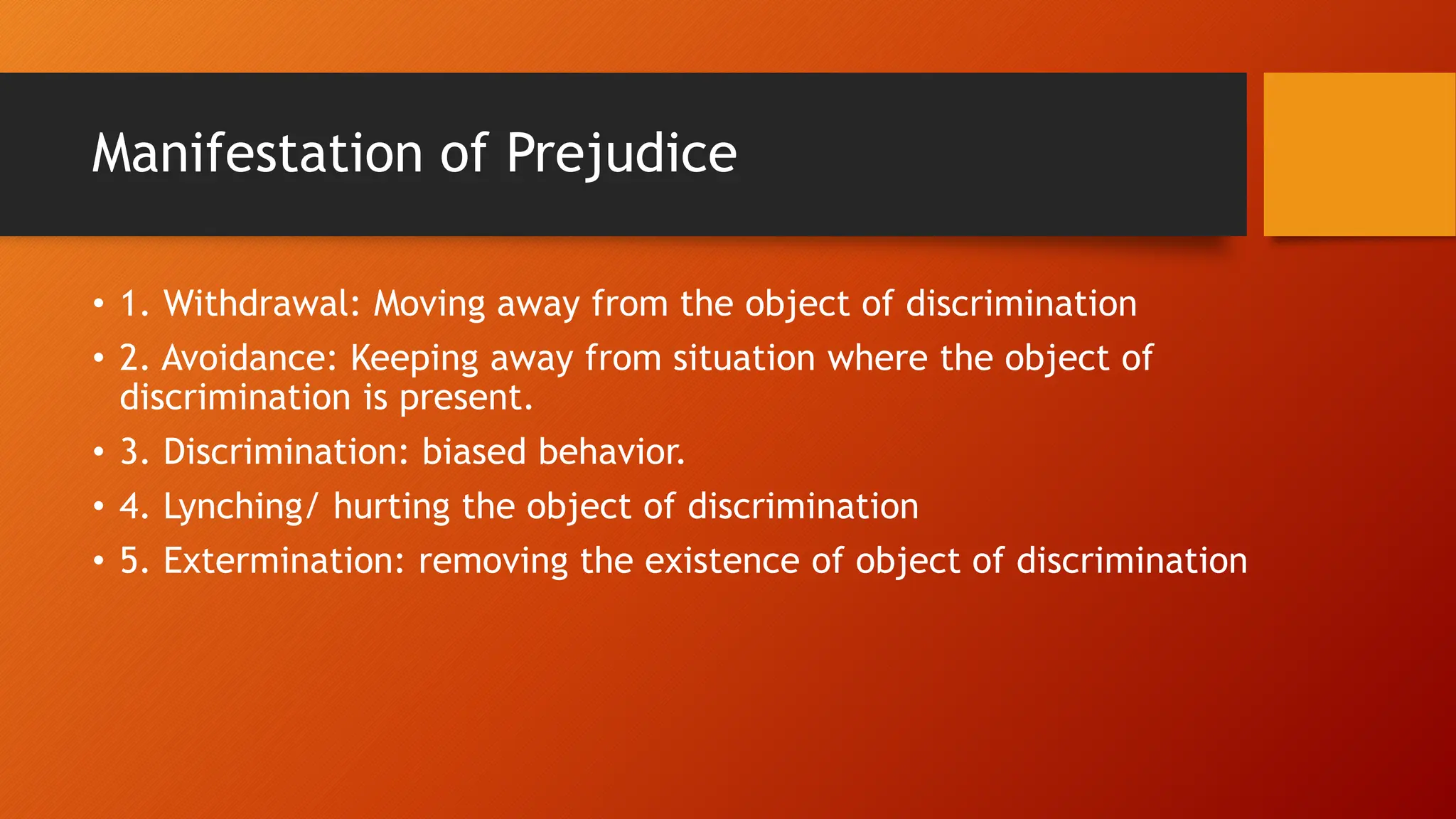
Manifestation of Prejudice
• 1. Withdrawal: Moving away from the object of discrimination
• 2. Avoidance: Keeping away from situation where the object of
discrimination is present.
• 3. Discrimination: biased behavior.
• 4. Lynching/ hurting the object of discrimination
• 5. Extermination: removing the existence of object of discrimination
Methods of reducing prejudice and
discrimination
• 1. Intergroup contact
• 2. Education
• 3. Anti-prejudice Propaganda
• 4. Incongruent role
• 5. Social Legislation: Eg reservation, Govt promote inter-caste marriage
• 6. Personality change techniques
• 7. Most importantly acceptance and respect for all.
Attribution
• Human beings are innately curious and we always wish to know
why people behave the way way they do.
• Causes of Behavior:
• 1. Internal Vs External attributions
• 2. Covariation Principle
• The actor
• The entity
• The circumstances
Prerequisite information to check the
explanation
• 1. Consensus
• 2. Consistency
• 3. Distinctiveness
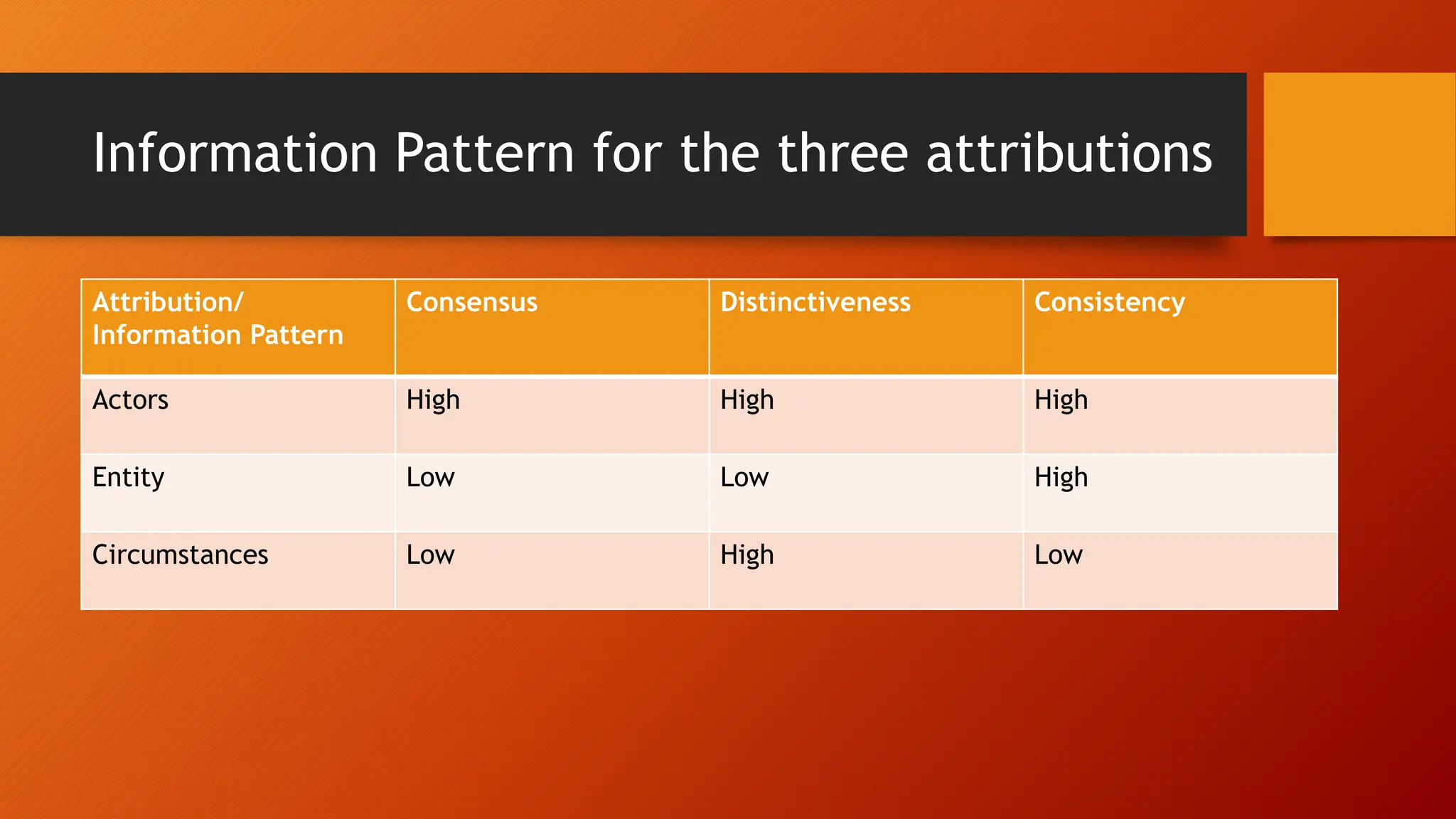
Information Pattern for the three attributions
Attribution/
Information Pattern
Consensus Distinctiveness Consistency
Actors High High High
Entity Low Low High
Circumstances Low High Low
Errors in Attribution
• 1. The fundamental attribution error:
• When we rate behavior of others as due to dispositional/internal
cause and cause of our own behavior as due to situational
/external.
• 2. Halo Effects: Assuming consistency within a person
• The halo effect is the phenomenon in which the initial familiarity
that a person has positive traits is used to infer other uniformly
positive characteristics.
Theory of Attribution-Weiner (1980, 1992)
• According to the theory, the explanations that people tend to make to
explain success or failure can be analysed in terms of three sets of
characteristics:
• 1. Internal or external
• 2. Stable or unstable
• 3. Controllable or uncontrollable
• People interpret the environment in such a way as to maintain a positive
image, i.e they will attribute their success and failure to factors that
will enable them to feel as good as possible about themselves.
Four factors
Thanks

Attitude.pptx

  • 1.
    Unit IV: Attitude, Stereotypes,Prejudice, Discrimination and Attribution Dr Juhi Garg
  • 2.
    Definition Attitude is psychologicaltendency. It is an hypothetical construct which can only be inferred through the behavior of an individual.
  • 3.
    Attitude Formation • Onthe basis of various scientific researches and studies, psychologists have found out various factors responsible for attitude formation: • 1. Need Satisfaction. • 2. Social Learning • 3. Classical Conditioning • 4. Operant Conditioning-behavior modification through reward or punishment • 5. Observational Learning • 6. Group Affiliations • 7. Cultural factors • 8. Personality Factors • 9. Stereotypes • 10. Given information
  • 4.
    Attitude Change Types: Congruentand Incongruent Factors that change attitude • 1. Changing reference groups • 2. changing group affiliations • 3. Additional information • 4. Persuasive communication • 5. Source of communication • 6. Characteristics' and content of communication • 7. Channel • 8. Creditability of communicator • 9. Attractiveness of communicator
  • 5.
    Stereotypes • A stereotypesis a cluster of beliefs usually lacking a rational basis regarding the members of some groups. • “Stereotypes is a belief about some particular trait being prevalent among all members of a social group. Whatever be the characteristic it is assumed to vest all people in that category. Therefore, all members of the group are perceived and understood alike”-Albrecht, Thomas & Chadwick (1980)
  • 6.
    Characteristics' of stereotypes •1. Mental pictures about people or community or category on the basis of which we ascertain their traits etc. • 2. It is a widely agreed view about people or community or category • 3. It involves gross or exaggerated generalisations • 4. It is generally not amendable to change despite of information and evidence to the contrary. • 5. It can have both positive and negative direction.
  • 7.
    Development and Maintenanceof Stereotypes • 1. Socialization • 2. Imitation • 3. Tradition and Folkways • 4. Social and Cultural distance
  • 8.
    Stereotypes and SocialLife/functions • Stereotypes play a important role, it works as a heuristic. • 1. Help understand social behavior. • 2. Helps control social behavior • 3. Helps in prediction
  • 9.
    Difference between Stereotypesand Prejudice • In stereotype, all members of a community are treated alike as they are believed to have same characteristics while prejudice can take any direction it can be positive or negative both. • Prejudice is a type of an attitude and has all three components i.e. affective, cognitive and behavioral (ABC). • However, stereotypes is cognition and expectations from person simply because he is a member of a particular group or community. • Stereotypes are more stable than prejudice.
  • 10.
    Prejudice • “Prejudice isan attitude that predisposes a person to think, perceive, feel and act in favorable and unfavorable ways towards a group or its individual members”- Secord and Backman • “Prejudice is generally a negative attitude towards members of some social, ethnic or religious” - Baron & Byrne
  • 11.
    Characteristics' of Prejudice •1. It is acquired • 2. It has emotional overtones • 3. Prejudice is irrational • 4. It is functional – prejudice helps individual to to justify their hostilities, repressed desires and strengthen feelings of self-esteem and prestige. • 5. It has no connection to reality.
  • 12.
    Types of Prejudice •1. Racial • 2. Sex/gender • 3. Caste • 4. Language • 5. Religious Others are: • Political, communal etc.
  • 13.
    Discrimination • Discrimination isthe differential treatment of individuals belonging to a particular social group or community or religion. • It is generally overt or behavioral expression of prejudice. • Generally the person or the discriminated group is denied some privilege or right that is accorded to other members of society who do not belong to the minority group.
  • 14.
    Development and Maintenanceof Prejudice and Discrimination 1. Status and power structure 2. Historical facts 3. Situational factors 4. Job competition 5. Conformity to norms 6. Interaction patterns 7. Psychodynamic factors 8. Frustration and aggression 9. Authoritarian Personality 10. Personality needs
  • 15.
    Manifestation of Prejudice •1. Withdrawal: Moving away from the object of discrimination • 2. Avoidance: Keeping away from situation where the object of discrimination is present. • 3. Discrimination: biased behavior. • 4. Lynching/ hurting the object of discrimination • 5. Extermination: removing the existence of object of discrimination
  • 16.
    Methods of reducingprejudice and discrimination • 1. Intergroup contact • 2. Education • 3. Anti-prejudice Propaganda • 4. Incongruent role • 5. Social Legislation: Eg reservation, Govt promote inter-caste marriage • 6. Personality change techniques • 7. Most importantly acceptance and respect for all.
  • 17.
    Attribution • Human beingsare innately curious and we always wish to know why people behave the way way they do. • Causes of Behavior: • 1. Internal Vs External attributions • 2. Covariation Principle • The actor • The entity • The circumstances
  • 18.
    Prerequisite information tocheck the explanation • 1. Consensus • 2. Consistency • 3. Distinctiveness
  • 19.
    Information Pattern forthe three attributions Attribution/ Information Pattern Consensus Distinctiveness Consistency Actors High High High Entity Low Low High Circumstances Low High Low
  • 20.
    Errors in Attribution •1. The fundamental attribution error: • When we rate behavior of others as due to dispositional/internal cause and cause of our own behavior as due to situational /external. • 2. Halo Effects: Assuming consistency within a person • The halo effect is the phenomenon in which the initial familiarity that a person has positive traits is used to infer other uniformly positive characteristics.
  • 21.
    Theory of Attribution-Weiner(1980, 1992) • According to the theory, the explanations that people tend to make to explain success or failure can be analysed in terms of three sets of characteristics: • 1. Internal or external • 2. Stable or unstable • 3. Controllable or uncontrollable • People interpret the environment in such a way as to maintain a positive image, i.e they will attribute their success and failure to factors that will enable them to feel as good as possible about themselves.
  • 22.
  • 23.