Chapter Nine
Prejudice: Disliking Others
Carol Saccaggi
Psych 2C – Social Psychology
22-23 April 2013
1
What Is the Nature and Power
of Prejudice?
 Defining Prejudice
 Preconceived negative judgment of a
group and its individual members
 Prejudice is an attitude (a combination of
feelings, inclinations to act and beliefs)
 Supported by stereotypes
 Beliefs about the personal attributes of a group
of people
 Although stereotypes can be positive and true,
they also result in overgeneralization
2
What Is the Nature and Power
of Prejudice?
 Defining Prejudice
 Discrimination
 Unjustified negative behaviour toward a
group or its members
 Racism
 Prejudicial attitudes and discriminatory
behaviour toward people of a given race
 Sexism
 Prejudicial attitudes and discriminatory
behaviour toward people of a given sex
3
What Is the Nature and Power
of Prejudice?
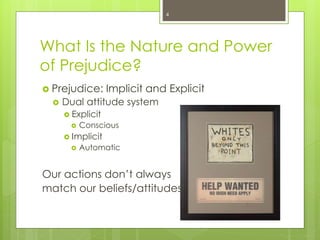
 Prejudice: Implicit and Explicit
 Dual attitude system
 Explicit
 Conscious
 Implicit
 Automatic
Our actions don’t always
match our beliefs/attitudes
4
What Is the Nature and Power of
Prejudice?
5
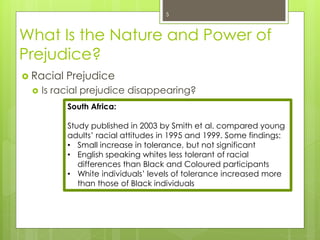
 Racial Prejudice
 Is racial prejudice disappearing?
South Africa:
Study published in 2003 by Smith et al. compared young
adults’ racial attitudes in 1995 and 1999. Some findings:
• Small increase in tolerance, but not significant
• English speaking whites less tolerant of racial
differences than Black and Coloured participants
• White individuals’ levels of tolerance increased more
than those of Black individuals
What Is the Nature and Power
of Prejudice?
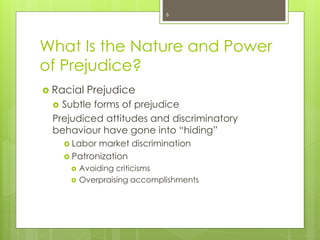
 Racial Prejudice
 Subtle forms of prejudice
Prejudiced attitudes and discriminatory
behaviour have gone into “hiding”
 Labor market discrimination
 Patronization
 Avoiding criticisms
 Overpraising accomplishments
6
What Is the Nature and Power
of Prejudice?
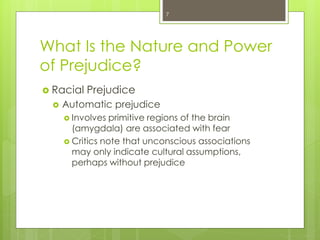
 Racial Prejudice
 Automatic prejudice
 Involves primitive regions of the brain
(amygdala) are associated with fear
 Critics note that unconscious associations
may only indicate cultural assumptions,
perhaps without prejudice
7
What Is the Nature and Power
of Prejudice?
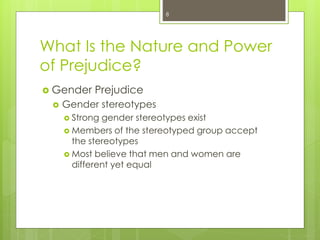
 Gender Prejudice
 Gender stereotypes
 Strong gender stereotypes exist
 Members of the stereotyped group accept
the stereotypes
 Most believe that men and women are
different yet equal
8
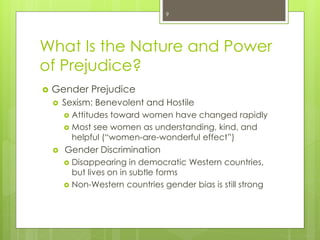
What Is the Nature and Power
of Prejudice?
 Gender Prejudice
 Sexism: Benevolent and Hostile
 Attitudes toward women have changed rapidly
 Most see women as understanding, kind, and
helpful (“women-are-wonderful effect”)
 Gender Discrimination
 Disappearing in democratic Western countries,
but lives on in subtle forms
 Non-Western countries gender bias is still strong
9
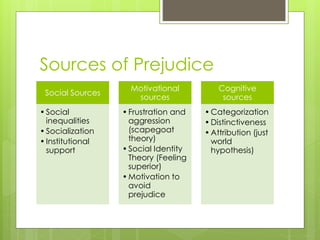
Sources of Prejudice
Social Sources
•Social
inequalities
•Socialization
•Institutional
support
Motivational
sources
•Frustration and
aggression
(scapegoat
theory)
•Social Identity
Theory (Feeling
superior)
•Motivation to
avoid
prejudice
Cognitive
sources
•Categorization
•Distinctiveness
•Attribution (just
world
hypothesis)
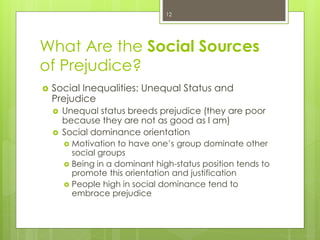
What Are the Social Sources
of Prejudice?
 Social Inequalities: Unequal Status and
Prejudice
 Unequal status breeds prejudice (they are poor
because they are not as good as I am)
 Social dominance orientation
 Motivation to have one’s group dominate other
social groups
 Being in a dominant high-status position tends to
promote this orientation and justification
 People high in social dominance tend to
embrace prejudice
12
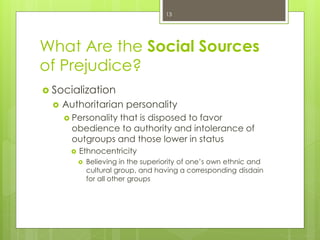
What Are the Social Sources
of Prejudice?
 Socialization
 Authoritarian personality
 Personality that is disposed to favor
obedience to authority and intolerance of
outgroups and those lower in status
 Ethnocentricity
 Believing in the superiority of one’s own ethnic and
cultural group, and having a corresponding disdain
for all other groups
13
What Are the Social Sources
of Prejudice?
 Socialization
 Religion and Prejudice
 In almost every country, leaders invoke religion
to sanctify the present order
 Use of religion to support injustice helps explain
a pair of findings concerning North American
Christianity
 Church members express more racial prejudice
than nonmembers
 Those professing traditional or fundamentalist
Christian beliefs express more prejudice than those
professing more progressive beliefs
 Remember that this is correlational, not causal
14
What Are the Social Sources
of Prejudice?
 Socialization
 Conformity
 If prejudice is socially accepted, many
people will follow the path of least resistance
and conform to the fashion
 If prejudice is not deeply ingrained in
personality, then as fashions change and new
norms evolve, prejudice can diminish
15
What Are the Social Sources
of Prejudice?
 Institutional Supports
 Government
 Schools
 Magazines and newspapers
 Face-ism
 Films and television
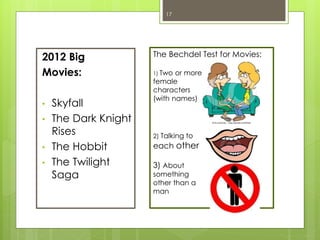
2012 Big
Movies:
• Skyfall
• The Dark Knight
Rises
• The Hobbit
• The Twilight
Saga
17
The Bechdel Test for Movies:
1) Two or more
female
characters
(with names)
2) Talking to
each other
3) About
something
other than a
man
What Are the Motivational
Sources of Prejudice?
 Frustration and Aggression: The
Scapegoat Theory
 Displaced aggression
 Hate crimes
 Realistic group conflict theory
 Prejudice arises from competition between
groups for scarce resources
18
What Are the Motivational
Sources of Prejudice?
 Social Identity Theory: Feeling Superior to
Others
 The “we” aspect of our self-concept; the
part of our answer to “Who am I?” that
comes from our group memberships
 We categorize
 We identify (ingroup)
 We compare (outgroup)
19
What Are the Motivational
Sources of Prejudice?
 Social Identity Theory: Feeling Superior to
Others
 Ingroup bias
 Tendency to favor one’s own group
 Because of our social identifications, we
conform to our group norms
 When our group succeeds, we feel better by
identifying strongly with it
20
What Are the Motivational
Sources of Prejudice?
 Social Identity Theory: Feeling Superior to
Others
 Need for status, self-regard, and belonging
 High status can only exist if someone else has
low status
 Terror management
 People’s self-protective emotional and cognitive
responses when confronted with reminders of
their mortality
21
What Are the Motivational
Sources of Prejudice?
 Motivation to Avoid Prejudice
 Motivation to avoid prejudice can lead
people to modify their thoughts and
actions
 Self-conscious people will feel guilt and try to
inhibit their prejudicial response
22
What Are the Cognitive
Sources of Prejudice?
 Categorization: Classifying People into
Groups
 Spontaneous categorization
 Social identity theory implies that those who
feel their social identity keenly will concern
themselves with correctly categorizing people
as us or them
 Necessary for prejudice
23
What Are the Cognitive
Sources of Prejudice?
 Categorization: Classifying People into
Groups
 Perceived Similarities and Differences
 Outgroup homogeneity effect
 Perception of outgroup members as more similar
to one another than are ingroup members
 Own-race bias
 Tendency for people to more accurately
recognize faces of their own race
24
What Are the Cognitive
Sources of Prejudice?
 Distinctiveness: Perceiving People Who
Stand Out
 Distinctive people
 Feeds on self-consciousness
 Stigma consciousness
 Person’s expectation of being victimized by
prejudice or discrimination
25
What Are the Cognitive
Sources of Prejudice?
 Distinctiveness: Perceiving People Who
Stand Out
 Vivid cases
 Given limited experience with a particular
social group, we recall examples of it and
generalize
 Can prime the stereotype
26
What Are the Cognitive
Sources of Prejudice?
 Distinctiveness: Perceiving People Who
Stand Out
 Distinctive events
 Stereotypes assume a correlation between
group membership and individuals’ presumed
characteristics
 Attentiveness to unusual occurrences can
create illusory correlations
27
What Are the Cognitive
Sources of Prejudice?
 Attribution: Is It a Just World?
 Group-serving bias
 Explaining away outgroup members’ positive
behaviors; also attributing negative behaviors
to their dispositions
 Just-world phenomenon
 Tendency of people to believe that the world
is just and that people therefore get what
they deserve and deserve what they get
28
What Are the Consequences
of Prejudice?
 Self-Perpetuating Stereotypes
 Whenever a member of a group behaves
as expected, we duly note the fact; our
prior belief is confirmed
 When a member of a group behaves
inconsistently with our expectation, we may
interpret or explain away the behavior as
due to special circumstances
29
What Are the Consequences
of Prejudice?
 Self-Perpetuating Stereotypes
 Subtyping
 Accommodating individuals who deviate
from one’s stereotype by thinking of them as
“exceptions to the rule”
 Subgrouping
 Accommodating individuals who deviate
from one's stereotype by forming a new
stereotype about this subset of the group
30
What Are the Consequences
of Prejudice?
 Discrimination’s Impact: The Self-Fulfilling
Prophecy
 Social beliefs can be self-confirming
 Prejudice affects its targets
31
What Are the Consequences of
Prejudice?
Figure 9.10
32
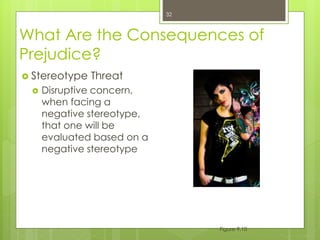
 Stereotype Threat
 Disruptive concern,
when facing a
negative stereotype,
that one will be
evaluated based on a
negative stereotype
What Are the Consequences
of Prejudice?
 Do Stereotypes Bias Judgment of
Individuals?
 Yes, but people often evaluate individuals
more positively than the groups they
compose
 Strong Stereotypes Matter
 Stereotypes Bias Interpretations
 Affect how events are interpreted
 We evaluate people more extremely when
their behavior violates our stereotypes
33

Chapter 9

  • 1.
    Chapter Nine Prejudice: DislikingOthers Carol Saccaggi Psych 2C – Social Psychology 22-23 April 2013 1
  • 2.
    What Is theNature and Power of Prejudice?  Defining Prejudice  Preconceived negative judgment of a group and its individual members  Prejudice is an attitude (a combination of feelings, inclinations to act and beliefs)  Supported by stereotypes  Beliefs about the personal attributes of a group of people  Although stereotypes can be positive and true, they also result in overgeneralization 2
  • 3.
    What Is theNature and Power of Prejudice?  Defining Prejudice  Discrimination  Unjustified negative behaviour toward a group or its members  Racism  Prejudicial attitudes and discriminatory behaviour toward people of a given race  Sexism  Prejudicial attitudes and discriminatory behaviour toward people of a given sex 3
  • 4.
    What Is theNature and Power of Prejudice?  Prejudice: Implicit and Explicit  Dual attitude system  Explicit  Conscious  Implicit  Automatic Our actions don’t always match our beliefs/attitudes 4
  • 5.
    What Is theNature and Power of Prejudice? 5  Racial Prejudice  Is racial prejudice disappearing? South Africa: Study published in 2003 by Smith et al. compared young adults’ racial attitudes in 1995 and 1999. Some findings: • Small increase in tolerance, but not significant • English speaking whites less tolerant of racial differences than Black and Coloured participants • White individuals’ levels of tolerance increased more than those of Black individuals
  • 6.
    What Is theNature and Power of Prejudice?  Racial Prejudice  Subtle forms of prejudice Prejudiced attitudes and discriminatory behaviour have gone into “hiding”  Labor market discrimination  Patronization  Avoiding criticisms  Overpraising accomplishments 6
  • 7.
    What Is theNature and Power of Prejudice?  Racial Prejudice  Automatic prejudice  Involves primitive regions of the brain (amygdala) are associated with fear  Critics note that unconscious associations may only indicate cultural assumptions, perhaps without prejudice 7
  • 8.
    What Is theNature and Power of Prejudice?  Gender Prejudice  Gender stereotypes  Strong gender stereotypes exist  Members of the stereotyped group accept the stereotypes  Most believe that men and women are different yet equal 8
  • 9.
    What Is theNature and Power of Prejudice?  Gender Prejudice  Sexism: Benevolent and Hostile  Attitudes toward women have changed rapidly  Most see women as understanding, kind, and helpful (“women-are-wonderful effect”)  Gender Discrimination  Disappearing in democratic Western countries, but lives on in subtle forms  Non-Western countries gender bias is still strong 9
  • 11.
    Sources of Prejudice SocialSources •Social inequalities •Socialization •Institutional support Motivational sources •Frustration and aggression (scapegoat theory) •Social Identity Theory (Feeling superior) •Motivation to avoid prejudice Cognitive sources •Categorization •Distinctiveness •Attribution (just world hypothesis)
  • 12.
    What Are theSocial Sources of Prejudice?  Social Inequalities: Unequal Status and Prejudice  Unequal status breeds prejudice (they are poor because they are not as good as I am)  Social dominance orientation  Motivation to have one’s group dominate other social groups  Being in a dominant high-status position tends to promote this orientation and justification  People high in social dominance tend to embrace prejudice 12
  • 13.
    What Are theSocial Sources of Prejudice?  Socialization  Authoritarian personality  Personality that is disposed to favor obedience to authority and intolerance of outgroups and those lower in status  Ethnocentricity  Believing in the superiority of one’s own ethnic and cultural group, and having a corresponding disdain for all other groups 13
  • 14.
    What Are theSocial Sources of Prejudice?  Socialization  Religion and Prejudice  In almost every country, leaders invoke religion to sanctify the present order  Use of religion to support injustice helps explain a pair of findings concerning North American Christianity  Church members express more racial prejudice than nonmembers  Those professing traditional or fundamentalist Christian beliefs express more prejudice than those professing more progressive beliefs  Remember that this is correlational, not causal 14
  • 15.
    What Are theSocial Sources of Prejudice?  Socialization  Conformity  If prejudice is socially accepted, many people will follow the path of least resistance and conform to the fashion  If prejudice is not deeply ingrained in personality, then as fashions change and new norms evolve, prejudice can diminish 15
  • 16.
    What Are theSocial Sources of Prejudice?  Institutional Supports  Government  Schools  Magazines and newspapers  Face-ism  Films and television
  • 17.
    2012 Big Movies: • Skyfall •The Dark Knight Rises • The Hobbit • The Twilight Saga 17 The Bechdel Test for Movies: 1) Two or more female characters (with names) 2) Talking to each other 3) About something other than a man
  • 18.
    What Are theMotivational Sources of Prejudice?  Frustration and Aggression: The Scapegoat Theory  Displaced aggression  Hate crimes  Realistic group conflict theory  Prejudice arises from competition between groups for scarce resources 18
  • 19.
    What Are theMotivational Sources of Prejudice?  Social Identity Theory: Feeling Superior to Others  The “we” aspect of our self-concept; the part of our answer to “Who am I?” that comes from our group memberships  We categorize  We identify (ingroup)  We compare (outgroup) 19
  • 20.
    What Are theMotivational Sources of Prejudice?  Social Identity Theory: Feeling Superior to Others  Ingroup bias  Tendency to favor one’s own group  Because of our social identifications, we conform to our group norms  When our group succeeds, we feel better by identifying strongly with it 20
  • 21.
    What Are theMotivational Sources of Prejudice?  Social Identity Theory: Feeling Superior to Others  Need for status, self-regard, and belonging  High status can only exist if someone else has low status  Terror management  People’s self-protective emotional and cognitive responses when confronted with reminders of their mortality 21
  • 22.
    What Are theMotivational Sources of Prejudice?  Motivation to Avoid Prejudice  Motivation to avoid prejudice can lead people to modify their thoughts and actions  Self-conscious people will feel guilt and try to inhibit their prejudicial response 22
  • 23.
    What Are theCognitive Sources of Prejudice?  Categorization: Classifying People into Groups  Spontaneous categorization  Social identity theory implies that those who feel their social identity keenly will concern themselves with correctly categorizing people as us or them  Necessary for prejudice 23
  • 24.
    What Are theCognitive Sources of Prejudice?  Categorization: Classifying People into Groups  Perceived Similarities and Differences  Outgroup homogeneity effect  Perception of outgroup members as more similar to one another than are ingroup members  Own-race bias  Tendency for people to more accurately recognize faces of their own race 24
  • 25.
    What Are theCognitive Sources of Prejudice?  Distinctiveness: Perceiving People Who Stand Out  Distinctive people  Feeds on self-consciousness  Stigma consciousness  Person’s expectation of being victimized by prejudice or discrimination 25
  • 26.
    What Are theCognitive Sources of Prejudice?  Distinctiveness: Perceiving People Who Stand Out  Vivid cases  Given limited experience with a particular social group, we recall examples of it and generalize  Can prime the stereotype 26
  • 27.
    What Are theCognitive Sources of Prejudice?  Distinctiveness: Perceiving People Who Stand Out  Distinctive events  Stereotypes assume a correlation between group membership and individuals’ presumed characteristics  Attentiveness to unusual occurrences can create illusory correlations 27
  • 28.
    What Are theCognitive Sources of Prejudice?  Attribution: Is It a Just World?  Group-serving bias  Explaining away outgroup members’ positive behaviors; also attributing negative behaviors to their dispositions  Just-world phenomenon  Tendency of people to believe that the world is just and that people therefore get what they deserve and deserve what they get 28
  • 29.
    What Are theConsequences of Prejudice?  Self-Perpetuating Stereotypes  Whenever a member of a group behaves as expected, we duly note the fact; our prior belief is confirmed  When a member of a group behaves inconsistently with our expectation, we may interpret or explain away the behavior as due to special circumstances 29
  • 30.
    What Are theConsequences of Prejudice?  Self-Perpetuating Stereotypes  Subtyping  Accommodating individuals who deviate from one’s stereotype by thinking of them as “exceptions to the rule”  Subgrouping  Accommodating individuals who deviate from one's stereotype by forming a new stereotype about this subset of the group 30
  • 31.
    What Are theConsequences of Prejudice?  Discrimination’s Impact: The Self-Fulfilling Prophecy  Social beliefs can be self-confirming  Prejudice affects its targets 31
  • 32.
    What Are theConsequences of Prejudice? Figure 9.10 32  Stereotype Threat  Disruptive concern, when facing a negative stereotype, that one will be evaluated based on a negative stereotype
  • 33.
    What Are theConsequences of Prejudice?  Do Stereotypes Bias Judgment of Individuals?  Yes, but people often evaluate individuals more positively than the groups they compose  Strong Stereotypes Matter  Stereotypes Bias Interpretations  Affect how events are interpreted  We evaluate people more extremely when their behavior violates our stereotypes 33