Prejudice and Stereotyping
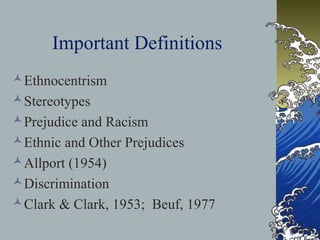
Important Definitions
Ethnocentrism
Stereotypes
Prejudice and Racism
Ethnic and Other Prejudices
Allport (1954)
Discrimination
Clark & Clark, 1953; Beuf, 1977
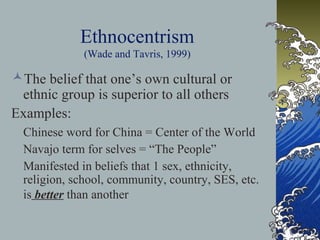
Ethnocentrism
(Wade and Tavris, 1999)
The belief that one’s own cultural or
ethnic group is superior to all others
Examples:
Chinese word for China = Center of the World
Navajo term for selves = “The People”
Manifested in beliefs that 1 sex, ethnicity,
religion, school, community, country, SES, etc.
is better than another
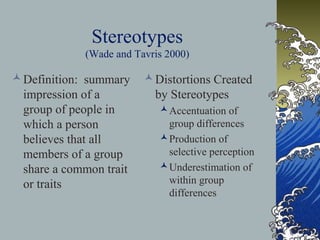
Stereotypes
(Wade and Tavris 2000)
Definition: summary
impression of a
group of people in
which a person
believes that all
members of a group
share a common trait
or traits
Distortions Created
by Stereotypes
Accentuation of
group differences
Production of
selective perception
Underestimation of
within group
differences
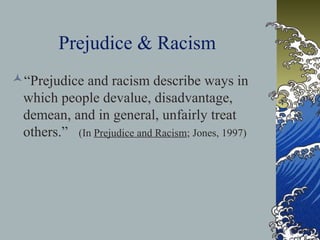
Prejudice & Racism
“Prejudice and racism describe ways in
which people devalue, disadvantage,
demean, and in general, unfairly treat
others.” (In Prejudice and Racism; Jones, 1997)
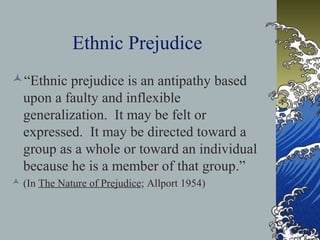
Ethnic Prejudice
“Ethnic prejudice is an antipathy based
upon a faulty and inflexible
generalization. It may be felt or
expressed. It may be directed toward a
group as a whole or toward an individual
because he is a member of that group.”
 (In The Nature of Prejudice; Allport 1954)
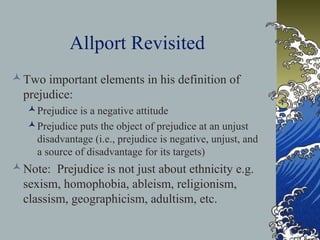
Allport Revisited
Two important elements in his definition of
prejudice:
Prejudice is a negative attitude
Prejudice puts the object of prejudice at an unjust
disadvantage (i.e., prejudice is negative, unjust, and
a source of disadvantage for its targets)
Note: Prejudice is not just about ethnicity e.g.
sexism, homophobia, ableism, religionism,
classism, geographicism, adultism, etc.
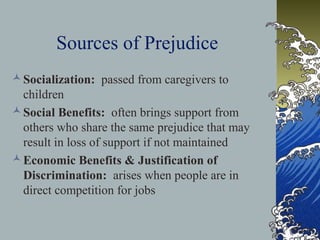
Sources of Prejudice
Socialization: passed from caregivers to
children
Social Benefits: often brings support from
others who share the same prejudice that may
result in loss of support if not maintained
Economic Benefits & Justification of
Discrimination: arises when people are in
direct competition for jobs
Discrimination
“Discrimination consists of negative
behavior toward a person based on
negative attitudes one holds toward the
group to which the person belongs, or,
positive behavior toward a person based
on positive attributes one holds toward
the group to which that person belongs.”
(In Prejudice and Racism; Jones, 1997)
Social Consequences of
Prejudice and Discrimination
1944 Clark, M.
Changes in primary
mental abilities with
age
1946 The Northside
Child Development
Center in Harlem
Clark & Clark, 1953
Brown V. Board of
Education of Topeka
1977 Beuf, A. Biting
Off the Bracelet:
Red Children in
White America
Beauty is the Beast
Reducing Prejudice
Education, self-esteem, and
religious/spiritual conversion (prob. w/ Dutch
Reform Church & Apartheid)
Contact hypothesis (prob. w/cliques)
Law (Title IX, Affirmative Action, Prop. 187,
English Only)
Working toward a common goal
Effective Strategies for
Reducing Prejudice & Conflict
Both sides must cooperate for a common goal
Both sides must have equal status & standing
Both sides must believe they have the moral,
legal, and economic support of authorities
Both sides must have opportunities to work and
socialize together formally & informally
(Amir, 1994; Brewer, 1986; Kohn, 1992; Stephan & Brigham, 1985; Stephan
& Stephan, 1992)

Prejudice and stereotyping

  • 1.
  • 2.
    Important Definitions Ethnocentrism Stereotypes Prejudice andRacism Ethnic and Other Prejudices Allport (1954) Discrimination Clark & Clark, 1953; Beuf, 1977
  • 3.
    Ethnocentrism (Wade and Tavris,1999) The belief that one’s own cultural or ethnic group is superior to all others Examples: Chinese word for China = Center of the World Navajo term for selves = “The People” Manifested in beliefs that 1 sex, ethnicity, religion, school, community, country, SES, etc. is better than another
  • 4.
    Stereotypes (Wade and Tavris2000) Definition: summary impression of a group of people in which a person believes that all members of a group share a common trait or traits Distortions Created by Stereotypes Accentuation of group differences Production of selective perception Underestimation of within group differences
  • 5.
    Prejudice & Racism “Prejudiceand racism describe ways in which people devalue, disadvantage, demean, and in general, unfairly treat others.” (In Prejudice and Racism; Jones, 1997)
  • 6.
    Ethnic Prejudice “Ethnic prejudiceis an antipathy based upon a faulty and inflexible generalization. It may be felt or expressed. It may be directed toward a group as a whole or toward an individual because he is a member of that group.”  (In The Nature of Prejudice; Allport 1954)
  • 7.
    Allport Revisited Two importantelements in his definition of prejudice: Prejudice is a negative attitude Prejudice puts the object of prejudice at an unjust disadvantage (i.e., prejudice is negative, unjust, and a source of disadvantage for its targets) Note: Prejudice is not just about ethnicity e.g. sexism, homophobia, ableism, religionism, classism, geographicism, adultism, etc.
  • 8.
    Sources of Prejudice Socialization:passed from caregivers to children Social Benefits: often brings support from others who share the same prejudice that may result in loss of support if not maintained Economic Benefits & Justification of Discrimination: arises when people are in direct competition for jobs
  • 9.
    Discrimination “Discrimination consists ofnegative behavior toward a person based on negative attitudes one holds toward the group to which the person belongs, or, positive behavior toward a person based on positive attributes one holds toward the group to which that person belongs.” (In Prejudice and Racism; Jones, 1997)
  • 10.
    Social Consequences of Prejudiceand Discrimination 1944 Clark, M. Changes in primary mental abilities with age 1946 The Northside Child Development Center in Harlem Clark & Clark, 1953 Brown V. Board of Education of Topeka 1977 Beuf, A. Biting Off the Bracelet: Red Children in White America Beauty is the Beast
  • 11.
    Reducing Prejudice Education, self-esteem,and religious/spiritual conversion (prob. w/ Dutch Reform Church & Apartheid) Contact hypothesis (prob. w/cliques) Law (Title IX, Affirmative Action, Prop. 187, English Only) Working toward a common goal
  • 12.
    Effective Strategies for ReducingPrejudice & Conflict Both sides must cooperate for a common goal Both sides must have equal status & standing Both sides must believe they have the moral, legal, and economic support of authorities Both sides must have opportunities to work and socialize together formally & informally (Amir, 1994; Brewer, 1986; Kohn, 1992; Stephan & Brigham, 1985; Stephan & Stephan, 1992)