Social Psychology Lecture 10 Review Semester 2, 2008 Lecturer: James Neill
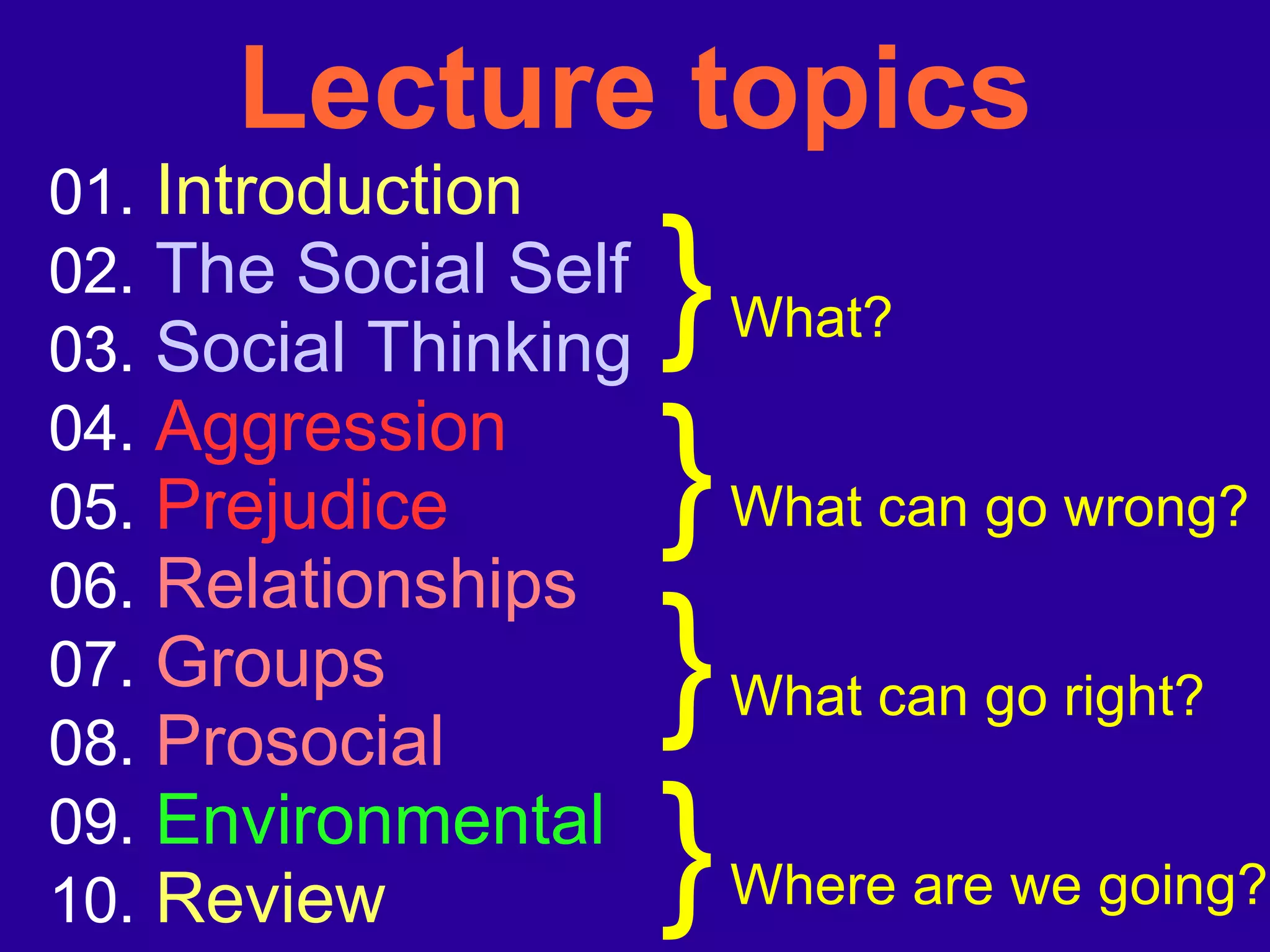
Lecture topics 01.   Introduction 02.   The Social Self 03.   Social Thinking 04.   Aggression 05.   Prejudice 06.   Relationships 07.   Groups 08.   Prosocial 09.   Environmental 10.   Review }  What? }  What can go wrong? }  What can go right? }  Where are we going?
01. Introduction
Human behaviour...  in social context. What is social psychology?
How the thoughts, feelings, and behaviours of  individuals are influenced  by the... actual, imagined,   or   implied presence of others (based on Allport, 1935) What is social psychology?
Population bottleneck Why does social psychology matter?
Sociology vs.  Social Psychology
Culture Info-based system of common ways of doing things and ideas shared via language Humans are social animals who need to manage tension between self-interest and collective interest. (Nature makes us selfish; Culture helps us to resist selfish impulses)
Culture Humans have evolved to  participate  in culture. Individuals generally need to work to gain social acceptance. Inner emotional and cognitive states help us to  connect to others . People get most of what they need from other people.
Social brain theory Larger brain is linked to complex social systems  (Dunbar, 1993, 1996)
Social Relations
History Volkerpsychologie and Crowd Mind (mid-late 1800s) Social facilitation (Triplett, 1898) Attitudes (early 20 th  C) Split from behaviourism and psychoanalysis. Gestalt theorists (1930s-50s) Post-WW2 studies e.g.,  Authoritarian personality (Allport), Obedience (Milgram), Roles (Zimbardo).
History Attribution theory, cognitive dissonance (Festinger, 1960s) European developments e.g., Tajfel (social identity theory) Moscovici (minority influence) Crisis (Late 1960s - early 1970s) Rise of social cognitive perspectives (1970s to now) Alternatives e.g., social constructionism
02. Social Self
Domains / Units of Analysis
Note:  Fuzzy boundaries Self Groups Culture Environ-ment
What is the “self”? “ The self is an important tool with which the human organism makes its way through human society and thereby manages to satisfy its needs.”
What is the “self”? The psychological self includes: Attitudes Cognitions Emotions Group Memberships (Social Identity) Ideal / Imagined Selves Memories Possessions Self-Beliefs, Self-Concepts, Self-Images Social Roles
What is the self? Self-knowledge Self-concept – info about self Interpersonal self Public self Agent self Decision-making, active responding
What is the “social self”? Humans are gregarious, group-based creatures. A significant portion of our ‘self’ and its ‘behaviour’ is socially directed and influenced.
Purpose of the social self Gain social acceptance Play social roles
Self-constructs Self-Esteem Self-Concept Self-Efficacy Self-Congruence illustrate how social psychologists study people’s selves, in cognitive, affective, and behavioural terms.
Social Self Evolutionary & adaptational functions Self-complexity Social comparison Social feedback Strategic self-presentation Self-monitoring Self-regulation
03. Social Thinking
Social thinking Social psychology was initially influenced by  behaviourism . (1930’s-1950’s) By the 1970’s, cognitive psychology lead to greater investigation of  social thinking and feeling .
Overview Social thinking Attribution theory Cognitive dissonance Self-regulation Social comparison Attitudes Influence & persuasion
Social perception Refers to how people: form impressions of, &  make inferences about  other people.
Cognitive miser “ There is ample evidence that when people’s capacity for thinking is already preoccupied, they take even more shortcuts to reduce further need for thought” Bushman & Baumeister, 2008, p. 148) – Brief Version
Knowledge structures “ Automatic thinking requires little effort because it relies on knowledge structures”, e.g., Schemas Scripts Stereotypes
Framing Context influences interpretation. Changing the frame can change and even reverse interpretation.
Attribution Theory “… deals with how the  social perceiver  uses information to arrive at  causal explanations  for events”
Fundamental Attribution Error Tendency to attribute others’ behaviour to enduring dispositions because: Underestimation of the influence of situational factors. Overestimation of the influence of dispositional factors. Extent of the FAE varies by culture.
Actor/Observer Bias “ there is a pervasive tendency for  actors  to attribute their actions to situational requirements, whereas  observers  tend to attribute the same actions to stable personal dispositions”
Self-serving bias Taking credit for success = Self-enhancing bias Denying responsibility for failure =  Self-protecting bias
Ultimate Attribution Error FAE applied to in- and out- groups, i.e.,  Bias towards  internal attributions for in-group success and external attributions for in-group failures Opposite for out-groups
Why Have Attitudes? Help deal with complex world Initial evaluations are immediate and unconscious - helpful in making choices Implicit attitude :   Automatic evaluative response Explicit attitude :   Conscious evaluative response
Mere-exposure effect Tendency for people to come to like things  simply because they see or encounter them repeatedly   Exception - If you dislike something initially, repeated exposure will not change that attitude Attitudes are further influenced by classical and operant conditioning, social learning, and attitudinal polarisation
Cognitive Dissonance Unpleasant state when attitude and behaviour are inconsistent    people desire  consistency  i.e., try to bring their attitude into line with their actions (or their actions into line with their attitudes) There is an even stronger  desire to be viewed as consistent by others
Attitudes & Behaviour Predictions of behaviour based on attitudes is best when Attitudes are specific Behaviours are aggregated Attitudes are conscious and come to mind easil y
Social Influence Normative vs. informational influence Influence/persuastion techniques Minority influence Resisting persuasion
04. Prejudice
Prejudice Categorisation Natural human tendency to group objects Social categorisation Sorting people into groups on common characteristics
Why Prejudice Exists Tendency to hold stereotypes and prejudices may be innate Content of stereotypes is learned though socialisation People have to work to override  stereotyes and prejudice Extra effort leaves people less able to self regulate
Why Prejudice Exists Minimal group effect Ingroup favouritism Rationalisation for oppression Self-esteem  (through social comparison)
Accuracy of Stereotypes Many stereotypes may be based on genuine difference, but then become overgeneralised Heuristics may be fairly accurate, but stereotypes become exaggerated with little factual basis Used to boost self-esteem, oppression, or rationalise status quo
Overcoming Stereotypes, Reducing Prejudices Conscious override Increase available information Positive, equal contact Superordinate goals
05. Aggression
Aggression “ The intentional infliction of some form of harm on others”  (Baron & Byrne, 2000) Expression of aggression is culturally influenced. (Culture offers nonviolent ways of resolving conflicts and problems)
Types of aggression Hostile Instrumental Passive  Active
Theories & Factors of Aggression Inner causes   e.g., excitation-transfer,  cognitive theories, testosterone Interpersonal causes  e.g., social-learning theory External / situational causes  e.g., frustration-aggression, relative deprivation, crowd behaviour, intergroup conflict
06. Relationships
Relationships Overview Affiliation (the need to belong) Attraction Rejection / exclusion Types Maintaining & ending Sexuality Jealousy
The Need to Belong (Affiliation) Intrinsic need for affiliation Harlow’s experiments Affiliation & stress/health  (not belonging is bad for you)
Attraction Ingratiation Social rewards Reciprocity Playing hard to get Self-monitoring Similarity Propinquity Matching hypothesis Beauty Evolutionary perspectives
Love Types of love Passionate vs companionate Sternberg’s triangle of love Passion, Intimacy, Commitment Types of relationships exchange vs. communal attachment styles Schacter’s 2-factor theory (Arousal-Cognition) Hatfield & Walster's 3-factor theory (Culture-Arousal-Cognition)
Ending relationships Levinger’s 4 factors (new life, alternative partners, expectation of failure, lack of comittment) Rusult & Zembrodt – 4 stages to failing relationship (loyalty, neglect, voice behaviour, exit behaviour) Duck’s relationship dissolution (intrapsychic, dyadic, social, grave-dressing)
07. Groups & Leadership
Groups Overview What is a group? Social facilitation Social loafing Effects of groups on individuals Intergroup conflict Co-operation between groups
Leadership Overview Leader? Follower? Power? Leadership theories Genetic Great man theory Trait theory Situational theory – Leadership styles Task- vs. people-oriented Transformational theory Alternatives to leadership Bad bosses
08. Prosocial Behaviour
Pro-social Behaviour Overview Pro-social / anti-social behaviour Altruism Cooperation - Dilemmas Forgiveness Who helps? When? Why? Bystander help Impact of receiving help Increasing helping
Pro-social Behaviour Theories Genetic/evolutionary  e.g., survival, social exchange, egoism Social norms   e.g., altruism, principalism, collectivism Learning theory   e.g., social exchange, social learning
Bystander intervention Cognitive Model - 5 steps  (Latane & Darley) Bystander-Calculus Model - 3 stages (Pilliavin et al.) - weigh up costs of helping & not helping Empathy-Altruism Hypothesis  (Batson)
Personal  determinants of helping Personality Competence Gender Attributions Personal norms Mood
Interpersonal  determinants of helping Attractiveness Similarity Closeness Deservingness Gender
09. Environmental Psychology
Environmental Psychology What is it? Negative environmental influences Environmental design Natural environment Evolutionary psychology Biophilia Changing environmental attitudes and behaviour
Conclusion
Final thoughts What have we explored and learnt? Is it worth knowing? How have we been limited by theory and method? How worthwhile has it been? Feedback

Social Psychology: Review

  • 1.
    Social Psychology Lecture10 Review Semester 2, 2008 Lecturer: James Neill
  • 2.
    Lecture topics 01. Introduction 02. The Social Self 03. Social Thinking 04. Aggression 05. Prejudice 06. Relationships 07. Groups 08. Prosocial 09. Environmental 10. Review } What? } What can go wrong? } What can go right? } Where are we going?
  • 3.
  • 4.
    Human behaviour... in social context. What is social psychology?
  • 5.
    How the thoughts,feelings, and behaviours of individuals are influenced by the... actual, imagined, or implied presence of others (based on Allport, 1935) What is social psychology?
  • 6.
    Population bottleneck Whydoes social psychology matter?
  • 7.
    Sociology vs. Social Psychology
  • 8.
    Culture Info-based systemof common ways of doing things and ideas shared via language Humans are social animals who need to manage tension between self-interest and collective interest. (Nature makes us selfish; Culture helps us to resist selfish impulses)
  • 9.
    Culture Humans haveevolved to participate in culture. Individuals generally need to work to gain social acceptance. Inner emotional and cognitive states help us to connect to others . People get most of what they need from other people.
  • 10.
    Social brain theoryLarger brain is linked to complex social systems (Dunbar, 1993, 1996)
  • 11.
  • 12.
    History Volkerpsychologie andCrowd Mind (mid-late 1800s) Social facilitation (Triplett, 1898) Attitudes (early 20 th C) Split from behaviourism and psychoanalysis. Gestalt theorists (1930s-50s) Post-WW2 studies e.g., Authoritarian personality (Allport), Obedience (Milgram), Roles (Zimbardo).
  • 13.
    History Attribution theory,cognitive dissonance (Festinger, 1960s) European developments e.g., Tajfel (social identity theory) Moscovici (minority influence) Crisis (Late 1960s - early 1970s) Rise of social cognitive perspectives (1970s to now) Alternatives e.g., social constructionism
  • 14.
  • 15.
    Domains / Unitsof Analysis
  • 16.
    Note: Fuzzyboundaries Self Groups Culture Environ-ment
  • 17.
    What is the“self”? “ The self is an important tool with which the human organism makes its way through human society and thereby manages to satisfy its needs.”
  • 18.
    What is the“self”? The psychological self includes: Attitudes Cognitions Emotions Group Memberships (Social Identity) Ideal / Imagined Selves Memories Possessions Self-Beliefs, Self-Concepts, Self-Images Social Roles
  • 19.
    What is theself? Self-knowledge Self-concept – info about self Interpersonal self Public self Agent self Decision-making, active responding
  • 20.
    What is the“social self”? Humans are gregarious, group-based creatures. A significant portion of our ‘self’ and its ‘behaviour’ is socially directed and influenced.
  • 21.
    Purpose of thesocial self Gain social acceptance Play social roles
  • 22.
    Self-constructs Self-Esteem Self-ConceptSelf-Efficacy Self-Congruence illustrate how social psychologists study people’s selves, in cognitive, affective, and behavioural terms.
  • 23.
    Social Self Evolutionary& adaptational functions Self-complexity Social comparison Social feedback Strategic self-presentation Self-monitoring Self-regulation
  • 24.
  • 25.
    Social thinking Socialpsychology was initially influenced by behaviourism . (1930’s-1950’s) By the 1970’s, cognitive psychology lead to greater investigation of social thinking and feeling .
  • 26.
    Overview Social thinkingAttribution theory Cognitive dissonance Self-regulation Social comparison Attitudes Influence & persuasion
  • 27.
    Social perception Refersto how people: form impressions of, & make inferences about other people.
  • 28.
    Cognitive miser “There is ample evidence that when people’s capacity for thinking is already preoccupied, they take even more shortcuts to reduce further need for thought” Bushman & Baumeister, 2008, p. 148) – Brief Version
  • 29.
    Knowledge structures “Automatic thinking requires little effort because it relies on knowledge structures”, e.g., Schemas Scripts Stereotypes
  • 30.
    Framing Context influencesinterpretation. Changing the frame can change and even reverse interpretation.
  • 31.
    Attribution Theory “…deals with how the social perceiver uses information to arrive at causal explanations for events”
  • 32.
    Fundamental Attribution ErrorTendency to attribute others’ behaviour to enduring dispositions because: Underestimation of the influence of situational factors. Overestimation of the influence of dispositional factors. Extent of the FAE varies by culture.
  • 33.
    Actor/Observer Bias “there is a pervasive tendency for actors to attribute their actions to situational requirements, whereas observers tend to attribute the same actions to stable personal dispositions”
  • 34.
    Self-serving bias Takingcredit for success = Self-enhancing bias Denying responsibility for failure = Self-protecting bias
  • 35.
    Ultimate Attribution ErrorFAE applied to in- and out- groups, i.e., Bias towards internal attributions for in-group success and external attributions for in-group failures Opposite for out-groups
  • 36.
    Why Have Attitudes?Help deal with complex world Initial evaluations are immediate and unconscious - helpful in making choices Implicit attitude : Automatic evaluative response Explicit attitude : Conscious evaluative response
  • 37.
    Mere-exposure effect Tendencyfor people to come to like things simply because they see or encounter them repeatedly Exception - If you dislike something initially, repeated exposure will not change that attitude Attitudes are further influenced by classical and operant conditioning, social learning, and attitudinal polarisation
  • 38.
    Cognitive Dissonance Unpleasantstate when attitude and behaviour are inconsistent  people desire consistency i.e., try to bring their attitude into line with their actions (or their actions into line with their attitudes) There is an even stronger desire to be viewed as consistent by others
  • 39.
    Attitudes & BehaviourPredictions of behaviour based on attitudes is best when Attitudes are specific Behaviours are aggregated Attitudes are conscious and come to mind easil y
  • 40.
    Social Influence Normativevs. informational influence Influence/persuastion techniques Minority influence Resisting persuasion
  • 41.
  • 42.
    Prejudice Categorisation Naturalhuman tendency to group objects Social categorisation Sorting people into groups on common characteristics
  • 43.
    Why Prejudice ExistsTendency to hold stereotypes and prejudices may be innate Content of stereotypes is learned though socialisation People have to work to override stereotyes and prejudice Extra effort leaves people less able to self regulate
  • 44.
    Why Prejudice ExistsMinimal group effect Ingroup favouritism Rationalisation for oppression Self-esteem (through social comparison)
  • 45.
    Accuracy of StereotypesMany stereotypes may be based on genuine difference, but then become overgeneralised Heuristics may be fairly accurate, but stereotypes become exaggerated with little factual basis Used to boost self-esteem, oppression, or rationalise status quo
  • 46.
    Overcoming Stereotypes, ReducingPrejudices Conscious override Increase available information Positive, equal contact Superordinate goals
  • 47.
  • 48.
    Aggression “ Theintentional infliction of some form of harm on others” (Baron & Byrne, 2000) Expression of aggression is culturally influenced. (Culture offers nonviolent ways of resolving conflicts and problems)
  • 49.
    Types of aggressionHostile Instrumental Passive Active
  • 50.
    Theories & Factorsof Aggression Inner causes e.g., excitation-transfer, cognitive theories, testosterone Interpersonal causes e.g., social-learning theory External / situational causes e.g., frustration-aggression, relative deprivation, crowd behaviour, intergroup conflict
  • 51.
  • 52.
    Relationships Overview Affiliation(the need to belong) Attraction Rejection / exclusion Types Maintaining & ending Sexuality Jealousy
  • 53.
    The Need toBelong (Affiliation) Intrinsic need for affiliation Harlow’s experiments Affiliation & stress/health (not belonging is bad for you)
  • 54.
    Attraction Ingratiation Socialrewards Reciprocity Playing hard to get Self-monitoring Similarity Propinquity Matching hypothesis Beauty Evolutionary perspectives
  • 55.
    Love Types oflove Passionate vs companionate Sternberg’s triangle of love Passion, Intimacy, Commitment Types of relationships exchange vs. communal attachment styles Schacter’s 2-factor theory (Arousal-Cognition) Hatfield & Walster's 3-factor theory (Culture-Arousal-Cognition)
  • 56.
    Ending relationships Levinger’s4 factors (new life, alternative partners, expectation of failure, lack of comittment) Rusult & Zembrodt – 4 stages to failing relationship (loyalty, neglect, voice behaviour, exit behaviour) Duck’s relationship dissolution (intrapsychic, dyadic, social, grave-dressing)
  • 57.
    07. Groups &Leadership
  • 58.
    Groups Overview Whatis a group? Social facilitation Social loafing Effects of groups on individuals Intergroup conflict Co-operation between groups
  • 59.
    Leadership Overview Leader?Follower? Power? Leadership theories Genetic Great man theory Trait theory Situational theory – Leadership styles Task- vs. people-oriented Transformational theory Alternatives to leadership Bad bosses
  • 60.
  • 61.
    Pro-social Behaviour OverviewPro-social / anti-social behaviour Altruism Cooperation - Dilemmas Forgiveness Who helps? When? Why? Bystander help Impact of receiving help Increasing helping
  • 62.
    Pro-social Behaviour TheoriesGenetic/evolutionary e.g., survival, social exchange, egoism Social norms e.g., altruism, principalism, collectivism Learning theory e.g., social exchange, social learning
  • 63.
    Bystander intervention CognitiveModel - 5 steps (Latane & Darley) Bystander-Calculus Model - 3 stages (Pilliavin et al.) - weigh up costs of helping & not helping Empathy-Altruism Hypothesis (Batson)
  • 64.
    Personal determinantsof helping Personality Competence Gender Attributions Personal norms Mood
  • 65.
    Interpersonal determinantsof helping Attractiveness Similarity Closeness Deservingness Gender
  • 66.
  • 67.
    Environmental Psychology Whatis it? Negative environmental influences Environmental design Natural environment Evolutionary psychology Biophilia Changing environmental attitudes and behaviour
  • 68.
  • 69.
    Final thoughts Whathave we explored and learnt? Is it worth knowing? How have we been limited by theory and method? How worthwhile has it been? Feedback

Editor's Notes

  • #2 Image source: Unknown 21 July, 2008, 11:30-13:30, 2B11 7125-6666 Social Psychology / G Centre for Applied Psyhology Faculty of Health University of Canberra Bruce, ACT 2601, Australia ph: +61 2 6201 2536 [email_address] http://wilderdom.com/7125 http://wilderdom.com/6666 http://ucspace.canberra.edu.au/display/7125/Unit+Outline