SELF-PERPETUATING STEREOTYPES
 Prejudice is preconceived judgment.
Prejudgments are inevitable: None of us is a
dispassionate bookkeeper of social happenings,
tallying evidence for and against our biases.
 Prejudgments guide our attention and our
memories. People who accept gender stereotypes
often misrecall their own school grades in
stereotype-consistent ways.
For example, women often recall receiving worse
math grades and better arts grades than were
actually the case (Chatard & others, 2007).
 Prejudgments are self-perpetuating.
Whenever a member of a group behaves as
expected, we duly note the fact; our prior belief is
confirmed. When a member of a group behaves
inconsistently with our expectation, we may
interpret or explain away the behavior as due to
special circumstances (Crocker & others, 1983).
 subtyping
- Accommodating individuals who deviate from one’s
stereotype by thinking of them as “exceptions to the
rule.”
o subgrouping
- Accommodating individuals who deviate from one’s
stereotype by forming a new stereotype about this
subset of the group.
DISCRIMINATION’S IMPACT: THE SELF-
FULFILLING PROPHECY
 Attitudes may coincide with the social hierarchy
not only as a rationalization for it but also
because discrimination affects its victims.
“One’s reputation,” wrote Gordon Allport, “cannot be
hammered, hammered, hammered into one’s head
without doing something to one’s character” (1958,
p. 139)
 The Nature of Prejudice
two basic types
—those that involve blaming oneself (withdrawal,
self-hate, aggression against one’s own group) and
--- those that involve blaming external causes
(fighting back, suspiciousness, increased group
pride)
STEREOTYPE THREAT
 A disruptive concern, when facing a negative
stereotype, that one will be evaluated based on a
negative stereotype. Unlike self-fulfilling prophecies
that hammer one’s reputation into one’s self-
concept, stereotype threat situations have
immediate effects.
STEREOTYPE THREAT
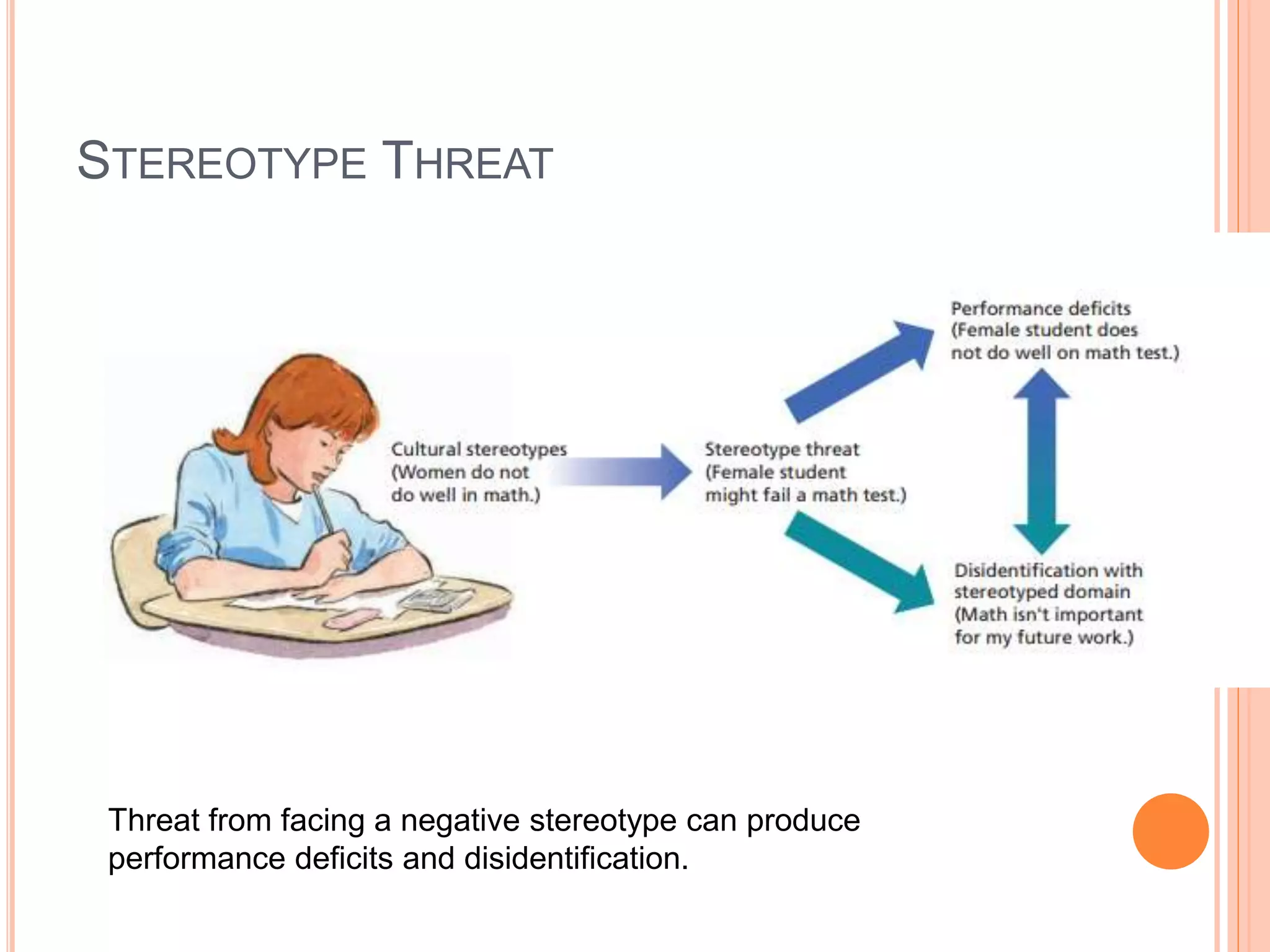
Threat from facing a negative stereotype can produce
performance deficits and disidentification.
STEREOTYPE THREAT
 How does stereotype threat undermine (weaken)
performance?
 Stress. fMRI brain scans suggest that the stress of
stereotype threat impairs brain activity associated with
mathematical processing and increases activity in areas
associated with emotion processing (Derks & others,
2008; Krendl & others, 2008; Wraga & others, 2007).
• Self-monitoring. Worrying about making mistakes
disrupts focused attention (Keller & Dauenheimer, 2003;
Seibt & Forster, 2004).
• Suppressing unwanted thoughts and emotions. The
effort required to regulate one’s thinking takes energy
and disrupts working memory (Bonnot & Croizet, 2007).
DO STEREOTYPES BIAS JUDGMENTS OF
INDIVIDUALS?
 Yes, stereotypes bias judgments, but here is some
good news: People often evaluate individuals more
positively than the groups they compose (Miller &
Felicio, 1990).
STRONG STEREOTYPES MATTER
 Strong and seemingly relevant stereotypes do color
our judgments of individuals (Krueger & Rothbart,
1988)
 In a follow-up study, Nelson, Michele Acker, and Manis
(1996) showed University of Michigan students photos
of other students from the university’s engineering and
nursing schools, along with descriptions of each
student’s interests. Even when informed that the sample
contained an equal number of males and females from
each school, the same description was judged more
likely to come from a nursing student when attached to a
female face. Thus, even when a strong gender
stereotype is known to be irrelevant, it has an irresistible
force.
STEREOTYPES BIAS
INTERPRETATIONS
 Stereotypes also color how we interpret events,
note David Dunning and David Sherman (1997).
 Sometimes we make judgments, or begin
interacting with someone, with little to go on but our
stereotype. In such cases stereotypes can strongly
bias our interpretations and memories of people.
For example, Charles Bond and his colleagues
(1988) found that after getting to know their
patients, White psychiatric nurses put Black and
White patients in physical restraints equally often.
But they restrained incoming Black patients more
often than their White counterparts. With little else
to go on, stereotypes mattered.
 Sometimes we make judgments, or begin
interacting with someone, with little to go on but our
stereotype. In such cases stereotypes can strongly
bias our interpretations and memories of people.
 For example, Charles Bond and his colleagues
(1988) found that after getting to know their
patients, White psychiatric nurses put Black and
White patients in physical restraints equally often.
But they restrained incoming Black patients more
often than their White counterparts. With little else
to go on, stereotypes mattered.
 When stereotypes are strong and the information
about someone is ambiguous, stereotypes can
subtly bias our judgments of individuals.
 We evaluate people more extremely when their
behavior violates our stereotypes (Bettencourt &
others, 1997).
A woman who rebukes someone cutting in front of
her in a movie line (“Shouldn’t you go to the end of
the line?”) may seem more assertive than a man
who reacts similarly (Manis & others, 1988).
SUMMARY
 Prejudice and stereotyping have important consequences,
especially when strongly held, when judging unknown
individuals, and when deciding policies regarding whole
groups.
 Once formed, stereotypes tend to perpetuate themselves
and resist change. They also create their own realities
through self-fulfilling prophecies.
 Prejudice can also undermine people’s performance
through stereotype threat, by making people
apprehensive that others will view them stereotypically.
 Stereotypes, especially when strong, can predispose how
we perceive people and interpret events.

What Are the Consequences of Prejudice?

  • 2.
    SELF-PERPETUATING STEREOTYPES  Prejudiceis preconceived judgment. Prejudgments are inevitable: None of us is a dispassionate bookkeeper of social happenings, tallying evidence for and against our biases.  Prejudgments guide our attention and our memories. People who accept gender stereotypes often misrecall their own school grades in stereotype-consistent ways. For example, women often recall receiving worse math grades and better arts grades than were actually the case (Chatard & others, 2007).
  • 3.
     Prejudgments areself-perpetuating. Whenever a member of a group behaves as expected, we duly note the fact; our prior belief is confirmed. When a member of a group behaves inconsistently with our expectation, we may interpret or explain away the behavior as due to special circumstances (Crocker & others, 1983).
  • 4.
     subtyping - Accommodatingindividuals who deviate from one’s stereotype by thinking of them as “exceptions to the rule.” o subgrouping - Accommodating individuals who deviate from one’s stereotype by forming a new stereotype about this subset of the group.
  • 5.
    DISCRIMINATION’S IMPACT: THESELF- FULFILLING PROPHECY  Attitudes may coincide with the social hierarchy not only as a rationalization for it but also because discrimination affects its victims. “One’s reputation,” wrote Gordon Allport, “cannot be hammered, hammered, hammered into one’s head without doing something to one’s character” (1958, p. 139)
  • 6.
     The Natureof Prejudice two basic types —those that involve blaming oneself (withdrawal, self-hate, aggression against one’s own group) and --- those that involve blaming external causes (fighting back, suspiciousness, increased group pride)
  • 7.
    STEREOTYPE THREAT  Adisruptive concern, when facing a negative stereotype, that one will be evaluated based on a negative stereotype. Unlike self-fulfilling prophecies that hammer one’s reputation into one’s self- concept, stereotype threat situations have immediate effects.
  • 8.
    STEREOTYPE THREAT Threat fromfacing a negative stereotype can produce performance deficits and disidentification.
  • 9.
    STEREOTYPE THREAT  Howdoes stereotype threat undermine (weaken) performance?  Stress. fMRI brain scans suggest that the stress of stereotype threat impairs brain activity associated with mathematical processing and increases activity in areas associated with emotion processing (Derks & others, 2008; Krendl & others, 2008; Wraga & others, 2007). • Self-monitoring. Worrying about making mistakes disrupts focused attention (Keller & Dauenheimer, 2003; Seibt & Forster, 2004). • Suppressing unwanted thoughts and emotions. The effort required to regulate one’s thinking takes energy and disrupts working memory (Bonnot & Croizet, 2007).
  • 10.
    DO STEREOTYPES BIASJUDGMENTS OF INDIVIDUALS?  Yes, stereotypes bias judgments, but here is some good news: People often evaluate individuals more positively than the groups they compose (Miller & Felicio, 1990).
  • 11.
    STRONG STEREOTYPES MATTER Strong and seemingly relevant stereotypes do color our judgments of individuals (Krueger & Rothbart, 1988)  In a follow-up study, Nelson, Michele Acker, and Manis (1996) showed University of Michigan students photos of other students from the university’s engineering and nursing schools, along with descriptions of each student’s interests. Even when informed that the sample contained an equal number of males and females from each school, the same description was judged more likely to come from a nursing student when attached to a female face. Thus, even when a strong gender stereotype is known to be irrelevant, it has an irresistible force.
  • 12.
    STEREOTYPES BIAS INTERPRETATIONS  Stereotypesalso color how we interpret events, note David Dunning and David Sherman (1997).  Sometimes we make judgments, or begin interacting with someone, with little to go on but our stereotype. In such cases stereotypes can strongly bias our interpretations and memories of people. For example, Charles Bond and his colleagues (1988) found that after getting to know their patients, White psychiatric nurses put Black and White patients in physical restraints equally often. But they restrained incoming Black patients more often than their White counterparts. With little else to go on, stereotypes mattered.
  • 13.
     Sometimes wemake judgments, or begin interacting with someone, with little to go on but our stereotype. In such cases stereotypes can strongly bias our interpretations and memories of people.  For example, Charles Bond and his colleagues (1988) found that after getting to know their patients, White psychiatric nurses put Black and White patients in physical restraints equally often. But they restrained incoming Black patients more often than their White counterparts. With little else to go on, stereotypes mattered.
  • 14.
     When stereotypesare strong and the information about someone is ambiguous, stereotypes can subtly bias our judgments of individuals.  We evaluate people more extremely when their behavior violates our stereotypes (Bettencourt & others, 1997). A woman who rebukes someone cutting in front of her in a movie line (“Shouldn’t you go to the end of the line?”) may seem more assertive than a man who reacts similarly (Manis & others, 1988).
  • 15.
    SUMMARY  Prejudice andstereotyping have important consequences, especially when strongly held, when judging unknown individuals, and when deciding policies regarding whole groups.  Once formed, stereotypes tend to perpetuate themselves and resist change. They also create their own realities through self-fulfilling prophecies.  Prejudice can also undermine people’s performance through stereotype threat, by making people apprehensive that others will view them stereotypically.  Stereotypes, especially when strong, can predispose how we perceive people and interpret events.