WHY DO WE QUESTION ? I NEVER JUDGE THE ABILITY OF MY STUDENTS WITH THE ACCURACY OF THE  ANSWERS  THEY PRODUCE FOR MY QUESTIONS BUT WITH THE  QUESTIONS  THEY PUT FORWARD…… DR. S. RADHAKRISHNAN
? WHAT IS HISTORY The George Macaulay Trevelyan lectures delivered in the University of Cambridge  January – March 1961 By  EDWARD HALLETT CARR Fellow of Trinity College GROUP  ‘D’
SOCIETY, INDIVIDUAL AND HISTORY Society and the individual are inseparable: they are necessary and complementary to each other, not opposites. Donne says ‘No man is an island, entire of itself, every man is a piece of the continent, a part of the main.’ Anthropologists say that primitive man is less individual and more completely moulded by his society than civilized man. The development of society and the development of the individual go hand in hand,and condition each other.
Civilized man, like primitive man is moulded by society just as effectively as society is moulded by him. The cult of individualism is one of the most pervasive of modern historical myths. Individualism was the basis of the great nineteenth-century philosophy of utilitarianism. A social revolution brings about new social groups to positions of power. SOCIETY, INDIVIDUAL AND HISTORY
The historian,then,is an individual human being.Like other individuals,he is also a social phenomenon,both the product and the concious or unconcious spokesperson of the society to which he belongs :it is this capacity he approaches the facts of the historical past. Great history is written precisely when the historian’s vision of the past is illuminated by insights into the problems of the present. SOCIETY, INDIVIDUAL AND HISTORY
THE HISTORIAN AND HIS FACTS It was from Germany, the country which was to do so much to upset, the comfortable reign of 19 th  century liberalism, that the first challenge came in the 1880s and 1890s to the doctrine of the primacy and autonomy of the facts in history [pg no. 14-15]
THE HISTORIAN AND HIS FACTS The facts are really not at all like fish on the fishmonger’s slab. They are like fish swimming about in a vast and sometimes inaccessible ocean; and what the historian catches will depend partly on chance but mainly on what part of the ocean he chooses to fish in.. and what tackle he chooses to use – these two factors being of course determined by the kind of fish he wants to catch. By  and large, the historian will get the kind of facts he wants. [pg. no. 18]
The past which a historian studies is not a dead past, but a past which in some sense is still living in the present and that the main work of the historian is not to record, but to evaluate; for, if he does not evaluate, how can he know what is worth recording [pg. no. 16, 15] THE HISTORIAN AND HIS FACTS
The historian is necessarily selective. The fact that we reached in this room few minutes ago after taking our lunch is just as much a fact about the past as the fact that India got freedom in 1947. But it will most probably be ignored by historians  THE HISTORIAN AND HIS FACTS
And so, history can be defined as a continuous process of interaction between the historians and his facts and unending dialogue between the present and the past Interpretation is the life blood of history.  [pg. no. 24, 22] THE HISTORIAN AND HIS FACTS
HISTORY, SCIENCE AND MORALITY Examining fundamental distinction between science and history: History deals exclusively with the unique, science with the general History teaches lessons through generalization History is unable to predict History is necessarily subjective History involves issues of religion and morality What is  GOD  to a historian?
The hypotheses used by the historian is remarkably similar to that of the hypotheses used by the scientist Some of the hypotheses in history are: Division of history into periods Division of history into geographical sectors HISTORY, SCIENCE AND MORALITY
A GLANCE AT HISTORICAL INTERPRETATIONS 1857 Revolt vs. Mutiny Nude portrayals – Ravi Verma – M.F. Hushain – Exile
What is the cause of Robinson’s Death? Jones, returning from a party at which he has consumed more than his usual ration of alcohol, in a car whose brakes turn out to have been defective, at  a blind corner where visibility is notoriously poor, knocks down and kills Robinson, who was crossing the road to buy cigarettes at the shop on the corner.  [pg. no. 98] Rational vs. Accidental Causes CAUSATION IN HISTORY
CAUSATION IN HISTORY History - marshalling the events of the past in an orderly sequence of cause and effect The causes determine historian’s interpretation of the historical process, and his interpretation determines his selection and marshalling of the causes The fact is that all human actions are both free and determined, according to the point of view from which one considers them
The world of the historian, like the world of the scientist, is not a photographic copy of the real world But rather a working model which enables him more or less effectively to understand it and to master it  Historians do not assume that events are inevitable before they have taken place CAUSATION IN HISTORY
CAUSATION IN HISTORY History begins with the handling down of tradition; and tradition means the carrying of the habits and lessons of the past into the future. Records of the past begin to be kept for the benefit of future generations.
THE WIDENING HORIZON Now, it has become possible for the first time even to imagine a whole world consisting of people who have in the fullest sense entered into history and become the concern. No longer of the colonial administrator or of the anthropologist, but of the historian This is a revolution in our conception of history.   Till 18 th  century, history was a prerogative of the elites [pg. no. 144]
CRITICAL REFLECTIONS Like Marx and all other philosophers….Carr also seem to be in a hurry…………  hurry to conclude..  and in doing so what he misses out most probably is that every socio-economic reality is a dynamic activity…………. and so is history.
How far is it possible for the observer to keep him/herself away from the observed ??? The unending debate on subjectivity vs. objectivity !!! CRITICAL REFLECTIONS
THINK OF IT !! How many times we question our questions before forwarding it in front of a person powered by the state…………… Just as the kings came out of our oblivion, the state may emerge with our silence !!!
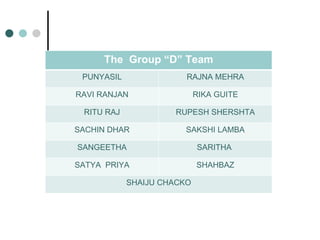
The  Group “D” Team PUNYASIL RAJNA MEHRA RAVI RANJAN RIKA GUITE RITU RAJ RUPESH SHERSHTA SACHIN DHAR SAKSHI LAMBA SANGEETHA SARITHA  SATYA  PRIYA SHAHBAZ SHAIJU CHACKO

What is History

  • 1.
    WHY DO WEQUESTION ? I NEVER JUDGE THE ABILITY OF MY STUDENTS WITH THE ACCURACY OF THE ANSWERS THEY PRODUCE FOR MY QUESTIONS BUT WITH THE QUESTIONS THEY PUT FORWARD…… DR. S. RADHAKRISHNAN
  • 2.
    ? WHAT ISHISTORY The George Macaulay Trevelyan lectures delivered in the University of Cambridge January – March 1961 By EDWARD HALLETT CARR Fellow of Trinity College GROUP ‘D’
  • 3.
    SOCIETY, INDIVIDUAL ANDHISTORY Society and the individual are inseparable: they are necessary and complementary to each other, not opposites. Donne says ‘No man is an island, entire of itself, every man is a piece of the continent, a part of the main.’ Anthropologists say that primitive man is less individual and more completely moulded by his society than civilized man. The development of society and the development of the individual go hand in hand,and condition each other.
  • 4.
    Civilized man, likeprimitive man is moulded by society just as effectively as society is moulded by him. The cult of individualism is one of the most pervasive of modern historical myths. Individualism was the basis of the great nineteenth-century philosophy of utilitarianism. A social revolution brings about new social groups to positions of power. SOCIETY, INDIVIDUAL AND HISTORY
  • 5.
    The historian,then,is anindividual human being.Like other individuals,he is also a social phenomenon,both the product and the concious or unconcious spokesperson of the society to which he belongs :it is this capacity he approaches the facts of the historical past. Great history is written precisely when the historian’s vision of the past is illuminated by insights into the problems of the present. SOCIETY, INDIVIDUAL AND HISTORY
  • 6.
    THE HISTORIAN ANDHIS FACTS It was from Germany, the country which was to do so much to upset, the comfortable reign of 19 th century liberalism, that the first challenge came in the 1880s and 1890s to the doctrine of the primacy and autonomy of the facts in history [pg no. 14-15]
  • 7.
    THE HISTORIAN ANDHIS FACTS The facts are really not at all like fish on the fishmonger’s slab. They are like fish swimming about in a vast and sometimes inaccessible ocean; and what the historian catches will depend partly on chance but mainly on what part of the ocean he chooses to fish in.. and what tackle he chooses to use – these two factors being of course determined by the kind of fish he wants to catch. By and large, the historian will get the kind of facts he wants. [pg. no. 18]
  • 8.
    The past whicha historian studies is not a dead past, but a past which in some sense is still living in the present and that the main work of the historian is not to record, but to evaluate; for, if he does not evaluate, how can he know what is worth recording [pg. no. 16, 15] THE HISTORIAN AND HIS FACTS
  • 9.
    The historian isnecessarily selective. The fact that we reached in this room few minutes ago after taking our lunch is just as much a fact about the past as the fact that India got freedom in 1947. But it will most probably be ignored by historians THE HISTORIAN AND HIS FACTS
  • 10.
    And so, historycan be defined as a continuous process of interaction between the historians and his facts and unending dialogue between the present and the past Interpretation is the life blood of history. [pg. no. 24, 22] THE HISTORIAN AND HIS FACTS
  • 11.
    HISTORY, SCIENCE ANDMORALITY Examining fundamental distinction between science and history: History deals exclusively with the unique, science with the general History teaches lessons through generalization History is unable to predict History is necessarily subjective History involves issues of religion and morality What is GOD to a historian?
  • 12.
    The hypotheses usedby the historian is remarkably similar to that of the hypotheses used by the scientist Some of the hypotheses in history are: Division of history into periods Division of history into geographical sectors HISTORY, SCIENCE AND MORALITY
  • 13.
    A GLANCE ATHISTORICAL INTERPRETATIONS 1857 Revolt vs. Mutiny Nude portrayals – Ravi Verma – M.F. Hushain – Exile
  • 14.
    What is thecause of Robinson’s Death? Jones, returning from a party at which he has consumed more than his usual ration of alcohol, in a car whose brakes turn out to have been defective, at a blind corner where visibility is notoriously poor, knocks down and kills Robinson, who was crossing the road to buy cigarettes at the shop on the corner. [pg. no. 98] Rational vs. Accidental Causes CAUSATION IN HISTORY
  • 15.
    CAUSATION IN HISTORYHistory - marshalling the events of the past in an orderly sequence of cause and effect The causes determine historian’s interpretation of the historical process, and his interpretation determines his selection and marshalling of the causes The fact is that all human actions are both free and determined, according to the point of view from which one considers them
  • 16.
    The world ofthe historian, like the world of the scientist, is not a photographic copy of the real world But rather a working model which enables him more or less effectively to understand it and to master it Historians do not assume that events are inevitable before they have taken place CAUSATION IN HISTORY
  • 17.
    CAUSATION IN HISTORYHistory begins with the handling down of tradition; and tradition means the carrying of the habits and lessons of the past into the future. Records of the past begin to be kept for the benefit of future generations.
  • 18.
    THE WIDENING HORIZONNow, it has become possible for the first time even to imagine a whole world consisting of people who have in the fullest sense entered into history and become the concern. No longer of the colonial administrator or of the anthropologist, but of the historian This is a revolution in our conception of history. Till 18 th century, history was a prerogative of the elites [pg. no. 144]
  • 19.
    CRITICAL REFLECTIONS LikeMarx and all other philosophers….Carr also seem to be in a hurry………… hurry to conclude.. and in doing so what he misses out most probably is that every socio-economic reality is a dynamic activity…………. and so is history.
  • 20.
    How far isit possible for the observer to keep him/herself away from the observed ??? The unending debate on subjectivity vs. objectivity !!! CRITICAL REFLECTIONS
  • 21.
    THINK OF IT!! How many times we question our questions before forwarding it in front of a person powered by the state…………… Just as the kings came out of our oblivion, the state may emerge with our silence !!!
  • 22.
    The Group“D” Team PUNYASIL RAJNA MEHRA RAVI RANJAN RIKA GUITE RITU RAJ RUPESH SHERSHTA SACHIN DHAR SAKSHI LAMBA SANGEETHA SARITHA SATYA PRIYA SHAHBAZ SHAIJU CHACKO