What is prejudice?

          The word comes from the Latin "pre" (before) and "judge".
Prejudice :is a negative emotional attitude held toward members
of a specific social group.
For example:
             1 Prejudices may be reflected in the policies of schools, businesses,
             2 police departments, or governments.

Becoming Prejudiced
  How do prejudices develop?

               One major theory suggests that
 prejudice is a form of scapegoating (blaming a person or a
group for the actions of others or for conditions not of their
                           making).

The Prejudiced Personality

Other research suggests that prejudice can be a general personality
                 characteristicIn the process, they
  found that people who are prejudiced against one group tend
   to be prejudiced against all out-groups (Perreault & Bourhis,
                               1999).
The Prejudiced Personality
 Other research suggests that prejudice can be a general personality
 characteristicIn the process, they
 found that people who are prejudiced against one group tend
 to be prejudiced against all out-groups (Perreault & Bourhis,
 1999).


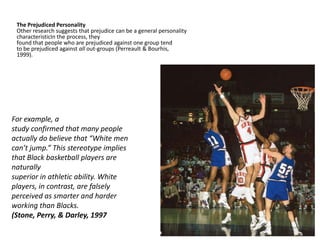
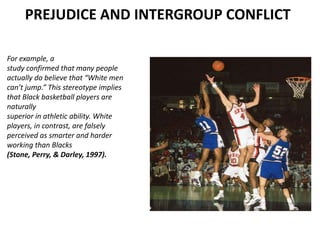
For example, a
study confirmed that many people
actually do believe that “White men
can’t jump.” This stereotype implies
that Black basketball players are
naturally
superior in athletic ability. White
players, in contrast, are falsely
perceived as smarter and harder
working than Blacks.

(Stone, Perry, & Darley, 1997
Different types of prejudice

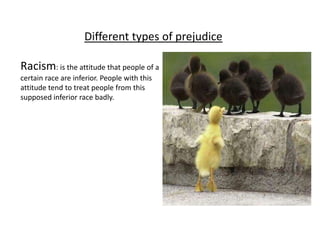
Racism: is the attitude that people of a
certain race are inferior. People with this

attitude tend to treat people from this
supposed inferior race badly.
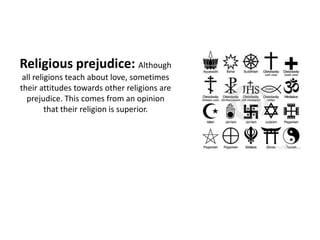
Religious prejudice: Although
 all religions teach about love, sometimes
their attitudes towards other religions are
  prejudice. This comes from an opinion
         that their religion is superior.
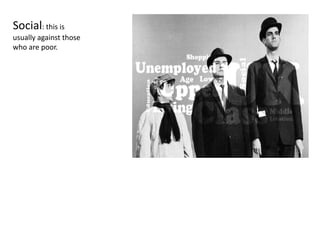
Social: this is
usually against those
who are poor.
Ageism:
   some elderly
 people feel they
are discriminated
  against (as do
   some young
  people) due to
     their age.
Homophobia: This is
  when a person feels
 they are discriminated
against because they are
   homosexual (gay).
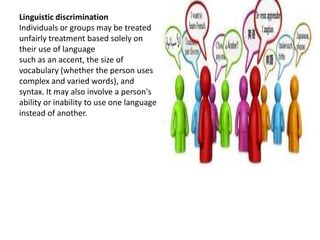
Linguistic discrimination
Individuals or groups may be treated
unfairly treatment based solely on
their use of language
such as an accent, the size of
vocabulary (whether the person uses
complex and varied words), and
syntax. It may also involve a person's
ability or inability to use one language
instead of another.
Causes of Prejudice
•   Economic and Political Competition
•   Displaced Aggression
•   Maintenance of Self-Image and Status
•   Dispositional Prejudice
•   Prejudice Through Conformity
•   Hatred
•   Social learning and conformity
Effects of prejudice


It leads to :
1. Fights/ Arguments
2. Hate
3. Jealousy
4. Bloodshed
5. War/ Riots
6. Hurt
Why is prejudice a
            problem?
• It affects the victims and causes them
  hurt
• It is unjust
• It goes against the principle that our
  society establishes and promotes
Prejudice in our daily lives
• Prejudice against disabled people (physical and
  mental disabilities)
• Racial Prejudice (the most dominant race,
  Chinese, against other races)
• Class Prejudice (more successful vs. less successful)
• Prejudice against the less gifted/ talented
Reducing Prejudice
•   Behavior leads to attitude change
•   Clear inevitability leads to attitude change
•   Economic conflict blocks progress
•   Competition can block progress
•   Interdependence helps
•   Equal status familiarity helps
PREJUDICE AND INTERGROUP CONFLICT

For example, a
study confirmed that many people
actually do believe that “White men
can’t jump.” This stereotype implies
that Black basketball players are
naturally
superior in athletic ability. White
players, in contrast, are falsely
perceived as smarter and harder
working than Blacks
(Stone, Perry, & Darley, 1997).
Different types of prejudice
Racism:


Racism: is the attitude that people of a certain race are inferior. People with
   this attitude tend to treat people from this supposed inferior race badly.
                                       E.g:
 like Kosovo and Iraq, where a great many people from certain races in these
        countries have been murdered. This is called ‘ethnic cleansing’.
Religious prejudice: Although all religions teach about love, sometimes their
attitudes towards other religions are prejudice. This comes from an opinion that their
religion is superior.
Social: this is usually against those who are poor.
Ageism: some elderly people feel they are discriminated against (as do some
young people) due to their age.
Homophobia: This is when a person feels they are discriminated against because
they are homosexual (gay).
Linguistic discrimination
Individuals or groups may be treated unfairly treatment based solely on their use of language
such as an accent, the size of vocabulary (whether the person uses complex and varied words),
and syntax. It may also involve a person's ability or inability to use one language instead of
another.
Causes of Prejudice
•   Economic and Political Competition
•   Displaced Aggression
•   Maintenance of Self-Image and Status
•   Dispositional Prejudice
•   Prejudice Through Conformity
•   Hatred
•   Social learning and conformity
1. Effects of prejudice
   - It leads to :
Fights/ Arguments
        Hate
      Jealousy
     Bloodshed
    War/ Riots
        Hurt
Why is prejudice a
            problem?
• It affects the victims and causes them
  hurt
• It is unjust
• It goes against the principle that our
  society establishes and promotes
Prejudice in our daily lives
• Prejudice against disabled people (physical and
  mental disabilities)
• Racial Prejudice (the most dominant race,
  Chinese, against other races)
• Class Prejudice (more successful vs. less successful)
• Prejudice against the less gifted/ talented
Reducing Prejudice
•   Behavior leads to attitude change
•   Clear inevitability leads to attitude change
•   Economic conflict blocks progress
•   Competition can block progress
•   Interdependence helps
•   Equal status familiarity helps

Prejudice

  • 1.
    What is prejudice? The word comes from the Latin "pre" (before) and "judge". Prejudice :is a negative emotional attitude held toward members of a specific social group. For example: 1 Prejudices may be reflected in the policies of schools, businesses, 2 police departments, or governments.
  • 2.
    Becoming Prejudiced How do prejudices develop? One major theory suggests that prejudice is a form of scapegoating (blaming a person or a group for the actions of others or for conditions not of their making).
  • 3.
    The Prejudiced Personality Otherresearch suggests that prejudice can be a general personality characteristicIn the process, they found that people who are prejudiced against one group tend to be prejudiced against all out-groups (Perreault & Bourhis, 1999).
  • 4.
    The Prejudiced Personality Other research suggests that prejudice can be a general personality characteristicIn the process, they found that people who are prejudiced against one group tend to be prejudiced against all out-groups (Perreault & Bourhis, 1999). For example, a study confirmed that many people actually do believe that “White men can’t jump.” This stereotype implies that Black basketball players are naturally superior in athletic ability. White players, in contrast, are falsely perceived as smarter and harder working than Blacks. (Stone, Perry, & Darley, 1997
  • 5.
    Different types ofprejudice Racism: is the attitude that people of a certain race are inferior. People with this attitude tend to treat people from this supposed inferior race badly.
  • 6.
    Religious prejudice: Although all religions teach about love, sometimes their attitudes towards other religions are prejudice. This comes from an opinion that their religion is superior.
  • 7.
    Social: this is usuallyagainst those who are poor.
  • 8.
    Ageism: some elderly people feel they are discriminated against (as do some young people) due to their age.
  • 9.
    Homophobia: This is when a person feels they are discriminated against because they are homosexual (gay).
  • 10.
    Linguistic discrimination Individuals orgroups may be treated unfairly treatment based solely on their use of language such as an accent, the size of vocabulary (whether the person uses complex and varied words), and syntax. It may also involve a person's ability or inability to use one language instead of another.
  • 11.
    Causes of Prejudice • Economic and Political Competition • Displaced Aggression • Maintenance of Self-Image and Status • Dispositional Prejudice • Prejudice Through Conformity • Hatred • Social learning and conformity
  • 12.
    Effects of prejudice Itleads to : 1. Fights/ Arguments 2. Hate 3. Jealousy 4. Bloodshed 5. War/ Riots 6. Hurt
  • 13.
    Why is prejudicea problem? • It affects the victims and causes them hurt • It is unjust • It goes against the principle that our society establishes and promotes
  • 14.
    Prejudice in ourdaily lives • Prejudice against disabled people (physical and mental disabilities) • Racial Prejudice (the most dominant race, Chinese, against other races) • Class Prejudice (more successful vs. less successful) • Prejudice against the less gifted/ talented
  • 15.
    Reducing Prejudice • Behavior leads to attitude change • Clear inevitability leads to attitude change • Economic conflict blocks progress • Competition can block progress • Interdependence helps • Equal status familiarity helps
  • 166.
    PREJUDICE AND INTERGROUPCONFLICT For example, a study confirmed that many people actually do believe that “White men can’t jump.” This stereotype implies that Black basketball players are naturally superior in athletic ability. White players, in contrast, are falsely perceived as smarter and harder working than Blacks (Stone, Perry, & Darley, 1997).
  • 167.
    Different types ofprejudice Racism: Racism: is the attitude that people of a certain race are inferior. People with this attitude tend to treat people from this supposed inferior race badly. E.g: like Kosovo and Iraq, where a great many people from certain races in these countries have been murdered. This is called ‘ethnic cleansing’.
  • 168.
    Religious prejudice: Althoughall religions teach about love, sometimes their attitudes towards other religions are prejudice. This comes from an opinion that their religion is superior. Social: this is usually against those who are poor. Ageism: some elderly people feel they are discriminated against (as do some young people) due to their age.
  • 169.
    Homophobia: This iswhen a person feels they are discriminated against because they are homosexual (gay). Linguistic discrimination Individuals or groups may be treated unfairly treatment based solely on their use of language such as an accent, the size of vocabulary (whether the person uses complex and varied words), and syntax. It may also involve a person's ability or inability to use one language instead of another.
  • 170.
    Causes of Prejudice • Economic and Political Competition • Displaced Aggression • Maintenance of Self-Image and Status • Dispositional Prejudice • Prejudice Through Conformity • Hatred • Social learning and conformity
  • 171.
    1. Effects ofprejudice - It leads to : Fights/ Arguments Hate Jealousy Bloodshed War/ Riots Hurt
  • 172.
    Why is prejudicea problem? • It affects the victims and causes them hurt • It is unjust • It goes against the principle that our society establishes and promotes
  • 174.
    Prejudice in ourdaily lives • Prejudice against disabled people (physical and mental disabilities) • Racial Prejudice (the most dominant race, Chinese, against other races) • Class Prejudice (more successful vs. less successful) • Prejudice against the less gifted/ talented
  • 175.
    Reducing Prejudice • Behavior leads to attitude change • Clear inevitability leads to attitude change • Economic conflict blocks progress • Competition can block progress • Interdependence helps • Equal status familiarity helps