INTRODUCTION TO
ENGINEERING MATERIALS
BY GANESH
KULKARNI
Why should WE study Engineering
Materials?
The world is in the middle of a
materials revolution.
Materials science and engineering has
transformed every aspect of modern
living.
 Advances in engineered materials are
crucial to the continued vitality of
COURSE OUTCOMES
o Describe the role of engineering materials in the design
of systems and their selection strategy.
o Apply the knowledge of crystal structure and
deformation behaviour to select appropriate material.
o Discuss how engineering materials respond to applied
mechanical loads in both a macroscopic and
microscopic sense at ambient temperature and high
temperature applications.
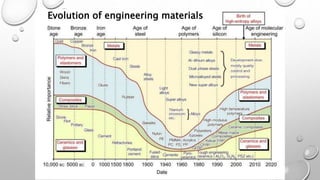
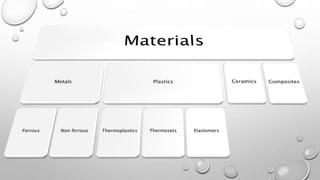
Evolution of engineering materials
CLASSES OF MATERIALS
Ionic crystals
Covalent materials
Metal & alloys
Semiconductors
Superconductors
Polymers
Composite materials
Ceramics
Inorganic glasses
Catalysts
IONIC CRYSTALS
Ionic Bond is Formed by transfer of
electrons
Example: NaCl,KCl,MgCl2 etc
Properties of Ionic Crystals
1.Solid Crystals have high melting
point.
2.They Conduct electricity in molten
state.
3.Low thermal conductivity.
4.Soluble in polar solvents.
APPLICATION OF IONIC
CRYSTALS
Nacl is used for cooking purpose which make
food tasty.
 Preservation of cheese, dairy products, meat,
pickles and sauces.
 Cacl2 salt is used as Road salt to remove
snow fallen on road in Cold countries. It
lowers the freezing point water.
 Potassium chloride produced is used for
making fertilizer
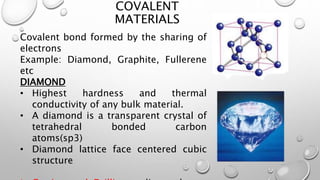
COVALENT
MATERIALS
Covalent bond formed by the sharing of
electrons
Example: Diamond, Graphite, Fullerene
etc
DIAMOND
• Highest hardness and thermal
conductivity of any bulk material.
• A diamond is a transparent crystal of
tetrahedral bonded carbon
atoms(sp3)
• Diamond lattice face centered cubic
structure
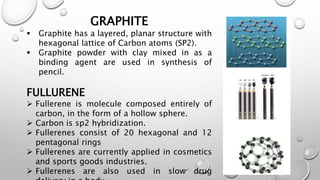
GRAPHITE
 Graphite has a layered, planar structure with
hexagonal lattice of Carbon atoms (SP2).
 Graphite powder with clay mixed in as a
binding agent are used in synthesis of
pencil.
FULLURENE
 Fullerene is molecule composed entirely of
carbon, in the form of a hollow sphere.
 Carbon is sp2 hybridization.
 Fullerenes consist of 20 hexagonal and 12
pentagonal rings
 Fullerenes are currently applied in cosmetics
and sports goods industries.
 Fullerenes are also used in slow drug
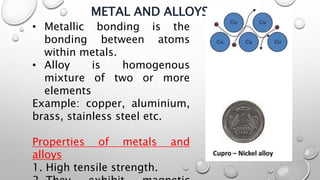
METAL AND ALLOYS
• Metallic bonding is the
bonding between atoms
within metals.
• Alloy is homogenous
mixture of two or more
elements
Example: copper, aluminium,
brass, stainless steel etc.
Properties of metals and
alloys
1. High tensile strength.
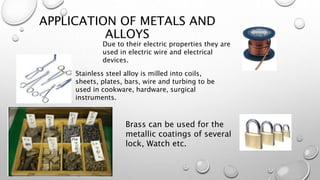
APPLICATION OF METALS AND
ALLOYS
Due to their electric properties they are
used in electric wire and electrical
devices.
Stainless steel alloy is milled into coils,
sheets, plates, bars, wire and turbing to be
used in cookware, hardware, surgical
instruments.
Brass can be used for the
metallic coatings of several
lock, Watch etc.
SEMICONDUCTORS
 The bonding is covalent (electrons are shared
between atoms). Their electrical properties depend
strongly on minute proportions of dopants.
Examples: Si,Ge etc
Dopants:
Boron (3rd group element)
Phosphorus (5th group element)
Properties of semiconductors
1. They are crystalline properties lie In-between
insulator and conductors.
2. Their conductivity varies with temperature.
Application of semiconductors
Semiconductor memory uses semiconductor-
based integrated circuits to store information
Si wafer in photovoltaic cells to convert
light energy to electric energy.
A transistor is a semiconductor device
used to amplify and switch electronic
signals
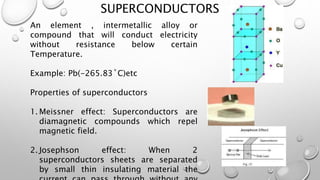
SUPERCONDUCTORS
An element , intermetallic alloy or
compound that will conduct electricity
without resistance below certain
Temperature.
Example: Pb(-265.83˚C)etc
Properties of superconductors
1. Meissner effect: Superconductors are
diamagnetic compounds which repel
magnetic field.
2. Josephson effect: When 2
superconductors sheets are separated
by small thin insulating material the
APPLICATION OF
SUPERCONDUCTORS
Based on Meissner effect trains can be made to “float” on strong
superconducting magnets, virtually eliminating friction between
the train and its tracks.
Speed: 581 Kph in shanghai.
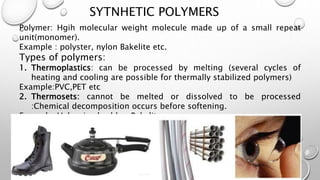
SYTNHETIC POLYMERS
Polymer: Hgih molecular weight molecule made up of a small repeat
unit(monomer).
Example : polyster, nylon Bakelite etc.
Types of polymers:
1. Thermoplastics: can be processed by melting (several cycles of
heating and cooling are possible for thermally stabilized polymers)
Example:PVC,PET etc
2. Thermosets: cannot be melted or dissolved to be processed
:Chemical decomposition occurs before softening.
Example: Vulcanized rubber Bakelite.
APPLICATION OF SYNTHETIC
POLYMER
Polypropylene the polymer we are using from morning to night
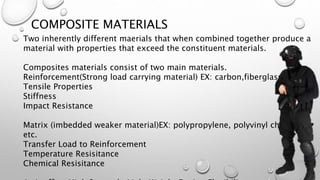
COMPOSITE MATERIALS
Two inherently different maerials that when combined together produce a
material with properties that exceed the constituent materials.
Composites materials consist of two main materials.
Reinforcement(Strong load carrying material) EX: carbon,fiberglass
Tensile Properties
Stiffness
Impact Resistance
Matrix (imbedded weaker material)EX: polypropylene, polyvinyl chloride
etc.
Transfer Load to Reinforcement
Temperature Resisitance
Chemical Resisitance
APPLICATION OF COMPOSITE
MATERIALS
Carbon fiber composites with polymer
matrices,have become the advanced composite
materials for aerospace, due to their high
strength,high Modulus and low cost.
Helmet and bullet proof
jacket made up of
Aramide Composite
material
Fiber-reinforced plastics have reached the stage
where they could be used for making wheels.
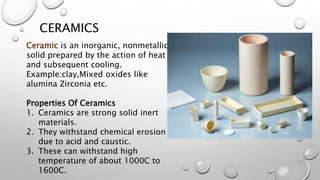
CERAMICS
Ceramic is an inorganic, nonmetallic
solid prepared by the action of heat
and subsequent cooling.
Example:clay,Mixed oxides like
alumina Zirconia etc.
Properties Of Ceramics
1. Ceramics are strong solid inert
materials.
2. They withstand chemical erosion
due to acid and caustic.
3. These can withstand high
temperature of about 1000C to
1600C.
CATALYST
Catalyst is substance which alters the rate of reaction without
itself undergoing any chemical change in the reaction
Acid catalyzed reaction usually catalyzed by acids
Ex: H2SO4,Hcl,Alcl3,HF,BF3etc
Solid Acid catalyst
Zeolites
Heteropolyacids
Sulfated zirconia
Mixed oxides
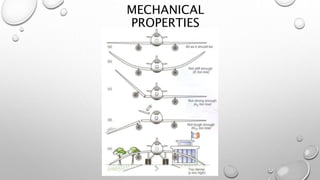
MECHANICAL
PROPERTIES
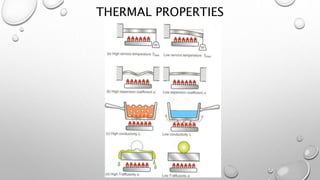
THERMAL PROPERTIES
ELECTRICAL, MAGNETIC AND OPTICAL
PROPERTIES
CHEMICAL
PROPERTIES
engineering materials.pptx

engineering materials.pptx

  • 1.
  • 2.
    Why should WEstudy Engineering Materials? The world is in the middle of a materials revolution. Materials science and engineering has transformed every aspect of modern living.  Advances in engineered materials are crucial to the continued vitality of
  • 3.
    COURSE OUTCOMES o Describethe role of engineering materials in the design of systems and their selection strategy. o Apply the knowledge of crystal structure and deformation behaviour to select appropriate material. o Discuss how engineering materials respond to applied mechanical loads in both a macroscopic and microscopic sense at ambient temperature and high temperature applications.
  • 4.
  • 6.
    CLASSES OF MATERIALS Ioniccrystals Covalent materials Metal & alloys Semiconductors Superconductors Polymers Composite materials Ceramics Inorganic glasses Catalysts
  • 7.
    IONIC CRYSTALS Ionic Bondis Formed by transfer of electrons Example: NaCl,KCl,MgCl2 etc Properties of Ionic Crystals 1.Solid Crystals have high melting point. 2.They Conduct electricity in molten state. 3.Low thermal conductivity. 4.Soluble in polar solvents.
  • 8.
    APPLICATION OF IONIC CRYSTALS Naclis used for cooking purpose which make food tasty.  Preservation of cheese, dairy products, meat, pickles and sauces.  Cacl2 salt is used as Road salt to remove snow fallen on road in Cold countries. It lowers the freezing point water.  Potassium chloride produced is used for making fertilizer
  • 9.
    COVALENT MATERIALS Covalent bond formedby the sharing of electrons Example: Diamond, Graphite, Fullerene etc DIAMOND • Highest hardness and thermal conductivity of any bulk material. • A diamond is a transparent crystal of tetrahedral bonded carbon atoms(sp3) • Diamond lattice face centered cubic structure
  • 10.
    GRAPHITE  Graphite hasa layered, planar structure with hexagonal lattice of Carbon atoms (SP2).  Graphite powder with clay mixed in as a binding agent are used in synthesis of pencil. FULLURENE  Fullerene is molecule composed entirely of carbon, in the form of a hollow sphere.  Carbon is sp2 hybridization.  Fullerenes consist of 20 hexagonal and 12 pentagonal rings  Fullerenes are currently applied in cosmetics and sports goods industries.  Fullerenes are also used in slow drug
  • 11.
    METAL AND ALLOYS •Metallic bonding is the bonding between atoms within metals. • Alloy is homogenous mixture of two or more elements Example: copper, aluminium, brass, stainless steel etc. Properties of metals and alloys 1. High tensile strength.
  • 12.
    APPLICATION OF METALSAND ALLOYS Due to their electric properties they are used in electric wire and electrical devices. Stainless steel alloy is milled into coils, sheets, plates, bars, wire and turbing to be used in cookware, hardware, surgical instruments. Brass can be used for the metallic coatings of several lock, Watch etc.
  • 13.
    SEMICONDUCTORS  The bondingis covalent (electrons are shared between atoms). Their electrical properties depend strongly on minute proportions of dopants. Examples: Si,Ge etc Dopants: Boron (3rd group element) Phosphorus (5th group element) Properties of semiconductors 1. They are crystalline properties lie In-between insulator and conductors. 2. Their conductivity varies with temperature.
  • 14.
    Application of semiconductors Semiconductormemory uses semiconductor- based integrated circuits to store information Si wafer in photovoltaic cells to convert light energy to electric energy. A transistor is a semiconductor device used to amplify and switch electronic signals
  • 15.
    SUPERCONDUCTORS An element ,intermetallic alloy or compound that will conduct electricity without resistance below certain Temperature. Example: Pb(-265.83˚C)etc Properties of superconductors 1. Meissner effect: Superconductors are diamagnetic compounds which repel magnetic field. 2. Josephson effect: When 2 superconductors sheets are separated by small thin insulating material the
  • 16.
    APPLICATION OF SUPERCONDUCTORS Based onMeissner effect trains can be made to “float” on strong superconducting magnets, virtually eliminating friction between the train and its tracks. Speed: 581 Kph in shanghai.
  • 17.
    SYTNHETIC POLYMERS Polymer: Hgihmolecular weight molecule made up of a small repeat unit(monomer). Example : polyster, nylon Bakelite etc. Types of polymers: 1. Thermoplastics: can be processed by melting (several cycles of heating and cooling are possible for thermally stabilized polymers) Example:PVC,PET etc 2. Thermosets: cannot be melted or dissolved to be processed :Chemical decomposition occurs before softening. Example: Vulcanized rubber Bakelite.
  • 18.
    APPLICATION OF SYNTHETIC POLYMER Polypropylenethe polymer we are using from morning to night
  • 19.
    COMPOSITE MATERIALS Two inherentlydifferent maerials that when combined together produce a material with properties that exceed the constituent materials. Composites materials consist of two main materials. Reinforcement(Strong load carrying material) EX: carbon,fiberglass Tensile Properties Stiffness Impact Resistance Matrix (imbedded weaker material)EX: polypropylene, polyvinyl chloride etc. Transfer Load to Reinforcement Temperature Resisitance Chemical Resisitance
  • 20.
    APPLICATION OF COMPOSITE MATERIALS Carbonfiber composites with polymer matrices,have become the advanced composite materials for aerospace, due to their high strength,high Modulus and low cost. Helmet and bullet proof jacket made up of Aramide Composite material Fiber-reinforced plastics have reached the stage where they could be used for making wheels.
  • 21.
    CERAMICS Ceramic is aninorganic, nonmetallic solid prepared by the action of heat and subsequent cooling. Example:clay,Mixed oxides like alumina Zirconia etc. Properties Of Ceramics 1. Ceramics are strong solid inert materials. 2. They withstand chemical erosion due to acid and caustic. 3. These can withstand high temperature of about 1000C to 1600C.
  • 22.
    CATALYST Catalyst is substancewhich alters the rate of reaction without itself undergoing any chemical change in the reaction Acid catalyzed reaction usually catalyzed by acids Ex: H2SO4,Hcl,Alcl3,HF,BF3etc Solid Acid catalyst Zeolites Heteropolyacids Sulfated zirconia Mixed oxides
  • 23.
  • 24.
  • 25.
    ELECTRICAL, MAGNETIC ANDOPTICAL PROPERTIES
  • 26.