LEARNING OUTCOMES
 Describe the structure of atoms of atomic numbers
1 to 20 using illustrations
 State the properties of electrons, protons and
neutrons
 Define atomic number and mass number
 Define relative atomic mass
 Interpret notations of the form
 Define isotopy
 List the uses of isotopes
 Predict the likelihood of an atom forming an ionic
or covalent bond based on atomic structure
Atomic Structure
Chapter 2
Xa
b
Structure of Atoms
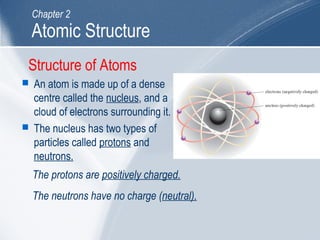
 An atom is made up of a dense
centre called the nucleus, and a
cloud of electrons surrounding it.
 The nucleus has two types of
particles called protons and
neutrons.
The protons are positively charged.
The neutrons have no charge (neutral).
Atomic Structure
Chapter 2
Structure of Atoms
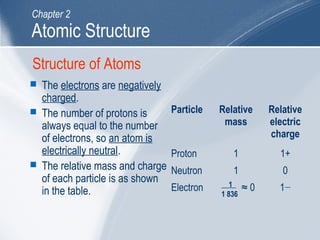
 The electrons are negatively
charged.
 The number of protons is
always equal to the number
of electrons, so an atom is
electrically neutral.
 The relative mass and charge
of each particle is as shown
in the table.
Particle Relative
mass
Relative
electric
charge
Proton 1 1+
Neutron 1 0
Electron ≈ 0 1−
Atomic Structure
Chapter 2
__1_
1 836
Proton number and Nucleon number
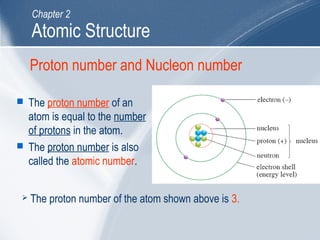
 The proton number of an
atom is equal to the number
of protons in the atom.
 The proton number is also
called the atomic number.
 The proton number of the atom shown above is 3.
Atomic Structure
Chapter 2
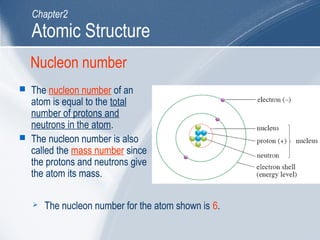
Nucleon number
 The nucleon number of an
atom is equal to the total
number of protons and
neutrons in the atom.
 The nucleon number is also
called the mass number since
the protons and neutrons give
the atom its mass.
 The nucleon number for the atom shown is 6.
Atomic Structure
Chapter2
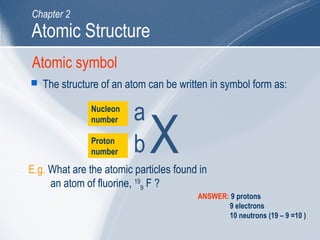
Atomic symbol
 The structure of an atom can be written in symbol form as:
Nucleon
number
Proton
number
 E.g. What are the atomic particles found in
an atom of fluorine, 19
9 F ?
ANSWER: 9 protons
9 electrons
10 neutrons (19 – 9 =10 )
Atomic Structure
Chapter 2
X
a
b
Electron arrangement
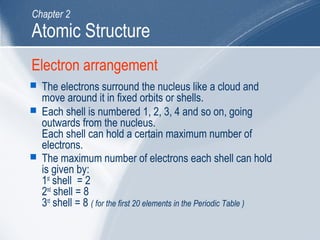
 The electrons surround the nucleus like a cloud and
move around it in fixed orbits or shells.
 Each shell is numbered 1, 2, 3, 4 and so on, going
outwards from the nucleus.
Each shell can hold a certain maximum number of
electrons.
 The maximum number of electrons each shell can hold
is given by:
1st
shell = 2
2nd
shell = 8
3rd
shell = 8 ( for the first 20 elements in the Periodic Table )
Atomic Structure
Chapter 2
Electron arrangement
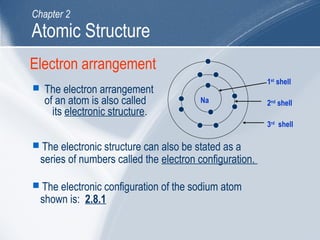
 The electron arrangement
of an atom is also called
its electronic structure.
Na
 The electronic structure can also be stated as a
series of numbers called the electron configuration.
 The electronic configuration of the sodium atom
shown is: 2.8.1
1st
shell
2nd
shell
3rd
shell
Atomic Structure
Chapter 2
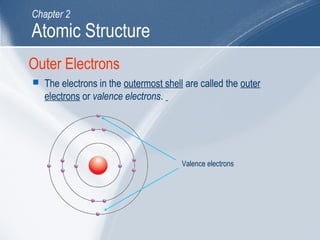
Outer Electrons
 The electrons in the outermost shell are called the outer
electrons or valence electrons.
Atomic Structure
Chapter 2
Valence electrons
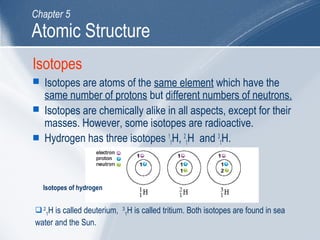
Isotopes
 Isotopes are atoms of the same element which have the
same number of protons but different numbers of neutrons.
 Isotopes are chemically alike in all aspects, except for their
masses. However, some isotopes are radioactive.
 Hydrogen has three isotopes 1
1H, 2
1H and 3
1H.
2
1H is called deuterium, 3
1H is called tritium. Both isotopes are found in sea
water and the Sun.
Isotopes of hydrogen
Atomic Structure
Chapter 5
Isotopes
 Chlorine exists as two main isotopes: 35
17Cl (75%) and
37
17Cl (25%).
 The average atomic mass of chlorine is given by the
weighted mean of the two isotopes:
0.75 x 35 + 0.25 x 37 = 35.5
 Hence, in the Periodic Table the atomic mass of
chlorine is given as 35.5
17Cl.
Atomic Structure
Chapter 5
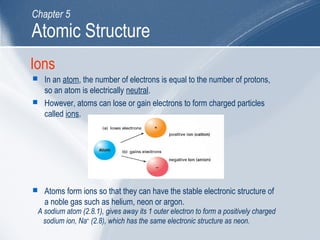
Ions
 In an atom, the number of electrons is equal to the number of protons,
so an atom is electrically neutral.
 However, atoms can lose or gain electrons to form charged particles
called ions.
 Atoms form ions so that they can have the stable electronic structure of
a noble gas such as helium, neon or argon.
A sodium atom (2.8.1), gives away its 1 outer electron to form a positively charged
sodium ion, Na+
(2.8), which has the same electronic structure as neon.
Atomic Structure
Chapter 5
Positive and negative Ions
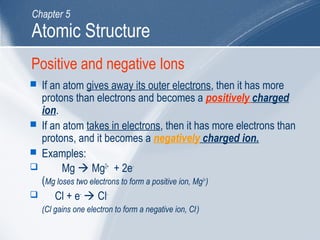
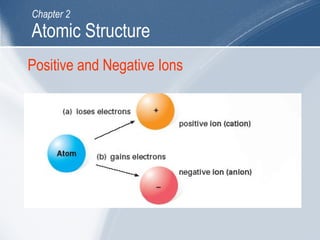
 If an atom gives away its outer electrons, then it has more
protons than electrons and becomes a positively charged
ion.
 If an atom takes in electrons, then it has more electrons than
protons, and it becomes a negatively charged ion.
 Examples:
 Mg  Mg2+
+ 2e-
(Mg loses two electrons to form a positive ion, Mg2+
)
 Cl + e-
 Cl-
(Cl gains one electron to form a negative ion, Cl-
)
Atomic Structure
Chapter 5
Positive and Negative Ions
Atomic Structure
Chapter 2
Ions of metals and non-metals
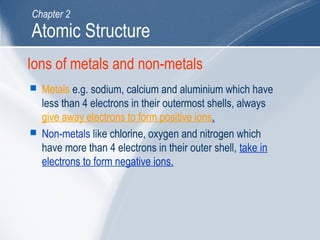
 Metals e.g. sodium, calcium and aluminium which have
less than 4 electrons in their outermost shells, always
give away electrons to form positive ions.
 Non-metals like chlorine, oxygen and nitrogen which
have more than 4 electrons in their outer shell, take in
electrons to form negative ions.
Atomic Structure
Chapter 2
Molecules of elements and compounds
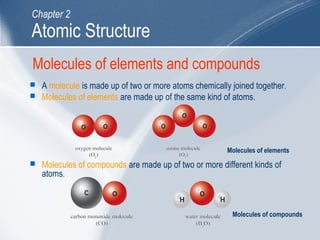
 A molecule is made up of two or more atoms chemically joined together.
 Molecules of elements are made up of the same kind of atoms.
 Molecules of compounds are made up of two or more different kinds of
atoms.
Atomic Structure
Chapter 2
Molecules of elements
Molecules of compounds
Quick check 1
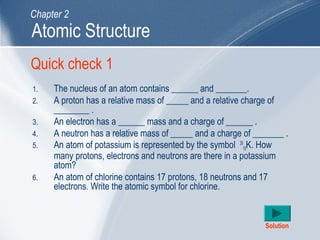
1. The nucleus of an atom contains ______ and _______.
2. A proton has a relative mass of _____ and a relative charge of
________ .
3. An electron has a ______ mass and a charge of ______ .
4. A neutron has a relative mass of _____ and a charge of _______ .
5. An atom of potassium is represented by the symbol 39
19K. How
many protons, electrons and neutrons are there in a potassium
atom?
6. An atom of chlorine contains 17 protons, 18 neutrons and 17
electrons. Write the atomic symbol for chlorine.
Solution
Atomic Structure
Chapter 2
Quick check 2
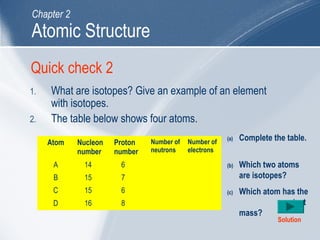
1. What are isotopes? Give an example of an element
with isotopes.
2. The table below shows four atoms.
Atom Nucleon
number
Proton
number
Number of
neutrons
Number of
electrons
A 14 6
B 15 7
C 15 6
D 16 8
(a) Complete the table.
(b) Which two atoms
are isotopes?
(c) Which atom has the
greatest
mass?
Solution
Atomic Structure
Chapter 2
Quick check 3
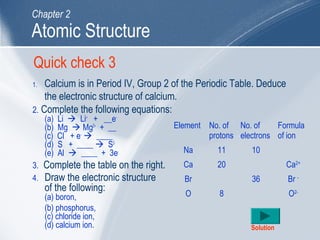
2. Complete the following equations:
(a) Li  Li+
+ __e-
(b) Mg  Mg2+
+ __
(c) Cl + e-
 ____
(d) S + ____  S2-
(e) Al  ____ + 3e-
3. Complete the table on the right.
4. Draw the electronic structure
of the following:
(a) boron,
(b) phosphorus,
(c) chloride ion,
(d) calcium ion.
Element No. of
protons
No. of
electrons
Formula
of ion
Na 11 10
Ca 20 Ca2+
Br 36 Br -
O 8 O2-
Solution
1. Calcium is in Period IV, Group 2 of the Periodic Table. Deduce
the electronic structure of calcium.
Atomic Structure
Chapter 2
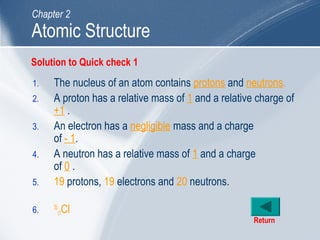
1. The nucleus of an atom contains protons and neutrons.
2. A proton has a relative mass of 1 and a relative charge of
+1 .
3. An electron has a negligible mass and a charge
of - 1.
4. A neutron has a relative mass of 1 and a charge
of 0 .
5. 19 protons, 19 electrons and 20 neutrons.
6. 35
17Cl
Return
Atomic Structure
Chapter 2
Solution to Quick check 1
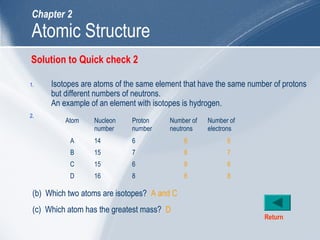
1. Isotopes are atoms of the same element that have the same number of protons
but different numbers of neutrons.
An example of an element with isotopes is hydrogen.
2.
Atom Nucleon
number
Proton
number
Number of
neutrons
Number of
electrons
A 14 6 8 6
B 15 7 8 7
C 15 6 9 6
D 16 8 8 8
(b) Which two atoms are isotopes? A and C
(c) Which atom has the greatest mass? D
Return
Atomic Structure
Chapter 2
Solution to Quick check 2
Solution to Quick check 3
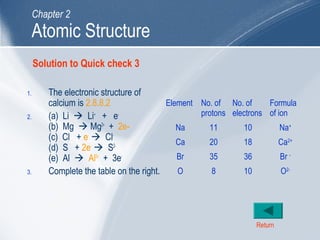
1. The electronic structure of
calcium is 2.8.8.2
2. (a) Li  Li+
+ e-
(b) Mg  Mg2+
+ 2e-
(c) Cl + e-
 Cl-
(d) S + 2e-
 S2-
(e) Al  Al3+
+ 3e-
3. Complete the table on the right.
Return
Atomic Structure
Chapter 2
Element No. of
protons
No. of
electrons
Formula
of ion
Na 11 10 Na+
Ca 20 18 Ca2+
Br 35 36 Br -
O 8 10 O2-
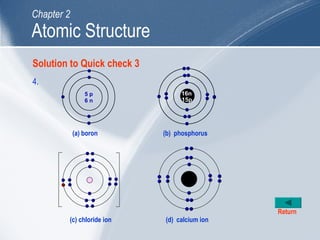
4.
(a) boron (b) phosphorus
(c) chloride ion (d) calcium ion
Return
Atomic Structure
Chapter 2
Solution to Quick check 3
1. http://www.unisanet.unisa.edu.au/08365/h&patoms.htm
2. http://web.jjay.cuny.edu/~acarpi/NSC/3-atoms.htm
3. http://www.chem4kids.com/files/atom_structure.html
4. http://www.colorado.edu/physics/2000/isotopes/
To learn more about Atomic Structure,
click on the links below!
Atomic Structure
Chapter 2
ReferencesReferences
 Chemistry for CSEC Examinations by
Mike Taylor and Tania Chung
 Longman Chemistry for CSEC by Jim
Clark and Ray Oliver

C02 atomic structure

  • 1.
    LEARNING OUTCOMES  Describethe structure of atoms of atomic numbers 1 to 20 using illustrations  State the properties of electrons, protons and neutrons  Define atomic number and mass number  Define relative atomic mass  Interpret notations of the form  Define isotopy  List the uses of isotopes  Predict the likelihood of an atom forming an ionic or covalent bond based on atomic structure Atomic Structure Chapter 2 Xa b
  • 2.
    Structure of Atoms An atom is made up of a dense centre called the nucleus, and a cloud of electrons surrounding it.  The nucleus has two types of particles called protons and neutrons. The protons are positively charged. The neutrons have no charge (neutral). Atomic Structure Chapter 2
  • 3.
    Structure of Atoms The electrons are negatively charged.  The number of protons is always equal to the number of electrons, so an atom is electrically neutral.  The relative mass and charge of each particle is as shown in the table. Particle Relative mass Relative electric charge Proton 1 1+ Neutron 1 0 Electron ≈ 0 1− Atomic Structure Chapter 2 __1_ 1 836
  • 4.
    Proton number andNucleon number  The proton number of an atom is equal to the number of protons in the atom.  The proton number is also called the atomic number.  The proton number of the atom shown above is 3. Atomic Structure Chapter 2
  • 5.
    Nucleon number  Thenucleon number of an atom is equal to the total number of protons and neutrons in the atom.  The nucleon number is also called the mass number since the protons and neutrons give the atom its mass.  The nucleon number for the atom shown is 6. Atomic Structure Chapter2
  • 6.
    Atomic symbol  Thestructure of an atom can be written in symbol form as: Nucleon number Proton number  E.g. What are the atomic particles found in an atom of fluorine, 19 9 F ? ANSWER: 9 protons 9 electrons 10 neutrons (19 – 9 =10 ) Atomic Structure Chapter 2 X a b
  • 7.
    Electron arrangement  Theelectrons surround the nucleus like a cloud and move around it in fixed orbits or shells.  Each shell is numbered 1, 2, 3, 4 and so on, going outwards from the nucleus. Each shell can hold a certain maximum number of electrons.  The maximum number of electrons each shell can hold is given by: 1st shell = 2 2nd shell = 8 3rd shell = 8 ( for the first 20 elements in the Periodic Table ) Atomic Structure Chapter 2
  • 8.
    Electron arrangement  Theelectron arrangement of an atom is also called its electronic structure. Na  The electronic structure can also be stated as a series of numbers called the electron configuration.  The electronic configuration of the sodium atom shown is: 2.8.1 1st shell 2nd shell 3rd shell Atomic Structure Chapter 2
  • 9.
    Outer Electrons  Theelectrons in the outermost shell are called the outer electrons or valence electrons. Atomic Structure Chapter 2 Valence electrons
  • 10.
    Isotopes  Isotopes areatoms of the same element which have the same number of protons but different numbers of neutrons.  Isotopes are chemically alike in all aspects, except for their masses. However, some isotopes are radioactive.  Hydrogen has three isotopes 1 1H, 2 1H and 3 1H. 2 1H is called deuterium, 3 1H is called tritium. Both isotopes are found in sea water and the Sun. Isotopes of hydrogen Atomic Structure Chapter 5
  • 11.
    Isotopes  Chlorine existsas two main isotopes: 35 17Cl (75%) and 37 17Cl (25%).  The average atomic mass of chlorine is given by the weighted mean of the two isotopes: 0.75 x 35 + 0.25 x 37 = 35.5  Hence, in the Periodic Table the atomic mass of chlorine is given as 35.5 17Cl. Atomic Structure Chapter 5
  • 12.
    Ions  In anatom, the number of electrons is equal to the number of protons, so an atom is electrically neutral.  However, atoms can lose or gain electrons to form charged particles called ions.  Atoms form ions so that they can have the stable electronic structure of a noble gas such as helium, neon or argon. A sodium atom (2.8.1), gives away its 1 outer electron to form a positively charged sodium ion, Na+ (2.8), which has the same electronic structure as neon. Atomic Structure Chapter 5
  • 13.
    Positive and negativeIons  If an atom gives away its outer electrons, then it has more protons than electrons and becomes a positively charged ion.  If an atom takes in electrons, then it has more electrons than protons, and it becomes a negatively charged ion.  Examples:  Mg  Mg2+ + 2e- (Mg loses two electrons to form a positive ion, Mg2+ )  Cl + e-  Cl- (Cl gains one electron to form a negative ion, Cl- ) Atomic Structure Chapter 5
  • 14.
    Positive and NegativeIons Atomic Structure Chapter 2
  • 15.
    Ions of metalsand non-metals  Metals e.g. sodium, calcium and aluminium which have less than 4 electrons in their outermost shells, always give away electrons to form positive ions.  Non-metals like chlorine, oxygen and nitrogen which have more than 4 electrons in their outer shell, take in electrons to form negative ions. Atomic Structure Chapter 2
  • 16.
    Molecules of elementsand compounds  A molecule is made up of two or more atoms chemically joined together.  Molecules of elements are made up of the same kind of atoms.  Molecules of compounds are made up of two or more different kinds of atoms. Atomic Structure Chapter 2 Molecules of elements Molecules of compounds
  • 17.
    Quick check 1 1.The nucleus of an atom contains ______ and _______. 2. A proton has a relative mass of _____ and a relative charge of ________ . 3. An electron has a ______ mass and a charge of ______ . 4. A neutron has a relative mass of _____ and a charge of _______ . 5. An atom of potassium is represented by the symbol 39 19K. How many protons, electrons and neutrons are there in a potassium atom? 6. An atom of chlorine contains 17 protons, 18 neutrons and 17 electrons. Write the atomic symbol for chlorine. Solution Atomic Structure Chapter 2
  • 18.
    Quick check 2 1.What are isotopes? Give an example of an element with isotopes. 2. The table below shows four atoms. Atom Nucleon number Proton number Number of neutrons Number of electrons A 14 6 B 15 7 C 15 6 D 16 8 (a) Complete the table. (b) Which two atoms are isotopes? (c) Which atom has the greatest mass? Solution Atomic Structure Chapter 2
  • 19.
    Quick check 3 2.Complete the following equations: (a) Li  Li+ + __e- (b) Mg  Mg2+ + __ (c) Cl + e-  ____ (d) S + ____  S2- (e) Al  ____ + 3e- 3. Complete the table on the right. 4. Draw the electronic structure of the following: (a) boron, (b) phosphorus, (c) chloride ion, (d) calcium ion. Element No. of protons No. of electrons Formula of ion Na 11 10 Ca 20 Ca2+ Br 36 Br - O 8 O2- Solution 1. Calcium is in Period IV, Group 2 of the Periodic Table. Deduce the electronic structure of calcium. Atomic Structure Chapter 2
  • 20.
    1. The nucleusof an atom contains protons and neutrons. 2. A proton has a relative mass of 1 and a relative charge of +1 . 3. An electron has a negligible mass and a charge of - 1. 4. A neutron has a relative mass of 1 and a charge of 0 . 5. 19 protons, 19 electrons and 20 neutrons. 6. 35 17Cl Return Atomic Structure Chapter 2 Solution to Quick check 1
  • 21.
    1. Isotopes areatoms of the same element that have the same number of protons but different numbers of neutrons. An example of an element with isotopes is hydrogen. 2. Atom Nucleon number Proton number Number of neutrons Number of electrons A 14 6 8 6 B 15 7 8 7 C 15 6 9 6 D 16 8 8 8 (b) Which two atoms are isotopes? A and C (c) Which atom has the greatest mass? D Return Atomic Structure Chapter 2 Solution to Quick check 2
  • 22.
    Solution to Quickcheck 3 1. The electronic structure of calcium is 2.8.8.2 2. (a) Li  Li+ + e- (b) Mg  Mg2+ + 2e- (c) Cl + e-  Cl- (d) S + 2e-  S2- (e) Al  Al3+ + 3e- 3. Complete the table on the right. Return Atomic Structure Chapter 2 Element No. of protons No. of electrons Formula of ion Na 11 10 Na+ Ca 20 18 Ca2+ Br 35 36 Br - O 8 10 O2-
  • 23.
    4. (a) boron (b)phosphorus (c) chloride ion (d) calcium ion Return Atomic Structure Chapter 2 Solution to Quick check 3
  • 24.
    1. http://www.unisanet.unisa.edu.au/08365/h&patoms.htm 2. http://web.jjay.cuny.edu/~acarpi/NSC/3-atoms.htm 3.http://www.chem4kids.com/files/atom_structure.html 4. http://www.colorado.edu/physics/2000/isotopes/ To learn more about Atomic Structure, click on the links below! Atomic Structure Chapter 2
  • 25.
    ReferencesReferences  Chemistry forCSEC Examinations by Mike Taylor and Tania Chung  Longman Chemistry for CSEC by Jim Clark and Ray Oliver

Editor's Notes