1
MSE 170: Introduction to Materials Science and Engineering
Instructor Prof. Christine Luscombe
Email luscombe@u.washington.edu
Office 302B Roberts Hall
Office hours 10:00am – 12:00pm, Monday, or by appointment
Course website http://courses.washington.edu/mse170
Lab TAs:
Peter Kazarinoff peterkaz@u.washington.edu Mueller 168
Omid Veiseh omid@u.washington.edu Mueller 168 M 1:30-2:30pm
Steven Hau skhau@u.washington.edu Mueller 168 T 10:30-11:30am
2
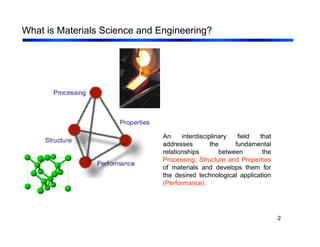
What is Materials Science and Engineering?
An interdisciplinary field that
addresses the fundamental
relationships between the
Processing, Structure and Properties
of materials and develops them for
the desired technological application
(Performance).
3
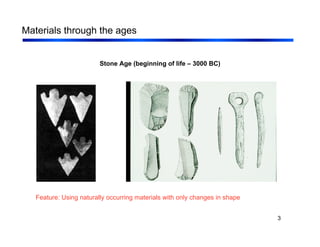
Materials through the ages
Stone Age (beginning of life – 3000 BC)
Feature: Using naturally occurring materials with only changes in shape
4
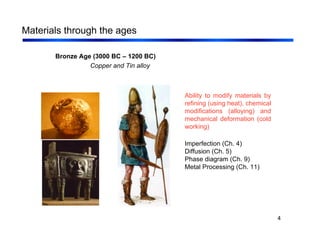
Materials through the ages
Bronze Age (3000 BC – 1200 BC)
Copper and Tin alloy
Ability to modify materials by
refining (using heat), chemical
modifications (alloying) and
mechanical deformation (cold
working)
Imperfection (Ch. 4)
Diffusion (Ch. 5)
Phase diagram (Ch. 9)
Metal Processing (Ch. 11)
5
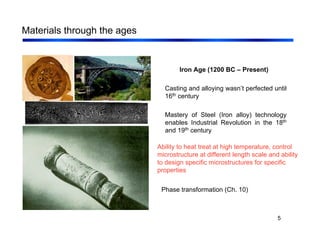
Materials through the ages
Iron Age (1200 BC – Present)
Casting and alloying wasn’t perfected until
16th century
Mastery of Steel (Iron alloy) technology
enables Industrial Revolution in the 18th
and 19th century
Ability to heat treat at high temperature, control
microstructure at different length scale and ability
to design specific microstructures for specific
properties
Phase transformation (Ch. 10)
6
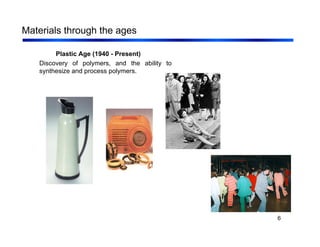
Materials through the ages
Plastic Age (1940 - Present)
Discovery of polymers, and the ability to
synthesize and process polymers.
7
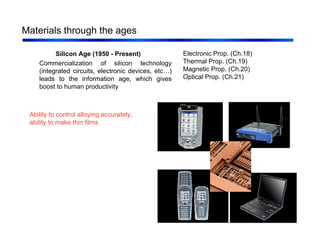
Materials through the ages
Silicon Age (1950 - Present)
Commercialization of silicon technology
(integrated circuits, electronic devices, etc…)
leads to the information age, which gives
boost to human productivity
Ability to control alloying accurately,
ability to make thin films
Electronic Prop. (Ch.18)
Thermal Prop. (Ch.19)
Magnetic Prop. (Ch.20)
Optical Prop. (Ch.21)
8
Future
1. Nanotechnology
- Synthesis and characterizations of nanomaterials and nanostructure
2. Biotechnology
- biomimetics and biomaterials
3. Energy/Environmental
- Next generation energy conversion
4. Information Technology
- Materials informatics
9
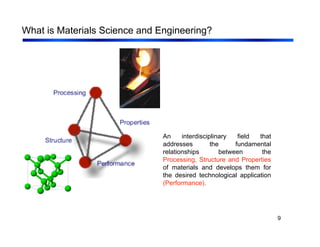
What is Materials Science and Engineering?
An interdisciplinary field that
addresses the fundamental
relationships between the
Processing, Structure and Properties
of materials and develops them for
the desired technological application
(Performance).
10
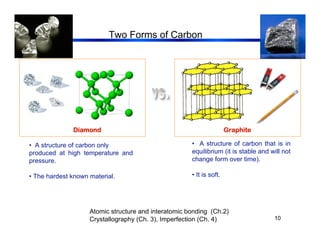
Two Forms of Carbon
Graphite
Diamond
• A structure of carbon only
produced at high temperature and
pressure.
• The hardest known material.
• A structure of carbon that is in
equilibrium (it is stable and will not
change form over time).
• It is soft.
Atomic structure and interatomic bonding (Ch.2)
Crystallography (Ch. 3), Imperfection (Ch. 4)
11
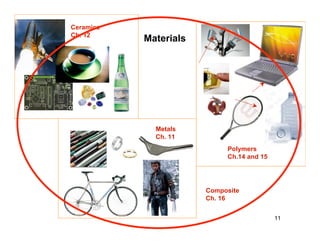
Ceramics
Ch. 12
Polymers
Ch.14 and 15
Metals
Ch. 11
Materials
Composite
Ch. 16
12
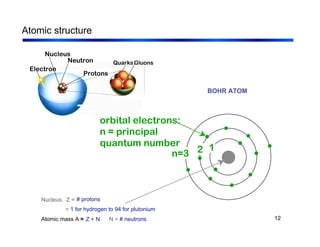
Atomic structure
QuarksGluons
Neutron
Nucleus
Electron
Protons
orbital electrons:
n = principal
quantum number
n=3 2 1
BOHR ATOM
Nucleus: Z =
= 1 for hydrogen to 94 for plutonium
Atomic mass A ≈
# protons
N = # neutrons
Z + N
13
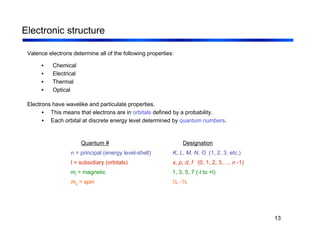
Electronic structure
Valence electrons determine all of the following properties:
Electrons have wavelike and particulate properties.
• This means that electrons are in orbitals defined by a probability.
• Each orbital at discrete energy level determined by quantum numbers.
Quantum # Designation
• Chemical
• Electrical
• Thermal
• Optical
n = principal (energy level-shell) K, L, M, N, O (1, 2, 3, etc.)
l = subsidiary (orbitals) s, p, d, f (0, 1, 2, 3,…, n -1)
ml = magnetic 1, 3, 5, 7 (-l to +l)
ms = spin ½, -½
14
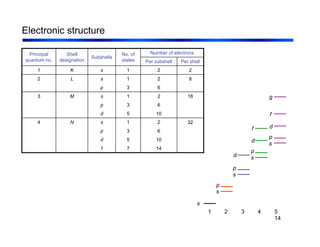
Electronic structure
14
7
f
10
5
d
6
3
p
32
2
1
s
N
4
10
5
d
6
3
p
18
2
1
s
M
3
6
3
p
8
2
1
s
L
2
2
2
1
s
K
1
Per shell
Per subshell
Number of electrons
No. of
states
Subshells
Shell
designation
Principal
quantum no.
1 2 3 4 5
s
s
p
s
p
d s
p
d
f
s
p
d
f
g
15
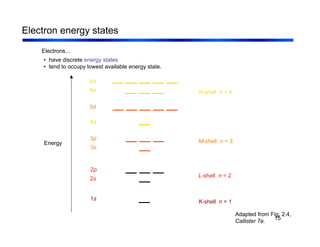
Electron energy states
1s
2s
2p
K-shell n = 1
L-shell n = 2
3s
3p M-shell n = 3
3d
4s
4p
4d
Energy
N-shell n = 4
• have discrete energy states
• tend to occupy lowest available energy state.
Electrons...
Adapted from Fig. 2.4,
Callister 7e.
16
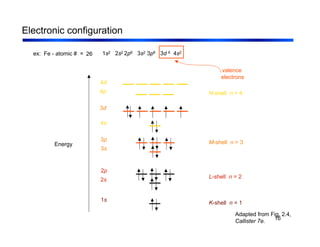
Electronic configuration
ex: Fe - atomic # = 26
Adapted from Fig. 2.4,
Callister 7e.
1s
2s
2p
K-shell n = 1
L-shell n = 2
3s
3p M-shell n = 3
3d
4s
4p
4d
Energy
N-shell n = 4
1s2 2s2 2p6 3s2 3p6 3d 6 4s2
valence
electrons
17
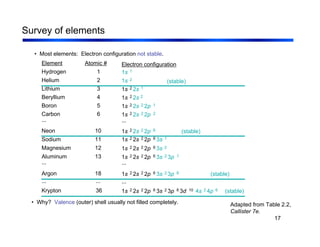
Survey of elements
• Why? Valence (outer) shell usually not filled completely.
• Most elements: Electron configuration not stable.
Electron configuration
(stable)
...
...
1s 2 2s 2 2p 6 3s 2 3p 6 (stable)
...
1s 2 2s 2 2p 6 3s 2 3p 6 3d 10 4s 2 4p 6 (stable)
Atomic #
18
...
36
Element
1s 1
1
Hydrogen
1s 2
2
Helium
1s 2 2s 1
3
Lithium
1s 2 2s 2
4
Beryllium
1s 2 2s 2 2p 1
5
Boron
1s 2 2s 2 2p 2
6
Carbon
...
1s 2 2s 2 2p 6 (stable)
10
Neon
1s 2 2s 2 2p 6 3s 1
11
Sodium
1s 2 2s 2 2p 6 3s 2
12
Magnesium
1s 2 2s 2 2p 6 3s 2 3p 1
13
Aluminum
...
Argon
...
Krypton
Adapted from Table 2.2,
Callister 7e.
18
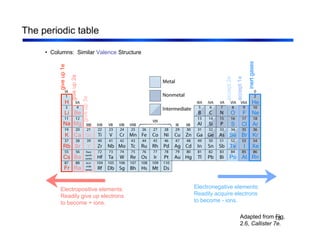
The periodic table
• Columns: Similar Valence Structure
Adapted from Fig.
2.6, Callister 7e.
Electropositive elements:
Readily give up electrons
to become + ions.
Electronegative elements:
Readily acquire electrons
to become - ions.
give
up
1e
give
up
2e
give
up
3e
inert
gases
accept
1e
accept
2e
O
Se
Te
Po At
I
Br
He
Ne
Ar
Kr
Xe
Rn
F
Cl
S
Li Be
H
Na Mg
Ba
Cs
Ra
Fr
Ca
K Sc
Sr
Rb Y
19
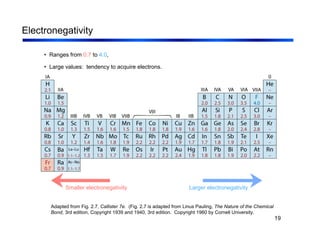
Electronegativity
• Ranges from 0.7 to 4.0,
Smaller electronegativity Larger electronegativity
• Large values: tendency to acquire electrons.
Adapted from Fig. 2.7, Callister 7e. (Fig. 2.7 is adapted from Linus Pauling, The Nature of the Chemical
Bond, 3rd edition, Copyright 1939 and 1940, 3rd edition. Copyright 1960 by Cornell University.
20
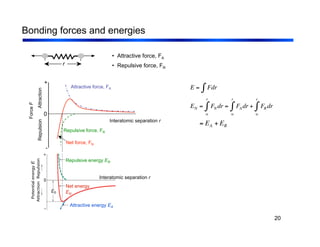
Bonding forces and energies
r
• Attractive force, FA
• Repulsive force, FR
Force
F
Repulsion
Attraction
0
+
-
Attractive force, FA
Interatomic separation r
Repulsive force, FR
Net force, FN
!
E = Fdr
"
!
EN = FN dr
"
r
# = FA dr
"
r
# + FR dr
"
r
#
!
= EA + ER
Attractive energy EA
Net energy
EN
Repulsive energy ER
Interatomic separation r
21
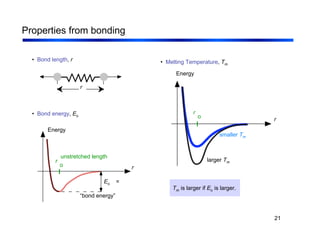
Properties from bonding
• Bond length, r
• Bond energy, Eo
• Melting Temperature, Tm
Tm is larger if Eo is larger.
r
o r
Energy
r
larger Tm
smaller Tm
Eo =
“bond energy”
Energy
r
o r
unstretched length
22
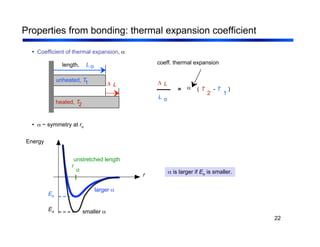
Properties from bonding: thermal expansion coefficient
• Coefficient of thermal expansion, α
• α ~ symmetry at ro
α is larger if Eo is smaller.
= α ( T
2
- T
1
)
Δ L
L o
coeff. thermal expansion
Δ L
length, L o
unheated, T
1
heated, T2
r
o
r
larger α
smaller α
Energy
unstretched length
Eo
Eo
23
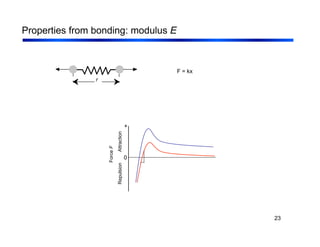
Properties from bonding: modulus E
Force
F
Repulsion
Attraction
0
+
F = kx
r
24
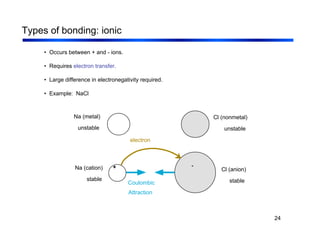
Types of bonding: ionic
• Occurs between + and - ions.
• Requires electron transfer.
• Large difference in electronegativity required.
• Example: NaCl
Na (metal)
unstable
Cl (nonmetal)
unstable
+ -
Coulombic
Attraction
Na (cation)
stable
Cl (anion)
stable
electron
25
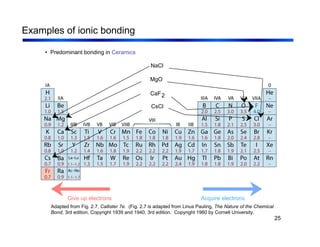
Examples of ionic bonding
• Predominant bonding in Ceramics
Adapted from Fig. 2.7, Callister 7e. (Fig. 2.7 is adapted from Linus Pauling, The Nature of the Chemical
Bond, 3rd edition, Copyright 1939 and 1940, 3rd edition. Copyright 1960 by Cornell University.
Give up electrons Acquire electrons
NaCl
MgO
CaF2
CsCl
26
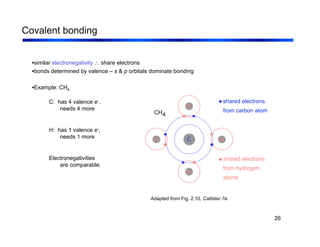
Covalent bonding
C: has 4 valence e-,
needs 4 more
H: has 1 valence e-,
needs 1 more
Electronegativities
are comparable.
Adapted from Fig. 2.10, Callister 7e.
•similar electronegativity ∴ share electrons
•bonds determined by valence – s & p orbitals dominate bonding
•Example: CH4
shared electrons
from carbon atom
shared electrons
from hydrogen
atoms
H
H
H
H
C
CH4
27
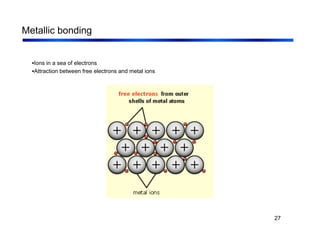
Metallic bonding
•Ions in a sea of electrons
•Attraction between free electrons and metal ions
28
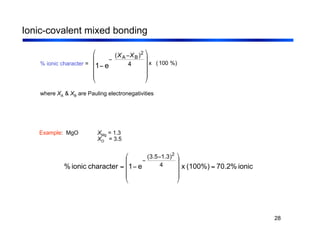
Ionic-covalent mixed bonding
% ionic character =
where XA & XB are Pauling electronegativities
%)
100
(
x
!
1" e
"
(XA"XB)2
4
#
$
%
%
%
&
'
(
(
(
ionic
70.2%
(100%)
x
e
1
character
ionic
% 4
)
3
.
1
5
.
3
( 2
=
!
!
!
"
#
$
$
$
%
&
'
=
'
'
Example: MgO XMg = 1.3
XO = 3.5
29
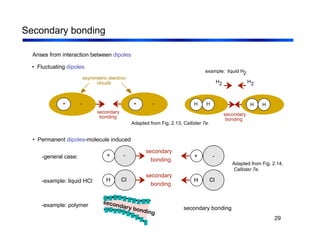
Secondary bonding
Arises from interaction between dipoles
• Permanent dipoles-molecule induced
• Fluctuating dipoles
-general case:
-example: liquid HCl
-example: polymer
Adapted from Fig. 2.13, Callister 7e.
Adapted from Fig. 2.14,
Callister 7e.
asymmetric electron
clouds
+ - + -
secondary
bonding
H
H H
H
H2 H2
secondary
bonding
example: liquid H2
H Cl H Cl
secondary
bonding
secondary
bonding
+ - + -
secondary bonding
secondary bonding
30
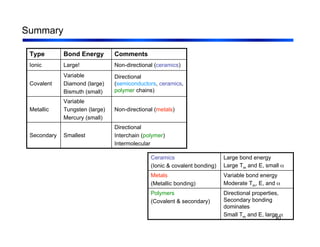
Summary
Directional
Interchain (polymer)
Intermolecular
Smallest
Secondary
Non-directional (metals)
Variable
Tungsten (large)
Mercury (small)
Metallic
Directional
(semiconductors, ceramics,
polymer chains)
Variable
Diamond (large)
Bismuth (small)
Covalent
Non-directional (ceramics)
Large!
Ionic
Comments
Bond Energy
Type
Directional properties,
Secondary bonding
dominates
Small Tm and E, large α
Polymers
(Covalent & secondary)
Variable bond energy
Moderate Tm, E, and α
Metals
(Metallic bonding)
Large bond energy
Large Tm and E, small α
Ceramics
(Ionic & covalent bonding)
31
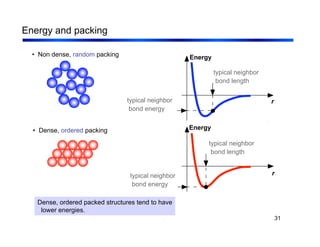
Energy and packing
• Non dense, random packing
• Dense, ordered packing
Dense, ordered packed structures tend to have
lower energies.
Energy
r
typical neighbor
bond length
typical neighbor
bond energy
Energy
r
typical neighbor
bond length
typical neighbor
bond energy
32
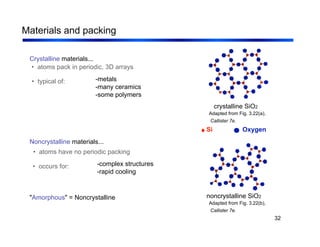
Materials and packing
• atoms pack in periodic, 3D arrays
Crystalline materials...
-metals
-many ceramics
-some polymers
• atoms have no periodic packing
Noncrystalline materials...
-complex structures
-rapid cooling
crystalline SiO2
noncrystalline SiO2
"Amorphous" = Noncrystalline
Adapted from Fig. 3.22(b),
Callister 7e.
Adapted from Fig. 3.22(a),
Callister 7e.
Si Oxygen
• typical of:
• occurs for:
33
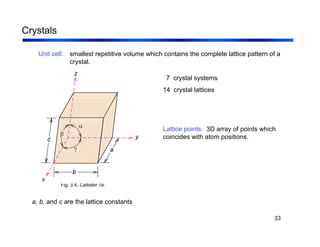
Crystals
7 crystal systems
14 crystal lattices
Fig. 3.4, Callister 7e.
Unit cell:
a, b, and c are the lattice constants
Lattice points: 3D array of points which
coincides with atom positions.
smallest repetitive volume which contains the complete lattice pattern of a
crystal.
34
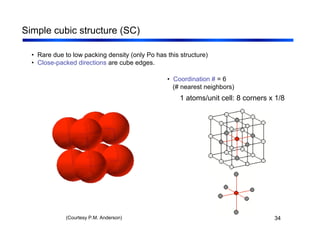
Simple cubic structure (SC)
• Rare due to low packing density (only Po has this structure)
• Close-packed directions are cube edges.
• Coordination # = 6
(# nearest neighbors)
(Courtesy P.M. Anderson)
1 atoms/unit cell: 8 corners x 1/8
35
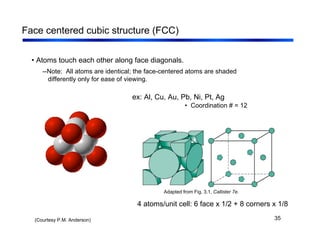
Face centered cubic structure (FCC)
• Coordination # = 12
Adapted from Fig. 3.1, Callister 7e.
(Courtesy P.M. Anderson)
• Atoms touch each other along face diagonals.
--Note: All atoms are identical; the face-centered atoms are shaded
differently only for ease of viewing.
ex: Al, Cu, Au, Pb, Ni, Pt, Ag
4 atoms/unit cell: 6 face x 1/2 + 8 corners x 1/8
36
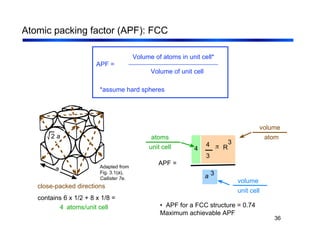
Atomic packing factor (APF): FCC
• APF for a FCC structure = 0.74
Maximum achievable APF
APF =
a 3
4
3
π R
3
4
atoms
unit cell
atom
volume
unit cell
volume
APF =
Volume of atoms in unit cell*
Volume of unit cell
*assume hard spheres
close-packed directions
contains 6 x 1/2 + 8 x 1/8 =
4 atoms/unit cell
a
2 a
Adapted from
Fig. 3.1(a),
Callister 7e.
37
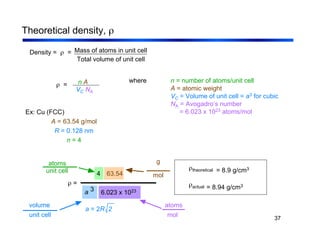
Theoretical density, ρ
where n = number of atoms/unit cell
A = atomic weight
VC = Volume of unit cell = a3 for cubic
NA = Avogadro’s number
= 6.023 x 10²³ atoms/mol
VC NA
n A
ρ =
Density = ρ =
Total volume of unit cell
Mass of atoms in unit cell
Ex: Cu (FCC)
A = 63.54 g/mol
R = 0.128 nm
n = 4
a = 2R 2
ρ =
a 3
63.54
4
atoms
unit cell
mol
g
unit cell
volume atoms
mol
6.023 x 10²³
ρtheoretical
ρactual
= 8.9 g/cm3
= 8.94 g/cm3
38
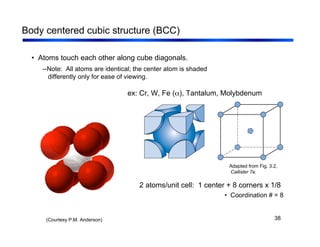
Body centered cubic structure (BCC)
• Coordination # = 8
Adapted from Fig. 3.2,
Callister 7e.
(Courtesy P.M. Anderson)
• Atoms touch each other along cube diagonals.
--Note: All atoms are identical; the center atom is shaded
differently only for ease of viewing.
ex: Cr, W, Fe (α), Tantalum, Molybdenum
2 atoms/unit cell: 1 center + 8 corners x 1/8
39
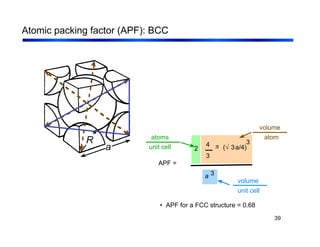
Atomic packing factor (APF): BCC
• APF for a FCC structure = 0.68
APF =
a 3
4
3
π (√ 3a/4)
3
2
atoms
unit cell
atom
volume
unit cell
volume
a
R
40
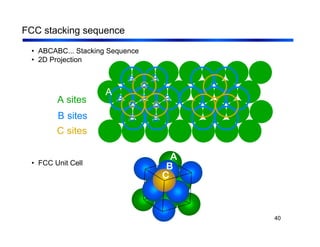
FCC stacking sequence
A sites
B B
B
B
B
B B
C sites
C C
C
A
B
B sites
• ABCABC... Stacking Sequence
• 2D Projection
• FCC Unit Cell
B B
B
B
B
B B
B sites
C C
C
A
C C
C
A
A
B
C
41
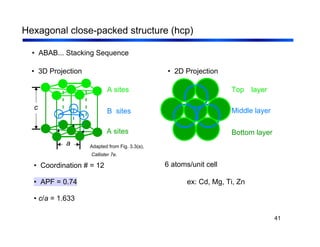
Hexagonal close-packed structure (hcp)
• Coordination # = 12
• ABAB... Stacking Sequence
• APF = 0.74
• 3D Projection • 2D Projection
Adapted from Fig. 3.3(a),
Callister 7e.
6 atoms/unit cell
ex: Cd, Mg, Ti, Zn
• c/a = 1.633
c
a
A sites
B sites
A sites Bottom layer
Middle layer
Top layer

Week1complete

  • 1.
    1 MSE 170: Introductionto Materials Science and Engineering Instructor Prof. Christine Luscombe Email luscombe@u.washington.edu Office 302B Roberts Hall Office hours 10:00am – 12:00pm, Monday, or by appointment Course website http://courses.washington.edu/mse170 Lab TAs: Peter Kazarinoff peterkaz@u.washington.edu Mueller 168 Omid Veiseh omid@u.washington.edu Mueller 168 M 1:30-2:30pm Steven Hau skhau@u.washington.edu Mueller 168 T 10:30-11:30am
  • 2.
    2 What is MaterialsScience and Engineering? An interdisciplinary field that addresses the fundamental relationships between the Processing, Structure and Properties of materials and develops them for the desired technological application (Performance).
  • 3.
    3 Materials through theages Stone Age (beginning of life – 3000 BC) Feature: Using naturally occurring materials with only changes in shape
  • 4.
    4 Materials through theages Bronze Age (3000 BC – 1200 BC) Copper and Tin alloy Ability to modify materials by refining (using heat), chemical modifications (alloying) and mechanical deformation (cold working) Imperfection (Ch. 4) Diffusion (Ch. 5) Phase diagram (Ch. 9) Metal Processing (Ch. 11)
  • 5.
    5 Materials through theages Iron Age (1200 BC – Present) Casting and alloying wasn’t perfected until 16th century Mastery of Steel (Iron alloy) technology enables Industrial Revolution in the 18th and 19th century Ability to heat treat at high temperature, control microstructure at different length scale and ability to design specific microstructures for specific properties Phase transformation (Ch. 10)
  • 6.
    6 Materials through theages Plastic Age (1940 - Present) Discovery of polymers, and the ability to synthesize and process polymers.
  • 7.
    7 Materials through theages Silicon Age (1950 - Present) Commercialization of silicon technology (integrated circuits, electronic devices, etc…) leads to the information age, which gives boost to human productivity Ability to control alloying accurately, ability to make thin films Electronic Prop. (Ch.18) Thermal Prop. (Ch.19) Magnetic Prop. (Ch.20) Optical Prop. (Ch.21)
  • 8.
    8 Future 1. Nanotechnology - Synthesisand characterizations of nanomaterials and nanostructure 2. Biotechnology - biomimetics and biomaterials 3. Energy/Environmental - Next generation energy conversion 4. Information Technology - Materials informatics
  • 9.
    9 What is MaterialsScience and Engineering? An interdisciplinary field that addresses the fundamental relationships between the Processing, Structure and Properties of materials and develops them for the desired technological application (Performance).
  • 10.
    10 Two Forms ofCarbon Graphite Diamond • A structure of carbon only produced at high temperature and pressure. • The hardest known material. • A structure of carbon that is in equilibrium (it is stable and will not change form over time). • It is soft. Atomic structure and interatomic bonding (Ch.2) Crystallography (Ch. 3), Imperfection (Ch. 4)
  • 11.
    11 Ceramics Ch. 12 Polymers Ch.14 and15 Metals Ch. 11 Materials Composite Ch. 16
  • 12.
    12 Atomic structure QuarksGluons Neutron Nucleus Electron Protons orbital electrons: n= principal quantum number n=3 2 1 BOHR ATOM Nucleus: Z = = 1 for hydrogen to 94 for plutonium Atomic mass A ≈ # protons N = # neutrons Z + N
  • 13.
    13 Electronic structure Valence electronsdetermine all of the following properties: Electrons have wavelike and particulate properties. • This means that electrons are in orbitals defined by a probability. • Each orbital at discrete energy level determined by quantum numbers. Quantum # Designation • Chemical • Electrical • Thermal • Optical n = principal (energy level-shell) K, L, M, N, O (1, 2, 3, etc.) l = subsidiary (orbitals) s, p, d, f (0, 1, 2, 3,…, n -1) ml = magnetic 1, 3, 5, 7 (-l to +l) ms = spin ½, -½
  • 14.
    14 Electronic structure 14 7 f 10 5 d 6 3 p 32 2 1 s N 4 10 5 d 6 3 p 18 2 1 s M 3 6 3 p 8 2 1 s L 2 2 2 1 s K 1 Per shell Persubshell Number of electrons No. of states Subshells Shell designation Principal quantum no. 1 2 3 4 5 s s p s p d s p d f s p d f g
  • 15.
    15 Electron energy states 1s 2s 2p K-shelln = 1 L-shell n = 2 3s 3p M-shell n = 3 3d 4s 4p 4d Energy N-shell n = 4 • have discrete energy states • tend to occupy lowest available energy state. Electrons... Adapted from Fig. 2.4, Callister 7e.
  • 16.
    16 Electronic configuration ex: Fe- atomic # = 26 Adapted from Fig. 2.4, Callister 7e. 1s 2s 2p K-shell n = 1 L-shell n = 2 3s 3p M-shell n = 3 3d 4s 4p 4d Energy N-shell n = 4 1s2 2s2 2p6 3s2 3p6 3d 6 4s2 valence electrons
  • 17.
    17 Survey of elements •Why? Valence (outer) shell usually not filled completely. • Most elements: Electron configuration not stable. Electron configuration (stable) ... ... 1s 2 2s 2 2p 6 3s 2 3p 6 (stable) ... 1s 2 2s 2 2p 6 3s 2 3p 6 3d 10 4s 2 4p 6 (stable) Atomic # 18 ... 36 Element 1s 1 1 Hydrogen 1s 2 2 Helium 1s 2 2s 1 3 Lithium 1s 2 2s 2 4 Beryllium 1s 2 2s 2 2p 1 5 Boron 1s 2 2s 2 2p 2 6 Carbon ... 1s 2 2s 2 2p 6 (stable) 10 Neon 1s 2 2s 2 2p 6 3s 1 11 Sodium 1s 2 2s 2 2p 6 3s 2 12 Magnesium 1s 2 2s 2 2p 6 3s 2 3p 1 13 Aluminum ... Argon ... Krypton Adapted from Table 2.2, Callister 7e.
  • 18.
    18 The periodic table •Columns: Similar Valence Structure Adapted from Fig. 2.6, Callister 7e. Electropositive elements: Readily give up electrons to become + ions. Electronegative elements: Readily acquire electrons to become - ions. give up 1e give up 2e give up 3e inert gases accept 1e accept 2e O Se Te Po At I Br He Ne Ar Kr Xe Rn F Cl S Li Be H Na Mg Ba Cs Ra Fr Ca K Sc Sr Rb Y
  • 19.
    19 Electronegativity • Ranges from0.7 to 4.0, Smaller electronegativity Larger electronegativity • Large values: tendency to acquire electrons. Adapted from Fig. 2.7, Callister 7e. (Fig. 2.7 is adapted from Linus Pauling, The Nature of the Chemical Bond, 3rd edition, Copyright 1939 and 1940, 3rd edition. Copyright 1960 by Cornell University.
  • 20.
    20 Bonding forces andenergies r • Attractive force, FA • Repulsive force, FR Force F Repulsion Attraction 0 + - Attractive force, FA Interatomic separation r Repulsive force, FR Net force, FN ! E = Fdr " ! EN = FN dr " r # = FA dr " r # + FR dr " r # ! = EA + ER Attractive energy EA Net energy EN Repulsive energy ER Interatomic separation r
  • 21.
    21 Properties from bonding •Bond length, r • Bond energy, Eo • Melting Temperature, Tm Tm is larger if Eo is larger. r o r Energy r larger Tm smaller Tm Eo = “bond energy” Energy r o r unstretched length
  • 22.
    22 Properties from bonding:thermal expansion coefficient • Coefficient of thermal expansion, α • α ~ symmetry at ro α is larger if Eo is smaller. = α ( T 2 - T 1 ) Δ L L o coeff. thermal expansion Δ L length, L o unheated, T 1 heated, T2 r o r larger α smaller α Energy unstretched length Eo Eo
  • 23.
    23 Properties from bonding:modulus E Force F Repulsion Attraction 0 + F = kx r
  • 24.
    24 Types of bonding:ionic • Occurs between + and - ions. • Requires electron transfer. • Large difference in electronegativity required. • Example: NaCl Na (metal) unstable Cl (nonmetal) unstable + - Coulombic Attraction Na (cation) stable Cl (anion) stable electron
  • 25.
    25 Examples of ionicbonding • Predominant bonding in Ceramics Adapted from Fig. 2.7, Callister 7e. (Fig. 2.7 is adapted from Linus Pauling, The Nature of the Chemical Bond, 3rd edition, Copyright 1939 and 1940, 3rd edition. Copyright 1960 by Cornell University. Give up electrons Acquire electrons NaCl MgO CaF2 CsCl
  • 26.
    26 Covalent bonding C: has4 valence e-, needs 4 more H: has 1 valence e-, needs 1 more Electronegativities are comparable. Adapted from Fig. 2.10, Callister 7e. •similar electronegativity ∴ share electrons •bonds determined by valence – s & p orbitals dominate bonding •Example: CH4 shared electrons from carbon atom shared electrons from hydrogen atoms H H H H C CH4
  • 27.
    27 Metallic bonding •Ions ina sea of electrons •Attraction between free electrons and metal ions
  • 28.
    28 Ionic-covalent mixed bonding %ionic character = where XA & XB are Pauling electronegativities %) 100 ( x ! 1" e " (XA"XB)2 4 # $ % % % & ' ( ( ( ionic 70.2% (100%) x e 1 character ionic % 4 ) 3 . 1 5 . 3 ( 2 = ! ! ! " # $ $ $ % & ' = ' ' Example: MgO XMg = 1.3 XO = 3.5
  • 29.
    29 Secondary bonding Arises frominteraction between dipoles • Permanent dipoles-molecule induced • Fluctuating dipoles -general case: -example: liquid HCl -example: polymer Adapted from Fig. 2.13, Callister 7e. Adapted from Fig. 2.14, Callister 7e. asymmetric electron clouds + - + - secondary bonding H H H H H2 H2 secondary bonding example: liquid H2 H Cl H Cl secondary bonding secondary bonding + - + - secondary bonding secondary bonding
  • 30.
    30 Summary Directional Interchain (polymer) Intermolecular Smallest Secondary Non-directional (metals) Variable Tungsten(large) Mercury (small) Metallic Directional (semiconductors, ceramics, polymer chains) Variable Diamond (large) Bismuth (small) Covalent Non-directional (ceramics) Large! Ionic Comments Bond Energy Type Directional properties, Secondary bonding dominates Small Tm and E, large α Polymers (Covalent & secondary) Variable bond energy Moderate Tm, E, and α Metals (Metallic bonding) Large bond energy Large Tm and E, small α Ceramics (Ionic & covalent bonding)
  • 31.
    31 Energy and packing •Non dense, random packing • Dense, ordered packing Dense, ordered packed structures tend to have lower energies. Energy r typical neighbor bond length typical neighbor bond energy Energy r typical neighbor bond length typical neighbor bond energy
  • 32.
    32 Materials and packing •atoms pack in periodic, 3D arrays Crystalline materials... -metals -many ceramics -some polymers • atoms have no periodic packing Noncrystalline materials... -complex structures -rapid cooling crystalline SiO2 noncrystalline SiO2 "Amorphous" = Noncrystalline Adapted from Fig. 3.22(b), Callister 7e. Adapted from Fig. 3.22(a), Callister 7e. Si Oxygen • typical of: • occurs for:
  • 33.
    33 Crystals 7 crystal systems 14crystal lattices Fig. 3.4, Callister 7e. Unit cell: a, b, and c are the lattice constants Lattice points: 3D array of points which coincides with atom positions. smallest repetitive volume which contains the complete lattice pattern of a crystal.
  • 34.
    34 Simple cubic structure(SC) • Rare due to low packing density (only Po has this structure) • Close-packed directions are cube edges. • Coordination # = 6 (# nearest neighbors) (Courtesy P.M. Anderson) 1 atoms/unit cell: 8 corners x 1/8
  • 35.
    35 Face centered cubicstructure (FCC) • Coordination # = 12 Adapted from Fig. 3.1, Callister 7e. (Courtesy P.M. Anderson) • Atoms touch each other along face diagonals. --Note: All atoms are identical; the face-centered atoms are shaded differently only for ease of viewing. ex: Al, Cu, Au, Pb, Ni, Pt, Ag 4 atoms/unit cell: 6 face x 1/2 + 8 corners x 1/8
  • 36.
    36 Atomic packing factor(APF): FCC • APF for a FCC structure = 0.74 Maximum achievable APF APF = a 3 4 3 π R 3 4 atoms unit cell atom volume unit cell volume APF = Volume of atoms in unit cell* Volume of unit cell *assume hard spheres close-packed directions contains 6 x 1/2 + 8 x 1/8 = 4 atoms/unit cell a 2 a Adapted from Fig. 3.1(a), Callister 7e.
  • 37.
    37 Theoretical density, ρ wheren = number of atoms/unit cell A = atomic weight VC = Volume of unit cell = a3 for cubic NA = Avogadro’s number = 6.023 x 10²³ atoms/mol VC NA n A ρ = Density = ρ = Total volume of unit cell Mass of atoms in unit cell Ex: Cu (FCC) A = 63.54 g/mol R = 0.128 nm n = 4 a = 2R 2 ρ = a 3 63.54 4 atoms unit cell mol g unit cell volume atoms mol 6.023 x 10²³ ρtheoretical ρactual = 8.9 g/cm3 = 8.94 g/cm3
  • 38.
    38 Body centered cubicstructure (BCC) • Coordination # = 8 Adapted from Fig. 3.2, Callister 7e. (Courtesy P.M. Anderson) • Atoms touch each other along cube diagonals. --Note: All atoms are identical; the center atom is shaded differently only for ease of viewing. ex: Cr, W, Fe (α), Tantalum, Molybdenum 2 atoms/unit cell: 1 center + 8 corners x 1/8
  • 39.
    39 Atomic packing factor(APF): BCC • APF for a FCC structure = 0.68 APF = a 3 4 3 π (√ 3a/4) 3 2 atoms unit cell atom volume unit cell volume a R
  • 40.
    40 FCC stacking sequence Asites B B B B B B B C sites C C C A B B sites • ABCABC... Stacking Sequence • 2D Projection • FCC Unit Cell B B B B B B B B sites C C C A C C C A A B C
  • 41.
    41 Hexagonal close-packed structure(hcp) • Coordination # = 12 • ABAB... Stacking Sequence • APF = 0.74 • 3D Projection • 2D Projection Adapted from Fig. 3.3(a), Callister 7e. 6 atoms/unit cell ex: Cd, Mg, Ti, Zn • c/a = 1.633 c a A sites B sites A sites Bottom layer Middle layer Top layer