This work is licensed under a Creative Commons Attribution-Noncommercial-Share Alike 2.0 UK: England & Wales License   Chemical Bonding 4  IONIC, METALLIC & COORDINATE BONDS University of Lincoln presentation
Ionic Bonding This work is licensed under a Creative Commons Attribution-Noncommercial-Share Alike 2.0 UK: England & Wales License
IONIC BONDING Very important form of bonding – main bonding mechanism of metals: >80 elements are METALS 19 elements are non-metals 5 elements are metalloids This work is licensed under a Creative Commons Attribution-Noncommercial-Share Alike 2.0 UK: England & Wales License
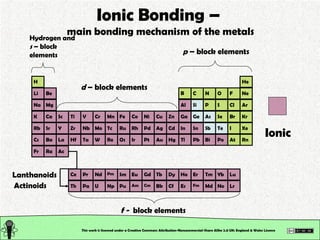
Ionic Bonding –   main bonding mechanism of the metals This work is licensed under a Creative Commons Attribution-Noncommercial-Share Alike 2.0 UK: England & Wales License   Ionic f -  block elements H Be Li Na K Rb Cs Fr Mg Ca Sr Ba Ra Sc Y La Ac Ti V Cr Mn Fe Co Ni Cu Zn Zr Hf Ta W Re Os Ir Pt Au Hg Tl Nb Mo Tc Ru Rh Pd Ag Cd In Sn Pb Bi Po At Rn Xe Kr Ar Ne Sb Te I Ga Al Ge Si P S Cl As Se Br Ce Pr Nd Pm Sm Eu Gd Tb Dy Ho Er Tm Yb Lu Th Pa U Np Pu Am Cm Bk Cf Es Fm Md No Lr He B C N O F Lanthanoids Actinoids d  – block elements Hydrogen and  s  – block elements p  – block elements
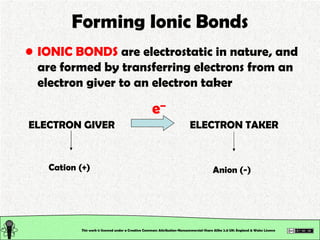
Forming Ionic Bonds IONIC BONDS  are electrostatic in nature, and are formed by transferring electrons from an  electron giver  to an  electron taker This work is licensed under a Creative Commons Attribution-Noncommercial-Share Alike 2.0 UK: England & Wales License   ELECTRON GIVER ELECTRON TAKER e – Cation (+) Anion (-)
Electron Givers Most metals have 1–3 valence electrons that they would like to lose Metals are therefore  ELECTRON GIVERS This work is licensed under a Creative Commons Attribution-Noncommercial-Share Alike 2.0 UK: England & Wales License
Electron Takers Elements on the RHS of the periodic table (non-metals) would like to gain electrons Non-metals are therefore good  ELECTRON TAKERS This work is licensed under a Creative Commons Attribution-Noncommercial-Share Alike 2.0 UK: England & Wales License
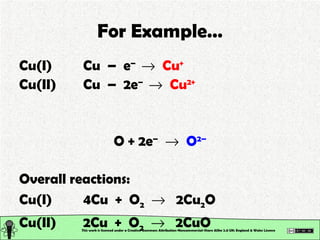
For Example… Cu(I) Cu  –  e –     Cu + Cu(II) Cu  –  2e –     Cu 2+ O + 2e –      O 2– Overall reactions: Cu(I) 4Cu  +  O 2      2Cu 2 O Cu(II) 2Cu  +  O 2      2CuO This work is licensed under a Creative Commons Attribution-Noncommercial-Share Alike 2.0 UK: England & Wales License
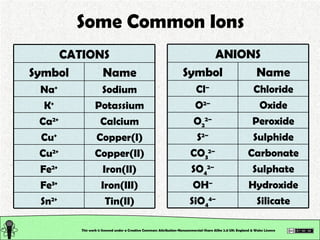
Some Common Ions This work is licensed under a Creative Commons Attribution-Noncommercial-Share Alike 2.0 UK: England & Wales License   Silicate SiO 4 4– Hydroxide OH – Sulphate SO 4 2– Carbonate CO 3 2– Sulphide S 2– Peroxide O 2 2– Oxide O 2– Chloride Cl – Name Symbol ANIONS Tin(II) Sn 2+ Iron(III) Fe 3+ Iron(II) Fe 2+ Copper(II) Cu 2+ Copper(I) Cu + Calcium Ca 2+ Potassium K + Sodium Na + Name Symbol CATIONS
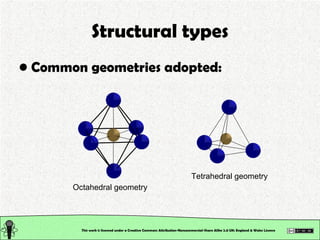
Structural types Common geometries adopted: This work is licensed under a Creative Commons Attribution-Noncommercial-Share Alike 2.0 UK: England & Wales License   Octahedral geometry Tetrahedral geometry
There are only a few structural shapes adopted in solid ionic compounds (salts): Rock Salt   (sodium chloride)  Caesium chloride   Fluorite   (calcium fluoride) Rutile   (titanium(IV) oxide) Structural shapes This work is licensed under a Creative Commons Attribution-Noncommercial-Share Alike 2.0 UK: England & Wales License
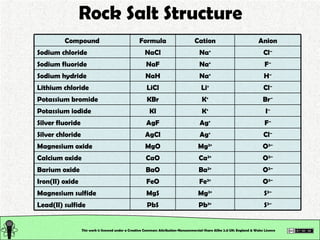
Rock Salt Structure This work is licensed under a Creative Commons Attribution-Noncommercial-Share Alike 2.0 UK: England & Wales License   S 2– Pb 2+ PbS Lead(II) sulfide S 2– Mg 2+ MgS Magnesium sulfide O 2– Fe 2+ FeO Iron(II) oxide O 2– Ba 2+ BaO Barium oxide O 2– Ca 2+ CaO Calcium oxide O 2– Mg 2+ MgO Magnesium oxide Cl – Ag + AgCl Silver chloride F – Ag + AgF Silver fluoride I – K + KI Potassium iodide Br – K + KBr Potassium bromide Cl – Li + LiCl Lithium chloride H – Na + NaH Sodium hydride F – Na + NaF Sodium fluoride Cl – Na + NaCl Sodium chloride Anion Cation Formula Compound
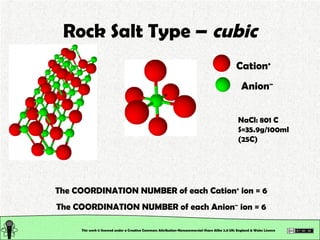
Rock Salt Type –  cubic This work is licensed under a Creative Commons Attribution-Noncommercial-Share Alike 2.0 UK: England & Wales License   Cation + Anion – The COORDINATION NUMBER of each Cation +  ion = 6 The COORDINATION NUMBER of each Anion –  ion = 6 NaCl: 801 C S=35.9g/100ml (25C)
The  COORDINATION NUMBER  of an ion is the number of nearest neighbours Definition… This work is licensed under a Creative Commons Attribution-Noncommercial-Share Alike 2.0 UK: England & Wales License
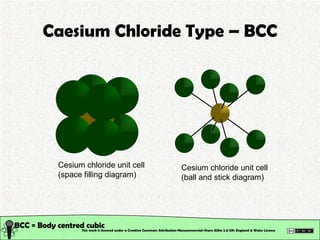
Caesium Chloride Type – BCC This work is licensed under a Creative Commons Attribution-Noncommercial-Share Alike 2.0 UK: England & Wales License   BCC = Body centred cubic Cesium chloride unit cell (space filling diagram) Cesium chloride unit cell (ball and stick diagram)
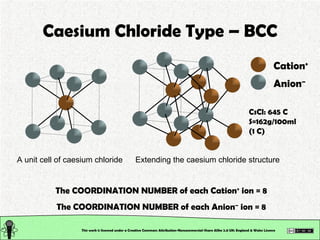
Caesium Chloride Type – BCC This work is licensed under a Creative Commons Attribution-Noncommercial-Share Alike 2.0 UK: England & Wales License   Cation + Anion – The COORDINATION NUMBER of each Cation +  ion = 8 The COORDINATION NUMBER of each Anion –  ion = 8 CsCl: 645 C S=162g/100ml (1 C) A unit cell of caesium chloride Extending the caesium chloride structure
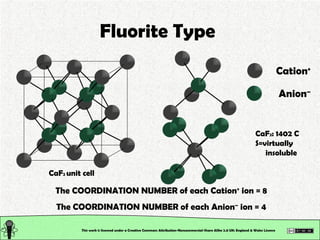
Fluorite Type  This work is licensed under a Creative Commons Attribution-Noncommercial-Share Alike 2.0 UK: England & Wales License   Cation + Anion – The COORDINATION NUMBER of each Cation +  ion = 8 The COORDINATION NUMBER of each Anion –  ion = 4 CaF 2 : 1402 C S=virtually  insoluble CaF 2  unit cell
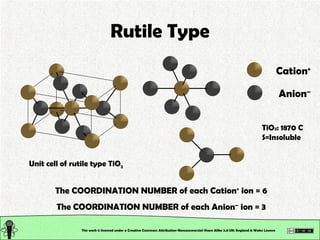
Rutile Type This work is licensed under a Creative Commons Attribution-Noncommercial-Share Alike 2.0 UK: England & Wales License   Cation + Anion – The COORDINATION NUMBER of each Cation +  ion = 6 The COORDINATION NUMBER of each Anion –  ion = 3 TiO 2 : 1870 C S=Insoluble Unit cell of rutile type TiO 2
Metallic Bonding This work is licensed under a Creative Commons Attribution-Noncommercial-Share Alike 2.0 UK: England & Wales License
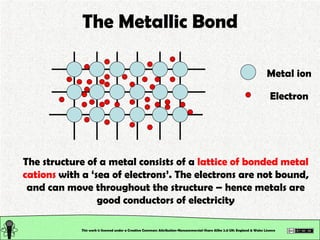
Solid State Metals METALLIC BONDING  is a variation on both covalent and ionic bonding: The bonding is  electrostatic  in nature (like ionic) but involves the  sharing of electrons  (like covalent) over many atoms of the same type This work is licensed under a Creative Commons Attribution-Noncommercial-Share Alike 2.0 UK: England & Wales License
The Metallic Bond This work is licensed under a Creative Commons Attribution-Noncommercial-Share Alike 2.0 UK: England & Wales License   Metal ion Electron The structure of a metal consists of a  lattice of bonded metal cations  with a ‘ sea of electrons ’. The electrons are not bound, and can move throughout the structure – hence metals are good conductors of electricity
Coordinate Bonding This work is licensed under a Creative Commons Attribution-Noncommercial-Share Alike 2.0 UK: England & Wales License
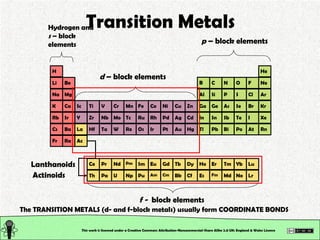
Transition Metals This work is licensed under a Creative Commons Attribution-Noncommercial-Share Alike 2.0 UK: England & Wales License   The TRANSITION METALS (d- and f-block metals) usually form COORDINATE BONDS f -  block elements H Be Li Na K Rb Cs Fr Mg Ca Sr Ba Ra Sc Y La Ac Ti V Cr Mn Fe Co Ni Cu Zn Zr Hf Ta W Re Os Ir Pt Au Hg Tl Nb Mo Tc Ru Rh Pd Ag Cd In Sn Pb Bi Po At Rn Xe Kr Ar Ne Sb Te I Ga Al Ge Si P S Cl As Se Br Ce Pr Nd Pm Sm Eu Gd Tb Dy Ho Er Tm Yb Lu Th Pa U Np Pu Am Cm Bk Cf Es Fm Md No Lr He B C N O F Lanthanoids Actinoids d  – block elements Hydrogen and  s  – block elements p  – block elements
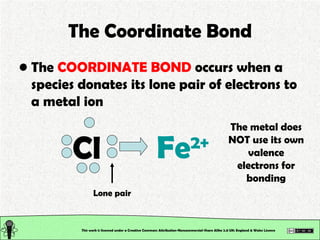
The Coordinate Bond The  COORDINATE BOND  occurs when a species donates its lone pair of electrons to a metal ion This work is licensed under a Creative Commons Attribution-Noncommercial-Share Alike 2.0 UK: England & Wales License   Cl Lone pair The metal does NOT use its own valence electrons for bonding Fe 2+
Definition… A species that donates a lone pair of electrons to a metal ion to form a coordinate bond is called a  LIGAND A ligand can be either  anionic  or  neutral This work is licensed under a Creative Commons Attribution-Noncommercial-Share Alike 2.0 UK: England & Wales License
Definitions… Covalent bond Ionic bond Metallic bond Coordinate bond Coordination number Ligand This work is licensed under a Creative Commons Attribution-Noncommercial-Share Alike 2.0 UK: England & Wales License
This work is licensed under a Creative Commons Attribution-Noncommercial-Share Alike 2.0 UK: England & Wales License   Acknowledgements JISC HEA Centre for Educational Research and Development School of natural and applied sciences School of Journalism SirenFM http:// tango.freedesktop.org

Chemical Structure: Chemical Bonding. Ionic, Metallic & Coordinate Bonds

  • 1.
    This work islicensed under a Creative Commons Attribution-Noncommercial-Share Alike 2.0 UK: England & Wales License Chemical Bonding 4 IONIC, METALLIC & COORDINATE BONDS University of Lincoln presentation
  • 2.
    Ionic Bonding Thiswork is licensed under a Creative Commons Attribution-Noncommercial-Share Alike 2.0 UK: England & Wales License
  • 3.
    IONIC BONDING Veryimportant form of bonding – main bonding mechanism of metals: >80 elements are METALS 19 elements are non-metals 5 elements are metalloids This work is licensed under a Creative Commons Attribution-Noncommercial-Share Alike 2.0 UK: England & Wales License
  • 4.
    Ionic Bonding – main bonding mechanism of the metals This work is licensed under a Creative Commons Attribution-Noncommercial-Share Alike 2.0 UK: England & Wales License Ionic f - block elements H Be Li Na K Rb Cs Fr Mg Ca Sr Ba Ra Sc Y La Ac Ti V Cr Mn Fe Co Ni Cu Zn Zr Hf Ta W Re Os Ir Pt Au Hg Tl Nb Mo Tc Ru Rh Pd Ag Cd In Sn Pb Bi Po At Rn Xe Kr Ar Ne Sb Te I Ga Al Ge Si P S Cl As Se Br Ce Pr Nd Pm Sm Eu Gd Tb Dy Ho Er Tm Yb Lu Th Pa U Np Pu Am Cm Bk Cf Es Fm Md No Lr He B C N O F Lanthanoids Actinoids d – block elements Hydrogen and s – block elements p – block elements
  • 5.
    Forming Ionic BondsIONIC BONDS are electrostatic in nature, and are formed by transferring electrons from an electron giver to an electron taker This work is licensed under a Creative Commons Attribution-Noncommercial-Share Alike 2.0 UK: England & Wales License ELECTRON GIVER ELECTRON TAKER e – Cation (+) Anion (-)
  • 6.
    Electron Givers Mostmetals have 1–3 valence electrons that they would like to lose Metals are therefore ELECTRON GIVERS This work is licensed under a Creative Commons Attribution-Noncommercial-Share Alike 2.0 UK: England & Wales License
  • 7.
    Electron Takers Elementson the RHS of the periodic table (non-metals) would like to gain electrons Non-metals are therefore good ELECTRON TAKERS This work is licensed under a Creative Commons Attribution-Noncommercial-Share Alike 2.0 UK: England & Wales License
  • 8.
    For Example… Cu(I)Cu – e –  Cu + Cu(II) Cu – 2e –  Cu 2+ O + 2e –  O 2– Overall reactions: Cu(I) 4Cu + O 2  2Cu 2 O Cu(II) 2Cu + O 2  2CuO This work is licensed under a Creative Commons Attribution-Noncommercial-Share Alike 2.0 UK: England & Wales License
  • 9.
    Some Common IonsThis work is licensed under a Creative Commons Attribution-Noncommercial-Share Alike 2.0 UK: England & Wales License Silicate SiO 4 4– Hydroxide OH – Sulphate SO 4 2– Carbonate CO 3 2– Sulphide S 2– Peroxide O 2 2– Oxide O 2– Chloride Cl – Name Symbol ANIONS Tin(II) Sn 2+ Iron(III) Fe 3+ Iron(II) Fe 2+ Copper(II) Cu 2+ Copper(I) Cu + Calcium Ca 2+ Potassium K + Sodium Na + Name Symbol CATIONS
  • 10.
    Structural types Commongeometries adopted: This work is licensed under a Creative Commons Attribution-Noncommercial-Share Alike 2.0 UK: England & Wales License Octahedral geometry Tetrahedral geometry
  • 11.
    There are onlya few structural shapes adopted in solid ionic compounds (salts): Rock Salt (sodium chloride) Caesium chloride Fluorite (calcium fluoride) Rutile (titanium(IV) oxide) Structural shapes This work is licensed under a Creative Commons Attribution-Noncommercial-Share Alike 2.0 UK: England & Wales License
  • 12.
    Rock Salt StructureThis work is licensed under a Creative Commons Attribution-Noncommercial-Share Alike 2.0 UK: England & Wales License S 2– Pb 2+ PbS Lead(II) sulfide S 2– Mg 2+ MgS Magnesium sulfide O 2– Fe 2+ FeO Iron(II) oxide O 2– Ba 2+ BaO Barium oxide O 2– Ca 2+ CaO Calcium oxide O 2– Mg 2+ MgO Magnesium oxide Cl – Ag + AgCl Silver chloride F – Ag + AgF Silver fluoride I – K + KI Potassium iodide Br – K + KBr Potassium bromide Cl – Li + LiCl Lithium chloride H – Na + NaH Sodium hydride F – Na + NaF Sodium fluoride Cl – Na + NaCl Sodium chloride Anion Cation Formula Compound
  • 13.
    Rock Salt Type– cubic This work is licensed under a Creative Commons Attribution-Noncommercial-Share Alike 2.0 UK: England & Wales License Cation + Anion – The COORDINATION NUMBER of each Cation + ion = 6 The COORDINATION NUMBER of each Anion – ion = 6 NaCl: 801 C S=35.9g/100ml (25C)
  • 14.
    The COORDINATIONNUMBER of an ion is the number of nearest neighbours Definition… This work is licensed under a Creative Commons Attribution-Noncommercial-Share Alike 2.0 UK: England & Wales License
  • 15.
    Caesium Chloride Type– BCC This work is licensed under a Creative Commons Attribution-Noncommercial-Share Alike 2.0 UK: England & Wales License BCC = Body centred cubic Cesium chloride unit cell (space filling diagram) Cesium chloride unit cell (ball and stick diagram)
  • 16.
    Caesium Chloride Type– BCC This work is licensed under a Creative Commons Attribution-Noncommercial-Share Alike 2.0 UK: England & Wales License Cation + Anion – The COORDINATION NUMBER of each Cation + ion = 8 The COORDINATION NUMBER of each Anion – ion = 8 CsCl: 645 C S=162g/100ml (1 C) A unit cell of caesium chloride Extending the caesium chloride structure
  • 17.
    Fluorite Type This work is licensed under a Creative Commons Attribution-Noncommercial-Share Alike 2.0 UK: England & Wales License Cation + Anion – The COORDINATION NUMBER of each Cation + ion = 8 The COORDINATION NUMBER of each Anion – ion = 4 CaF 2 : 1402 C S=virtually insoluble CaF 2 unit cell
  • 18.
    Rutile Type Thiswork is licensed under a Creative Commons Attribution-Noncommercial-Share Alike 2.0 UK: England & Wales License Cation + Anion – The COORDINATION NUMBER of each Cation + ion = 6 The COORDINATION NUMBER of each Anion – ion = 3 TiO 2 : 1870 C S=Insoluble Unit cell of rutile type TiO 2
  • 19.
    Metallic Bonding Thiswork is licensed under a Creative Commons Attribution-Noncommercial-Share Alike 2.0 UK: England & Wales License
  • 20.
    Solid State MetalsMETALLIC BONDING is a variation on both covalent and ionic bonding: The bonding is electrostatic in nature (like ionic) but involves the sharing of electrons (like covalent) over many atoms of the same type This work is licensed under a Creative Commons Attribution-Noncommercial-Share Alike 2.0 UK: England & Wales License
  • 21.
    The Metallic BondThis work is licensed under a Creative Commons Attribution-Noncommercial-Share Alike 2.0 UK: England & Wales License Metal ion Electron The structure of a metal consists of a lattice of bonded metal cations with a ‘ sea of electrons ’. The electrons are not bound, and can move throughout the structure – hence metals are good conductors of electricity
  • 22.
    Coordinate Bonding Thiswork is licensed under a Creative Commons Attribution-Noncommercial-Share Alike 2.0 UK: England & Wales License
  • 23.
    Transition Metals Thiswork is licensed under a Creative Commons Attribution-Noncommercial-Share Alike 2.0 UK: England & Wales License The TRANSITION METALS (d- and f-block metals) usually form COORDINATE BONDS f - block elements H Be Li Na K Rb Cs Fr Mg Ca Sr Ba Ra Sc Y La Ac Ti V Cr Mn Fe Co Ni Cu Zn Zr Hf Ta W Re Os Ir Pt Au Hg Tl Nb Mo Tc Ru Rh Pd Ag Cd In Sn Pb Bi Po At Rn Xe Kr Ar Ne Sb Te I Ga Al Ge Si P S Cl As Se Br Ce Pr Nd Pm Sm Eu Gd Tb Dy Ho Er Tm Yb Lu Th Pa U Np Pu Am Cm Bk Cf Es Fm Md No Lr He B C N O F Lanthanoids Actinoids d – block elements Hydrogen and s – block elements p – block elements
  • 24.
    The Coordinate BondThe COORDINATE BOND occurs when a species donates its lone pair of electrons to a metal ion This work is licensed under a Creative Commons Attribution-Noncommercial-Share Alike 2.0 UK: England & Wales License Cl Lone pair The metal does NOT use its own valence electrons for bonding Fe 2+
  • 25.
    Definition… A speciesthat donates a lone pair of electrons to a metal ion to form a coordinate bond is called a LIGAND A ligand can be either anionic or neutral This work is licensed under a Creative Commons Attribution-Noncommercial-Share Alike 2.0 UK: England & Wales License
  • 26.
    Definitions… Covalent bondIonic bond Metallic bond Coordinate bond Coordination number Ligand This work is licensed under a Creative Commons Attribution-Noncommercial-Share Alike 2.0 UK: England & Wales License
  • 27.
    This work islicensed under a Creative Commons Attribution-Noncommercial-Share Alike 2.0 UK: England & Wales License Acknowledgements JISC HEA Centre for Educational Research and Development School of natural and applied sciences School of Journalism SirenFM http:// tango.freedesktop.org