



Organisasi dan Arsitektur
Komputer
Ajeng Savitri Puspaningrum, M.Kom
Pertemuan 17
Bus System (part 2)
Learning bus interconnection
Learning elements of bus
Single Bus Problems
 Lots of devices on one bus leads to:
 Propagation delays
Long data paths mean that co-ordination of bus use can adversely affect
performance
If aggregate data transfer approaches bus capacity
 Most systems use multiple buses to overcome these
problems
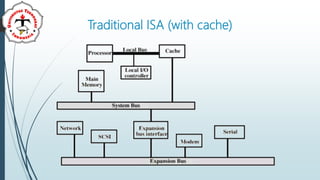
Traditional ISA (with cache)
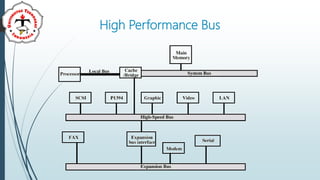
High Performance Bus
Bus Types
 Dedicated
 Separate data & address lines
 Multiplexed
 Shared lines
 Address valid or data valid control line
 Advantage - fewer lines
 Disadvantages
More complex control
Ultimate performance
Bus Arbitration
 More than one module controlling the bus
 e.g. CPU and DMA controller
 Only one module may control bus at one time
 Arbitration may be centralised or distributed
Centralised or Distributed Arbitration
 Centralised
 Single hardware device controlling bus access
Bus Controller
Arbiter
 May be part of CPU or separate
 Distributed
 Each module may claim the bus
 Control logic on all modules
Timing
 Co-ordination of events on bus
 Synchronous
 Events determined by clock signals
 Control Bus includes clock line
 A single 1-0 is a bus cycle
 All devices can read clock line
 Usually sync on leading edge
 Usually a single cycle for an event
PCI Bus
 Peripheral Component Interconnection
 Intel released to public domain
 32 or 64 bit
 50 lines
PCI Bus Lines (required)
 Systems lines
 Including clock and reset
 Address & Data
 32 time mux lines for address/data
 Interrupt & validate lines
 Interface Control
 Arbitration
 Not shared
 Direct connection to PCI bus arbiter
 Error lines
PCI Bus Lines (Optional)
 Interrupt lines
 Not shared
 Cache support
 64-bit Bus Extension
 Additional 32 lines
 Time multiplexed
 2 lines to enable devices to agree to use 64-bit transfer
 JTAG/Boundary Scan
 For testing procedures
PCI Commands
 Transaction between initiator (master) and target
 Master claims bus
 Determine type of transaction
 e.g. I/O read/write
 Address phase
 One or more data phases
Refference
Stalling, William, Computer Organization
and Architecture, 10th Edition, Pearson,
2015
Abdurohman, Maman, Organisasi dan
Arsitektur Komputer revisi ke-4, Penerbit
Informatika, 2017
Terima Kasih
ajeng.savitri@teknokrat.ac.id
https://teknokrat.ac.id/en/
https://spada.teknokrat.ac.id/

Bus System (part 2)

  • 1.
    Organisasi dan Arsitektur Komputer AjengSavitri Puspaningrum, M.Kom Pertemuan 17
  • 2.
  • 3.
  • 4.
    Single Bus Problems Lots of devices on one bus leads to:  Propagation delays Long data paths mean that co-ordination of bus use can adversely affect performance If aggregate data transfer approaches bus capacity  Most systems use multiple buses to overcome these problems
  • 5.
  • 6.
  • 7.
    Bus Types  Dedicated Separate data & address lines  Multiplexed  Shared lines  Address valid or data valid control line  Advantage - fewer lines  Disadvantages More complex control Ultimate performance
  • 8.
    Bus Arbitration  Morethan one module controlling the bus  e.g. CPU and DMA controller  Only one module may control bus at one time  Arbitration may be centralised or distributed
  • 9.
    Centralised or DistributedArbitration  Centralised  Single hardware device controlling bus access Bus Controller Arbiter  May be part of CPU or separate  Distributed  Each module may claim the bus  Control logic on all modules
  • 10.
    Timing  Co-ordination ofevents on bus  Synchronous  Events determined by clock signals  Control Bus includes clock line  A single 1-0 is a bus cycle  All devices can read clock line  Usually sync on leading edge  Usually a single cycle for an event
  • 11.
    PCI Bus  PeripheralComponent Interconnection  Intel released to public domain  32 or 64 bit  50 lines
  • 12.
    PCI Bus Lines(required)  Systems lines  Including clock and reset  Address & Data  32 time mux lines for address/data  Interrupt & validate lines  Interface Control  Arbitration  Not shared  Direct connection to PCI bus arbiter  Error lines
  • 13.
    PCI Bus Lines(Optional)  Interrupt lines  Not shared  Cache support  64-bit Bus Extension  Additional 32 lines  Time multiplexed  2 lines to enable devices to agree to use 64-bit transfer  JTAG/Boundary Scan  For testing procedures
  • 14.
    PCI Commands  Transactionbetween initiator (master) and target  Master claims bus  Determine type of transaction  e.g. I/O read/write  Address phase  One or more data phases
  • 15.
    Refference Stalling, William, ComputerOrganization and Architecture, 10th Edition, Pearson, 2015 Abdurohman, Maman, Organisasi dan Arsitektur Komputer revisi ke-4, Penerbit Informatika, 2017
  • 16.