Presentation
Computer Architecture Design (CAD)
Group Members
Name
 Marukh Munir
 Saira Kanwal
 Hamda Amjad
 Sana Aslam
Roll #
 020
 026
 022
 033
Topic
Processor : Data path and Control
Processor
• A processor is an electronic circuit which performs operations on some external data source,
usually memory rain.
• A computer flow analyze data and controls data flow in a computer.
• It handles the central management functions of a high powered PC.
• Brain
• Basic arithmetic and logic
• For Example CPU.
Interprets and carries out the basic instructions that operate the computer.
Used to direct the operation of all other hardware devices and execute application instruction.
Processors carry out these functions by processing digital information, receiving data and
providing data.
Functions
Component Of Processor:
Data Path
Control
Data path:
• A data path is a collection of functional units, such as arithmetic logic units that perform data
processing operations, registers, and buses. Along with the control unit it composes
the central processing unit (CPU).
• A bus consist of a set of parallel lines. It is used to transfer data between different components
of the computer . One line of bus can transfer one bit at a time.
• A Data Path Contains:
 Registers – general purpose, special purpose
 Execution Units capable of multiple functions
Types of buses
 System bus
 Expansion bus
 System Bus:
system bus is used to connect the main component of a computer such as CPU
and main memory. System buses are part of mother board. Computer normally have system
bus of 70- 100 lines.
 Expansion bus:
expansion bus is used to connect CPU with peripheral devices such as mouse ,
keyboard , printer etc.
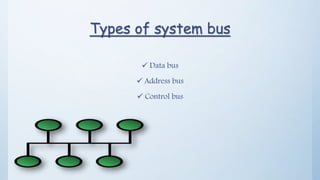
Types of system bus
 Data bus
 Address bus
 Control bus
Continued……..
Data bus
Data bus is the most common type of bus. This bus is used to transfer data between
different component of the computer. The number of lines in data bus affect the speed of data
transfer between different components. The data bus consist of 8, 16, 32, 64 lines.
the data bus lines are bi directional it means that:
 CPU can read data from memory using these lines.
 CPU can write data to memory location using these lines.
Address bus
Many components are connected to each other using these lines. Each
component is assigned a unique ID. This ID is called the address of that component. If the
component wants to communicate with another component, it uses address bus to specify the
address of that component.
 The address bus is unidirectional bus . It can carry information only in one direction. It
carries address of memory location from microprocessor to the main memory.
Continued………
Control bus
Control bus is used to transmit different commands or control signals from one
component to another component.
 The control bus is also used to transmit control signals like ACKS(acknowledgement signals).
It contain the following:
 Timing information
It specify the time for which a device can use data and address bus.
 Command signal
It specify the type of operation to be performed.
Control:
• Component of the processor that commands the data path, memory, I/O devices according to
the instructions of the memory.
• A control unit or CU is circuitry that directs operations within a computer's processor. It tells
the computer's logic unit, memory, as well as both input and output devices know how to
respond to instructions received from a program. Examples of devices that utilize control
units include CPUs and GPUs.
• The control unit of CPU select and interprets program instruction and then coordinate their
execution.
Working:
A control unit works by receiving input information that it converts into control
signals, which are then sent to the central processor. The computer's processor
then tells the attached hardware what operations to carry out. The functions that
a control unit performs are dependent on the type of CPU, due to the variance of
architecture between different manufacturers. The following diagram illustrates
how instructions from a program are processed.
Functions:
• The control unit directs the entire to computer system to carry out stored program
instructions.
• The control unit must communicate both the arithmetic logic unit (ALU) and main memory.
• The control unit coordinates the activities of the other two units as well as all peripherals
axillaries storage devices linked to the computer.
Computer Architecture Design (CAD)

Computer Architecture Design (CAD)

  • 1.
  • 2.
    Group Members Name  MarukhMunir  Saira Kanwal  Hamda Amjad  Sana Aslam Roll #  020  026  022  033
  • 3.
    Topic Processor : Datapath and Control
  • 4.
    Processor • A processoris an electronic circuit which performs operations on some external data source, usually memory rain. • A computer flow analyze data and controls data flow in a computer. • It handles the central management functions of a high powered PC. • Brain • Basic arithmetic and logic • For Example CPU.
  • 6.
    Interprets and carriesout the basic instructions that operate the computer. Used to direct the operation of all other hardware devices and execute application instruction. Processors carry out these functions by processing digital information, receiving data and providing data. Functions
  • 7.
  • 8.
    Data path: • Adata path is a collection of functional units, such as arithmetic logic units that perform data processing operations, registers, and buses. Along with the control unit it composes the central processing unit (CPU). • A bus consist of a set of parallel lines. It is used to transfer data between different components of the computer . One line of bus can transfer one bit at a time. • A Data Path Contains:  Registers – general purpose, special purpose  Execution Units capable of multiple functions
  • 9.
    Types of buses System bus  Expansion bus  System Bus: system bus is used to connect the main component of a computer such as CPU and main memory. System buses are part of mother board. Computer normally have system bus of 70- 100 lines.  Expansion bus: expansion bus is used to connect CPU with peripheral devices such as mouse , keyboard , printer etc.
  • 10.
    Types of systembus  Data bus  Address bus  Control bus
  • 11.
    Continued…….. Data bus Data busis the most common type of bus. This bus is used to transfer data between different component of the computer. The number of lines in data bus affect the speed of data transfer between different components. The data bus consist of 8, 16, 32, 64 lines. the data bus lines are bi directional it means that:  CPU can read data from memory using these lines.  CPU can write data to memory location using these lines.
  • 12.
    Address bus Many componentsare connected to each other using these lines. Each component is assigned a unique ID. This ID is called the address of that component. If the component wants to communicate with another component, it uses address bus to specify the address of that component.  The address bus is unidirectional bus . It can carry information only in one direction. It carries address of memory location from microprocessor to the main memory.
  • 13.
    Continued……… Control bus Control busis used to transmit different commands or control signals from one component to another component.  The control bus is also used to transmit control signals like ACKS(acknowledgement signals). It contain the following:  Timing information It specify the time for which a device can use data and address bus.  Command signal It specify the type of operation to be performed.
  • 14.
    Control: • Component ofthe processor that commands the data path, memory, I/O devices according to the instructions of the memory. • A control unit or CU is circuitry that directs operations within a computer's processor. It tells the computer's logic unit, memory, as well as both input and output devices know how to respond to instructions received from a program. Examples of devices that utilize control units include CPUs and GPUs. • The control unit of CPU select and interprets program instruction and then coordinate their execution.
  • 15.
    Working: A control unitworks by receiving input information that it converts into control signals, which are then sent to the central processor. The computer's processor then tells the attached hardware what operations to carry out. The functions that a control unit performs are dependent on the type of CPU, due to the variance of architecture between different manufacturers. The following diagram illustrates how instructions from a program are processed.
  • 16.
    Functions: • The controlunit directs the entire to computer system to carry out stored program instructions. • The control unit must communicate both the arithmetic logic unit (ALU) and main memory. • The control unit coordinates the activities of the other two units as well as all peripherals axillaries storage devices linked to the computer.