William Stallings
Computer Organization
and Architecture
Chapter 3
System Buses
Program Concept
Hardwired systems are inflexible
General purpose hardware can do different
tasks, given correct control signals
Instead of re-wiring, supply a new set of control
signals
What is a program?
A sequence of steps
For each step, an arithmetic or logical operation
is done
For each operation, a different set of control
signals is needed
Function of Control Unit
For each operation a unique code is provided
e.g. ADD, MOVE
A hardware segment accepts the code and
issues the control signals
We have a computer!
Components
The Control Unit and the Arithmetic and Logic
Unit constitute the Central Processing Unit
Data and instructions need to get into the
system and results out
Input/output
Temporary storage of code and results is
needed
Main memory
Computer Components:
Top Level View
Instruction Cycle
Two steps:
Fetch
Execute
Fetch Cycle
Program Counter (PC) holds address of next
instruction to fetch
Processor fetches instruction from memory
location pointed to by PC
Increment PC
Unless told otherwise
Instruction loaded into Instruction Register (IR)
Processor interprets instruction and performs
required actions
Execute Cycle
Processor-memory
data transfer between CPU and main memory
Processor I/O
Data transfer between CPU and I/O module
Data processing
Some arithmetic or logical operation on data
Control
Alteration of sequence of operations
e.g. jump
Combination of above
Example of Program Execution
Instruction Cycle -
State Diagram
Interrupts
Mechanism by which other modules (e.g. I/O)
may interrupt normal sequence of processing
Program
e.g. overflow, division by zero
Timer
Generated by internal processor timer
Used in pre-emptive multi-tasking
I/O
from I/O controller
Hardware failure
e.g. memory parity error
Program Flow Control
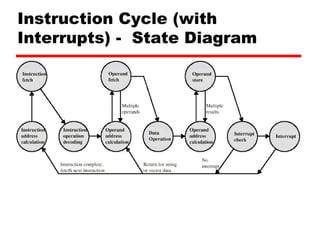
Interrupt Cycle
Added to instruction cycle
Processor checks for interrupt
Indicated by an interrupt signal
If no interrupt, fetch next instruction
If interrupt pending:
Suspend execution of current program
Save context
Set PC to start address of interrupt handler routine
Process interrupt
Restore context and continue interrupted program
Instruction Cycle (with
Interrupts) - State Diagram
Multiple Interrupts
Disable interrupts
Processor will ignore further interrupts whilst
processing one interrupt
Interrupts remain pending and are checked after first
interrupt has been processed
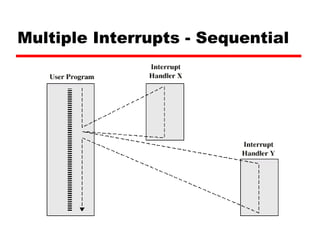
Interrupts handled in sequence as they occur
Define priorities
Low priority interrupts can be interrupted by higher
priority interrupts
When higher priority interrupt has been processed,
processor returns to previous interrupt
Multiple Interrupts - Sequential
Multiple Interrupts - Nested
Connecting
All the units must be connected
Different type of connection for different type of
unit
Memory
Input/Output
CPU
Memory Connection
Receives and sends data
Receives addresses (of locations)
Receives control signals
Read
Write
Timing
Input/Output Connection(1)
Similar to memory from computer’s viewpoint
Output
Receive data from computer
Send data to peripheral
Input
Receive data from peripheral
Send data to computer
Input/Output Connection(2)
Receive control signals from computer
Send control signals to peripherals
e.g. spin disk
Receive addresses from computer
e.g. port number to identify peripheral
Send interrupt signals (control)
CPU Connection
Reads instruction and data
Writes out data (after processing)
Sends control signals to other units
Receives (& acts on) interrupts
Buses
There are a number of possible interconnection
systems
Single and multiple BUS structures are most
common
e.g. Control/Address/Data bus (PC)
e.g. Unibus (DEC-PDP)
What is a Bus?
A communication pathway connecting two or
more devices
Usually broadcast
Often grouped
A number of channels in one bus
e.g. 32 bit data bus is 32 separate single bit channels
Power lines may not be shown
Data Bus
Carries data
Remember that there is no difference between “data”
and “instruction” at this level
Width is a key determinant of performance
8, 16, 32, 64 bit
Address bus
Identify the source or destination of data
e.g. CPU needs to read an instruction (data)
from a given location in memory
Bus width determines maximum memory
capacity of system
e.g. 8080 has 16 bit address bus giving 64k address
space
Control Bus
Control and timing information
Memory read/write signal
Interrupt request
Clock signals
Bus Interconnection Scheme
Big and Yellow?
What do buses look like?
Parallel lines on circuit boards
Ribbon cables
Strip connectors on mother boards
e.g. PCI
Sets of wires
Single Bus Problems
Lots of devices on one bus leads to:
Propagation delays
Long data paths mean that co-ordination of bus use can
adversely affect performance
If aggregate data transfer approaches bus capacity
Most systems use multiple buses to overcome
these problems
Traditional (ISA)
(with cache)
High Performance Bus
Bus Types
Dedicated
Separate data & address lines
Multiplexed
Shared lines
Address valid or data valid control line
Advantage - fewer lines
Disadvantages
More complex control
Ultimate performance
Bus Arbitration
More than one module controlling the bus
e.g. CPU and DMA controller
Only one module may control bus at one time
Arbitration may be centralised or distributed
Centralised Arbitration
Single hardware device controlling bus access
Bus Controller
Arbiter
May be part of CPU or separate
Distributed Arbitration
Each module may claim the bus
Control logic on all modules
Timing
Co-ordination of events on bus
Synchronous
Events determined by clock signals
Control Bus includes clock line
A single 1-0 is a bus cycle
All devices can read clock line
Usually sync on leading edge
Usually a single cycle for an event
Synchronous Timing Diagram
Asynchronous Timing Diagram
PCI Bus
Peripheral Component Interconnection
Intel released to public domain
32 or 64 bit
50 lines
PCI Bus Lines (required)
Systems lines
Including clock and reset
Address & Data
32 time mux lines for address/data
Interrupt & validate lines
Interface Control
Arbitration
Not shared
Direct connection to PCI bus arbiter
Error lines
PCI Bus Lines (Optional)
Interrupt lines
Not shared
Cache support
64-bit Bus Extension
Additional 32 lines
Time multiplexed
2 lines to enable devices to agree to use 64-bit transfer
JTAG/Boundary Scan
For testing procedures
PCI Commands
Transaction between initiator (master) and
target
Master claims bus
Determine type of transaction
e.g. I/O read/write
Address phase
One or more data phases
PCI Read Timing Diagram
PCI Bus Arbitration
Foreground Reading
Stallings, chapter 3 (all of it)
www.pcguide.com/ref/mbsys/buses/
In fact, read the whole site!
www.pcguide.com/

Ch 3 System Buses

  • 1.
    William Stallings Computer Organization andArchitecture Chapter 3 System Buses
  • 2.
    Program Concept Hardwired systemsare inflexible General purpose hardware can do different tasks, given correct control signals Instead of re-wiring, supply a new set of control signals
  • 3.
    What is aprogram? A sequence of steps For each step, an arithmetic or logical operation is done For each operation, a different set of control signals is needed
  • 4.
    Function of ControlUnit For each operation a unique code is provided e.g. ADD, MOVE A hardware segment accepts the code and issues the control signals We have a computer!
  • 5.
    Components The Control Unitand the Arithmetic and Logic Unit constitute the Central Processing Unit Data and instructions need to get into the system and results out Input/output Temporary storage of code and results is needed Main memory
  • 6.
  • 7.
  • 8.
    Fetch Cycle Program Counter(PC) holds address of next instruction to fetch Processor fetches instruction from memory location pointed to by PC Increment PC Unless told otherwise Instruction loaded into Instruction Register (IR) Processor interprets instruction and performs required actions
  • 9.
    Execute Cycle Processor-memory data transferbetween CPU and main memory Processor I/O Data transfer between CPU and I/O module Data processing Some arithmetic or logical operation on data Control Alteration of sequence of operations e.g. jump Combination of above
  • 10.
  • 11.
  • 12.
    Interrupts Mechanism by whichother modules (e.g. I/O) may interrupt normal sequence of processing Program e.g. overflow, division by zero Timer Generated by internal processor timer Used in pre-emptive multi-tasking I/O from I/O controller Hardware failure e.g. memory parity error
  • 13.
  • 14.
    Interrupt Cycle Added toinstruction cycle Processor checks for interrupt Indicated by an interrupt signal If no interrupt, fetch next instruction If interrupt pending: Suspend execution of current program Save context Set PC to start address of interrupt handler routine Process interrupt Restore context and continue interrupted program
  • 15.
  • 16.
    Multiple Interrupts Disable interrupts Processorwill ignore further interrupts whilst processing one interrupt Interrupts remain pending and are checked after first interrupt has been processed Interrupts handled in sequence as they occur Define priorities Low priority interrupts can be interrupted by higher priority interrupts When higher priority interrupt has been processed, processor returns to previous interrupt
  • 17.
  • 18.
  • 19.
    Connecting All the unitsmust be connected Different type of connection for different type of unit Memory Input/Output CPU
  • 20.
    Memory Connection Receives andsends data Receives addresses (of locations) Receives control signals Read Write Timing
  • 21.
    Input/Output Connection(1) Similar tomemory from computer’s viewpoint Output Receive data from computer Send data to peripheral Input Receive data from peripheral Send data to computer
  • 22.
    Input/Output Connection(2) Receive controlsignals from computer Send control signals to peripherals e.g. spin disk Receive addresses from computer e.g. port number to identify peripheral Send interrupt signals (control)
  • 23.
    CPU Connection Reads instructionand data Writes out data (after processing) Sends control signals to other units Receives (& acts on) interrupts
  • 24.
    Buses There are anumber of possible interconnection systems Single and multiple BUS structures are most common e.g. Control/Address/Data bus (PC) e.g. Unibus (DEC-PDP)
  • 25.
    What is aBus? A communication pathway connecting two or more devices Usually broadcast Often grouped A number of channels in one bus e.g. 32 bit data bus is 32 separate single bit channels Power lines may not be shown
  • 26.
    Data Bus Carries data Rememberthat there is no difference between “data” and “instruction” at this level Width is a key determinant of performance 8, 16, 32, 64 bit
  • 27.
    Address bus Identify thesource or destination of data e.g. CPU needs to read an instruction (data) from a given location in memory Bus width determines maximum memory capacity of system e.g. 8080 has 16 bit address bus giving 64k address space
  • 28.
    Control Bus Control andtiming information Memory read/write signal Interrupt request Clock signals
  • 29.
  • 30.
    Big and Yellow? Whatdo buses look like? Parallel lines on circuit boards Ribbon cables Strip connectors on mother boards e.g. PCI Sets of wires
  • 31.
    Single Bus Problems Lotsof devices on one bus leads to: Propagation delays Long data paths mean that co-ordination of bus use can adversely affect performance If aggregate data transfer approaches bus capacity Most systems use multiple buses to overcome these problems
  • 32.
  • 33.
  • 34.
    Bus Types Dedicated Separate data& address lines Multiplexed Shared lines Address valid or data valid control line Advantage - fewer lines Disadvantages More complex control Ultimate performance
  • 35.
    Bus Arbitration More thanone module controlling the bus e.g. CPU and DMA controller Only one module may control bus at one time Arbitration may be centralised or distributed
  • 36.
    Centralised Arbitration Single hardwaredevice controlling bus access Bus Controller Arbiter May be part of CPU or separate
  • 37.
    Distributed Arbitration Each modulemay claim the bus Control logic on all modules
  • 38.
    Timing Co-ordination of eventson bus Synchronous Events determined by clock signals Control Bus includes clock line A single 1-0 is a bus cycle All devices can read clock line Usually sync on leading edge Usually a single cycle for an event
  • 39.
  • 40.
  • 41.
    PCI Bus Peripheral ComponentInterconnection Intel released to public domain 32 or 64 bit 50 lines
  • 42.
    PCI Bus Lines(required) Systems lines Including clock and reset Address & Data 32 time mux lines for address/data Interrupt & validate lines Interface Control Arbitration Not shared Direct connection to PCI bus arbiter Error lines
  • 43.
    PCI Bus Lines(Optional) Interrupt lines Not shared Cache support 64-bit Bus Extension Additional 32 lines Time multiplexed 2 lines to enable devices to agree to use 64-bit transfer JTAG/Boundary Scan For testing procedures
  • 44.
    PCI Commands Transaction betweeninitiator (master) and target Master claims bus Determine type of transaction e.g. I/O read/write Address phase One or more data phases
  • 45.
  • 46.
  • 47.
    Foreground Reading Stallings, chapter3 (all of it) www.pcguide.com/ref/mbsys/buses/ In fact, read the whole site! www.pcguide.com/