1- Reaction at Ester linkage
2- Bromination
3- Mercuration
Presented By
Muslim
Subject: Chemistry of Edible fats and Oil
M.Sc (Hons) Food & Science Technology
Agricultural University Tando Jam
Ester
 Any one of a group of organic compounds
Made by replacing hydrogen of an acid by an
alkyl are any organic group with general
formula RCO2R′ (where R and R′ are alkyl grou
ps Hydrogen atom, eg. Corboxylic acid is
treated with an alcohol and an acid catalyst,
ester is formed ( esterfication)
Uses and functions
 Volatili Esters with characteristic odors are used in
synthetic flavors , perfumes and cosmetics, some used
as a solvents for paints and varnishes
 Naturally occurring esters of organic acids in fruits and
flowers give them their distinctive odors.
functions in the animal body; e.g., the ester acetylcholin
e is a chemical transmitter of nerve stimuli
Why are esters not soluble in water?
 Small esters are soluble in water. However, as the
length of the carbon chain increases,
their solubility decreases. The solubility of esters is
possible because the hydrogen atoms
in water molecules are able to hydrogen bond with the
oxygen atoms.
Esters in Nature
 Esters are found throughout nature and are an
essential part of physiology. Organic acids in plants
combine with carboxylic acid to form aroma-causing
compounds. Many fruits and flowers give off their
distinct scents due to naturally occurring esters, which
form in the plant. In animals, esters serve a vital
function in physiology. For example, the ester
acetylcholine is responsible for nerve stimuli.
Reactions
 Esters react with nucleophiles at the carbonyl carbon.
The carbonyl is weakly electrophilic but is attacked by
strong nucleophiles (amines, alkoxides, hydride
sources, organolithium compounds, etc.). The C–H
bonds adjacent to the carbonyl are weakly acidic but
undergo deprotonation with strong bases. This process
is the one that usually initiates condensation reactions.
Addition of Nucleophiles at Carbonyl
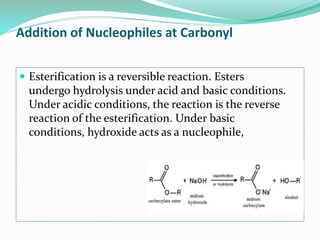
 Esterification is a reversible reaction. Esters
undergo hydrolysis under acid and basic conditions.
Under acidic conditions, the reaction is the reverse
reaction of the esterification. Under basic
conditions, hydroxide acts as a nucleophile,
Reduction
 Compared to ketones and aldehydes, esters
are relatively resistant to reduction.
The introduction of catalytic hydrogenation in the early
part of the 20th century was a breakthrough; esters of
fatty acids are hydrogenated to fatty alcohols.
 RCO2R′ + 2 H2 → RCH2OH + R′OH
 A typical catalyst is copper chromite. Prior to the
development of catalytic hydrogenation,
Claisen condensation and related reactions
 As for aldehydes, the hydrogen atoms on the carbon
adjacent to the carboxyl group in esters are sufficiently
acidic to undergo deprotonation, which in turn leads
to a variety of useful reactions. Deprotonation requires
relatively strong bases, such as alkoxides.
Other Reactions
 Phenyl esters react to hydroxyarylketones in the Fries
rearrangement.
 Specific esters are functionalized with an α-hydroxyl
group in the Chan rearrangement.
 Esters with β-hydrogen atoms can be converted to
alkenes in ester pyrolysis.
 A direct conversion of esters to nitriles.
Protecting groups
 As a class, esters serve as protecting
groups for carboxylic acids. Protecting a carboxylic
acid is useful in peptide synthesis, to prevent self-
reactions of the bifunctional amino acids. Methyl and
ethyl esters are commonly available for many amino
acids;
Lipids
 Lipid is the collective name for fats, oils, waxes and fat-like
molecules (such as steroids) found in the body. Their roles
include:
 components of cell membranes (phospholipids and
cholesterol)
 energy stores
 chemical messengers (steroid 'hormones')
 protection, waterproofing, insulation and buoyancy agents.
 The basic unit of lipids is a triglyceride, synthesised from
glycerol (propane-1,2,3-triol) and fatty acids.
Ester gum
(organic chemistry)
 A compound obtained by forming an ester of
a natural resin with a polyhydric alcohol; used in
varnishes, paints, and cellulosic lacquers.
Also known as rosin Ester
Bromination
 The process of treating a substance with bromine:
especially, for the introduction of a bromine atom
in place of hydrogen (in an organic compound)
 Any reaction which introduces a bromine atom in to
compound
 The bromination solution is prepared by mixing
liquid bromine with glacial acetic acid. 1:4v/v
(bromine to acid)
Bromine
 Is a chemical element it is third lightest halogen and is fuming
red brown liquid at room temperature that evaporates readily to
form a similar colored gas.
 Elemental bromine is very reactive and thus does not
occur free in nature, but in colorless soluble crystalline mineral
halide salts, analogous to table salt.
 While it is rather rare in the Earth's crust, the high solubility of
the bromide ion (Br−) has caused its accumulation in the oceans.
Commercially the element is easily extracted from brine pools.
 The mass of bromine in the oceans is about one three-hundredth
of that of chlorine.
Bromine
 Bromine has sometimes been considered to be possibly
essential in humans, but with the support of only limited
circumstantial evidence, and no clear biological role.
 As a pharmaceutical, the simple bromide ion (Br−) has
inhibitory effects on the central nervous system, and
bromide salts were once a major medical sedative.
 Atomic number:- are 35
 Symbol:- are Br
Bromomethane
 commonly known as methyl bromide
an organobromine compound this colorless, odorless,
nonflammable gas is produced both industrially and
particularly biologically.
 It has a tetrahedral shape and it is a recognized ozone-
depleting chemical. It was used extensively as
a pesticide until being phased out by most countries in
the early 2000
 Formula :- CH3Br.
Bromomethane
 Bromomethane originates from both natural and
human sources. In the ocean, marine organisms are
estimated to produce 56,000 tones annually.
 It is also produced in small quantities by certain
terrestrial plants, such as members of
the Brassicaceae family.
 It is manufactured for agricultural and industrial use
by reacting methanol with hydrogen bromide.
Organobromine
 Are organic compounds that
contain carbon bonded to bromine. The most pervasive is
the naturally produced bromomethane.
 One prominent application is the use of polybrominated
diphenyl ethers as fire-retardants.
 A variety of minor organobromine compounds are found
in nature, but none are biosynthesized or required by
mammals.
 Organobromine compounds have fallen under increased
scrutiny for their environmental impact
Brominated vegetable oil (BVO)
 is a complex mixture of plant-derived triglycerides that
have been reacted to contain atoms of
the element bromine bonded to the molecules.
 Brominated vegetable oil is used primarily to
help emulsify citrus-flavored soft drinks, preventing
them from separating during distribution.
 Brominated vegetable oil has been used by the soft
drink industry since 1931, generally at a level of about
8 ppm
Brominated vegetable oil (BVO)
 About 10 percent of sodas sold in the US contain an
additive called brominated vegetable oil (BVO), which
has been banned in food throughout Europe and
Japan.
 BVO is corn- or soybean oil bonded with the toxic
element bromine.
 BVO has been shown to bioaccumulate in human
tissue and animal studies have found it causes
reproductive and behavioral problems in large doses.
Brominated vegetable oil (BVO)
 Bromines are common endocrine disruptors, and are
part of the halide family, a group of elements that
includes fluorine, chlorine and iodine.
 When ingested, bromine competes for the same
receptors that are used to capture iodine. This can lead
to iodine deficiency, which can have a very detrimental
impact on your health.
 Bromine is a central nervous system depressant, and
can trigger a number of psychological symptoms such
as acute paranoia and other psychotic symptoms.
Bromination of Alkenes
 alkene is an unsaturated hydrocarbon that contains at
least one carbon–carbon double bond.
 Treatment of an alkene with bromine (Br2) in a
chlorinated solvent (CHCl3, and CH2Cl2 are popular
choices which leads to the formation of products
containing two bromine atoms.
Observation #1: Bromination Proceeds
with anti stereochemistry
 Possibly the most interesting feature of this reaction is
that the products follow a very predictable
stereochemical pattern.
 For instance, in the reaction of cyclohexene with Br2,
the two bromine atoms add to opposite faces of the
alkene (“anti” stereochemistry). No products are
observed.
 Observation #2: The reaction is stereospecific
 The stereochemistry of the starting alkene is directly
related to the stereo chemistry of the product.
 For instance if we treat cis-2-butene with Br2, we get a
mixture of enantiomers. But if we treat trans-2-butene,
we only get a single product . This property is called
“stereospecificity” .
 Observation #3: Rearrangements are never
observed ;-
 rearrangements does not occur in bromination
reactions
 Observation #4: Certain solvents can affect the
reaction products
 When we use water as the solvent for this reaction, we
get the product called “bromohydrin” since we have
incorporated both bromine and water
Mercuration
 The oxymercuration reaction is an electrophilic
addition organic reaction that transforms
an alkene into a neutral alcohol.
 In oxymercuration, the alkene reacts with mercuric
acetate (AcO–Hg–OAc) in aqueous solution to yield
the addition of an acetoxymercury (HgOAc) group and
a hydroxyl (OH) group across the double bond.
 Carbocations are not formed in this process and thus
rearrangements are not observed
Mechanism
 mercuration can be fully described in three steps(the whole
process is sometimes called deoxymercuration),
 In the first step, the nucleophilic double bond attacks the
mercury ion, ejecting an acetoxy group. The electron pair
on the mercury ion in turn attacks a carbon on the double
bond, forming a mercurinium ion in which the mercury
atom bears a positive charge.
 In the second step, the nucleophilic water molecule attacks
the more substituted carbon, liberating the electrons
participating in its bond with mercury. The electrons
collapse to the mercury ion and neutralizes it.
Mechanism
 In the third step, the negatively charged acetoxy ion
that was expelled in the first step attacks a hydrogen of
the water group, forming the waste product HOAc.
 The two electrons participating in the bond between
oxygen and the attacked hydrogen collapse into the
oxygen, neutralizing its charge and creating the final
alcohol product
reactions at ester linkages

reactions at ester linkages

  • 2.
    1- Reaction atEster linkage 2- Bromination 3- Mercuration Presented By Muslim Subject: Chemistry of Edible fats and Oil M.Sc (Hons) Food & Science Technology Agricultural University Tando Jam
  • 3.
    Ester  Any oneof a group of organic compounds Made by replacing hydrogen of an acid by an alkyl are any organic group with general formula RCO2R′ (where R and R′ are alkyl grou ps Hydrogen atom, eg. Corboxylic acid is treated with an alcohol and an acid catalyst, ester is formed ( esterfication)
  • 4.
    Uses and functions Volatili Esters with characteristic odors are used in synthetic flavors , perfumes and cosmetics, some used as a solvents for paints and varnishes  Naturally occurring esters of organic acids in fruits and flowers give them their distinctive odors. functions in the animal body; e.g., the ester acetylcholin e is a chemical transmitter of nerve stimuli
  • 5.
    Why are estersnot soluble in water?  Small esters are soluble in water. However, as the length of the carbon chain increases, their solubility decreases. The solubility of esters is possible because the hydrogen atoms in water molecules are able to hydrogen bond with the oxygen atoms.
  • 6.
    Esters in Nature Esters are found throughout nature and are an essential part of physiology. Organic acids in plants combine with carboxylic acid to form aroma-causing compounds. Many fruits and flowers give off their distinct scents due to naturally occurring esters, which form in the plant. In animals, esters serve a vital function in physiology. For example, the ester acetylcholine is responsible for nerve stimuli.
  • 7.
    Reactions  Esters reactwith nucleophiles at the carbonyl carbon. The carbonyl is weakly electrophilic but is attacked by strong nucleophiles (amines, alkoxides, hydride sources, organolithium compounds, etc.). The C–H bonds adjacent to the carbonyl are weakly acidic but undergo deprotonation with strong bases. This process is the one that usually initiates condensation reactions.
  • 8.
    Addition of Nucleophilesat Carbonyl  Esterification is a reversible reaction. Esters undergo hydrolysis under acid and basic conditions. Under acidic conditions, the reaction is the reverse reaction of the esterification. Under basic conditions, hydroxide acts as a nucleophile,
  • 9.
    Reduction  Compared toketones and aldehydes, esters are relatively resistant to reduction. The introduction of catalytic hydrogenation in the early part of the 20th century was a breakthrough; esters of fatty acids are hydrogenated to fatty alcohols.  RCO2R′ + 2 H2 → RCH2OH + R′OH  A typical catalyst is copper chromite. Prior to the development of catalytic hydrogenation,
  • 10.
    Claisen condensation andrelated reactions  As for aldehydes, the hydrogen atoms on the carbon adjacent to the carboxyl group in esters are sufficiently acidic to undergo deprotonation, which in turn leads to a variety of useful reactions. Deprotonation requires relatively strong bases, such as alkoxides.
  • 11.
    Other Reactions  Phenylesters react to hydroxyarylketones in the Fries rearrangement.  Specific esters are functionalized with an α-hydroxyl group in the Chan rearrangement.  Esters with β-hydrogen atoms can be converted to alkenes in ester pyrolysis.  A direct conversion of esters to nitriles.
  • 12.
    Protecting groups  Asa class, esters serve as protecting groups for carboxylic acids. Protecting a carboxylic acid is useful in peptide synthesis, to prevent self- reactions of the bifunctional amino acids. Methyl and ethyl esters are commonly available for many amino acids;
  • 13.
    Lipids  Lipid isthe collective name for fats, oils, waxes and fat-like molecules (such as steroids) found in the body. Their roles include:  components of cell membranes (phospholipids and cholesterol)  energy stores  chemical messengers (steroid 'hormones')  protection, waterproofing, insulation and buoyancy agents.  The basic unit of lipids is a triglyceride, synthesised from glycerol (propane-1,2,3-triol) and fatty acids.
  • 14.
    Ester gum (organic chemistry) A compound obtained by forming an ester of a natural resin with a polyhydric alcohol; used in varnishes, paints, and cellulosic lacquers. Also known as rosin Ester
  • 15.
    Bromination  The processof treating a substance with bromine: especially, for the introduction of a bromine atom in place of hydrogen (in an organic compound)  Any reaction which introduces a bromine atom in to compound  The bromination solution is prepared by mixing liquid bromine with glacial acetic acid. 1:4v/v (bromine to acid)
  • 16.
    Bromine  Is achemical element it is third lightest halogen and is fuming red brown liquid at room temperature that evaporates readily to form a similar colored gas.  Elemental bromine is very reactive and thus does not occur free in nature, but in colorless soluble crystalline mineral halide salts, analogous to table salt.  While it is rather rare in the Earth's crust, the high solubility of the bromide ion (Br−) has caused its accumulation in the oceans. Commercially the element is easily extracted from brine pools.  The mass of bromine in the oceans is about one three-hundredth of that of chlorine.
  • 17.
    Bromine  Bromine hassometimes been considered to be possibly essential in humans, but with the support of only limited circumstantial evidence, and no clear biological role.  As a pharmaceutical, the simple bromide ion (Br−) has inhibitory effects on the central nervous system, and bromide salts were once a major medical sedative.  Atomic number:- are 35  Symbol:- are Br
  • 18.
    Bromomethane  commonly knownas methyl bromide an organobromine compound this colorless, odorless, nonflammable gas is produced both industrially and particularly biologically.  It has a tetrahedral shape and it is a recognized ozone- depleting chemical. It was used extensively as a pesticide until being phased out by most countries in the early 2000  Formula :- CH3Br.
  • 19.
    Bromomethane  Bromomethane originatesfrom both natural and human sources. In the ocean, marine organisms are estimated to produce 56,000 tones annually.  It is also produced in small quantities by certain terrestrial plants, such as members of the Brassicaceae family.  It is manufactured for agricultural and industrial use by reacting methanol with hydrogen bromide.
  • 20.
    Organobromine  Are organiccompounds that contain carbon bonded to bromine. The most pervasive is the naturally produced bromomethane.  One prominent application is the use of polybrominated diphenyl ethers as fire-retardants.  A variety of minor organobromine compounds are found in nature, but none are biosynthesized or required by mammals.  Organobromine compounds have fallen under increased scrutiny for their environmental impact
  • 21.
    Brominated vegetable oil(BVO)  is a complex mixture of plant-derived triglycerides that have been reacted to contain atoms of the element bromine bonded to the molecules.  Brominated vegetable oil is used primarily to help emulsify citrus-flavored soft drinks, preventing them from separating during distribution.  Brominated vegetable oil has been used by the soft drink industry since 1931, generally at a level of about 8 ppm
  • 22.
    Brominated vegetable oil(BVO)  About 10 percent of sodas sold in the US contain an additive called brominated vegetable oil (BVO), which has been banned in food throughout Europe and Japan.  BVO is corn- or soybean oil bonded with the toxic element bromine.  BVO has been shown to bioaccumulate in human tissue and animal studies have found it causes reproductive and behavioral problems in large doses.
  • 23.
    Brominated vegetable oil(BVO)  Bromines are common endocrine disruptors, and are part of the halide family, a group of elements that includes fluorine, chlorine and iodine.  When ingested, bromine competes for the same receptors that are used to capture iodine. This can lead to iodine deficiency, which can have a very detrimental impact on your health.  Bromine is a central nervous system depressant, and can trigger a number of psychological symptoms such as acute paranoia and other psychotic symptoms.
  • 24.
    Bromination of Alkenes alkene is an unsaturated hydrocarbon that contains at least one carbon–carbon double bond.  Treatment of an alkene with bromine (Br2) in a chlorinated solvent (CHCl3, and CH2Cl2 are popular choices which leads to the formation of products containing two bromine atoms.
  • 25.
    Observation #1: BrominationProceeds with anti stereochemistry  Possibly the most interesting feature of this reaction is that the products follow a very predictable stereochemical pattern.  For instance, in the reaction of cyclohexene with Br2, the two bromine atoms add to opposite faces of the alkene (“anti” stereochemistry). No products are observed.
  • 26.
     Observation #2:The reaction is stereospecific  The stereochemistry of the starting alkene is directly related to the stereo chemistry of the product.  For instance if we treat cis-2-butene with Br2, we get a mixture of enantiomers. But if we treat trans-2-butene, we only get a single product . This property is called “stereospecificity” .
  • 27.
     Observation #3:Rearrangements are never observed ;-  rearrangements does not occur in bromination reactions  Observation #4: Certain solvents can affect the reaction products  When we use water as the solvent for this reaction, we get the product called “bromohydrin” since we have incorporated both bromine and water
  • 28.
    Mercuration  The oxymercurationreaction is an electrophilic addition organic reaction that transforms an alkene into a neutral alcohol.  In oxymercuration, the alkene reacts with mercuric acetate (AcO–Hg–OAc) in aqueous solution to yield the addition of an acetoxymercury (HgOAc) group and a hydroxyl (OH) group across the double bond.  Carbocations are not formed in this process and thus rearrangements are not observed
  • 29.
    Mechanism  mercuration canbe fully described in three steps(the whole process is sometimes called deoxymercuration),  In the first step, the nucleophilic double bond attacks the mercury ion, ejecting an acetoxy group. The electron pair on the mercury ion in turn attacks a carbon on the double bond, forming a mercurinium ion in which the mercury atom bears a positive charge.  In the second step, the nucleophilic water molecule attacks the more substituted carbon, liberating the electrons participating in its bond with mercury. The electrons collapse to the mercury ion and neutralizes it.
  • 30.
    Mechanism  In thethird step, the negatively charged acetoxy ion that was expelled in the first step attacks a hydrogen of the water group, forming the waste product HOAc.  The two electrons participating in the bond between oxygen and the attacked hydrogen collapse into the oxygen, neutralizing its charge and creating the final alcohol product