Carcinoma of Breast
Dr.CSBR.Prasad, M.D.
Classification of Breast Cancer
• Breast cancers can be classifed histologically based
upon the types and patterns of cells that compose
them.
• Carcinomas can be invasive (extending into the
surrounding stroma) or non-invasive (confined
just to the ducts or lobules).
• The "NOS" categories contain carcinomas not
easily classified into other histologic types or
carcinomas for which minimal tissue was available
for diagnosis.
Source: Sabiston – Text book of Surgery, 15th
Ed, Vol-1
Medullary carcinoma
Mucinous carcinoma
Adenoid cystic carcinoma
Non-invasive Carcinomas of the Breast
Histologic Type
Frequency
(%)
5-year
Survival (%)
Intraductal Carcinoma (DCIS) 3.6 >99
Lobular Carcinoma in situ (LCIS) 1.6 >99
DCIS & LCIS 0.2 >99
Papillary Carcinoma 0.4 >99
Comedocarcinoma 0.3 >99
Invasive Carcinomas of the Breast
Histologic Type
Frequency
(%)
5-year
Survival
(%)
Infiltrating Ductal Carcinoma 63.6 79
Infiltrating Lobular Carcinoma 5.9 84
Infiltrating Ductal & Lobular Carcinoma 1.6 85
Medullary Carcinoma 2.8 82
Mucinous (Colloid) Carcinoma 2.1 95
Comedocarcinoma 1.4 87
Paget's Disease 1.0 79
Papillary Carcinoma 0.8 96
Tubular Carcinoma 0.6 96
Adenocarcinoma, NOS 7.5 65
Carcinoma, NOS 3.5 62
Clinical features
• Mass in the breast
• Retraction of the nipple
• Pain
• Peau d’ orange
• Lymphadenopathy
• Eczema or ulceration of nipple
• Mammographic densities / calcifications
• Nipple discharge
Source: Sabiston – Text book of Surgery, 15th
Ed, Vol-
1
Source: Sabiston – Text book of Surgery, 15th
Ed, Vol-
1
Paget’s disease of
the nipple.
Peau d’ orange of
the breast
Schirrhous
carcinoma of
the breast.
Note the
shrinkning
and elevation
of the breast
with nipple
retraction.
Large fungating carcinoma of the right breast with
enlarged axillary lymphnodes.
Carcinoma of the male breast – advanced.
Carcinoma of the
male breast.
Lymphangiosarcoma developed after 3years after radical
mastectomy.
Source: Sabiston –
Text book of
Surgery, 15th
Ed,
Vol-1
-Phyllode’s
tumor in a
women of
18years.
-Weight 18kgs.
-Ulceration
(arrow) due
to pressure.
Carcinoma in situ
DCIS – malignant population of cells limited to ducts and lobules by the
basement membrane.
• Vaguely palpable mass
• Mammographic calcifications / densities
• Incidental finding in biopsy done for some other reason
Sub types (based on the architecture):
1-comedo ca
2-solid ca
3-cribriform ca
4-papillary ca
5-micropapillary ca
Carcinoma in situ - comedo
• Grossly on the cut surface worm like
extrusions (comedons) occur when pressure
is applied laterally to the involved area.
• Size of the carcinoma vary, some measuring
several centimeters.
The gross appearance of a comedocarcinoma pattern of intraductal carcinoma is seen here, with small,
yellow central necrotic areas in the ducts. This pattern is not common, but the overall prognosis for
patients with this type of breast carcinoma is generally good. Source: webpath
• Microscopy:
solid sheets of pleomorphic cells with
high grade nuclei.
central necrosis.
intact basement membrane.
there may be microcalcifications.
periductal concentric fibrosis.
Carcinoma in situ - comedo
Here is a comedocarcinoma pattern of intraductal carcinoma, which is
characterized by the presence of rapidly proliferating, high-grade malignant
cells. Note the prominent central necrosis in the ducts (arrows). Source: webpath
The cells in the center of the ducts with comedocarcinoma are often necrotic and calcify,
as shown here. This central necrosis leads to the gross characteristic of extrusion of cheesy
material from the ducts with pressure (comedone-like). Source: webpath
Carcinoma-in-situ of the comedo pattern distending an acinus, not a duct.
The lumen contains red cells, necrotic epithelial cells and macrophages
with brown pigment. H&E.
http://www.georgetown.edu/dml/educ/path/cpc/gyn_breast/06.html
In-situ and invasive ductal carcinoma with microcalcification.
H&E.
http://www.hopkinsbreastcenter.org/pathology/malignant/
Ductal carcinoma in-situ (comedo-type). FNAC. PAP.
http://www.hopkinsbreastcenter.org/pathology/malignant/33
Ductal carcinoma in-situ (comedo-type) with central
microcalcification. H&E
http://www.hopkinsbreastcenter.org/pathology/malignant/33
Permanent section of the breast lump showing Ductal carcinoma in situ (DCIS -
Comedo pattern with central necrosis) along with invasive glands. (H/E, 10x)
http://www.georgetown.edu/dml/educ/path/cpc/gyn_breast/06.html
DCIS ("comedo type), low magnification. (Actual field size 1.5 X 1 mm) This duct has a central plug of
necrotic cellular debris (outlined by the arrow heads). The distance from the edge of this necrotic zone
to the basal lamina is constant throughout this duct and pathologists assume that the necrosis is due to a
lack of a crucial nutrient such as oxygen in cells that have a high metabolic demand. The box shows the
area for next Figure. <http://www.georgetown.edu/dml/educ/path/cpc/gyn_breast/06.html>
DCIS ("comedo type"), high magnification.
When the cells die, the nuclei undergo pyknosis, or collapse of the nuclear
membrane and collapse of the chromatin into dense masses. Over several days, the
pyknotic nuclei lose all staining, presumably as the DNA is autolyzed.
http://www.georgetown.edu/dml/educ/path/cpc/gyn_breast/06.html
• Monomorphic population of cells
• Low to high nuclear grades
• Intraepithelial spaces are evenly distributed
and regular in shape – cookie cutter-like
Carcinoma in situ - Cribriform
The classic cribriform pattern of intraductal carcinoma of the breast is shown
here. The neoplastic epithelial cells within the duct show minimal
hyperchromatism and pleomorphism, but they surround holes with sharp
margins, as though punched out by a cookie cutter.
Different cookie cutters
The rigid bars (A) and the round, punched-out open spaces
(B) characteristic of this, the most common in situ carcinoma,
are apparent under low magnification.
www.wisc.edu/wolberg/comedb_s.html
Both intraductal and infiltrating ductal carcinoma are seen here. Note the intraductal component in the
center with cribriform pattern and prominent microcalcifications. Surrounding this are infiltrating
carcinoma cells. Source: webpath
Carcinoma in situ – Solid type
• Monomorphic population of cells
• Low to high nuclear grades
• Cells completely fill the involved spaces
Ductal carcinoma in-situ (solid-type). H&E..
http://www.hopkinsbreastcenter.org/pathology/malignant/33
This high power microscopic view demonstrates intraductal carcinoma. Neoplastic cells
are still within the ductules and have not broken through into the stroma. Note that the
two large lobules in the center contain microcalcifications. Such microcalcifications can
appear on mammography. Source: webpath
Carcinoma in situ –
Papillary/mcoropapillary types
• Monomorphic population of cells
• Low to high nuclear grades
• Papillary DCIS grows in to spaces and lines the
fibrovascular spaces
• No myoepithelial lining
• Micropapillary DCIS shows bulbous protrusions
without a fibrovascular core
• May form complex intraductal patterns
Figure 23-18 Noncomedo DCIS. A, Papillary DCIS. Delicate fibrovascular
cores extend into a duct and are lined by a monomorphic population of tall
columnar cells. Myoepithelial cells are absent. B, Micropapillary DCIS. The
papillae are connected to the duct wall by a narrow base and often have bulbous
or complex outgrowths. The papillae are solid and do not have fibrovascular
cores.
Ductal carcinoma in-situ,
micropapillary type. H&E.
Source: jhu week-91case-4
Ductal carcinoma in-situ, micropapillary type. H&E.
http://www.hopkinsbreastcenter.org/pathology/malignant/33
Ductal carcinoma in-situ, micropapillary type. FNAC, PAP.
http://www.hopkinsbreastcenter.org/pathology/malignant/33
Carcinoma in situ – Paget’s disease
• It’s a rare manifestation of breast ca (1-2%)
• Palpable mass is present in 50-60% of cases
• Unilateral erythematous eruption with a scale crust
• Pruritus is common
• May be mistaken for eczema
• Malignant cells extend from DCIS into the nipple without crossing the
BM.
• Carcinomas are usually poorly differentiated and over express
HER2/Neu
• Prognosis depends on the extent of underlying carcinoma
Figure 23-19 Paget disease of the nipple. DCIS arising within the ductal system of
the breast can extend up the lactiferous ducts into nipple skin without crossing the
basement membrane. The malignant cells disrupt the normally tight squamous
epithelial cell barrier, allowing extracellular fluid to seep out and form an oozing
scaly crust over the nipple skin.
Paget's disease of the breast is shown here. Note the overlying hyperkeratosis of the skin, which helps to
produce the rough, red, scaling appearance seen grossly, and there is often ulceration. The large cells
infiltrating into the epidermis represent intraepithelial extension of an underlying ductal carcinoma in situ or
invasive ductal carcinoma. Source: webpath
At high magnification, the large Paget's cells of Paget's disease of breast have abundant
clear cytoplasm and appear in the epidermis either singly or in clusters. The nuclei of the
Paget's cells are atypical and, though not seen here, often have prominent nucleoli. webpath
A PAS stain demonstrates mucin within the Paget's cells of Paget's disease of the breast. This is
evidence for their origin from an underlying ductal carcinoma. By immunoperoxidase staining, they
will also be keratin positive and epithelial membrane antigen positive. Source: webpath
Dr.James Paget.
Famous man of St.
Barts. Described
diseases of breast and
bone
DCIS with microinvsion
• Def: foci of tumor cells <0.1cm in diameter
invading the stroma.
• Microinvasion is most commonly seen in
association with comedocarcinoma.
Lobular Carcinoma in situ - LCIS
• Always an incidental finding in biopsies
• Not associated with calcifications / densities
• Bilateral in 20-40% of women (cf. 10-20% in DCIS)
• More common in younger women (80-90% occur before
menopause)
• Small cells that have oval or round nuclei with small
nucleoli that do not adhere to one another.
• Signet ring cells containing mucin are present commonly.
• LCIS rarely distorts the architecture, and the involved
acini remain recognizable as lobules.
• LCIS always express ER/PR and may be negative for
HER2/Neu.
Lobular carcinoma in-situ. H&E
http://www.hopkinsbreastcenter.org/pathology/malignant/
Lobular carcinoma in-situ. H&E
http://www.hopkinsbreastcenter.org/pathology/malignant/
Lobular carcinoma in-situ. FNAC, PAP
http://www.hopkinsbreastcenter.org/pathology/malignant/33
Infiltrating lobular carcinoma. FNAC, PAP.
http://www.hopkinsbreastcenter.org/pathology/malignant/33
Invasive carcinomas
• Almost always present as palpable masses
• 50% will have LN mets
• Clinical features of malignancy is present
• Inflammatory carcinoma is a clinical entity
and is not a specific histological type
Detailed views of the
microcalcifications in the CC of
the left breast.
[79 year old asymptomatic
woman with screening
mammogram.]
http://www.rad.washington.edu/quickcases/cases/Case11/answers.html
Detailed views of the
microcalcifications in the CC of the left
breast.
This pattern of microcalcifications is
classic for ductal carcinoma of the
breast. There is not really any
differential diagnosis here. This patient
needs surgery.
79 year old asymptomatic woman79 year old asymptomatic woman
with screening mammogram.with screening mammogram.
Detailed views of the microcalcifications in the CC of the left breast.
http://www.rad.washington.edu/quickcases/cases/Case11/answers.html
Source: webpath
This mammogram
demonstrates a lesion
consistent with a neoplasm
in the upper portion above
and just to the left of the
white dot marking the point
the patient felt some pain on
palpation. On biopsy, this
was an infiltrating ductal
carcinoma.
Invasive carcinoma - NST
• Most common type (70-80%)
• Firm to hard and have irregular border
• Center of the lesion shows streaks of chaky white
elastotic stroma
• Gives a grating sensation while cutting
• They are well differentiated with tubules lined by
minimally atypical cells
• Typically ER/PR+ when they are WD
• And ER/PR- when they are PD
The irregular mass lesion seen here is an infiltrating ductal carcinoma of breast. The
center is very firm (scirrhous) and white because of the desmoplasia. There are areas of
yellowish necrosis in the portions of neoplasm infiltrating into the surrounding breast.
Such tumors appear very firm and non-mobile on physical exam. Source: webpath
This breast biopsy demonstrates a carcinoma. Note the irregular margins and varied cut surface. This
small cancer was found by mammography. The margins of the specimen have been inked with green
dye following removal to assist in determining whether cancer extends to the margins once histologic
sections are made. Source: webpath
Infiltrating ductal carcinoma.Hematoxylin and Eosin stain
http://www.hopkinsbreastcenter.org/pathology/malignant/
This is infiltrating ductal carcinoma of breast. Note the infiltration of ill-defined glands into the
surrounding collagenous stroma. There is also a small microcalcification at the lower right of center,
a finding that could be seen by mammography. About 65 to 80% of breast cancers are of this type.
Source: webpath
This infiltrating ductal carcinoma of breast at low magnification appears to radiate from a central area
of desmoplasia. This collagenous component gives the neoplasm a hard "scirrhous" consistency that is
palpable. Such an invasive carcinoma may be fixed to underlying chest wall, making it non-mobile.
Source: webpath
Note the small nests and infiltrating strands of neoplastic cells with prominent bands of collagen between them in
this ductal carcinoma of the breast. It is this marked increase in the dense fibrous tissue stroma that produces the
characteristic hard "scirrhous" appearance of the typical infiltrating ductal carcinoma. Note the nerve surrounded by
the neoplasm at the lower left. Source: webpath
At high magnification, the pleomorphism of the carcinoma cells within the duct in
the center (in a cribriform pattern), as well as the neoplastic cells infiltrating
through the stroma and fat, can be seen with this infiltrating ductal carcinoma.
• Clinical presentation is similar to NST
• 25% will have diffuse growth pattern without desmoplasia
• High incidence of bilaterality
• Most tumors are firm to hard with irregular margins
• Minimal desmoplasia
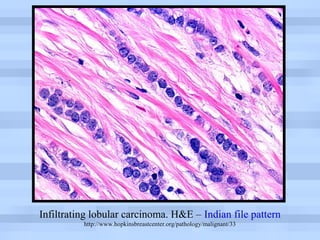
• Indian file pattern (typical of LC)
• Tumor cells may be seen around the normal duct in
concentric pattern
Invasive Lobular carcinoma
Infiltrating lobular carcinoma. FNAC, PAP.
http://www.hopkinsbreastcenter.org/pathology/malignant/33
Infiltrating lobular carcinoma. FNAC, PAP.
http://www.hopkinsbreastcenter.org/pathology/malignant/33
Infiltrating lobular carcinoma. H&E – Indian file pattern
http://www.hopkinsbreastcenter.org/pathology/malignant/33
Infiltrating lobular carcinoma. H&E – Indian file pattern
http://www.hopkinsbreastcenter.org/pathology/malignant/33
Infiltrating lobular carcinoma. H&E – Indian file pattern
http://www.hopkinsbreastcenter.org/pathology/malignant/33
Lobular carcinomas:Lobular carcinomas: They exhibit different
pattern of metastasis
They prefer:They prefer:
Peritoneum
Retroperitoneum
Meninges
GIT
&
Ovaries
Mucinous carcinoma
•1-6% of all breast cancers
•Well circumscribed
•Extremely soft
•Majority express hormone receptors
•BRCA1 mutations
•Gray blue gelatinous appearance
•Tumor cell float in a see of mucin
Colloid (mucinous) carcinoma. FNAC, Diff-Quik stain.
http://www.hopkinsbreastcenter.org/pathology/malignant/33
Colloid (mucinous) carcinoma. FNAC, PAP.
http://www.hopkinsbreastcenter.org/pathology/malignant/33
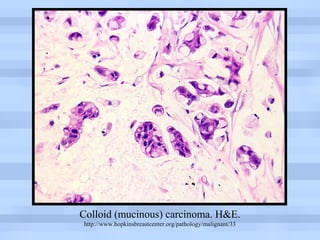
Colloid (mucinous) carcinoma. H&E.
http://www.hopkinsbreastcenter.org/pathology/malignant/33
This variant of breast cancer is known as colloid, or mucinous, carcinoma.
Note the abundant bluish mucin. The carcinoma cells appear to be floating in
the mucin. This variant tends to occur in older women and is slower growing,
and if it is the predominant histologic pattern present, then the prognosis is
better than for non-mucinous, invasive carcinomas.
Tubular carcinoma
•2% breast cancers
•Multifocal with in one breast 10-55% of cases
•Bilateral in 10-38% of cases
•Well formed tubules
•No myoepithelial layer
•Apocrine snouts in the epithelial cells
Tubular carcinoma. H&E.
http://www.hopkinsbreastcenter.org/pathology/malignant/
Ductal carcinoma of the breast showing lymphovascular invasion.
H&E http://www.hopkinsbreastcenter.org/pathology/malignant/33
Tumor embolus from ductal carcinoma in a lymphatic channel. H&E
http://www.hopkinsbreastcenter.org/pathology/malignant/33
Medulalry carcinoma
• Well circumscribed carcinoma of the breast
• May be mistaken for fibroadenoma
• Rapidly growing with pushing margins
• BRCA1 positive
• Solid syncytium of cells (75% of the tumor)
• High nuclear grade
• Lymphocytic infiltration
• No lymphatic or vascular invasion
Medullary carcinomas account for less than 5% of breast cancers. They can sometimes be large,
fleshy masses up to 5 cm in size. At low power, sheets and nests of cells are surrounded by a
lymphoid stroma with little desmoplasia. The prognosis with medullary carcinoma is better than
for infiltrating ductal or lobular carcinoma. Source: webpath
At high magnification, medullary carcinoma is composed of cells with
pleomorphic nuclei that have prominent nucleoli. Though not seen here, foci of
necrosis and hemorrhage can be found. Source: webpath
Metaplastic carcinoma
Source: jhu week-113 case-2
St. John's Medical College, Bangalore
This metaplastic breast carcinoma has elements of squamous metaplasia as shown
here at high magnification. Such tumors are rare in humans (though common in
canines). The metaplastic patterns can include cartilagenous, bony, and myxoid
areas as well. Source: webpath
Ductal carcinoma. FNAC. Diff-Quik stain.
http://www.hopkinsbreastcenter.org/pathology/malignant/
Ductal carcinoma. FNAC. Diff-Quik stain.
http://www.hopkinsbreastcenter.org/pathology/malignant/
Ductal carcinoma, FNAC, Papanicolaou stain
http://www.hopkinsbreastcenter.org/pathology/malignant/
Inflammatory carcinoma
• The definition of inflammatory carcinoma is
currently a matter of debate.
• Many feel that the diagnosis should be based on
clinical exam with the classic symptoms being
increased warmth, erythema, peau d'orange, and
skin thickening.
• Others feel that the diagnosis should be made
solely on the basis of dermal biopsy.
• The histological appearance is one of diffuse
carcinomatous involvement of the dermal
lymphatics.
References:
Cardenosa, G Breast Imaging Companion. Philadelhia: Lippincott-Raven, 1997 Kopans, D Breast imaging . second
edition.Philadelphia: Lippincott Williams & Wilkins 1998
Inflammatory carcinoma
This mastectomy specimen demonstrates the gross findings of "inflammatory" carcinoma of breast. This is not a
specific histologic type of breast cancer, but rather it implies dermal lymphatic invasion by some type of
underlying breast carcinoma. Such involvement of dermal lymphatics gives the grossly thickened, erythematous,
and rough skin surface with the appearance of an orange peel ("peau d'orange"). Source: webpath
The skin overlying the breast has prominent lymphatic spaces filled with small
metastases from breast carcinoma. Carcinomas often metastasize to lymphatics. Breast
cancers most often metastasize to the axillary lymph nodes, and these nodes are often
removed at the time of surgery for breast cancer. Source: webpath
The microscopic appearance of a dermal lymphatic distended by ductal
carcinoma of the breast is shown here. This is the hallmark of so-called
inflammatory carcinoma of the breast. Source: webpath
Metastatic deposits in breast
Metastatic small cell carcinoma from the lung. FNAC. PAP
http://www.hopkinsbreastcenter.org/pathology/malignant/
Squamous cell carcinoma. FNAC. PAP
http://www.hopkinsbreastcenter.org/pathology/malignant/
Metastatic malignant melanoma. FNAC. PAP.
http://www.hopkinsbreastcenter.org/pathology/malignant/
Prognostic & predictive factors
• Prognosis is determined by pathological
examination of:
1-Primary carcinoma
2-Axillary LNs
• This is essential to assess
1-The possible outcome of the disease
2-To choose the appropriate Tx.
• They are divided into:
1-Major PF ((strongest predictor of death from breast cancerstrongest predictor of death from breast cancer))
2-Minor PF
The predictive factors are used to determine the
likelihood of response to a particular Tx.
Prognostic & predictive factors
MAJOR PF MINOR PF
Invasive Vs in situ Small tumor w or w/o node
positivity
Distant mets ER/PR status
LN mets Her-2/Neu
Tumor size Tumor grade
Locally advanced disease Histological type
Inflammatory carcinoma Proliferation rate
DNA content
LVI
Predictive factors - Major
• Invasive Vs in situ
- Majority with DCIS when adequate Tx is
given they will be cured of the disease
- 50% of invasive Ca show local distant
mets at the time of diagnosis.
• Distant mets:
---with distant mets cure is unlikely
---Long term remission is possible with
hormonally responsive tumors.
Favoured sites for distant mets:
Lungs, Bone, Liver, Adrenals and Brain.
Predictive factors - Major
• LN mets:
--most important factors in the absence of distnat
mets.
--LN biopsy is necessary for accurate assessment
--Clinical assessment of nodal involvement is very
inaccurate
Predictive factors - Major
10yr disease free survival
LN negative 70-80%
One LN positive 35-40%
10 or more LN positive 10-15%
• Sentinel LN biopsy
--Radiotracer / colour dye
--Identifies the draining LN with high
probability of mets
--The question of axillary dissection
--Macromets (>0.2cm) – is of proven importance
--Micromets (IHC / RT-PCR) – is of unclear
significance
Predictive factors - Major
• Tumor size:
Risk of axillary LN mets increases with
increasing size of cancer
1-Tumor <1cm LN-negative
survival is similar to women witout br.ca
10yr survival is 90%
2-Tumor >2cms
50% will have LN mets
Many will die of their disease
Predictive factors - Major
• Locally advanced disease:
Tumors with skin or skeletal muscle
involvement are frequently associated with
concurrent or subsequent distant mets.
Predictive factors - Major
• Inflammatory carcinoma:
1-Breast swelling
2-Skin thickening
Very poor prognosis with 3yr survival rate of only
3-10%
Predictive factors - Major
Inflammatory carcinoma
The skin overlying the breast has prominent lymphatic spaces filled with small
metastases from breast carcinoma. Carcinomas often metastasize to lymphatics. Breast
cancers most often metastasize to the axillary lymph nodes, and these nodes are often
removed at the time of surgery for breast cancer. Source: webpath
• Women with node + and / or Ca >1cm
will benefit from systemic Tx
• Women with node – and small carcinoma
minor prognostic assessment will tell
who needs additional Tx and who can be
left alone.
Among them ER/PR/Her2 are most useful
predictors of response to specific Tx.
Predictive factors - Minor
• Histological subtypes:
Predictive factors - Minor
10yr survival >60% 10yr survival <20%
1-Tubular ca
2-Mucinous ca
3-Medullary ca
4-Lobular ca
5-Papillary ca
6-Adenoid cystic ca
Carcinoma -NST
• Tumor grade: (Scarff-Bloom-Richardson)
1-Nuclear pleomorphism (Small uniform, Moderate
variation, marked variation)
2-Tubule formation (>75%, 10-75%, <10%)
3-Mitotic activity (7, 8-14, >15/10hpf)
10yr survival:
Grade-I 80%
Grade-II 60%
Grade-III 15%
Predictive factors - Minor
• ER / PR status:
Predictive factors - Minor
Receptor Response to hormone Tx
Both ER+ & PR+ 80%
Either ER+ or PR+ 40%
ER negative
PR negative
10%
Mechanism of
estrogen action
on cancer cells
having estrogen
receptor.
Source: Sabiston – Text
book of Surgery, 15th
Ed,
Vol-1
The cells of this breast carcinoma are highly positive for estrogen
receptor with this immunoperoxidase stain. Source: webpath
This is progesterone receptor (PR) positivity in a breast carcinoma. Carcinomas that are
PR positive, but not ER positive, may have a worse prognosis. Source: webpath
This is positive immunoperoxidase staining for C-erb B-2 (HER-2/neu) in a breast carcinoma. Note
the membranous staining of the neoplastic cells with the antibody directed against the HER-2 gene
product. The drug trastuzumab is a monoclonal antibody directed against HER-2 positive breast
cancer cells. Source: webpath
Marker studies
• The hormone receptor status of the breast
cancer cells can be useful information for
treatment and prognosis.
• The neoplastic cells can express a variety of
receptors.
• The presence of these receptors can provide
a means for controlling cell growth through
chemotherapeutic agents.
Marker studies
• Estrogen receptor (ER)
• Progesterone receptor (PR)
Other markers:
• Cathepsin D
• C-erb B-2 (HER-2/neu)
• In general, cancers in which the cells express
estrogen receptor (ER) in their nuclei will have a
better prognosis. They can respond to hormonal
manipulation.
• The drug tamoxifen is often utilized for this
purpose.
• Almost three-fourths of breast cancers expressing
ER will respond to this therapy, whereas less than
5% not expressing ER will respond.
Marker studies
• The significance of progesterone receptor
(PR) positivity in a breast carcinoma is less
well understood.
• In general, cancers that are ER positive will
also be PR positive.
• However, carcinomas that are PR positive,
but not ER positive, may have a worse
prognosis.
Marker studies
• C-erb B-2 (HER-2/neu) is another marker in breast
carcinomas, and it is identified around the cytoplasmic
membrane of the cells with immunohistochemical
methods.
• HER-2 oncogene overexpression is typically the result of
gene amplification (more gene copies) and is detected by
the fluorescence in situ hybridization (FISH) assay, but in
a few cases may be due to transcription activation.
• This gene encodes for an epithelial growth factor receptor
on the cell membrane that stimulates cellular proliferation.
There is a correlation between HER-2 positivity and high
nuclear grade and aneuploidy.
Marker studies
This is positive immunoperoxidase staining for C-erb B-2 (HER-2/neu) in a breast carcinoma. Note
the membranous staining of the neoplastic cells with the antibody directed against the HER-2 gene
product. The drug trastuzumab is a monoclonal antibody directed against HER-2 positive breast
cancer cells. Source: webpath
• LVI (lymphovascular invasion)
Tumor cells with in either lymphatic or
vascular spaces is associated with poor
prognosis as many have LN mets.
Predictive factors - Minor
The microscopic appearance of a dermal lymphatic distended by ductal
carcinoma of the breast is shown here. This is the hallmark of so-called
inflammatory carcinoma of the breast. Source: webpath
Source: Sabiston – Text book of Surgery, 15th
Ed, Vol-
1
Significance of negative surgical
margins in Invasive (A)
compared with intraductal (B)
carcinoma.
• Proliferative rate
flow cytometry
thymidine labelling
mitotic count
Ki 67
cyclin E count
Tumors with high proliferative index are associated
with much worse prognosis.
Predictive factors - Minor
• Tumror DNA content:
tumor aneuploidy is asociated with worse
prognosis.
Predictive factors - Minor
This mammogram
demonstrates a large
10 cm mass lesion
consistent with a
phyllodes tumor.
Source: webpath
Cystosarcoma phyllodes. H&E
http://www.hopkinsbreastcenter.org/pathology/malignant/
A phyllodes tumor of the breast is shown here. They arise from interlobular stroma, but unlike
fibroadenomas are not common and are much larger. They are low-grade neoplasms that rarely
metastasize. They are more cellular than fibroadenomas. Projections of stroma into the ducts create the
leaf-like pattern for which these tumors are named
(from the Greek word phyllodes meaning leaf-like).

Breast pathology 3

  • 1.
  • 2.
    Classification of BreastCancer • Breast cancers can be classifed histologically based upon the types and patterns of cells that compose them. • Carcinomas can be invasive (extending into the surrounding stroma) or non-invasive (confined just to the ducts or lobules). • The "NOS" categories contain carcinomas not easily classified into other histologic types or carcinomas for which minimal tissue was available for diagnosis.
  • 3.
    Source: Sabiston –Text book of Surgery, 15th Ed, Vol-1 Medullary carcinoma Mucinous carcinoma Adenoid cystic carcinoma
  • 4.
    Non-invasive Carcinomas ofthe Breast Histologic Type Frequency (%) 5-year Survival (%) Intraductal Carcinoma (DCIS) 3.6 >99 Lobular Carcinoma in situ (LCIS) 1.6 >99 DCIS & LCIS 0.2 >99 Papillary Carcinoma 0.4 >99 Comedocarcinoma 0.3 >99
  • 5.
    Invasive Carcinomas ofthe Breast Histologic Type Frequency (%) 5-year Survival (%) Infiltrating Ductal Carcinoma 63.6 79 Infiltrating Lobular Carcinoma 5.9 84 Infiltrating Ductal & Lobular Carcinoma 1.6 85 Medullary Carcinoma 2.8 82 Mucinous (Colloid) Carcinoma 2.1 95 Comedocarcinoma 1.4 87 Paget's Disease 1.0 79 Papillary Carcinoma 0.8 96 Tubular Carcinoma 0.6 96 Adenocarcinoma, NOS 7.5 65 Carcinoma, NOS 3.5 62
  • 6.
    Clinical features • Massin the breast • Retraction of the nipple • Pain • Peau d’ orange • Lymphadenopathy • Eczema or ulceration of nipple • Mammographic densities / calcifications • Nipple discharge
  • 8.
    Source: Sabiston –Text book of Surgery, 15th Ed, Vol- 1
  • 9.
    Source: Sabiston –Text book of Surgery, 15th Ed, Vol- 1
  • 11.
  • 12.
    Peau d’ orangeof the breast
  • 13.
    Schirrhous carcinoma of the breast. Notethe shrinkning and elevation of the breast with nipple retraction.
  • 14.
    Large fungating carcinomaof the right breast with enlarged axillary lymphnodes.
  • 15.
    Carcinoma of themale breast – advanced.
  • 16.
  • 17.
    Lymphangiosarcoma developed after3years after radical mastectomy.
  • 18.
    Source: Sabiston – Textbook of Surgery, 15th Ed, Vol-1
  • 19.
    -Phyllode’s tumor in a womenof 18years. -Weight 18kgs. -Ulceration (arrow) due to pressure.
  • 20.
    Carcinoma in situ DCIS– malignant population of cells limited to ducts and lobules by the basement membrane. • Vaguely palpable mass • Mammographic calcifications / densities • Incidental finding in biopsy done for some other reason Sub types (based on the architecture): 1-comedo ca 2-solid ca 3-cribriform ca 4-papillary ca 5-micropapillary ca
  • 21.
    Carcinoma in situ- comedo • Grossly on the cut surface worm like extrusions (comedons) occur when pressure is applied laterally to the involved area. • Size of the carcinoma vary, some measuring several centimeters.
  • 22.
    The gross appearanceof a comedocarcinoma pattern of intraductal carcinoma is seen here, with small, yellow central necrotic areas in the ducts. This pattern is not common, but the overall prognosis for patients with this type of breast carcinoma is generally good. Source: webpath
  • 23.
    • Microscopy: solid sheetsof pleomorphic cells with high grade nuclei. central necrosis. intact basement membrane. there may be microcalcifications. periductal concentric fibrosis. Carcinoma in situ - comedo
  • 24.
    Here is acomedocarcinoma pattern of intraductal carcinoma, which is characterized by the presence of rapidly proliferating, high-grade malignant cells. Note the prominent central necrosis in the ducts (arrows). Source: webpath
  • 25.
    The cells inthe center of the ducts with comedocarcinoma are often necrotic and calcify, as shown here. This central necrosis leads to the gross characteristic of extrusion of cheesy material from the ducts with pressure (comedone-like). Source: webpath
  • 26.
    Carcinoma-in-situ of thecomedo pattern distending an acinus, not a duct. The lumen contains red cells, necrotic epithelial cells and macrophages with brown pigment. H&E. http://www.georgetown.edu/dml/educ/path/cpc/gyn_breast/06.html
  • 27.
    In-situ and invasiveductal carcinoma with microcalcification. H&E. http://www.hopkinsbreastcenter.org/pathology/malignant/
  • 28.
    Ductal carcinoma in-situ(comedo-type). FNAC. PAP. http://www.hopkinsbreastcenter.org/pathology/malignant/33
  • 29.
    Ductal carcinoma in-situ(comedo-type) with central microcalcification. H&E http://www.hopkinsbreastcenter.org/pathology/malignant/33
  • 30.
    Permanent section ofthe breast lump showing Ductal carcinoma in situ (DCIS - Comedo pattern with central necrosis) along with invasive glands. (H/E, 10x) http://www.georgetown.edu/dml/educ/path/cpc/gyn_breast/06.html
  • 31.
    DCIS ("comedo type),low magnification. (Actual field size 1.5 X 1 mm) This duct has a central plug of necrotic cellular debris (outlined by the arrow heads). The distance from the edge of this necrotic zone to the basal lamina is constant throughout this duct and pathologists assume that the necrosis is due to a lack of a crucial nutrient such as oxygen in cells that have a high metabolic demand. The box shows the area for next Figure. <http://www.georgetown.edu/dml/educ/path/cpc/gyn_breast/06.html>
  • 32.
    DCIS ("comedo type"),high magnification. When the cells die, the nuclei undergo pyknosis, or collapse of the nuclear membrane and collapse of the chromatin into dense masses. Over several days, the pyknotic nuclei lose all staining, presumably as the DNA is autolyzed. http://www.georgetown.edu/dml/educ/path/cpc/gyn_breast/06.html
  • 33.
    • Monomorphic populationof cells • Low to high nuclear grades • Intraepithelial spaces are evenly distributed and regular in shape – cookie cutter-like Carcinoma in situ - Cribriform
  • 34.
    The classic cribriformpattern of intraductal carcinoma of the breast is shown here. The neoplastic epithelial cells within the duct show minimal hyperchromatism and pleomorphism, but they surround holes with sharp margins, as though punched out by a cookie cutter.
  • 35.
  • 36.
    The rigid bars(A) and the round, punched-out open spaces (B) characteristic of this, the most common in situ carcinoma, are apparent under low magnification. www.wisc.edu/wolberg/comedb_s.html
  • 37.
    Both intraductal andinfiltrating ductal carcinoma are seen here. Note the intraductal component in the center with cribriform pattern and prominent microcalcifications. Surrounding this are infiltrating carcinoma cells. Source: webpath
  • 38.
    Carcinoma in situ– Solid type • Monomorphic population of cells • Low to high nuclear grades • Cells completely fill the involved spaces
  • 39.
    Ductal carcinoma in-situ(solid-type). H&E.. http://www.hopkinsbreastcenter.org/pathology/malignant/33
  • 40.
    This high powermicroscopic view demonstrates intraductal carcinoma. Neoplastic cells are still within the ductules and have not broken through into the stroma. Note that the two large lobules in the center contain microcalcifications. Such microcalcifications can appear on mammography. Source: webpath
  • 41.
    Carcinoma in situ– Papillary/mcoropapillary types • Monomorphic population of cells • Low to high nuclear grades • Papillary DCIS grows in to spaces and lines the fibrovascular spaces • No myoepithelial lining • Micropapillary DCIS shows bulbous protrusions without a fibrovascular core • May form complex intraductal patterns
  • 42.
    Figure 23-18 NoncomedoDCIS. A, Papillary DCIS. Delicate fibrovascular cores extend into a duct and are lined by a monomorphic population of tall columnar cells. Myoepithelial cells are absent. B, Micropapillary DCIS. The papillae are connected to the duct wall by a narrow base and often have bulbous or complex outgrowths. The papillae are solid and do not have fibrovascular cores.
  • 43.
    Ductal carcinoma in-situ, micropapillarytype. H&E. Source: jhu week-91case-4
  • 44.
    Ductal carcinoma in-situ,micropapillary type. H&E. http://www.hopkinsbreastcenter.org/pathology/malignant/33
  • 45.
    Ductal carcinoma in-situ,micropapillary type. FNAC, PAP. http://www.hopkinsbreastcenter.org/pathology/malignant/33
  • 46.
    Carcinoma in situ– Paget’s disease • It’s a rare manifestation of breast ca (1-2%) • Palpable mass is present in 50-60% of cases • Unilateral erythematous eruption with a scale crust • Pruritus is common • May be mistaken for eczema • Malignant cells extend from DCIS into the nipple without crossing the BM. • Carcinomas are usually poorly differentiated and over express HER2/Neu • Prognosis depends on the extent of underlying carcinoma
  • 49.
    Figure 23-19 Pagetdisease of the nipple. DCIS arising within the ductal system of the breast can extend up the lactiferous ducts into nipple skin without crossing the basement membrane. The malignant cells disrupt the normally tight squamous epithelial cell barrier, allowing extracellular fluid to seep out and form an oozing scaly crust over the nipple skin.
  • 50.
    Paget's disease ofthe breast is shown here. Note the overlying hyperkeratosis of the skin, which helps to produce the rough, red, scaling appearance seen grossly, and there is often ulceration. The large cells infiltrating into the epidermis represent intraepithelial extension of an underlying ductal carcinoma in situ or invasive ductal carcinoma. Source: webpath
  • 51.
    At high magnification,the large Paget's cells of Paget's disease of breast have abundant clear cytoplasm and appear in the epidermis either singly or in clusters. The nuclei of the Paget's cells are atypical and, though not seen here, often have prominent nucleoli. webpath
  • 52.
    A PAS staindemonstrates mucin within the Paget's cells of Paget's disease of the breast. This is evidence for their origin from an underlying ductal carcinoma. By immunoperoxidase staining, they will also be keratin positive and epithelial membrane antigen positive. Source: webpath
  • 53.
    Dr.James Paget. Famous manof St. Barts. Described diseases of breast and bone
  • 54.
    DCIS with microinvsion •Def: foci of tumor cells <0.1cm in diameter invading the stroma. • Microinvasion is most commonly seen in association with comedocarcinoma.
  • 55.
    Lobular Carcinoma insitu - LCIS • Always an incidental finding in biopsies • Not associated with calcifications / densities • Bilateral in 20-40% of women (cf. 10-20% in DCIS) • More common in younger women (80-90% occur before menopause) • Small cells that have oval or round nuclei with small nucleoli that do not adhere to one another. • Signet ring cells containing mucin are present commonly. • LCIS rarely distorts the architecture, and the involved acini remain recognizable as lobules. • LCIS always express ER/PR and may be negative for HER2/Neu.
  • 56.
    Lobular carcinoma in-situ.H&E http://www.hopkinsbreastcenter.org/pathology/malignant/
  • 57.
    Lobular carcinoma in-situ.H&E http://www.hopkinsbreastcenter.org/pathology/malignant/
  • 58.
    Lobular carcinoma in-situ.FNAC, PAP http://www.hopkinsbreastcenter.org/pathology/malignant/33
  • 59.
    Infiltrating lobular carcinoma.FNAC, PAP. http://www.hopkinsbreastcenter.org/pathology/malignant/33
  • 60.
    Invasive carcinomas • Almostalways present as palpable masses • 50% will have LN mets • Clinical features of malignancy is present • Inflammatory carcinoma is a clinical entity and is not a specific histological type
  • 61.
    Detailed views ofthe microcalcifications in the CC of the left breast. [79 year old asymptomatic woman with screening mammogram.] http://www.rad.washington.edu/quickcases/cases/Case11/answers.html
  • 62.
    Detailed views ofthe microcalcifications in the CC of the left breast. This pattern of microcalcifications is classic for ductal carcinoma of the breast. There is not really any differential diagnosis here. This patient needs surgery. 79 year old asymptomatic woman79 year old asymptomatic woman with screening mammogram.with screening mammogram.
  • 63.
    Detailed views ofthe microcalcifications in the CC of the left breast. http://www.rad.washington.edu/quickcases/cases/Case11/answers.html
  • 64.
    Source: webpath This mammogram demonstratesa lesion consistent with a neoplasm in the upper portion above and just to the left of the white dot marking the point the patient felt some pain on palpation. On biopsy, this was an infiltrating ductal carcinoma.
  • 65.
    Invasive carcinoma -NST • Most common type (70-80%) • Firm to hard and have irregular border • Center of the lesion shows streaks of chaky white elastotic stroma • Gives a grating sensation while cutting • They are well differentiated with tubules lined by minimally atypical cells • Typically ER/PR+ when they are WD • And ER/PR- when they are PD
  • 66.
    The irregular masslesion seen here is an infiltrating ductal carcinoma of breast. The center is very firm (scirrhous) and white because of the desmoplasia. There are areas of yellowish necrosis in the portions of neoplasm infiltrating into the surrounding breast. Such tumors appear very firm and non-mobile on physical exam. Source: webpath
  • 67.
    This breast biopsydemonstrates a carcinoma. Note the irregular margins and varied cut surface. This small cancer was found by mammography. The margins of the specimen have been inked with green dye following removal to assist in determining whether cancer extends to the margins once histologic sections are made. Source: webpath
  • 68.
    Infiltrating ductal carcinoma.Hematoxylinand Eosin stain http://www.hopkinsbreastcenter.org/pathology/malignant/
  • 69.
    This is infiltratingductal carcinoma of breast. Note the infiltration of ill-defined glands into the surrounding collagenous stroma. There is also a small microcalcification at the lower right of center, a finding that could be seen by mammography. About 65 to 80% of breast cancers are of this type. Source: webpath
  • 70.
    This infiltrating ductalcarcinoma of breast at low magnification appears to radiate from a central area of desmoplasia. This collagenous component gives the neoplasm a hard "scirrhous" consistency that is palpable. Such an invasive carcinoma may be fixed to underlying chest wall, making it non-mobile. Source: webpath
  • 71.
    Note the smallnests and infiltrating strands of neoplastic cells with prominent bands of collagen between them in this ductal carcinoma of the breast. It is this marked increase in the dense fibrous tissue stroma that produces the characteristic hard "scirrhous" appearance of the typical infiltrating ductal carcinoma. Note the nerve surrounded by the neoplasm at the lower left. Source: webpath
  • 72.
    At high magnification,the pleomorphism of the carcinoma cells within the duct in the center (in a cribriform pattern), as well as the neoplastic cells infiltrating through the stroma and fat, can be seen with this infiltrating ductal carcinoma.
  • 73.
    • Clinical presentationis similar to NST • 25% will have diffuse growth pattern without desmoplasia • High incidence of bilaterality • Most tumors are firm to hard with irregular margins • Minimal desmoplasia • Indian file pattern (typical of LC) • Tumor cells may be seen around the normal duct in concentric pattern Invasive Lobular carcinoma
  • 74.
    Infiltrating lobular carcinoma.FNAC, PAP. http://www.hopkinsbreastcenter.org/pathology/malignant/33
  • 75.
    Infiltrating lobular carcinoma.FNAC, PAP. http://www.hopkinsbreastcenter.org/pathology/malignant/33
  • 76.
    Infiltrating lobular carcinoma.H&E – Indian file pattern http://www.hopkinsbreastcenter.org/pathology/malignant/33
  • 77.
    Infiltrating lobular carcinoma.H&E – Indian file pattern http://www.hopkinsbreastcenter.org/pathology/malignant/33
  • 78.
    Infiltrating lobular carcinoma.H&E – Indian file pattern http://www.hopkinsbreastcenter.org/pathology/malignant/33
  • 79.
    Lobular carcinomas:Lobular carcinomas:They exhibit different pattern of metastasis They prefer:They prefer: Peritoneum Retroperitoneum Meninges GIT & Ovaries
  • 80.
    Mucinous carcinoma •1-6% ofall breast cancers •Well circumscribed •Extremely soft •Majority express hormone receptors •BRCA1 mutations •Gray blue gelatinous appearance •Tumor cell float in a see of mucin
  • 81.
    Colloid (mucinous) carcinoma.FNAC, Diff-Quik stain. http://www.hopkinsbreastcenter.org/pathology/malignant/33
  • 82.
    Colloid (mucinous) carcinoma.FNAC, PAP. http://www.hopkinsbreastcenter.org/pathology/malignant/33
  • 83.
    Colloid (mucinous) carcinoma.H&E. http://www.hopkinsbreastcenter.org/pathology/malignant/33
  • 84.
    This variant ofbreast cancer is known as colloid, or mucinous, carcinoma. Note the abundant bluish mucin. The carcinoma cells appear to be floating in the mucin. This variant tends to occur in older women and is slower growing, and if it is the predominant histologic pattern present, then the prognosis is better than for non-mucinous, invasive carcinomas.
  • 85.
    Tubular carcinoma •2% breastcancers •Multifocal with in one breast 10-55% of cases •Bilateral in 10-38% of cases •Well formed tubules •No myoepithelial layer •Apocrine snouts in the epithelial cells
  • 86.
  • 87.
    Ductal carcinoma ofthe breast showing lymphovascular invasion. H&E http://www.hopkinsbreastcenter.org/pathology/malignant/33
  • 88.
    Tumor embolus fromductal carcinoma in a lymphatic channel. H&E http://www.hopkinsbreastcenter.org/pathology/malignant/33
  • 89.
    Medulalry carcinoma • Wellcircumscribed carcinoma of the breast • May be mistaken for fibroadenoma • Rapidly growing with pushing margins • BRCA1 positive • Solid syncytium of cells (75% of the tumor) • High nuclear grade • Lymphocytic infiltration • No lymphatic or vascular invasion
  • 90.
    Medullary carcinomas accountfor less than 5% of breast cancers. They can sometimes be large, fleshy masses up to 5 cm in size. At low power, sheets and nests of cells are surrounded by a lymphoid stroma with little desmoplasia. The prognosis with medullary carcinoma is better than for infiltrating ductal or lobular carcinoma. Source: webpath
  • 91.
    At high magnification,medullary carcinoma is composed of cells with pleomorphic nuclei that have prominent nucleoli. Though not seen here, foci of necrosis and hemorrhage can be found. Source: webpath
  • 92.
  • 93.
    Metaplastic carcinoma Source: jhuweek-113 case-2 St. John's Medical College, Bangalore
  • 94.
    This metaplastic breastcarcinoma has elements of squamous metaplasia as shown here at high magnification. Such tumors are rare in humans (though common in canines). The metaplastic patterns can include cartilagenous, bony, and myxoid areas as well. Source: webpath
  • 95.
    Ductal carcinoma. FNAC.Diff-Quik stain. http://www.hopkinsbreastcenter.org/pathology/malignant/
  • 96.
    Ductal carcinoma. FNAC.Diff-Quik stain. http://www.hopkinsbreastcenter.org/pathology/malignant/
  • 97.
    Ductal carcinoma, FNAC,Papanicolaou stain http://www.hopkinsbreastcenter.org/pathology/malignant/
  • 98.
    Inflammatory carcinoma • Thedefinition of inflammatory carcinoma is currently a matter of debate. • Many feel that the diagnosis should be based on clinical exam with the classic symptoms being increased warmth, erythema, peau d'orange, and skin thickening. • Others feel that the diagnosis should be made solely on the basis of dermal biopsy. • The histological appearance is one of diffuse carcinomatous involvement of the dermal lymphatics. References: Cardenosa, G Breast Imaging Companion. Philadelhia: Lippincott-Raven, 1997 Kopans, D Breast imaging . second edition.Philadelphia: Lippincott Williams & Wilkins 1998
  • 99.
  • 100.
    This mastectomy specimendemonstrates the gross findings of "inflammatory" carcinoma of breast. This is not a specific histologic type of breast cancer, but rather it implies dermal lymphatic invasion by some type of underlying breast carcinoma. Such involvement of dermal lymphatics gives the grossly thickened, erythematous, and rough skin surface with the appearance of an orange peel ("peau d'orange"). Source: webpath
  • 101.
    The skin overlyingthe breast has prominent lymphatic spaces filled with small metastases from breast carcinoma. Carcinomas often metastasize to lymphatics. Breast cancers most often metastasize to the axillary lymph nodes, and these nodes are often removed at the time of surgery for breast cancer. Source: webpath
  • 102.
    The microscopic appearanceof a dermal lymphatic distended by ductal carcinoma of the breast is shown here. This is the hallmark of so-called inflammatory carcinoma of the breast. Source: webpath
  • 103.
  • 104.
    Metastatic small cellcarcinoma from the lung. FNAC. PAP http://www.hopkinsbreastcenter.org/pathology/malignant/
  • 105.
    Squamous cell carcinoma.FNAC. PAP http://www.hopkinsbreastcenter.org/pathology/malignant/
  • 106.
    Metastatic malignant melanoma.FNAC. PAP. http://www.hopkinsbreastcenter.org/pathology/malignant/
  • 107.
    Prognostic & predictivefactors • Prognosis is determined by pathological examination of: 1-Primary carcinoma 2-Axillary LNs • This is essential to assess 1-The possible outcome of the disease 2-To choose the appropriate Tx.
  • 108.
    • They aredivided into: 1-Major PF ((strongest predictor of death from breast cancerstrongest predictor of death from breast cancer)) 2-Minor PF The predictive factors are used to determine the likelihood of response to a particular Tx. Prognostic & predictive factors
  • 109.
    Prognostic & predictivefactors MAJOR PF MINOR PF Invasive Vs in situ Small tumor w or w/o node positivity Distant mets ER/PR status LN mets Her-2/Neu Tumor size Tumor grade Locally advanced disease Histological type Inflammatory carcinoma Proliferation rate DNA content LVI
  • 110.
    Predictive factors -Major • Invasive Vs in situ - Majority with DCIS when adequate Tx is given they will be cured of the disease - 50% of invasive Ca show local distant mets at the time of diagnosis.
  • 111.
    • Distant mets: ---withdistant mets cure is unlikely ---Long term remission is possible with hormonally responsive tumors. Favoured sites for distant mets: Lungs, Bone, Liver, Adrenals and Brain. Predictive factors - Major
  • 113.
    • LN mets: --mostimportant factors in the absence of distnat mets. --LN biopsy is necessary for accurate assessment --Clinical assessment of nodal involvement is very inaccurate Predictive factors - Major 10yr disease free survival LN negative 70-80% One LN positive 35-40% 10 or more LN positive 10-15%
  • 114.
    • Sentinel LNbiopsy --Radiotracer / colour dye --Identifies the draining LN with high probability of mets --The question of axillary dissection --Macromets (>0.2cm) – is of proven importance --Micromets (IHC / RT-PCR) – is of unclear significance Predictive factors - Major
  • 115.
    • Tumor size: Riskof axillary LN mets increases with increasing size of cancer 1-Tumor <1cm LN-negative survival is similar to women witout br.ca 10yr survival is 90% 2-Tumor >2cms 50% will have LN mets Many will die of their disease Predictive factors - Major
  • 116.
    • Locally advanceddisease: Tumors with skin or skeletal muscle involvement are frequently associated with concurrent or subsequent distant mets. Predictive factors - Major
  • 117.
    • Inflammatory carcinoma: 1-Breastswelling 2-Skin thickening Very poor prognosis with 3yr survival rate of only 3-10% Predictive factors - Major
  • 118.
  • 119.
    The skin overlyingthe breast has prominent lymphatic spaces filled with small metastases from breast carcinoma. Carcinomas often metastasize to lymphatics. Breast cancers most often metastasize to the axillary lymph nodes, and these nodes are often removed at the time of surgery for breast cancer. Source: webpath
  • 120.
    • Women withnode + and / or Ca >1cm will benefit from systemic Tx • Women with node – and small carcinoma minor prognostic assessment will tell who needs additional Tx and who can be left alone. Among them ER/PR/Her2 are most useful predictors of response to specific Tx. Predictive factors - Minor
  • 121.
    • Histological subtypes: Predictivefactors - Minor 10yr survival >60% 10yr survival <20% 1-Tubular ca 2-Mucinous ca 3-Medullary ca 4-Lobular ca 5-Papillary ca 6-Adenoid cystic ca Carcinoma -NST
  • 122.
    • Tumor grade:(Scarff-Bloom-Richardson) 1-Nuclear pleomorphism (Small uniform, Moderate variation, marked variation) 2-Tubule formation (>75%, 10-75%, <10%) 3-Mitotic activity (7, 8-14, >15/10hpf) 10yr survival: Grade-I 80% Grade-II 60% Grade-III 15% Predictive factors - Minor
  • 123.
    • ER /PR status: Predictive factors - Minor Receptor Response to hormone Tx Both ER+ & PR+ 80% Either ER+ or PR+ 40% ER negative PR negative 10%
  • 124.
    Mechanism of estrogen action oncancer cells having estrogen receptor. Source: Sabiston – Text book of Surgery, 15th Ed, Vol-1
  • 125.
    The cells ofthis breast carcinoma are highly positive for estrogen receptor with this immunoperoxidase stain. Source: webpath
  • 126.
    This is progesteronereceptor (PR) positivity in a breast carcinoma. Carcinomas that are PR positive, but not ER positive, may have a worse prognosis. Source: webpath
  • 127.
    This is positiveimmunoperoxidase staining for C-erb B-2 (HER-2/neu) in a breast carcinoma. Note the membranous staining of the neoplastic cells with the antibody directed against the HER-2 gene product. The drug trastuzumab is a monoclonal antibody directed against HER-2 positive breast cancer cells. Source: webpath
  • 128.
    Marker studies • Thehormone receptor status of the breast cancer cells can be useful information for treatment and prognosis. • The neoplastic cells can express a variety of receptors. • The presence of these receptors can provide a means for controlling cell growth through chemotherapeutic agents.
  • 129.
    Marker studies • Estrogenreceptor (ER) • Progesterone receptor (PR) Other markers: • Cathepsin D • C-erb B-2 (HER-2/neu)
  • 130.
    • In general,cancers in which the cells express estrogen receptor (ER) in their nuclei will have a better prognosis. They can respond to hormonal manipulation. • The drug tamoxifen is often utilized for this purpose. • Almost three-fourths of breast cancers expressing ER will respond to this therapy, whereas less than 5% not expressing ER will respond. Marker studies
  • 131.
    • The significanceof progesterone receptor (PR) positivity in a breast carcinoma is less well understood. • In general, cancers that are ER positive will also be PR positive. • However, carcinomas that are PR positive, but not ER positive, may have a worse prognosis. Marker studies
  • 132.
    • C-erb B-2(HER-2/neu) is another marker in breast carcinomas, and it is identified around the cytoplasmic membrane of the cells with immunohistochemical methods. • HER-2 oncogene overexpression is typically the result of gene amplification (more gene copies) and is detected by the fluorescence in situ hybridization (FISH) assay, but in a few cases may be due to transcription activation. • This gene encodes for an epithelial growth factor receptor on the cell membrane that stimulates cellular proliferation. There is a correlation between HER-2 positivity and high nuclear grade and aneuploidy. Marker studies
  • 133.
    This is positiveimmunoperoxidase staining for C-erb B-2 (HER-2/neu) in a breast carcinoma. Note the membranous staining of the neoplastic cells with the antibody directed against the HER-2 gene product. The drug trastuzumab is a monoclonal antibody directed against HER-2 positive breast cancer cells. Source: webpath
  • 134.
    • LVI (lymphovascularinvasion) Tumor cells with in either lymphatic or vascular spaces is associated with poor prognosis as many have LN mets. Predictive factors - Minor
  • 135.
    The microscopic appearanceof a dermal lymphatic distended by ductal carcinoma of the breast is shown here. This is the hallmark of so-called inflammatory carcinoma of the breast. Source: webpath
  • 136.
    Source: Sabiston –Text book of Surgery, 15th Ed, Vol- 1 Significance of negative surgical margins in Invasive (A) compared with intraductal (B) carcinoma.
  • 137.
    • Proliferative rate flowcytometry thymidine labelling mitotic count Ki 67 cyclin E count Tumors with high proliferative index are associated with much worse prognosis. Predictive factors - Minor
  • 138.
    • Tumror DNAcontent: tumor aneuploidy is asociated with worse prognosis. Predictive factors - Minor
  • 139.
    This mammogram demonstrates alarge 10 cm mass lesion consistent with a phyllodes tumor. Source: webpath
  • 140.
  • 141.
    A phyllodes tumorof the breast is shown here. They arise from interlobular stroma, but unlike fibroadenomas are not common and are much larger. They are low-grade neoplasms that rarely metastasize. They are more cellular than fibroadenomas. Projections of stroma into the ducts create the leaf-like pattern for which these tumors are named (from the Greek word phyllodes meaning leaf-like).

Editor's Notes

  • #3 Breast cancers can be classifed histologically based upon the types and patterns of cells that compose them. Carcinomas can be invasive (extending into the surrounding stroma) or non-invasive (confined just to the ducts or lobules). The tables below identify the major histologic types of invasive and non-invasive breast cancers, along with their frequency of all breast cancer types, and overall relative 5-year survival (% of patients with that histologic type surviving for 5 years following diagnosis). The &amp;quot;NOS&amp;quot; categories contain carcinomas not easily classified into other histologic types or carcinomas for which minimal tissue was available for diagnosis.
  • #23 The gross appearance of a comedocarcinoma pattern of intraductal carcinoma is seen here, with small, yellow central necrotic areas in the ducts. This pattern is not common, but the overall prognosis for patients with this type of breast carcinoma is generally good.
  • #24 Comedon: Latin comed, glutton (from a comparison of the worm-like shape of the waxy material that can be squeezed from a blackhead to a worm believed to feed on the body), from comedere, to eat up : com-, intensive pref.; see com– + edere, to eat; see ed- in Appendix I.
  • #25 Here is a comedocarcinoma pattern of intraductal carcinoma, which is characterized by the presence of rapidly proliferating, high-grade malignant cells. Note the prominent central necrosis in the ducts.
  • #30 Comedon: Latin comed, glutton (from a comparison of the worm-like shape of the waxy material that can be squeezed from a blackhead to a worm believed to feed on the body), from comedere, to eat up : com-, intensive pref.; see com– + edere, to eat; see ed- in Appendix I.
  • #31 Permanent section of the breast lump showing Ductal carcinoma in situ (DCIS - Comedo pattern with central necrosis) along with invasive glands. (H/E, 10x) http://www.georgetown.edu/dml/educ/path/cpc/gyn_breast/06.html
  • #32 DCIS V, (&amp;quot;comedo type), low magnification. (Actual field size 1.5 X 1 mm) This duct has a central plug of necrotic cellular debris (outlined by the arrow heads). The distance from the edge of this necrotic zone to the basal lamina is constant throughout this duct and pathologists assume that the necrosis is due to a lack of a crucial nutrient such as oxygen in cells that have a high metabolic demand. The box shows the area for next figure.
  • #33 DCIS (&amp;quot;comedo type&amp;quot;), high magnification. (Actual field size 360 X 240 microns) Comedo carcinoma, high magnification. When the cells die, the nuclei undergo pyknosis, or collapse of the nuclear membrane and collapse of the chromatin into dense masses. Pyknosis differs in appearance from the heterochromatinization depicted in previous Figures. Over several days, the pycnotic nuclei lose all staining, presumably as the DNA is autolyzed. DCIS can be diagnosed because the cells maintain the same (very active) chromatin appearance, independent of their position in the duct. Note the similar appearance of the cells shown by the arrows. The cells apparently can maintain similar functional activities even when they are immediately adjacent to the zone of necrosis. Numerous mitotic figures are seen (arrow heads) including one next to the central necrosis.
  • #38 Both intraductal and infiltrating ductal carcinoma are seen here. Note the intraductal component in the center with cribriform pattern and prominent microcalcifications. Surrounding this are infiltrating carcinoma cells.
  • #41 This high power microscopic view demonstrates intraductal carcinoma. Neoplastic cells are still within the ductules and have not broken through into the stroma. Note that the two large lobules in the center contain microcalcifications. Such microcalcifications can appear on mammography.
  • #43 Figure 23-18  Noncomedo DCIS. A, Papillary DCIS. Delicate fibrovascular cores extend into a duct and are lined by a monomorphic population of tall columnar cells. Myoepithelial cells are absent. B, Micropapillary DCIS. The papillae are connected to the duct wall by a narrow base and often have bulbous or complex outgrowths. The papillae are solid and do not have fibrovascular cores.
  • #47 Tumor cells disrupt the normal epithelial barrier and this allows extracellular fluid to seep out onto the nipple surface. Prognosis: depends on the extent of the underlying carcinoma and is nor affected by the presence or absence of DCIS involving the skin when matched for age, tumor size, grade, HER2/Neu status and nodal status.
  • #50 Figure 23-19  Paget disease of the nipple. DCIS arising within the ductal system of the breast can extend up the lactiferous ducts into nipple skin without crossing the basement membrane. The malignant cells disrupt the normally tight squamous epithelial cell barrier, allowing extracellular fluid to seep out and form an oozing scaly crust over the nipple skin.
  • #51 Paget&amp;apos;s disease of the breast is shown here. Note the overlying hyperkeratosis of the skin, which helps to produce the rough, red, scaling appearance seen grossly, and there is often ulceration. The large cells infiltrating into the epidermis represent intraepithelial extension of an underlying ductal carcinoma in situ or invasive ductal carcinoma.
  • #62 Detailed views of the microcalcifications in the CC of the left breast. [79 year old asymptomatic woman with screening mammogram.] http://www.rad.washington.edu/quickcases/cases/Case11/answers.html
  • #63 Detailed views of the microcalcifications in the CC of the left breast. [79 year old asymptomatic woman with screening mammogram. This pattern of microcalcifications is classic for ductal carcinoma of the breast. There is not really any differential diagnosis here. This patient needs surgery.] http://www.rad.washington.edu/quickcases/cases/Case11/answers.html
  • #64 Detailed views of the microcalcifications in the CC of the left breast. [79 year old asymptomatic woman with screening mammogram.] http://www.rad.washington.edu/quickcases/cases/Case11/answers.html
  • #65 This mammogram demonstrates a lesion consistent with a neoplasm in the upper portion above and just to the left of the white dot marking the point the patient felt some pain on palpation. On biopsy, this was an infiltrating ductal carcinoma.
  • #68 This breast biopsy demonstrates a carcinoma. Note the irregular margins and varied cut surface. This small cancer was found by mammography. The margins of the specimen have been inked with green dye following removal to assist in determining whether cancer extends to the margins once histologic sections are made.
  • #70 This is infiltrating ductal carcinoma of breast. Note the infiltration of ill-defined glands into the surrounding collagenous stroma. There is also a small microcalcification at the lower right of center, a finding that could be seen by mammography. About 65 to 80% of breast cancers are of this type.
  • #71 This infiltrating ductal carcinoma of breast at low magnification appears to radiate from a central area of desmoplasia. This collagenous component gives the neoplasm a hard &amp;quot;scirrhous&amp;quot; consistency that is palpable. Such an invasive carcinoma may be fixed to underlying chest wall, making it non-mobile.
  • #72 Note the small nests and infiltrating strands of neoplastic cells with prominent bands of collagen between them in this ductal carcinoma of the breast. It is this marked increase in the dense fibrous tissue stroma that produces the characteristic hard &amp;quot;scirrhous&amp;quot; appearance of the typical infiltrating ductal carcinoma. Note the nerve surrounded by the neoplasm at the lower left.
  • #73 At high magnification, the pleomorphism of the carcinoma cells within the duct in the center (in a cribriform pattern), as well as the neoplastic cells infiltrating through the stroma and fat, can be seen with this infiltrating ductal carcinoma.
  • #78 Indian file pattern: A row of soldiers ranged one behind another; -- in contradistinction to {rank}, which designates a row of soldiers standing abreast; a number consisting the depth of a body of troops, which in the ordinary modern formation, consists of two men, the battalion standing two deep, or in two ranks.
  • #91 Medullary carcinomas account for less than 5% of breast cancers. They can sometimes be large, fleshy masses up to 5 cm in size. At low power, sheets and nests of cells are surrounded by a lymphoid stroma with little desmoplasia. The prognosis with medullary carcinoma is better than for infiltrating ductal or lobular carcinoma.
  • #92 At high magnification, medullary carcinoma is composed of cells with pleomorphic nuclei that have prominent nucleoli. Though not seen here, foci of necrosis and hemorrhage can be found.
  • #95 This metaplastic breast carcinoma has elements of squamous metaplasia as shown here at high magnification. Such tumors are rare in humans (though common in canines). The metaplastic patterns can include cartilagenous, bony, and myxoid areas as well.
  • #101 This mastectomy specimen demonstrates the gross findings of &amp;quot;inflammatory&amp;quot; carcinoma of breast. This is not a specific histologic type of breast cancer, but rather it implies dermal lymphatic invasion by some type of underlying breast carcinoma. Such involvement of dermal lymphatics gives the grossly thickened, erythematous, and rough skin surface with the appearance of an orange peel (&amp;quot;peau d&amp;apos;orange&amp;quot; for you francophiles).
  • #102 The skin overlying the breast has prominent lymphatic spaces filled with small metastases from breast carcinoma. Carcinomas often metastasize to lymphatics. Breast cancers most often metastasize to the axillary lymph nodes, and these nodes are often removed at the time of surgery for breast cancer.
  • #105 Metastatic small cell carcinoma from the lung. FNAC. PAP
  • #106 Squamous cell carcinoma. FNAC. PAP
  • #107 Metastatic malignant melanoma. FNAC. PAP.
  • #112 Mechanism of favoured sites: Homing is by expression of chemokines receptors in cancer cells and presence of chemokines in the target organs.
  • #120 The skin overlying the breast has prominent lymphatic spaces filled with small metastases from breast carcinoma. Carcinomas often metastasize to lymphatics. Breast cancers most often metastasize to the axillary lymph nodes, and these nodes are often removed at the time of surgery for breast cancer.
  • #126 The cells of this breast carcinoma are highly positive for estrogen receptor with this immunoperoxidase stain. Estrogen receptor positivity correlates with a better prognosis because such positive neoplastic cells are better differentiated and more amenable to hormonal manipulation.
  • #127 This is progesterone receptor (PR) positivity in a breast carcinoma. The usefulness of this determination is not as well established as for estrogen receptors. Carcinomas that are PR positive, but not ER positive, may have a worse prognosis.
  • #128 This is positive immunoperoxidase staining for C-erb B-2 (HER-2/neu) in a breast carcinoma. Note the membranous staining of the neoplastic cells with the antibody directed against the HER-2 gene product (normal cells do not make this product). This gene encodes for an epithelial growth factor receptor on the cell membrane that stimulates cellular proliferation. There is a correlation between HER-2 positivity and high nuclear grade and aneuploidy. The drug trastuzumab is a monoclonal antibody directed against HER-2 positive breast cancer cells.
  • #129 The hormone receptor status of the breast cancer cells can be useful information for treatment and prognosis. The neoplastic cells can express a variety of receptors. The presence of these receptors can provide a means for controlling cell growth through chemotherapeutic agents.
  • #131 In general, cancers in which the cells express estrogen receptor (ER) in their nuclei will have a better prognosis. This is because such positive neoplastic cells are better differentiated, and they can respond to hormonal manipulation. The drug tamoxifen is often utilized for this purpose. Almost three-fourths of breast cancers expressing ER will respond to this therapy, whereas less than 5% not expressing ER will respond
  • #132 The significance of progesterone receptor (PR) positivity in a breast carcinoma is less well understood. In general, cancers that are ER positive will also be PR positive. However, carcinomas that are PR positive, but not ER positive, may have a worse prognosis.
  • #133 C-erb B-2 (HER-2/neu) is another marker in breast carcinomas, and it is identified around the cytoplasmic membrane of the cells with immunohistochemical methods. HER-2 oncogene overexpression is typically the result of gene amplification (more gene copies) and is detected by the fluorescence in situ hybridization (FISH) assay, but in a few cases may be due to transcription activation. This gene encodes for an epithelial growth factor receptor on the cell membrane that stimulates cellular proliferation. There is a correlation between HER-2 positivity and high nuclear grade and aneuploidy.
  • #134 This is positive immunoperoxidase staining for C-erb B-2 (HER-2/neu) in a breast carcinoma. Note the membranous staining of the neoplastic cells with the antibody directed against the HER-2 gene product (normal cells do not make this product). This gene encodes for an epithelial growth factor receptor on the cell membrane that stimulates cellular proliferation. There is a correlation between HER-2 positivity and high nuclear grade and aneuploidy. The drug trastuzumab is a monoclonal antibody directed against HER-2 positive breast cancer cells.
  • #142 A phyllodes tumor of the breast is shown here. They arise from interlobular stroma, but unlike fibroadenomas are not common and are much larger. They are low-grade neoplasms that rarely metastasize. They are more cellular than fibroadenomas. Projections of stroma into the ducts create the leaf-like pattern for which these tumors are named (from the Greek word phyllodes meaning leaf-like).