Dr.P.Karpagam  Kiruba  Rajeswari,M.B.B.S,D.C.P., Tutor in Pathology, MAPIMS.
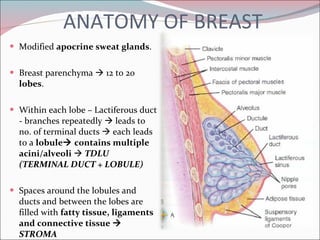
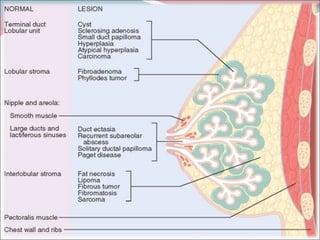
ANATOMY OF BREAST Modified  apocrine sweat glands . Breast parenchyma    12 to 20  lobes . Within each lobe – Lactiferous duct - branches repeatedly    leads to no. of terminal ducts    each leads to a  lobule   contains multiple acini/alveoli     TDLU  (TERMINAL DUCT + LOBULE) Spaces around the lobules and ducts and between the lobes are filled with  fatty tissue, ligaments and connective tissue      STROMA
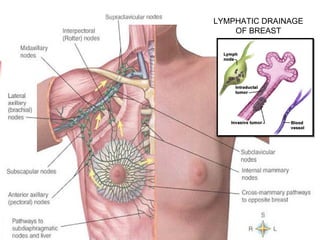
LYMPHATIC DRAINAGE OF BREAST
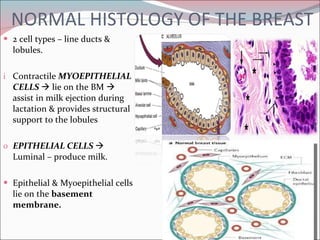
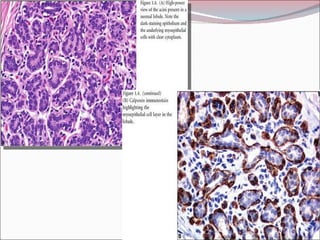
NORMAL HISTOLOGY OF THE BREAST 2 cell types – line ducts & lobules. Contractile  MYOEPITHELIAL CELLS    lie on the BM    assist in milk ejection during lactation & provides structural support to the lobules EPITHELIAL CELLS    Luminal – produce milk. Epithelial & Myoepithelial cells lie on the  basement membrane.
 
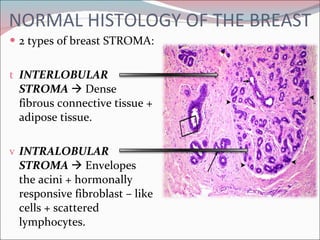
NORMAL HISTOLOGY OF THE BREAST 2 types of breast STROMA: INTERLOBULAR STROMA    Dense fibrous connective tissue + adipose tissue. INTRALOBULAR STROMA    Envelopes the acini + hormonally responsive fibroblast – like cells + scattered lymphocytes.


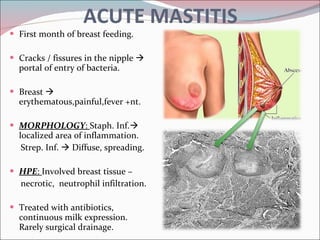
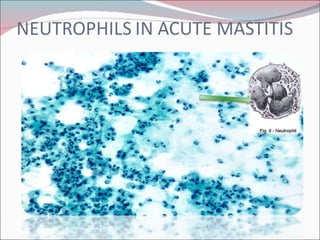
ACUTE MASTITIS First month of breast feeding. Cracks / fissures in the nipple    portal of entry of bacteria. Breast    erythematous,painful,fever +nt. MORPHOLOGY :  Staph. Inf.   localized area of inflammation. Strep. Inf.    Diffuse, spreading. HPE :  Involved breast tissue –  necrotic,  neutrophil infiltration. Treated with antibiotics, continuous milk expression. Rarely surgical drainage.
 
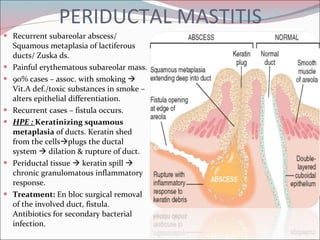
PERIDUCTAL MASTITIS Recurrent subareolar abscess/ Squamous metaplasia of lactiferous ducts/ Zuska ds. Painful erythematous subareolar mass. 90% cases – assoc. with smoking    Vit.A def./toxic substances in smoke – alters epithelial differentiation. Recurrent cases – fistula occurs. HPE :  Keratinizing squamous metaplasia  of ducts. Keratin shed from the cells  plugs the ductal system    dilation & rupture of duct. Periductal tissue    keratin spill    chronic granulomatous inflammatory response. Treatment:  En bloc surgical removal of the involved duct, fistula. Antibiotics for secondary bacterial infection.
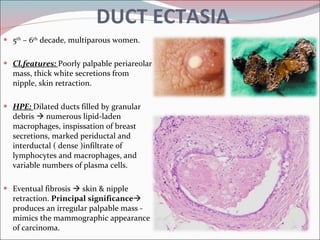
DUCT ECTASIA 5 th  – 6 th  decade, multiparous women. Cl.features:  Poorly palpable periareolar mass, thick white secretions from nipple, skin retraction. HPE:  Dilated ducts   filled by granular debris    numerous lipid-laden macrophages, inspissation of breast secretions, marked periductal and interductal ( dense )infiltrate of lymphocytes and macrophages, and variable numbers of plasma cells. Eventual fibrosis    skin & nipple retraction.  Principal significance   produces an irregular palpable mass - mimics the mammographic appearance of carcinoma.
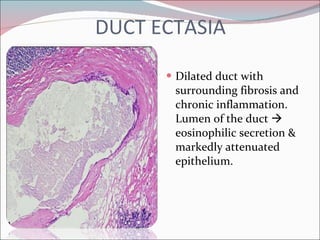
DUCT ECTASIA Dilated duct with surrounding fibrosis and chronic inflammation. Lumen of the duct    eosinophilic secretion & markedly attenuated epithelium.
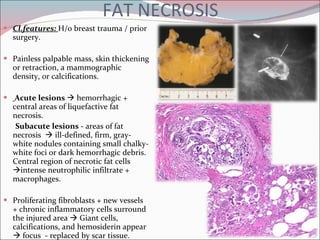
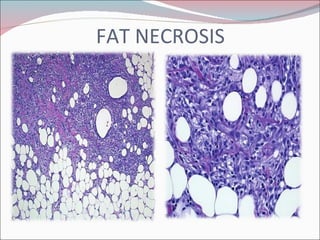
FAT NECROSIS Cl.features:  H/o breast trauma / prior surgery. Painless palpable mass, skin thickening or retraction, a mammographic density, or calcifications.  Acute lesions    hemorrhagic + central areas of liquefactive fat necrosis. Subacute lesions  - areas of fat necrosis    ill-defined, firm, gray-white nodules containing small chalky-white foci or dark hemorrhagic debris. Central region of necrotic fat cells   intense neutrophilic infiltrate + macrophages.  Proliferating fibroblasts + new vessels  + chronic inflammatory cells surround the injured area    Giant cells, calcifications, and hemosiderin appear    focus  - replaced by scar tissue.
FAT NECROSIS
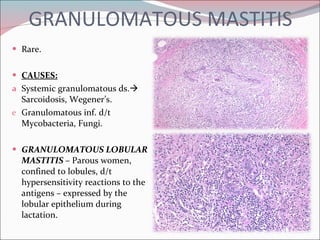
GRANULOMATOUS MASTITIS Rare. CAUSES: Systemic granulomatous ds.   Sarcoidosis, Wegener’s. Granulomatous inf. d/t Mycobacteria, Fungi. GRANULOMATOUS LOBULAR MASTITIS   – Parous women, confined to lobules, d/t hypersensitivity reactions to the antigens – expressed by the lobular epithelium during lactation.
 
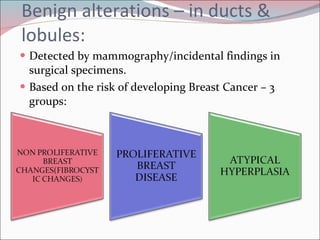
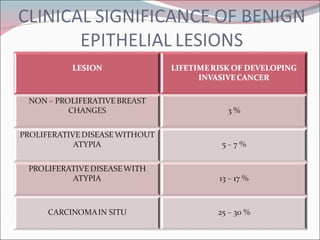
Benign alterations – in ducts & lobules: Detected by mammography/incidental findings in surgical specimens. Based on the risk of developing Breast Cancer – 3 groups:
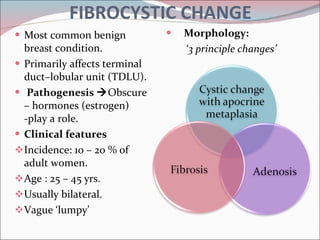
FIBROCYSTIC CHANGE Most common benign breast condition.  Primarily affects terminal duct–lobular unit (TDLU). Pathogenesis   Obscure – hormones (estrogen) -play a role. Clinical features Incidence: 10 – 20 % of adult women. Age : 25 – 45 yrs. Usually bilateral. Vague ‘lumpy’ Morphology:  ‘ 3 principle changes’
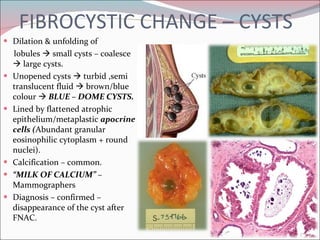
FIBROCYSTIC CHANGE – CYSTS Dilation & unfolding of  lobules    small cysts – coalesce    large cysts. Unopened cysts    turbid ,semi translucent fluid    brown/blue colour    BLUE – DOME CYSTS. Lined by flattened atrophic epithelium/metaplastic  apocrine cells ( Abundant granular eosinophilic cytoplasm + round nuclei). Calcification – common. “ MILK OF CALCIUM”  – Mammographers Diagnosis – confirmed – disappearance of the cyst after FNAC.
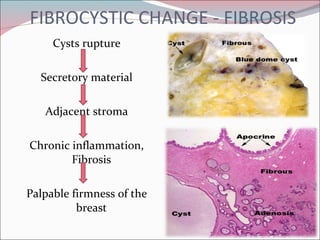
FIBROCYSTIC CHANGE - FIBROSIS Cysts rupture Secretory material Adjacent stroma Chronic inflammation, Fibrosis Palpable firmness of the breast
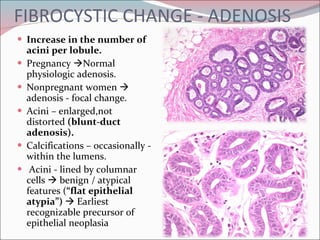
FIBROCYSTIC CHANGE - ADENOSIS Increase in the number of acini per lobule. Pregnancy   Normal physiologic adenosis.  Nonpregnant women    adenosis - focal change.  Acini – enlarged,not distorted  (blunt-duct adenosis). Calcifications – occasionally - within the lumens.  Acini - lined by columnar cells    benign / atypical features ( “flat epithelial atypia”)    Earliest recognizable precursor of epithelial neoplasia
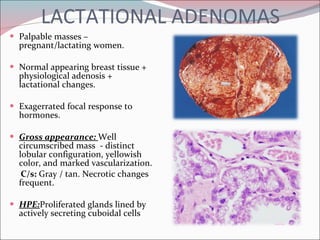
LACTATIONAL ADENOMAS Palpable masses – pregnant/lactating women. Normal appearing breast tissue + physiological adenosis + lactational changes. Exagerrated focal response to hormones. Gross appearance:  Well circumscribed mass  - distinct lobular configuration, yellowish color, and marked vascularization. C/s:  Gray / tan. Necrotic changes frequent. HPE: Proliferated glands lined by actively secreting cuboidal cells
 
PROLIFERATIVE BREAST DISEASE WITHOUT ATYPIA Mammographic densities, calcifications, or as incidental findings in specimens from biopsies. Found alone/assoc. with non prolif. breast changes. Lesions     proliferation of ductal epithelium and/or stroma  without cytologic or architectural features suggestive of carcinoma in situ.
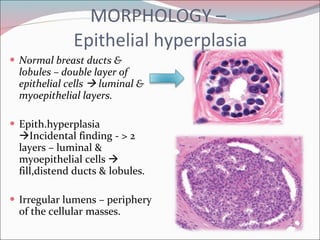
MORPHOLOGY –  Epithelial hyperplasia Normal breast ducts & lobules – double layer of epithelial cells    luminal & myoepithelial layers. Epith.hyperplasia   Incidental finding - > 2 layers – luminal & myoepithelial cells    fill,distend ducts & lobules. Irregular lumens – periphery of the cellular masses.
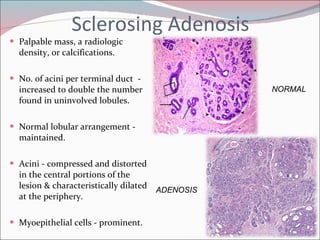
Sclerosing Adenosis Palpable mass, a radiologic density, or calcifications. No. of acini per terminal duct  -  increased to double the number found in uninvolved lobules.  Normal lobular arrangement - maintained. Acini - compressed and distorted in the central portions of the lesion & characteristically dilated at the periphery.  Myoepithelial cells - prominent.  NORMAL ADENOSIS
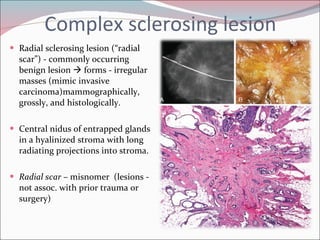
Complex sclerosing lesion Radial sclerosing lesion (“radial scar”) - commonly occurring benign lesion    forms - irregular masses (mimic invasive carcinoma)mammographically, grossly, and histologically. Central nidus of entrapped glands in a hyalinized stroma with long radiating projections into stroma. Radial scar  – misnomer  (lesions - not assoc. with prior trauma or surgery)
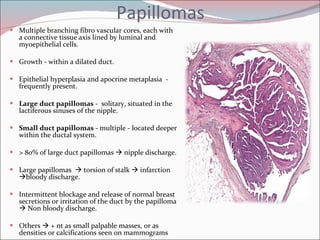
Papillomas Multiple branching fibro vascular cores, each with  a connective tissue axis lined by luminal and myoepithelial cells. Growth - within a dilated duct. Epithelial hyperplasia and apocrine metaplasia  - frequently present.  Large duct papillomas  -  solitary, situated in the lactiferous sinuses of the nipple. Small duct papillomas -  multiple - located deeper within the ductal system. > 80% of large duct papillomas    nipple discharge.  Large papillomas    torsion of stalk    infarction   bloody discharge.  Intermittent blockage and release of normal breast secretions or irritation of the duct by the papilloma    Non bloody discharge. Others    + nt as small palpable masses, or as densities or calcifications seen on mammograms
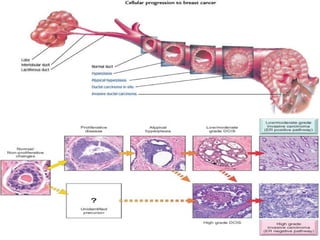
Atypical ductal/lobular hyperplasia     Cellular proliferation - resembles carcinoma in situ - but lacks sufficient qualitative or quantitative features for diagnosis as carcinoma.
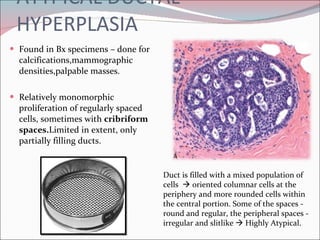
ATYPICAL DUCTAL HYPERPLASIA Found in Bx specimens – done for calcifications,mammographic densities,palpable masses. Relatively monomorphic proliferation of regularly spaced cells, sometimes with  cribriform spaces. Limited in extent, only partially filling ducts.  Duct is filled with a mixed population of cells    oriented columnar cells at the periphery and more rounded cells within the central portion. Some of the spaces - round and regular, the peripheral spaces - irregular and slitlike    Highly Atypical.
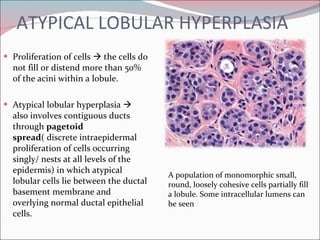
ATYPICAL LOBULAR HYPERPLASIA Proliferation of cells    the cells do not fill or distend more than 50% of the acini within a lobule. Atypical lobular hyperplasia    also involves contiguous ducts through  pagetoid spread ( discrete intraepidermal proliferation of cells occurring singly/ nests at all levels of the epidermis) in which atypical lobular cells lie between the ductal basement membrane and overlying normal ductal epithelial cells. A population of monomorphic small, round, loosely cohesive cells partially fill a lobule. Some intracellular lumens can be seen


Breast benign disorders pathology

  • 1.
    Dr.P.Karpagam Kiruba Rajeswari,M.B.B.S,D.C.P., Tutor in Pathology, MAPIMS.
  • 2.
    ANATOMY OF BREASTModified apocrine sweat glands . Breast parenchyma  12 to 20 lobes . Within each lobe – Lactiferous duct - branches repeatedly  leads to no. of terminal ducts  each leads to a lobule  contains multiple acini/alveoli  TDLU (TERMINAL DUCT + LOBULE) Spaces around the lobules and ducts and between the lobes are filled with fatty tissue, ligaments and connective tissue  STROMA
  • 3.
  • 4.
    NORMAL HISTOLOGY OFTHE BREAST 2 cell types – line ducts & lobules. Contractile MYOEPITHELIAL CELLS  lie on the BM  assist in milk ejection during lactation & provides structural support to the lobules EPITHELIAL CELLS  Luminal – produce milk. Epithelial & Myoepithelial cells lie on the basement membrane.
  • 5.
  • 6.
    NORMAL HISTOLOGY OFTHE BREAST 2 types of breast STROMA: INTERLOBULAR STROMA  Dense fibrous connective tissue + adipose tissue. INTRALOBULAR STROMA  Envelopes the acini + hormonally responsive fibroblast – like cells + scattered lymphocytes.
  • 7.
  • 8.
  • 9.
  • 10.
    ACUTE MASTITIS Firstmonth of breast feeding. Cracks / fissures in the nipple  portal of entry of bacteria. Breast  erythematous,painful,fever +nt. MORPHOLOGY : Staph. Inf.  localized area of inflammation. Strep. Inf.  Diffuse, spreading. HPE : Involved breast tissue – necrotic, neutrophil infiltration. Treated with antibiotics, continuous milk expression. Rarely surgical drainage.
  • 11.
  • 12.
    PERIDUCTAL MASTITIS Recurrentsubareolar abscess/ Squamous metaplasia of lactiferous ducts/ Zuska ds. Painful erythematous subareolar mass. 90% cases – assoc. with smoking  Vit.A def./toxic substances in smoke – alters epithelial differentiation. Recurrent cases – fistula occurs. HPE : Keratinizing squamous metaplasia of ducts. Keratin shed from the cells  plugs the ductal system  dilation & rupture of duct. Periductal tissue  keratin spill  chronic granulomatous inflammatory response. Treatment: En bloc surgical removal of the involved duct, fistula. Antibiotics for secondary bacterial infection.
  • 13.
    DUCT ECTASIA 5th – 6 th decade, multiparous women. Cl.features: Poorly palpable periareolar mass, thick white secretions from nipple, skin retraction. HPE: Dilated ducts filled by granular debris  numerous lipid-laden macrophages, inspissation of breast secretions, marked periductal and interductal ( dense )infiltrate of lymphocytes and macrophages, and variable numbers of plasma cells. Eventual fibrosis  skin & nipple retraction. Principal significance  produces an irregular palpable mass - mimics the mammographic appearance of carcinoma.
  • 14.
    DUCT ECTASIA Dilatedduct with surrounding fibrosis and chronic inflammation. Lumen of the duct  eosinophilic secretion & markedly attenuated epithelium.
  • 15.
    FAT NECROSIS Cl.features: H/o breast trauma / prior surgery. Painless palpable mass, skin thickening or retraction, a mammographic density, or calcifications. Acute lesions  hemorrhagic + central areas of liquefactive fat necrosis. Subacute lesions - areas of fat necrosis  ill-defined, firm, gray-white nodules containing small chalky-white foci or dark hemorrhagic debris. Central region of necrotic fat cells  intense neutrophilic infiltrate + macrophages. Proliferating fibroblasts + new vessels + chronic inflammatory cells surround the injured area  Giant cells, calcifications, and hemosiderin appear  focus - replaced by scar tissue.
  • 16.
  • 17.
    GRANULOMATOUS MASTITIS Rare.CAUSES: Systemic granulomatous ds.  Sarcoidosis, Wegener’s. Granulomatous inf. d/t Mycobacteria, Fungi. GRANULOMATOUS LOBULAR MASTITIS – Parous women, confined to lobules, d/t hypersensitivity reactions to the antigens – expressed by the lobular epithelium during lactation.
  • 18.
  • 19.
    Benign alterations –in ducts & lobules: Detected by mammography/incidental findings in surgical specimens. Based on the risk of developing Breast Cancer – 3 groups:
  • 20.
    FIBROCYSTIC CHANGE Mostcommon benign breast condition. Primarily affects terminal duct–lobular unit (TDLU). Pathogenesis  Obscure – hormones (estrogen) -play a role. Clinical features Incidence: 10 – 20 % of adult women. Age : 25 – 45 yrs. Usually bilateral. Vague ‘lumpy’ Morphology: ‘ 3 principle changes’
  • 21.
    FIBROCYSTIC CHANGE –CYSTS Dilation & unfolding of lobules  small cysts – coalesce  large cysts. Unopened cysts  turbid ,semi translucent fluid  brown/blue colour  BLUE – DOME CYSTS. Lined by flattened atrophic epithelium/metaplastic apocrine cells ( Abundant granular eosinophilic cytoplasm + round nuclei). Calcification – common. “ MILK OF CALCIUM” – Mammographers Diagnosis – confirmed – disappearance of the cyst after FNAC.
  • 22.
    FIBROCYSTIC CHANGE -FIBROSIS Cysts rupture Secretory material Adjacent stroma Chronic inflammation, Fibrosis Palpable firmness of the breast
  • 23.
    FIBROCYSTIC CHANGE -ADENOSIS Increase in the number of acini per lobule. Pregnancy  Normal physiologic adenosis. Nonpregnant women  adenosis - focal change. Acini – enlarged,not distorted (blunt-duct adenosis). Calcifications – occasionally - within the lumens. Acini - lined by columnar cells  benign / atypical features ( “flat epithelial atypia”)  Earliest recognizable precursor of epithelial neoplasia
  • 24.
    LACTATIONAL ADENOMAS Palpablemasses – pregnant/lactating women. Normal appearing breast tissue + physiological adenosis + lactational changes. Exagerrated focal response to hormones. Gross appearance: Well circumscribed mass - distinct lobular configuration, yellowish color, and marked vascularization. C/s: Gray / tan. Necrotic changes frequent. HPE: Proliferated glands lined by actively secreting cuboidal cells
  • 25.
  • 26.
    PROLIFERATIVE BREAST DISEASEWITHOUT ATYPIA Mammographic densities, calcifications, or as incidental findings in specimens from biopsies. Found alone/assoc. with non prolif. breast changes. Lesions  proliferation of ductal epithelium and/or stroma without cytologic or architectural features suggestive of carcinoma in situ.
  • 27.
    MORPHOLOGY – Epithelial hyperplasia Normal breast ducts & lobules – double layer of epithelial cells  luminal & myoepithelial layers. Epith.hyperplasia  Incidental finding - > 2 layers – luminal & myoepithelial cells  fill,distend ducts & lobules. Irregular lumens – periphery of the cellular masses.
  • 28.
    Sclerosing Adenosis Palpablemass, a radiologic density, or calcifications. No. of acini per terminal duct - increased to double the number found in uninvolved lobules. Normal lobular arrangement - maintained. Acini - compressed and distorted in the central portions of the lesion & characteristically dilated at the periphery. Myoepithelial cells - prominent. NORMAL ADENOSIS
  • 29.
    Complex sclerosing lesionRadial sclerosing lesion (“radial scar”) - commonly occurring benign lesion  forms - irregular masses (mimic invasive carcinoma)mammographically, grossly, and histologically. Central nidus of entrapped glands in a hyalinized stroma with long radiating projections into stroma. Radial scar – misnomer (lesions - not assoc. with prior trauma or surgery)
  • 30.
    Papillomas Multiple branchingfibro vascular cores, each with a connective tissue axis lined by luminal and myoepithelial cells. Growth - within a dilated duct. Epithelial hyperplasia and apocrine metaplasia - frequently present. Large duct papillomas - solitary, situated in the lactiferous sinuses of the nipple. Small duct papillomas - multiple - located deeper within the ductal system. > 80% of large duct papillomas  nipple discharge. Large papillomas  torsion of stalk  infarction  bloody discharge. Intermittent blockage and release of normal breast secretions or irritation of the duct by the papilloma  Non bloody discharge. Others  + nt as small palpable masses, or as densities or calcifications seen on mammograms
  • 31.
    Atypical ductal/lobular hyperplasia  Cellular proliferation - resembles carcinoma in situ - but lacks sufficient qualitative or quantitative features for diagnosis as carcinoma.
  • 32.
    ATYPICAL DUCTAL HYPERPLASIAFound in Bx specimens – done for calcifications,mammographic densities,palpable masses. Relatively monomorphic proliferation of regularly spaced cells, sometimes with cribriform spaces. Limited in extent, only partially filling ducts. Duct is filled with a mixed population of cells  oriented columnar cells at the periphery and more rounded cells within the central portion. Some of the spaces - round and regular, the peripheral spaces - irregular and slitlike  Highly Atypical.
  • 33.
    ATYPICAL LOBULAR HYPERPLASIAProliferation of cells  the cells do not fill or distend more than 50% of the acini within a lobule. Atypical lobular hyperplasia  also involves contiguous ducts through pagetoid spread ( discrete intraepidermal proliferation of cells occurring singly/ nests at all levels of the epidermis) in which atypical lobular cells lie between the ductal basement membrane and overlying normal ductal epithelial cells. A population of monomorphic small, round, loosely cohesive cells partially fill a lobule. Some intracellular lumens can be seen
  • 34.
  • 35.
  • 36.