
BRANCHES OF
ANATOMY
• Anatomy is a big subject.
• The Human Body is studied in different
ways and aspects.
• We can study this Human Body region
wise or system wise.
• We can see the development of the
Human Being. How the body develops.
How it looks like at different stages.
• We can see the microscopic structure of
human tissues and organs.
• We can see different radiographs,
ultrasounds, MRI etc. to study the human
body.
• So Anatomy is a broad science, and the
study of the human body becomes more
meaningful when specific aspects of this
science are considered.
GROSS ANATOMY
• It is the study of structures that can be
examined without the use of a
microscope.
So it is also called Macroscopic Anatomy.
• It is based upon observations through
dissection on cadaver.
So we can call it Cadaveric Anatomy also.
• Gross anatomy has following two main
subdivisions.
• Systemic anatomy
• Regional Anatomy
SYSTEMIC ANATOMY
• It is the study of specific systems of the
body.
• There are three main groups of systems
present in the body.
• Somatic or voluntary systems
• They are
• osteology (bones),
• arthrology (joints),
• myology (muscles) and
• dermatology
(skin and its appendages)
• Visceral or involuntary systems
• These include
• alimentary tract,
• respiratory tract,
• urinary tract and reproductive tract
• The study of these systems is called
splanchnology (study of viscera)
• Operative or regulatory systems
• These systems regulate the activities of
somatic and visceral systems.
• These are
• nervous system,
• endocrine system and
• cardiovascular system
Somatic or voluntary systems
• The skeletal system (osteology)
It is composed of bones and cartilage. It
is responsible for providing support to
the body and protection of vital organs
such as the heart, lungs, brain etc. The
muscular system acts on it to produce
movement.
• The articular system (arthrology)
Its components are joints and their
ligaments. Joints are responsible for
connecting the body parts. They provide
locations where movements occur.
• The muscular system (Myology)
it consists of muscles
that contract and
cause movements of bones at joints
• Locomotor system
• The bones, joints and muscles taken
together are termed as the ‘locomotor
system’ as they are responsible for
producing movement or ability to move
(locomotion)
• Integumentary system (Dermatology)
• It consists of the skin and its associated
structures e.g. hair, nails, sweat glands
etc. the skin is not merely a protective
covering for our body. It is a sensory
organ and helps maintain our body
temperature. These are a few of the
many functions of the skin.
Visceral or involuntary systems
• The digestive or alimentary system
The organs which make up this system
perform following functions related to food
Ingestion (intake)
Mastication (chewing)
Deglutition (swallowing)
Digestion
Absorption
Elimination of faces (solid waste) remaining
after the absorption of the nutrients.
• The respiratory system (pulmonology)
• It is concerned with
• oxygen intake and carbon dioxide
elimination.
• It consists of
• the air passages
• and lungs
• The urinary system (urology)
• Its components are
• Kidneys (filtration of blood,
production of urine)
• Ureters (transport of urine)
• Urinary bladder (storage of urine)
• Urethra (elimination of urine
intermittently)
• The reproductive or genital system
• The main function of this system is
reproduction.
• This is obviously different in two sexes
• Female reproductive system (gynecology)
• It consists of
ovaries; uterus and external genitalia
• Male reproductive system (andrology)
• It consists of
testes and external genitalia
Operative or regulatory systems
• The nervous system (neurology)
It controls and coordinates the functions
of all the systems of the body. It has a
“central” part consisting of brain and
spinal cord and a ‘peripheral’ portion
made up of cranial and spinal nerves.
Both systems function in harmony.
• The circulatory system (angiology)
It has 2 parts (a) the cardiovascular system,
made up of heart and blood vessels which
send the blood all over the body (b) lymphatic
system, which is a network of lymphatic
vessels which withdraw excess tissue fluid
(lymph) from the body inter cellular
compartment. Later, it filters it by lymph nodes.
Ultimately, all the fluid returns to the blood
stream.
• The endocrine system (endocrinology)
It is a diffuse system consisting of ductless
(endocrine) glands located in different parts of
human body. These secrete chemicals known
as hormones, which are carried by the
circulatory system to all parts of body.
Hormones affect many processes of the body
which are vital to life. Pituitary gland is one
example, the secretions of which control
growth, reproduction, water balance etc. other
endocrine glands are thyroid, parathyroid,
pineal and adrenal glands.
REGIONAL ANATOMY.
• Study of the specific regions of the body is
called regional anatomy.
• It is also known as topographical anatomy
(topography = a detailed account of
superficial features of a tract or country,
description of a place)
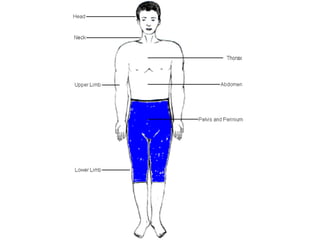
• There are three main regions.
• Upper and Lower limbs
• Thorax, Abdomen and Pelvis
• Head and Neck including Brain
• The body is studied region by region
employing cadaver dissection.
• This is very common practice in almost all
medical colleges. Students dissect upper
limb, lower limb, thorax, abdomen, pelvis,
head and neck.
• In each region,
• all different types of structures (fascia
muscles, arteries, veins, nerves and
bones)
• and organs of different systems are
studied in relation to one another
• Another method is “prosection”
• where carefully prepared dissections, to
display anatomical structures, are used.
• The computer is a very useful tool in
teaching regional anatomy. It can display
the images obtained by Computed
Tomography (CT scans) and Magnetic
Resonance Imaging (MRI). It can also
create three-dimensional effects, which
can be manipulated.
RADIOLOGICAL ANATOMY
• This is the study of the structure of human
body that includes the use of several
imaging techniques, such as radiography,
ultrasonography, echocardiography
radioisotope studies, computed
tomographic scanning (CT Scanning) and
Magnetic resonance imaging (MRI)
Radiography
• These are peculiar orientation of the body
or part of the body in front of the
radiographic machines from which
radiographic films are taken only for
clinical interest. The study of radiographs
is radiology.
Ultrasonography
• It is the transmission of ultrasonic waves in the
body planes and gathered by a machine and a
computer image is constructed from that.
Based upon the echogenic intensity of these
waves the computer can differentiate between
bone, soft tissue and fluid.
[Gr. echo a returned sound] repetition of a
sound or reflection of ultrasonic, radio and
radar waves.
• Echocardiography
These are ultrasound waves particularly
directed toward heart and associated
structures.
Scanning
• The act of examining visually, different isolated
areas, in detail.
• The act of examining visually by regularly
recurring pauses.
• Scan is shortened form of scintiscan.
• Scintiscan is a two-dimensional map or
representation of a gamma rays emitted by a
radio-isotope, revealing its varying concentration
in a specific tissue or organ of the body.
• It may be brain scan or kidney scan or thyroid
scan etc.
Radio-isotope studies
• It is the production of a two-dimensional picture (
scintiscan or scan) representing the gamma rays
emitted by a radioactive isotope concentrated in
a specific tissue such as brain or thyroid gland.
• Radio-labeled dye or other chemicals are
injected into the body where they concentrate
according to their distribution to specific tissues.
Later on they are imaged. Example is radio-
labeled iodine will differentially accumulate in
thyroid gland.
Tomography
• Tomo- [Gr. tomē a cutting] a combining form
denoting relationship to a cutting or to a
designated layer, as might be achieved by
cutting or slicing.
• Graphy [Gr. graphein to write, to record] the act
of writing or recording, or a method of recording.
• Tomograph is an x-ray apparatus which makes a
roentgenogram of a layer of tissue at any depth.
• Tomography is the roentgenogram of a layer of
tissue at any depth.
• Computerized and tomographic scanning
(CT Scanning)
• CT scan is relatively low intensity X-rays,
which is made to pass through a particular
part of the body from all directions. Latter
on the data is assimilated by a computer
and the body planes of that particular part
are presented in cut sections of 2mm
thickness.
Magnetic resonance imaging (MRI)
• MRI is based upon the fact that if strong
magnetic fields are generated around body it
brings temporary changes in magnetic field of
the body. When magnetic fields are turned off
the body fields return to its original, generating
changes easily picked up by computer and
represented in cut sections.
• It is safer than CT SCAN as there is less danger
of radiation exposure but it is too costly.
SURFACE ANATOMY
• It is the identification and study of the form
(morphology) and markings of various
structures in the living person on the surface of
the body.
• It enables to “visualize” deeper structures by
observing the surface and employing different
landmarks (soft tissue & skeletal), which can be
easily identified. The knowledge of their
relationship to the different landmarks helps in
“mapping out” their location.
• It helps to enhance the knowledge acquired
through dissection of the cadaver. It is helpful
both in health and disease and is daily used in
medical practice.
• Surface anatomy helps the clinician in ascribing
the cause of different signs and symptoms to a
certain structure in performing diagnostic
procedures, in ascertaining damage done as a
result of injury and in planning incisions for
exploring a certain area of the body.
DEVELOPMENTAL ANATOMY
• It is the Study of development of human body
from the fertilized egg to adult form. The study
of development of human being inside the
uterus is normally called Embryology, but in
fact it is the study of development from the
fertilized egg to the eighth week in utero. Rest
of the development in the uterus is the fetal
development and can be given the name
fetology. In fact a sequence of studies in the
changes that take place from a fertilized egg to
the old age and death of human being is
developmental anatomy.
MICROSCOPIC ANATOMY
OR HISTOLOGY
• It is the study of the structure of organs tissues
and cells under the microscope. There are two
main branches of microscopic anatomy
depending upon the use of:
• Light microscope
• Electron microscope
• The study of the structure of cell with the help
of microscope is given a special name
Cytology.
CLINICAL ANATOMY
• Clinical anatomy is concerned with the
correlation of structure to function. This
emphasizes the relation of structure and
function to medical practice. This correlation is
important in understanding various alterations
that occur in injury or disease. It is based on
the knowledge gained by studying regional and
systemic anatomy. Clinical problem solving in
an interesting approach by applying anatomical
knowledge to real life case histories.
APPLIED ANATOMY
• It is the direct application of facts of
human anatomy to medicine and surgery.
• So applied and clinical anatomy are same.
COMPARATIVE ANATOMY
• Comparative anatomy is the study of
anatomy of various animal groups and
helps to understand and correlate the
morphological differences between
different animal groups and the human
beings.
• Ha-Mim. The revelation of this book is from ALLAH,
The All-Mighty, The All-Wise. The fact is that there are
countless Signs in the heavens and in earth for those
who believe. And in your own creation and in the
animals, whom ALLAH is scattering (all over the
earth), there are signs for those who affirm Faith. And
in the difference of night and day, and in the
provisions that ALLAH sends down from the heaven,
whereby HE revives the earth after its death, and in
the circulation of winds, there are many signs for those
who use there common sense. These are the
revelations of ALLAH, which WE are rehearsing to you
accurately. Then what is there after ALLAH and HIS
revelations in which they will believe.
• Al-JASIYAH 45, 1-6. Part 25.
• By the fig and the olive and the Mount Sinai
and this city of peace (Makkah), WE have
indeed created insan in the finest of moulds,
then WE reversed him to the lowest of the low,
except those who believed and did good works.
For them there is a reward unending.
Therefore, (O Prophet) who can belie you after
this concerning the rewards and punishments.
Is not ALLAH the best of all judges?
• At-Teen, 95. Part 30.
• It does not reflect the evolutionary trends
among various animal forms. Rather it
makes clear that every thing is created by
ALLAH The Creator.
• Comparative anatomy is also to study the
body structure of female and male, then
compare their forms with each other.

Branches of anatomy

  • 1.
  • 2.
    • Anatomy isa big subject. • The Human Body is studied in different ways and aspects. • We can study this Human Body region wise or system wise.
  • 3.
    • We cansee the development of the Human Being. How the body develops. How it looks like at different stages. • We can see the microscopic structure of human tissues and organs.
  • 4.
    • We cansee different radiographs, ultrasounds, MRI etc. to study the human body. • So Anatomy is a broad science, and the study of the human body becomes more meaningful when specific aspects of this science are considered.
  • 5.
    GROSS ANATOMY • Itis the study of structures that can be examined without the use of a microscope. So it is also called Macroscopic Anatomy. • It is based upon observations through dissection on cadaver. So we can call it Cadaveric Anatomy also.
  • 6.
    • Gross anatomyhas following two main subdivisions. • Systemic anatomy • Regional Anatomy
  • 7.
    SYSTEMIC ANATOMY • Itis the study of specific systems of the body. • There are three main groups of systems present in the body.
  • 8.
    • Somatic orvoluntary systems • They are • osteology (bones), • arthrology (joints), • myology (muscles) and • dermatology (skin and its appendages)
  • 9.
    • Visceral orinvoluntary systems • These include • alimentary tract, • respiratory tract, • urinary tract and reproductive tract • The study of these systems is called splanchnology (study of viscera)
  • 10.
    • Operative orregulatory systems • These systems regulate the activities of somatic and visceral systems. • These are • nervous system, • endocrine system and • cardiovascular system
  • 11.
    Somatic or voluntarysystems • The skeletal system (osteology) It is composed of bones and cartilage. It is responsible for providing support to the body and protection of vital organs such as the heart, lungs, brain etc. The muscular system acts on it to produce movement.
  • 12.
    • The articularsystem (arthrology) Its components are joints and their ligaments. Joints are responsible for connecting the body parts. They provide locations where movements occur.
  • 13.
    • The muscularsystem (Myology) it consists of muscles that contract and cause movements of bones at joints
  • 14.
    • Locomotor system •The bones, joints and muscles taken together are termed as the ‘locomotor system’ as they are responsible for producing movement or ability to move (locomotion)
  • 15.
    • Integumentary system(Dermatology) • It consists of the skin and its associated structures e.g. hair, nails, sweat glands etc. the skin is not merely a protective covering for our body. It is a sensory organ and helps maintain our body temperature. These are a few of the many functions of the skin.
  • 16.
    Visceral or involuntarysystems • The digestive or alimentary system The organs which make up this system perform following functions related to food Ingestion (intake) Mastication (chewing) Deglutition (swallowing) Digestion Absorption Elimination of faces (solid waste) remaining after the absorption of the nutrients.
  • 17.
    • The respiratorysystem (pulmonology) • It is concerned with • oxygen intake and carbon dioxide elimination. • It consists of • the air passages • and lungs
  • 18.
    • The urinarysystem (urology) • Its components are • Kidneys (filtration of blood, production of urine) • Ureters (transport of urine) • Urinary bladder (storage of urine) • Urethra (elimination of urine intermittently)
  • 19.
    • The reproductiveor genital system • The main function of this system is reproduction. • This is obviously different in two sexes
  • 20.
    • Female reproductivesystem (gynecology) • It consists of ovaries; uterus and external genitalia • Male reproductive system (andrology) • It consists of testes and external genitalia
  • 21.
    Operative or regulatorysystems • The nervous system (neurology) It controls and coordinates the functions of all the systems of the body. It has a “central” part consisting of brain and spinal cord and a ‘peripheral’ portion made up of cranial and spinal nerves. Both systems function in harmony.
  • 22.
    • The circulatorysystem (angiology) It has 2 parts (a) the cardiovascular system, made up of heart and blood vessels which send the blood all over the body (b) lymphatic system, which is a network of lymphatic vessels which withdraw excess tissue fluid (lymph) from the body inter cellular compartment. Later, it filters it by lymph nodes. Ultimately, all the fluid returns to the blood stream.
  • 23.
    • The endocrinesystem (endocrinology) It is a diffuse system consisting of ductless (endocrine) glands located in different parts of human body. These secrete chemicals known as hormones, which are carried by the circulatory system to all parts of body. Hormones affect many processes of the body which are vital to life. Pituitary gland is one example, the secretions of which control growth, reproduction, water balance etc. other endocrine glands are thyroid, parathyroid, pineal and adrenal glands.
  • 24.
    REGIONAL ANATOMY. • Studyof the specific regions of the body is called regional anatomy. • It is also known as topographical anatomy (topography = a detailed account of superficial features of a tract or country, description of a place)
  • 25.
    • There arethree main regions. • Upper and Lower limbs • Thorax, Abdomen and Pelvis • Head and Neck including Brain
  • 27.
    • The bodyis studied region by region employing cadaver dissection. • This is very common practice in almost all medical colleges. Students dissect upper limb, lower limb, thorax, abdomen, pelvis, head and neck.
  • 28.
    • In eachregion, • all different types of structures (fascia muscles, arteries, veins, nerves and bones) • and organs of different systems are studied in relation to one another
  • 29.
    • Another methodis “prosection” • where carefully prepared dissections, to display anatomical structures, are used.
  • 30.
    • The computeris a very useful tool in teaching regional anatomy. It can display the images obtained by Computed Tomography (CT scans) and Magnetic Resonance Imaging (MRI). It can also create three-dimensional effects, which can be manipulated.
  • 31.
    RADIOLOGICAL ANATOMY • Thisis the study of the structure of human body that includes the use of several imaging techniques, such as radiography, ultrasonography, echocardiography radioisotope studies, computed tomographic scanning (CT Scanning) and Magnetic resonance imaging (MRI)
  • 32.
    Radiography • These arepeculiar orientation of the body or part of the body in front of the radiographic machines from which radiographic films are taken only for clinical interest. The study of radiographs is radiology.
  • 33.
    Ultrasonography • It isthe transmission of ultrasonic waves in the body planes and gathered by a machine and a computer image is constructed from that. Based upon the echogenic intensity of these waves the computer can differentiate between bone, soft tissue and fluid. [Gr. echo a returned sound] repetition of a sound or reflection of ultrasonic, radio and radar waves.
  • 34.
    • Echocardiography These areultrasound waves particularly directed toward heart and associated structures.
  • 35.
    Scanning • The actof examining visually, different isolated areas, in detail. • The act of examining visually by regularly recurring pauses. • Scan is shortened form of scintiscan. • Scintiscan is a two-dimensional map or representation of a gamma rays emitted by a radio-isotope, revealing its varying concentration in a specific tissue or organ of the body. • It may be brain scan or kidney scan or thyroid scan etc.
  • 36.
    Radio-isotope studies • Itis the production of a two-dimensional picture ( scintiscan or scan) representing the gamma rays emitted by a radioactive isotope concentrated in a specific tissue such as brain or thyroid gland. • Radio-labeled dye or other chemicals are injected into the body where they concentrate according to their distribution to specific tissues. Later on they are imaged. Example is radio- labeled iodine will differentially accumulate in thyroid gland.
  • 37.
    Tomography • Tomo- [Gr.tomē a cutting] a combining form denoting relationship to a cutting or to a designated layer, as might be achieved by cutting or slicing. • Graphy [Gr. graphein to write, to record] the act of writing or recording, or a method of recording. • Tomograph is an x-ray apparatus which makes a roentgenogram of a layer of tissue at any depth. • Tomography is the roentgenogram of a layer of tissue at any depth.
  • 38.
    • Computerized andtomographic scanning (CT Scanning) • CT scan is relatively low intensity X-rays, which is made to pass through a particular part of the body from all directions. Latter on the data is assimilated by a computer and the body planes of that particular part are presented in cut sections of 2mm thickness.
  • 39.
    Magnetic resonance imaging(MRI) • MRI is based upon the fact that if strong magnetic fields are generated around body it brings temporary changes in magnetic field of the body. When magnetic fields are turned off the body fields return to its original, generating changes easily picked up by computer and represented in cut sections. • It is safer than CT SCAN as there is less danger of radiation exposure but it is too costly.
  • 40.
    SURFACE ANATOMY • Itis the identification and study of the form (morphology) and markings of various structures in the living person on the surface of the body. • It enables to “visualize” deeper structures by observing the surface and employing different landmarks (soft tissue & skeletal), which can be easily identified. The knowledge of their relationship to the different landmarks helps in “mapping out” their location.
  • 41.
    • It helpsto enhance the knowledge acquired through dissection of the cadaver. It is helpful both in health and disease and is daily used in medical practice. • Surface anatomy helps the clinician in ascribing the cause of different signs and symptoms to a certain structure in performing diagnostic procedures, in ascertaining damage done as a result of injury and in planning incisions for exploring a certain area of the body.
  • 42.
    DEVELOPMENTAL ANATOMY • Itis the Study of development of human body from the fertilized egg to adult form. The study of development of human being inside the uterus is normally called Embryology, but in fact it is the study of development from the fertilized egg to the eighth week in utero. Rest of the development in the uterus is the fetal development and can be given the name fetology. In fact a sequence of studies in the changes that take place from a fertilized egg to the old age and death of human being is developmental anatomy.
  • 43.
    MICROSCOPIC ANATOMY OR HISTOLOGY •It is the study of the structure of organs tissues and cells under the microscope. There are two main branches of microscopic anatomy depending upon the use of: • Light microscope • Electron microscope • The study of the structure of cell with the help of microscope is given a special name Cytology.
  • 44.
    CLINICAL ANATOMY • Clinicalanatomy is concerned with the correlation of structure to function. This emphasizes the relation of structure and function to medical practice. This correlation is important in understanding various alterations that occur in injury or disease. It is based on the knowledge gained by studying regional and systemic anatomy. Clinical problem solving in an interesting approach by applying anatomical knowledge to real life case histories.
  • 45.
    APPLIED ANATOMY • Itis the direct application of facts of human anatomy to medicine and surgery. • So applied and clinical anatomy are same.
  • 46.
    COMPARATIVE ANATOMY • Comparativeanatomy is the study of anatomy of various animal groups and helps to understand and correlate the morphological differences between different animal groups and the human beings.
  • 48.
    • Ha-Mim. Therevelation of this book is from ALLAH, The All-Mighty, The All-Wise. The fact is that there are countless Signs in the heavens and in earth for those who believe. And in your own creation and in the animals, whom ALLAH is scattering (all over the earth), there are signs for those who affirm Faith. And in the difference of night and day, and in the provisions that ALLAH sends down from the heaven, whereby HE revives the earth after its death, and in the circulation of winds, there are many signs for those who use there common sense. These are the revelations of ALLAH, which WE are rehearsing to you accurately. Then what is there after ALLAH and HIS revelations in which they will believe. • Al-JASIYAH 45, 1-6. Part 25.
  • 50.
    • By thefig and the olive and the Mount Sinai and this city of peace (Makkah), WE have indeed created insan in the finest of moulds, then WE reversed him to the lowest of the low, except those who believed and did good works. For them there is a reward unending. Therefore, (O Prophet) who can belie you after this concerning the rewards and punishments. Is not ALLAH the best of all judges? • At-Teen, 95. Part 30.
  • 51.
    • It doesnot reflect the evolutionary trends among various animal forms. Rather it makes clear that every thing is created by ALLAH The Creator. • Comparative anatomy is also to study the body structure of female and male, then compare their forms with each other.