Prof. Dr. Talib Jawad
Anatomy introduction
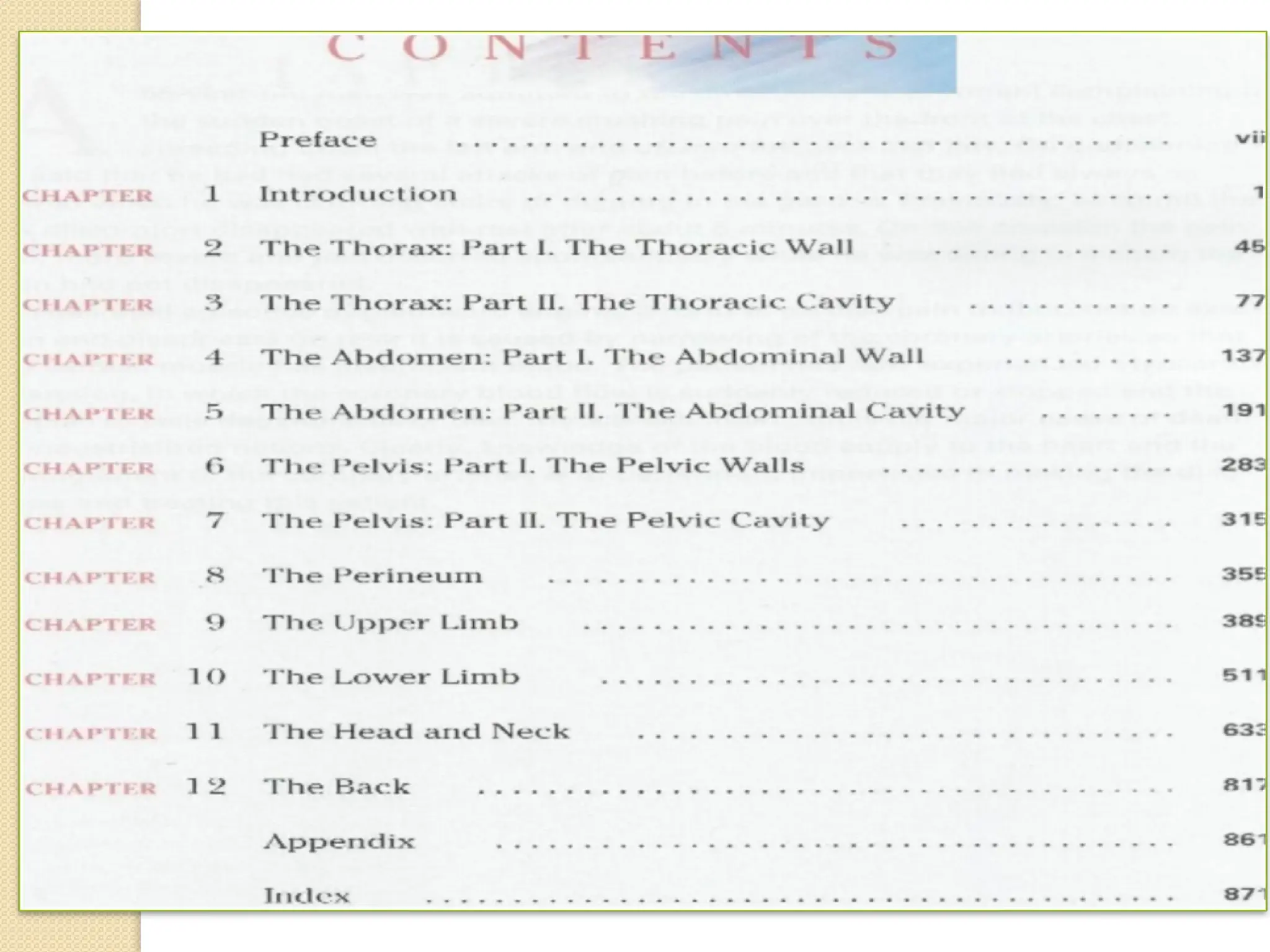
Clinical Anatomy by Regions -
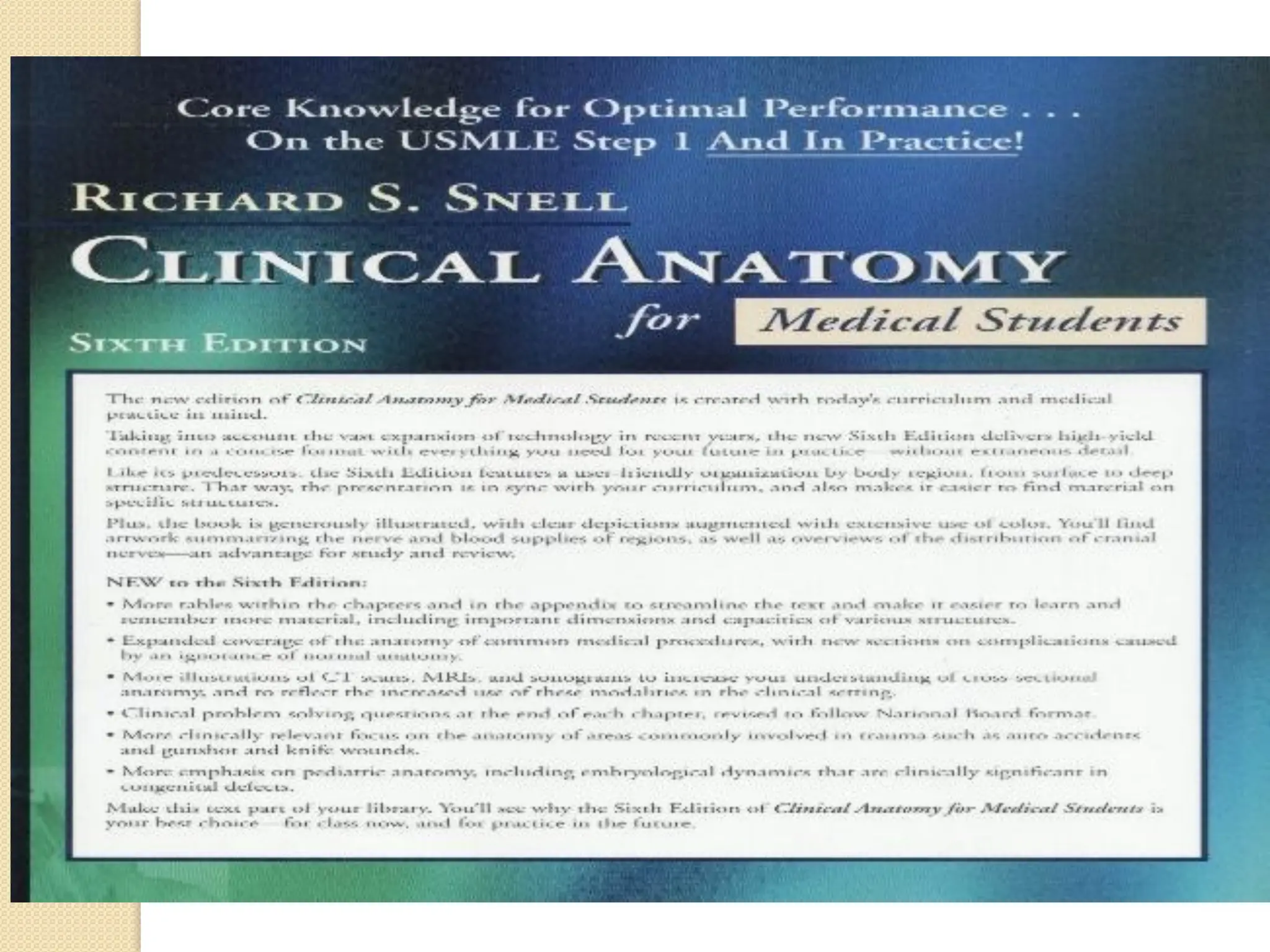
Richard S. Snell
‫ِيم‬‫ح‬َ‫الر‬ ‫حمن‬َ‫الر‬ ‫هللا‬ ‫بسم‬
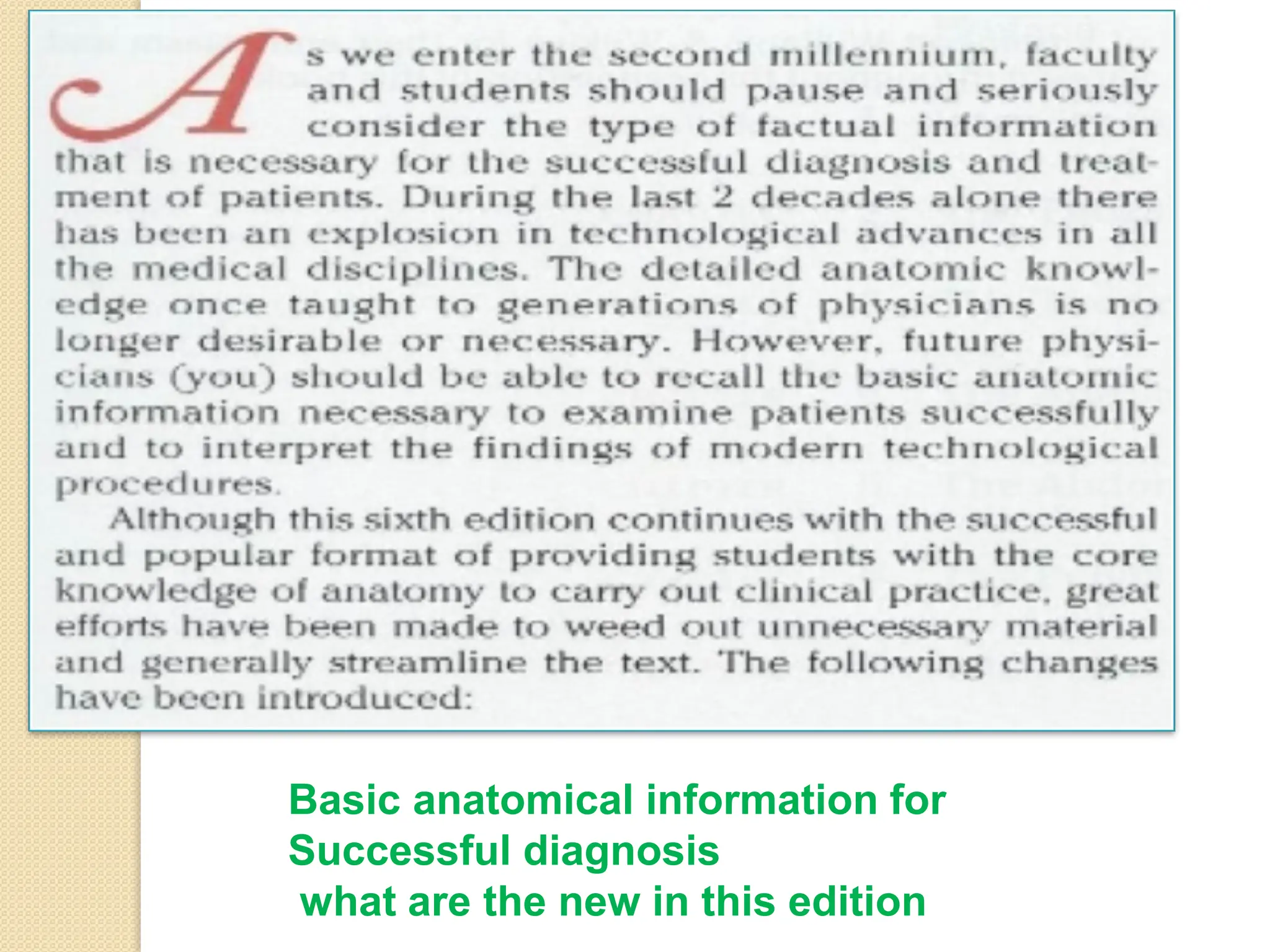
Basic anatomical information for
Successful diagnosis
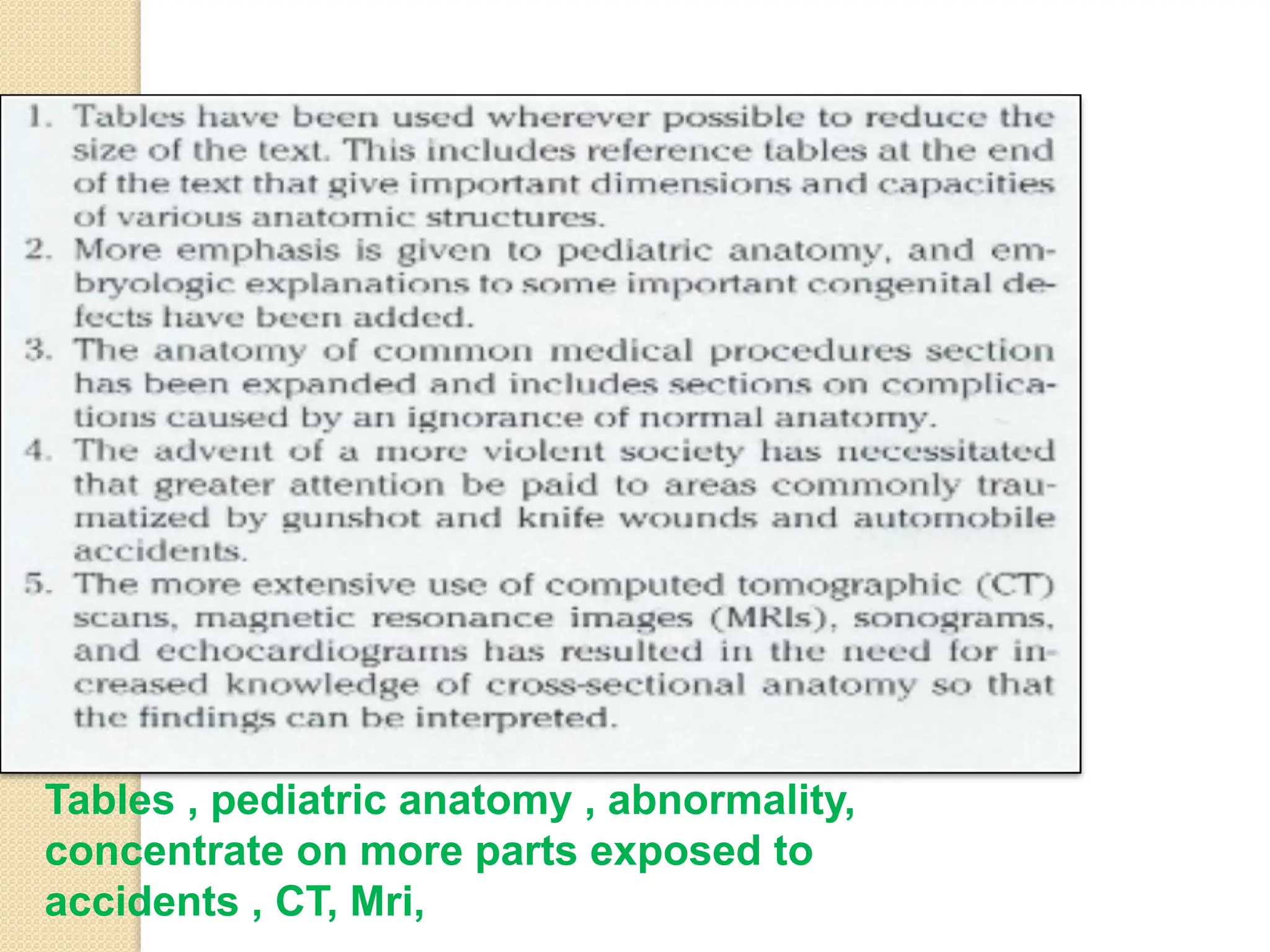
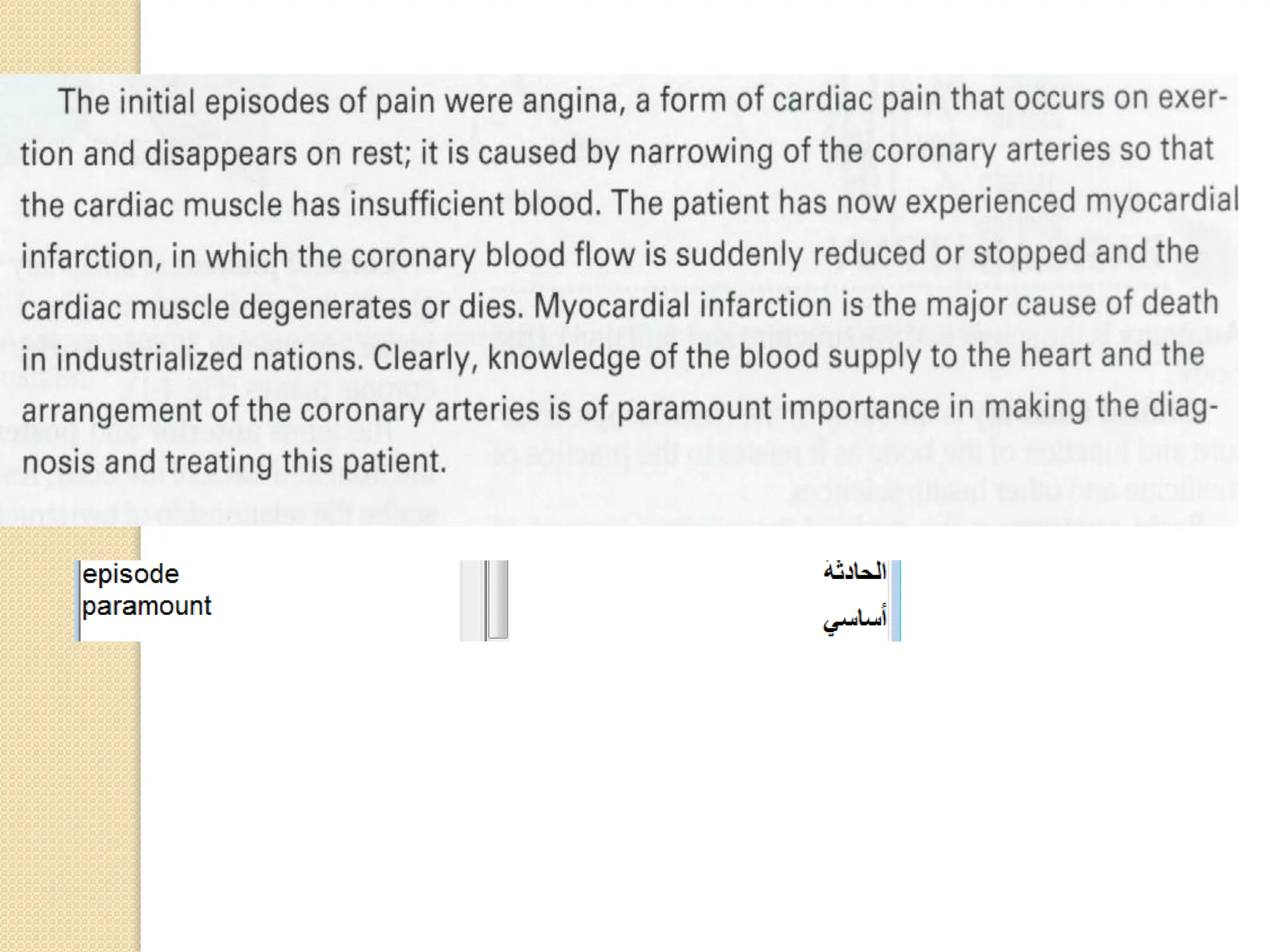
what are the new in this edition
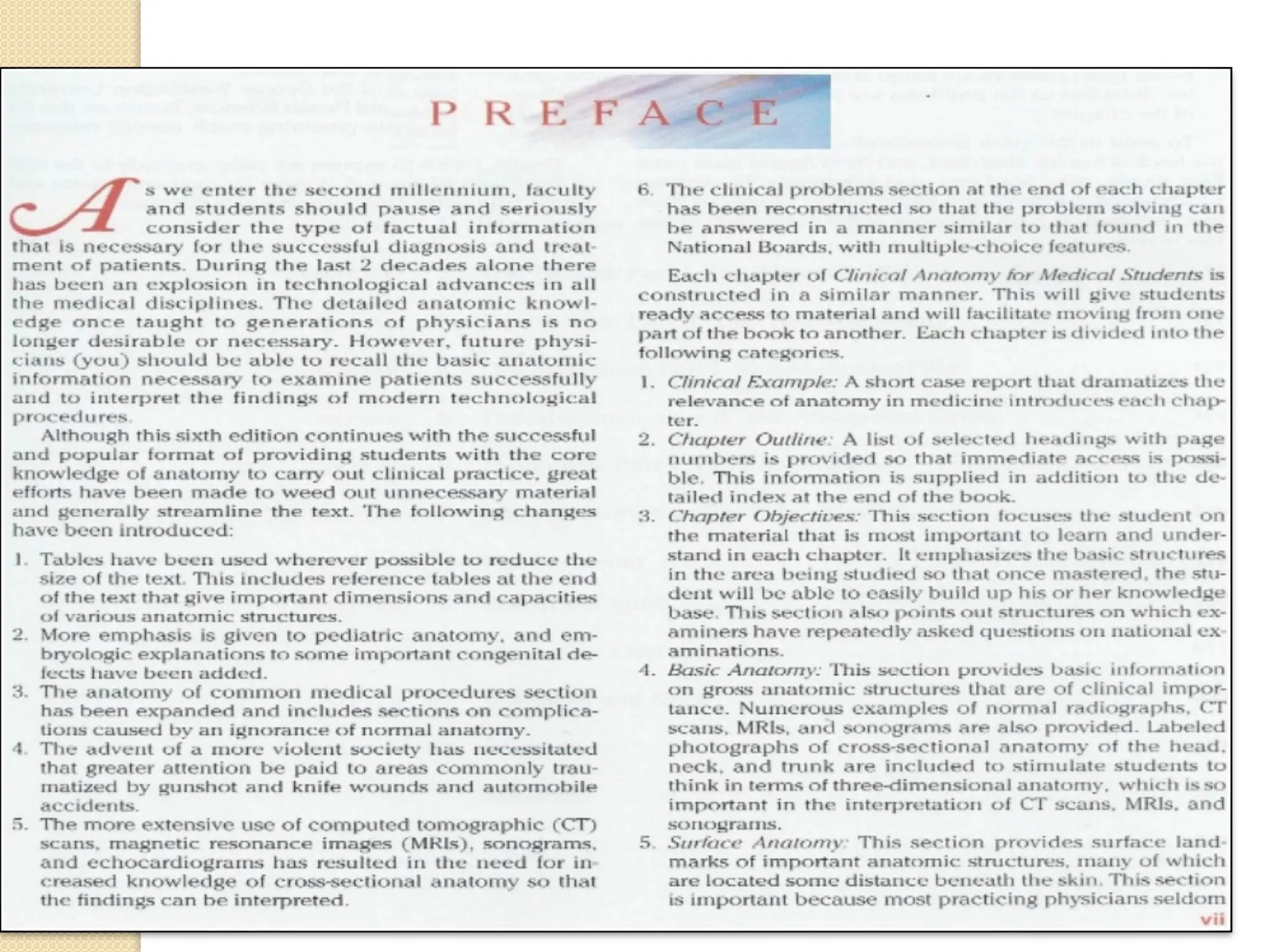
Tables , pediatric anatomy , abnormality,
concentrate on more parts exposed to
accidents , CT, Mri,
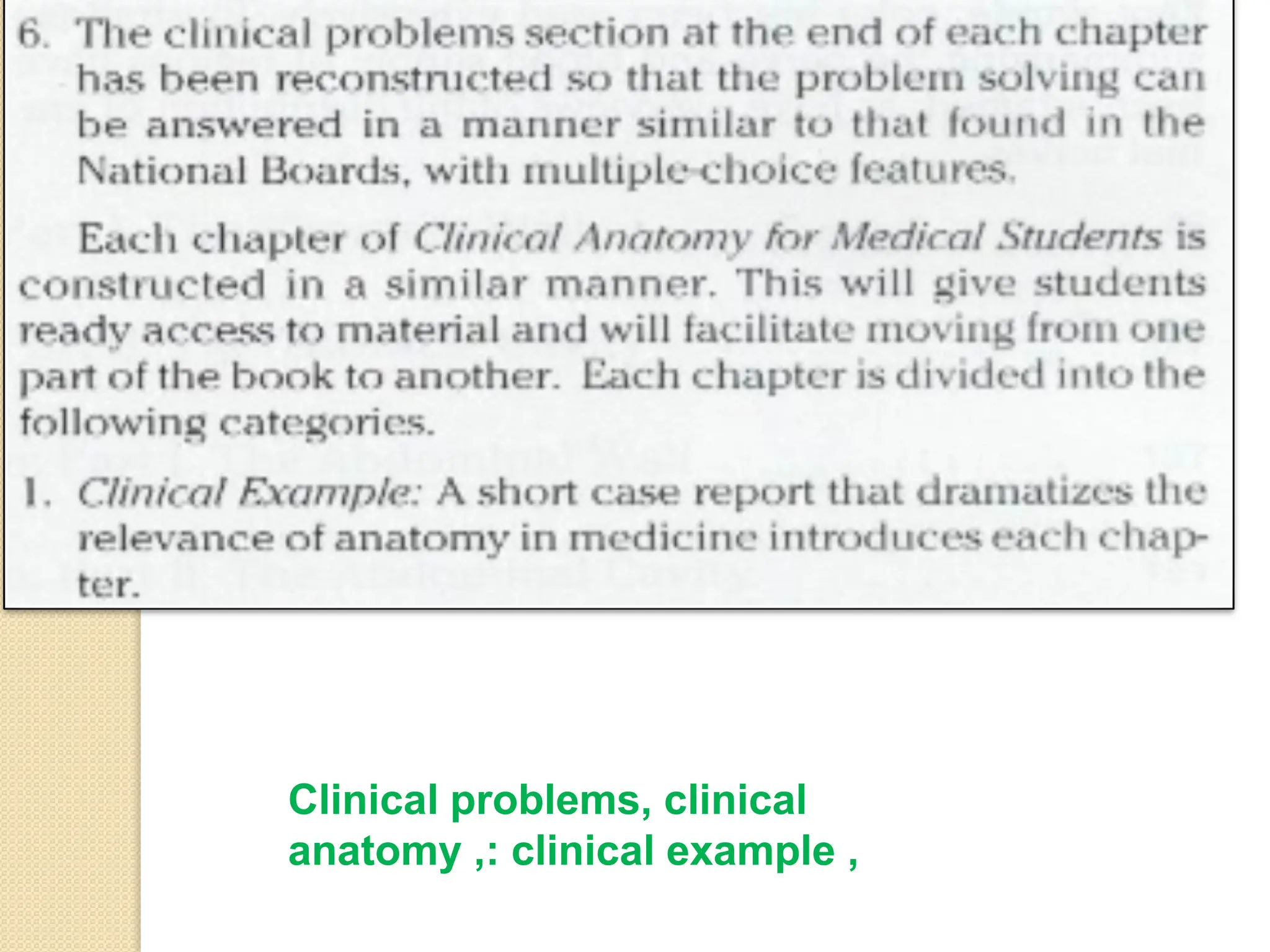
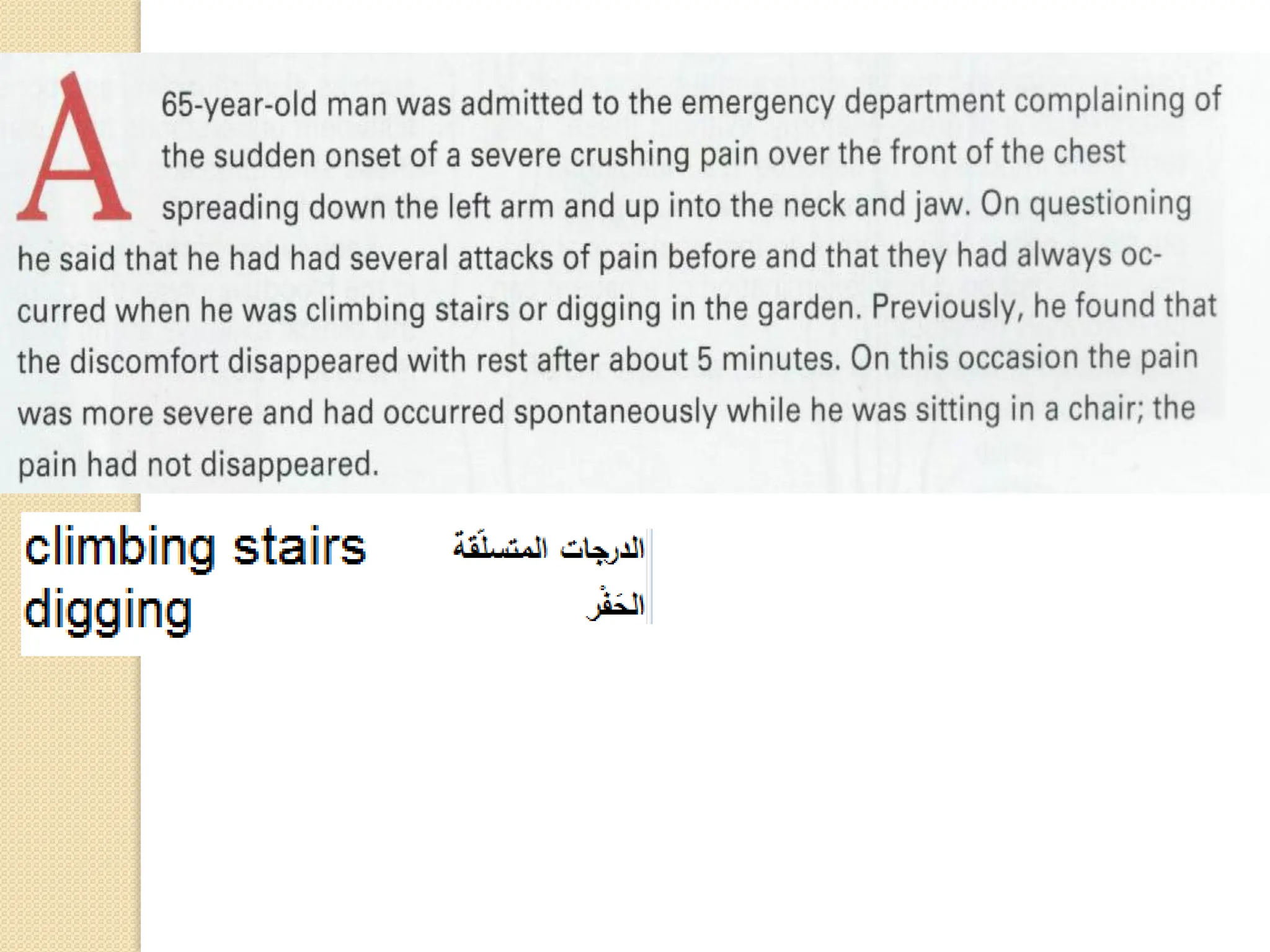
Clinical problems, clinical
anatomy ,: clinical example ,
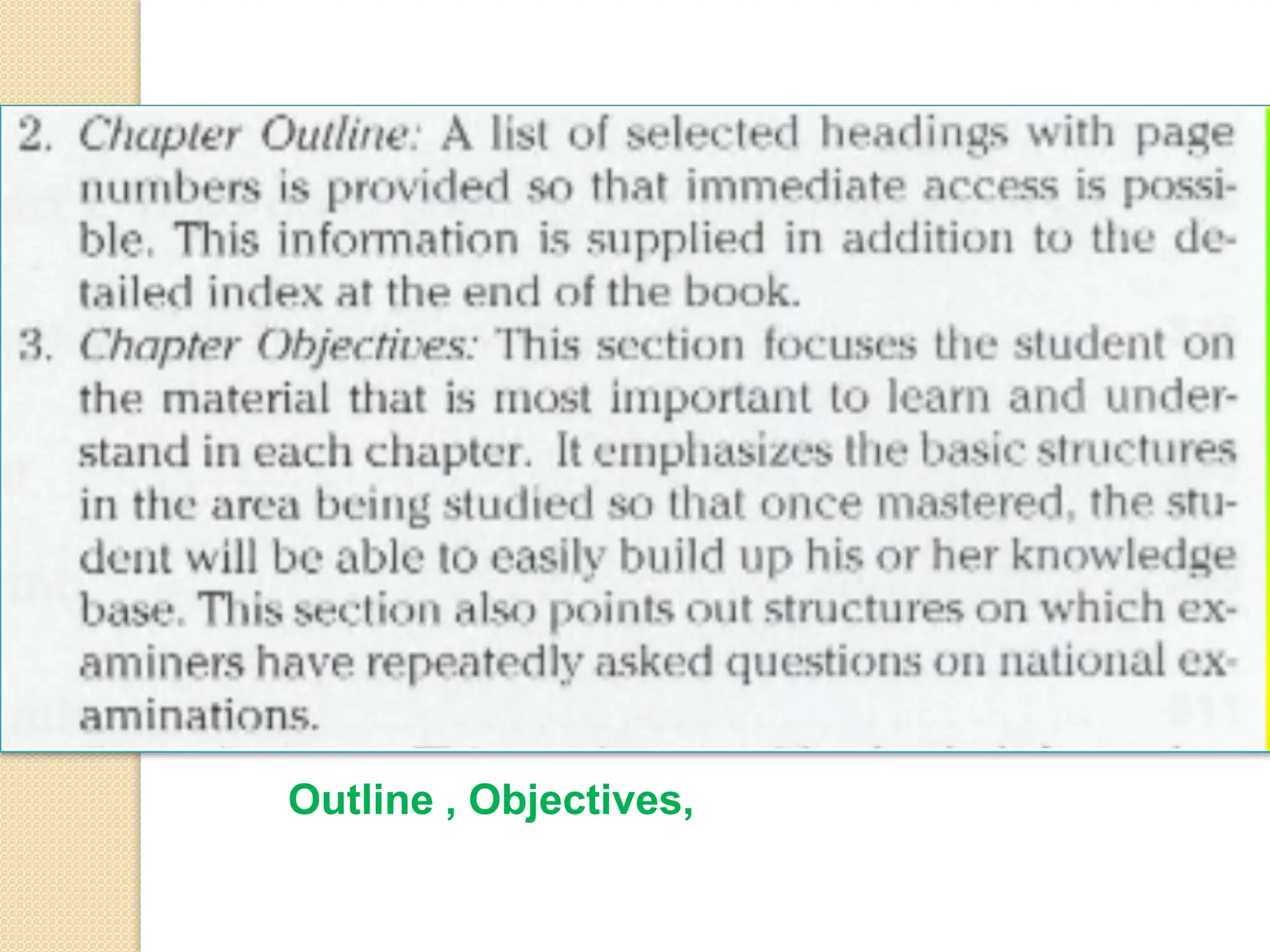
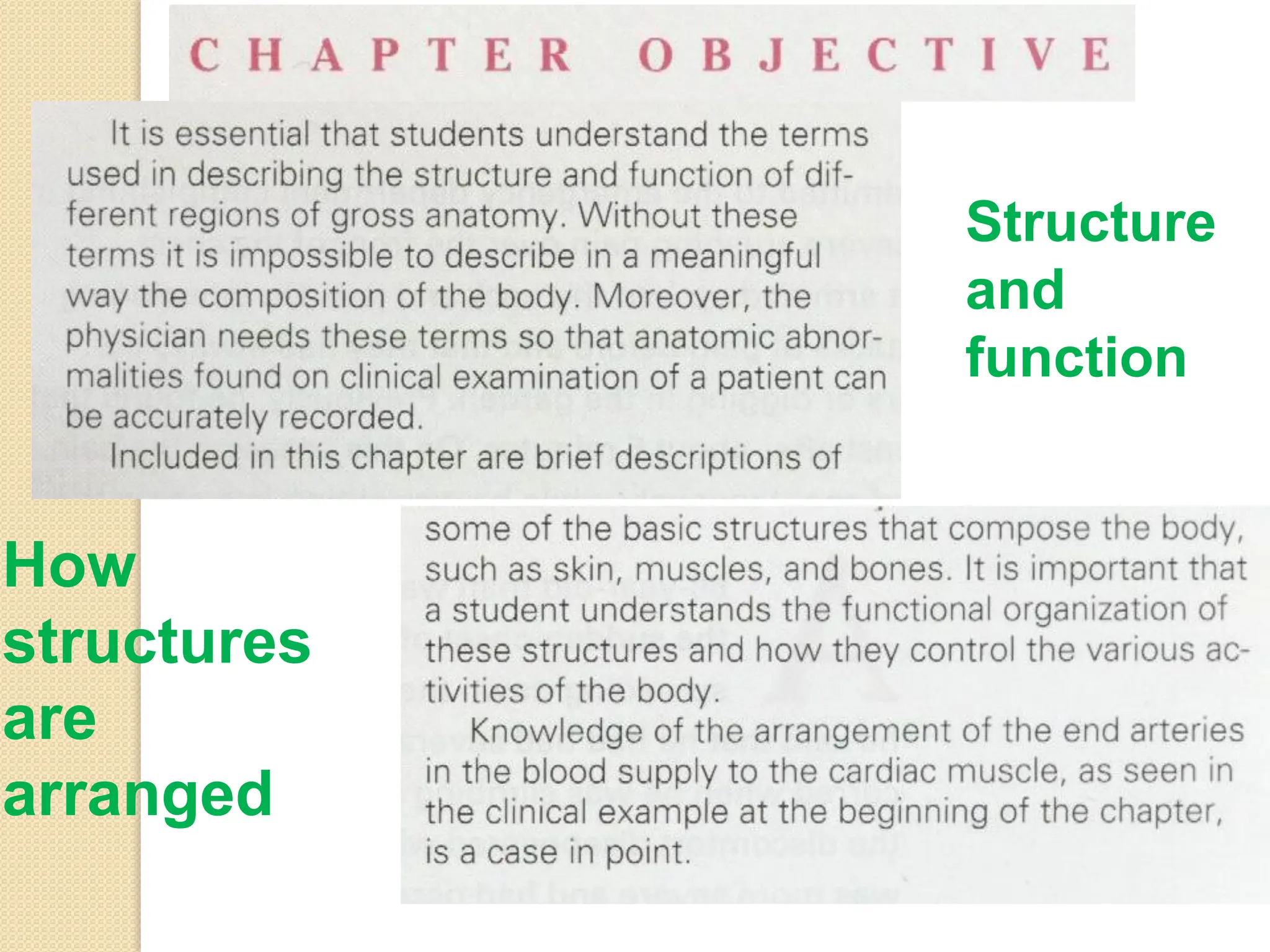
Outline , Objectives,
1985
Structure
and
function
How
structures
are
arranged
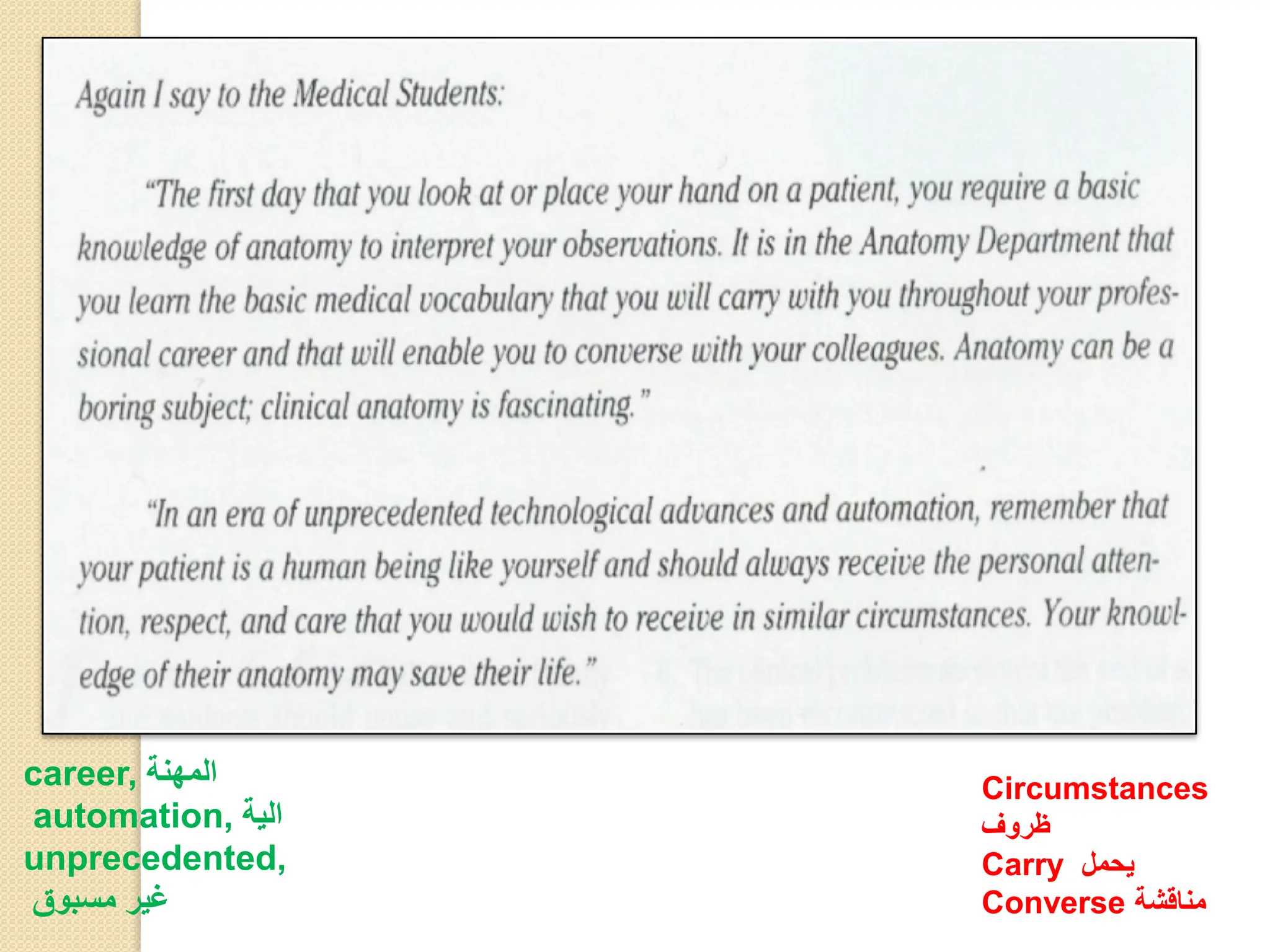
career, ‫المهنة‬
automation, ‫الية‬
unprecedented,
‫مسبوق‬ ‫غير‬
Circumstances
‫ظروف‬
Carry ‫يحمل‬
Converse ‫مناقشة‬
Anatomy
Definition
Anatomy is the study of structure and
functions of the body parts (its one of the
oldest basic medical science , firstly studied
in Egypt 500B.C.)
Term Anatomy refer to cutting up or taking
a part.
Modern anatomy = functional anatomy , so
anatomy is the structure in which the
function of life occur .
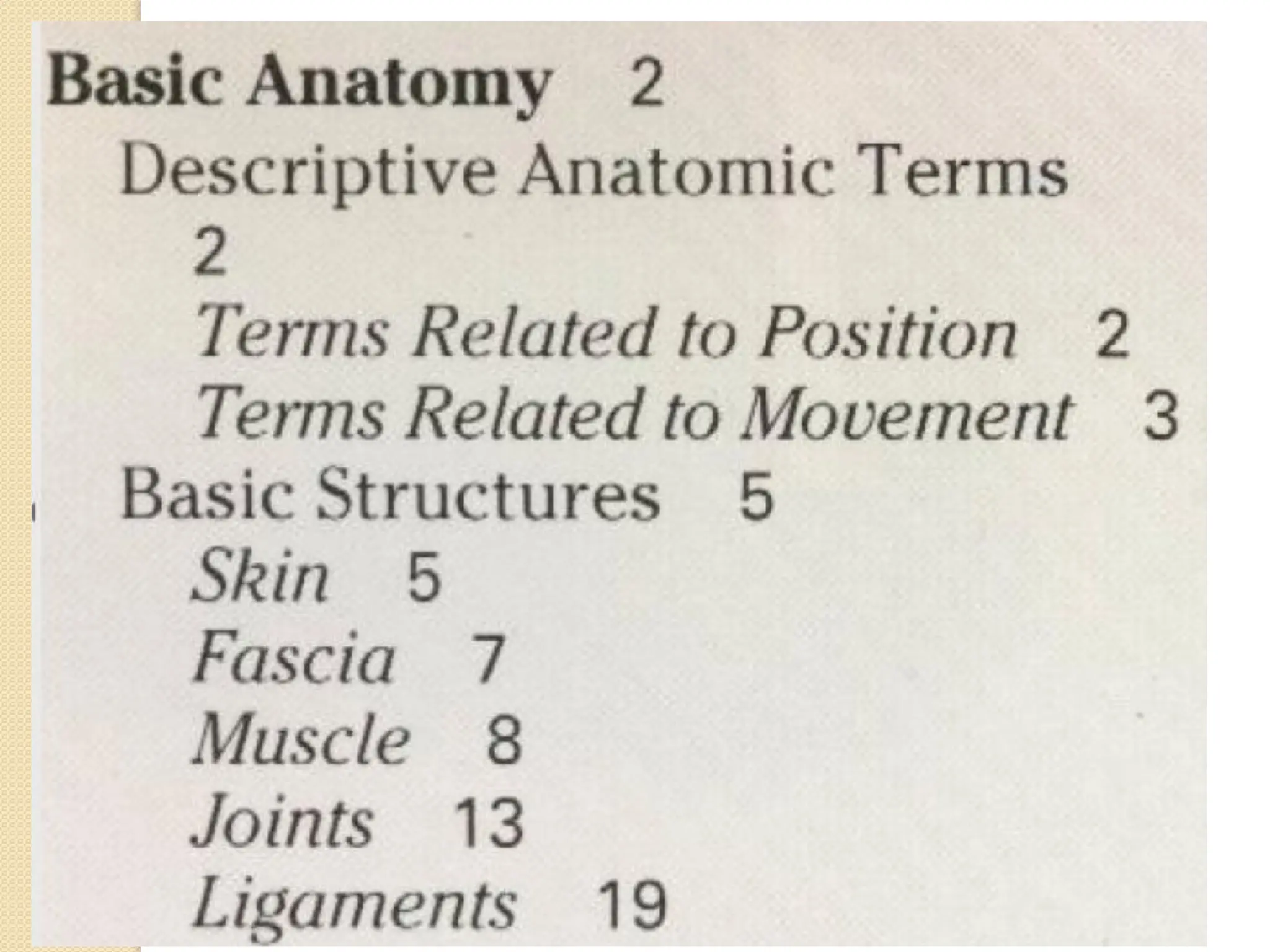
Basic Anatomy
Approaches of studying anatomy

1-Regional Anatomy ( Topographical anatomy)
*** Regional Anatomy (it’s the method of
studying the body's structure by focusing
attention on a specific parts . e.g., the head –
region the face ), Conceders the organization
or major parts
as segments
of human body
based on form & mass.
main body parts consisting of Head –
neck, trunk (subdivided into thorax ,
abdomen , back) &(pelvisperineum ) &
paired upper limbs & lower limbs .
All the major parts may be further subdivided into
regions & zones
Regional anatomy also
recognizes the body's
organization by layers : skin ,
subcutaneous tissue & deep
fascia covering the deeper
structures of muscles , skeleton
& cavities which contain viscera
(internal organs)
: is an
Surface anatomy
***
essential part of the study
of regional anatomy , we
can learn much by
observing the external
form & surface of the body
& observing or feeling the
superficial aspects of
structures beneath its
surface
2-Systemic anatomy
*** recognizes the
organization of the body's
organs into system or
collective apparatuses that
work together to carry
out complex functions so
it’s a study of the
functional systems of the
body
The body system include
system
Integumentary
(dermatology ) consist of the skin & its
appendages ( hair, nails , sweat glands )
consist
)
Osteology
(
Skeletal system
of bones and cartilage ,, its provides
our basic shape & support for the body
& its what the muscular system acts on
to produce movement , also it protect
vital organs .
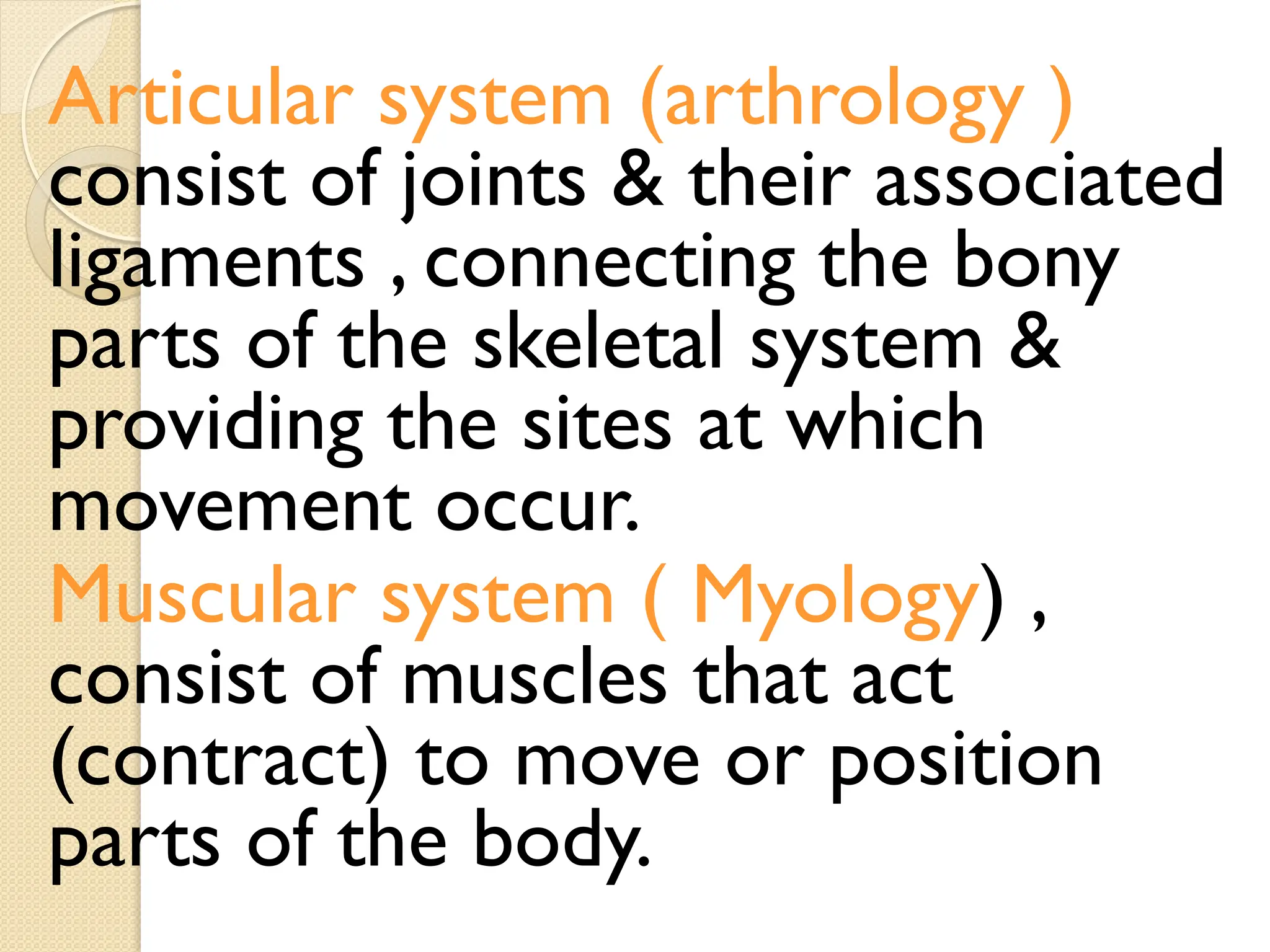
Articular system (arthrology )
consist of joints & their associated
ligaments , connecting the bony
parts of the skeletal system &
providing the sites at which
movement occur.
Muscular system ( Myology) ,
consist of muscles that act
(contract) to move or position
parts of the body.
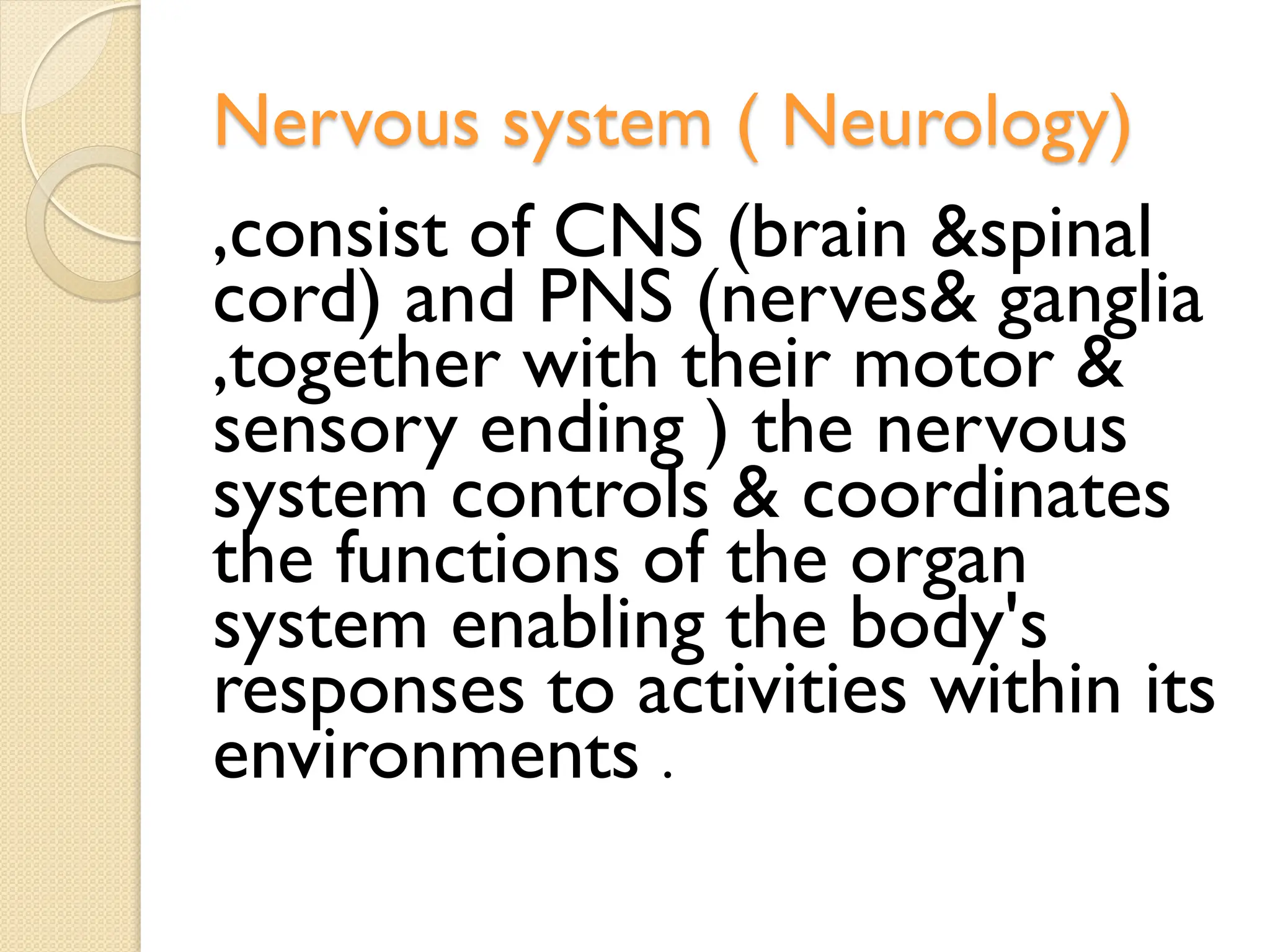
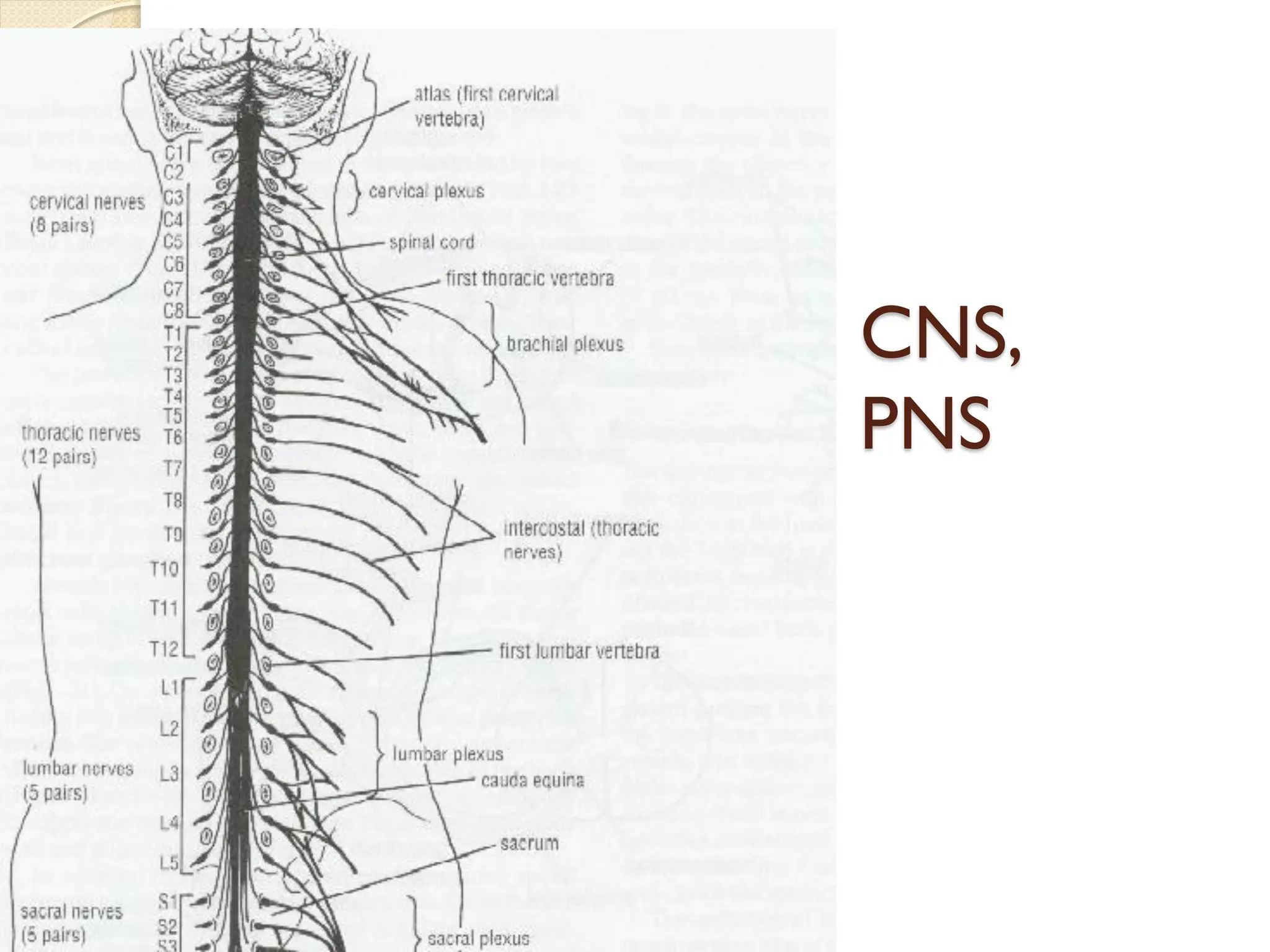
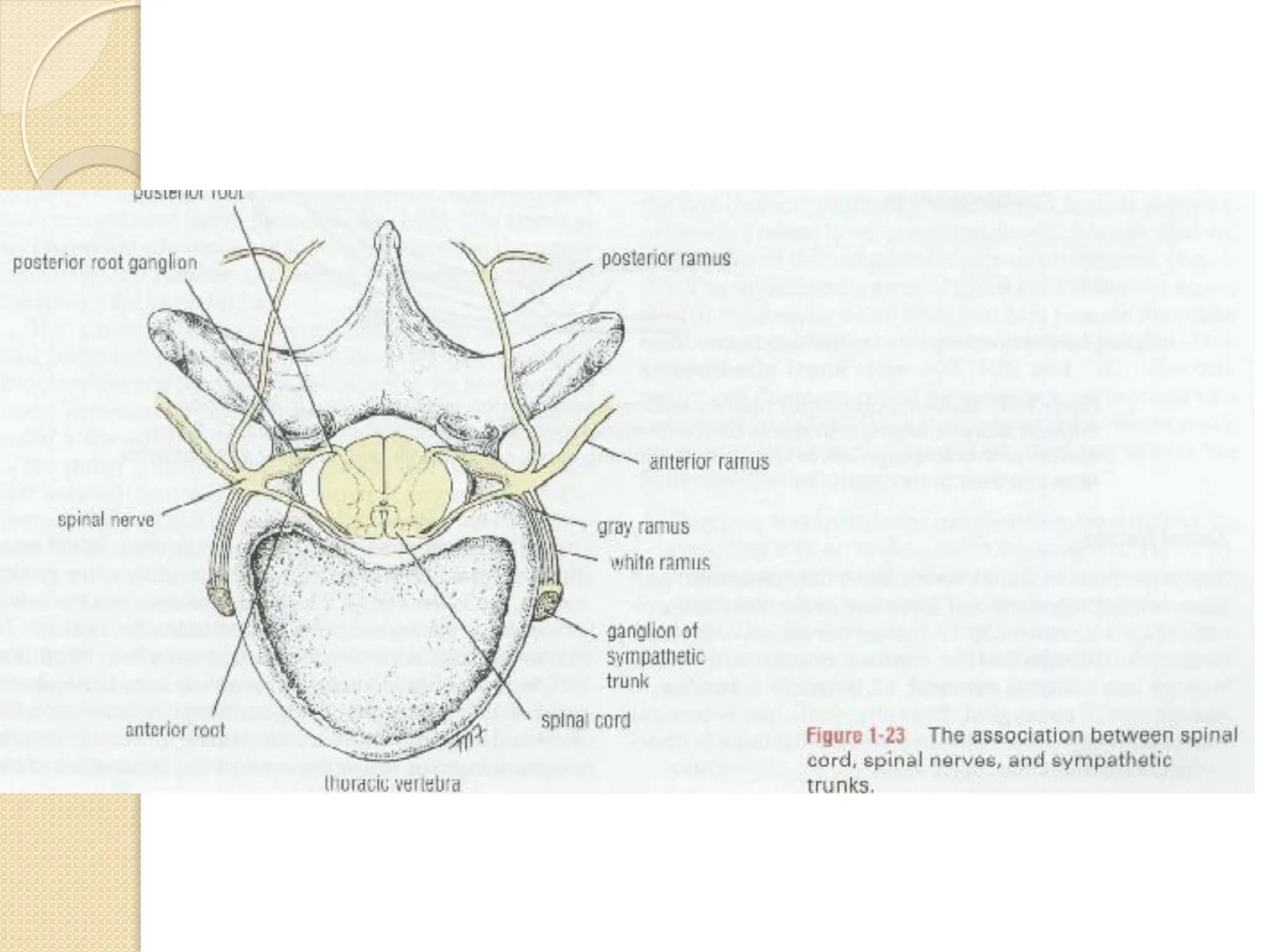
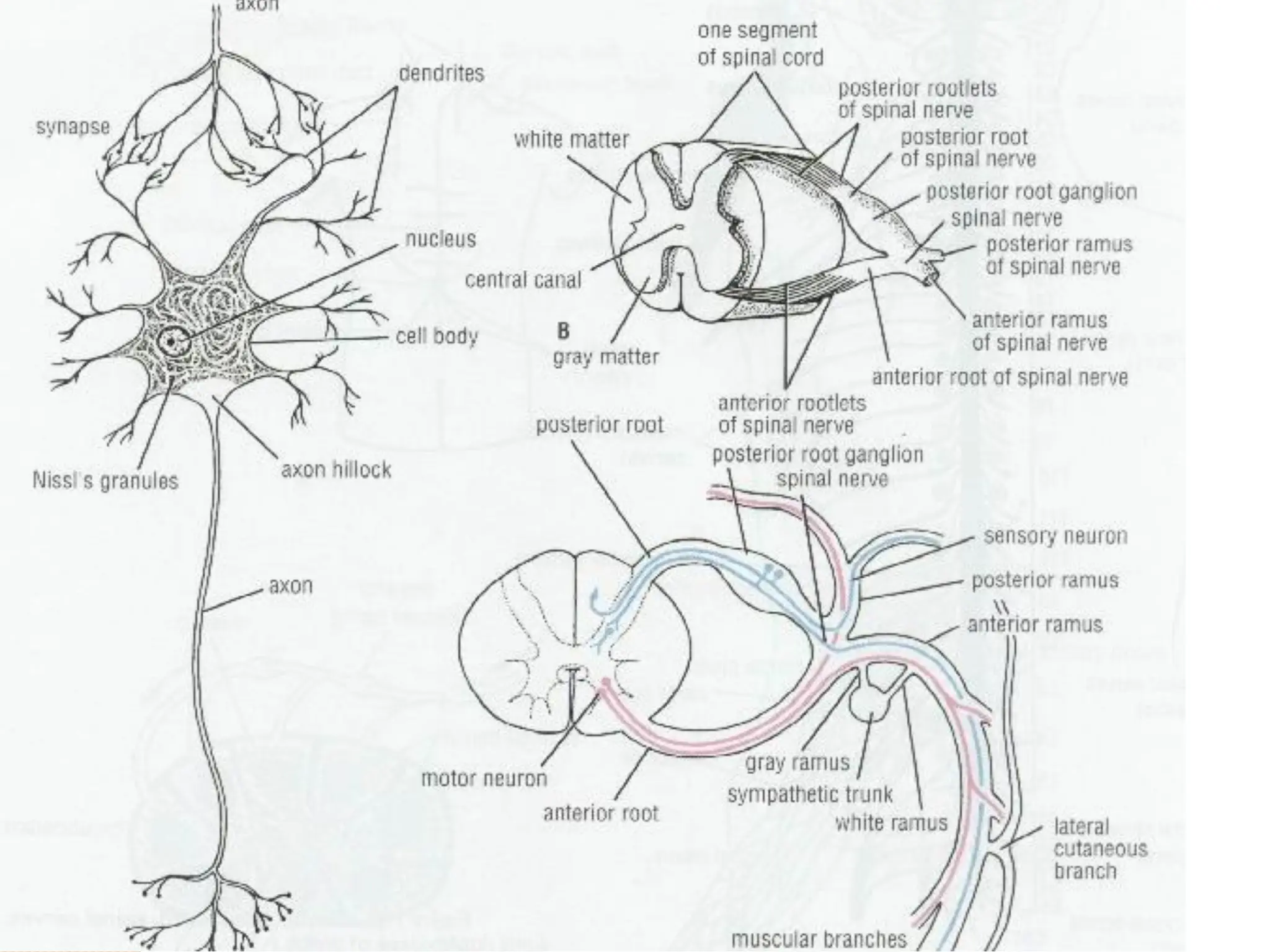
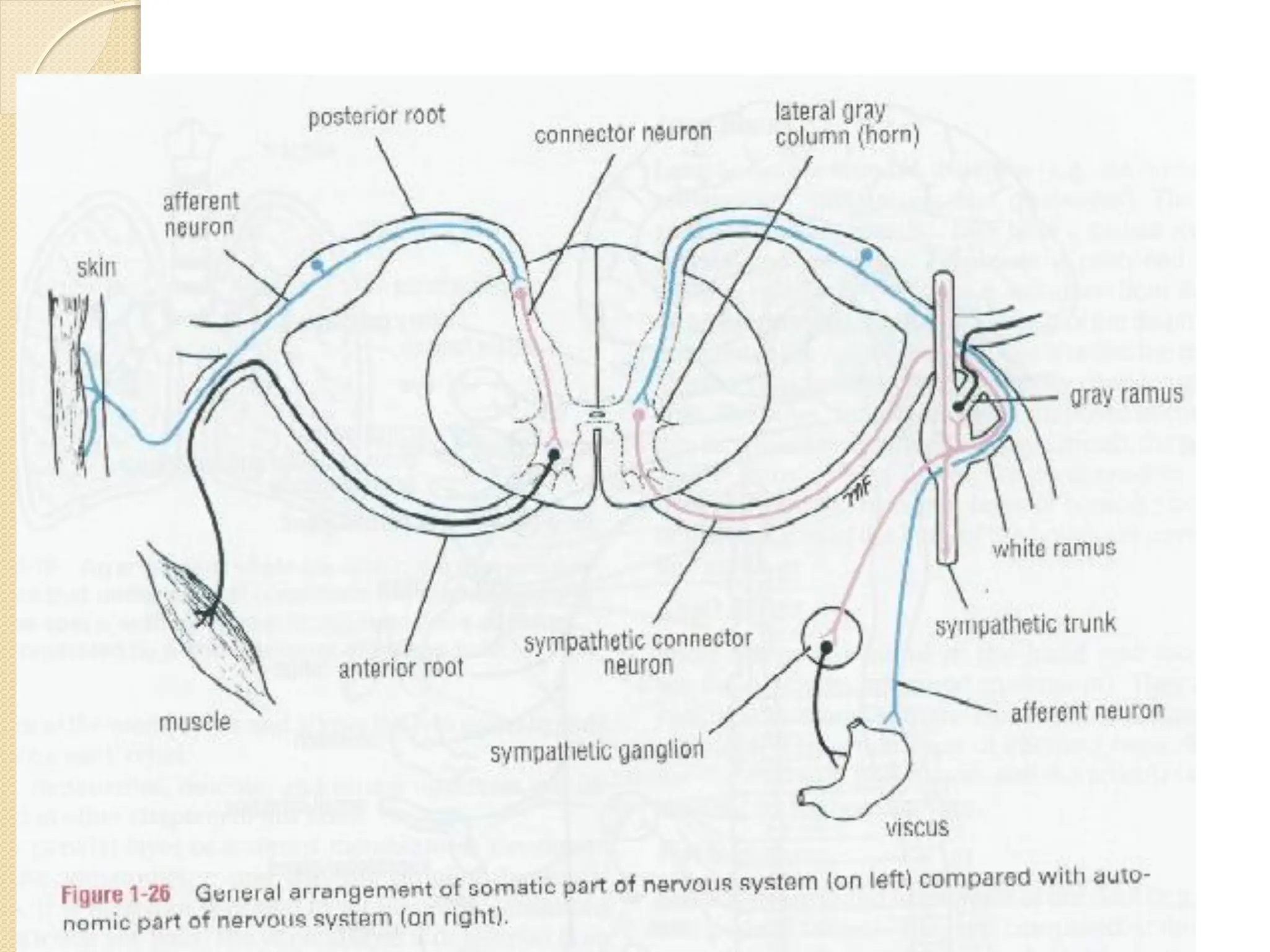
Nervous system ( Neurology)
,consist of CNS (brain &spinal
cord) and PNS (nerves& ganglia
,together with their motor &
sensory ending ) the nervous
system controls & coordinates
the functions of the organ
system enabling the body's
responses to activities within its
environments .
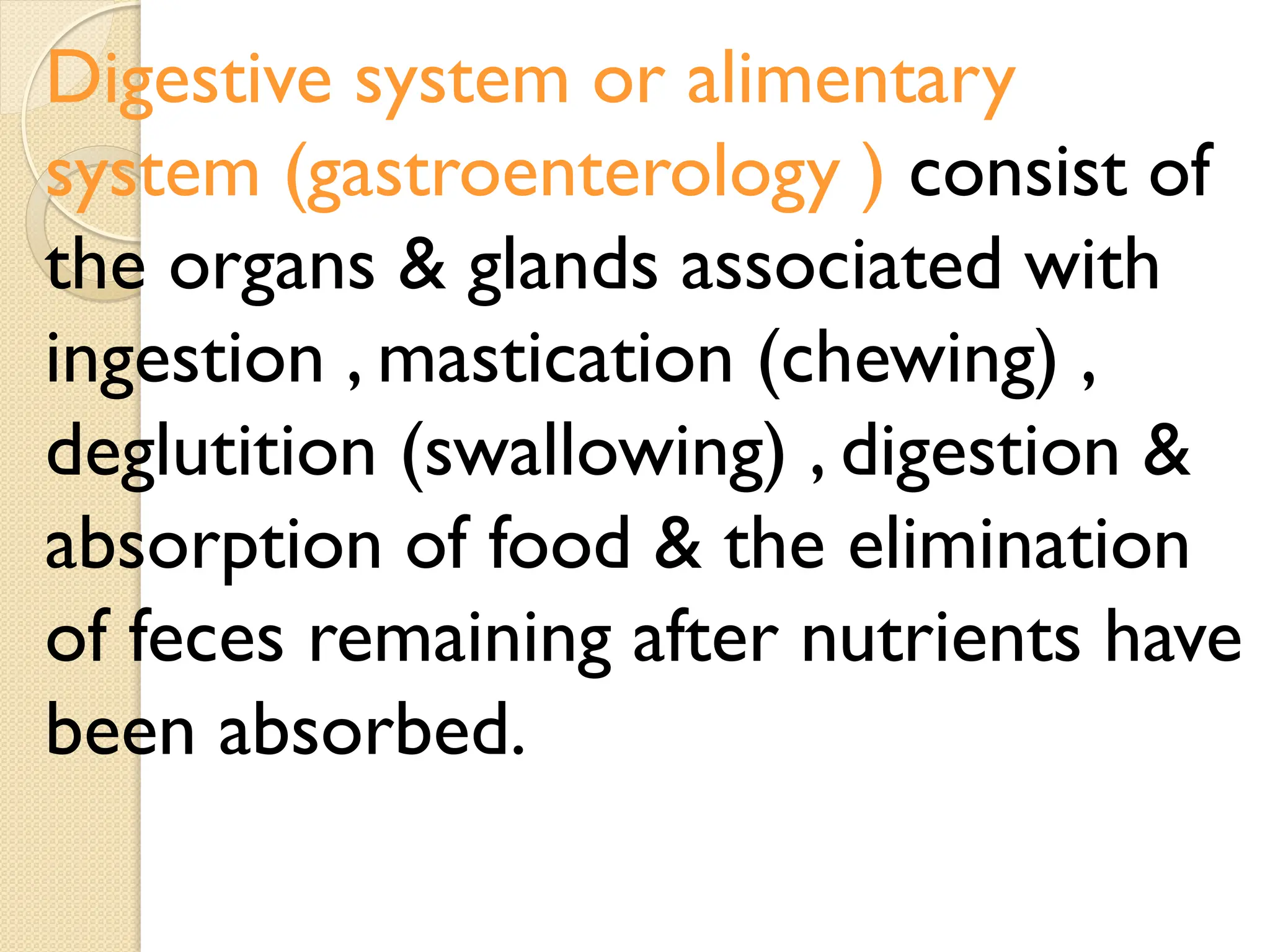
Digestive system or alimentary
system (gastroenterology ) consist of
the organs & glands associated with
ingestion , mastication (chewing) ,
deglutition (swallowing) , digestion &
absorption of food & the elimination
of feces remaining after nutrients have
been absorbed.
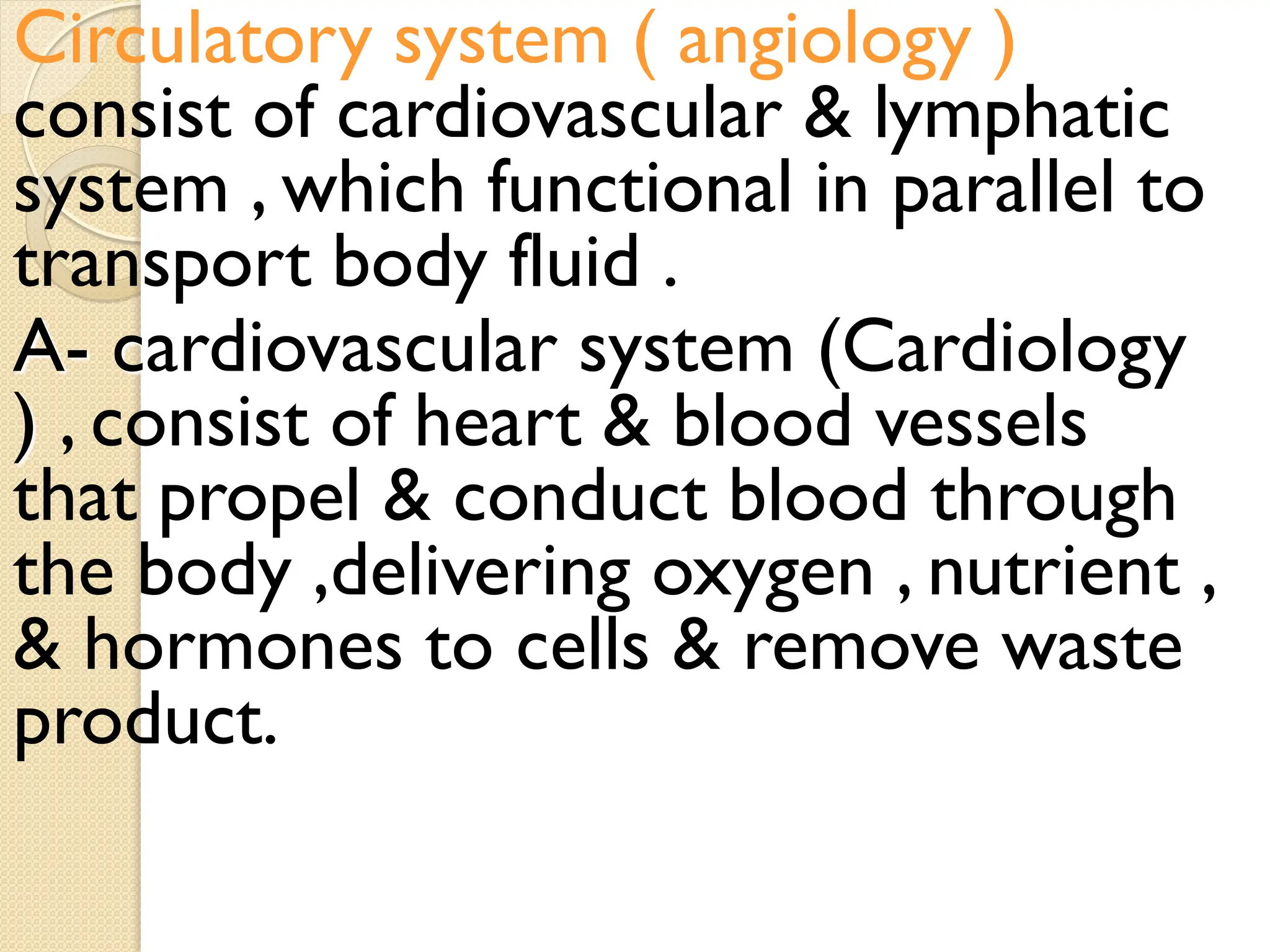
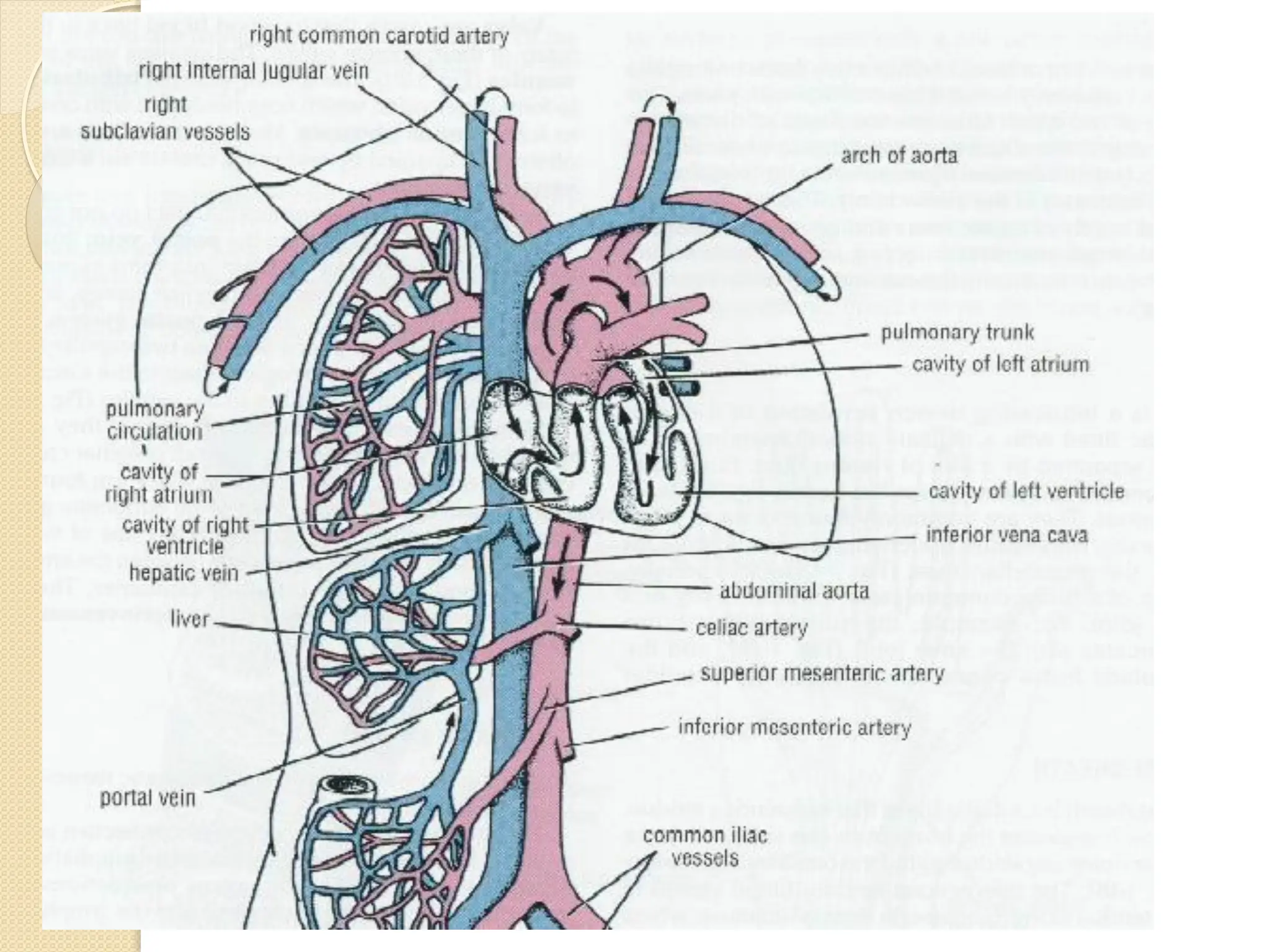
Circulatory system ( angiology )
consist of cardiovascular & lymphatic
system , which functional in parallel to
transport body fluid .
A- cardiovascular system (Cardiology
) , consist of heart & blood vessels
that propel & conduct blood through
the body ,delivering oxygen , nutrient ,
& hormones to cells & remove waste
product.
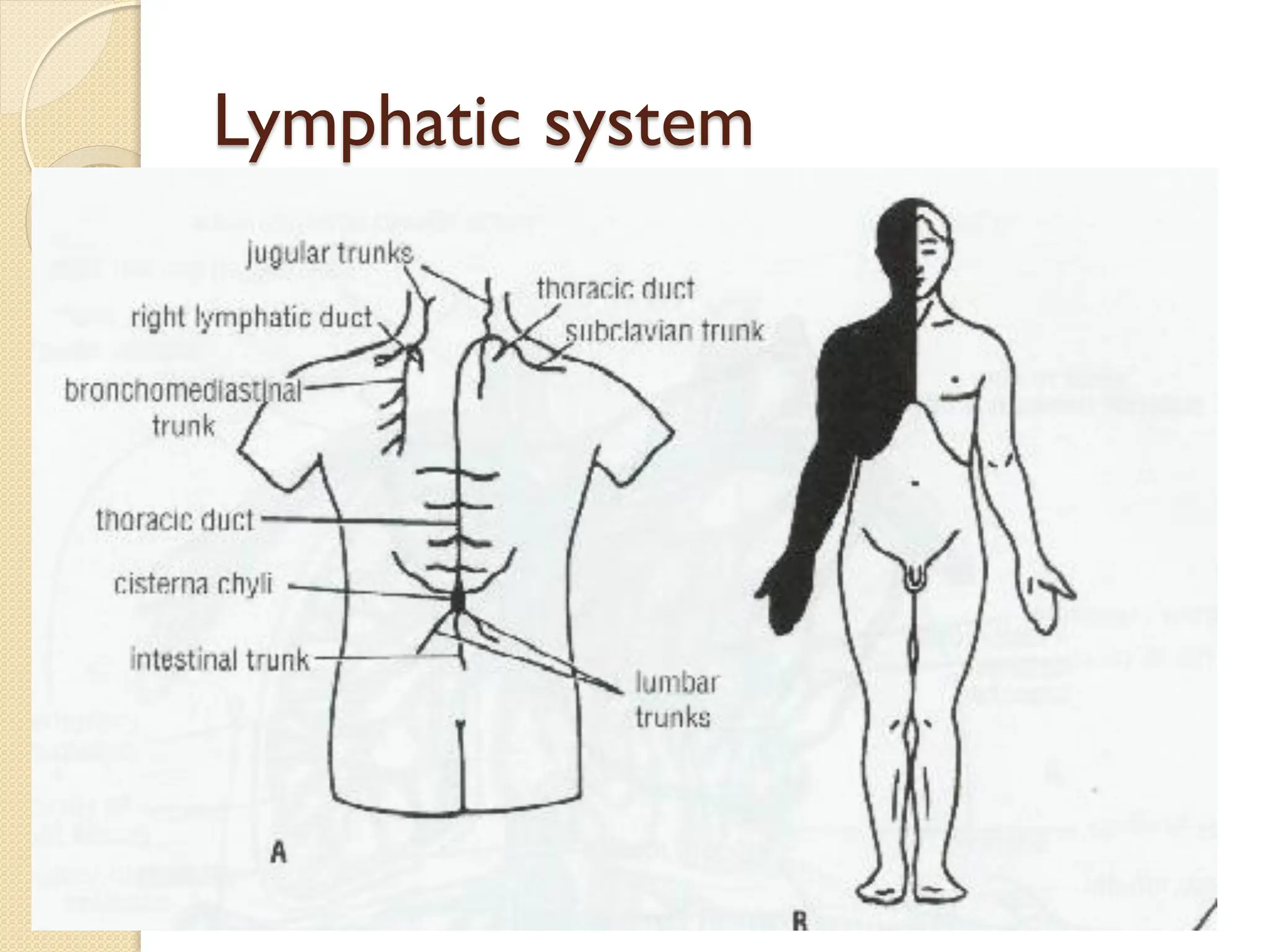
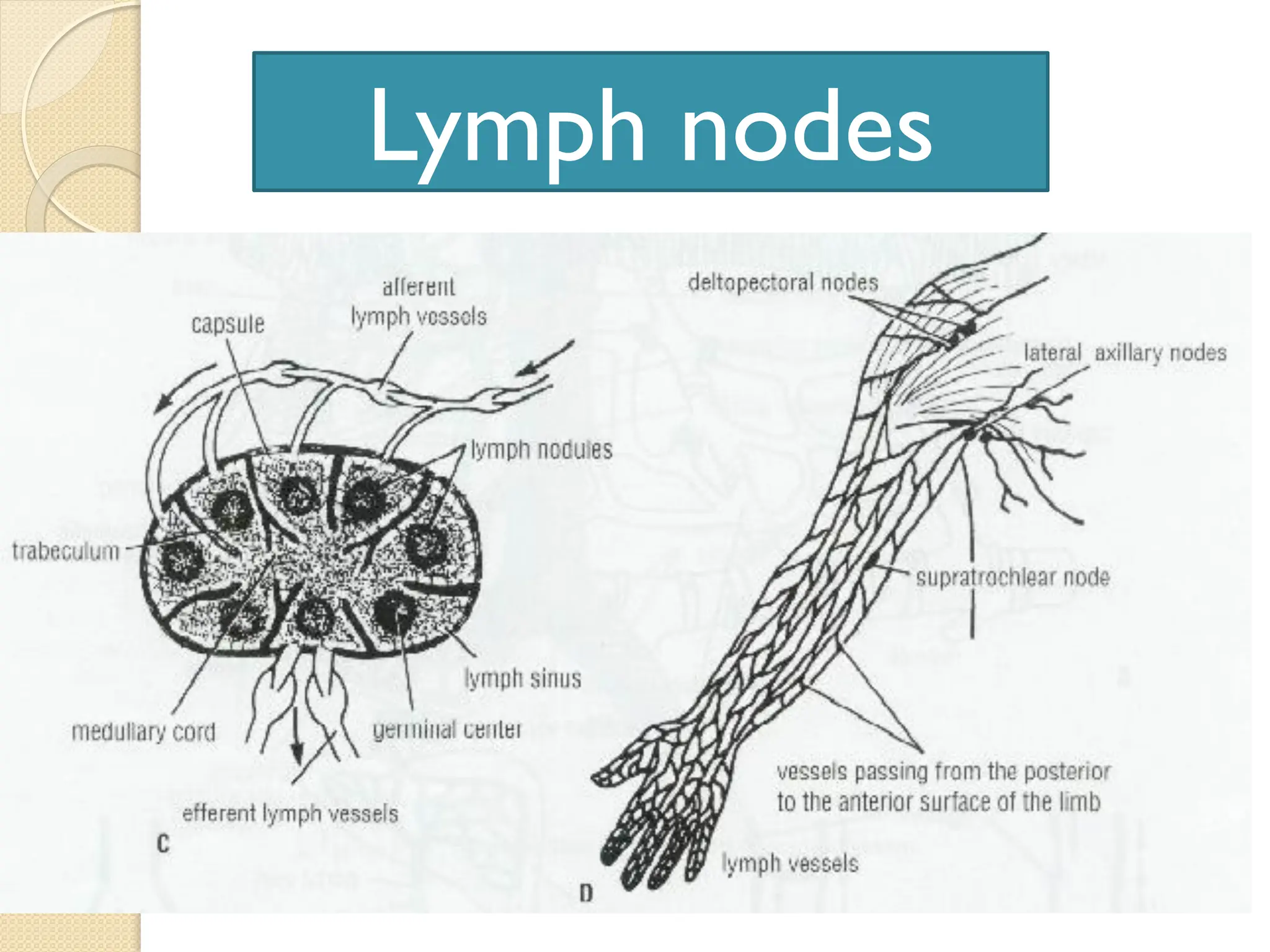
B- lymphatic systems , it’s a
network of lymphatic vessels
that withdraw excess tissue fluid
(lymph) from the body's
interstitial (intercellular) fluid
compartment , filters it through
lymph nodes & returns it to the
body stream .
Respiratory system ( pulmonology )
consist of the air passages & lungs that
supply oxygen to the blood for cellular
respiration & eliminate carbon dioxides
from it. Diaphragm & larynx control the
flow of air through the system ,which may
also produce tone in the larynx that is
further modified by tongue , teeth , &lips
into speech
Urinary system (urology) consist
of the kidneys ,ureters, urinary
bladder & urethra ,which filter
blood & subsequently produce ,
transport , store & intermittently
excrete urine

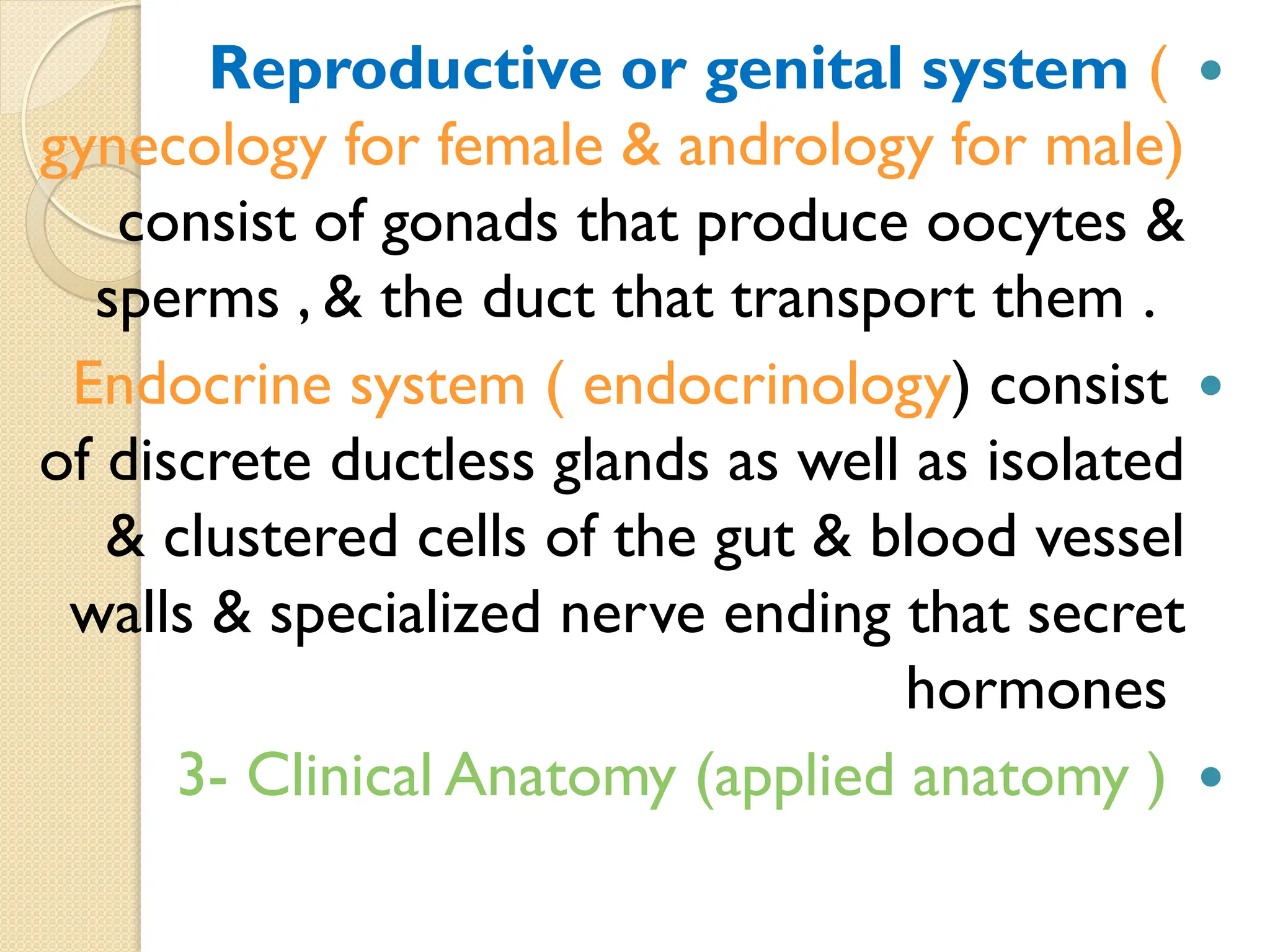
Reproductive or genital system (
gynecology for female & andrology for male)
consist of gonads that produce oocytes &
sperms , & the duct that transport them .

Endocrine system ( endocrinology) consist
of discrete ductless glands as well as isolated
& clustered cells of the gut & blood vessel
walls & specialized nerve ending that secret
hormones

3- Clinical Anatomy (applied anatomy )
DESCRIPTIVE
ANATOMIC TERMS
Anatomical planes
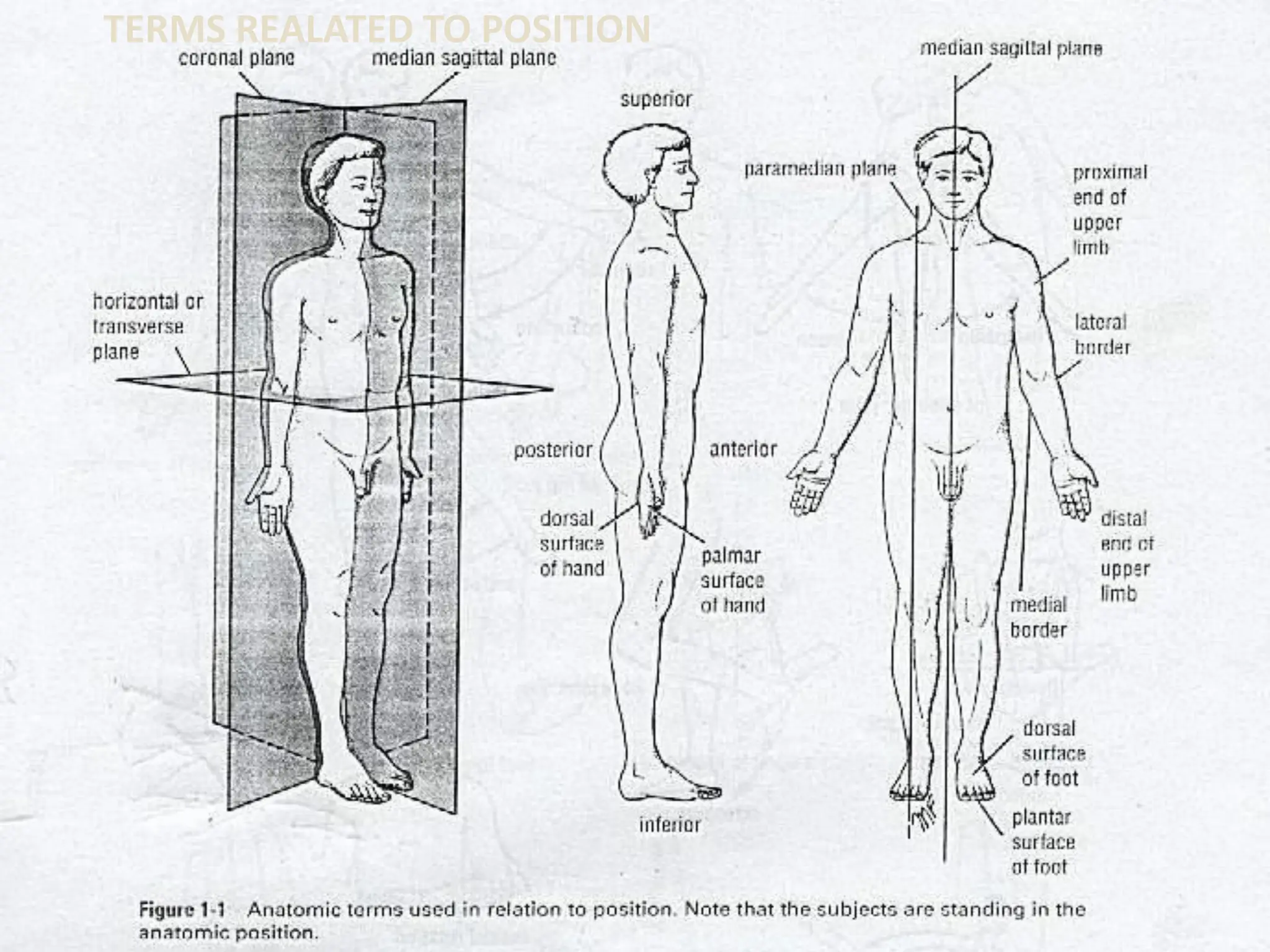
The median plane : the vertical
plane passing longitudinally
through the body ,divides the
body into right & left halves .The
plane intersects the midlines of
the anterior & posterior surface of
the body .its often erroneously
used as a synonym for the median
plane.
Sagittal plane: are vertical
plans passing through the
body parallel to the median
plane. Its helpful to give a
point of reference by naming
a structure intersected by
the plane you are referring
to.
The term midsagittal plane is
superfluous term for the median plane.
Parasaggittal ,commonly used by
neuroanatomists & neurologists ,is also
unnecessary because any plane parallel &
to either side of the median plane is
sagittal by definition ( however a plane
parallel & near to the median plane may
be referred to as a Para median plane
: are
Frontal (coronal) plane
vertical planes passing through
the body at right angles to the
median plain ,dividing the body
into anterior (front) and
posterior (back) parts.Again a
point of reference is necessary
to indicate the position of the
plane (e.g. a frontal plane
through the heads of mandible
Transverse plane : are plane passing
through the body at right angles to the
median & frontal planes divided the
body into superior (upper) & inferior
(lower) parts . Its helpful to give a
reference point to identify the level of
the plane such as (transverse plane
through the umbilicus).
TERMS REALATED TO POSITION
Type of sectioning
Longitudinal section : run lengthwise or parallel
to the long axis of the body or any of its parts &
the term applies regardless of the position of
the body .
Transverse section (cross section ) : are slices of
the body or its parts that are cut at right angles
to the longitudinal axis of the body or any of its
parts .
Oblique sections : are slice of the body or any
of its parts that are not cut along one of the
previously mentioned anatomical planes .
Anatomic position :that
position in which the person
standing erect ,with the
upper limbs by the sides and
the face and palms of the
hands directed forward .
TERMS REALATED TO POSITION
Superficial Deep
Internal external
Anterior posterior
Palmer dorsal
Ipsi lateral contra lateral
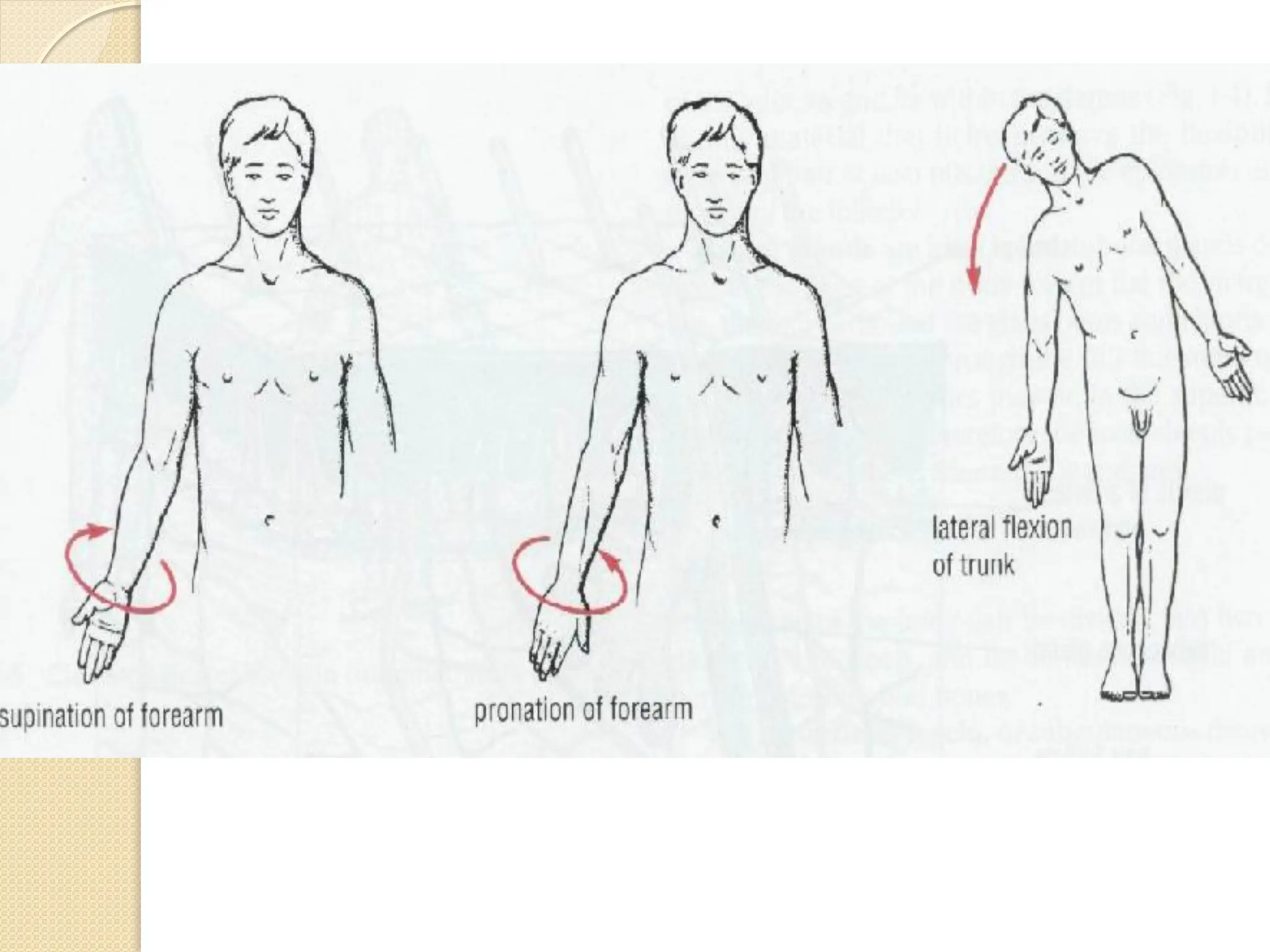
Supine prone
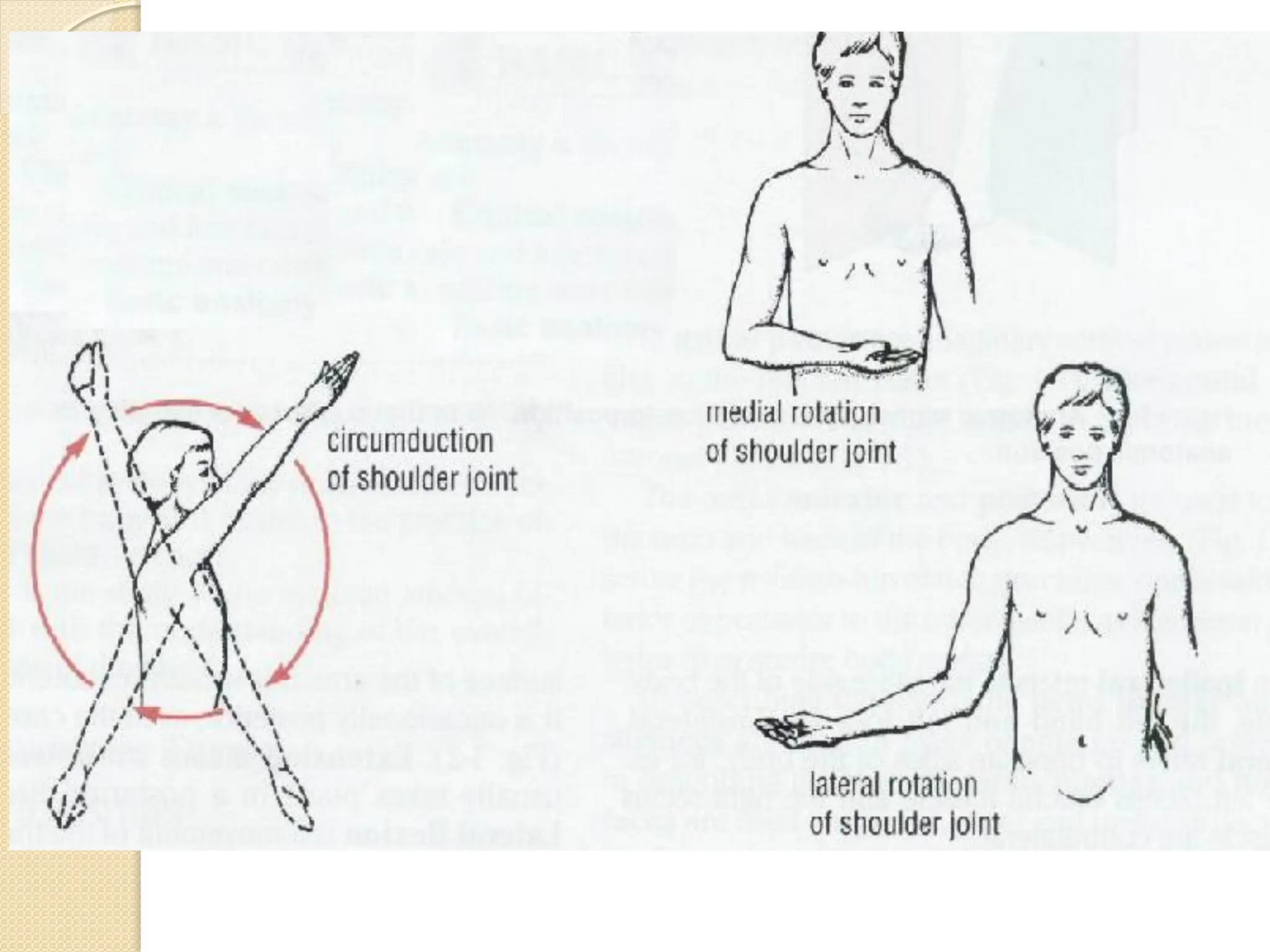
Lateral flexion of trunk
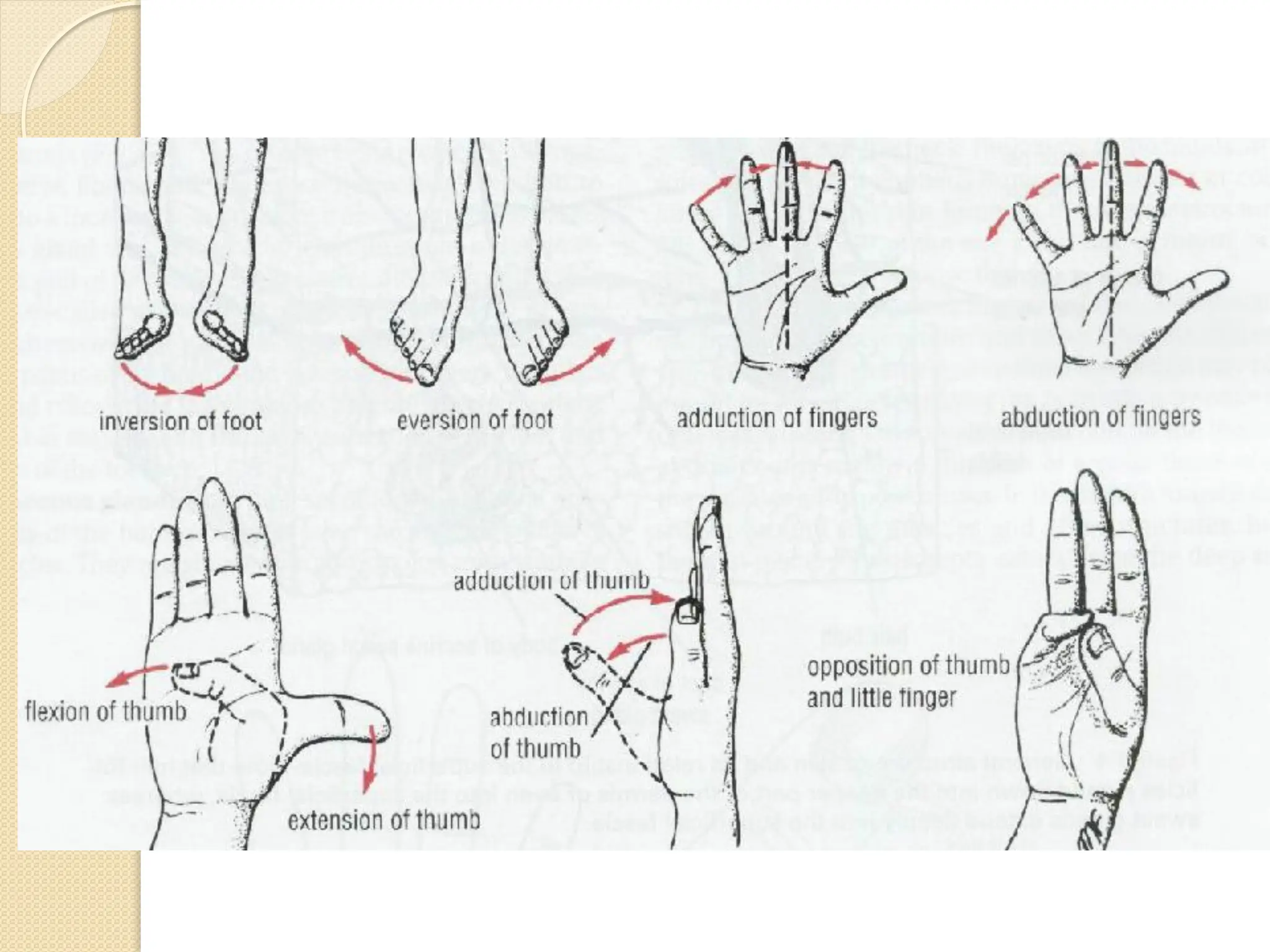
Abduction adduction
Protraction retraction
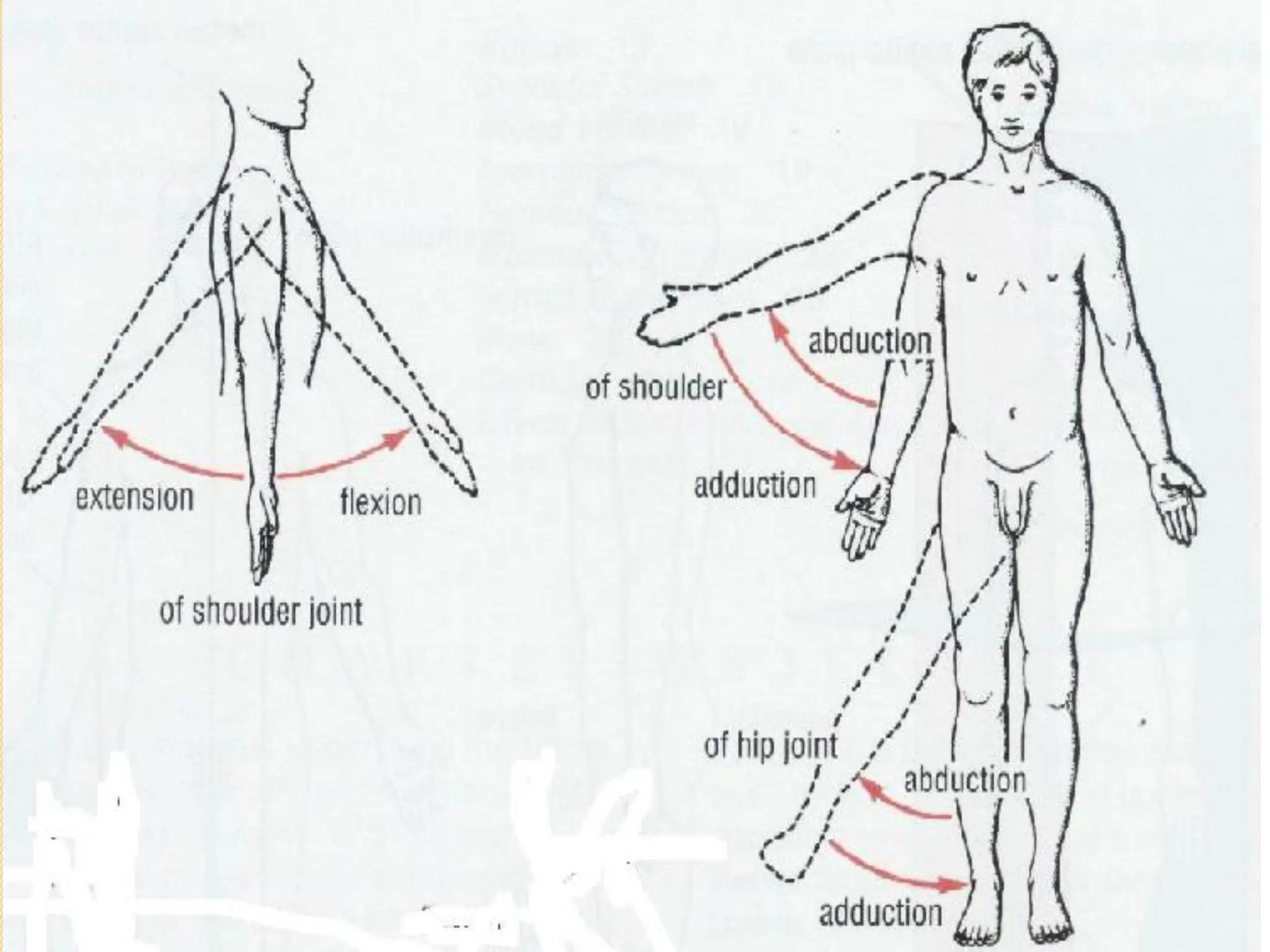
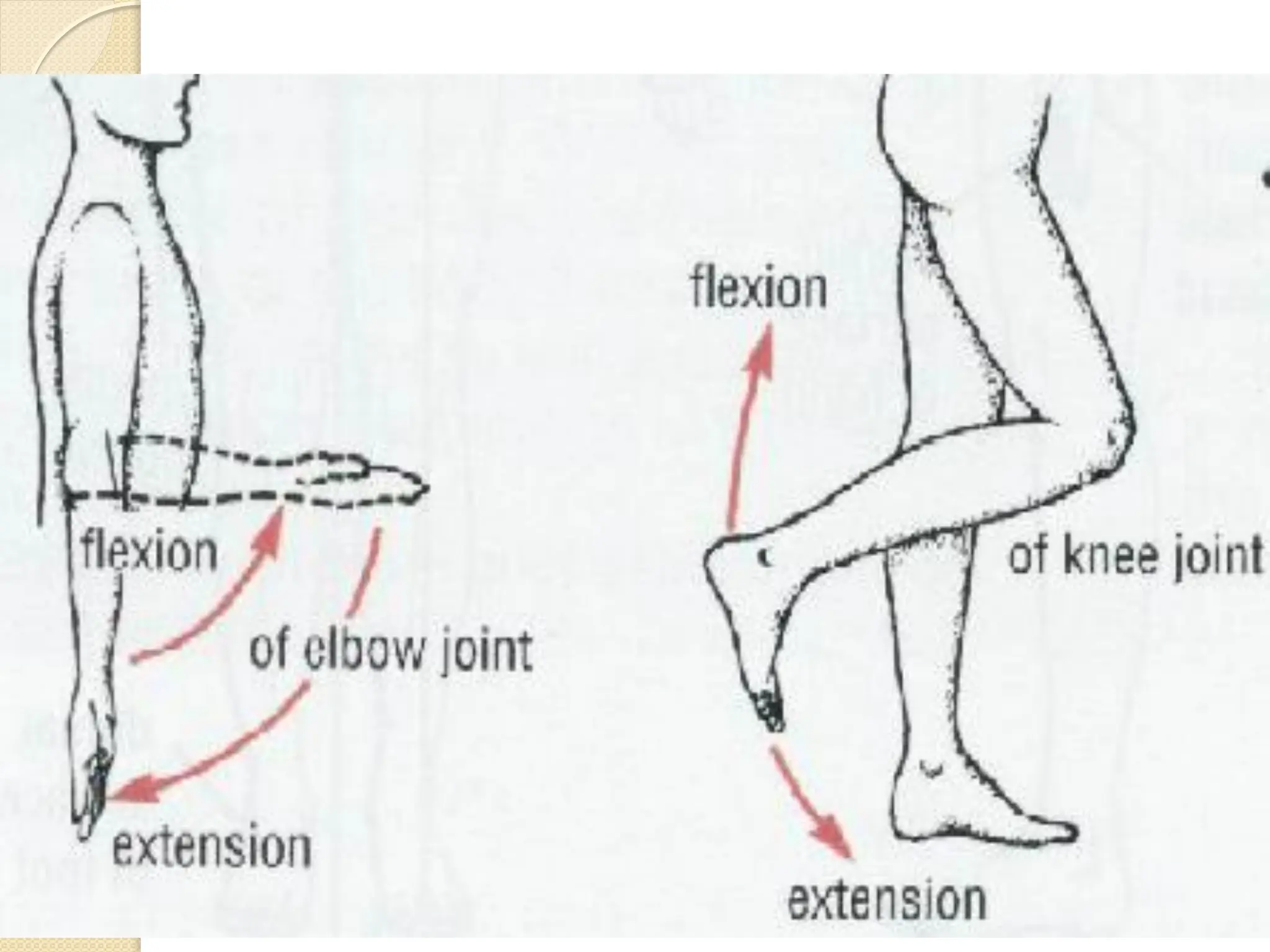
TERMS REALATED TO MOVENENT
BASIC
STRUCTURES
SKIN
Epidermis
Dermis
Superficial fasciae :is mixture of loose areolas and adipose tissue that unites
the dermis of the skin to the underlining deep fasciae
deep fasciae is membranous layer of connective tissue that invest the muscles
and other deep structures
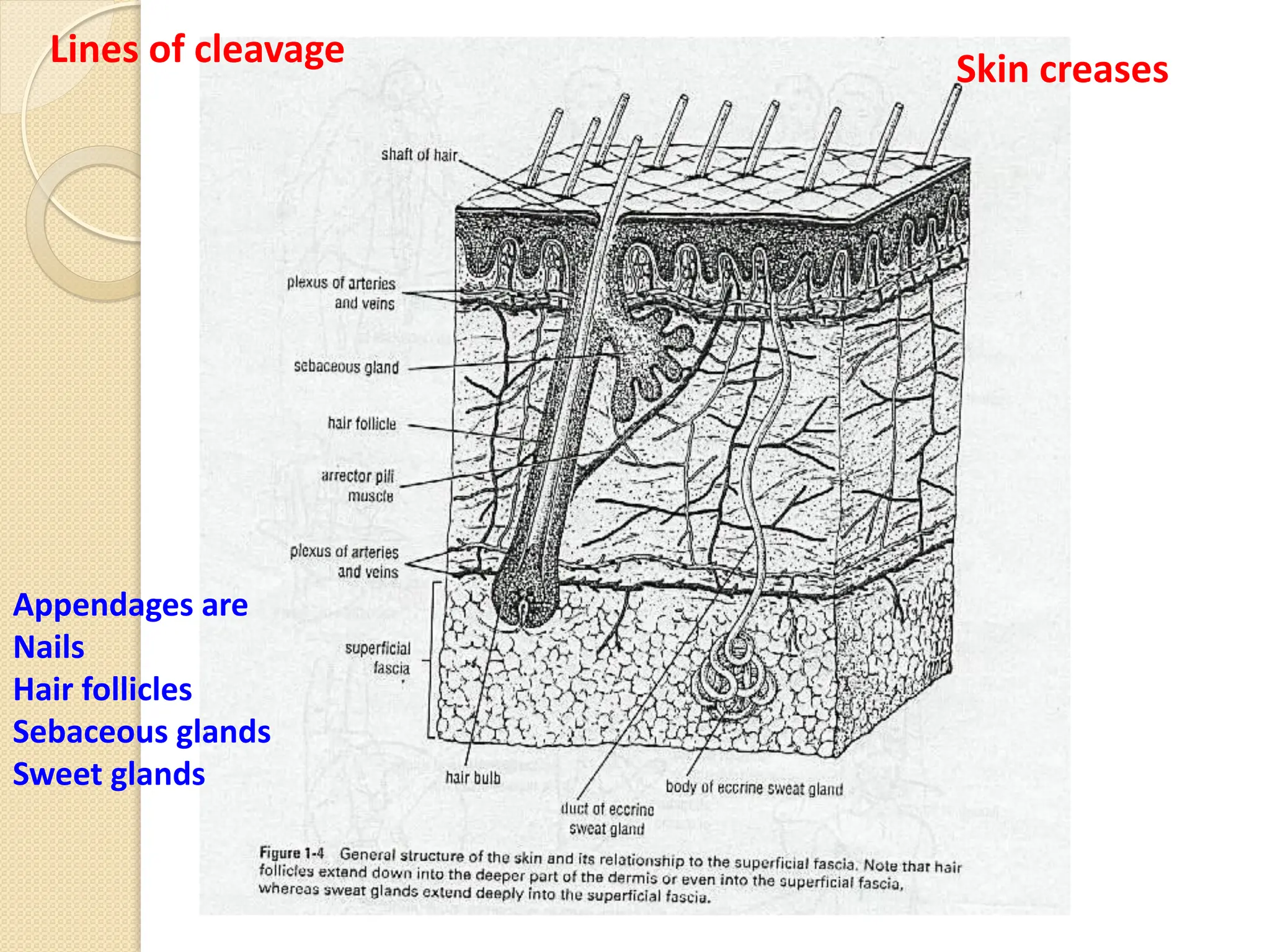
Lines of cleavage Skin creases
Appendages are
Nails
Hair follicles
Sebaceous glands
Sweet glands
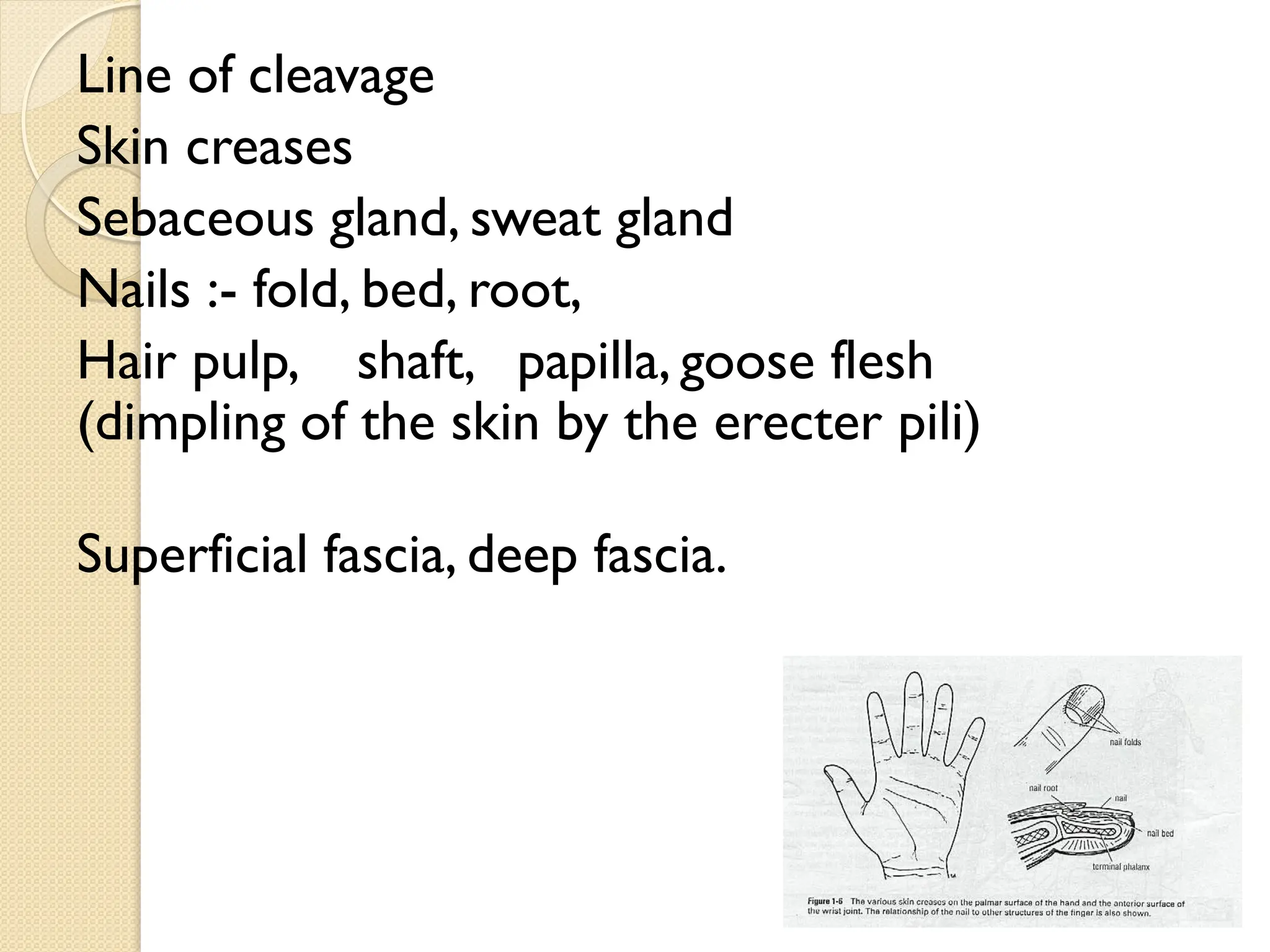
Line of cleavage
Skin creases
Sebaceous gland, sweat gland
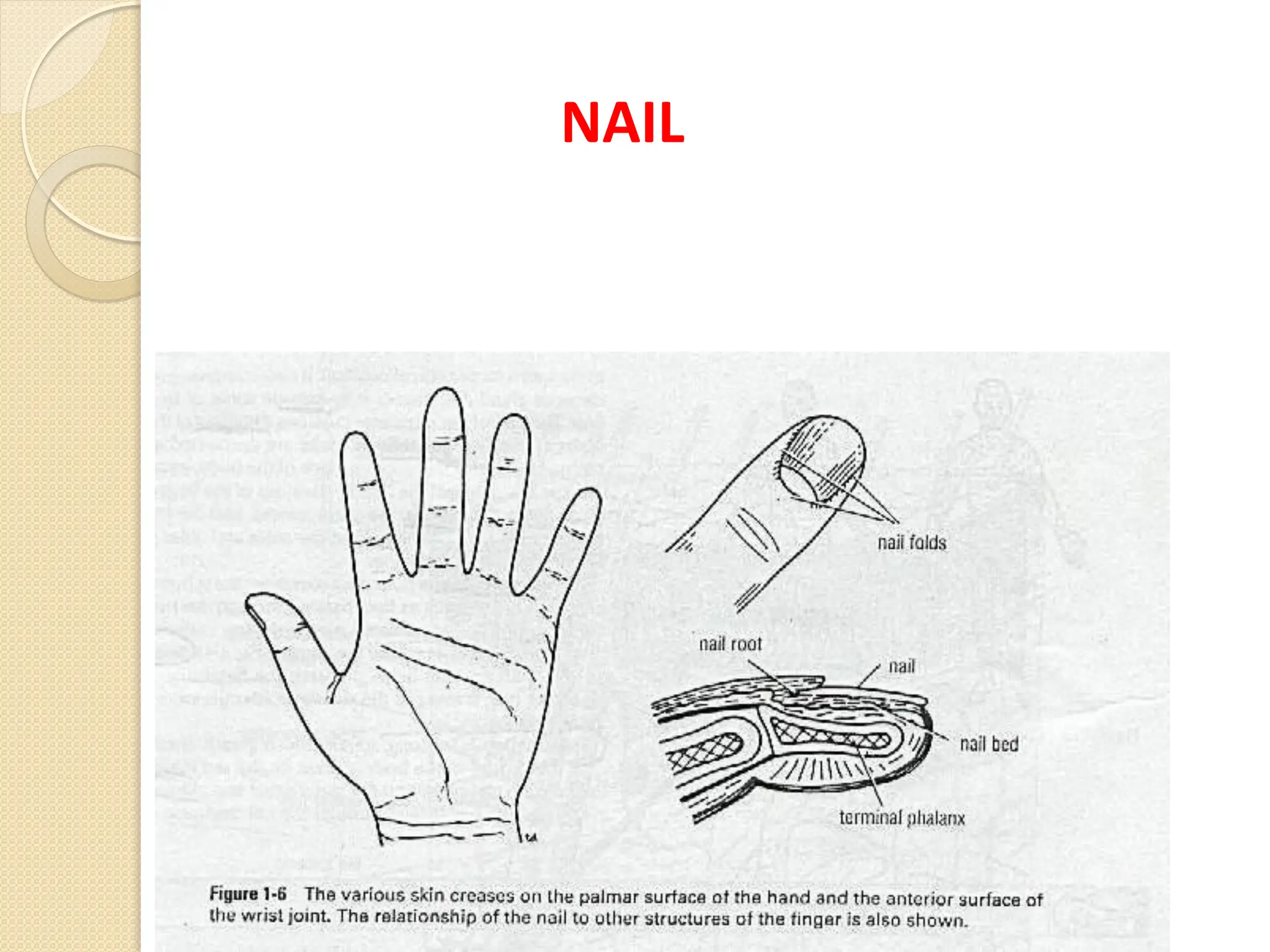
Nails :- fold, bed, root,
Hair pulp, shaft, papilla, goose flesh
(dimpling of the skin by the erecter pili)
Superficial fascia, deep fascia.
NAIL
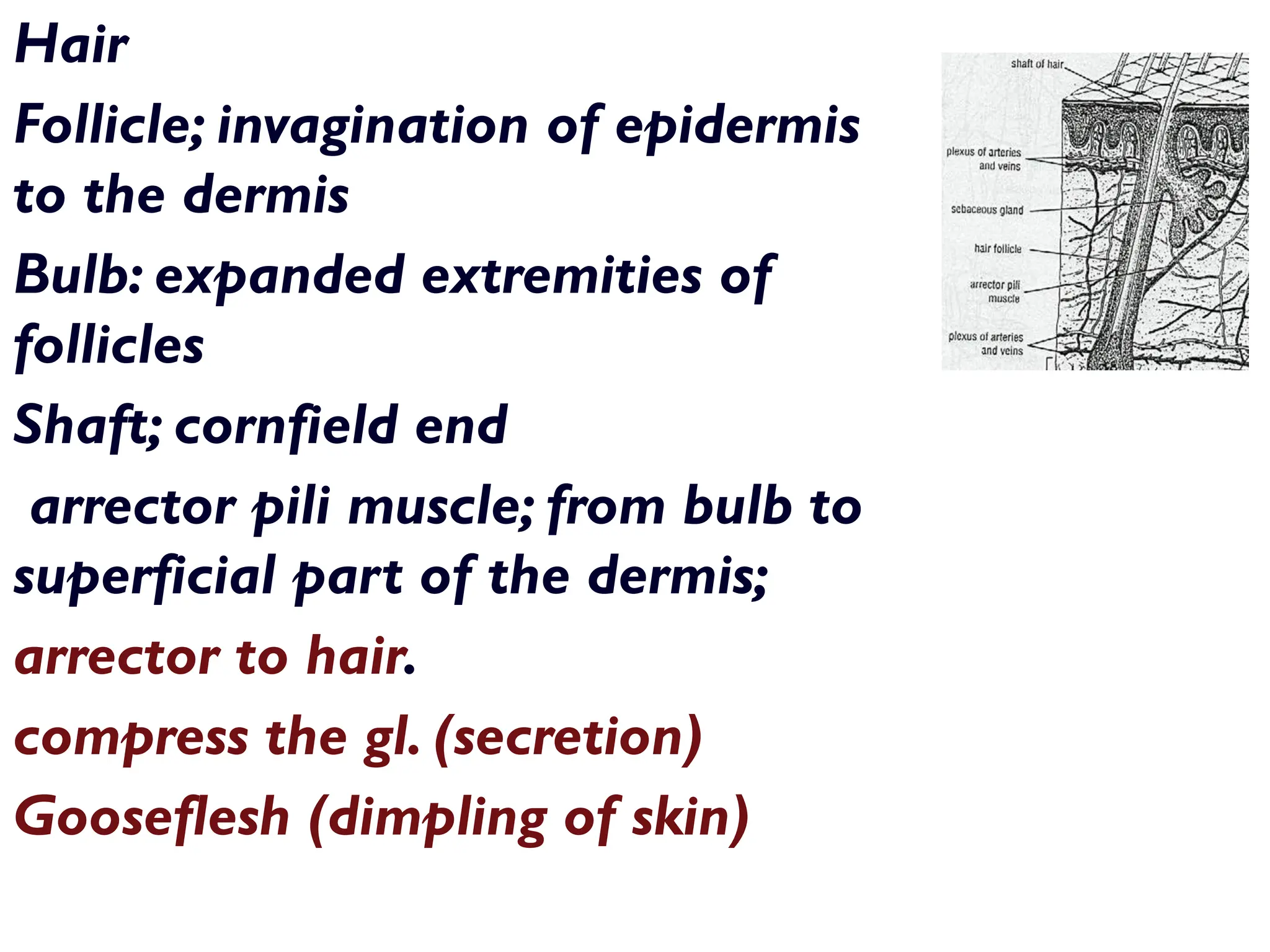
Hair
Follicle; invagination of epidermis
to the dermis
Bulb: expanded extremities of
follicles
Shaft; cornfield end
arrector pili muscle; from bulb to
superficial part of the dermis;
arrector to hair.
compress the gl. (secretion)
Gooseflesh (dimpling of skin)
Sebaceous gland; sebum for
flexibility of hair.
Sweat glands; long spiral
tubular,extend to
hypodermis.
Fascia ; (superficial & deep)
retinacula ; hold tendon in
position
Clinical notes
Line of cleavage: direction of collagen
fibers
Skin infection:
a- paronychia; nail bed infection
(streptococcus)
b- common boil ; hair follicle &
sebaceous glands
c- carbuncle; inflammation begins
with hair follicle then to superficial
fascia (staphylococcal)
Sebaceous cyst ;
abstraction mouth of ducts
Shock; pale skin and
gooseflesh, sympathetic
stimulation that cause
contraction of dermal
arterioles and erector pili
muscles.
Muscles
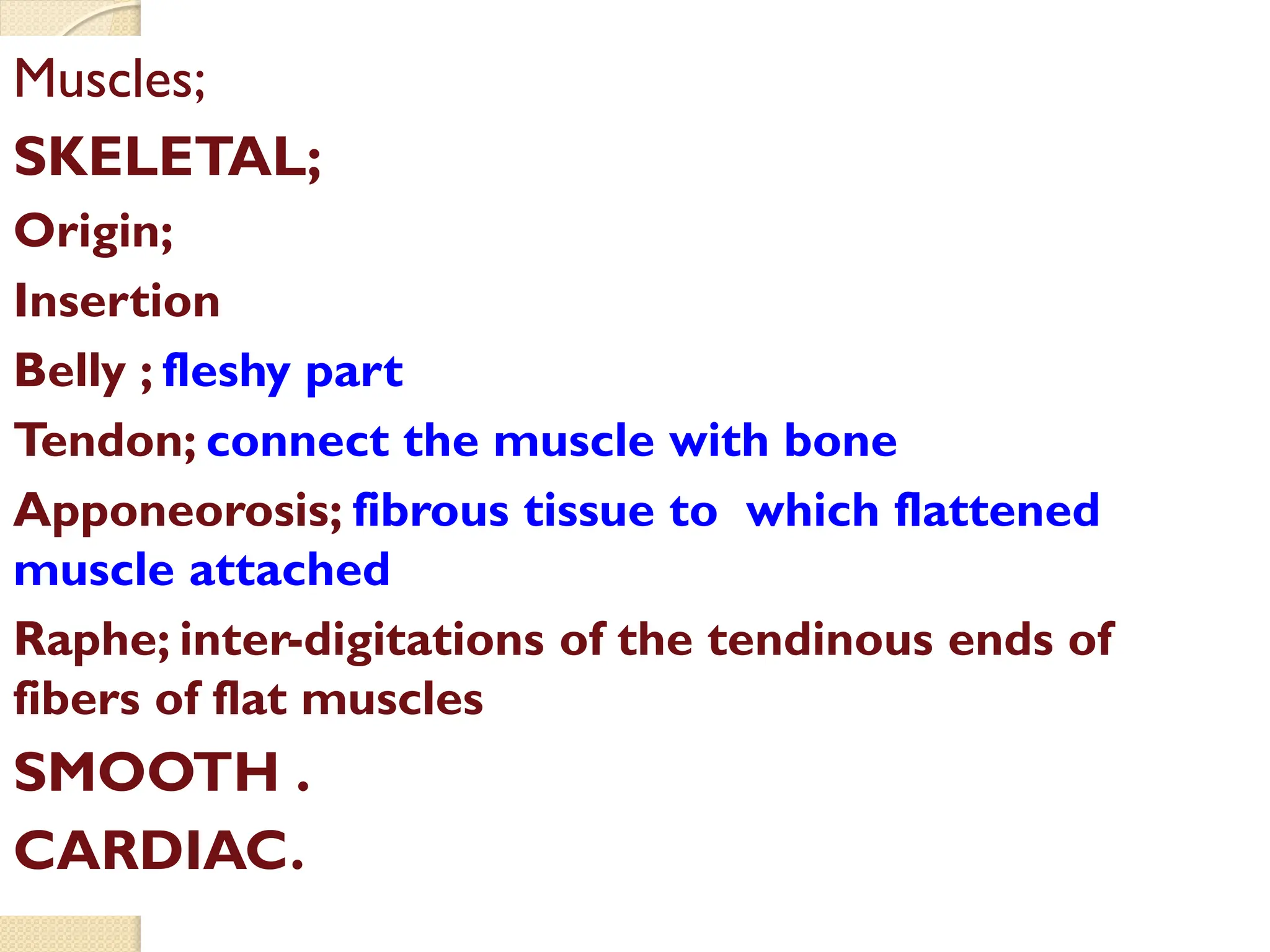
Muscles;
SKELETAL;
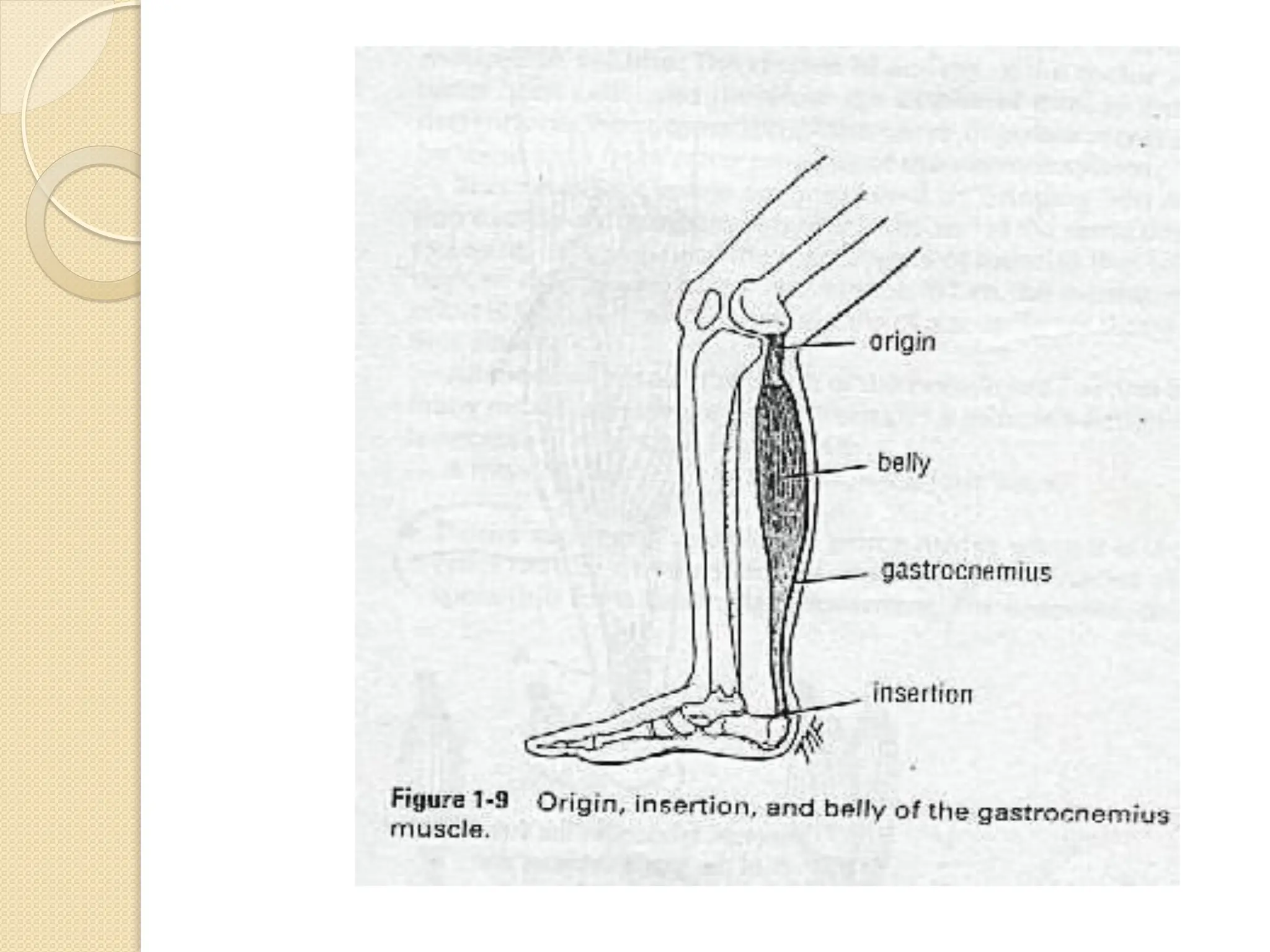
Origin;
Insertion
Belly ; fleshy part
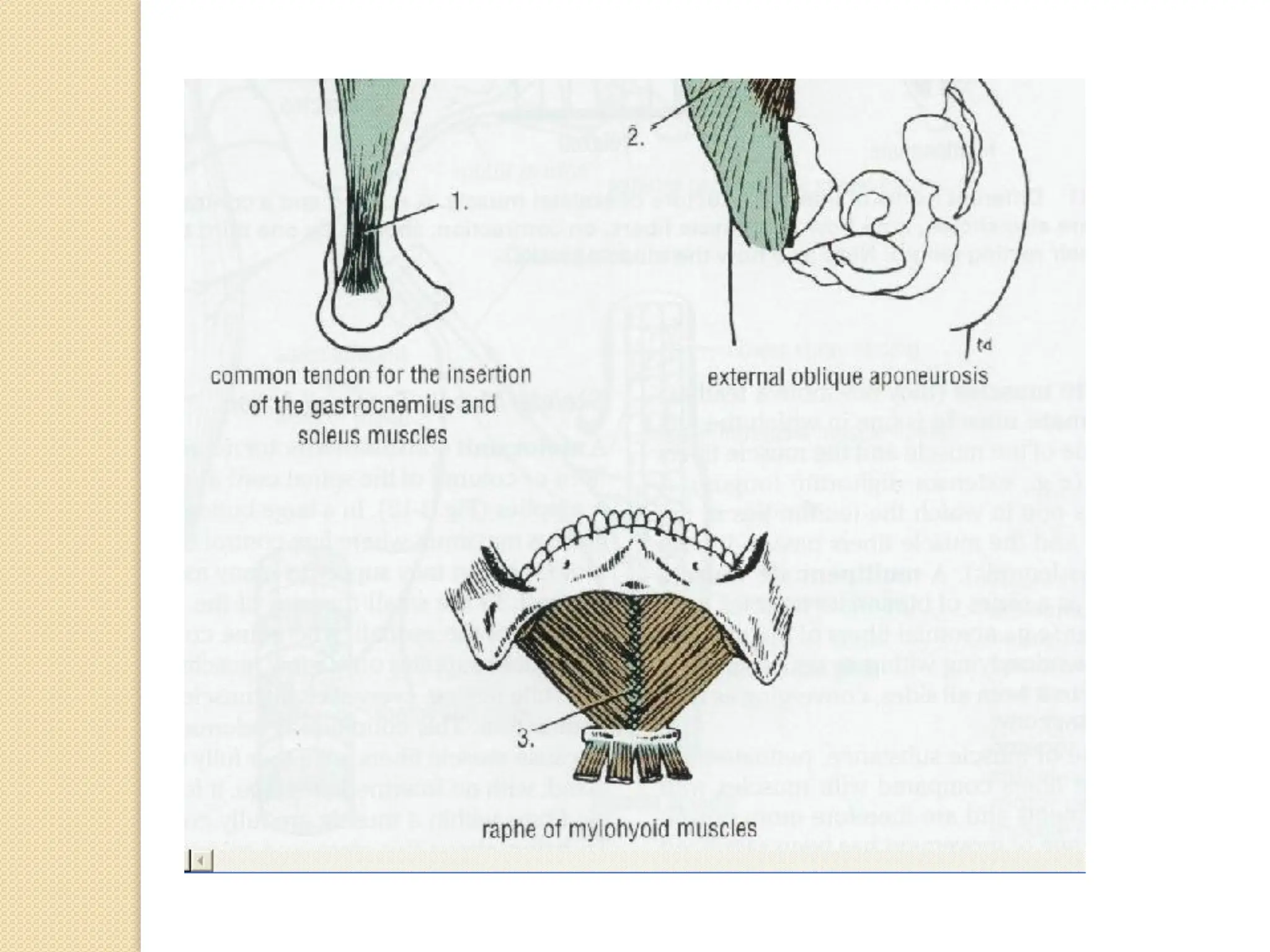
Tendon; connect the muscle with bone
Apponeorosis; fibrous tissue to which flattened
muscle attached
Raphe; inter-digitations of the tendinous ends of
fibers of flat muscles
SMOOTH .
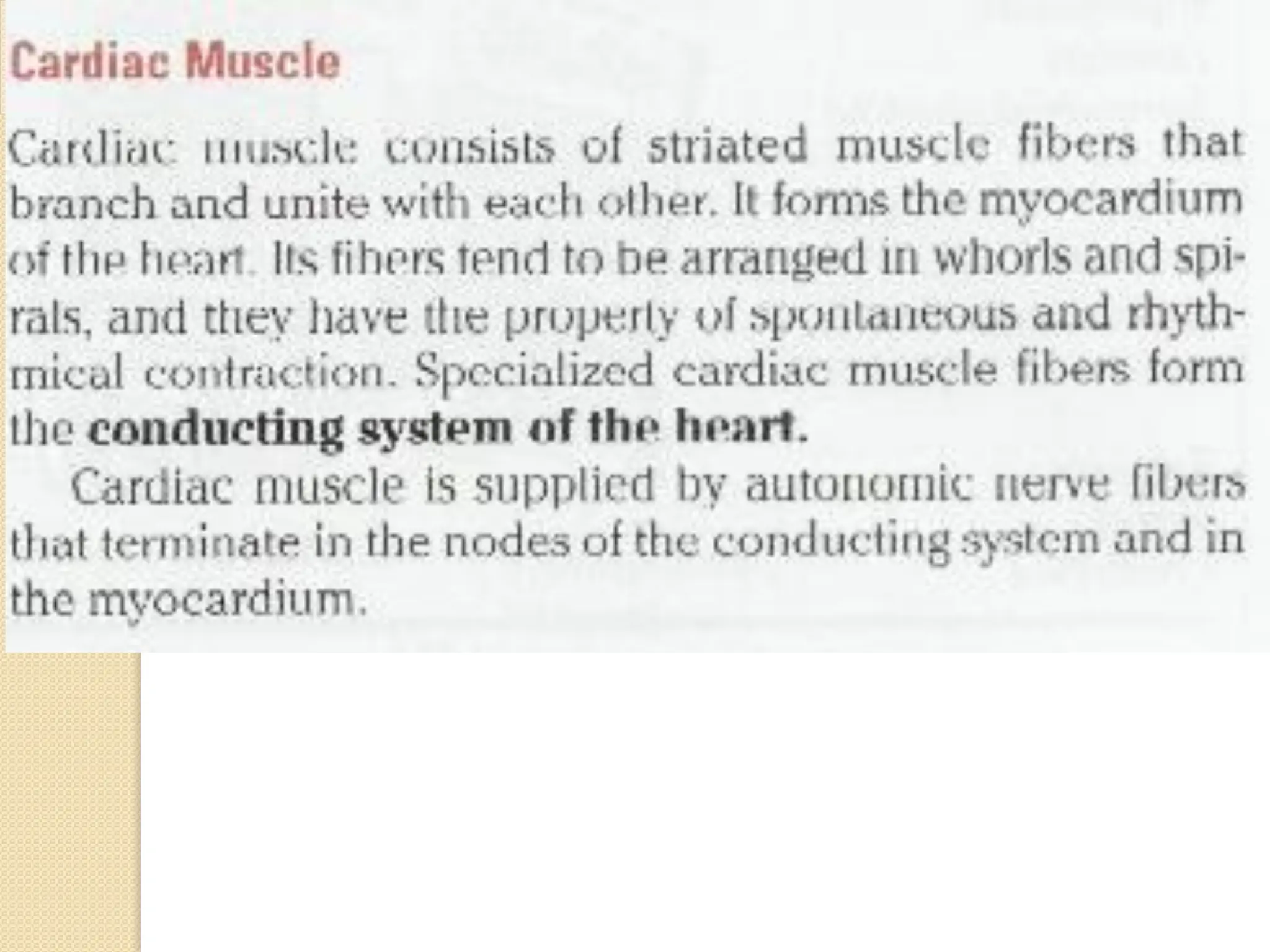
CARDIAC.
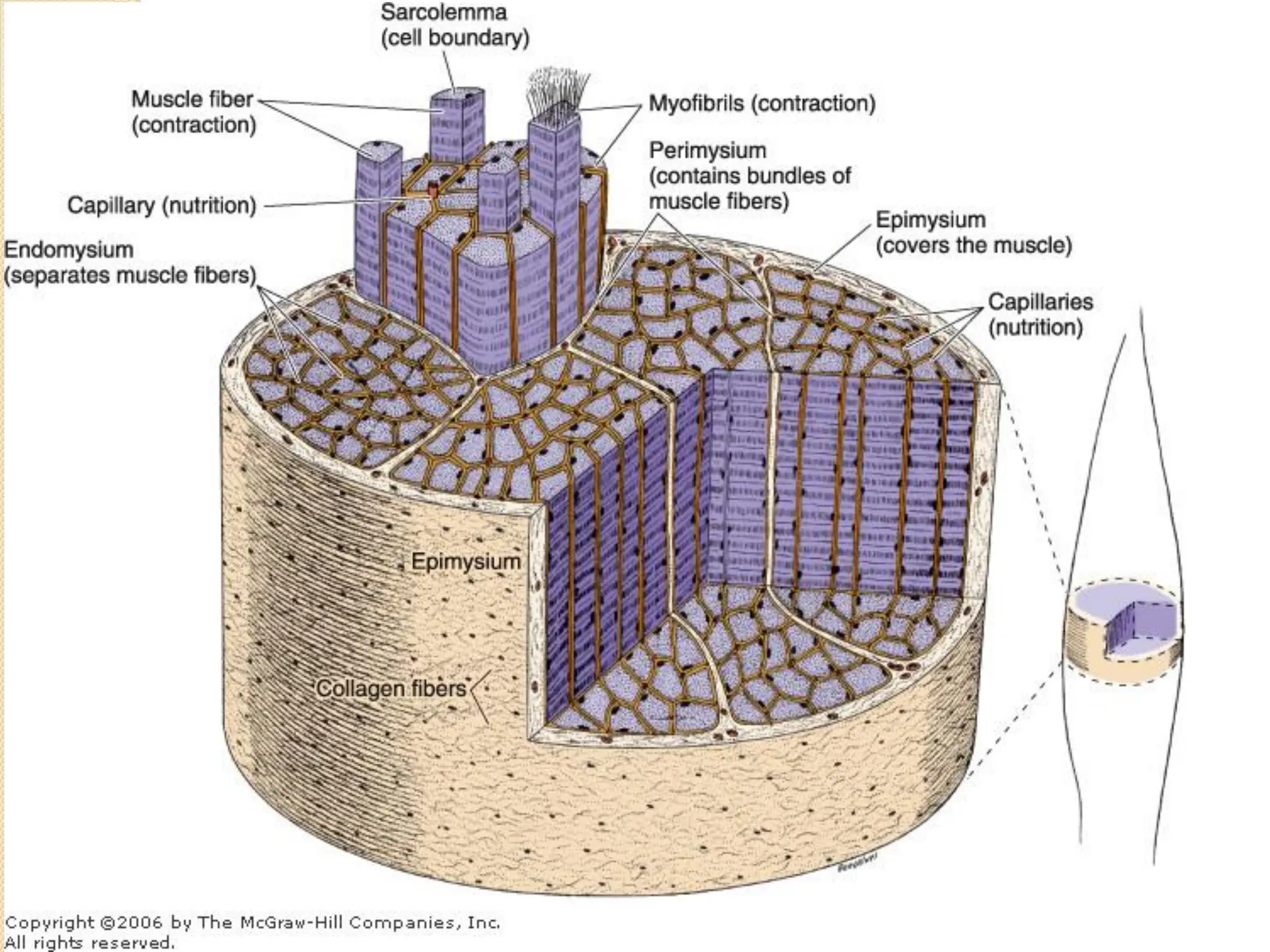
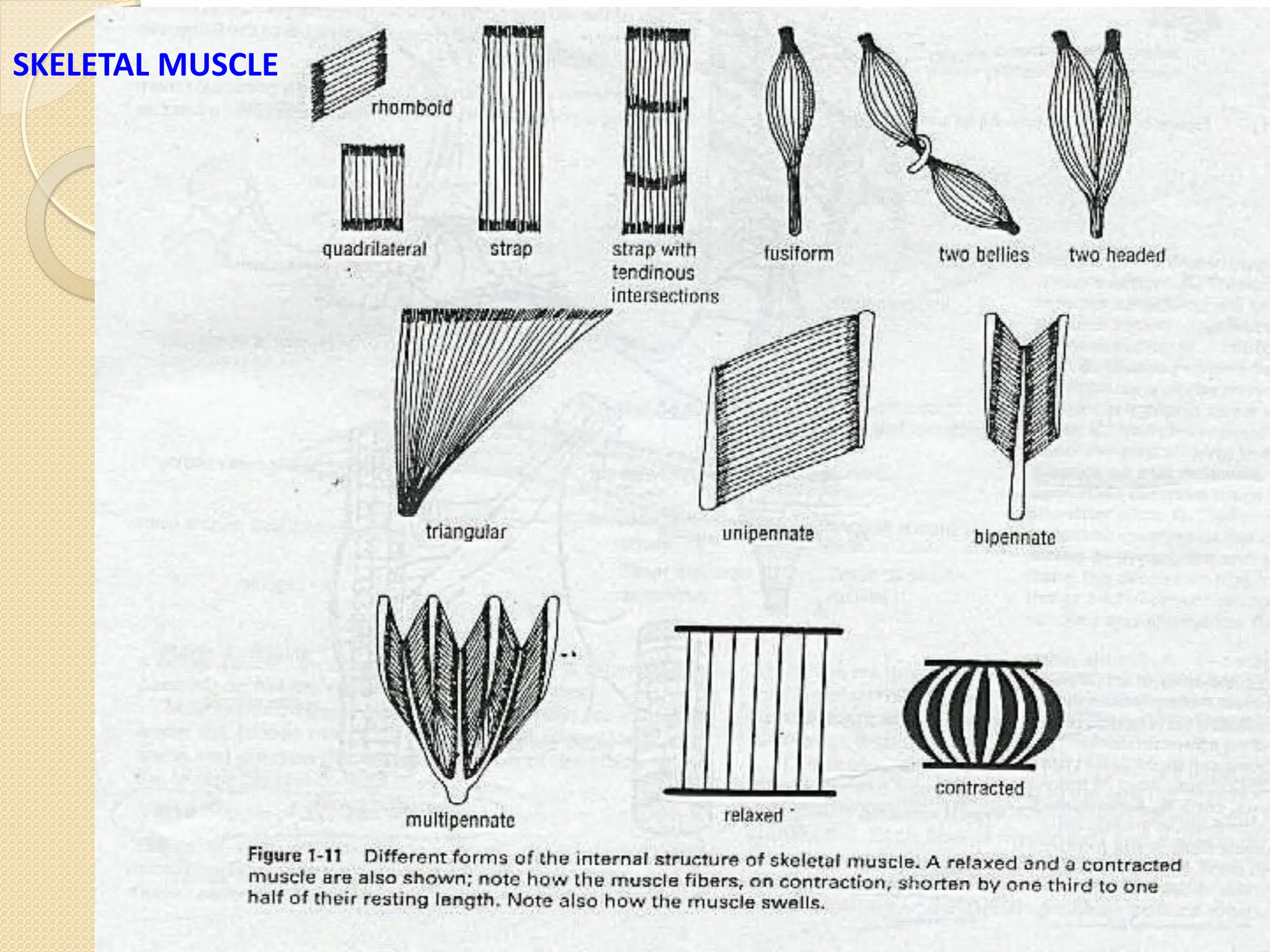
SKELETAL MUSCLE
Voluntary muscles
SKELETAL MUSCLE
Muscle tone;
partial
contraction
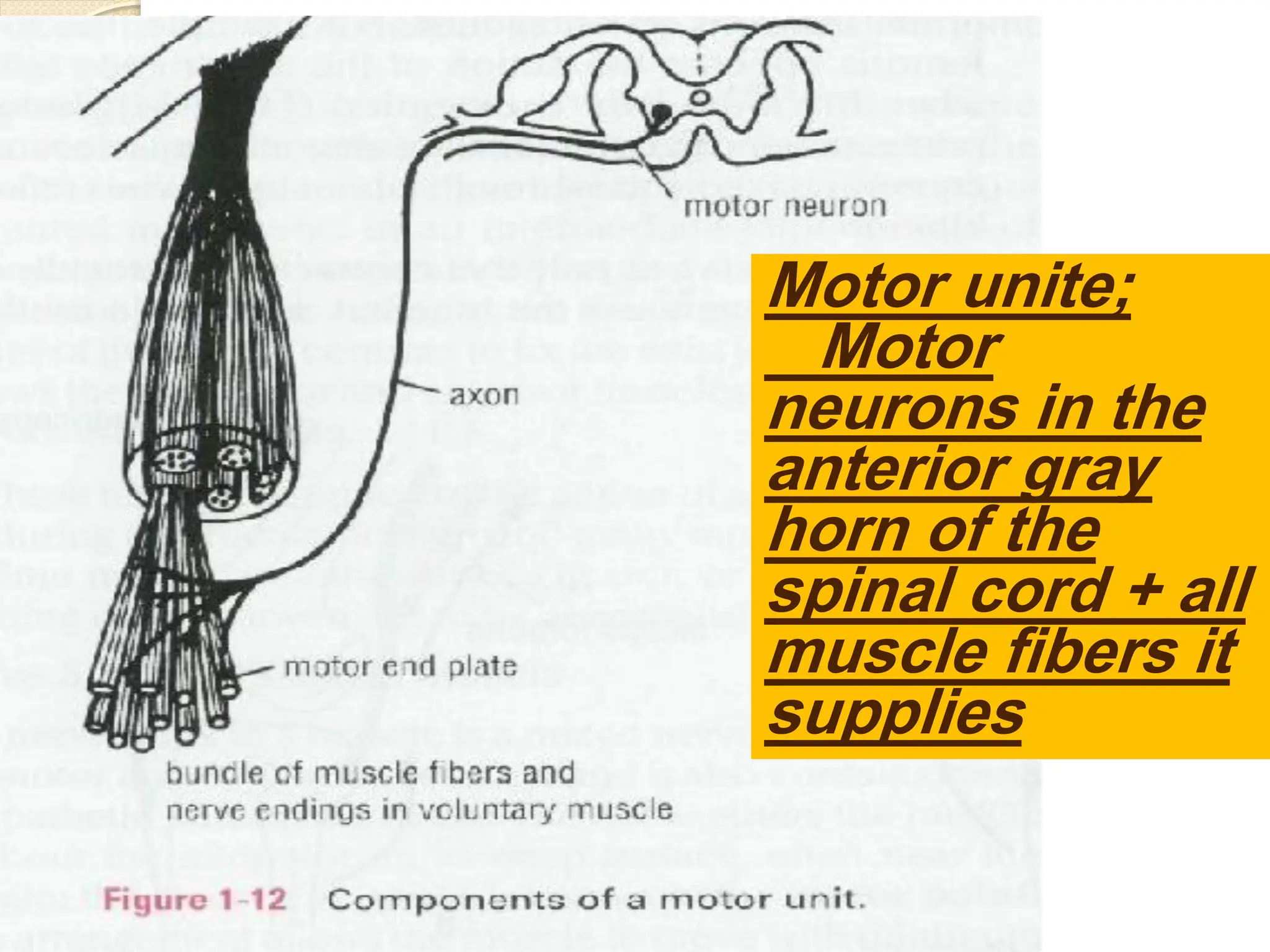
Motor unite;
Motor
neurons in the
anterior gray
horn of the
spinal cord + all
muscle fibers it
supplies
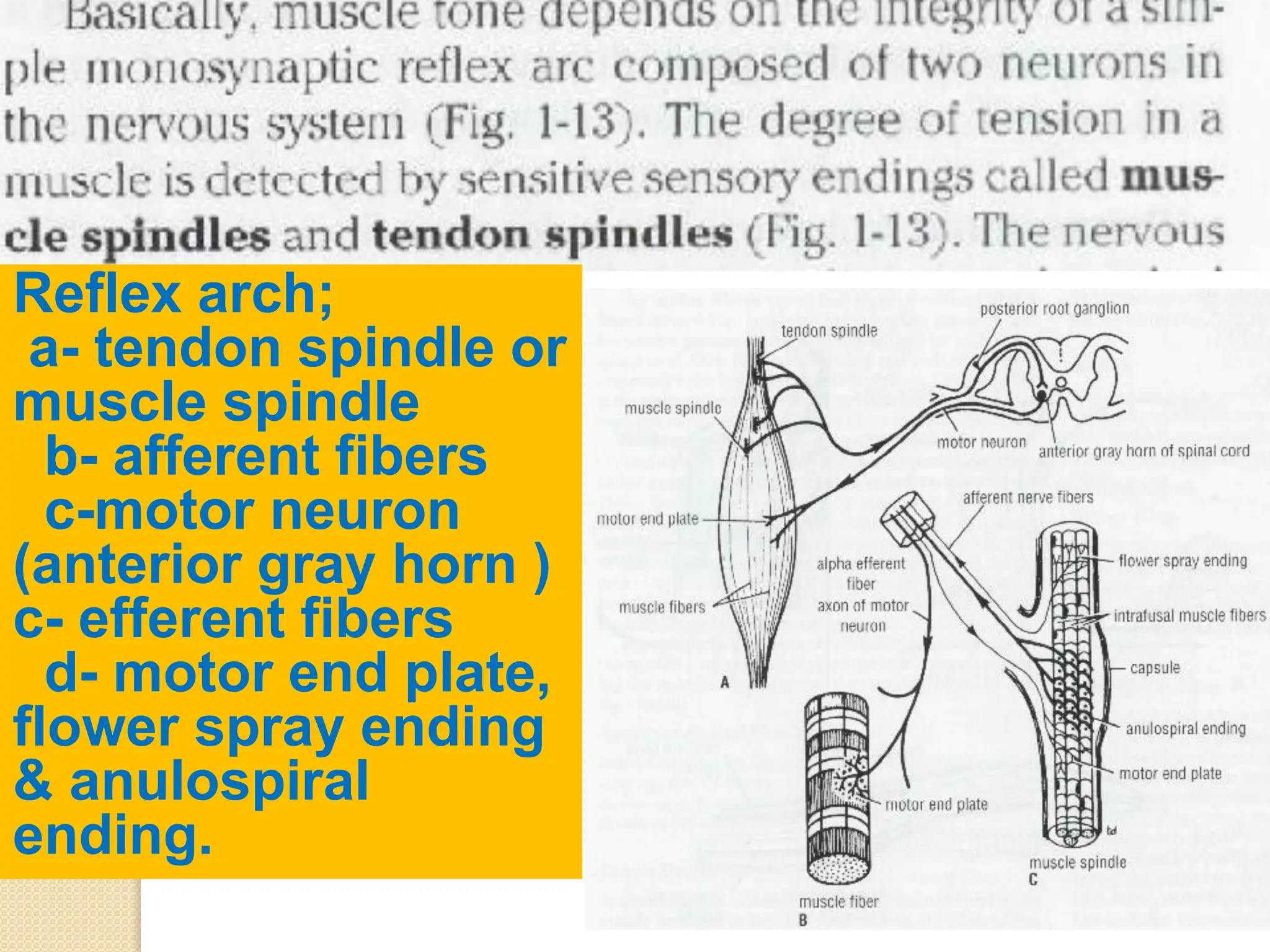
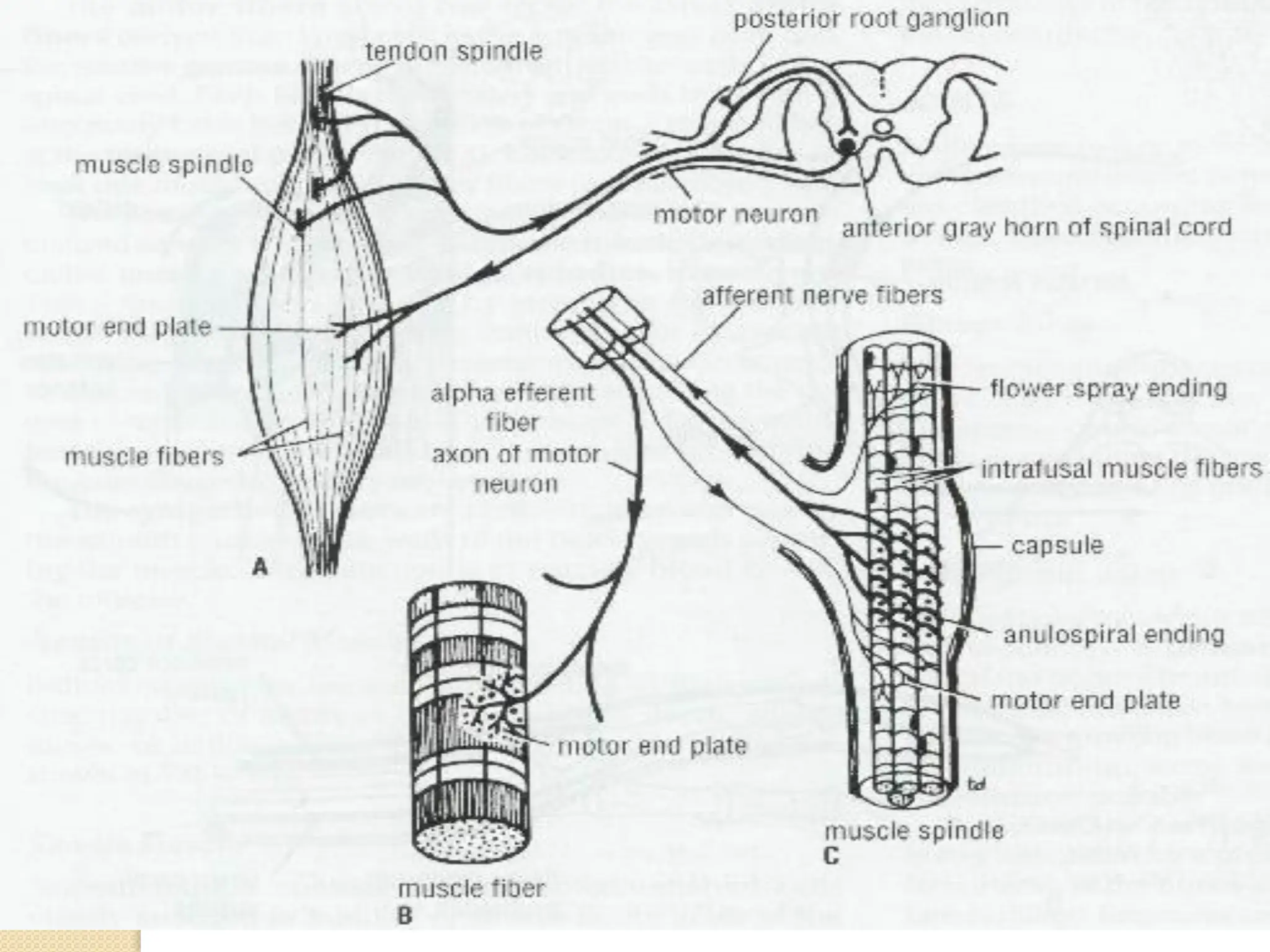
Reflex arch;
a- tendon spindle or
muscle spindle
b- afferent fibers
c-motor neuron
(anterior gray horn )
c- efferent fibers
d- motor end plate,
flower spray ending
& anulospiral
ending.
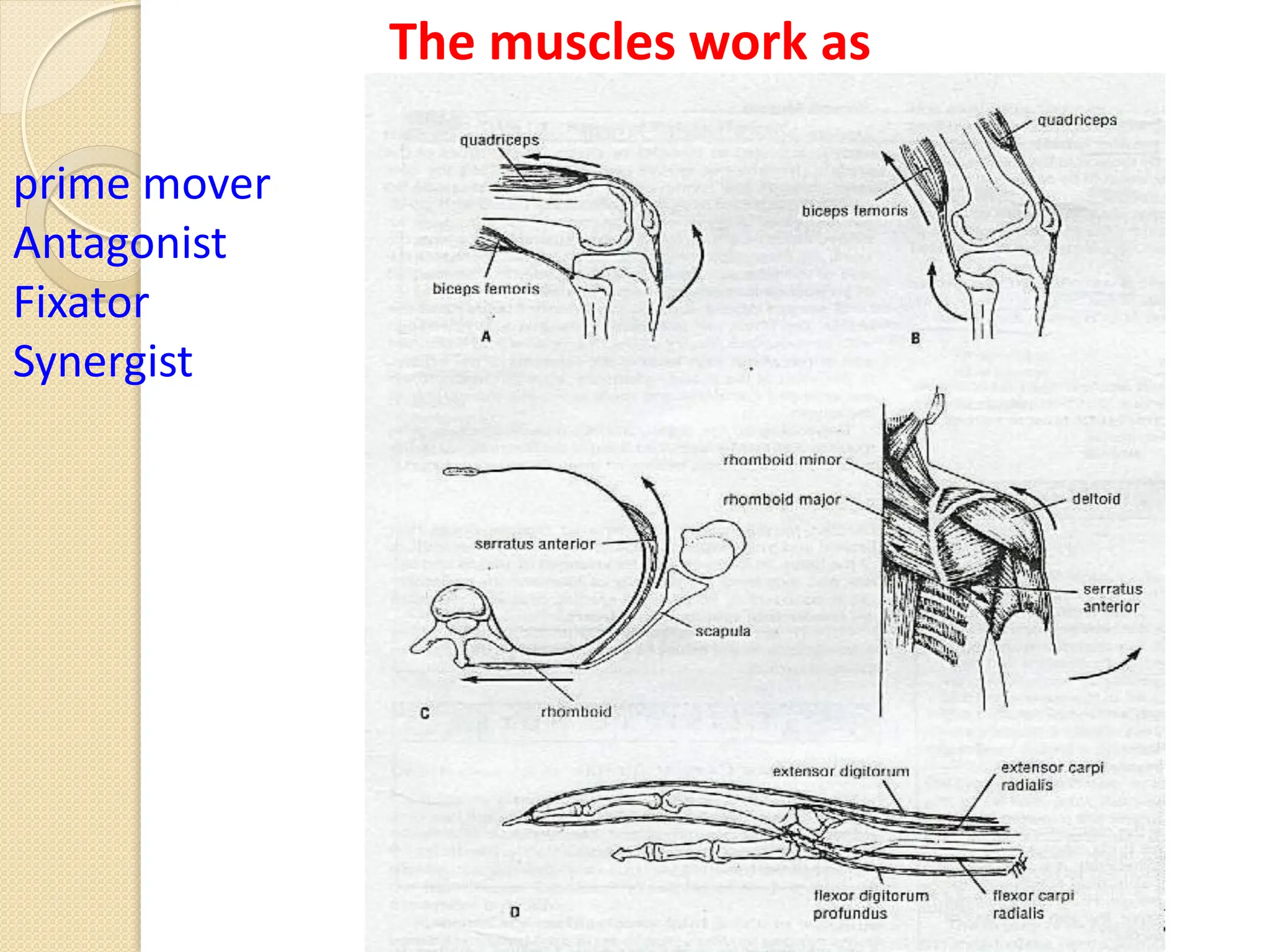
The muscles work as
prime mover
Antagonist
Fixator
Synergist
Nerve supply of skeletal muscles ;
Trunk; inner muscle midpoint on deep surface
(motor point)
peripheral nerves
60 % motor
40 % sensory
some autonomic
Alfa fibers : from large neurons
Gamma fibers; smaller neurons
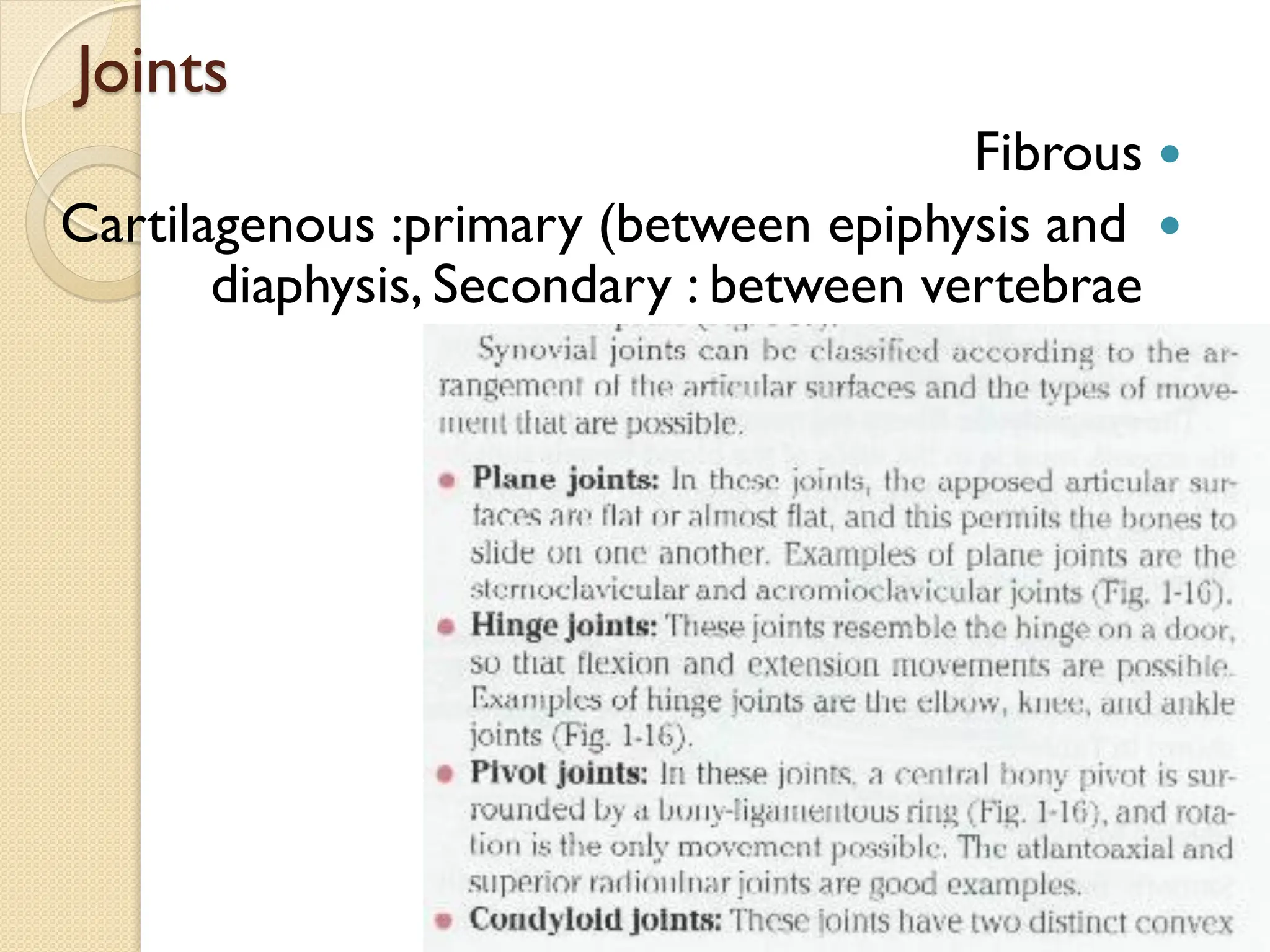
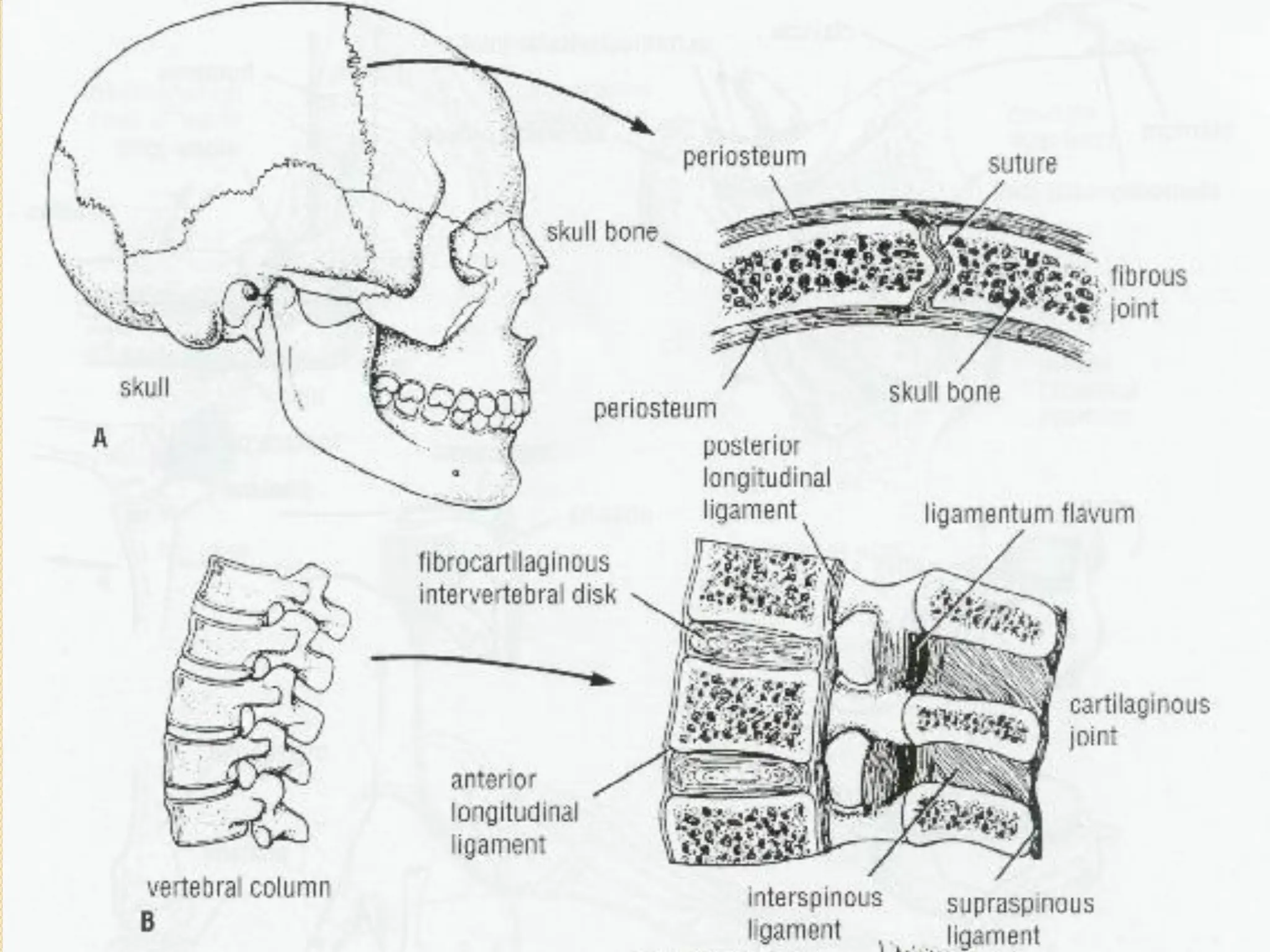
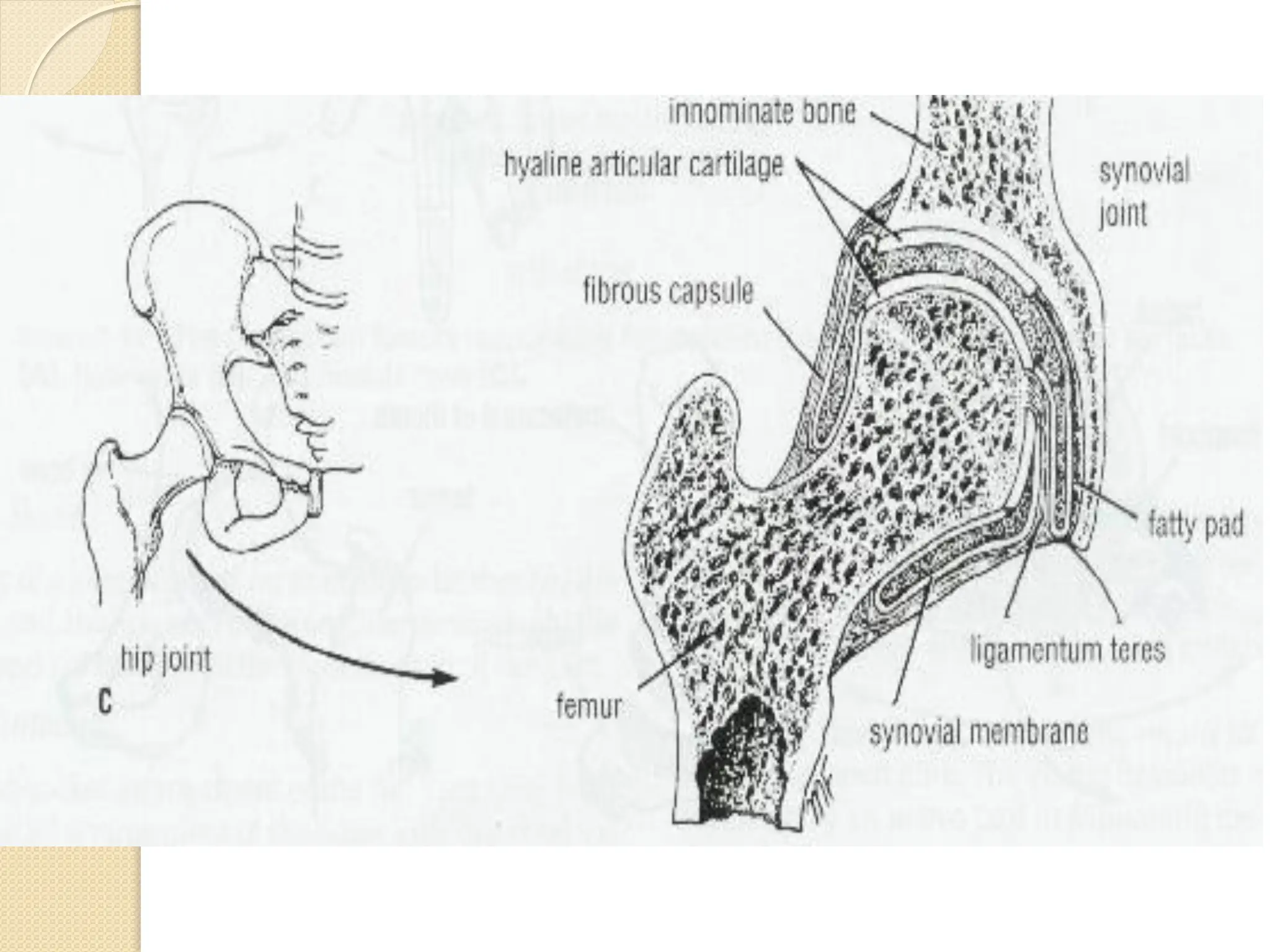
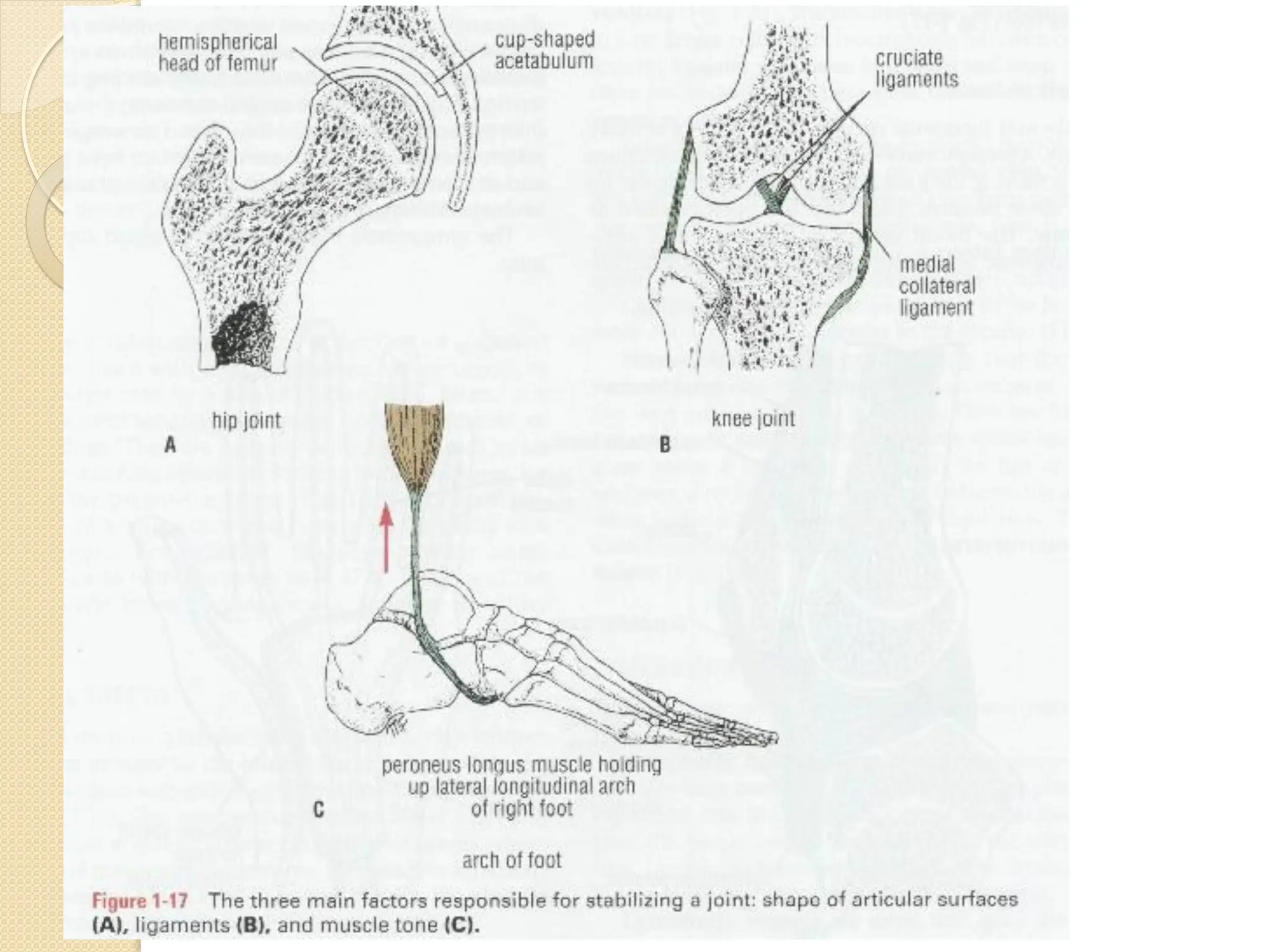
Joints

Fibrous

Cartilagenous :primary (between epiphysis and
diaphysis, Secondary : between vertebrae

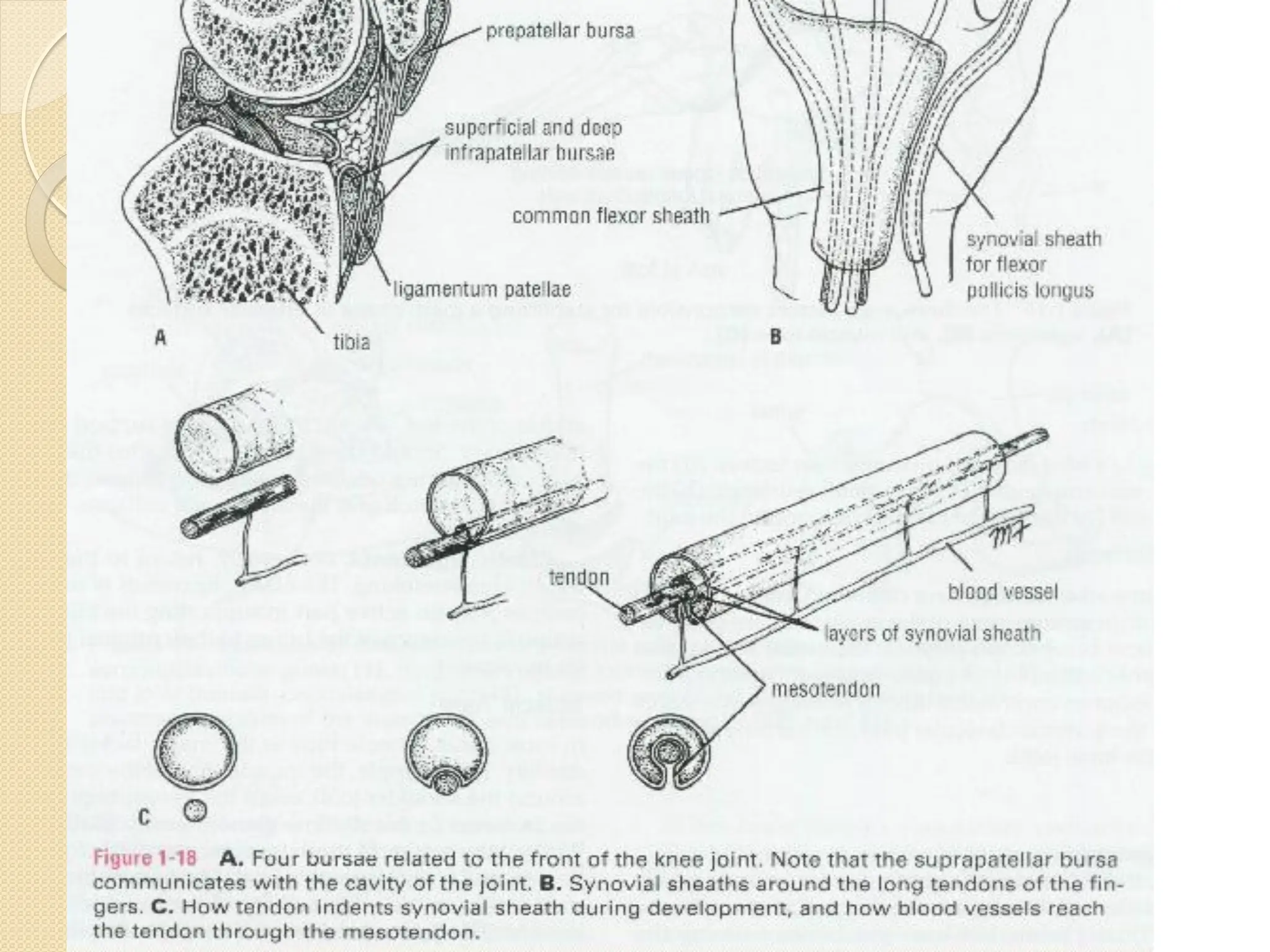
Synovial : knee
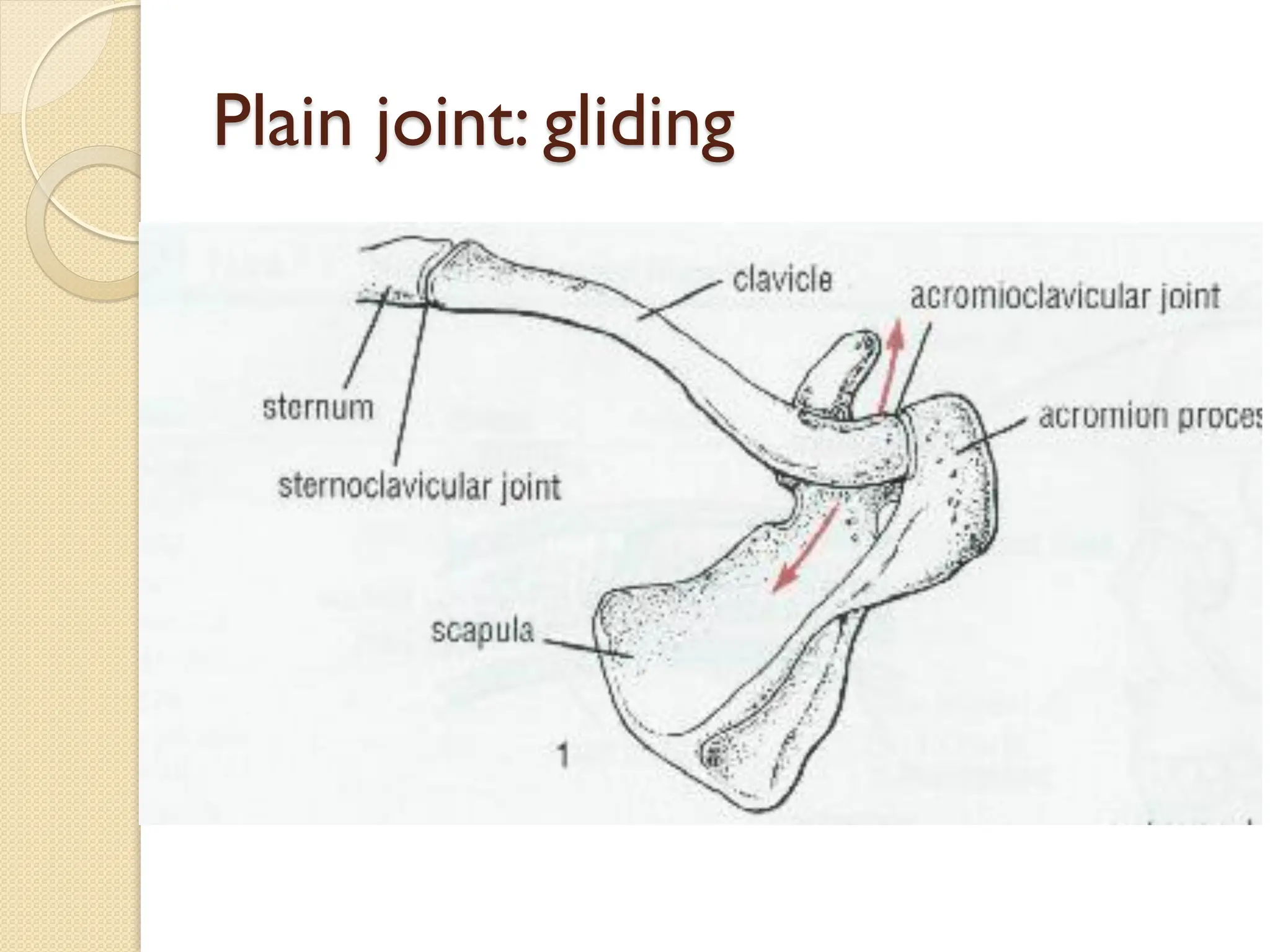
Plain joint: gliding
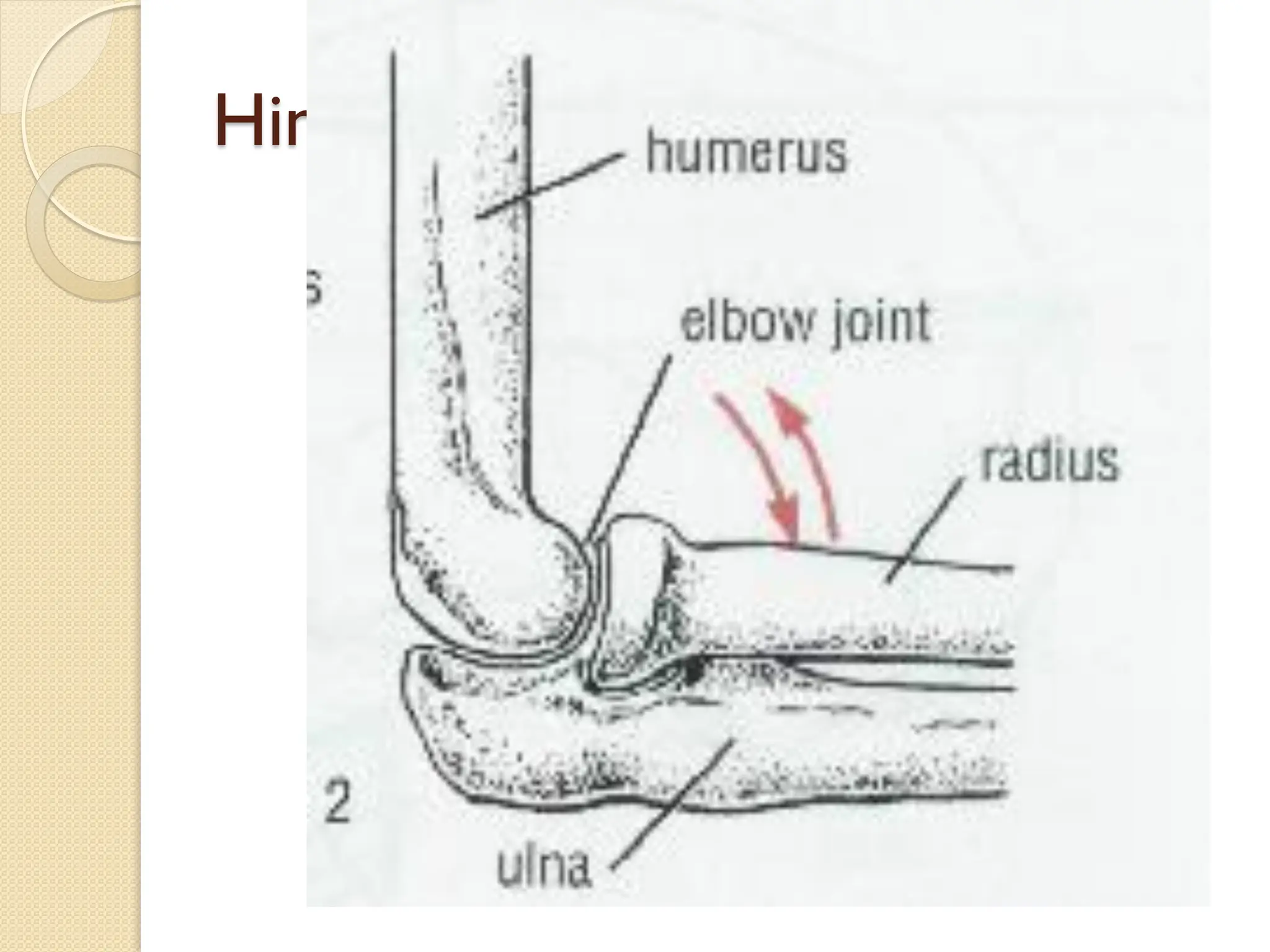
Hinge
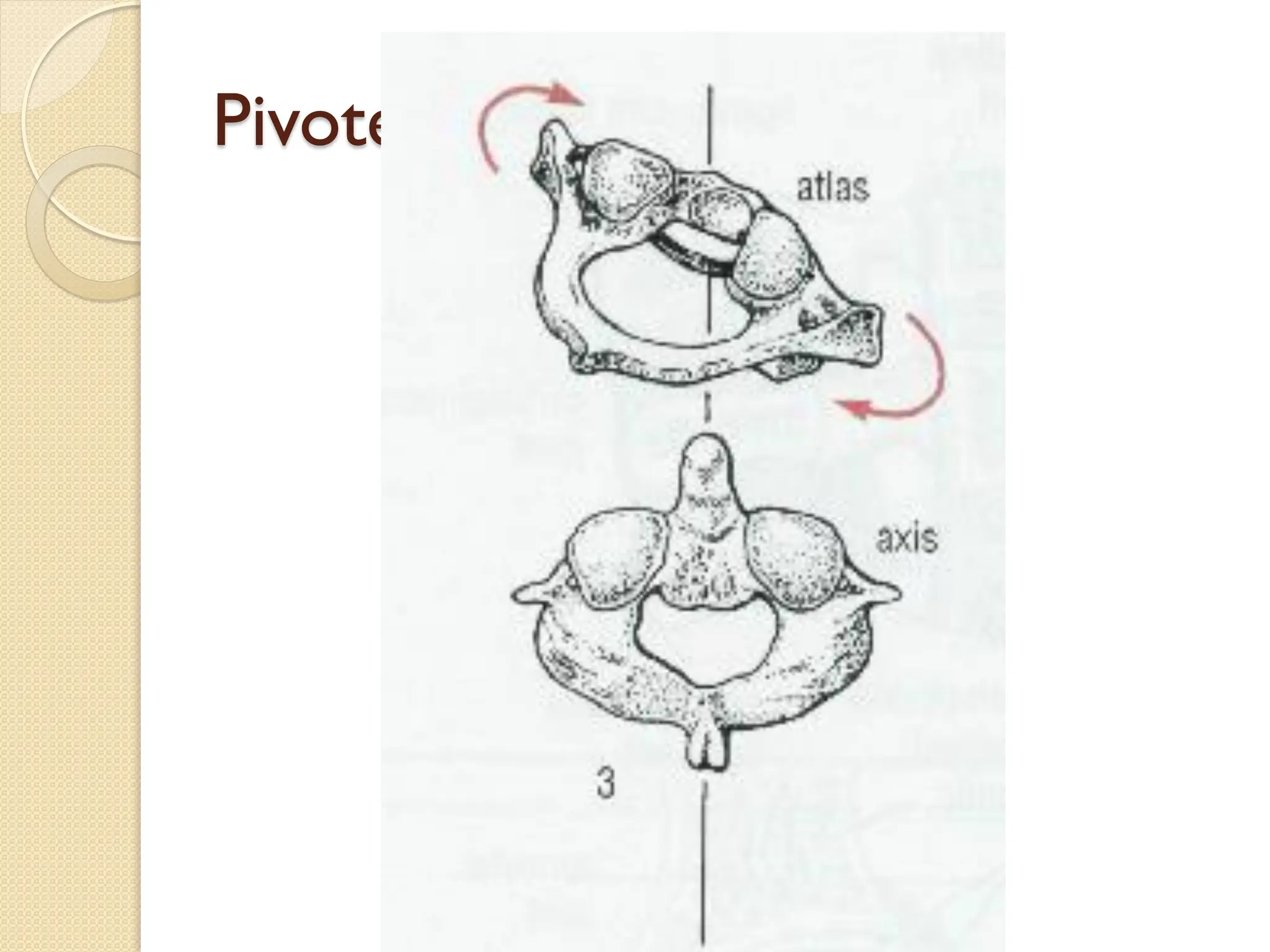
Pivote
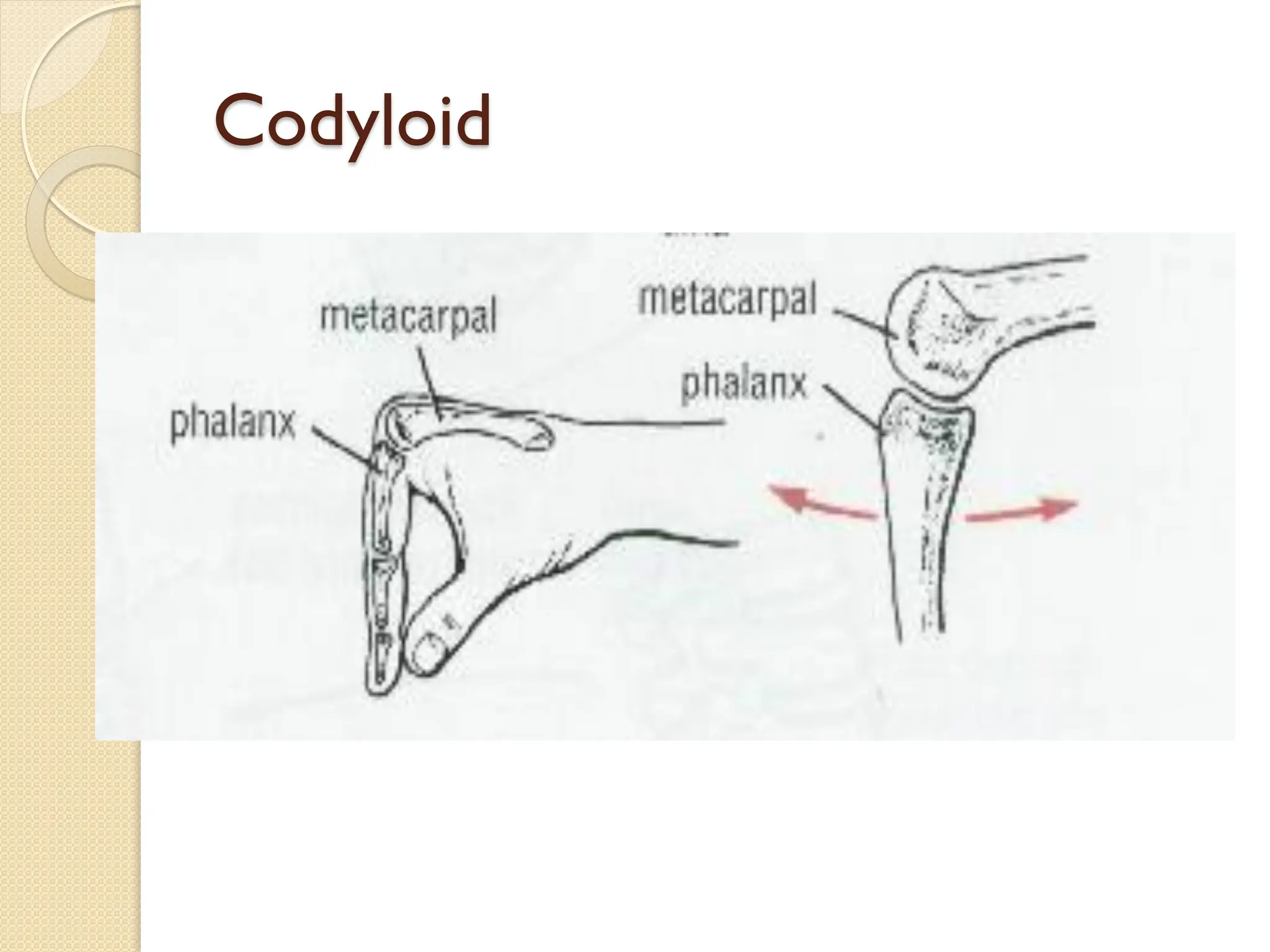
Codyloid
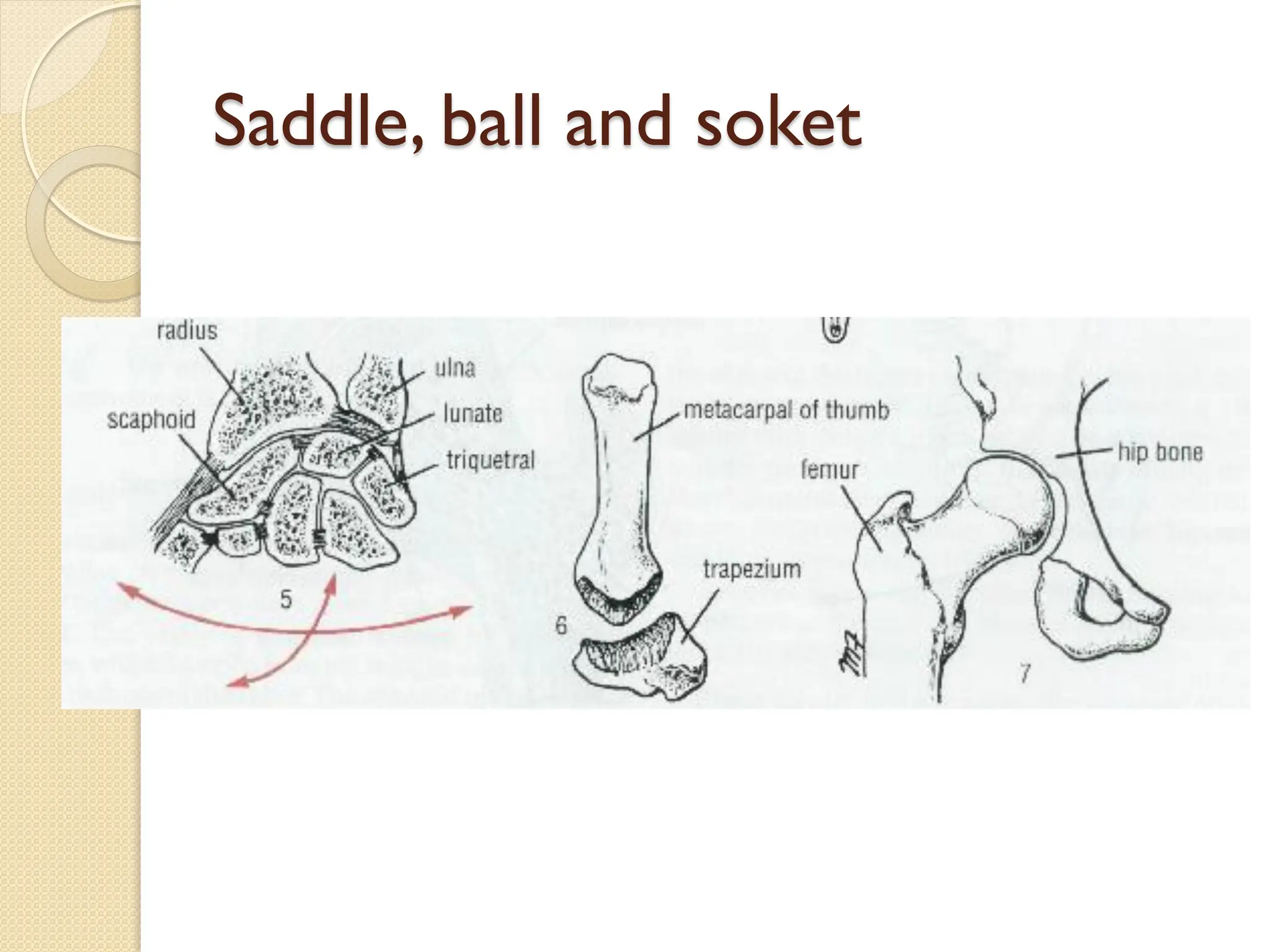
Saddle, ball and soket
Ligaments

Elastic : support the ossicles

Fibrous : feet
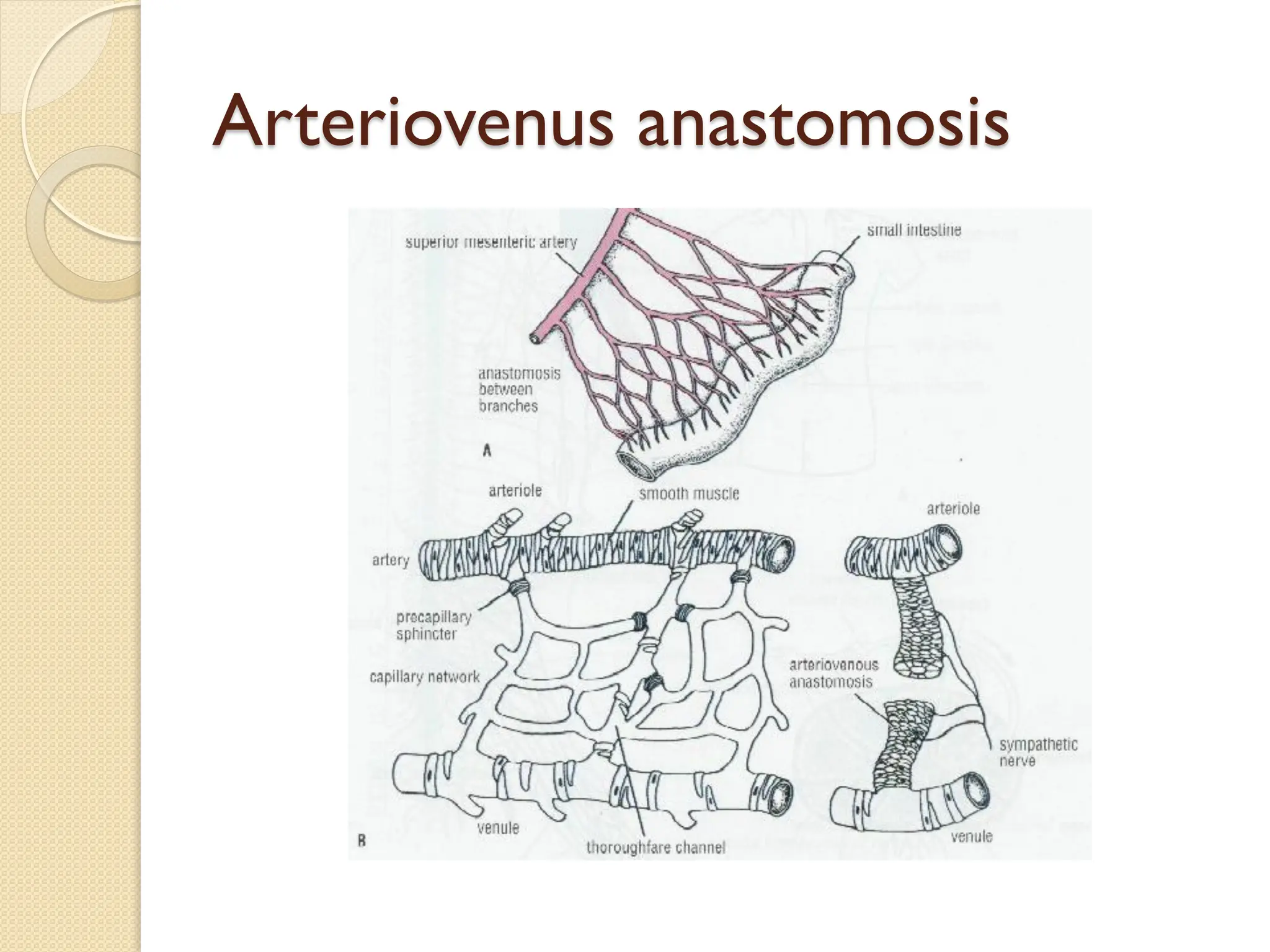
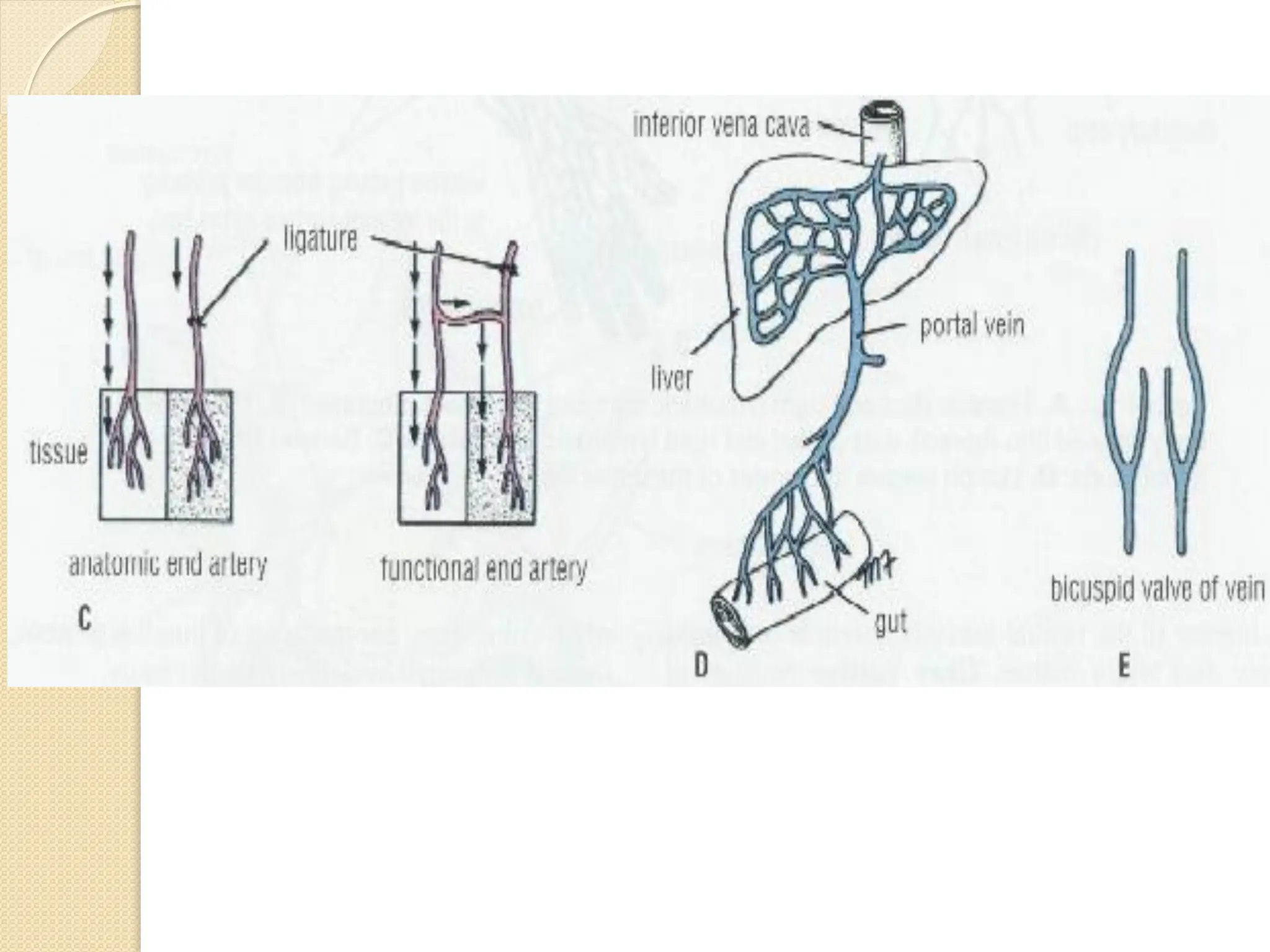
Arteriovenus anastomosis
Lymphatic system
Lymph nodes
CNS,
PNS
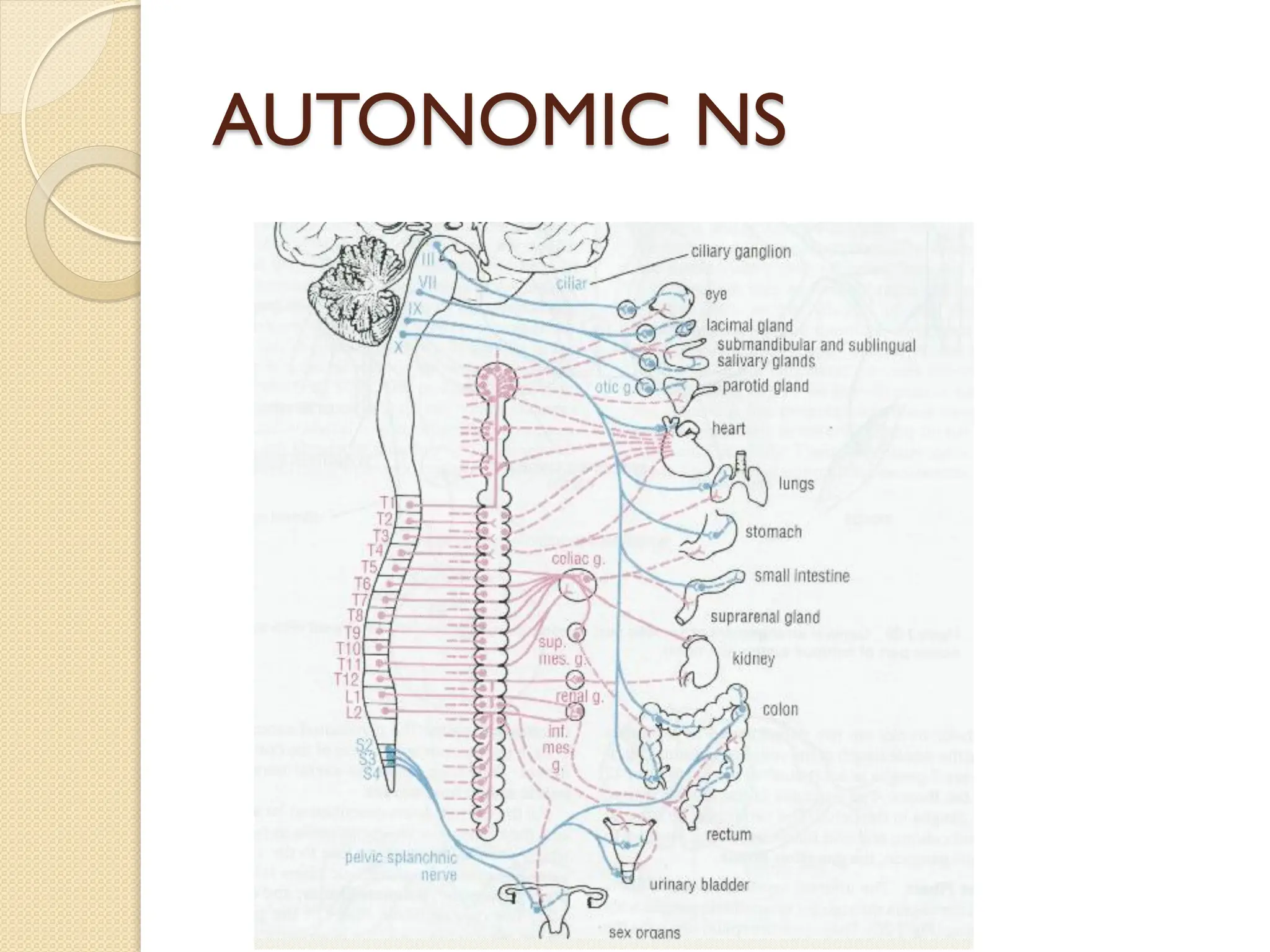
AUTONOMIC NS
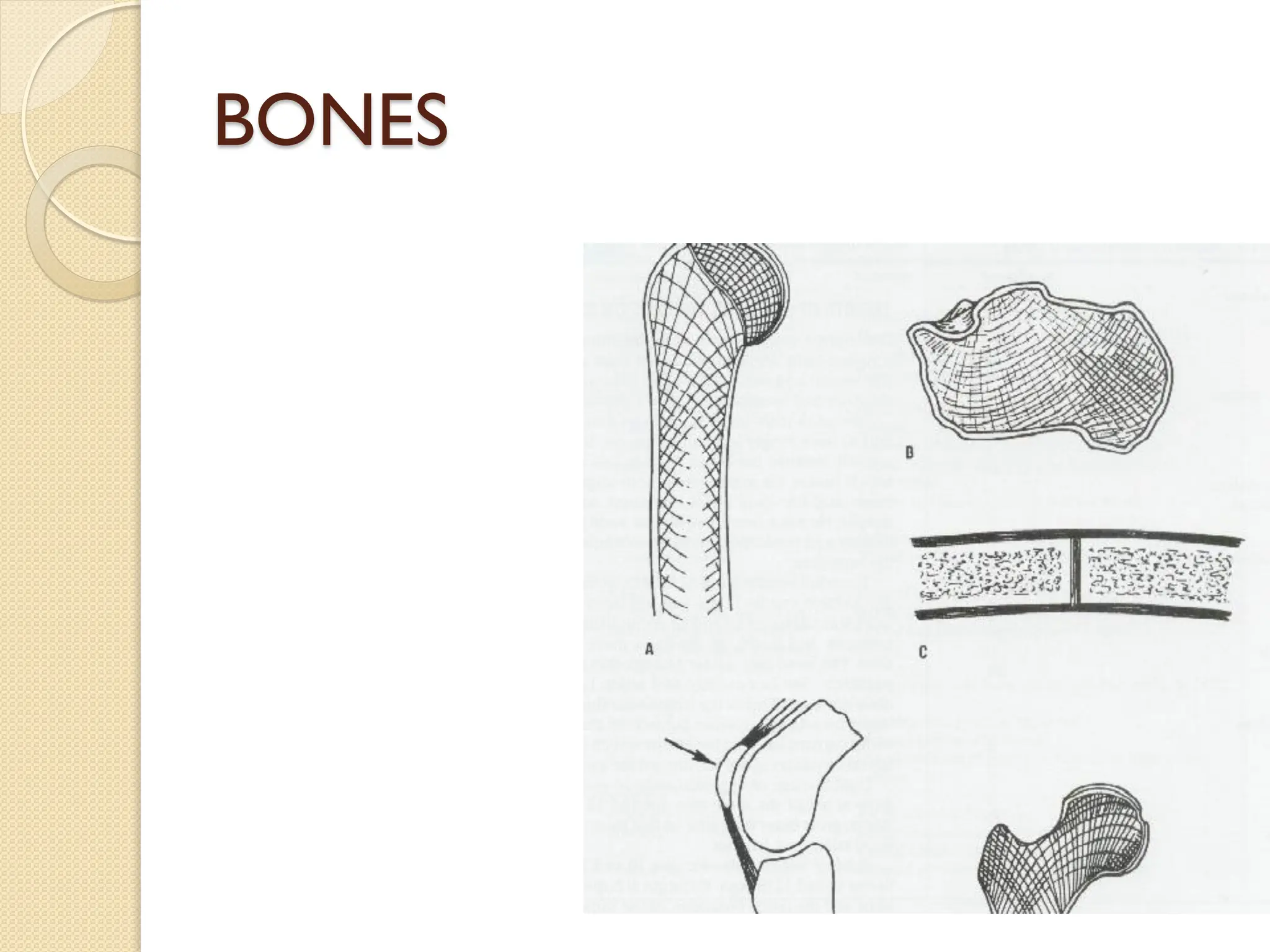
BONES

CLASIFICATION
Lecture1 - Introduction.pdfygygyttytygygy6g67g76y76y76h

Lecture1 - Introduction.pdfygygyttytygygy6g67g76y76y76h

  • 1.
    Prof. Dr. TalibJawad Anatomy introduction Clinical Anatomy by Regions - Richard S. Snell
  • 2.
  • 6.
    Basic anatomical informationfor Successful diagnosis what are the new in this edition
  • 7.
    Tables , pediatricanatomy , abnormality, concentrate on more parts exposed to accidents , CT, Mri,
  • 8.
  • 9.
  • 16.
  • 22.
  • 25.
    career, ‫المهنة‬ automation, ‫الية‬ unprecedented, ‫مسبوق‬‫غير‬ Circumstances ‫ظروف‬ Carry ‫يحمل‬ Converse ‫مناقشة‬
  • 26.
    Anatomy Definition Anatomy is thestudy of structure and functions of the body parts (its one of the oldest basic medical science , firstly studied in Egypt 500B.C.) Term Anatomy refer to cutting up or taking a part. Modern anatomy = functional anatomy , so anatomy is the structure in which the function of life occur . Basic Anatomy
  • 27.
    Approaches of studyinganatomy  1-Regional Anatomy ( Topographical anatomy) *** Regional Anatomy (it’s the method of studying the body's structure by focusing attention on a specific parts . e.g., the head – region the face ), Conceders the organization or major parts as segments of human body based on form & mass. main body parts consisting of Head – neck, trunk (subdivided into thorax , abdomen , back) &(pelvisperineum ) & paired upper limbs & lower limbs .
  • 28.
    All the majorparts may be further subdivided into regions & zones Regional anatomy also recognizes the body's organization by layers : skin , subcutaneous tissue & deep fascia covering the deeper structures of muscles , skeleton & cavities which contain viscera (internal organs)
  • 29.
    : is an Surfaceanatomy *** essential part of the study of regional anatomy , we can learn much by observing the external form & surface of the body & observing or feeling the superficial aspects of structures beneath its surface
  • 30.
    2-Systemic anatomy *** recognizesthe organization of the body's organs into system or collective apparatuses that work together to carry out complex functions so it’s a study of the functional systems of the body
  • 31.
    The body systeminclude system Integumentary (dermatology ) consist of the skin & its appendages ( hair, nails , sweat glands ) consist ) Osteology ( Skeletal system of bones and cartilage ,, its provides our basic shape & support for the body & its what the muscular system acts on to produce movement , also it protect vital organs .
  • 32.
    Articular system (arthrology) consist of joints & their associated ligaments , connecting the bony parts of the skeletal system & providing the sites at which movement occur. Muscular system ( Myology) , consist of muscles that act (contract) to move or position parts of the body.
  • 33.
    Nervous system (Neurology) ,consist of CNS (brain &spinal cord) and PNS (nerves& ganglia ,together with their motor & sensory ending ) the nervous system controls & coordinates the functions of the organ system enabling the body's responses to activities within its environments .
  • 34.
    Digestive system oralimentary system (gastroenterology ) consist of the organs & glands associated with ingestion , mastication (chewing) , deglutition (swallowing) , digestion & absorption of food & the elimination of feces remaining after nutrients have been absorbed.
  • 35.
    Circulatory system (angiology ) consist of cardiovascular & lymphatic system , which functional in parallel to transport body fluid . A- cardiovascular system (Cardiology ) , consist of heart & blood vessels that propel & conduct blood through the body ,delivering oxygen , nutrient , & hormones to cells & remove waste product.
  • 36.
    B- lymphatic systems, it’s a network of lymphatic vessels that withdraw excess tissue fluid (lymph) from the body's interstitial (intercellular) fluid compartment , filters it through lymph nodes & returns it to the body stream .
  • 37.
    Respiratory system (pulmonology ) consist of the air passages & lungs that supply oxygen to the blood for cellular respiration & eliminate carbon dioxides from it. Diaphragm & larynx control the flow of air through the system ,which may also produce tone in the larynx that is further modified by tongue , teeth , &lips into speech
  • 38.
    Urinary system (urology)consist of the kidneys ,ureters, urinary bladder & urethra ,which filter blood & subsequently produce , transport , store & intermittently excrete urine
  • 39.
     Reproductive or genitalsystem ( gynecology for female & andrology for male) consist of gonads that produce oocytes & sperms , & the duct that transport them .  Endocrine system ( endocrinology) consist of discrete ductless glands as well as isolated & clustered cells of the gut & blood vessel walls & specialized nerve ending that secret hormones  3- Clinical Anatomy (applied anatomy )
  • 40.
  • 41.
    Anatomical planes The medianplane : the vertical plane passing longitudinally through the body ,divides the body into right & left halves .The plane intersects the midlines of the anterior & posterior surface of the body .its often erroneously used as a synonym for the median plane.
  • 42.
    Sagittal plane: arevertical plans passing through the body parallel to the median plane. Its helpful to give a point of reference by naming a structure intersected by the plane you are referring to.
  • 43.
    The term midsagittalplane is superfluous term for the median plane. Parasaggittal ,commonly used by neuroanatomists & neurologists ,is also unnecessary because any plane parallel & to either side of the median plane is sagittal by definition ( however a plane parallel & near to the median plane may be referred to as a Para median plane
  • 44.
    : are Frontal (coronal)plane vertical planes passing through the body at right angles to the median plain ,dividing the body into anterior (front) and posterior (back) parts.Again a point of reference is necessary to indicate the position of the plane (e.g. a frontal plane through the heads of mandible
  • 45.
    Transverse plane :are plane passing through the body at right angles to the median & frontal planes divided the body into superior (upper) & inferior (lower) parts . Its helpful to give a reference point to identify the level of the plane such as (transverse plane through the umbilicus).
  • 46.
  • 47.
    Type of sectioning Longitudinalsection : run lengthwise or parallel to the long axis of the body or any of its parts & the term applies regardless of the position of the body . Transverse section (cross section ) : are slices of the body or its parts that are cut at right angles to the longitudinal axis of the body or any of its parts . Oblique sections : are slice of the body or any of its parts that are not cut along one of the previously mentioned anatomical planes .
  • 48.
    Anatomic position :that positionin which the person standing erect ,with the upper limbs by the sides and the face and palms of the hands directed forward . TERMS REALATED TO POSITION
  • 49.
    Superficial Deep Internal external Anteriorposterior Palmer dorsal Ipsi lateral contra lateral Supine prone Lateral flexion of trunk Abduction adduction Protraction retraction
  • 50.
  • 56.
  • 57.
    SKIN Epidermis Dermis Superficial fasciae :ismixture of loose areolas and adipose tissue that unites the dermis of the skin to the underlining deep fasciae deep fasciae is membranous layer of connective tissue that invest the muscles and other deep structures
  • 58.
    Lines of cleavageSkin creases Appendages are Nails Hair follicles Sebaceous glands Sweet glands
  • 59.
    Line of cleavage Skincreases Sebaceous gland, sweat gland Nails :- fold, bed, root, Hair pulp, shaft, papilla, goose flesh (dimpling of the skin by the erecter pili) Superficial fascia, deep fascia.
  • 60.
  • 61.
    Hair Follicle; invagination ofepidermis to the dermis Bulb: expanded extremities of follicles Shaft; cornfield end arrector pili muscle; from bulb to superficial part of the dermis; arrector to hair. compress the gl. (secretion) Gooseflesh (dimpling of skin)
  • 62.
    Sebaceous gland; sebumfor flexibility of hair. Sweat glands; long spiral tubular,extend to hypodermis. Fascia ; (superficial & deep) retinacula ; hold tendon in position
  • 63.
    Clinical notes Line ofcleavage: direction of collagen fibers Skin infection: a- paronychia; nail bed infection (streptococcus) b- common boil ; hair follicle & sebaceous glands c- carbuncle; inflammation begins with hair follicle then to superficial fascia (staphylococcal)
  • 64.
    Sebaceous cyst ; abstractionmouth of ducts Shock; pale skin and gooseflesh, sympathetic stimulation that cause contraction of dermal arterioles and erector pili muscles.
  • 65.
  • 66.
    Muscles; SKELETAL; Origin; Insertion Belly ; fleshypart Tendon; connect the muscle with bone Apponeorosis; fibrous tissue to which flattened muscle attached Raphe; inter-digitations of the tendinous ends of fibers of flat muscles SMOOTH . CARDIAC.

  • 68.
  • 71.
  • 73.
  • 74.
    Motor unite; Motor neurons inthe anterior gray horn of the spinal cord + all muscle fibers it supplies
  • 75.
    Reflex arch; a- tendonspindle or muscle spindle b- afferent fibers c-motor neuron (anterior gray horn ) c- efferent fibers d- motor end plate, flower spray ending & anulospiral ending.
  • 77.
    The muscles workas prime mover Antagonist Fixator Synergist
  • 78.
    Nerve supply ofskeletal muscles ; Trunk; inner muscle midpoint on deep surface (motor point) peripheral nerves 60 % motor 40 % sensory some autonomic Alfa fibers : from large neurons Gamma fibers; smaller neurons
  • 80.
    Joints  Fibrous  Cartilagenous :primary (betweenepiphysis and diaphysis, Secondary : between vertebrae  Synovial : knee
  • 83.
  • 84.
  • 85.
  • 86.
  • 87.
  • 89.
    Ligaments  Elastic : supportthe ossicles  Fibrous : feet
  • 92.
  • 94.
  • 95.
  • 96.
  • 100.
  • 101.