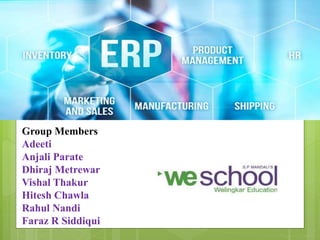
Group Members
Adeeti
Anjali Parate
Dhiraj Metrewar
Vishal Thakur
Hitesh Chawla
Rahul Nandi
Faraz R Siddiqui
What is ERP ?
..E..
An Enterprise is a group of people with a
common goal, which has certain resources at
its disposal to achieve that goal.
..R..
Resources included are money, and all other
things that are required to run the enterprise.
..P..
Planning is done to ensure that nothing goes
wrong.
In general ERP is :
“a business strategy and set of industry-
domain-specific applications that build
customer and shareholder communities
value network system by enabling and
optimizing enterprise and inter-
enterprise collaborative operational and
financial processes”
 (Source: Gartner’s Research Note SPA-12-0420)
Goal of ERP
The goal of our enterprise is simply to get, keep,
and grow customers.
GET
 Acquire profitable customers
KEEP
 Retain profitable customers longer.
 Win back profitable customers
 Eliminate unprofitable customers
GROW
 Up sell additional products in a solution
 Cross sell other products to customers
 Reduce service and operations cost.
Why ERP?
• ERP offers solutions for all business
functions
• Packages available for
organizations of all sizes and types
• Global nature (multi currency)
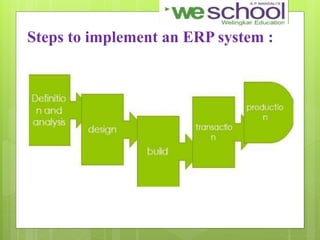
Steps to implement an ERP system :
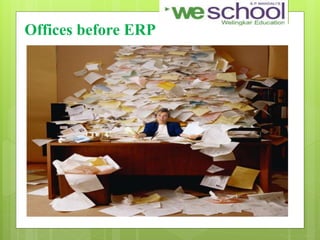
Offices before ERP
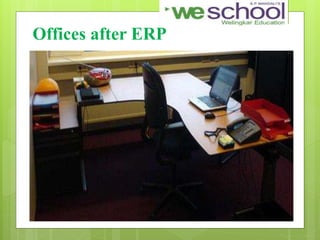
Offices after ERP
Advantages of ERP
Integration
Efficiency
Cost reduction
Less personnel
Accuracy
Disadvantages
Take time to implement
Security issues
ROI in the context of ERP project
It represents metric of completed due
diligence and a time phase plan that
defines when money will be needed and
what for it will be used.
ROI calculation is made by dividing
monetary gain by amount spent.
http://www.managementstudyguide.com/return-on-
investment-in-erp-project.htm
Tangible benefits of ERP
Reduced level of inventories
Reduced material cost
Reduced labour cost
Improved Production
Reduction in the cost of after sales
services.
Intangible Benefits of ERP
Integration of information
Error reduction
Improved customer services
Establishment of standardized
procedures
Improved accounting control
Calculation of ERP
First step is to determine cost of various
components of the project such as consulting
fees, license fees, modification and
implementation cost, hardware cost etc.
Maintenance fees for a pre determined period
(say for three or five years) should be added
to arrive at Total Cost of Ownership over the
specified period.
The estimated expenditure should be time
phased over the period, used to calculate
TCO.
Calculation of ERP cont.
 Next step is the more difficult part which is to estimate
expected benefits over a period of time. For estimating
these figures, there should be wide consultation and
reference to statistics emanating from various survey
reports.
 Benefits will largely occur from the reduction of
inventory level, operation cost, labor cost and
improved production.
 Whereas the last three elements will have a direct
impact on profit and loss account, the reduction in
inventory will cause release of additional cash which
can be assigned to a yearly value of saving, based on
organization’s standard internal rate of return.
Benefits
Improved inventory management
Improved customer service
experience
Improved use of IT resources
Improved integration with
accounting
Improved Profitability
How do you begin to estimate the
anticipated ROI of an ERP
system?
What would be a reasonable
methodology?”
To answer this question, We would
look at five main factors to
estimate the ROI of an ERP
system:
1) IT costs,
2) productivity,
3) visibility,
4) risk
5) Audit and compliance impacts.
IT Costs: Hardware, replacement, personnel,
ongoing training, related services, software
and subscription costs all factor into your IT
costs.
Desired Productivity Impacts: The impact of
data errors due to an un-integrated system can
be costly, waste time, and is a very common
ROI component to consider.
Visibility Impacts: New ERP systems generally
provide better access to more reliable data,
which improves financial control.
Audit and Compliance Impacts: Improved
controls and repeatable processes increase
your ROI by lowering audit and oversight
costs.
Risk Impact: The cost of risk is often the
hardest to estimate.
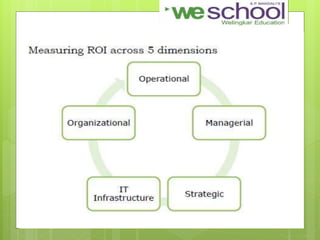
Operational
Cost reduction (Labor, Inventory,
Administrative)
Cycle time reduction,
Productivity improvement
Quality improvement (error rate,
redundancy, accuracy, reliability)
Customer services improvement (ease of
data access for customer queries)
Managerial
Better resource management (Better workforce
management)
Improved decision making and
planning(reports, real-time use of data,
accessibility)
Performance improvement (financial,
operational efficiency, and effectiveness
management)
Standardization, compliance
Strategic
 Support business growth
(transaction volume, capacity,
capability, new functions)
Build cost leadership (economies of
scale, shared services)
IT Infrastructure
Build business flexibility for current
and future changes (integration with
other systems)
IT costs reduction (hardware, support
staff, etc)
Increased IT infrastructure capability
(standardized platform, performance,
reliability, availability, disaster recovery
etc)
Organizational
Support organizational changes
Facilitate Business learning (cross training of
employees)
Empowerment (accountability, value added
responsibility, users have ownership)
Built common visions (efficient
communications , collaboration)
Better Employee morale and job satisfaction
(improved skill levels)
Conclusion
Bit problematic particularly in
terms of unquantifiable figure
Enhance chance of successful
completion of project
Erp

Erp

  • 1.
    Group Members Adeeti Anjali Parate DhirajMetrewar Vishal Thakur Hitesh Chawla Rahul Nandi Faraz R Siddiqui
  • 2.
    What is ERP? ..E.. An Enterprise is a group of people with a common goal, which has certain resources at its disposal to achieve that goal. ..R.. Resources included are money, and all other things that are required to run the enterprise. ..P.. Planning is done to ensure that nothing goes wrong.
  • 3.
    In general ERPis : “a business strategy and set of industry- domain-specific applications that build customer and shareholder communities value network system by enabling and optimizing enterprise and inter- enterprise collaborative operational and financial processes”  (Source: Gartner’s Research Note SPA-12-0420)
  • 4.
    Goal of ERP Thegoal of our enterprise is simply to get, keep, and grow customers. GET  Acquire profitable customers KEEP  Retain profitable customers longer.  Win back profitable customers  Eliminate unprofitable customers GROW  Up sell additional products in a solution  Cross sell other products to customers  Reduce service and operations cost.
  • 5.
    Why ERP? • ERPoffers solutions for all business functions • Packages available for organizations of all sizes and types • Global nature (multi currency)
  • 6.
    Steps to implementan ERP system :
  • 7.
  • 8.
  • 9.
    Advantages of ERP Integration Efficiency Costreduction Less personnel Accuracy
  • 10.
    Disadvantages Take time toimplement Security issues
  • 11.
    ROI in thecontext of ERP project It represents metric of completed due diligence and a time phase plan that defines when money will be needed and what for it will be used. ROI calculation is made by dividing monetary gain by amount spent. http://www.managementstudyguide.com/return-on- investment-in-erp-project.htm
  • 12.
    Tangible benefits ofERP Reduced level of inventories Reduced material cost Reduced labour cost Improved Production Reduction in the cost of after sales services.
  • 13.
    Intangible Benefits ofERP Integration of information Error reduction Improved customer services Establishment of standardized procedures Improved accounting control
  • 14.
    Calculation of ERP Firststep is to determine cost of various components of the project such as consulting fees, license fees, modification and implementation cost, hardware cost etc. Maintenance fees for a pre determined period (say for three or five years) should be added to arrive at Total Cost of Ownership over the specified period. The estimated expenditure should be time phased over the period, used to calculate TCO.
  • 15.
    Calculation of ERPcont.  Next step is the more difficult part which is to estimate expected benefits over a period of time. For estimating these figures, there should be wide consultation and reference to statistics emanating from various survey reports.  Benefits will largely occur from the reduction of inventory level, operation cost, labor cost and improved production.  Whereas the last three elements will have a direct impact on profit and loss account, the reduction in inventory will cause release of additional cash which can be assigned to a yearly value of saving, based on organization’s standard internal rate of return.
  • 16.
    Benefits Improved inventory management Improvedcustomer service experience Improved use of IT resources Improved integration with accounting Improved Profitability
  • 17.
    How do youbegin to estimate the anticipated ROI of an ERP system? What would be a reasonable methodology?”
  • 18.
    To answer thisquestion, We would look at five main factors to estimate the ROI of an ERP system: 1) IT costs, 2) productivity, 3) visibility, 4) risk 5) Audit and compliance impacts.
  • 19.
    IT Costs: Hardware,replacement, personnel, ongoing training, related services, software and subscription costs all factor into your IT costs. Desired Productivity Impacts: The impact of data errors due to an un-integrated system can be costly, waste time, and is a very common ROI component to consider. Visibility Impacts: New ERP systems generally provide better access to more reliable data, which improves financial control.
  • 20.
    Audit and ComplianceImpacts: Improved controls and repeatable processes increase your ROI by lowering audit and oversight costs. Risk Impact: The cost of risk is often the hardest to estimate.
  • 22.
    Operational Cost reduction (Labor,Inventory, Administrative) Cycle time reduction, Productivity improvement Quality improvement (error rate, redundancy, accuracy, reliability) Customer services improvement (ease of data access for customer queries)
  • 23.
    Managerial Better resource management(Better workforce management) Improved decision making and planning(reports, real-time use of data, accessibility) Performance improvement (financial, operational efficiency, and effectiveness management) Standardization, compliance
  • 24.
    Strategic  Support businessgrowth (transaction volume, capacity, capability, new functions) Build cost leadership (economies of scale, shared services)
  • 25.
    IT Infrastructure Build businessflexibility for current and future changes (integration with other systems) IT costs reduction (hardware, support staff, etc) Increased IT infrastructure capability (standardized platform, performance, reliability, availability, disaster recovery etc)
  • 26.
    Organizational Support organizational changes FacilitateBusiness learning (cross training of employees) Empowerment (accountability, value added responsibility, users have ownership) Built common visions (efficient communications , collaboration) Better Employee morale and job satisfaction (improved skill levels)
  • 27.
    Conclusion Bit problematic particularlyin terms of unquantifiable figure Enhance chance of successful completion of project

Editor's Notes

  • #7 1. Definition and Analysis Hold discussions with various functional personnel to establish the actual number of systems operating at client site, what they are used for, why and how often Produce the Project Scoping Document outlining current situation, proposed solution and budgeted time Challenge : REQUISITE EXPERTISE - No two clients are the same 2. Design Prepare various functional reports - specifies current scenario and wish list Prepare Design document which specifies how the system is going to work Prepare test scripts to be followed on system testing Map out the interface paths to various modules Challenge : INFORMATION SHARING - Availability of staff 3. Build Configure system as per set up document specifications i.e. transfer conceptual model into reality Test system to verify accuracy (preliminary tests) Challenge : TECHNICAL ENVIRONMENT - System functionality 4. Transition Train users on their specific areas Assist in test data compilation and system testing by users Finalise the Live system and captured opening balances Challenge : USER RESISTANCE Understanding and acceptance data preparation 5. Production Official hand holding Effectiveness assessment Business and Technical Direction recommendations