Business Processes in IPD and
ERP for IPD-Tangible
Group Members
Adeeti
Anjali Parate
Jay Vasani
Dhiraj Metrewar
Vishal Thakur
Hitesh Chawla
Rahul Nandi
Faraz R Siddiqui
1
What is IPD?
• The Indoor patient department commences
when the patient is being registered and allotted
a bed in the ward.
• It deals with complete treatment and services
provided to the patient during his stay in the
hospital.
• During his stay in the hospital, every patient is
provided various services in terms of consultant’s
visits, investigations, procedures, medicines &
consumables, room service, diet, etc.
2
Step 1:- When they get confirmation that a patient has arrived with an
emergency to their hospital campus, the first thing they do is give a call to
ward boys and patient attendants to shift the patient from ambulance to
stretcher.
Step 2:- Give a call to principal medical officer.
Step 3:-After the principal medical officer examines the patient, they ask
him as to where they have to shift a patient.
Step 4:- Generally they shift the patient to the recovery ward or ICU and
after patient becomes stable, only then they shift the patient to the
relevant ward.
Step 5:- After counseling with the PMO/RMO/SMO and permission of the
same they do registration of patient in IPD register and in their software
too. 3
Initial Process for IPD
Step 6:- Making a file and fill the details of patient.
Name of Patient
Age & Sex
Residence address
Care taker of patient
Mobile No
Chief Complaint, etc.
Step7:- Fill the patient’s consent form and after telling them the purpose
and meaning of the form, get it signed by the patient’s relatives.
Step 8:- Send the file of patient to the corresponding ward where the
Medical Officer has asked the patient to be shifted.
Step 9:- Confirmation that the file of patient is received by RMO of the
corresponding ward. 4
Cont…
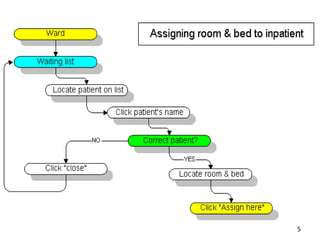
5
Key Aspects
• Patient Admission
• Bed Allocation and Transfer
• Consultants visit entry
• Recording Patient’s clinical data
• Requisition of investigations required
• Requisition to Store & Pharmacy stores for
Medicines and Consumables
• OT/ICU Billing and Management
6
Upstream and Downstream Dept.
• Upstream – Reception and Administration
• Downstream – OT/ICU, Pharmacy, Laboratory,
Blood Bank, Billing/Accounting, etc.
7
Data Types
• There are basically 3 Data types in terms of an
ERP
1. Operational
2. Transactional
3. Master
8
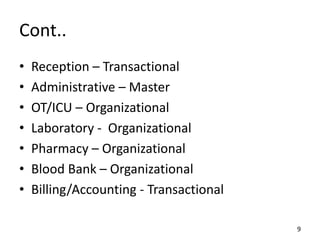
Cont..
• Reception – Transactional
• Administrative – Master
• OT/ICU – Organizational
• Laboratory - Organizational
• Pharmacy – Organizational
• Blood Bank – Organizational
• Billing/Accounting - Transactional
9
10

In patient department

  • 1.
    Business Processes inIPD and ERP for IPD-Tangible Group Members Adeeti Anjali Parate Jay Vasani Dhiraj Metrewar Vishal Thakur Hitesh Chawla Rahul Nandi Faraz R Siddiqui 1
  • 2.
    What is IPD? •The Indoor patient department commences when the patient is being registered and allotted a bed in the ward. • It deals with complete treatment and services provided to the patient during his stay in the hospital. • During his stay in the hospital, every patient is provided various services in terms of consultant’s visits, investigations, procedures, medicines & consumables, room service, diet, etc. 2
  • 3.
    Step 1:- Whenthey get confirmation that a patient has arrived with an emergency to their hospital campus, the first thing they do is give a call to ward boys and patient attendants to shift the patient from ambulance to stretcher. Step 2:- Give a call to principal medical officer. Step 3:-After the principal medical officer examines the patient, they ask him as to where they have to shift a patient. Step 4:- Generally they shift the patient to the recovery ward or ICU and after patient becomes stable, only then they shift the patient to the relevant ward. Step 5:- After counseling with the PMO/RMO/SMO and permission of the same they do registration of patient in IPD register and in their software too. 3 Initial Process for IPD
  • 4.
    Step 6:- Makinga file and fill the details of patient. Name of Patient Age & Sex Residence address Care taker of patient Mobile No Chief Complaint, etc. Step7:- Fill the patient’s consent form and after telling them the purpose and meaning of the form, get it signed by the patient’s relatives. Step 8:- Send the file of patient to the corresponding ward where the Medical Officer has asked the patient to be shifted. Step 9:- Confirmation that the file of patient is received by RMO of the corresponding ward. 4 Cont…
  • 5.
  • 6.
    Key Aspects • PatientAdmission • Bed Allocation and Transfer • Consultants visit entry • Recording Patient’s clinical data • Requisition of investigations required • Requisition to Store & Pharmacy stores for Medicines and Consumables • OT/ICU Billing and Management 6
  • 7.
    Upstream and DownstreamDept. • Upstream – Reception and Administration • Downstream – OT/ICU, Pharmacy, Laboratory, Blood Bank, Billing/Accounting, etc. 7
  • 8.
    Data Types • Thereare basically 3 Data types in terms of an ERP 1. Operational 2. Transactional 3. Master 8
  • 9.
    Cont.. • Reception –Transactional • Administrative – Master • OT/ICU – Organizational • Laboratory - Organizational • Pharmacy – Organizational • Blood Bank – Organizational • Billing/Accounting - Transactional 9
  • 10.