What is HSPA ?
• High Speed Packet Access
• A wireless access technology designed for increasing the
capacity of Internet connectivity from 3G mobile terminals
• 3G(3rd Generation)Mobile Telecommunication is based on
UMTS protocols
WCDMA & UMTS
• Universal Mobile Telecommunications System
• UMTS uses WCDMA radio access Technology
• Wideband Code Division Multiplexing Access
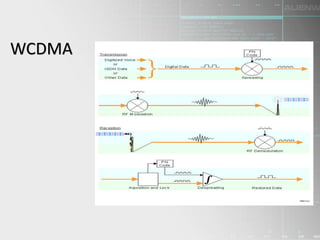
• It employs Spread –spectrum Technology uses
large Bandwidth-5MHz
WCDMA
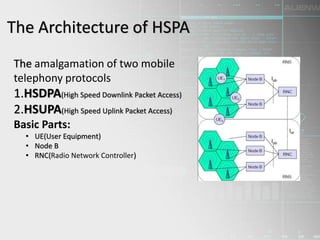
The Architecture of HSPA
The amalgamation of two mobile
telephony protocols
1.HSDPA(High Speed Downlink Packet Access)
2.HSUPA(High Speed Uplink Packet Access)
Basic Parts:
• UE(User Equipment)
• Node B
• RNC(Radio Network Controller)
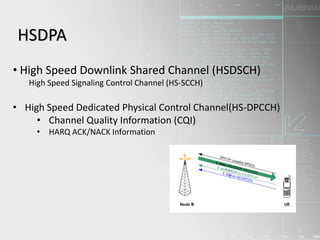
HSDPA
• High Speed Downlink Shared Channel (HSDSCH)
High Speed Signaling Control Channel (HS-SCCH)
• High Speed Dedicated Physical Control Channel(HS-DPCCH)
• Channel Quality Information (CQI)
• HARQ ACK/NACK Information
• Adaptive Modulation and Coding
• Fast scheduling
• Fast retransmissions
How Dose it Work
HSUPA
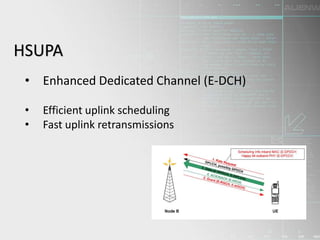
• Enhanced Dedicated Channel (E-DCH)
• Efficient uplink scheduling
• Fast uplink retransmissions
Advantages
• Downloading Speed-14Mbps uploading Speed-5.8 Mbps
• Smooth for Transferring Large file ,live streaming and Web Browsing
• Low latency below 50 m sec
• It uses Shared Channel Transmissions
• Recovering Losing Data by Soft Combining Method At the time of
retransmission
• Communication range
If UE is Far away from Base Station(Node B)it cannot get the total Bandwidth
• Number of users
The Quality of Service is Depends upon the Users
• Cost
Expense to upgrade the whole system
Expense to Upgrade User Equipment
Disadvantages
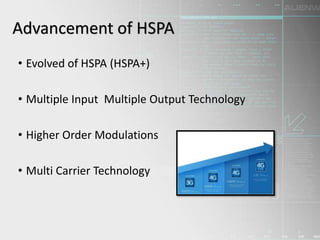
• Evolved of HSPA (HSPA+)
• Multiple Input Multiple Output Technology
• Higher Order Modulations
• Multi Carrier Technology
Advancement of HSPA
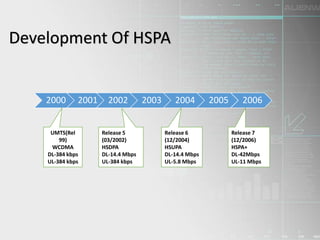
2000 2001 2002 2003 2004 2005 2006
UMTS(Rel
99)
WCDMA
DL-384 kbps
UL-384 kbps
Release 5
(03/2002)
HSDPA
DL-14.4 Mbps
UL-384 kbps
Release 6
(12/2004)
HSUPA
DL-14.4 Mbps
UL-5.8 Mbps
Release 7
(12/2006)
HSPA+
DL-42Mbps
UL-11 Mbps
Development Of HSPA
Conclusion
HSPA (High-Speed Packet Access) is a mobile telephony protocol
which is based on packet sand is used in the 3G or 3.5G radio
networks in order to increase the size of data to be stored and the
speed of the rates of data transfer.
HSPA provides five times the download speeds of the previous
versions by improving spectral efficiency and providing high
download speeds and low latency thus allowing users to download
large files quickly.
Reference
3G Evolution HSPA and LTE for Mobile Broadband
-by Eric Dalhman
www.nomor.de
www.3gpp.org
Thank You 

HSPA(High Speed Packet Access)

  • 2.
    What is HSPA? • High Speed Packet Access • A wireless access technology designed for increasing the capacity of Internet connectivity from 3G mobile terminals • 3G(3rd Generation)Mobile Telecommunication is based on UMTS protocols
  • 3.
    WCDMA & UMTS •Universal Mobile Telecommunications System • UMTS uses WCDMA radio access Technology • Wideband Code Division Multiplexing Access • It employs Spread –spectrum Technology uses large Bandwidth-5MHz
  • 4.
  • 5.
    The Architecture ofHSPA The amalgamation of two mobile telephony protocols 1.HSDPA(High Speed Downlink Packet Access) 2.HSUPA(High Speed Uplink Packet Access) Basic Parts: • UE(User Equipment) • Node B • RNC(Radio Network Controller)
  • 6.
    HSDPA • High SpeedDownlink Shared Channel (HSDSCH) High Speed Signaling Control Channel (HS-SCCH) • High Speed Dedicated Physical Control Channel(HS-DPCCH) • Channel Quality Information (CQI) • HARQ ACK/NACK Information
  • 7.
    • Adaptive Modulationand Coding • Fast scheduling • Fast retransmissions How Dose it Work
  • 8.
    HSUPA • Enhanced DedicatedChannel (E-DCH) • Efficient uplink scheduling • Fast uplink retransmissions
  • 9.
    Advantages • Downloading Speed-14Mbpsuploading Speed-5.8 Mbps • Smooth for Transferring Large file ,live streaming and Web Browsing • Low latency below 50 m sec • It uses Shared Channel Transmissions • Recovering Losing Data by Soft Combining Method At the time of retransmission
  • 10.
    • Communication range IfUE is Far away from Base Station(Node B)it cannot get the total Bandwidth • Number of users The Quality of Service is Depends upon the Users • Cost Expense to upgrade the whole system Expense to Upgrade User Equipment Disadvantages
  • 11.
    • Evolved ofHSPA (HSPA+) • Multiple Input Multiple Output Technology • Higher Order Modulations • Multi Carrier Technology Advancement of HSPA
  • 12.
    2000 2001 20022003 2004 2005 2006 UMTS(Rel 99) WCDMA DL-384 kbps UL-384 kbps Release 5 (03/2002) HSDPA DL-14.4 Mbps UL-384 kbps Release 6 (12/2004) HSUPA DL-14.4 Mbps UL-5.8 Mbps Release 7 (12/2006) HSPA+ DL-42Mbps UL-11 Mbps Development Of HSPA
  • 13.
    Conclusion HSPA (High-Speed PacketAccess) is a mobile telephony protocol which is based on packet sand is used in the 3G or 3.5G radio networks in order to increase the size of data to be stored and the speed of the rates of data transfer. HSPA provides five times the download speeds of the previous versions by improving spectral efficiency and providing high download speeds and low latency thus allowing users to download large files quickly.
  • 14.
    Reference 3G Evolution HSPAand LTE for Mobile Broadband -by Eric Dalhman www.nomor.de www.3gpp.org
  • 15.