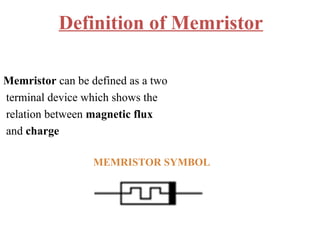
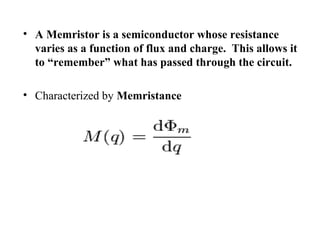
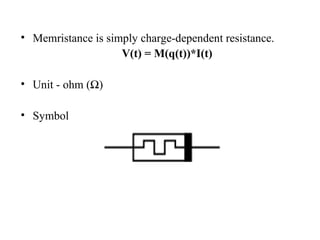
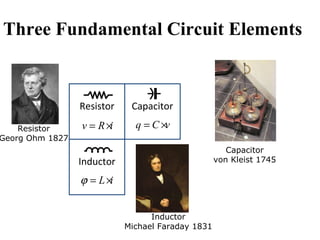
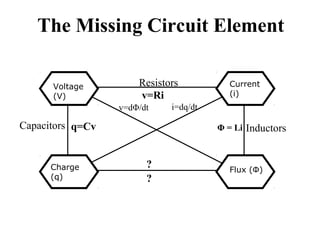
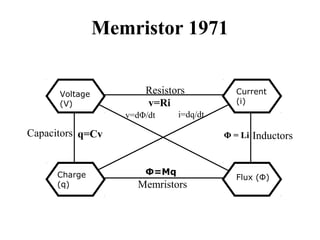
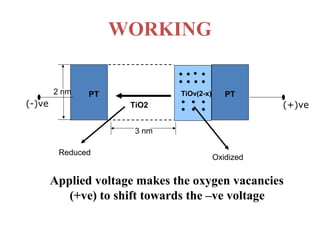
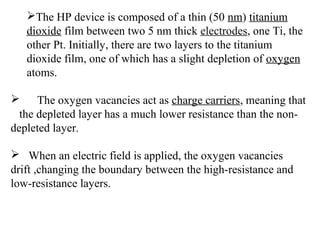
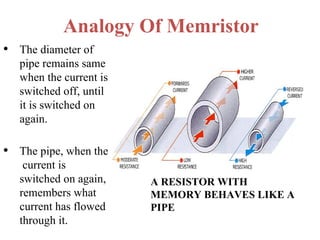
The document discusses the memristor, a new type of circuit element. It provides an overview of what a memristor is, how it works, its properties and benefits. A memristor is a two-terminal semiconductor device that can remember the amount of charge that has passed through it. It was first proposed in 1971 and works by changing resistance based on the direction and amount of current flow. Memristors have advantages like non-volatility, high density storage and lower power consumption. They could replace transistors and enable new technologies like boot-free computers with high storage capacity. However, challenges remain around speed, design standards and heat dissipation.