BRAIN GATE SYSTEM
By
SATHISHKUMAR G
(sathishsak111@gmail.com)
INTRODUCTION
 It is a mind-to-movement system that allows a
quadriplegic man to control a computer using his
thoughts.
 The system is to help those who have lost control of
their limbs, or other bodily functions such as patients
with spinal cord injury to operate various gadgets such
as TV, Computer, Lights, Fan etc.
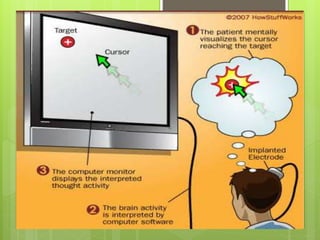
 It monitors brain activity in the patient and converts the
intention of the user into computer commands.
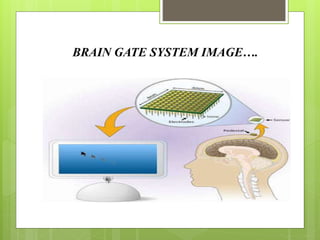
BRAIN GATE SYSTEM IMAGE….
DEVELOPMENT
 Brain Gate is a brain implant system developed by
the bio-tech company Cyber kinetics in 2003 in
conjunction with the Department of Neuroscience
at brown university.
 Nicholas HALSOPULES is the scientist who
implement the system of Brain Gate
WORKING PRINCIPLE
 The principle of brain gate neural interface system
is that which intact with brain functions, neural
signals generated are interpreted by the systems
and a cursor is shown to the user on a computer
screen that provides an alternate brain gate
pathway. The user can use that cursor to control
the computer, just as a mouse is used.
SENSE
TRANSMIT
AND
ANALYSE
APPLY
IMPLANTING
THE CHIP
PRE
PROCESSING
DETECTION CONTROL
TRAINING
BIO
FEEDBACK
BCI TECHNOLOGY
 “BCIs” usually connects the brain with a computer
system.
 A Brain computer interface, called as direct
communication pathway between human or
animal brain and an external device.
 Based on the communication pathway BCI is
classified as follows
 One way BCI
 Two way BCI
The components in the system
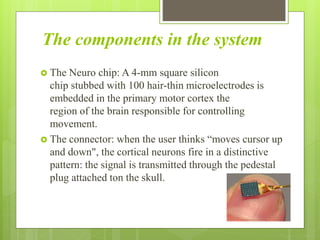
 The Neuro chip: A 4-mm square silicon
chip stubbed with 100 hair-thin microelectrodes is
embedded in the primary motor cortex the
region of the brain responsible for controlling
movement.
 The connector: when the user thinks “moves cursor up
and down", the cortical neurons fire in a distinctive
pattern: the signal is transmitted through the pedestal
plug attached ton the skull.
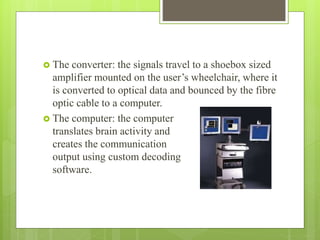
 The converter: the signals travel to a shoebox sized
amplifier mounted on the user’s wheelchair, where it
is converted to optical data and bounced by the fibre
optic cable to a computer.
 The computer: the computer
translates brain activity and
creates the communication
output using custom decoding
software.
TYPES OF BCI
 One way BCI
Computer either accept commands from the brain
or send signals to it.
 Two way BCI
Allows brains toand external devices to exchange
information in both directions.
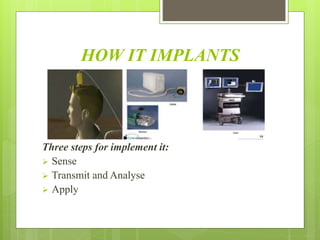
HOW IT IMPLANTS
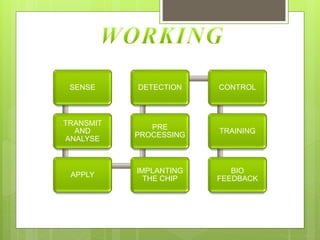
Three steps for implement it:
 Sense
 Transmit and Analyse
 Apply
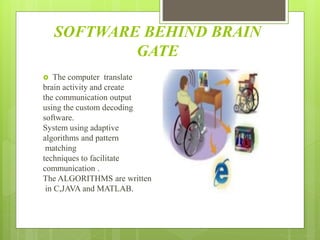
SOFTWARE BEHIND BRAIN
GATE
 The computer translate
brain activity and create
the communication output
using the custom decoding
software.
System using adaptive
algorithms and pattern
matching
techniques to facilitate
communication .
The ALGORITHMS are written
in C,JAVA and MATLAB.
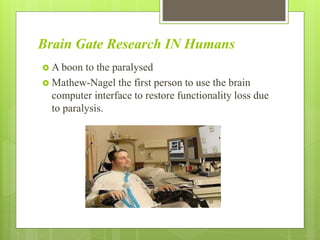
Brain Gate Research IN Humans
 A boon to the paralysed
 Mathew-Nagel the first person to use the brain
computer interface to restore functionality loss due
to paralysis.
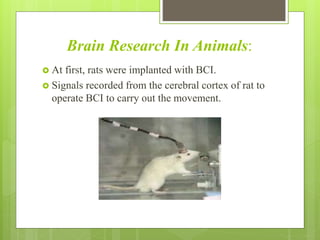
Brain Research In Animals:
 At first, rats were implanted with BCI.
 Signals recorded from the cerebral cortex of rat to
operate BCI to carry out the movement.
FURTHER CONCERNS…
 Emphasis should be on improving the information
transform rate.
 Stronger algorithm should be implemented.
Challenges faced by Brain Gate
 It is very expensive.
 Limitation in information transform rate. The latest
technology is 20 bits/min.
 Difficulty in adapting and learning.
APPLICATION
 In classification of EEG signals.
 In multimedia communications.
 In evaluation of spike detection algorithms.
 Actuated control of mobile robot by human EEG.
 As a brain controlled switch for asynchronous
control.
 In evaluating the machine learning algorithms.
CONCLUSIONS
 The invention of brain gate is such a revolution in
medical field. The remarkable breakthrough offers
hope that people who are paralysed will one day
be able to independently operate artificial limbs,
computer or wheelchairs….
BRAIN  GATE SYSTEM

BRAIN GATE SYSTEM

  • 1.
    BRAIN GATE SYSTEM By SATHISHKUMARG (sathishsak111@gmail.com)
  • 2.
    INTRODUCTION  It isa mind-to-movement system that allows a quadriplegic man to control a computer using his thoughts.  The system is to help those who have lost control of their limbs, or other bodily functions such as patients with spinal cord injury to operate various gadgets such as TV, Computer, Lights, Fan etc.  It monitors brain activity in the patient and converts the intention of the user into computer commands.
  • 3.
  • 4.
    DEVELOPMENT  Brain Gateis a brain implant system developed by the bio-tech company Cyber kinetics in 2003 in conjunction with the Department of Neuroscience at brown university.  Nicholas HALSOPULES is the scientist who implement the system of Brain Gate
  • 5.
    WORKING PRINCIPLE  Theprinciple of brain gate neural interface system is that which intact with brain functions, neural signals generated are interpreted by the systems and a cursor is shown to the user on a computer screen that provides an alternate brain gate pathway. The user can use that cursor to control the computer, just as a mouse is used.
  • 6.
  • 7.
    BCI TECHNOLOGY  “BCIs”usually connects the brain with a computer system.  A Brain computer interface, called as direct communication pathway between human or animal brain and an external device.  Based on the communication pathway BCI is classified as follows  One way BCI  Two way BCI
  • 9.
    The components inthe system  The Neuro chip: A 4-mm square silicon chip stubbed with 100 hair-thin microelectrodes is embedded in the primary motor cortex the region of the brain responsible for controlling movement.  The connector: when the user thinks “moves cursor up and down", the cortical neurons fire in a distinctive pattern: the signal is transmitted through the pedestal plug attached ton the skull.
  • 10.
     The converter:the signals travel to a shoebox sized amplifier mounted on the user’s wheelchair, where it is converted to optical data and bounced by the fibre optic cable to a computer.  The computer: the computer translates brain activity and creates the communication output using custom decoding software.
  • 11.
    TYPES OF BCI One way BCI Computer either accept commands from the brain or send signals to it.  Two way BCI Allows brains toand external devices to exchange information in both directions.
  • 12.
    HOW IT IMPLANTS Threesteps for implement it:  Sense  Transmit and Analyse  Apply
  • 13.
    SOFTWARE BEHIND BRAIN GATE The computer translate brain activity and create the communication output using the custom decoding software. System using adaptive algorithms and pattern matching techniques to facilitate communication . The ALGORITHMS are written in C,JAVA and MATLAB.
  • 14.
    Brain Gate ResearchIN Humans  A boon to the paralysed  Mathew-Nagel the first person to use the brain computer interface to restore functionality loss due to paralysis.
  • 15.
    Brain Research InAnimals:  At first, rats were implanted with BCI.  Signals recorded from the cerebral cortex of rat to operate BCI to carry out the movement.
  • 16.
    FURTHER CONCERNS…  Emphasisshould be on improving the information transform rate.  Stronger algorithm should be implemented.
  • 17.
    Challenges faced byBrain Gate  It is very expensive.  Limitation in information transform rate. The latest technology is 20 bits/min.  Difficulty in adapting and learning.
  • 18.
    APPLICATION  In classificationof EEG signals.  In multimedia communications.  In evaluation of spike detection algorithms.  Actuated control of mobile robot by human EEG.  As a brain controlled switch for asynchronous control.  In evaluating the machine learning algorithms.
  • 19.
    CONCLUSIONS  The inventionof brain gate is such a revolution in medical field. The remarkable breakthrough offers hope that people who are paralysed will one day be able to independently operate artificial limbs, computer or wheelchairs….