BRAIN GATE


     Under The Esteemed Guidance of
             Mr.G.Venugopal

             Associate Professor
Department Of Computer Science and Engineering
Sri Satya Narayana Engineering College, Ongole

                By

         M.Hanumantha Rao
1. INTRODUCTION
2.HISTORY
3.BRAINGATE DEVICE
4.WORKING
5. ADVANTAGES
6. DISADVANTAGES
7.CONCLUSION
INTRODUCTION
   BrainGate is a brain implant system developed by
    the bio-tech company Cyber kinetics in 2003.

   The computer chip, which is implanted into thebrain
    monitors brain activity in the patient .

   converts the intention of the user into computer
    commands.

   The Braingate Neural Interface device consists of a
    tiny chip containing 100 microscopic electrodes .
HISTORY
   After 10 years of study and research,
    Cyberkinetics, a biotech company in
    Foxboro, Massachusetts, has developed
    BrainGate in 2003

   Dr. John Donaghue director of the brain
    science program at Brown University

   The company behind the brain implant,
    lead the team to research and develop this
    brain implant system.
BRAINGATE DEVICE
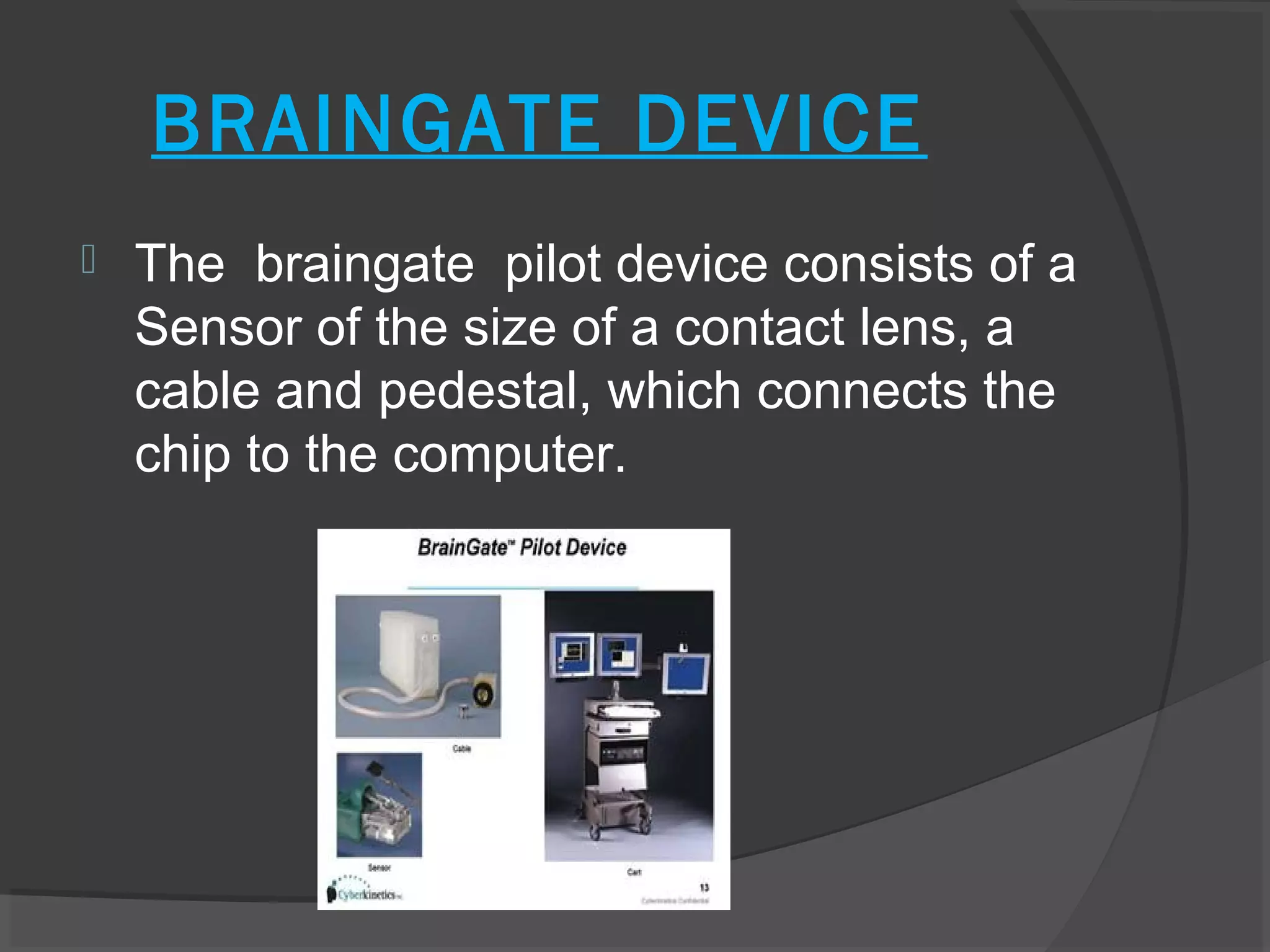
   The braingate pilot device consists of a
    Sensor of the size of a contact lens, a
    cable and pedestal, which connects the
    chip to the computer.
WORKING
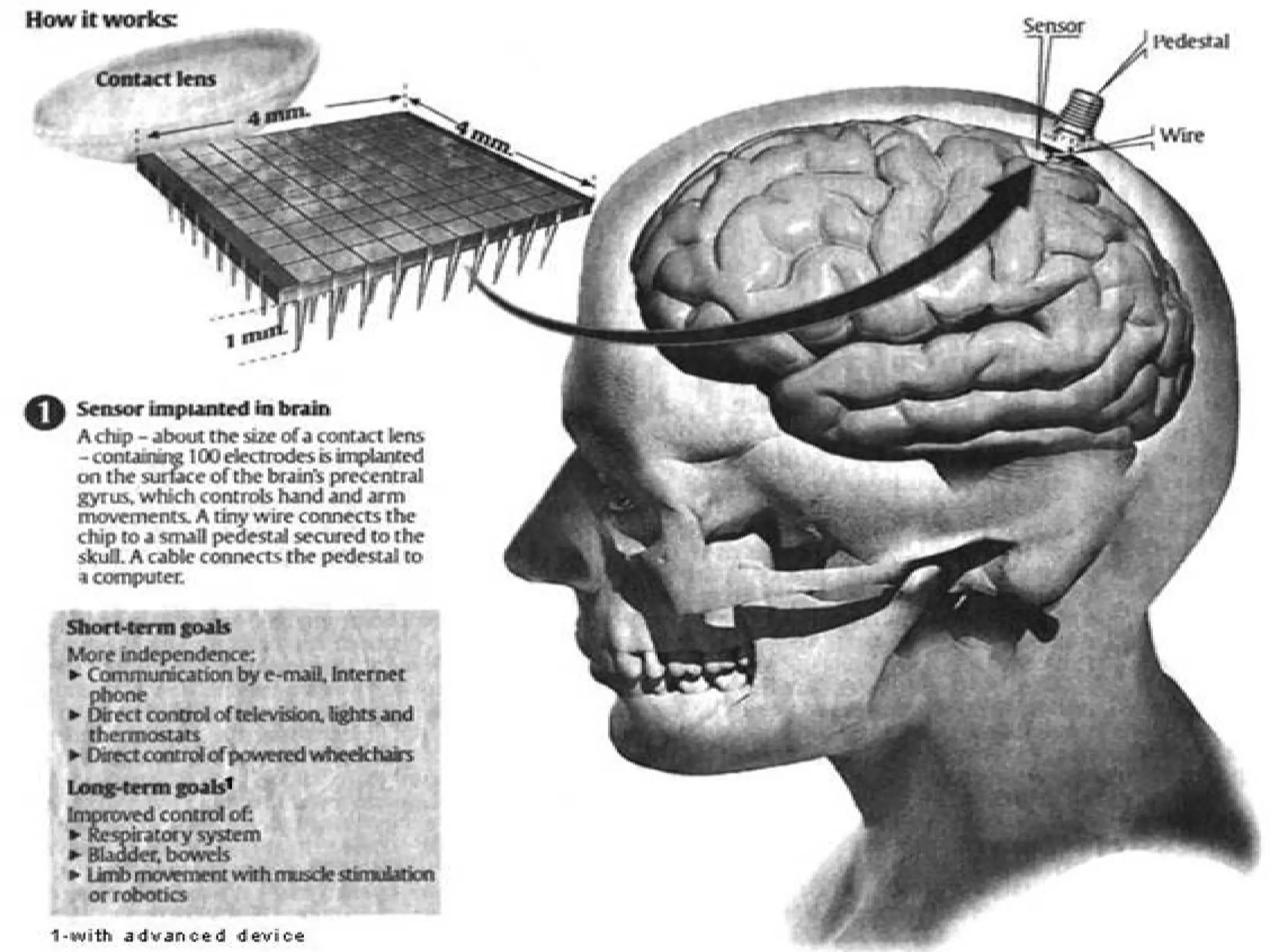
 The sensor of the size of a contact lens
  is implanted in brain’s percental gyrus
  which control hand and arm movements.
 A tiny wire connects the chip to a small
  pedestal secured in the scull.
 A cable connects the pedestal to a
  computer.
 The brain's 100bn neurons fire between
  20 and 200 times a second.
ADVANTAGES
 The BrainGate Neural Interface System
  is being designed to one day allow the
  user to interface with a computer .
 The BrainGate System may offer
  substantial improvement over existing
  assistive technologies
 Potential advantages of the BrainGate
  System over other muscle driven or
  brain-based computer interface
  approaches include
DISADVANTAGES
 BrainGate System is that at this time,
  while still being perfected, , the switches
  must be frequenly adjusted which is a
  time consuming process.
 There is also a worry that devices such
  as this will “normalize” society.
 The BrainGate Neural Interface System
  has not been approved by the FDA, but
  has been approved for IDE status
CONCLUSION
   The invention of Braingate is such a
    revolution in medical field.
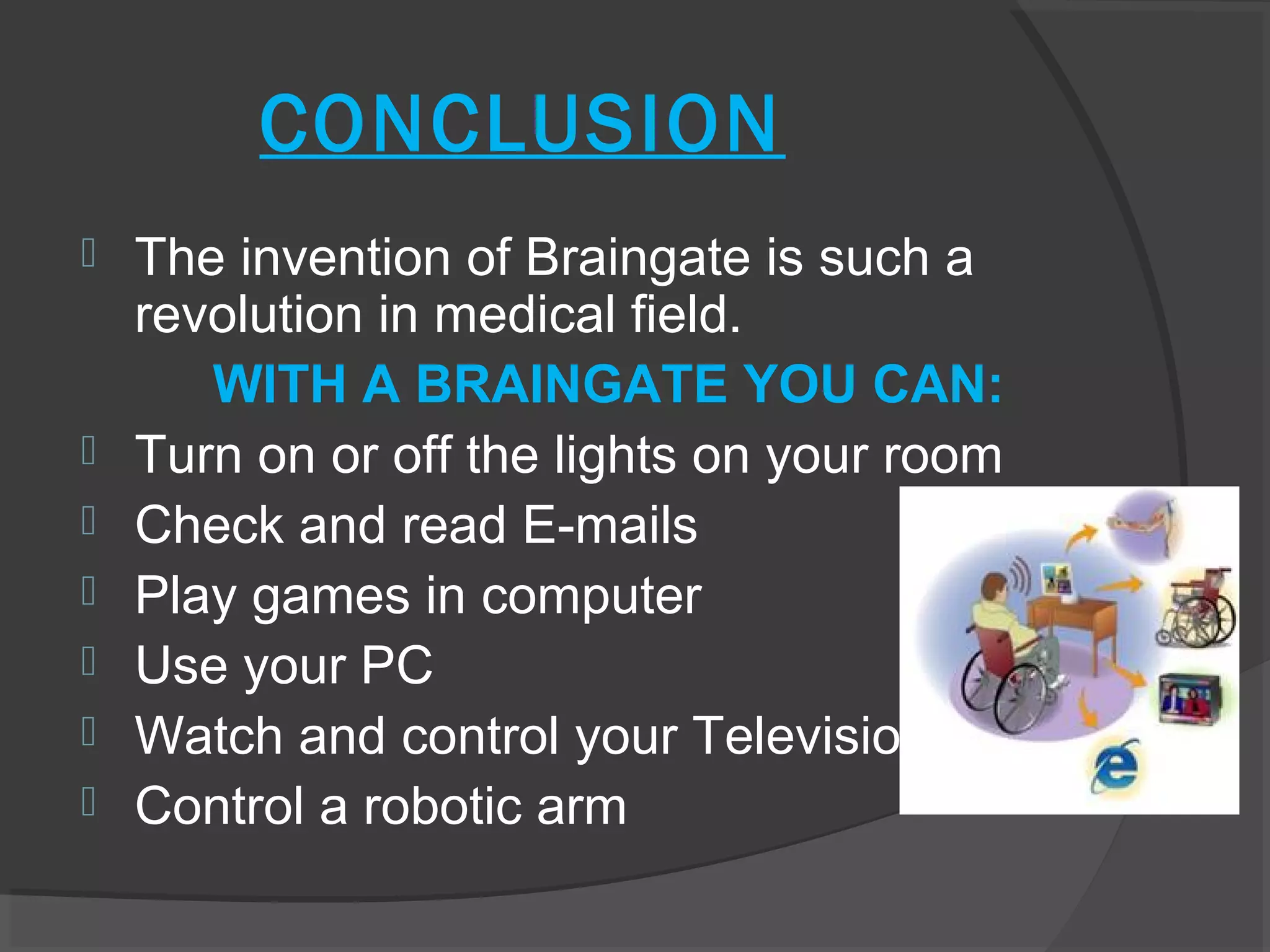
       WITH A BRAINGATE YOU CAN:
   Turn on or off the lights on your room
   Check and read E-mails
   Play games in computer
   Use your PC
   Watch and control your Television
   Control a robotic arm
Any
  Queries
THANK
  Q

Brain gate

  • 1.
    BRAIN GATE Under The Esteemed Guidance of Mr.G.Venugopal Associate Professor Department Of Computer Science and Engineering Sri Satya Narayana Engineering College, Ongole By M.Hanumantha Rao
  • 2.
    1. INTRODUCTION 2.HISTORY 3.BRAINGATE DEVICE 4.WORKING 5.ADVANTAGES 6. DISADVANTAGES 7.CONCLUSION
  • 3.
    INTRODUCTION  BrainGate is a brain implant system developed by the bio-tech company Cyber kinetics in 2003.  The computer chip, which is implanted into thebrain monitors brain activity in the patient .  converts the intention of the user into computer commands.  The Braingate Neural Interface device consists of a tiny chip containing 100 microscopic electrodes .
  • 4.
    HISTORY  After 10 years of study and research, Cyberkinetics, a biotech company in Foxboro, Massachusetts, has developed BrainGate in 2003  Dr. John Donaghue director of the brain science program at Brown University  The company behind the brain implant, lead the team to research and develop this brain implant system.
  • 5.
    BRAINGATE DEVICE  The braingate pilot device consists of a Sensor of the size of a contact lens, a cable and pedestal, which connects the chip to the computer.
  • 6.
    WORKING  The sensorof the size of a contact lens is implanted in brain’s percental gyrus which control hand and arm movements.  A tiny wire connects the chip to a small pedestal secured in the scull.  A cable connects the pedestal to a computer.  The brain's 100bn neurons fire between 20 and 200 times a second.
  • 8.
    ADVANTAGES  The BrainGateNeural Interface System is being designed to one day allow the user to interface with a computer .  The BrainGate System may offer substantial improvement over existing assistive technologies  Potential advantages of the BrainGate System over other muscle driven or brain-based computer interface approaches include
  • 9.
    DISADVANTAGES  BrainGate Systemis that at this time, while still being perfected, , the switches must be frequenly adjusted which is a time consuming process.  There is also a worry that devices such as this will “normalize” society.  The BrainGate Neural Interface System has not been approved by the FDA, but has been approved for IDE status
  • 10.
    CONCLUSION  The invention of Braingate is such a revolution in medical field. WITH A BRAINGATE YOU CAN:  Turn on or off the lights on your room  Check and read E-mails  Play games in computer  Use your PC  Watch and control your Television  Control a robotic arm
  • 11.
  • 12.